SmarterEd

Aussie Maths & Science Teachers: Save your time with SmarterEd

  • Login
  • Get Help
  • About

HMS, BM EQ-Bank 986

Explain the immediate physiological responses that occur during anaerobic interval training, including changes to heart rate, lactate levels, and ventilation rate.   (8 marks)

--- 28 WORK AREA LINES (style=lined) ---

Show Answers Only

Sample Answer 

  • Heart rate increases rapidly during anaerobic interval training. The increase occurs because the cardiovascular system must deliver oxygen at maximum capacity.
  • Sprint intervals cause heart rate to rise from resting to near-maximum levels. The increase happens within seconds of starting high-intensity work.
  • The rapid elevation results from immediate metabolic demands exceeding oxygen supply. Therefore, the heart compensates by beating faster to deliver available oxygen.
  • Ventilation rate escalates dramatically during intense intervals. Respiratory adjustments occur because muscles demand more oxygen while producing excess carbon dioxide.
  • Breathing frequency increases substantially with deeper breaths enhancing gas exchange. As a result, more oxygen enters while metabolic waste exits efficiently.
  • The dramatic increase happens due to chemoreceptors detecting rising carbon dioxide levels. Consequently, the respiratory centre drives increased ventilation to maintain blood gas balance.
  • Blood lactate accumulates rapidly during anaerobic intervals. Accumulation happens when energy demands exceed oxygen availability for aerobic metabolism.
  • Lactate rises from minimal resting levels to very high concentrations. The accumulation occurs because glycolytic metabolism produces lactate faster than clearance.
  • Therefore, muscles rely increasingly on anaerobic pathways for ATP production. Such metabolic shifts cause the characteristic burning sensation limiting performance duration.
  • These responses interact to support interval performance. Together they enable brief maximal efforts despite oxygen deficit conditions.
  • Recovery periods between intervals allow partial restoration. Brief rest periods allow repeated high-intensity efforts within a training session.
  • Overall, the coordinated response demonstrates the body’s remarkable capacity to meet extreme demands. Such integration enables anaerobic interval training effectiveness.
Show Worked Solution

Sample Answer 

  • Heart rate increases rapidly during anaerobic interval training. The increase occurs because the cardiovascular system must deliver oxygen at maximum capacity.
  • Sprint intervals cause heart rate to rise from resting to near-maximum levels. The increase happens within seconds of starting high-intensity work.
  • The rapid elevation results from immediate metabolic demands exceeding oxygen supply. Therefore, the heart compensates by beating faster to deliver available oxygen.
  • Ventilation rate escalates dramatically during intense intervals. Respiratory adjustments occur because muscles demand more oxygen while producing excess carbon dioxide.
  • Breathing frequency increases substantially with deeper breaths enhancing gas exchange. As a result, more oxygen enters while metabolic waste exits efficiently.
  • The dramatic increase happens due to chemoreceptors detecting rising carbon dioxide levels. Consequently, the respiratory centre drives increased ventilation to maintain blood gas balance.
  • Blood lactate accumulates rapidly during anaerobic intervals. Accumulation happens when energy demands exceed oxygen availability for aerobic metabolism.
  • Lactate rises from minimal resting levels to very high concentrations. The accumulation occurs because glycolytic metabolism produces lactate faster than clearance.
  • Therefore, muscles rely increasingly on anaerobic pathways for ATP production. Such metabolic shifts cause the characteristic burning sensation limiting performance duration.
  • These responses interact to support interval performance. Together they enable brief maximal efforts despite oxygen deficit conditions.
  • Recovery periods between intervals allow partial restoration. Brief rest periods allow repeated high-intensity efforts within a training session.
  • Overall, the coordinated response demonstrates the body’s remarkable capacity to meet extreme demands. Such integration enables anaerobic interval training effectiveness.

Filed Under: Responses to training Tagged With: Band 5, Band 6, smc-5532-08-Heart rate, smc-5532-12-Ventilation rate, smc-5532-17-Lactate levels

HMS, BM EQ-Bank 797 MC

During a progressively increasing exercise test, an athlete's blood lactate levels are measured at regular intervals. At which point would blood lactate levels begin to show a significant exponential increase?

  1. When the anaerobic threshold is reached
  2. When exercise intensity exceeds 85% of maximum heart rate
  3. As soon as any exercise begins, regardless of intensity
  4. When the aerobic threshold is reached
Show Answers Only

\(A\)

Show Worked Solution

Consider Option A: 

  • Blood lactate levels remain relatively stable with small increases until the anaerobic threshold (lactate threshold) is reached.
  • At this point, lactate production exceeds the body’s ability to clear it, resulting in exponential accumulation in the bloodstream.

Other Options:

  • B is incorrect: 85% of maximum heart rate approximates the threshold for many, but heart rate doesn’t directly determine lactate accumulation; it varies by individual.
  • C is incorrect: Lactate is produced during all exercise, but at lower intensities, clearance mechanisms prevent significant accumulation.
  • D is incorrect: The aerobic threshold causes only a slight increase in lactate levels, not the exponential increase described.

\(\Rightarrow A\)

Filed Under: Responses to training (EO-X) Tagged With: Band 5, smc-5532-17-Lactate levels

HMS, BM EQ-Bank 365

Explain how understanding physiological responses to aerobic training could be applied to design an effective aerobic training program for a beginner.   (6 marks)

--- 12 WORK AREA LINES (style=lined) ---

Show Answers Only

Sample Answer 

  • Set initial intensity below the lactate threshold to prevent excessive fatigue and promote adherence
  • Gradually increase duration before intensity to develop basic cardiorespiratory endurance
  • Include monitoring of heart rate to ensure training occurs at appropriate intensity (e.g., 60-70% of maximum heart rate)
  • Design rest periods based on ventilation and heart rate recovery to ensure adequate recovery between sessions
  • Apply the principle of progressive overload by incrementally increasing exercise demands as physiological adaptations occur
  • Incorporate variety in training modalities to address all components of the cardiorespiratory system while maintaining motivation
Show Worked Solution

Sample Answer 

  • Set initial intensity below the lactate threshold to prevent excessive fatigue and promote adherence
  • Gradually increase duration before intensity to develop basic cardiorespiratory endurance
  • Include monitoring of heart rate to ensure training occurs at appropriate intensity (e.g., 60-70% of maximum heart rate)
  • Design rest periods based on ventilation and heart rate recovery to ensure adequate recovery between sessions
  • Apply the principle of progressive overload by incrementally increasing exercise demands as physiological adaptations occur
  • Incorporate variety in training modalities to address all components of the cardiorespiratory system while maintaining motivation

Filed Under: Responses to training (EO-X) Tagged With: Band 4, Band 5, smc-5532-08-Heart rate, smc-5532-17-Lactate levels

HMS, BM EQ-Bank 363

Explain what happens to blood lactate levels during aerobic training of increasing intensity.   (5 marks)

--- 10 WORK AREA LINES (style=lined) ---

Show Answers Only

Sample Answer 

  • At rest, blood lactate levels remain low at approximately 1-2 mmol/L. This occurs because the aerobic system meets all energy demands without producing excess lactate.
  • During light to moderate aerobic exercise, lactate production increases slightly as a result of increased energy demands. However, it remains in equilibrium with clearance due to sufficient oxygen availability.
  • When exercise intensity increases to the aerobic threshold, lactate levels begin to rise gradually. The reason for this is that energy demands are approaching the capacity of the aerobic system, though the body can still manage lactate clearance effectively.
  • At the lactate threshold/inflection point, lactate production exceeds the body’s ability to clear it. This happens because insufficient oxygen delivery forces a shift toward anaerobic metabolism.
  • Beyond this point, lactate accumulates rapidly in the bloodstream. Consequently, increased muscle acidity develops, which leads to fatigue and limits performance duration.
Show Worked Solution

Sample Answer 

  • At rest, blood lactate levels remain low at approximately 1-2 mmol/L. This occurs because the aerobic system meets all energy demands without producing excess lactate.
  • During light to moderate aerobic exercise, lactate production increases slightly as a result of increased energy demands. However, it remains in equilibrium with clearance due to sufficient oxygen availability.
  • When exercise intensity increases to the aerobic threshold, lactate levels begin to rise gradually. The reason for this is that energy demands are approaching the capacity of the aerobic system, though the body can still manage lactate clearance effectively.
  • At the lactate threshold/inflection point, lactate production exceeds the body’s ability to clear it. This happens because insufficient oxygen delivery forces a shift toward anaerobic metabolism.
  • Beyond this point, lactate accumulates rapidly in the bloodstream. Consequently, increased muscle acidity develops, which leads to fatigue and limits performance duration.

Filed Under: Responses to training Tagged With: Band 2, Band 3, smc-5532-17-Lactate levels

HMS, BM EQ-Bank 355

Olympic swimming coach Michelle is monitoring her athlete's lactate levels during training to help prepare for the upcoming 200m freestyle event.

  1. Describe the relationship between exercise intensity and lactate production during swimming training.   (3 marks)

    --- 6 WORK AREA LINES (style=lined) ---

  2. Explain TWO immediate physiological responses that occur alongside changes in lactate levels during high-intensity swimming.   (3 marks)

    --- 6 WORK AREA LINES (style=lined) ---

  3. Outline ONE benefit of monitoring lactate levels during swimming training.   (2 marks)

    --- 4 WORK AREA LINES (style=lined) ---

Show Answers Only

Sample Answer 

a.   Relationship between exercise intensity and lactate production

  • At low swimming intensities (easy warm-up pace), lactate levels remain close to resting values (1-2 mmol/L) as the aerobic system adequately meets energy demands.
  • As swimming intensity increases to moderate levels, there is a gradual increase in lactate production, though the body can still effectively clear most lactate produced.
  • During high-intensity swimming (race pace), lactate levels rise significantly (may exceed 8-10 mmol/L) as the glycolytic energy system becomes the primary energy provider, producing lactate as a by-product.

b.   Immediate physiological responses –  Any TWO of the following

  • Heart rate increases substantially during high-intensity swimming as the cardiovascular system works to deliver more oxygen to working muscles, rising in proportion to the increase in lactate levels.
  • Ventilation rate (breathing rate) increases dramatically alongside rising lactate levels, as the swimmer attempts to take in more oxygen and expel carbon dioxide, often resulting in the characteristic gasping for air seen at the end of a race.
  • Stroke volume may initially increase but then plateau during very high-intensity swimming when lactate levels are highest.
  • Cardiac output increases proportionally with intensity to support greater oxygen demand and assist with lactate clearance.

c.   Benefit – Any ONE of the following

  • Monitoring lactate levels allows the coach to precisely determine appropriate training intensities for specific energy system development, ensuring the swimmer trains at the correct intensity to improve performance in the 200 m event.
  • Lactate testing provides objective feedback about the swimmer’s physiological response to training, allowing for adjustments to training volume and intensity based on individual adaptations rather than subjective feelings of effort.
  • Regular lactate monitoring can track improvements in the swimmer’s fitness, with lower lactate levels at the same swimming speed indicating enhanced aerobic capacity and efficiency.
Show Worked Solution

Sample Answer 

 a.   Relationship between exercise intensity and lactate production

  • At low swimming intensities (easy warm-up pace), lactate levels remain close to resting values (1-2 mmol/L) as the aerobic system adequately meets energy demands.
  • As swimming intensity increases to moderate levels, there is a gradual increase in lactate production, though the body can still effectively clear most lactate produced.
  • During high-intensity swimming (race pace), lactate levels rise significantly (may exceed 8-10 mmol/L) as the glycolytic energy system becomes the primary energy provider, producing lactate as a by-product.

b.   Immediate physiological responses – Any TWO of the following

  • Heart rate increases substantially during high-intensity swimming as the cardiovascular system works to deliver more oxygen to working muscles, rising in proportion to the increase in lactate levels.
  • Ventilation rate (breathing rate) increases dramatically alongside rising lactate levels, as the swimmer attempts to take in more oxygen and expel carbon dioxide, often resulting in the characteristic gasping for air seen at the end of a race.
  • Stroke volume may initially increase but then plateau during very high-intensity swimming when lactate levels are highest.
  • Cardiac output increases proportionally with intensity to support greater oxygen demand and assist with lactate clearance.

c.   Benefit – Any ONE of the following

  • Monitoring lactate levels allows the coach to precisely determine appropriate training intensities for specific energy system development, ensuring the swimmer trains at the correct intensity to improve performance in the 200 m event.
  • Lactate testing provides objective feedback about the swimmer’s physiological response to training, allowing for adjustments to training volume and intensity based on individual adaptations rather than subjective feelings of effort.
  • Regular lactate monitoring can track improvements in the swimmer’s fitness, with lower lactate levels at the same swimming speed indicating enhanced aerobic capacity and efficiency.

Filed Under: Responses to training Tagged With: Band 4, Band 5, smc-5532-08-Heart rate, smc-5532-10-Stroke volume, smc-5532-12-Ventilation rate, smc-5532-15-Cardiac output, smc-5532-17-Lactate levels

HMS, BM EQ-Bank 354

Explain how lactate levels respond to different training intensities and how these responses relate to other immediate physiological adaptations during exercise. Use specific examples to support your answer.   (8 marks)

--- 14 WORK AREA LINES (style=lined) ---

Show Answers Only

Sample Answer 

  • During low-intensity exercise, lactate levels remain relatively stable and close to resting values as the aerobic energy system can meet the body’s energy demands
  • As exercise intensity increases to moderate levels, there is a slight increase in lactate production, but the body is still able to remove or utilise most of the lactate produced
  • During high-intensity exercise, lactate levels rise significantly as the body increasingly relies on anaerobic glycolysis for energy production
  • The sensation of muscle burning during intense exercise is partly due to the accumulation of hydrogen ions associated with lactate production
  • Rising lactate levels coincide with increases in heart rate, as both respond to the increasing energy demands of the working muscles
  • Ventilation rate also increases in response to higher exercise intensities and is indirectly related to lactate accumulation, as the body attempts to supply more oxygen
  • For example, a basketball player performing repeated sprints during a game would experience elevated lactate levels, accompanied by increased heart rate and breathing rate, which all contribute to the feeling of fatigue
  • After exercise ceases, lactate levels gradually return toward baseline as the body clears lactate through various mechanisms, including conversion back to glucose in the liver
Show Worked Solution

Sample Answer 

  • During low-intensity exercise, lactate levels remain relatively stable and close to resting values as the aerobic energy system can meet the body’s energy demands
  • As exercise intensity increases to moderate levels, there is a slight increase in lactate production, but the body is still able to remove or utilise most of the lactate produced
  • During high-intensity exercise, lactate levels rise significantly as the body increasingly relies on anaerobic glycolysis for energy production
  • The sensation of muscle burning during intense exercise is partly due to the accumulation of hydrogen ions associated with lactate production
  • Rising lactate levels coincide with increases in heart rate, as both respond to the increasing energy demands of the working muscles
  • Ventilation rate also increases in response to higher exercise intensities and is indirectly related to lactate accumulation, as the body attempts to supply more oxygen
  • For example, a basketball player performing repeated sprints during a game would experience elevated lactate levels, accompanied by increased heart rate and breathing rate, which all contribute to the feeling of fatigue
  • After exercise ceases, lactate levels gradually return toward baseline as the body clears lactate through various mechanisms, including conversion back to glucose in the liver

Filed Under: Responses to training (EO-X) Tagged With: Band 4, Band 5, smc-5532-17-Lactate levels

HMS, BM EQ-Bank 353 MC

During a fitness test, which of the following observations indicates a significant increase in lactate levels as an immediate physiological response to training?

  1. A decrease in heart rate during the first minute of recovery
  2. An increase in breathing rate during high-intensity exercise
  3. A feeling of muscle burning during intense exercise
  4. A decrease in oxygen consumption during moderate exercise
Show Answers Only

\(C\)

Show Worked Solution
  • C is correct: The feeling of muscle burning during intense exercise is a common sensation associated with lactate accumulation in the muscles, which is an immediate physiological response to high-intensity training.

Other Options:

  • A is incorrect: Decreased heart rate during recovery relates to cardiovascular recovery, not lactate levels
  • B is incorrect: Increased breathing rate relates to ventilation response, not directly to lactate
  • D is incorrect: Oxygen consumption increases, not decreases, during exercise

Filed Under: Responses to training (EO-X) Tagged With: Band 4, smc-5532-17-Lactate levels

HMS, BM EQ-Bank 352

Evaluate the effectiveness of monitoring lactate levels to improve training outcomes for competitive athletes. Provide examples to support your answer.   (8 marks)

--- 24 WORK AREA LINES (style=lined) ---

Show Answers Only

Sample Answer 

Evaluation Statement:

  • Lactate monitoring proves highly effective for improving training outcomes in competitive athletes.
  • It enables precise training prescription and objective progress tracking despite some practical limitations.

Criterion 1 – Training Precision:

  • Lactate testing strongly meets the need for accurate training zones. Athletes identify exact intensities for targeting specific improvements.
  • Cyclists can determine their lactate threshold power precisely. Zone training becomes scientifically based rather than guesswork.
  • Runners use lactate curves to establish optimal pacing strategies. Marathon runners train just below threshold for race preparation.
  • Swimming coaches adjust interval intensities based on lactate responses. Precise recovery periods maximise training effectiveness.
  • The method demonstrates high effectiveness compared to heart rate alone. Perceived exertion becomes validated through objective measurement.

Criterion 2 – Practical Application:

  • Evidence indicates that lactate monitoring partially fulfills real-world training needs. Modern portable analysers allow field testing.
  • Sport-specific testing provides relevant data for athletes. Rowers test on water, cyclists on bikes.
  • However, limitations include equipment costs and invasive blood sampling. Expertise requirements restrict widespread adoption.
  • Individual lactate responses vary significantly between athletes. Some naturally produce higher levels, complicating interpretation.
  • Weather conditions and hydration status affect results. Testing consistency requires careful standardisation.

Final Evaluation:

  • Weighing these factors shows lactate monitoring delivers highly valuable objective data. Precision benefits outweigh practical constraints for serious athletes.
  • Most effective use occurs within comprehensive monitoring programs. Combined with other physiological markers enhances value.
  • Elite athletes gain competitive advantages through precise training zones. Recreational athletes may find simpler methods adequate.
  • Overall, lactate testing optimally guides training improvements for competitive success. The investment proves worthwhile for performance-focused athletes.
Show Worked Solution

Sample Answer 

Evaluation Statement:

  • Lactate monitoring proves highly effective for improving training outcomes in competitive athletes.
  • It enables precise training prescription and objective progress tracking despite some practical limitations.

Criterion 1 – Training Precision:

  • Lactate testing strongly meets the need for accurate training zones.
  • Athletes can identify exact intensities for targeting specific adaptations.
  • For example, cyclists determine threshold power at 4 mmol/L lactate (280 watts), enabling precise zone 2 aerobic training.
  • This demonstrates high effectiveness in eliminating guesswork compared to heart rate or perceived exertion alone.

Criterion 2 – Practical Application:

  • The evidence indicates that lactate monitoring partially fulfills real-world training needs.
  • Portable analysers allow field testing in sport-specific conditions.
  • However, this shows limitations including equipment costs, invasive blood sampling and expertise requirements.
  • Individual lactate responses vary significantly.
  • Some athletes naturally produce higher levels, complicating interpretation.

Final Evaluation:

  • Weighing these factors shows lactate monitoring delivers highly valuable objective data.
  • The precision benefits outweigh practical constraints for serious athletes.
  • It proves most effective within comprehensive monitoring programs.
  • When combined with physiological markers, perceived exertion and other performance metrics, lactate testing optimally guides training adaptations for competitive success.

Filed Under: Responses to training Tagged With: Band 5, Band 6, smc-5532-17-Lactate levels

HMS, BM EQ-Bank 351

Compare the lactate levels experienced by a sprinter and a marathon runner during their respective competitions. Use examples to support your answer.   (6 marks)

--- 12 WORK AREA LINES (style=lined) ---

Show Answers Only

Sample Answer 

Similarities:

  • Both athletes experience lactate production during competition.
  • Both start with low resting lactate levels before their events.
  • Both must manage lactate accumulation to maintain performance.
  • Both experience elevated lactate if they exceed their sustainable pace.

Differences:

  • Sprinters reach extreme lactate levels due to maximal anaerobic effort. Marathon runners maintain relatively low levels through aerobic metabolism.
  • Sprinters experience rapid lactate accumulation within seconds of starting. Marathon runners sustain steady lactate levels throughout their race.
  • Sprinters rely entirely on lactate tolerance for brief periods. Marathon runners train to maximise lactate clearance and aerobic efficiency.
  • Sprint events cause severe muscle burning from extreme lactate accumulation. Marathon runners experience minimal lactate-related discomfort until late stages.
  • Recovery differs significantly between events. Sprinters need extended time to clear high lactate levels post-race.

Examples:

  • A 400m sprinter experiences intense muscle burning in the final straight. Extreme lactate accumulation forces them to slow despite maximal effort.
  • Marathon runners maintain comfortable pacing for most of the race. Lactate only spikes during a final sprint or when hitting “the wall”.
Show Worked Solution

Sample Answer 

Similarities:

  • Both athletes experience lactate production during competition.
  • Both start with low resting lactate levels before their events.
  • Both must manage lactate accumulation to maintain performance.
  • Both experience elevated lactate if they exceed their sustainable pace.

Differences:

  • Sprinters reach extreme lactate levels due to maximal anaerobic effort. Marathon runners maintain relatively low levels through aerobic metabolism.
  • Sprinters experience rapid lactate accumulation within seconds of starting. Marathon runners sustain steady lactate levels throughout their race.
  • Sprinters rely entirely on lactate tolerance for brief periods. Marathon runners train to maximise lactate clearance and aerobic efficiency.
  • Sprint events cause severe muscle burning from extreme lactate accumulation. Marathon runners experience minimal lactate-related discomfort until late stages.
  • Recovery differs significantly between events. Sprinters need extended time to clear high lactate levels post-race.

Examples:

  • A 400m sprinter experiences intense muscle burning in the final straight. Extreme lactate accumulation forces them to slow despite maximal effort.
  • Marathon runners maintain comfortable pacing for most of the race. Lactate only spikes during a final sprint or when hitting “the wall”.

Filed Under: Responses to training Tagged With: Band 3, Band 4, smc-5532-17-Lactate levels

HMS, BM EQ-Bank 350

Analyse the relationship between lactate levels and other immediate physiological responses during high-intensity interval training (HIIT).   (8 marks)

--- 14 WORK AREA LINES (style=lined) ---

Show Answers Only

Sample Answer 

  • During HIIT, lactate levels increase rapidly during high-intensity intervals as the body relies heavily on glycolytic energy systems, causing an accumulation of lactate in the muscles and bloodstream
  • Heart rate increases proportionally with exercise intensity, with a correlation between elevated heart rate and increased lactate production during high-intensity intervals
  • Ventilation rate (breathing rate) increases to expel carbon dioxide and supply more oxygen, with rapid breathing during intense exercise periods coinciding with rising lactate levels
  • Stroke volume initially increases but may plateau or slightly decrease during very high-intensity intervals when lactate levels are at their highest
  • Cardiac output increases to deliver more oxygen to working muscles and help remove lactate, showing a direct relationship with rising lactate concentrations
  • Recovery intervals allow partial clearance of lactate as the body returns toward homeostasis, demonstrating the dynamic relationship between work and recovery periods
  • For example, a soccer player performing sprint intervals would experience rapid increases in lactate levels, heart rate, and ventilation during sprints, with partial recovery during rest periods
Show Worked Solution

Sample Answer 

  • During HIIT, lactate levels increase rapidly during high-intensity intervals as the body relies heavily on glycolytic energy systems, causing an accumulation of lactate in the muscles and bloodstream
  • Heart rate increases proportionally with exercise intensity, with a correlation between elevated heart rate and increased lactate production during high-intensity intervals
  • Ventilation rate (breathing rate) increases to expel carbon dioxide and supply more oxygen, with rapid breathing during intense exercise periods coinciding with rising lactate levels
  • Stroke volume initially increases but may plateau or slightly decrease during very high-intensity intervals when lactate levels are at their highest
  • Cardiac output increases to deliver more oxygen to working muscles and help remove lactate, showing a direct relationship with rising lactate concentrations
  • Recovery intervals allow partial clearance of lactate as the body returns toward homeostasis, demonstrating the dynamic relationship between work and recovery periods
  • For example, a soccer player performing sprint intervals would experience rapid increases in lactate levels, heart rate, and ventilation during sprints, with partial recovery during rest periods

Filed Under: Responses to training (EO-X) Tagged With: Band 4, Band 5, smc-5532-08-Heart rate, smc-5532-10-Stroke volume, smc-5532-12-Ventilation rate, smc-5532-15-Cardiac output, smc-5532-17-Lactate levels

HMS, BM EQ-Bank 349

Explain the significance of lactate levels for a 1500-metre runner during training. Provide an example to support your answer.   (5 marks)

--- 10 WORK AREA LINES (style=lined) ---

Show Answers Only

Sample Answer 

  • Lactate levels indicate exercise intensity and energy system usage for 1500-metre runners. This is significant because the event requires both aerobic and anaerobic contributions.
  • At the lactate threshold, blood lactate concentration increases sharply. The increase occurs when the shift from aerobic to anaerobic metabolism begins.
  • Training at or above this threshold improves lactate clearance ability. As a result, runners can maintain higher speeds before fatigue sets in.
  • Therefore, monitoring lactate helps coaches prescribe appropriate training intensities. Precise monitoring enables targeted development of specific energy systems for optimal performance.
  • Regular lactate testing allows precise adjustment of training zones. Consequently, runners avoid under-training or over-training at crucial intensities.
  • For example, a runner might perform 6 × 400m intervals at threshold pace. These intervals cause moderate lactate accumulation, which leads to improved lactate tolerance and clearance ability.
Show Worked Solution

Sample Answer 

  • Lactate levels indicate exercise intensity and energy system usage for 1500-metre runners. This is significant because the event requires both aerobic and anaerobic contributions.
  • At the lactate threshold, blood lactate concentration increases sharply. The increase occurs when the shift from aerobic to anaerobic metabolism begins.
  • Training at or above this threshold improves lactate clearance ability. As a result, runners can maintain higher speeds before fatigue sets in.
  • Therefore, monitoring lactate helps coaches prescribe appropriate training intensities. Precise monitoring enables targeted development of specific energy systems for optimal performance.
  • Regular lactate testing allows precise adjustment of training zones. Consequently, runners avoid under-training or over-training at crucial intensities.
  • For example, a runner might perform 6 × 400m intervals at threshold pace. These intervals cause moderate lactate accumulation, which leads to improved lactate tolerance and clearance ability.

Filed Under: Responses to training Tagged With: Band 3, Band 4, smc-5532-17-Lactate levels

HMS, BM EQ-Bank 348

Outline the relationship between exercise intensity and lactate levels during training.   (4 marks)

--- 8 WORK AREA LINES (style=lined) ---

Show Answers Only

Sample Answer 

  • At rest and during low-intensity exercise, lactate levels remain minimal. The aerobic system effectively meets energy demands without significant lactate accumulation.
  • As intensity increases to moderate levels, lactate production rises gradually. The body maintains balance between lactate production and removal.
  • At the lactate threshold during high-intensity exercise, production suddenly exceeds clearance ability. Blood lactate concentration increases sharply from this point.
  • During very high-intensity or maximal exercise, lactate accumulates rapidly in muscles and blood. This increasing acidity contributes to fatigue and limits performance duration.
Show Worked Solution

Sample Answer 

  • At rest and during low-intensity exercise, lactate levels remain minimal. The aerobic system effectively meets energy demands without significant lactate accumulation.
  • As intensity increases to moderate levels, lactate production rises gradually. The body maintains balance between lactate production and removal.
  • At the lactate threshold during high-intensity exercise, production suddenly exceeds clearance ability. Blood lactate concentration increases sharply from this point.
  • During very high-intensity or maximal exercise, lactate accumulates rapidly in muscles and blood. This increasing acidity contributes to fatigue and limits performance duration.

Filed Under: Responses to training Tagged With: Band 3, smc-5532-17-Lactate levels

HMS, BM EQ-Bank 347 MC

During a fitness assessment, an athlete's blood lactate concentration was measured as 4.0 mmol/L while exercising at 75% of their maximum heart rate. What does this measurement most likely indicate about the athlete's exercise intensity?

  1. The athlete is exercising below their lactate threshold and primarily using the ATP-PCr energy system
  2. The athlete has exceeded their lactate threshold and is accumulating lactate rapidly
  3. The athlete is exercising at or near their lactate threshold where lactate production and removal are balanced
  4. The athlete has reached their VO2 max and is producing maximum levels of lactate
Show Answers Only

\(C\)

Show Worked Solution
  • C is correct: 4.0 mmol/L indicates exercising at lactate threshold

Other Options:

  • A is incorrect: ATP-PCr system doesn’t produce significant lactate
  • B is incorrect: Exceeding threshold produces higher lactate levels
  • D is incorrect: VO2 max produces much higher lactate

Filed Under: Responses to training Tagged With: Band 4, smc-5532-17-Lactate levels

HMS, BM EQ-Bank 346 MC

During a 400-metre sprint, an athlete experiences a rapid increase in lactate levels. Which statement correctly explains what happens to the athlete's body during this activity?

  1. The aerobic energy system is the primary energy provider, resulting in decreased lactate levels
  2. Lactate production increases as the body relies on the ATP-PCr system for energy
  3. The athlete's muscles use more oxygen, which reduces lactate production in the bloodstream
  4. Lactate accumulates in the muscles as the glycolytic system produces energy without sufficient oxygen
Show Answers Only

\(D\)

Show Worked Solution
  • D is correct: Glycolytic system produces lactate during anaerobic sprinting

Other Options:

  • A is incorrect: Sprints use anaerobic not aerobic system
  • B is incorrect: ATP-PCr system doesn’t produce lactate
  • C is incorrect: Insufficient oxygen increases lactate production

Filed Under: Responses to training Tagged With: Band 3, smc-5532-17-Lactate levels

HMS, BM EQ-Bank 329

Explain the relationship between ventilation rate and lactate levels during and after high-intensity exercise.   (5 marks)

--- 10 WORK AREA LINES (style=lined) ---

Show Answers Only

Sample Answer

  • During high-intensity exercise, ventilation rate increases significantly. This occurs because working muscles require more oxygen and produce excess carbon dioxide.
  • As intensity exceeds the aerobic threshold, lactate accumulates in the bloodstream. This happens due to insufficient oxygen for complete aerobic metabolism.
  • The rising lactate levels cause blood pH to decrease, creating an acidic environment. As a result, hydrogen ions accumulate alongside lactate in the blood.
  • This triggers the respiratory control centre to increase ventilation rate further. Therefore, rapid breathing helps buffer the acidity by expelling more carbon dioxide.
  • The relationship creates a compensatory mechanism where higher lactate leads to increased ventilation. This process helps maintain blood pH within tolerable limits during intense exercise.
  • After exercise ceases, ventilation remains elevated because lactate clearance continues. Consequently, breathing rate gradually returns to normal as lactate levels decrease during recovery.
Show Worked Solution

Sample Answer

  • During high-intensity exercise, ventilation rate increases significantly. This occurs because working muscles require more oxygen and produce excess carbon dioxide.
  • As intensity exceeds the aerobic threshold, lactate accumulates in the bloodstream. This happens due to insufficient oxygen for complete aerobic metabolism.
  • The rising lactate levels cause blood pH to decrease, creating an acidic environment. As a result, hydrogen ions accumulate alongside lactate in the blood.
  • This triggers the respiratory control centre to increase ventilation rate further. Therefore, rapid breathing helps buffer the acidity by expelling more carbon dioxide.
  • The relationship creates a compensatory mechanism where higher lactate leads to increased ventilation. This process helps maintain blood pH within tolerable limits during intense exercise.
  • After exercise ceases, ventilation remains elevated because lactate clearance continues. Consequently, breathing rate gradually returns to normal as lactate levels decrease during recovery.

Filed Under: Responses to training Tagged With: Band 3, Band 4, smc-5532-12-Ventilation rate, smc-5532-17-Lactate levels

HMS, BM EQ-Bank 317

Analyse how the immediate physiological responses to high-intensity interval training differ from those during continuous moderate-intensity training. In your answer, address cardiac, respiratory, and metabolic responses.   (12 marks)

--- 24 WORK AREA LINES (style=lined) ---

Show Answers Only

Sample Answer 

Heart rate

  • HIIT
    • HR rises to near-maximum levels during work intervals
    • Partially recovers during rest periods, creating a fluctuating pattern.
  • CMIT
    • Steady elevated heart rate maintained throughout the session.

Stroke volume

  • HIIT
    • Reaches high levels during intense work intervals when the heart contracts forcefully.
    • Decreases during recovery periods.
  • CMIT
    • Increases to a moderate level and remains relatively consistent throughout the session.

Cardiac output

  • HIIT
    • Alternates between very high levels during work intervals and moderate levels during recovery
  • CMIT
    • Steady moderate cardiac output throughout training.

Blood pressure

  • HIIT
    • Sharp increases during work intervals with incomplete recovery between intervals 
  • CMIT
    • Moderate but stable increase in blood pressure.

Breathing rate

  • HIIT
    • Becomes very rapid during intense work intervals
    • Remains elevated during recovery periods as the body attempts to restore oxygen levels.
  • CMIT
    • Increases to a moderate level that matches the steady exercise intensity.

Oxygen consumption

  • HIIT
    • Repeatedly switches between very high demands during work intervals and recovery periods where the body attempts to repay oxygen deficit.
  • CMIT
    • Establishes a steady oxygen consumption that matches the consistent workload.

Lactate production

  • HIIT
    • Exceeds the body’s ability to remove it during intense intervals, causing lactate to accumulate throughout the session
  • CMIT
    • Production and removal remain relatively balanced, maintaining lactate at lower steady levels.

Energy systems

  • HIIT
    • Heavily relies on both aerobic and anaerobic energy systems during the intense intervals.
  • CMIT
    • Primarily uses the aerobic energy system throughout the session.

Muscle fibre recruitment

  • HIIT
    • Activates both slow-twitch and fast-twitch muscle fibres during high-intensity intervals
  • CMIT
    • Predominantly recruits slow-twitch, fatigue-resistant fibres.

Recovery patterns

  • HIIT
    • The body requires longer to return to resting levels due to greater physiological disruption
  • CMIT
    • Typically occurs more quickly since physiological systems weren’t pushed to their limits.
Show Worked Solution

Sample Answer

Heart rate

  • HIIT
    • HR rises to near-maximum levels during work intervals
    • Partially recovers during rest periods, creating a fluctuating pattern.
  • CMIT
    • Steady elevated heart rate maintained throughout the session.

Stroke volume

  • HIIT
    • Reaches high levels during intense work intervals when the heart contracts forcefully.
    • Decreases during recovery periods.
  • CMIT
    • Increases to a moderate level and remains relatively consistent throughout the session.

Cardiac output

  • HIIT
    • Alternates between very high levels during work intervals and moderate levels during recovery
  • CMIT
    • Steady moderate cardiac output throughout training.

Blood pressure

  • HIIT
    • Sharp increases during work intervals with incomplete recovery between intervals 
  • CMIT
    • Moderate but stable increase in blood pressure.

Breathing rate

  • HIIT
    • Becomes very rapid during intense work intervals
    • Remains elevated during recovery periods as the body attempts to restore oxygen levels.
  • CMIT
    • Increases to a moderate level that matches the steady exercise intensity.

Oxygen consumption

  • HIIT
    • Repeatedly switches between very high demands during work intervals and recovery periods where the body attempts to repay oxygen deficit.
  • CMIT
    • Establishes a steady oxygen consumption that matches the consistent workload.

Lactate production

  • HIIT
    • Exceeds the body’s ability to remove it during intense intervals, causing lactate to accumulate throughout the session
  • CMIT
    • Production and removal remain relatively balanced, maintaining lactate at lower steady levels.

Energy systems

  • HIIT
    • Heavily relies on both aerobic and anaerobic energy systems during the intense intervals.
  • CMIT
    • Primarily uses the aerobic energy system throughout the session.

Muscle fibre recruitment

  • HIIT
    • Activates both slow-twitch and fast-twitch muscle fibres during high-intensity intervals
  • CMIT
    • Predominantly recruits slow-twitch, fatigue-resistant fibres.

Recovery patterns

  • HIIT
    • The body requires longer to return to resting levels due to greater physiological disruption
  • CMIT
    • Typically occurs more quickly since physiological systems weren’t pushed to their limits.

Filed Under: Responses to training (EO-X) Tagged With: Band 5, Band 6, smc-5532-08-Heart rate, smc-5532-10-Stroke volume, smc-5532-12-Ventilation rate, smc-5532-15-Cardiac output, smc-5532-17-Lactate levels

HMS, BM EQ-Bank 312

Explain the immediate changes to lactate levels that occur during high-intensity sprint training.   (4 marks)

--- 8 WORK AREA LINES (style=lined) ---

Show Answers Only

Sample Answer 

  • At the onset of high-intensity sprint training, lactate levels begin to rise rapidly as the body uses the lactic acid energy system for immediate energy production.
  • During sprinting, the body produces lactate faster than it can remove it, causing lactate to build up in the blood and muscles.
  • As lactate accumulates during repeated sprints, it leads to increased acidity in the muscles, affecting performance and contributing to fatigue.
  • Between sprint intervals, lactate levels may slightly decrease during recovery periods but generally continue to rise throughout the training session.
  • Immediately after the training session, lactate levels remain high before gradually returning to normal during the recovery period.
Show Worked Solution

Sample Answer

  • At the onset of high-intensity sprint training, lactate levels begin to rise rapidly as the body uses the lactic acid energy system for immediate energy production.
  • During sprinting, the body produces lactate faster than it can remove it, causing lactate to build up in the blood and muscles.
  • As lactate accumulates during repeated sprints, it leads to increased acidity in the muscles, affecting performance and contributing to fatigue.
  • Between sprint intervals, lactate levels may slightly decrease during recovery periods but generally continue to rise throughout the training session.
  • Immediately after the training session, lactate levels remain high before gradually returning to normal during the recovery period.

Filed Under: Responses to training (EO-X) Tagged With: Band 3, smc-5532-17-Lactate levels

HMS, BM EQ-Bank 309 MC

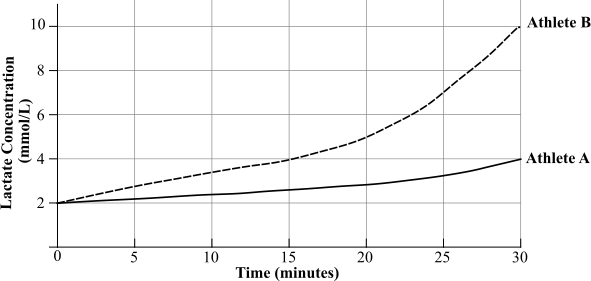
A swim coach is monitoring the physiological responses of athletes during different training sessions. The graph shows lactate levels of two athletes during their respective training sessions.

Based on the lactate response to training shown, which of the following statements is most accurate?

  1. Athlete A is likely performing high-intensity interval training
  2. Athlete B is likely performing low-intensity aerobic training
  3. Both athletes are performing the same training at different intensities
  4. Athlete A is likely performing moderate steady-state aerobic training
Show Answers Only

\(D\)

Show Worked Solution
  • D is correct: Athlete A’s lactate levels show a gradual, moderate increase typical of steady-state aerobic training below the lactate threshold.

Other Options:

  • A is incorrect: High-intensity interval training would produce higher, fluctuating lactate levels than shown for Athlete A.
  • B is incorrect: Athlete B’s steep lactate increase indicates high-intensity training, not low-intensity aerobic training.
  • C is incorrect: The lactate patterns suggest different types of training, not the same training at different intensities.

Filed Under: Responses to training Tagged With: Band 5, smc-5532-17-Lactate levels

Copyright © 2014–2025 SmarterEd.com.au · Log in