SmarterEd

Aussie Maths & Science Teachers: Save your time with SmarterEd

  • Login
  • Get Help
  • About

Data Analysis, GEN2 2024 NHT 3

The time difference between successive high tides and low tides is approximately normally distributed.

Analysis of the 2021 tide chart showed that

  • 99.85% of the time differences are more than 4.88 hours
  • 16% of the time differences are less than 5.76 hours.

Use the 68-95-99.7% rule to determine the mean and standard deviation for this normal distribution.   (2 marks)

--- 5 WORK AREA LINES (style=lined) ---
Show Answers Only

\(s_x=0.44, \ \overline{x}=6.2\)

Show Worked Solution

\(\text{99.85% of the time differences are more than 4.88 hours:}\)

\(-3=\dfrac{4.88-\overline{x}}{s_x}\ \ \Rightarrow \ -3 \times s_x=4.88-\overline{x}\ …\ (1)\)

\(\text{16% of the time differences are less than 5.76 hours:}\)

\(-1=\dfrac{5.76-\overline{x}}{s_x}\ \ \Rightarrow \ -s_x=5.76-\overline{x}\ …\ (2)\)

\(\text{Subtract}\ (2)-(1):\)

\(2s_x\) \(=0.88\)  
\(s_x\) \(=0.44\)  

 
\(\text{Substitute into (2):}\)

\(\overline{x}=5.76+0.44=6.2\)

Filed Under: Normal Distribution Tagged With: Band 5, smc-600-20-z-score Intervals

Data Analysis, GEN1 2024 NHT 6 MC

The weights of cans of fish on a production line are approximately normally distributed with a mean of 126.4 grams and a standard deviation of 2.4 grams.

13 600 cans of fish will be produced today.

Using the 68-95-99.7% rule, the number of these cans that are expected to weigh between 121.6 and 128.8 grams is

  1. 6460
  2. 9248
  3. 10 812
  4. 11 084
  5. 12 920
Show Answers Only

\(D\)

Show Worked Solution

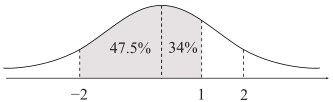
\(z\text{-score (121.6)} = \dfrac{121.6-126.4}{2.4}=-2 \)

\(z\text{-score (128.8)} = \dfrac{128.8-126.4}{2.4}=1 \)

\(\text{% between 121.6 and 128.8 = 47.5 + 34 = 81.5%} \)

\(\text{Number of cans}\ =0.815 \times 13\,600 = 11\,084\)

\(\Rightarrow D\)

Filed Under: Normal Distribution Tagged With: Band 4, smc-600-20-z-score Intervals

Data Analysis, GEN1 2022 VCAA 5 MC

The possum population of a large city park is 2498.

The body lengths of this species of possum are known to be approximately normally distributed with a mean of 88 cm and a standard deviation of 4 cm.

Using the 68–95–99.7% rule, the number of possums in this park with a body length between 84 cm and 96 cm is closest to

  1. 2036
  2. 2043
  3. 2047
  4. 2105
  5. 2156
Show Answers Only

\(A\)

Show Worked Solution

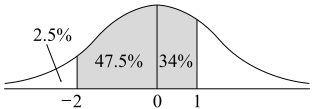
\(z\text{-score (84)} = \dfrac{x-\bar x}{s_x} = \dfrac{84-88}{4} = -1 \)

\(z\text{-score (96)} = \dfrac{96-88}{4} = 2 \)

\(\text{Possums 84–96 cm}\ = \dfrac{(34+47.5)}{100} \times 2498 = 0.815 \times 2498 = 2035.9 \)

\(\Rightarrow A\)

Filed Under: Normal Distribution Tagged With: Band 3, smc-600-20-z-score Intervals

Data Analysis, GEN2 2023 VCAA 1

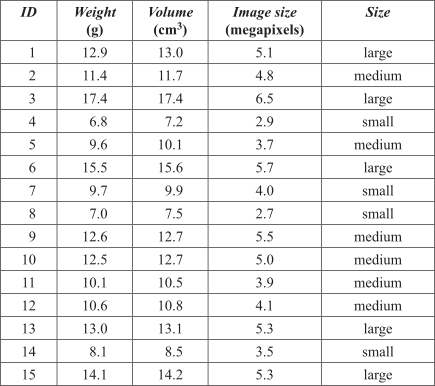
Data was collected to investigate the use of electronic images to automate the sizing of oysters for sale. The variables in this study were:

    • ID: identity number of the oyster
    • weight: weight of the oyster in grams (g)
    • volume: volume of the oyster in cubic centimetres (cm³)
    • image size: oyster size determined from its electronic image (in megapixels)
    • size: oyster size when offered for sale: small, medium or large

The data collected for a sample of 15 oysters is displayed in the table.
 

  1. Write down the number of categorical variables in the table.   (1 mark)

    --- 1 WORK AREA LINES (style=lined) ---
  2. Determine, in grams:
    1. the mean weight of all the oysters in this sample.   (1 mark)

      --- 1 WORK AREA LINES (style=lined) ---
    2. the median weight of the large oysters in this sample.   (1 mark)

      --- 1 WORK AREA LINES (style=lined) ---
  3. When a least squares line is used to model the association between oyster weight and volume, the equation is: 

    1. \(\textit{volume} = 0.780 + 0.953 \times \textit{weight} \)
    1. Name the response variable in this equation.   (1 mark)

      --- 1 WORK AREA LINES (style=lined) ---

    2. Complete the following sentence by filling in the blank space provided.   (1 mark)

      --- 0 WORK AREA LINES (style=lined) ---

      This equation predicts that, on average, each 10 g increase in the weight of an oyster is associated with a ________________ cm³ increase in its volume.
  1. A least squares line can also be used to model the association between an oyster's volume, in cm³, and its electronic image size, in megapixels. In this model, image size is the explanatory variable.
  2. Using data from the table, determine the equation of this least squares line. Use the template below to write your answer. Round the values of the intercept and slope to four significant figures.   (2 marks)

    --- 4 WORK AREA LINES (style=lined) ---

  3. The number of megapixels needed to construct an accurate electronic image of an oyster is approximately normally distributed.
  4. Measurements made on recently harvested oysters showed that:
    • 97.5% of the electronic images contain less than 4.6 megapixels
    • 84% of the electronic images contain more than 4.3 megapixels.
  1. Use the 68-95-99.7% rule to determine, in megapixels, the mean and standard deviation of this normal distribution.   (2 marks)

    --- 4 WORK AREA LINES (style=lined) ---

Show Answers Only

a.    \(\text{Categorical variables = 2 (ID and size)}\)

b.i.  \(\text{Mean weight}\ = \dfrac{\text{sum of oyster weights}}{15} = \dfrac{171.3}{15} = 11.42 \)

b.ii.  \(\text{Median}\ = 11.4 \)

c.i.   \(\text{Volume}\)

c.ii.  \(\text{Increase}\ = 0.953 \times 10 = 9.53\ \text{cm}^{3} \)

d.    \(\text{Volume}\ = 0.002857 + 2.571 \times \text{image size} \)

e.    \(s_x = 0.1 \)

\(\bar x = 4.4\) 

Show Worked Solution

a.    \(\text{Categorical variables = 2 (ID and size)}\)
 

b.i.  \(\text{Mean weight}\ = \dfrac{\text{sum of oyster weights}}{15} = \dfrac{171.3}{15} = 11.42 \)
 

b.ii.  \(\text{15 data points}\ \ \Rightarrow \ \ \text{Median = 8th data point (in order)}\)

 \(\text{Median}\ = 11.4 \)
 

c.i.   \(\text{Volume}\)
 

c.ii.  \(\text{Increase}\ = 0.953 \times 10 = 9.53\ \text{cm}^{3} \)
 

d.    \(\text{Input the image size column values}\ (x)\ \text{and volume} \)

\(\text{values}\ (y)\ \text{into the calculator:}\)

\(\textit{Volume}\ = 0.002857 + 2.571 \times \textit{image size} \)
 

e.    \(z\text{-score (4.6)}\ = 2\ \ \Rightarrow \bar x + 2 \times s_x = 4.6\ …\ (1)\)

\(z\text{-score (4.3)}\ = -1\ \ \Rightarrow \bar x-s_x = 4.3\ …\ (2)\)

\( (1)-(2) \)

\(3 s_x = 0.3 \ \ \Rightarrow\ \ s_x = 0.1 \)

\(\bar x = 4.4\) 

Filed Under: Correlation and Regression, Normal Distribution, Summary Statistics Tagged With: Band 3, Band 4, smc-265-20-Find LSRL Equation/Gradient, smc-265-30-LSRL formula, smc-265-75-Explanatory / Response, smc-468-20-Mean, smc-468-40-Median Mode and Range, smc-600-20-z-score Intervals

CORE, FUR1 2021 VCAA 9 MC

The heights of females living in a small country town are normally distributed:

    • 16% of the females are more than 160 cm tall.
    • 2.5% of the females are less than 115 cm tall.

The mean and the standard deviation of this female population, in centimetres, are closest to

  1. mean = 135               standard deviation = 15
  2. mean = 135               standard deviation = 25
  3. mean = 145               standard deviation = 15
  4. mean = 145               standard deviation = 20
  5. mean = 150               standard deviation = 10
Show Answers Only

`C`

Show Worked Solution

`160 -> ztext{-score} = 1`

`115 -> ztext{-score} = -2`

`1` `= {160 – mu}/sigma`
`mu + sigma` `= 160\ …\ (1)`
`-2` `= {115-mu}/sigma`
`mu-2 sigma` `= 115\ …\ (2)`

 
`(1)-(2)`

`3sigma` `=45`  
`sigma` `=15`  

 
`text{Substitute}\ \ sigma = 15\ \ text{into (1)}`

`mu = 145` 

`=> C`

Filed Under: Normal Distribution Tagged With: Band 4, smc-600-20-z-score Intervals

CORE, FUR2 2020 VCAA 2

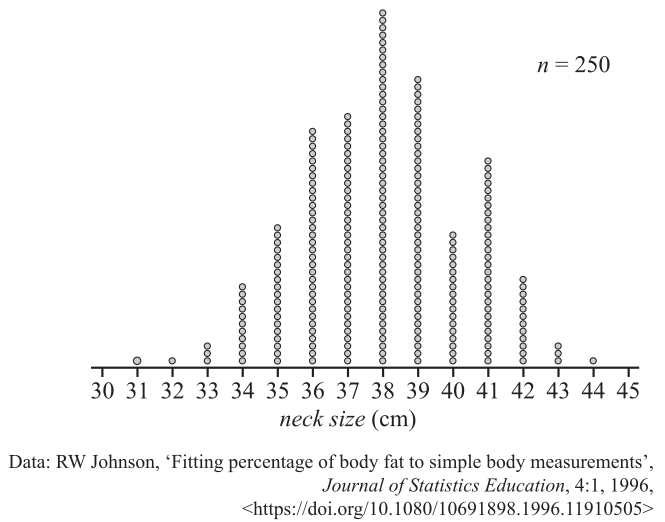
The neck size, in centimetres, of 250 men was recorded and displayed in the dot plot below.
 

  1. Write down the modal neck size, in centimetres, for these 250 men.   (1 mark)

    --- 1 WORK AREA LINES (style=lined) ---

  2. Assume that this sample of 250 men has been drawn at random from a population of men whose neck size is normally distributed with a mean of 38 cm and a standard deviation of 2.3 cm.
  3.  i. How many of these 250 men are expected to have a neck size that is more than three standard deviations above or below the mean? Round your answer to the nearest whole number.   (1 mark)

    --- 2 WORK AREA LINES (style=lined) ---

  4. ii. How many of these 250 men actually have a neck size that is more than three standard deviations above or below the mean?   (1 mark)

    --- 2 WORK AREA LINES (style=lined) ---

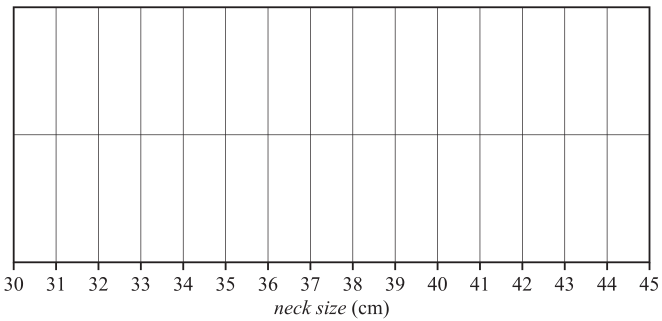
  5. The five-number summary for this sample of neck sizes, in centimetres, is given below.
     

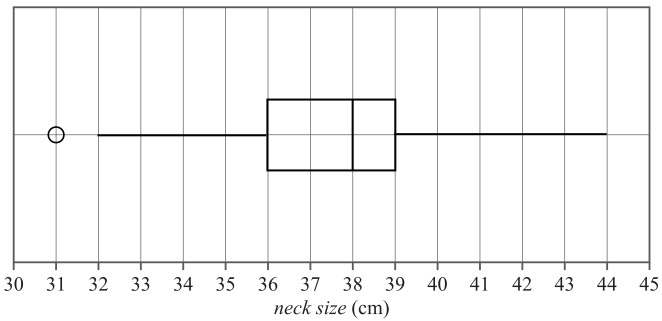
    Use the five-number summary to construct a boxplot, showing any outliers if appropriate, on the grid below.   (2 marks)

    --- 3 WORK AREA LINES (style=lined) ---

Show Answers Only

a.    `text(Mode) = 38\ text(cm)`

b.i.   `1`

b.ii. `1`

c.    `text(See Worked Solutions)`

Show Worked Solution

a.   `text(Mode) = 38\ text(cm)`


♦ Mean mark part b.i. 40%.
b.i.   `text(Expected number of men)` `= (1-0.997) xx 250`
    `= 0.75`
    `= 1\ text{(nearest whole)}`


♦ Mean mark part b.ii. 42%.
b.ii.   `text(When)\ \ z = +- 3`
  `text(Neck size limits)` `= 38 +- (2.3 xx 3)`
    `= 44.9 or 31.1`

 
`:.\ text(1 man has neck size outside 3 s.d.)`
 

c.   `IQR = 39-36=3`

`text(Upper fence)\ =Q_3 + 1.5 xx 3=39 + 4.5=43.5`

`text(Lower fence)\ =Q_1-1.5 xx 3=36-4.5=31.5`


Filed Under: Graphs - Stem/Leaf and Boxplots, Normal Distribution Tagged With: Band 2, Band 4, Band 5, smc-600-20-z-score Intervals, smc-643-10-Single Box-Plots

CORE, FUR1 2020 VCAA 9 MC

The lifetime of a certain brand of light globe, in hours, is approximately normally distributed.

It is known that 16% of the light globes have a lifetime of less than 655 hours and 50% of the light globes have a lifetime that is greater than 670 hours.

The mean and the standard deviation of this normal distribution are closest to

A.     mean = 655 hours standard deviation = 10 hours
B.     mean = 655 hours standard deviation = 15 hours
C.     mean = 670 hours standard deviation = 10 hours
D.     mean = 670 hours standard deviation = 15 hours
E.     mean = 670 hours standard deviation = 20 hours
Show Answers Only

`D`

Show Worked Solution

`text(mean) = 670`

`sigma = 670 – 655 = 15`

`=>  D`

Filed Under: Normal Distribution Tagged With: Band 4, smc-600-20-z-score Intervals

Data Analysis, GEN1 2019 NHT 5-7 MC

The birth weights of a large population of babies are approximately normally distributed with a mean of 3300 g and a standard deviation of 550 g.

Part 1

A baby selected at random from this population has a standardised weight of  `z = – 0.75`

Which one of the following calculations will result in the actual birth weight of this baby?
 

  1. `text(actual birth weight)\ = 550 - 0.75 × 3300`
  2. `text(actual birth weight)\ = 550 + 0.75 × 3300`
  3. `text(actual birth weight)\ = 3300 - 0.75 × 550`
  4. `text(actual birth weight)\ = 3300 + 0.75/550`
  5. `text(actual birth weight)\ = 3300 - 0.75/550`


Part 2

Using the 68–95–99.7% rule, the percentage of babies with a birth weight of less than 1650 g is closest to

  1. 0.14%
  2. 0.15%
  3. 0.17%
  4. 0.3%
  5. 2.5%


Part 3

A sample of 600 babies was drawn at random from this population.

Using the 68–95–99.7% rule, the number of these babies with a birth weight between 2200 g and 3850 g is closest to

  1. 111
  2. 113
  3. 185
  4. 408
  5. 489
Show Answers Only

`text(Part 1:)\ \ C`

`text(Part 2:)\ \ B`

`text(Part 3:)\ \ E`

Show Worked Solution

`text(Part 1)`

`text(Actual weight)` `= text(mean) + z xx text(std dev)`
  `= 3300 – 0.75 xx 550`

`=> C`


`text(Part 2)`

`z-text(score)` `= (x – barx)/5`
  `= (1650 – 3300)/550`
  `= −3`


`:. P(x < 1650)` `= P(z < −3)`
  `= 0.3/2`
  `= 0.15\ text(%)`

`=>B`
 

`text(Part 3)`

`ztext(-score)\ (2200) = (2200 – 3300)/550 = −2`

`ztext(-score)\ (3850) = (3850 – 3300)/550 = 1`


`text(Percentage)` `= (47.5 + 34)text(%) xx 600`
  `= 81.5text(%) xx 600`
  `= 48text(%)`

`=>\ E`

Filed Under: Normal Distribution Tagged With: Band 3, Band 4, Band 5, smc-600-10-Single z-score, smc-600-20-z-score Intervals

CORE, FUR1 2019 VCAA 6 MC

The time taken to travel between two regional cities is approximately normally distributed with a mean of 70 minutes and a standard deviation of 2 minutes.

The percentage of travel times that are between 66 minutes and 72 minutes is closest to

  1. `text(2.5%)`
  2. `text(34%)`
  3. `text(68%)`
  4. `text(81.5%)`
  5. `text(95%)`
Show Answers Only

`D`

Show Worked Solution

`bar x = 70,\ \ s = 2`

`z text(-score)\ (66) = (66 – 70)/2 = -2`

`z text(-score)\ (72) = (72 – 70)/2 = 1`


`:.\ text(Percentage between 66 – 72)`

`= 47.5 + 34`

`= 81.5\ text(%)`
 

`=>  D`

Filed Under: Normal Distribution Tagged With: Band 4, smc-600-20-z-score Intervals

CORE, FUR1 2018 VCAA 3-5 MC

The pulse rates of a population of Year 12 students are approximately normally distributed with a mean of 69 beats per minute and a standard deviation of 4 beats per minute.
 

Part 1

A student selected at random from this population has a standardised pulse rate of  `z = –2.5`

This student’s actual pulse rate is

  1.  59 beats per minute.
  2.  63 beats per minute.
  3.  65 beats per minute.
  4.  73 beats per minute.
  5.  79 beats per minute.
     

Part 2

Another student selected at random from this population has a standardised pulse rate of  `z=–1.`

The percentage of students in this population with a pulse rate greater than this student is closest to

  1.   2.5%
  2.   5%
  3.  16%
  4.  68%
  5.  84%
     

Part 3

A sample of 200 students was selected at random from this population.

The number of these students with a pulse rate of less than 61 beats per minute or greater than 73 beats per minute is closest to

  1.  19
  2.  37
  3.  64
  4.  95
  5. 190
Show Answers Only

`text(Part 1:)\ A`

`text(Part 2:)\ E`

`text(Part 3:)\ B`

Show Worked Solution

`text(Part 1)`

`ztext(-score)` `= (x – barx)/s`
`−2.5` `= (x – 69)/4`
`x – 69` `= −10`
`:. x` `= 59`

 
`=> A`
 

`text(Part 2)`

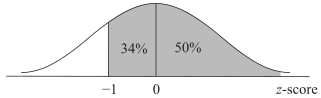
`ztext(-score) = −1`
 

`text(% above)` `= 34 + 50`
  `= 84 text(%)`

`=> E`
 

`text(Part 3)`

`z-text(score)\ (61)` `= (61 – 69)/4 = −2`
`z-text(score)\ (73)` `= (73 – 69)/4 = 1`


`text(Percentage)` `= 2.5 + 16`
  `= 18.5text(%)`


`:.\ text(Number of students)` `= 18.5 text(%) xx 200`
  `= 37`

`=> B`

Filed Under: Normal Distribution Tagged With: Band 3, Band 4, smc-600-10-Single z-score, smc-600-20-z-score Intervals

CORE, FUR1 2011 VCAA 9-10 MC

The length of a type of ant is approximately normally distributed with a mean of 4.8 mm and a standard deviation of 1.2 mm.

Part 1

From this information it can be concluded that around 95% of the lengths of these ants should lie between

A.   `text(2.4 mm and 6.0 mm)`

B.   `text(2.4 mm and 7.2 mm)`

C.   `text(3.6 mm and 6.0 mm)`

D.   `text(3.6 mm and 7.2 mm)`

E.   `text(4.8 mm and 7.2 mm)`


Part 2

A standardised ant length of  `z = text(−0.5)`  corresponds to an actual ant length of

A.   `text(2.4 mm)`

B.   `text(3.6 mm)`

C.   `text(4.2 mm)`

D.   `text(5.4 mm)`

E.   `text(7.0 mm)`

Show Answers Only

`text(Part 1:)\ B`

`text(Part 2:)\ C`

Show Worked Solution

`text(Part 1)`

`text(95% of scores lie between ±2 std dev)`

`bar x = 4.8, \ \ \ s = 1.2`

`text(Lower limit)` `= bar x – 2text(s)`
  `= 4.8 – 2(1.2)`
  `= 2.4\ text(mm)`
`text(Upper limit)` `= bar x + 2text(s)`
  `= 4.8 + 2(1.2)`
  `= 7.2\ text(mm)`

 
`=>B`
 

`text(Part 2)`

`z` `= \ \ (x – bar x)/s`
`-0.5` `= \ \ (x – 4.8)/1.2`
`-0.6` `= \ \ x – 4.8`
`x` `= \ \ 4.2\ text(mm)`

 
`=>C`


Filed Under: Normal Distribution Tagged With: Band 3, Band 4, smc-600-10-Single z-score, smc-600-20-z-score Intervals

CORE, FUR1 2008 VCAA 6-7 MC

The pulse rates of a large group of 18-year-old students are approximately normally distributed with a mean of 75 beats/minute and a standard deviation of 11 beats/minute.

Part 1

The percentage of 18-year-old students with pulse rates less than 75 beats/minute is closest to

A.   32%

B.   50%

C.   68%

D.   84%

E.   97.5%


Part 2

The percentage of 18-year-old students with pulse rates less than 53 beats/minute or greater than 86 beats/minute is closest to

A.      2.5%

B.      5%

C.    16%

D.    18.5%

E.     21%

Show Answers Only

`text(Part 1:)\ B`

`text(Part 2:)\ D`

Show Worked Solution

`text(Part 1)`

`barx=75,\ \ \ s=11`

`text(In a normal distribution, mean = median.)`

`:.\ text(50% of group are below mean of 75)`

`=>B`


`text(Part 2)`

♦ Mean mark 44%.
MARKERS’ COMMENT: Two applications of the 68-95-99.7% rule are required. A good strategy is to first draw a normal curve and shade the required areas.

`barx=75,\ \ \ s=11`

`z text{-score (53)}` `=(x-barx) /s`
   `=(53-75)/11`
   `= – 2`


`z text{-score (86)}` `= (86-75)/11`
  `=1`

core 2008 VCAA 6-7

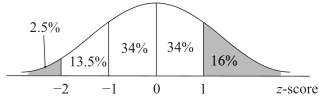
`text(From the diagram, the % of students that have a)`

`z text(-score below –2 or above 1)`

 `=2.5+16`

`=18.5 text(%)`

 `=>D`

Filed Under: Normal Distribution Tagged With: Band 4, Band 5, smc-600-10-Single z-score, smc-600-20-z-score Intervals

CORE, FUR1 2014 VCAA 2 MC

The time spent by shoppers at a hardware store on a Saturday is approximately normally distributed with a mean of 31 minutes and a standard deviation of 6 minutes.

If 2850 shoppers are expected to visit the store on a Saturday, the number of shoppers who are expected to spend between 25 and 37 minutes in the store is closest to

A.   16

B.   68

C.   460

D.   1900

E.   2400

Show Answers Only

`D`

Show Worked Solution
`barx=31` `s=6`
`ztext{-score (25)}` `=(x-barx)/s`
  `=(25-31)/6`
  `=–1`


`z text{-score (37)}` `=(37-31)/6`
  `=1`


`∴\ text(# Shoppers)` `= text(68%) xx 2850`
  `=1938`

 
`=>  D`

Filed Under: Normal Distribution Tagged With: Band 3, smc-600-20-z-score Intervals

CORE, FUR1 2010 VCAA 5-6 MC

The lengths of the left feet of a large sample of  Year 12 students were measured and recorded. These foot lengths are approximately normally distributed with a mean of 24.2 cm and a standard deviation of 4.2 cm.

Part 1

A Year 12 student has a foot length of 23 cm.
The student’s standardised foot length (standard `z` score) is closest to

A.   –1.2

B.   –0.9

C.   –0.3

D.    0.3

E.     1.2


Part 2

The percentage of students with foot lengths between 20.0 and 24.2 cm is closest to

A.   16%

B.   32%

C.   34%

D.   52%

E.   68%

Show Answers Only

`text(Part 1:)\ C`

`text(Part 2:)\ C`

Show Worked Solution

`text(Part 1)`

`bar(x) = 24.2,`    `s=4.2`
`z text{-score (23)}` `=(x – bar(x))/s`
  `= (23 – 24.2)/4.2`
  `= -0.285…`

`=>  C`


`text(Part 2)`

   `z text{-score (20)}` `=(20- 24.2)/4.2`
  `= -1`
 `z text{-score (24.2)}` `= 0`


`text(68% have a)\ z text(-score between  –1 and 1)`

`:.\ text(34% have a)\ z text(-score between  –1 and 0)`

`=>  C`

Filed Under: Normal Distribution Tagged With: Band 3, Band 4, smc-600-10-Single z-score, smc-600-20-z-score Intervals

CORE, FUR1 2013 VCAA 5-6 MC

The time, in hours, that each student spent sleeping on a school night was recorded for 1550 secondary-school students. The distribution of these times was found to be approximately normal with a mean of 7.4 hours and a standard deviation of 0.7 hours.
 

Part 1

The time that 95% of these students spent sleeping on a school night could be 

A.  less than 6.0 hours.   

B.  between 6.0 and 8.8 hours.

C.  between 6.7 and 8.8 hours.

D.  less than 6.0 hours or greater than 8.8 hours.

E.  less than 6.7 hours or greater than 9.5 hours.


Part 2

The number of these students who spent more than 8.1 hours sleeping on a school night was closest to

A.       16

B.     248

C.   1302

D.   1510

E.   1545

Show Answers Only

`text(Part 1:)\ B`

`text(Part 2:)\ B`

Show Worked Solution

`text(Part 1)`

`-2 < z text(-score) < 2,\ \ text(contains 95% of students.)`

`barx=7.4, \ \ \ s=0.7`

`z text(-score of +2)` `= 7.4+(2×0.7)`
  `= 8.8\ text(hours)`           
   
`z text(-score of –2)` `= 7.4−(2×0.7)`
  `= 6.0\ text(hours)`


`:. 95 text(% students sleep between 6 and 8.8 hours.`

 `=>B`
 

`text(Part 2)`

`text (Find)\ z text(-score of 8.1 hours)`

`ztext(-score)` `= (x-barx)/s` 
  `= (8.1-7.4)/0.7`
  `= 1`

 
`text(68% students have)\ \   –1 < z text(-score) < 1`

`:. 16 text(% have)\ z text(-score) > 1`

`:.\ text(# Students)` `= 16text(%) xx1550`
  `= 248`

 `=>B`

Filed Under: Normal Distribution Tagged With: Band 3, smc-600-10-Single z-score, smc-600-20-z-score Intervals

Copyright © 2014–2025 SmarterEd.com.au · Log in