SmarterEd

Aussie Maths & Science Teachers: Save your time with SmarterEd

  • Login
  • Get Help
  • About

Financial Maths, GEN1 2024 NHT 21 MC

Yolanda purchased a motorcycle for $30 000. She explores two options for predicting the value of the motorcycle after four years.

Option 1:

For the first two years, the value of the motorcycle is depreciated by 10% per annum using flat rate depreciation. For the next two years, the value of the motorcycle is depreciated by 10% per annum using reducing balance depreciation.

Option 2:

The value of the motorcycle is depreciated using reducing balance depreciation with a constant depreciation rate per annum for four years.

For both options to predict the same value after four years, the rate per annum used for Option 2 is closest to

  1. 9.4%
  2. 9.7%
  3. 10.0%
  4. 10.3%
  5. 10.6%
Show Answers Only

\(D\)

Show Worked Solution

\(\text{Let \(V_n\) = Value after \(n\) years}\)

\(\text{Option 1}\)

\(V_1=30\,000-(10\% \times 30\,000)=27\,000,\ \ V_2=27\,000-3000=24\,000\)

\(V_3=24\,000 \times 0.9=21\,600,\ \ V_4=21\,600 \times 0.9 = 19\,440\)

\(\text{Option 2}\)

\(30\,000(1-r)^{4}\) \(=19\,440\)  
\((1-r)^{4}\) \(=\dfrac{19\,440}{30\,000}\)  
\(r\) \(=\left(\dfrac{19\,440}{30\,000}\right)^{\frac{1}{4}}-1\approx 0.1027…\)  

 
\(\Rightarrow D\)

Filed Under: Depreciation Tagged With: Band 5, smc-602-40-Comparing methods

CORE, FUR2 2017 VCAA 5

Alex is a mobile mechanic.

He uses a van to travel to his customers to repair their cars.

The value of Alex’s van is depreciated using the flat rate method of depreciation.

The value of the van, in dollars, after `n` years, `V_n`, can be modelled by the recurrence relation shown below.

`V_0 = 75\ 000 qquad V_(n + 1) = V_n - 3375`

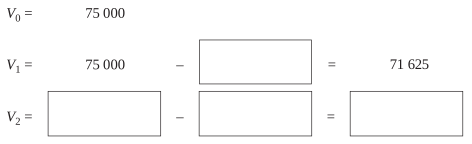
  1. Recursion can be used to calculate the value of the van after two years.


    Complete the calculations below by writing the appropriate numbers in the boxes provided.   (2 marks)

    --- 0 WORK AREA LINES (style=lined) ---


    1. By how many dollars is the value of the van depreciated each year?   (1 mark)

      --- 1 WORK AREA LINES (style=lined) ---

    2. Calculate the annual flat rate of depreciation in the value of the van.
    3. Write your answer as a percentage.   (1 mark)

      --- 2 WORK AREA LINES (style=lined) ---

  2. The value of Alex’s van could also be depreciated using the reducing balance method of depreciation.
  3. The value of the van, in dollars, after `n` years, `R_n`, can be modelled by the recurrence relation shown below.


            `R_0 = 75\ 000 qquad R_(n + 1) = 0.943R_n`

    At what annual percentage rate is the value of the van depreciated each year?   (1 mark)

    --- 2 WORK AREA LINES (style=lined) ---

Show Answers Only

a.

b.i.  `$3375`

b.ii. `4.5text(%)`

c.  `5.7text(%)`

Show Worked Solution

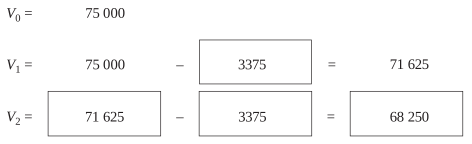
a.   

  
b.i.
   `$3375`


b.ii.    `text(Annual Rate)` `= 3375/(75\ 000) xx 100`
    `= 4.5text(%)`


c.    `text(Annual Rate)` `= (1-0.943) xx 100text(%)`
    `= 5.7text(%)`

Filed Under: Depreciation, Recursion - Financial Tagged With: Band 2, Band 3, Band 4, smc-602-40-Comparing methods, smc-602-50-Recurrence relation, smc-717-50-Depreciation (SL), smc-717-60-Depreciation (reducing balance)

CORE, FUR2 SM-Bank 4

Damon runs a swim school.

The value of his pool pump is depreciated over time using flat rate depreciation.

Damon purchased the pool pump for $28 000 and its value in dollars after `n` years, `P_n`, is modelled by the recursion equation below:

`P_0 = 28\ 000,qquad P_(n + 1) = P_n - 3500`

  1. Write down calculations, using the recurrence relation, to find the pool pump's value after 3 years.   (1 mark)

    --- 4 WORK AREA LINES (style=lined) ---

  2. After how many years will the pump's depreciated value reduce to $7000?   (1 mark)

    --- 5 WORK AREA LINES (style=lined) ---

The reducing balance depreciation method can also be used by Damon.

Using this method, the value of the pump is depreciated by 15% each year.

A recursion relation that models its value in dollars after `n` years, `P_n`, is:

`P_0 = 28\ 000, qquad P_(n + 1) = 0.85P_n`

  1. After how many years does the reducing balance method first give the pump a higher valuation than the flat rate method in part (a)?   (2 marks)

    --- 8 WORK AREA LINES (style=lined) ---

Show Answers Only
  1. `$17\ 500`
  2. `6\ text(years)`
  3. `4\ text(years)`
Show Worked Solution
a.    `P_1` `= 28\ 000-3500 = 24\ 500`
  `P_2` `= 24\ 500-3500 = 21\ 000`
  `P_3` `= 21\ 000-3500 = 17\ 500`

  
`:.\ text(After 3 years, the pump’s value is $17 500.)`
  

b.   `text(Find)\ n\ text(such that:)`

`7000` `= 28\ 000-3500n`
`3500n` `= 21\ 000`
`n` `= (21\ 000)/3500`
  `= 6\ text(years)`

  
c.
  `text(Using the reducing balance method)`

`P_1` `= 0.85 xx 28\ 000 = 23\ 800`
`P_2` `= 0.85 xx 23\ 800 = 20\ 230`
`P_3` `= 0.85 xx 20\ 230 = 17\ 195`
`P_4` `= 0.85 xx 17\ 195 = 14\ 615.75`

  
`text{Using the flat rate method (see part (a))}`

`P_4 = 17\ 500-3500 = 14\ 000`

`14\ 615.75 > 14\ 000`
  

`:.\ text(After 4 years, the reducing balance method)`

`text(first values the pump higher.)`

Filed Under: Depreciation, Recursion - Financial Tagged With: Band 4, Band 5, smc-602-40-Comparing methods, smc-602-50-Recurrence relation, smc-717-50-Depreciation (SL), smc-717-60-Depreciation (reducing balance)

CORE, FUR2 SM-Bank 3

Luke purchased a new pizza oven for his restaurant for $23 500.

He can depreciate the pizza oven using the reducing balance method at a rate of 12.5% per year.

  1. If `V_n` represents the value of the pizza oven after `n` years, write a recurrence relation that models its value.   (1 mark)

    --- 6 WORK AREA LINES (style=lined) ---

  2. During what year will the pizza oven's value drop below $15 000?   (1 mark)

    --- 5 WORK AREA LINES (style=lined) ---

Luke has been advised that he can use flat rate depreciation at 10% of the purchase price.

  1. After 4 years, show which depreciation method gives the pizza oven the highest value?   (1 mark)

    --- 6 WORK AREA LINES (style=lined) ---

Show Answers Only
  1. `V_0 = 23\ 500,qquadV_(n + 1) = 0.875V_n`
  2. `text(year 4)`
  3. `text(See Worked Solutions)`
Show Worked Solution
a.    `V_0` `= 23\ 500`
  `V_1` `= 23\ 500-(12.5text(%) xx 23\ 500)`
    `= 0.875 V_0`
  `V_2` `= 0.875(0.875V_0)`
    `= 0.875 V_1`

  
`:.\ text(Recurrence relationship:)`

`V_0 = 23\ 500,qquadV_(n + 1) = 0.875V_n`
  

b.    `V_1` `= 0.875 xx 23\ 500 = 20\ 562.50`
  `V_2` `= 0.875 xx 20\ 562.50 = 17\ 992.1875`
  `V_3` `= 0.875 xx 17\ 992.1875 = 15\ 743.16…`
  `V_4` `= 0.875 xx 15\ 743.16… = 13\ 775.26…`

  
`:.\ text(The value drops below $15 000 in year 4.)`

  
c.
  `text(Value after 4 years using reducing balance)`

`= 13\ 775.26`

`text(Depreciation each year for flat rate)`

`= 10text(%) xx 23\ 500`

`= $2350`

`text(Value of pizza oven after 4 years,)`

`= 23\ 500-(4 xx 2350)`

`= $14\ 100`
 

`:.\ text(The flat rate depreciation method)`

`text(values the pizza oven highest.)`

Filed Under: Depreciation, Recursion - Financial Tagged With: Band 4, smc-602-40-Comparing methods, smc-602-50-Recurrence relation, smc-717-60-Depreciation (reducing balance), smc-717-70-Find RR

CORE, FUR2 SM-Bank 1

Joe buys a tractor under a buy-back scheme. This scheme gives Joe the right to sell the tractor back to the dealer through either a flat rate depreciation or unit cost depreciation.

  1. The recurrence relation below can be used to calculate the price Joe sells the tractor back to the dealer `(P_n)`, based on the flat rate depreciation, after `n` years
     
    `qquadP_0 = 56\ 000,qquadP_n = P_(n-1)-7000`
     

    1. Write the general rule to find the value of `P_n` in terms of `n`.?   (1 mark)

      --- 4 WORK AREA LINES (style=lined) ---

    2. Hence or otherwise, find the time it will take Joe's tractor to lose half of its value.   (1 mark)

      --- 4 WORK AREA LINES (style=lined) ---

  2. Joe uses the unit cost method to depreciate his tractor, he depreciates $2.75 per kilometre travelled.
    1. How many kilometres does Joe's tractor need to travel for half its value to be depreciated? Round your answer to the nearest kilometre?   (1 mark)

      --- 3 WORK AREA LINES (style=lined) ---

    2. Joe's tractor travels, on average, 2500 kilometres per year. Which method, flat rate depreciation or unit cost depreciation, will result in the greater annual depreciation? Write down the greater depreciation amount correct to the nearest dollar.   (1 mark)

      --- 5 WORK AREA LINES (style=lined) ---

Show Answers Only

  1. i.  `P_n = 56\ 000-7000n`
    ii. `4\ text(years)`
  2. i. `10\ 182\ text{km  (nearest km)}`
    ii. `text(The flat rate depreciation results in an extra)`
         `text($125 depreciation each year.)`

Show Worked Solution

a.i.    `P_1` `= P_0-7000`
  `P_2` `= P_0-7000-7000`
    `= 56\ 000-7000 xx 2`
  `vdots`  
  `P_n`  `= 56\ 000-7000n` 


a.ii.    `text(Depreciated value)` `= 56\ 000 ÷ 2=$28\ 000`

`text(Find)\ n,`

`28\ 000` `= 56\ 000-7000n`
`7000n` `= 28\ 000`
`:. n` `= 4\ text(years)`


b.i.    `text(Distance travelled)` `= ((56\ 000-28\ 000))/2.75`
    `= 10\ 181.81…`
    `= 10\ 182\ text{km  (nearest km)}`

  
b.ii.
  `text(Annual depreciation of unit cost)`

`= 2500 xx $2.75`

`= $6875`

`text(Annual flat rate depreciation = $7000)`

`text(Difference)\ = 7000-6875 = $125`
 

`:.\ text(The flat rate depreciation results in an extra)`

 `text($125 depreciation each year.)`

Filed Under: Depreciation, Recursion - Financial Tagged With: Band 3, Band 4, smc-602-40-Comparing methods, smc-602-50-Recurrence relation, smc-717-50-Depreciation (SL)

CORE*, FUR2 2016 VCAA 6

Ken’s first caravan had a purchase price of $38 000.

After eight years, the value of the caravan was $16 000.

  1. Show that the average depreciation in the value of the caravan per year was $2750.   (1 mark)

    --- 2 WORK AREA LINES (style=lined) ---

  2. Let `C_n` be the value of the caravan `n` years after it was purchased.


    Assume that the value of the caravan has been depreciated using the flat rate method of depreciation.


    Write down a recurrence relation, in terms of `C_(n +1)` and `C_n`, that models the value of the caravan.   (1 mark)

    --- 2 WORK AREA LINES (style=lined) ---

  3. The caravan has travelled an average of 5000 km in each of the eight years since it was purchased.


    Assume that the value of the caravan has been depreciated using the unit cost method of depreciation.


    By how much is the value of the caravan reduced per kilometre travelled?   (1 mark)

    --- 5 WORK AREA LINES (style=lined) ---

Show Answers Only
  1. `text(Proof)\ text{(See Worked Solutions)}`
  2. `text(See Worked Solutions)`
  3. `$0.55`
Show Worked Solution
a.    `text(Average depreciation)`

`= {(38\ 000-16\ 000)}/8`

`= $2750`


♦♦ Mean mark (a) 39%.
MARKER’S COMMENT: A “show that” question should include an equation
  

b.    `C_0` `= 38\ 000,`
  `C_(n+1)` `= C_n-2750`

♦♦ Mean mark (b) 33%.
MARKER’S COMMENT: A lack of attention to detail and careless errors were common!
  

c.    `text(Total kms travelled)` `= 8 xx 5000`
    `= 40\ 000`

 
`:.\ text(Depreciation per km)`

`= {(38\ 000-16\ 000)}/(40\ 000)`

`= $0.55`


♦♦ Mean mark (c) 29%.
  

Filed Under: Depreciation, Recursion - Financial Tagged With: Band 5, Band 6, smc-602-40-Comparing methods, smc-717-50-Depreciation (SL), smc-717-70-Find RR

CORE*, FUR2 2006 VCAA 1

A company purchased a machine for $60 000.

For taxation purposes the machine is depreciated over time.

Two methods of depreciation are considered.

  1. Flat rate depreciation

    The machine is depreciated at a flat rate of 10% of the purchase price each year.

    i.
      By how many dollars will the machine depreciate annually?   (1 mark)

    --- 2 WORK AREA LINES (style=lined) ---

    ii.  Calculate the value of the machine after three years.   (1 mark)

    --- 2 WORK AREA LINES (style=lined) ---

  2. iii. After how many years will the machine be $12 000 in value?   (1 mark)

    --- 4 WORK AREA LINES (style=lined) ---

  3. Reducing balance depreciation

    The value, `V`, of the machine after `n` years is given by the formula `V=60\ 000 xx(0.85)^n`.

    i.
      By what percentage will the machine depreciate annually?   (1 mark)

    --- 2 WORK AREA LINES (style=lined) ---

    ii.  Calculate the value of the machine after three years.   (1 mark)

    --- 2 WORK AREA LINES (style=lined) ---

  4. iii. At the end of which year will the machine's value first fall below $12 000?   (1 mark)

    --- 5 WORK AREA LINES (style=lined) ---

  1. At the end of which year will the value of the machine first be less using flat rate depreciation than it will be using reducing balance depreciation?  (2 marks)

    --- 6 WORK AREA LINES (style=lined) ---

Show Answers Only
  1. i.   `$6000`
    ii.  `$42\ 000`
    iii. `8\ text(years)`
  2. i.   `text(15%)` 
    ii. 
    `$36\ 847.50`
    iii. `10\ text(years)`
  3. `text(7th year)`
Show Worked Solution
a.i.    `text(Annual depreciation)` `= 10text(%) xx 60\ 000`
    `= $6000`

a.ii.   `text(After 3 years,)`

`text(Value)` `= 60\ 000-(3 xx 6000)`
  `= $42\ 000`

a.iii.   `text(Find)\ n\ text(when value = $12 000)`

`12\ 000` `= 60\ 000-6000 xx n`
`6000n` `= 48\ 000`
`:.n` `=(48\ 000)/6000`
  `= 8\ text(years)`


b.i.    `1-r` `= 0.85`
   `r` `= 0.15`

`:.\ text(Annual depreciation is 15%.)`
  

b.ii.   `text(After 3 years,)`

`text(Value)` `= 60\ 000 xx (0.85)^3`
  `= $36\ 847.50`


b.iii.   `text(Find)\ n\ text(when)\ \ V = $12\ 000`

`12\ 000` `= 60\ 000 xx (0.85)^n`
`(0.85)^n` `= 0.2`
`:. n` `= 9.90…\ \ text(years)`

  
`:.\ text(Machine value falls below $12 000)`

`text(after 10 years.)`
  

c.   `text(Sketching both graphs,)`

BUSINESS, FUR2 2006 VCAA 1 Answer

`text(From the graph, at the end of the 7th year the)`

`text(value using flat rate drops below reducing)`

`text(balance for the 1st time.)`

Filed Under: Depreciation Tagged With: Band 3, Band 4, Band 5, smc-602-40-Comparing methods

CORE*, FUR2 2007 VCAA 3

Khan paid $900 for a fax machine.

This price includes 10% GST (goods and services tax).

  1. Determine the price of the fax machine before GST was added. Write your answer correct to the nearest cent.  (1 mark)

    --- 5 WORK AREA LINES (style=lined) ---

  2. Khan will depreciate his $900 fax machine for taxation purposes.
  3. He considers two methods of depreciation.
  4. Flat rate depreciation
  5. Under flat rate depreciation the fax machine will be valued at $300 after five years.
    1. Calculate the annual depreciation in dollars.   (1 mark)

      --- 2 WORK AREA LINES (style=lined) ---

    2. ii. Determine the value of the fax machine after five years.   (1 mark)

      --- 2 WORK AREA LINES (style=lined) ---

Show Answers Only

  1. `$818.18`
  2. i. `$120`
    ii. `$325` 

Show Worked Solution

a.   `text(Let $)P = text(price ex-GST)`

MARKER’S COMMENT: Reverse GST questions continue to cause problems for many students.

`:. P + 10text(%)P` `= 900`
`1.1P` `= 900`
`P` `= 900/1.1`
  `= 818.181…`
  `= $818.18\ \ text(nearest cent)`

  
b.i.
  `text(Annual depreciation)`

`= ((900-300))/5`

`= $120`


b.ii.   `text(Value after 5 years)`

`= 900-(250 xx 0.46 xx 5)`

`= $325`

Filed Under: Depreciation, Taxation and Other Tagged With: Band 3, Band 4, Band 5, smc-602-40-Comparing methods, smc-605-10-GST

CORE*, FUR2 2009 VCAA 4

The golf club management purchased new lawn mowers for $22 000.

  1. Use the flat rate depreciation method with a depreciation rate of 12% per annum to find the depreciated value of the lawn mowers after four years.   (2 marks)

    --- 5 WORK AREA LINES (style=lined) ---

  2. Use the reducing balance depreciation method with a depreciation rate of 16% per annum to calculate the depreciated value of the lawn mowers after four years. Write your answer in dollars correct to the nearest cent.   (1 mark)

    --- 4 WORK AREA LINES (style=lined) ---

  3. After 4 years, which method, flat rate depreciation or reducing balance depreciation, will give the greater depreciation? Write down the greater depreciation amount in dollars correct to the nearest cent.   (1 mark)

    --- 4 WORK AREA LINES (style=lined) ---

Show Answers Only
  1. `$11\ 440`
  2. `$10\ 953.17`
  3. `$11\ 046.83`
Show Worked Solution

a.   `text(When)\ n = 4,`

`text(Depreciation)` `= 22\ 000 xx 0.12 xx 4`
  `= $10\ 560`

 
`:.\ text(Depreciated Value)`

`= 22\ 000 – 10\ 560`

`= $11\ 440`
 

b.   `r = 16text(%)`

`text(Value)` `= 22\ 000(1 – r)^n`
  `= 22\ 000(0.84)^4`
  `= 10\ 953.169…`
  `= $10\ 953.17`


c.   `text(Reducing balance gives a greater depreciated)`

`text(amount after 4 years.)`

`text(Greater depreciation amount)`

`= 22\ 000 – 10\ 953.17`

`= $11\ 046.83`

Filed Under: Depreciation Tagged With: Band 4, Band 5, smc-602-40-Comparing methods

CORE*, FUR2 2012 VCAA 2

The value of the equipment will be depreciated using the unit cost method. 

The initial value of the equipment is $8360. It will depreciate by 22 cents per hour of use. 

On average, the equipment will be used for 3800 hours each year.

  1. Calculate the depreciated value of the equipment after three years.   (1 mark)

    --- 4 WORK AREA LINES (style=lined) ---

  2. Show that, in any one year, the flat rate method of depreciation with a depreciation rate of 10% per annum will give the same annual depreciation as the unit cost method.   (1 mark)

    --- 2 WORK AREA LINES (style=lined) ---

  3. After how many years will equipment be written off with a depreciated value of $0?   (1 mark)

    --- 3 WORK AREA LINES (style=lined) ---

  4. Suppose the reducing balance method is used to depreciate the equipment instead of the unit cost method.


    The initial value of the equipment is $8360. It will depreciate at a rate of 14% per annum of the reducing balance.


    Find, correct to the nearest dollar, the depreciated value of the equipment after ten years.   (1 mark)

    --- 6 WORK AREA LINES (style=lined) ---

Show Answers Only
  1. `$5852`
  2. `text(See Worked Solution)`
  3. `text(10 years)`
  4. `$1850\ \ text{(nearest $)}`
Show Worked Solution

a.   `text(Unit cost depreciation per year)`

`= 3800 xx 0.22`

`= $836`

`:.\ text(After 3 years, depreciated value)`

`= 8360-(3 xx 836)`

`= $5852`
  

b.   `text(10% Depreciation per year)`

`= 10text(%) xx 8360`

`= $836\ \ …text(as required.)`
  

c.   `text(Depreciated value of $0 occurs when)`

`8360 – 836n` `= 0`
`836n` `= 8360`
`n` `= 10\ text(years)`

  
d.
  `text(After 1 year,)`

`V_1` `= 8360(1-0.14)`
  `= 8360(0.86)`

  
`text(After 10 years,)`

`V_10` `= 8360(0.86)^10`
  `= 1850.08…`
  `= $1850\ \ text{(nearest $)}`

Filed Under: Depreciation Tagged With: Band 4, Band 5, smc-602-40-Comparing methods

CORE*, FUR2 2013 VCAA 1

Hugo is a professional bike rider.

The value of his bike will be depreciated over time using the flat rate method of depreciation.

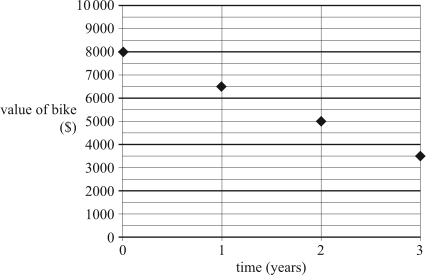
The graph below shows his bike’s initial purchase price and its value at the end of each year for a period of three years.
 

  1. What was the initial purchase price of the bike?   (1 mark)

    --- 1 WORK AREA LINES (style=lined) ---

    1. Show that the bike depreciates in value by $1500 each year.   (1 mark)

      --- 3 WORK AREA LINES (style=lined) ---

    2. Assume that the bike’s value continues to depreciate by $1500 each year.
    3. Determine its value five years after it was purchased.   (1 mark)

      --- 4 WORK AREA LINES (style=lined) ---

The unit cost method of depreciation can also be used to depreciate the value of the bike.

In a two-year period, the total depreciation calculated at $0.25 per kilometre travelled will equal the depreciation calculated using the flat rate method of depreciation as described above.

  1. Determine the number of kilometres the bike travels in the two-year period.   (1 mark)

    --- 5 WORK AREA LINES (style=lined) ---

Show Answers Only

  1. `$8000`
  2. i.  `text(See Worked Solutions)`
    ii. `$500`
  3. `12\ 000\ text(km)`

Show Worked Solution

a.   `$8000`
  

b.i.   `text(Value after 1 year) = $6500`

`:.\ text(Annual depreciation)` `= 8000-6500`
  `= $1500`

  
b.ii.
   `text(Value after)\ n\ text(years)`

`= 8000-1500n`

`:.\ text(After 5 years,)`

`text(Value)` `= 8000-1500 xx 5`
  `= $500`

  
c.
   `text(After 2 years,)`

`text(Depreciation)` `= 2 xx 1500`
  `= $3000`

  
`:.\ text(Distance travelled)`

`= 3000/0.25`

`= 12\ 000\ text(km)`

Filed Under: Depreciation Tagged With: Band 2, Band 3, Band 4, smc-602-40-Comparing methods, smc-602-60-Depreciation graphs

CORE*, FUR2 2015 VCAA 2

The sound system used by the business was initially purchased at a cost of $3800.

After two years, the value of the sound system had depreciated to $3150.

  1. Assuming the flat rate method of depreciation was used, show that the value of the sound system was depreciated by $325 each year.   (1 mark)

    --- 2 WORK AREA LINES (style=lined) ---

  2. The value of the sound system will continue to depreciate by $325 each year.


    How many years will it take, after the initial purchase, for the sound system to have a value of $550?   (1 mark)

    --- 4 WORK AREA LINES (style=lined) ---

  3. The recording equipment used by the business was initially purchased at a cost of $2100.


    After five years, the value of the recording equipment had depreciated to $1040 using the reducing balance method.


    Find the annual percentage rate by which the value of this recording equipment depreciated.


    Write your answer correct to two decimal places.   (1 mark) 

    --- 6 WORK AREA LINES (style=lined) ---

Show Answers Only
  1. `$325`
  2. `10`
  3. `13.11text(%)`
Show Worked Solution

a.   `text(Annual depreciation)`

`=(3800-3150)/ 2`

`= $325\ …\ text(as required)`

  
b.
  `text(Let)\ t =\ text(number of years.)`

`3800-325 xx t` `= 550`
`325t` `= 3250`
`:. t` `=3250/325`
  `=10\ text(years)`

  
c.
   `text(Let)\ r =\ text(annual depreciation rate)`

`2100(1-r)^5` `= 1040`
`(1-r)^5` `= 1040/2100`
`(1-r)` `=0.868…`
`:. r`  `=0.13111…`
  `=13.11 text{%  (2 d.p.)}`

Filed Under: Depreciation Tagged With: Band 4, Band 5, smc-602-40-Comparing methods

Copyright © 2014–2025 SmarterEd.com.au · Log in