SmarterEd

Aussie Maths & Science Teachers: Save your time with SmarterEd

  • Login
  • Get Help
  • About

Matrices, GEN1 2022 VCAA 3 MC

Each day, members of a swim centre can choose to attend a morning session \((M)\), an afternoon session \((A)\) or no session \((N)\).

The transition diagram below shows the transition from day to day.

The transition diagram is incomplete.
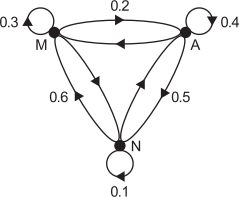
 

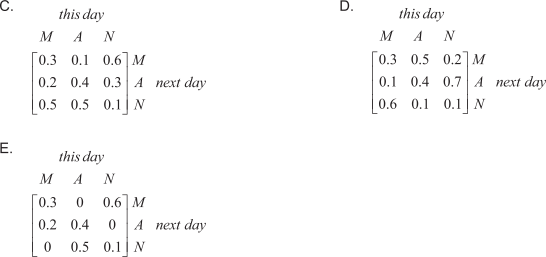
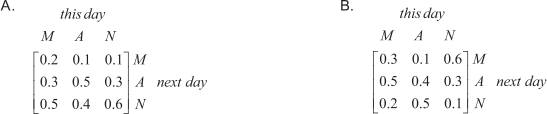
Which one of the following transition matrices represents this transition diagram?
 

Show Answers Only

\(C\)

Show Worked Solution

\(\text{By elimination}\)

\(\text{Option E: Eliminate as not all columns add to 1}\)

\(\text{Options A and D: Eliminate as N → M = 0.6, not 0.1 or 0.2}\)

\(\text{Option B: Eliminate as M → A = 0.2, not 0.5}\)

\(\text{Option C: Correct as N → M = 0.6,  M → A = 0.2,  A → N = 0.5 and leading diagonal 0.3, 0.4, 0.1 correct}\)

\(\Rightarrow C\)

Filed Under: Transition Matrices - Regular Tagged With: Band 4, smc-618-10-Diagram/Info to Matrix, smc-618-61-3x3 Matrix

Matrices, GEN1 2023 VCAA 32 MC

For one particular week in a school year, students at Phyllis Island Primary School can spend their lunch break at the playground \((P)\), basketball courts \((B)\), oval \((O)\) or the library \((L)\).

Students stay at the same location for the entire lunch break.

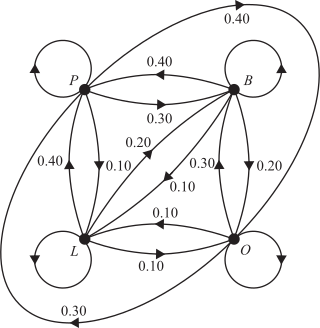
The transition diagram below shows the proportion of students who change location from one day to the next.
 

The transition diagram is incomplete.

On the Monday, 150 students spent their lunch break at the playground, 50 students spent it at the basketball courts, 220 students spent it at the oval, and 40 students spent it in the library.

Of the students expected to spend their lunch break on the oval on the Wednesday, the percentage of these students who also spent their lunch break on the oval on Tuesday is closest to

  1. 27%
  2. 30%
  3. 33%
  4. 47%
  5. 52%
Show Answers Only

\(C\)

Show Worked Solution

\(\text{Transition matrix}\ (T): \)

\begin{aligned}
& \quad \quad \quad \ \ \ \ \textit{today} \\
& \quad \ \ \ \  P \ \ \ \ \  B \ \ \ \ \ \  O \ \ \ \ \ \  L \ \ \\
\ \ \textit{next day}\ \ \ & \begin{array}{l}
P \\
B \\
O \\
L
\end{array}\begin{bmatrix}
0.2 & 0.4 & 0.3 & 0.4 \\
0.3 & 0.3 & 0.3 & 0.2 \\
0.4 & 0.2 & 0.3 & 0.1 \\
0.1 & 0.1 & 0.1 & 0.3
\end{bmatrix}
\begin{bmatrix}
150 \\
50 \\
220 \\
40
\end{bmatrix}
= \begin{bmatrix}
132 \\
134 \\
140 \\
54 \\
\end{bmatrix}
\end{aligned}

\(T \times \begin{bmatrix}
132 \\
134 \\
140 \\
54
\end{bmatrix}
= \begin{bmatrix}
143.6 \\
132.6 \\
127 \\
56.8
\end{bmatrix}\)

 
\(\text{Students at oval Tue and Wed}\ = 0.3 \times 140 = 42\)

\(\text{Percentage}\ = \dfrac{42}{127} = 0.3307 \approx 33\% \)

\(\Rightarrow C\)

Filed Under: Transition Matrices - Regular Tagged With: Band 5, smc-618-10-Diagram/Info to Matrix, smc-618-62-4x4 Matrix

MATRICES, FUR1 2021 VCAA 2 MC

Every Friday, the same number of workers from a large office building regularly purchase their lunch from one of two locations: the deli, `D `, or the cafe, `C`.

It has been found that:

    • of the workers who purchase lunch from the deli on one Friday, 65% will return to purchase from the deli on the next Friday
    • of the workers who purchase lunch  from the cafe on one Friday, 55% will return to purchase from the cafe on the next Friday.

A transition matrix that can be used to describe this situation is

A.  `qquad text(this Friday)`
       `{:(qquad\ D quadquad \ C quad),([(0.55,0.35),(0.45,0.65)]{:(D),(C):} qquad text(next Friday)):}`
B.  `qquad text(this Friday)`
       `{:(qquad\ D quadquad \ C quad),([(0.65,0.45),(0.45,0.55)]{:(D),(C):} qquad text(next Friday)):}`
 
     
C.  `qquad text(this Friday)`
       `{:(qquad\ D quadquad \ C quad),([(0.65,0.55),(0.45,0.55)]{:(D),(C):} qquad text(next Friday)):}`
D.  `qquad text(this Friday)`
       `{:(qquad\ D quadquad \ C quad),([(0.65,0.45),(0.35,0.55)]{:(D),(C):} qquad text(next Friday)):}`
 
     
E.  `qquad text(this Friday)`
       `{:(qquad\ D quadquad \ C quad),([(0.65,0.55),(0.35,0.45)]{:(D),(C):} qquad text(next Friday)):}`
   
Show Answers Only

`D`

Show Worked Solution

`text{65% of workers return to deli}`

`=> e_11 = 0.65`

`text{55% of workers return to cafe}`

`=> e_22 = 0.55`
 

`text{Column elements must sum to 1}`

`=> D`

Filed Under: Transition Matrices - Regular Tagged With: Band 4, smc-618-10-Diagram/Info to Matrix, smc-618-60-2x2 Matrix

MATRICES, FUR1 2020 VCAA 4 MC

In a particular supermarket, the three top-selling magazines are Angel (A), Bella (B) and Crystal (C).

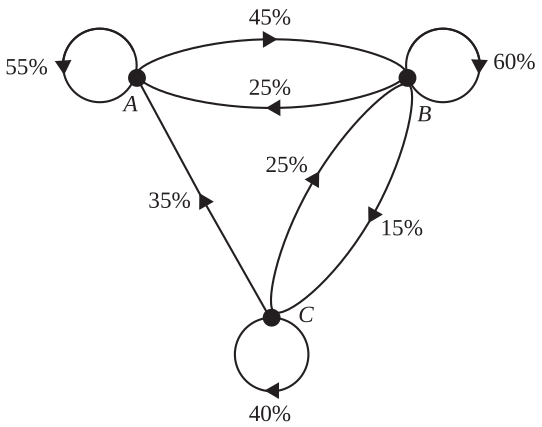
The transition diagram below shows the way shoppers at this supermarket change their magazine choice from week to week.
 

A transition matrix that provides the same information as the transition diagram is

A.  

`{:(qquadqquadquad this\ week),(qquadquadAqquadquad\ Bqquadquad\ C),([(0.55,0.70,0.35),(0.70,0.60,0.40),(0.35,0.40,0.40)]{:(A),(B),(C):}qquad n\ext\ week):}`


B.  

`{:(qquadqquadquad this\ week),(qquadquadAqquadquad\ Bqquadquad\ C),([(0.55,0.60,0.25),(0.45,0.15,0.35),(0,0.25,0.40)]{:(A),(B),(C):} qquad n\ext\ week):}`


C.  

`{:(qquadqquadquad this\ week),(qquadquadAqquadquad\ Bqquadquad\ C),([(0.55,0.25,0.35),(0.45,0.60,0.25),(0,0.15,0.40)]{:(A),(B),(C):} qquad n\ext\ week):}`


D.  

`{:(qquadqquadquad this\ week),(qquadquadAqquadquad\ Bqquadquad\ C),([(0.55,0.25,0.35),(0.45,0.60,0.25),(0.35,0.15,0.40)]{:(A),(B),(C):} qquad n\ext\ week):}`


E.  

`{:(qquadqquadquad this\ week),(qquadquadAqquadquad\ Bqquadquad\ C),([(0.55,0.25,0),(0.45,0.60,0.25),(0,0.15,0.75)]{:(A),(B),(C):} qquad n\ext\ week):}`


Show Answers Only

`C`

Show Worked Solution

`text(By Elimination):`

`25text(%)\ text(of)\ B\ text(moves to)\ A \ => \ e_12 = 0.25`

`:.\ text(Eliminate)\ A and B`
 

`C\ text(retains 40% from week to week)\ => \ e_33 = 0.4`

`:.\ text(Eliminate)\ E`

 
`0text(%)\ text(of)\ A\ text(moves to)\ C \ => \ e_31 = 0`

`:.\ text(Eliminate)\ D`

`=>  C`

Filed Under: Transition Matrices - Regular Tagged With: Band 3, smc-618-10-Diagram/Info to Matrix, smc-618-61-3x3 Matrix

MATRICES, FUR1-NHT 2019 VCAA 7-8 MC

A farm contains four water sources, `P`, `Q`, `R` and `S`.

Part 1

Cows on the farm are free to move between the four water sources.

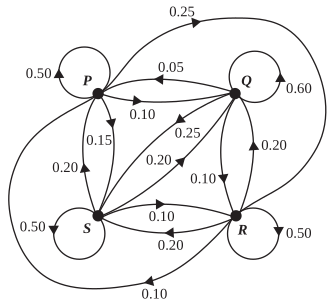
The change in the number of cows at each of these water sources from week to week is shown in the transition diagram below.
 

Let `C_n` be the state matrix for the location of the cows in week `n` of 2019.

The state matrix for the location of the cows in week 23 of 2019 is `C_23 = [(180),(200),(240),(180)]{:(P),(Q),(R),(S):}`
 

The state matrix for the location of the cows in week 24 of 2019 is `C_24 = [(160),(222),(203),(215)]{:(P),(Q),(R),(S):}`

Of the cows expected to be at `Q` in week 24 of 2019, the percentage of these cows at `R` in week 23 of 2019 is closest to

  1.   8%
  2.   9%
  3. 20%
  4. 22%
  5. 25%


Part 2

Sheep on the farm are also free to move between the four water sources.

The change in the number of sheep at each water source from week to week is shown in matrix `T` below.
 

`{:(),(),(T=):}{:(qquadqquadqquadtext(this week)),((qquadP,quadQ,quadR,quadS)),([(0.4,0.3,0.2,0.1),(0.2,0.1,0.5,0.3),(0.1,0.3,0.1,0.2),(0.3,0.3,0.2,0.4)]):}{:(),(),({:(P),(Q),(R),(S):}):}{:(),(),(text(next week)):}`
 

In the long term, 635 sheep are expected to be at `S` each week.

In the long term, the number of sheep expected to be at `Q` each week is closest to

  1. 371
  2. 493
  3. 527
  4. 607
  5. 635
Show Answers Only

`text(Part 1:)\ D`

`text(Part 2:)\ C`

Show Worked Solution

`text(Part 1)`

`text(In week 23, 240 cows are at)\ R.`

`text(In week 24, number of cows moving from)\ R\ text(to)\ Q`

`=20text(%) xx 240`

`= 48\ text(cows)`
 

`text(Total cows at)\ Q = 222`
 

`:.\ text(Percentage)` `= 48/222`
  `= 0.2162`
  `= 22text(%)`

`=>\ D`


`text(Part 2)`

`T^50 = [(0.2434, 0.2434, 0.2434, 0.2434),(0.2603, 0.2603, 0.2603, 0.2603),(0.1834, 0.1834, 0.1834, 0.1834),(0.3130, 0.3130, 0.3130, 0.3130)]`

 
`text(S)text(ince 635 sheep are expected long term at)\ S,`

`text(Total sheep)` `= 635/0.3130`
  `= 2029`

 
`:. text(Long term expected at)\ Q`

`~~ 0.2603 xx 2029`

`~~ 528`

`=>\ C`

Filed Under: Transition Matrices - Regular Tagged With: Band 5, Band 6, smc-618-10-Diagram/Info to Matrix, smc-618-40-Steady State

MATRICES, FUR1 2016 VCAA 6 MC

Families in a country town were asked about their annual holidays.

Every year, these families choose between staying at home (H), travelling (T) and camping (C).

The transition diagram below shows the way families in the town change their holiday preferences from year to year.


A transition matrix that provides the same information as the transition diagram is

A. `{:(qquadqquadqquad\ text(from)),((qquadH,qquadT,qquadC)),([(0.30,0.75,0.65),(0.75,0.50,0.20),(0.65,0.20,0.60)]{:(H),(T),(C):}quad{:text(to):}):}` B. `{:(qquadqquadqquad\ text(from)),((qquadH,qquadT,qquadC)),([(0.30,0.30,0.40),(0.45,0.50,0),(0.25,0.20,0.60)]{:(H),(T),(C):}quad{:text(to):}):}`
       
C. `{:(qquadqquadqquad\ text(from)),((qquadH,qquadT,qquadC)),([(0.30,0.30,0.40),(0.45,0.50,0.20),(0.25,0.20,0.60)]{:(H),(T),(C):}quad{:text(to):}):}` D. `{:(qquadqquadqquad\ text(from)),((qquadH,qquadT,qquadC)),([(0.30,0.30,0.40),(0.45,0.50,0.20),(0.25,0.20,0.40)]{:(H),(T),(C):}quad{:text(to):}):}`
       
E. `{:(qquadqquadqquad\ text(from)),((qquadH,qquadT,qquadC)),([(0.30,0.45,0.25),(0.30,0.50,0.20),(0.40,0,0.60)]{:(H),(T),(C):}quad{:text(to):}):}`    
Show Answers Only

`B`

Show Worked Solution

`text(By elimination,)`

`H -> T = 0.45`

`:.\ text(not)\ A\ text(or)\ E`

`C -> T = 0`

`:.\ text(not)\ C\ text(or)\ D`

`=> B`

Filed Under: Transition Matrices - Regular Tagged With: Band 3, smc-618-10-Diagram/Info to Matrix, smc-618-61-3x3 Matrix

MATRICES, FUR2 2006 VCAA 2

A new shopping centre called Shopper Heaven (`S`) is about to open. It will compete for customers with Eastown (`E`) and Noxland (`N`).

Market research suggests that each shopping centre will have a regular customer base but attract and lose customers on a weekly basis as follows.

80% of Shopper Heaven customers will return to Shopper Heaven next week
12% of Shopper Heaven customers will shop at Eastown next week
8% of Shopper Heaven customers will shop at Noxland next week

76% of Eastown customers will return to Eastown next week
9% of Eastown customers will shop at Shopper Heaven next week
15% of Eastown customers will shop at Noxland next week

85% of Noxland customers will return to Noxland next week
10% of Noxland customers will shop at Shopper Heaven next week
5% of Noxland customers will shop at Eastown next week

  1. Enter this information into transition matrix `T` as indicated below (express percentages as proportions, for example write 76% as 0.76).   (2 marks)

    --- 0 WORK AREA LINES (style=lined) ---


    `qquad{:(qquadqquadqquadtext(this week)),((qquadqquadqquad S,qquad E, quad N)),(T = [(qquadqquadqquadqquadqquadqquad),(),()]{:(S),(E),(N):}{:qquadtext(next week):}):}`
     

During the week that Shopper Heaven opened, it had 300 000 customers.

In the same week, Eastown had 120 000 customers and Noxland had 180 000 customers.

  1. Write this information in the form of a column matrix, `K_0`, as indicated below.   (1 mark)

    --- 0 WORK AREA LINES (style=lined) ---


    `qquadK_0 = [(quadqquadqquadqquadqquad),(),()]{:(S),(E),(N):}`
     

  2. Use `T` and `K_0` to write and evaluate a matrix product that determines the number of customers expected at each of the shopping centres during the following week.   (2 marks)

    --- 4 WORK AREA LINES (style=lined) ---

  3. Show by calculating at least two appropriate state matrices that, in the long term, the number of customers expected at each centre each week is given by the matrix   (2 marks)
  4. `qquadK = [(194\ 983),(150\ 513),(254\ 504)]`

    --- 5 WORK AREA LINES (style=lined) ---

Show Answers Only
  1.  
    `{:((qquadqquadqquad\ S,qquadE,qquadN)),(T = [(0.8,0.09,0.10),(0.12,0.76,0.05),(0.08,0.15,0.85)]{:(S),(E),(N):}):}`
  2.  
    `K_0 = [(300\ 000),(120\ 000),(180\ 000)]{:(S),(E),(N):}`
  3.  
    `TK_0 = [(268\ 800),(136\ 200),(195\ 000)]`
  4. `text(See Worked Solutions)`
Show Worked Solution
a.     `{:((qquadqquadqquad\ S,qquadE,qquadN)),(T = [(0.8,0.09,0.10),(0.12,0.76,0.05),(0.08,0.15,0.85)]{:(S),(E),(N):}):}`


b.     `K_0 = [(300\ 000),(120\ 000),(180\ 000)]{:(S),(E),(N):}`


c.   `text(Customers expected at each centre the next week,)`

`TK_0` `= [(0.80,0.09,0.10),(0.12,0.76,0.05),(0.08,0.15,0.85)][(300\ 000),(120\ 000),(180\ 000)]`
  `= [(268\ 800),(136\ 200),(195\ 000)]`


d.   `text(Consider)\ \ T^nK_0\ \ text(when)\ n\ text(large),`

`text(say)\ n=50, 51`

`T^50K_0` `= [(0.8,0.09,0.10),(0.12,0.76,0.05),(0.08,0.15,0.85)]^50[(300\ 000),(120\ 000),(180\ 000)]= [(194\ 983),(150\ 513),(254\ 504)]`


`T^51K_0` `= [(0.8,0.09,0.10),(0.12,0.76,0.05),(0.08,0.15,0.85)]^51[(300\ 000),(120\ 000),(180\ 000)]= [(194\ 983),(150\ 513),(254\ 504)]`
  ` = T^50K_0`

Filed Under: Transition Matrices - Regular Tagged With: Band 3, Band 4, Band 5, smc-618-10-Diagram/Info to Matrix, smc-618-30-State Matrix in discrete period, smc-618-61-3x3 Matrix

MATRICES, FUR1 2009 VCAA 7-8 MC

In a country town, people only have the choice of doing their food shopping at a store called Marks (`M`) or at a newly opened store called Foodies (`F`).

In the first week that Foodies opened, only 300 of the town’s 800 shoppers did their food shopping at Marks. The remainder did their food shopping at Foodies.
 

Part 1

A state matrix `S_1` that can be used to represent this situation is
 

A.   `S_1 = [[300],[800]]{:(M),(F):}`

B.   `S_1 = [[500],[300]]{:(M),(F):}`

C.   `S_1 = [[800],[300]]{:(M),(F):}`

D.   `S_1 = [[300],[500]]{:(M),(F):}`

E.   `S_1 = [[800],[500]]{:(M),(F):}`


Part 2

A market researcher predicts that

    • of those who do their food shopping at Marks this week, 70% will shop at Marks next week and 30% will shop at Foodies
    • of those who do their food shopping at Foodies this week, 90% will shop at Foodies next week and 10% will shop at Marks.

A transition matrix that can be used to represent this situation is
 

MATRICES, FUR1 2009 VCAA 7-8 MC ab

MATRICES, FUR1 2009 VCAA 7-8 MC cd

MATRICES, FUR1 2009 VCAA 7-8 MC e

Show Answers Only

`text(Part 1:)\ D`

`text(Part 2:)\ B`

Show Worked Solution

`text(Part 1)`

`=>  D`


`text(Part 2)`

`text(Columns must add up to 1.0,)`

`:.\ text(Eliminate)\ C\ text(and)\ D.`
 

`text(The information that 90% of Foodies)`

`text(shoppers stay means that)\ \ e_(FF) = 0.90.`

`:.\ text(Eliminate)\ A\ text(and)\ E.`

`=> B`

Filed Under: Transition Matrices - Regular Tagged With: Band 3, smc-618-10-Diagram/Info to Matrix, smc-618-30-State Matrix in discrete period, smc-618-60-2x2 Matrix

MATRICES, FUR1 2012 VCAA 5 MC

There are two fast-food shops in a country town: Big Burgers (B) and Fast Fries (F).

Every week, each family in the town will purchase takeaway food from one of these shops.

The transition diagram below shows the way families in the town change their preferences for fast food from one week to the next.
 

MATRICES, FUR1 2012 VCAA 5 MC 
 

A transition matrix that provides the same information as the transition diagram is

MATRICES, FUR1 2012 VCAA 5 MC ab

MATRICES, FUR1 2012 VCAA 5 MC cd

MATRICES, FUR1 2012 VCAA 5 MC e

Show Answers Only

`D`

Show Worked Solution

MATRICES, FUR1 2012 VCAA 5 MC Answer

`{:(qquadqquadqquadqquadquad\ text(from)),({:qquadqquadqquadqquad\ BqquadquadF:}),( :. T = [(0.8,0.3),(0.2,0.7)]{:(B),(F):}qquadtext(to)):}`

`rArr D`

Filed Under: Transition Matrices - Regular Tagged With: Band 3, smc-618-10-Diagram/Info to Matrix, smc-618-60-2x2 Matrix

Copyright © 2014–2025 SmarterEd.com.au · Log in