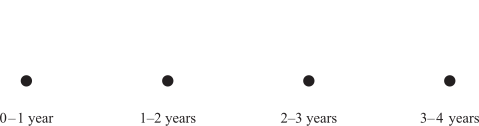
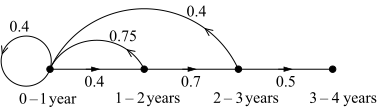
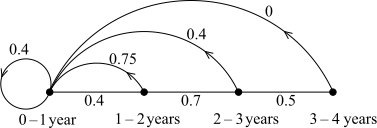
A population of a native animal species lives near the construction site. To ensure that the species is protected, information about the initial female population was collected at the beginning of 2023. The birth rates and the survival rates of the females in this population were also recorded. This species has a life span of 4 years and the information collected has been categorised into four age groups: 0-1 year, 1-2 years, 2-3 years, and 3-4 years. This information is displayed in the initial population matrix, \(R_0\), and the Leslie matrix, \(L\), below. \(R_0=\left[\begin{array}{c}70 \\ 80 \\ 90 \\ 40\end{array}\right] \quad \quad L=\left[\begin{array}{cccc}0.4 & 0.75 & 0.4 & 0 \\ 0.4 & 0 & 0 & 0 \\ 0 & 0.7 & 0 & 0 \\ 0 & 0 & 0.5 & 0\end{array}\right]\) --- 0 WORK AREA LINES (style=lined) --- --- 0 WORK AREA LINES (style=lined) --- --- 1 WORK AREA LINES (style=lined) --- a.i. a.ii. b. \(\text{5 years}\) a.ii. \(\text{Population after 1 yr calculations}\) \(0-1\ \text{year}\ =0.4\times 70+0.75\times 80+0.4\times 90=124\) \(1-2\ \text{years}\ =0.4\times 70=28\) \(2-3\ \text{years}\ =0.7\times 80=56\) \(3-4\ \text{years}\ =0.5\times 90=45\) b. \(\text{Using CAS:}\) \(R_1=L\times R_0=\begin{bmatrix} \(R_3=L\times R_2=\begin{bmatrix} \(R_5=L\times R_4=\begin{bmatrix}
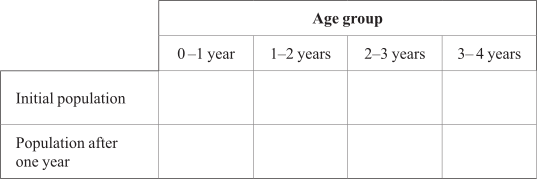
\(\textbf{Age Group}\)
\(\ 0-1\ \text{year}\ \)
\(\ 1-2\ \text{years}\ \)
\(\ 2-3\ \text{years}\ \)
\(\ 3-4\ \text{years}\ \)
\(\ \text{Initial population}\ \)
\(70\)
\(80\)
\(90\)
\(40\)
\(\ \text{Population after}\ \)
\(\ \text{one year}\)\(124\)
\(28\)
\(56\)
\(45\)
\(\textbf{Age Group}\)
\(\ 0-1\ \text{year}\ \)
\(\ 1-2\ \text{years}\ \)
\(\ 2-3\ \text{years}\ \)
\(\ 3-4\ \text{years}\ \)
\(\ \text{Initial population}\ \)
\(70\)
\(80\)
\(90\)
\(40\)
\(\ \text{Population after}\ \)
\(\ \text{one year}\)\(124\)
\(28\)
\(56\)
\(45\)
124 \\
28 \\
56 \\
45 \end{bmatrix}\ \ \text{Total = 253}\ ,\ \ R_2=L\times R_1=\begin{bmatrix}
93 \\
49.6 \\
19.6 \\
28 \end{bmatrix}\ \ \text{Total = 190.2}\)
82.24 \\
37.2 \\
34.72 \\
9.8 \end{bmatrix}\ \ \text{Total = 163.96}\ ,\ \ R_4=L\times R_3=\begin{bmatrix}
74.684 \\
32.896 \\
26.04 \\
17.36 \end{bmatrix}\ \ \text{Total =150.98}\)
64.9616 \\
29.8736 \\
23.0272 \\
13.02 \end{bmatrix}\ \ \text{Total = 130.8824}\)
\(\therefore\ \text{Total female population less than 140 after 5 years}\)
MATRICES, FUR1 2021 VCAA 6 MC
A fitness centre offers four different exercise classes: aerobics `(A)`, boxfit `(B)`, cardio `(C)` and dance `(D)`.
A customer's choice of fitness class is expected to change from week to week according to the transition matrix `P`, shown below.
`qquadqquadqquadqquadqquadqquad text(this week)`
`P = {:(qquad\ A quadquadqquad \ B quadquad \ C quadqquad \ D),([(0.65,0, 0.20, 0.10),(0,0.65,0.10,0.30),(0.20,0.10,0.70,0),(0.15,0.25,0,0.60)]{:(A),(B),(C),(D):} qquad text(next week)):}`
An equivalent transition diagram has been constructed below, but the labeling is not complete.
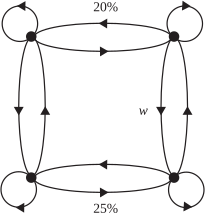
The proportion for one of the transitions is labelled `w`.
The value of `w` is
- 10%
- 15%
- 20%
- 25%
- 30%
Show Worked Solution
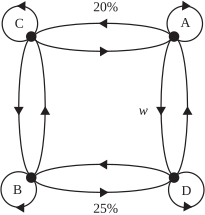
`text{The 25% edge label must be} \ B \ text{(this week) to} \ D \ text{(next week)}`
`text{No edge exists between} \ C \ text{and} \ D`
`=> \ text{top left vertex is} \ C \ text{and top right vertex is} \ A.`
| `w` | `= A \ text{this week,} \ D \ text{next week}` |
| `= 0.15` |
`=> B`
MATRICES, FUR1 2018 VCAA 6 MC
A transition matrix, `V`, is shown below.
`{:(),(),(),(),(V =),(),():}{:(qquadqquadtext(this month)),(qquadLqquadquadTqquadquadFqquad\ M),([(0.6,0.6,0.6,0.0),(0.1,0.2,0.0,0.1),(0.3,0.0,0.8,0.4),(0.0,0.2,0.0,0.5)]):}{:(),(),(L),(T),(F),(M):}{:\ text(next month):}`
The transition diagram below has been constructed from the transition matrix `V`.
The labelling in the transition diagram is not yet complete.
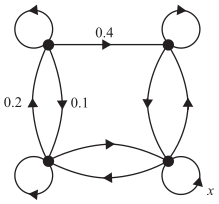
The proportion for one of the transitions is labelled `x`.
The value of `x` is
- 0.2
- 0.5
- 0.6
- 0.7
- 0.8
Show Worked Solution
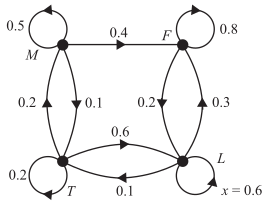
`x = 0.6`
`=> C`
MATRICES, FUR2 2009 VCAA 3
In 2009, the school entered a Rock Eisteddfod competition.
When rehearsals commenced in February, all students were asked whether they thought the school would make the state finals. The students’ responses, ‘yes’, ‘no’ or ‘undecided’ are shown in the initial state matrix `S_0`.
`S_0 = [(160),(120),(220)]{:(text(yes)),(text(no)),(text(undecided)):}`
- How many students attend this school? (1 mark)
--- 2 WORK AREA LINES (style=lined) ---
Each week some students are expected to change their responses. The changes in their responses from one week to the next are modelled by the transition matrix `T` shown below.
`{:(qquadqquadqquadtext( response this week)),(qquadqquadquadtext( yes no undecided)),(T = [(0.85quad,0.35quad,0.60),(0.10quad,0.40quad,0.30),(0.05quad,0.25quad,0.10)]{:(text(yes)),(text(no)),(text(undecided)):}qquad{:(text(response)),(text(next week)):}):}`
The following diagram can also be used to display the information represented in the transition matrix `T`.

-
- Complete the diagram above by writing the missing percentage in the shaded box. (1 mark)
--- 0 WORK AREA LINES (style=lined) ---
- Of the students who respond ‘yes’ one week, what percentage are expected to respond ‘undecided’ the next week when asked whether they think the school will make the state finals? (1 mark)
--- 1 WORK AREA LINES (style=lined) ---
- In total, how many students are not expected to have changed their response at the end of the first week? (2 marks)
--- 2 WORK AREA LINES (style=lined) ---
- Complete the diagram above by writing the missing percentage in the shaded box. (1 mark)
- Evaluate the product `S_1 = TS_0`, where `S_1` is the state matrix at the end of the first week. (1 mark)
--- 3 WORK AREA LINES (style=lined) ---
- How many students are expected to respond ‘yes’ at the end of the third week when asked whether they think the school will make the state finals? (1 mark)
--- 3 WORK AREA LINES (style=lined) ---
MATRICES, FUR2 2013 VCAA 2
10 000 trout eggs, 1000 baby trout and 800 adult trout are placed in a pond to establish a trout population.
In establishing this population
-
- eggs (`E`) may die (`D`) or they may live and eventually become baby trout (`B`)
- baby trout (`B`) may die (`D`) or they may live and eventually become adult trout (`A`)
- adult trout (`A`) may die (`D`) or they may live for a period of time but will eventually die.
From year to year, this situation can be represented by the transition matrix `T`, where
`{:(qquadqquadqquadqquadqquadtext(this year)),((qquadqquadqquadE,quad\ B,quad\ A,\ D)),(T = [(0,0,0,0),(0.4,0,0,0),(0,0.25,0.5,0),(0.6,0.75,0.5,1)]):}{:(),(),(E),(B),(A),(D):}{:(),(),(qquadtext(next year)):}`
- Use the information in the transition matrix `T` to
- determine the number of eggs in this population that die in the first year. (1 mark)
--- 2 WORK AREA LINES (style=lined) ---
- complete the transition diagram below, showing the relevant percentages. (2 marks)
--- 0 WORK AREA LINES (style=lined) ---
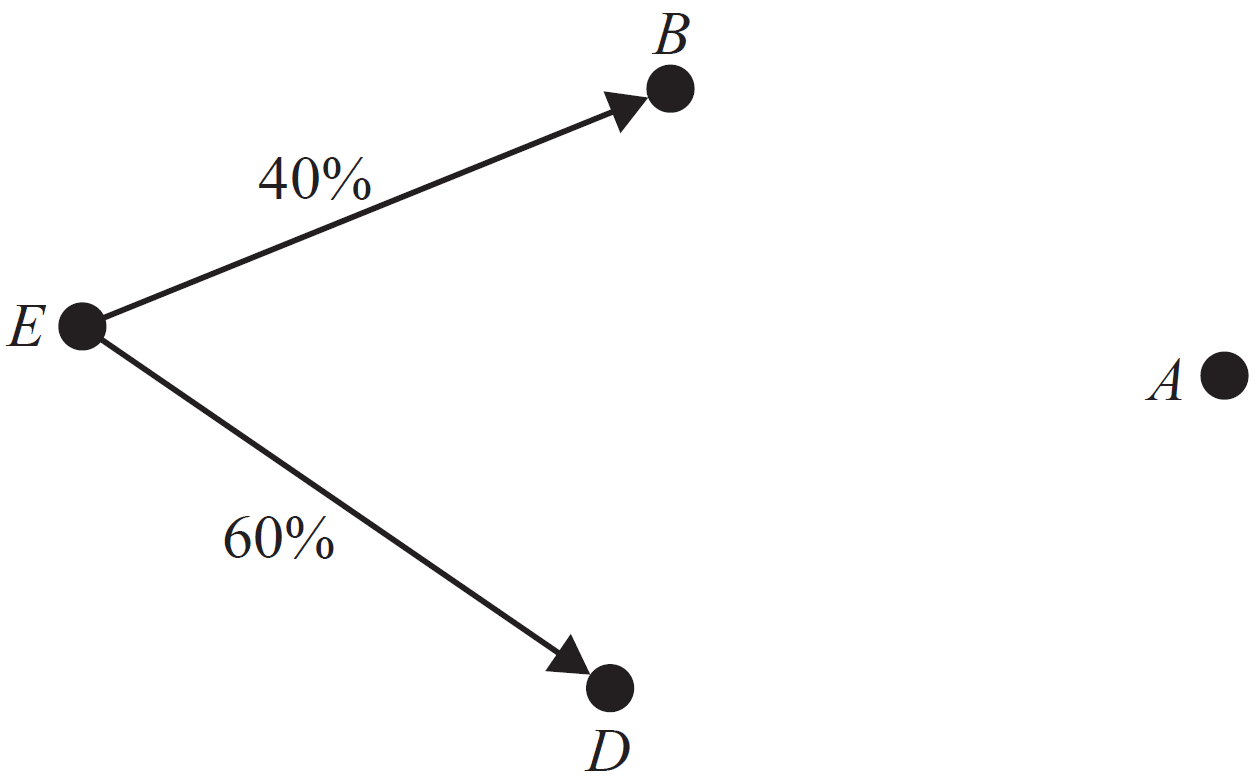
- determine the number of eggs in this population that die in the first year. (1 mark)
The initial state matrix for this trout population, `S_0`, can be written as
`S_0 = [(10\ 000),(1000),(800),(0)]{:(E),(B),(A),(D):}`
Let `S_n` represent the state matrix describing the trout population after `n` years.
- Using the rule `S_n = T S_(n-1)`, determine each of the following.
- `S_1` (1 mark)
--- 3 WORK AREA LINES (style=lined) ---
- the number of adult trout predicted to be in the population after four years (1 mark)
--- 3 WORK AREA LINES (style=lined) ---
- `S_1` (1 mark)
- The transition matrix `T` predicts that, in the long term, all of the eggs, baby trout and adult trout will die.
- How many years will it take for all of the adult trout to die (that is, when the number of adult trout in the population is first predicted to be less than one)? (1 mark)
--- 2 WORK AREA LINES (style=lined) ---
- What is the largest number of adult trout that is predicted to be in the pond in any one year? (1 mark)
--- 3 WORK AREA LINES (style=lined) ---
- How many years will it take for all of the adult trout to die (that is, when the number of adult trout in the population is first predicted to be less than one)? (1 mark)
- Determine the number of eggs, baby trout and adult trout that, if added to or removed from the pond at the end of each year, will ensure that the number of eggs, baby trout and adult trout in the population remains constant from year to year. (2 marks)
--- 4 WORK AREA LINES (style=lined) ---
The rule `S_n = T S_(n – 1)` that was used to describe the development of the trout in this pond does not take into account new eggs added to the population when the adult trout begin to breed.
- To take breeding into account, assume that 50% of the adult trout lay 500 eggs each year.
- The matrix describing the population after one year, `S_1`, is now given by the new rule
- `S_1 = T S_0 + 500\ M\ S_0`
- where `T=[(0,0,0,0),(0.40,0,0,0),(0,0.25,0.50,0),(0.60,0.75,0.50,1.0)], M=[(0,0,0.50,0),(0,0,0,0),(0,0,0,0),(0,0,0,0)]\ text(and)\ S_0=[(10\ 000),(1000),(800),(0)]`
- Use this new rule to determine `S_1`. (1 mark)
--- 4 WORK AREA LINES (style=lined) ---
- Use this new rule to determine `S_1`. (1 mark)
- This pattern continues so that the matrix describing the population after `n` years, `S_n`, is given by the rule
- `S_n = T\ S_(n-1) + 500\ M\ S_(n-1)`
- Use this rule to determine the number of eggs in the population after two years (2 marks)
--- 6 WORK AREA LINES (style=lined) ---
- Use this rule to determine the number of eggs in the population after two years (2 marks)
Show Worked Solution
a.i. `text(60% of eggs die in 1st year,)`
`:.\ text(Eggs that die in year 1)`
`= 0.60 xx 10\ 000`
`= 6000`
MARKER’S COMMENT: A 100% cycle drawn at `D` was a common omission. Do not draw loops and edges of 0%!
| a.ii. |
|

| b.i. | `S_1` | `= TS_0` |
| `= [(0,0,0,0),(0.4,0,0,0),(0,0.25,0.5,0),(0.6,0.75,0.5,1)][(10\ 000),(1000),(800),(0)]= [(0),(4000),(650),(7150)]` |
| b.ii. | `S_4` | `= T^4S_0` |
| `= [(0,0,0,0),(0.4,0,0,0),(0,0.25,0.5,0),(0.6,0.75,0.5,1)]^4[(10\ 000),(1000),(800),(0)]= [(0),(0),(331.25),(11\ 468.75)]` |
`:. 331\ text(trout is the predicted population after 4 years.)`
| c.i. | `S_12 = T^12S_0 = [(0),(0),(1.29),(11\ 791)]` |
`S_13 = T^13S_0 = [(0),(0),(0.65),(11\ 799)]`
`:.\ text{It will take 13 years (when the trout population drops below 1).}`
| c.ii. | `S_1 = TS_0 = [(0),(4000),(650),(7150)]` |
`text(After 1 year, 650 adult trout.)`
`text(Similarly,)`
`S_2 = T^2S_0 = [(0),(0),(1325),(10\ 475)]`
`S_3 = T^3S_0 = [(0),(0),(662.5),(11\ 137.5)]`
`S_4 = T^4S_0 = [(0),(0),(331),(11\ 469)]`
`:.\ text(Largest number of adult trout = 1325.)`
| d. | `S_0-S_1 = [(10\ 000),(1000),(800),(0)]-[(0),(4000),(650),(7150)] = [(10\ 000),(−3000),(150),(−7150)]` |
`:.\ text(Add 10 000 eggs, remove 3000 baby trout and add 150 adult)`
`text(trout to keep the population constant.)`
| e.i. | `S_1` | `= TS_0 + 500MS_0` |
| `= [(0),(4000),(650),(7150)] + 500 xx [(0,0,0.5,0),(0,0,0,0),(0,0,0,0),(0,0,0,0)][(10\ 000),(1000),(800),(0)]` | ||
| `= [(0),(4000),(650),(7150)] + 500[(400),(0),(0),(0)]` | ||
| `= [(200\ 000),(4000),(650),(7150)]` |
| e.ii. | `S_2` | `= TS_1 + 500MS_1` |
|
`= [(0,0,0,0),(0.4,0,0,0),(0,0.25,0.5,0),(0.6,0.75,0.5,1)][(200\ 000),(4000),(650),(7150)]` `+ 500 xx [(0,0,0.5,0),(0,0,0,0),(0,0,0,0),(0,0,0,0)][(200\ 000),(4000),(650),(7150)]` |
||
| `= [(162\ 500),(80\ 000),(1325),(130\ 475)]` |
MATRICES, FUR1 2009 VCAA 6 MC
`T` is a transition matrix, where
`{:(qquadqquadqquadquadtext(from)),({:qquadqquadqquad\ PqquadQ:}),(T = [(0.6,0.7),(0.4,0.3)]{:(P),(Q):}{:qquadtext(to):}):}`
An equivalent transition diagram, with proportions expressed as percentages, is


