SmarterEd

Aussie Maths & Science Teachers: Save your time with SmarterEd

  • Login
  • Get Help
  • About

Matrices, GEN1 2023 VCAA 27 MC

The following transition matrix, \(T\), models the movement of a species of bird around three different locations, \(M, N\) and \(O\) from one day to the next.

\begin{aligned}
& \quad \ \ \textit{this day} \\
& \quad  M \ \  N \ \ \  O\\
T = & \begin{bmatrix}
\frac{1}{3} & 0 & \frac{9}{10} \\
\frac{1}{3} & 1 & \frac{1}{10} \\
\frac{1}{3} & 0 & 0
\end{bmatrix}\begin{array}{l}
M\\
N\\
O
\end{array}\ \ \ next \ day
\end{aligned}

Which one of the following statements best represents what will occur in the long term?

  1. No birds will remain at location \(M\).
  2. No birds will remain at location \(N\).
  3. All of the birds will end up at location \(M\).
  4. All of the birds will end up at location \(O\).
  5. An equal number of birds will be at all three locations.
Show Answers Only

\(A\)

Show Worked Solution

\(\text{Steady state matrix:}\)

\(T^{50} =\begin{bmatrix}
\frac{1}{3} & 0 & \frac{9}{10} \\
\frac{1}{3} & 1 & \frac{1}{10} \\
\frac{1}{3} & 0 & 0
\end{bmatrix}
\approx \begin{bmatrix}
0 & 0 & 0 \\
1 & 1 & 1 \\
0 & 0 & 0
\end{bmatrix}\)

\(\Rightarrow A\)

Filed Under: Transition Matrices - Regular Tagged With: Band 4, smc-618-40-Steady State

MATRICES, FUR2 2020 VCAA 3

An offer to buy the Westmall shopping centre was made by a competitor.

One market research project suggested that if the Westmall shopping centre were sold, each of the three centres (Westmall, Grandmall and Eastmall) would continue to have regular shoppers but would attract and lose shoppers on a weekly basis.

Let  `S_n`  be the state matrix that shows the expected number of shoppers at each of the three centres  `n`  weeks after Westmall is sold.

A matrix recurrence relation that generates values of  `S_n`  is

`S_(n+1) = T xx S_n`

`{:(quad qquad qquad qquad qquad qquad qquad qquad text(this week)),(qquad qquad qquad qquad qquad qquad quad \ W qquad quad G qquad quad \ E),(text(where)\ T = [(quad 0.80, 0.09, 0.10),(quad 0.12, 0.79, 0.10),(quad 0.08, 0.12, 0.80)]{:(W),(G),(E):}\ text(next week,) qquad qquad  S_0 = [(250\ 000), (230\ 000), (200\ 000)]{:(W),(G),(E):}):}`
 

  1. Calculate the state matrix, `S_1`, to show the expected number of shoppers at each of the three centres one week after Westmall is sold.   (1 mark)

    --- 3 WORK AREA LINES (style=lined) ---

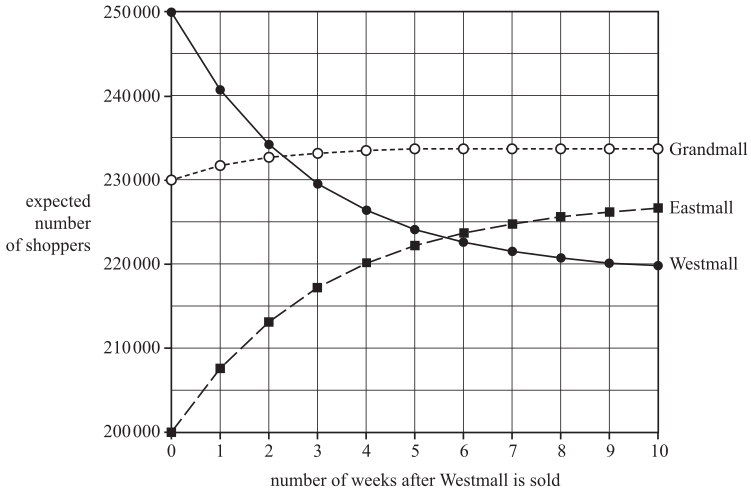
Using values from the recurrence relation above, the graph below shows the expected number of shoppers at Westmall, Grandmall and Eastmall for each of the 10 weeks after Westmall is sold.


  1. What is the difference in the expected weekly number of shoppers at Westmall from the time Westmall is sold to 10 weeks after Westmall is sold?
  2. Give your answer correct to the nearest thousand.   (1 mark)

    --- 2 WORK AREA LINES (style=lined) ---

  3. Grandmall is expected to achieve its maximum number of shoppers sometime between the fourth and the tenth week after Westmall is sold.
  4. Write down the week number in which this is expected to occur.   (1 mark)

    --- 4 WORK AREA LINES (style=lined) ---

  5. In the long term, what is the expected weekly number of shoppers at Westmall?
  6. Round your answer to the nearest whole number.   (1 mark)

    --- 3 WORK AREA LINES (style=lined) ---

Show Answers Only
  1. `S_1 =[(240\ 700),(231\ 700),(207\ 600)]`
  2. `30\ 000`
  3. `S_6 = T^6S_0 =  [(text(__)), (233\ 708), (text(__))]`
  4. `218\ 884`
Show Worked Solution
a.   `S_1` `= TS_0`
    `= [(0.80, 0.09, 0.10),(0.12, 0.79, 0.10),(0.08, 0.12, 0.80)][(250\ 000),(230\ 000),(200\ 000)]=[(240\ 700),(231\ 700),(207\ 600)]`


b.   `text(Using the graph)`
  `text(Difference)` `= 250\ 000-220\ 000`
    `= 30\ 000`


♦♦ Mean mark part (c) 27%.

c.  `text(Testing options:)`

`S_6 = T^6S_0 = [(0.80, 0.09, 0.10),(0.12, 0.79, 0.10),(0.08, 0.12, 0.80)]^6[(250\ 000),(230\ 000),(200\ 000)] = [(text(__)), (233\ 708), (text(__))]`
 

`:.\ text(Maximum shoppers in Grandmall expected in week 6.)`


♦ Mean mark part (d) 39%.

d.  `text(Test with high integer)\ n:`

`S_50 = T^50S_0 -> text(Westmall) = 218\ 884`

Filed Under: Transition Matrices - Regular Tagged With: Band 3, Band 4, Band 5, smc-618-30-State Matrix in discrete period, smc-618-40-Steady State, smc-618-61-3x3 Matrix

MATRICES, FUR1-NHT 2019 VCAA 7-8 MC

A farm contains four water sources, `P`, `Q`, `R` and `S`.

Part 1

Cows on the farm are free to move between the four water sources.

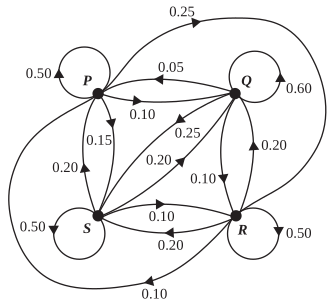
The change in the number of cows at each of these water sources from week to week is shown in the transition diagram below.
 

Let `C_n` be the state matrix for the location of the cows in week `n` of 2019.

The state matrix for the location of the cows in week 23 of 2019 is `C_23 = [(180),(200),(240),(180)]{:(P),(Q),(R),(S):}`
 

The state matrix for the location of the cows in week 24 of 2019 is `C_24 = [(160),(222),(203),(215)]{:(P),(Q),(R),(S):}`

Of the cows expected to be at `Q` in week 24 of 2019, the percentage of these cows at `R` in week 23 of 2019 is closest to

  1.   8%
  2.   9%
  3. 20%
  4. 22%
  5. 25%


Part 2

Sheep on the farm are also free to move between the four water sources.

The change in the number of sheep at each water source from week to week is shown in matrix `T` below.
 

`{:(),(),(T=):}{:(qquadqquadqquadtext(this week)),((qquadP,quadQ,quadR,quadS)),([(0.4,0.3,0.2,0.1),(0.2,0.1,0.5,0.3),(0.1,0.3,0.1,0.2),(0.3,0.3,0.2,0.4)]):}{:(),(),({:(P),(Q),(R),(S):}):}{:(),(),(text(next week)):}`
 

In the long term, 635 sheep are expected to be at `S` each week.

In the long term, the number of sheep expected to be at `Q` each week is closest to

  1. 371
  2. 493
  3. 527
  4. 607
  5. 635
Show Answers Only

`text(Part 1:)\ D`

`text(Part 2:)\ C`

Show Worked Solution

`text(Part 1)`

`text(In week 23, 240 cows are at)\ R.`

`text(In week 24, number of cows moving from)\ R\ text(to)\ Q`

`=20text(%) xx 240`

`= 48\ text(cows)`
 

`text(Total cows at)\ Q = 222`
 

`:.\ text(Percentage)` `= 48/222`
  `= 0.2162`
  `= 22text(%)`

`=>\ D`


`text(Part 2)`

`T^50 = [(0.2434, 0.2434, 0.2434, 0.2434),(0.2603, 0.2603, 0.2603, 0.2603),(0.1834, 0.1834, 0.1834, 0.1834),(0.3130, 0.3130, 0.3130, 0.3130)]`

 
`text(S)text(ince 635 sheep are expected long term at)\ S,`

`text(Total sheep)` `= 635/0.3130`
  `= 2029`

 
`:. text(Long term expected at)\ Q`

`~~ 0.2603 xx 2029`

`~~ 528`

`=>\ C`

Filed Under: Transition Matrices - Regular Tagged With: Band 5, Band 6, smc-618-10-Diagram/Info to Matrix, smc-618-40-Steady State

MATRICES, FUR1 2019 VCAA 6 MC

A water park is open from 9 am until 5 pm.

There are three activities, the pool `(P)`, the slide `(S)` and the water jets `(W)`, at the water park.

Children have been found to change their activity at the water park each half hour, as shown in the transition matrix, `T`, below.
 

`{:(qquad qquad qquad quadtext(this half year)),(qquad qquad qquad quad P qquad qquad S qquad quad W), (T = [(0.80,0.20,0.40),(0.05,0.60,0.10),(0.15,0.20,0.50)] {:(P),(S),(W):} text( next half year)):}`
 

A group of children has come to the water park for the whole day.

The percentage of these children who are expected to be at the slide `(S)` at closing time is closest to

  1.  14%
  2.  20%
  3.  24%
  4.  25%
  5.  62%
Show Answers Only

`A`

Show Worked Solution

`text(Park is open 8 hours → 15 × 30-minute transitions.)`

`text(After 15 transitions, matrix approaches a steady state.)`
 

`[(0.80,0.20,0.40),(0.05,0.60,0.10),(0.15,0.20,0.50)]^15 ~~ [(0.62,0.62,0.62),(0.14,0.14,0.14),(0.24,0.24,0.24)]`
 

`=>  A`

Filed Under: Transition Matrices - Regular Tagged With: Band 4, smc-618-40-Steady State, smc-618-61-3x3 Matrix

MATRICES, FUR1 2018 VCAA 8 MC

A public library organised 500 of its members into five categories according to the number of books each member borrows each month.

These categories are

J = no books borrowed per month
K = one book borrowed per month
L = two books borrowed per month
M = three books borrowed per month
N = four or more books borrowed per month

The transition matrix, `T`, below shows how the number of books borrowed per month by the members is expected to change from month to month.
 

`{:(),(),(T=):}{:(qquadqquadqquad\ text(this month)),((qquadJ,quadK,quadL,quadM,quadN)),([(0.1,0.2,0.2,0,0),(0.5,0.2,0.3,0.1,0),(0.3,0.3,0.4,0.1,0.2),(0.1,0.2,0.1,0.6,0.3),(0,0.1,0,0.2,0.5)]):}{:(),(),({:(J),(K),(L),(M),(N):}):}{:(),(),(text(next month)):}`

 
In the long term, which category is expected to have approximately 96 members each month?

  1. `J`
  2. `K`
  3. `L`
  4. `M`
  5. `N`
Show Answers Only

`B`

Show Worked Solution

`text(Any initial member split by category will)`

♦ Mean mark 46%.

`text(result in the same long term expectations.)`

`text(Starting with 100 in each category:)`
 

`T^50[(100),(100),(100),(100),(100)] = [(49),(96),(124),(151),(80)]`
 

`:.\ text(Category)\ K\ text(is expected to have 96 members.)`

`=> B`

Filed Under: Transition Matrices - Regular Tagged With: Band 5, smc-618-40-Steady State, smc-618-63-5x5 Matrix

MATRICES, FUR2 2018 VCAA 3

The Hiroads company has a contract to maintain and improve 2700 km of highway.

Each year sections of highway must be graded `(G)`, resurfaced `(R)` or sealed `(S)`.

The remaining highway will need no maintenance `(N)` that year.

Let `S_n` be the state matrix that shows the highway maintenance schedule for the `n`th year after 2018.

The maintenance schedule for 2018 is shown in matrix `S_0` below.

 
`S_0 = [(700),(400),(200),(1400)]{:(G),(R),(S),(N):}`
 

The type of maintenance in sections of highway varies from year to year, as shown in the transition matrix `T`, below.
 

`{:(qquad qquad qquad qquad qquad quad text(this year)),(qquad qquad quad quad G qquad quad R qquad quad S quad quad \ N),(T = [(0.2,0.1,0.0,0.2),(0.1,0.1,0.0,0.2),(0.2,0.1,0.2,0.1),(0.5, 0.7,0.8,0.5)]{:(G),(R),(S),(N):} \ text (next year)):}`
 

  1. Of the length of highway that was graded `(G)` in 2018, how many kilometres are expected to be resurfaced `(R)` the following year?   (1 mark)

    --- 2 WORK AREA LINES (style=lined) ---

  2. Show that the length of highway that is to be graded `(G)` in 2019 is 460 km by writing the appropriate numbers in the boxes below.   (1 mark)

    --- 0 WORK AREA LINES (style=lined) ---


`× 700 +`
 
`× 400 +`
 
`× 200 +`
 
`× 1400 = 460`


The state matrix describing the highway maintenance schedule for the nth year after 2018 is given by

`S_(n + 1) = TS_n`
 

  1. Complete the state matrix, `S_1`, below for the highway maintenance schedule for 2019 (one year after 2018).   (1 mark)

    --- 0 WORK AREA LINES (style=lined) ---


    `qquad qquad S_1 = [(460),(text{____}),(text{____}),(1490)]{:(G),(R),(S),(N):}`
     

  2. In 2020, 1536 km of highway is expected to require no maintenance `(N)`
  3. Of these kilometres, what percentage is expected to have had no maintenance `(N)` in 2019?
  4. Round your answer to one decimal place.   (1 mark)

    --- 3 WORK AREA LINES (style=lined) ---

  5. In the long term, what percentage of highway each year is expected to have no maintenance `(N)`?
  6. Round your answer to one decimal place.   (1 mark)

    --- 4 WORK AREA LINES (style=lined) ---

Show Answers Only
  1. `70\ text(km)`
  2. `G_2019 = 0.2 xx 700 + 0.1 xx 400 + 0 xx 200 + 0.2 xx 1400 = 460`
  3. `[(460),(390),(360),(1490)]`
  4. `48.5 text{%  (to 1 d.p.)}`
  5. `56.7 text{%  (to 1 d.p.)}`
Show Worked Solution
a.    `G -> R` `= 0.1 xx 700`
    `= 70\ text(km)`

♦ Mean mark part (a) 48%.


b.    `G_2019` `= 0.2 xx 700 + 0.1 xx 400 + 0 xx 200 + 0.2 xx 1400`
    `= 460`


c.    `S_1` `= TS_0`
    `= [(0.2,0.1,0.0,0.2),(0.1,0.1,0.0,0.2),(0.2,0.1,0.2,0.1),(0.5,0.7,0.8,0.5)][(700),(400),(200),(1400)]=[(460),(390),(360),(1490)]`


d.   `N_2019 = 1490`

`:.\ text(Percentage)` `= (0.5 xx 1490)/1536 xx 100`
  `= 48.502…`
  `= 48.5 text{%  (to 1 d.p.)}`


e.  `text(Raise)\ \ T\ \ text(to a high power)\ (n = 50):`

`T^50 = [(0.160,0.160,0.160,0.160),(0.144,0.144,0.144,0.144),(0.129,0.129,0.129,0.129),(0.567,0.567,0.567,0.567)]`

`:.\ %N` `= 0.567`
  `= 56.7 text{%  (to 1 d.p.)}`

Filed Under: Transition Matrices - Regular Tagged With: Band 3, Band 5, smc-618-30-State Matrix in discrete period, smc-618-40-Steady State, smc-618-62-4x4 Matrix

MATRICES, FUR1 2016 VCAA 7 MC

Each week, the 300 students at a primary school choose art (A), music (M) or sport (S) as an afternoon activity.

The transition matrix below shows how the students’ choices change from week to week.
 

`{:(qquadqquadqquadqquadtext(this week)),((qquadqquadqquadA,quadM,quadS)),(T=[(0.5,0.4,0.1),(0.3,0.4,0.4),(0.2,0.2,0.5)]{:(A),(M),(S):}quad{:text(next week):}):}`


Based on the information above, it can be concluded that, in the long term

  1. no student will choose sport.
  2. all students will choose to stay in the same activity each week.
  3. all students will have chosen to change their activity at least once.
  4. more students will choose to do music than sport.
  5. the number of students choosing to do art and music will be the same.
Show Answers Only

`D`

Show Worked Solution

`text(Consider)\ n\ text(large)\ (n = 50),\ text(and begin with)`

`text(the students spread equally among the sports.)`

`[(0.5,0.4,0.1),(0.3,0.4,0.4),(0.2,0.2,0.5)]^(50)[(100),(100),(100)]~~[(105),(109),(86)]`


`:.\ text(There will be 109 students in music)`

`text(and 86 in sport.)`

`=> D`

Filed Under: Transition Matrices - Regular Tagged With: Band 5, smc-618-40-Steady State, smc-618-61-3x3 Matrix

MATRICES, FUR2 2007 VCAA 2

To study the life-and-death cycle of an insect population, a number of insect eggs (`E`), juvenile insects (`J`) and adult insects (`A`) are placed in a closed environment.

The initial state of this population can be described by the column matrix

`S_0 = [(400),(200),(100),(0)]{:(E),(J),(A),(D):}`

A row has been included in the state matrix to allow for insects and eggs that die (`D`).

  1. What is the total number of insects in the population (including eggs) at the beginning of the study?   (1 mark)

    --- 1 WORK AREA LINES (style=lined) ---

In this population

    • eggs may die, or they may live and grow into juveniles
    • juveniles may die, or they may live and grow into adults
    • adults will live a period of time but they will eventually die.

In this population, the adult insects have been sterilised so that no new eggs are produced. In these circumstances, the life-and-death cycle of the insects can be modelled by the transition matrix
 

`{:(qquadqquadqquadqquadquadtext(this week)),((qquadqquadqquadE,quad\ J,quadA,\ D)),(T = [(0.4,0,0,0),(0.5,0.4,0,0),(0,0.5,0.8,0),(0.1,0.1,0.2,1)]{:(E),(J),(A),(D):}):}`
 

  1. What proportion of eggs turn into juveniles each week?   (1 mark)

    --- 1 WORK AREA LINES (style=lined) ---

    1. Evaluate the matrix product  `S_1 = TS_0`   (1 mark)

      --- 1 WORK AREA LINES (style=lined) ---

    2. Write down the number of live juveniles in the population after one week.   (1 mark)

      --- 3 WORK AREA LINES (style=lined) ---

    3. Determine the number of live juveniles in the population after four weeks. Write your answer correct to the nearest whole number.   (1 mark)

      --- 1 WORK AREA LINES (style=lined) ---

    4. After a number of weeks there will be no live eggs (less than one) left in the population.
    5. When does this first occur?   (1 mark)

      --- 4 WORK AREA LINES (style=lined) ---

    6. Write down the exact steady-state matrix for this population.  (1 mark)

      --- 3 WORK AREA LINES (style=lined) ---

  2. If the study is repeated with unsterilised adult insects, eggs will be laid and potentially grow into adults.
  3. Assuming 30% of adults lay eggs each week, the population matrix after one week, `S_1`, is now given by
  4. `qquad S_1 = TS_0 + BS_0`
  5. where   `B = [(0,0,0.3,0),(0,0,0,0),(0,0,0,0),(0,0,0,0)]`   and   `S_0 = [(400),(200),(100),(0)]{:(E),(J),(A),(D):}`
     

    1. Determine `S_1`  (1 mark)

      --- 3 WORK AREA LINES (style=lined) ---

    2. This pattern continues. The population matrix after `n` weeks, `S_n`, is given by
    3. `qquad qquad qquad S_n = TS_(n - 1) + BS_(n - 1)`
    4. Determine the number of live eggs in this insect population after two weeks.  (1 mark)

      --- 3 WORK AREA LINES (style=lined) ---

Show Answers Only
  1. `700`
  2. `50text(%)`
  3.  
    1. `[(160),(280),(180),(80)]{:(E),(J),(A),(D):}`
    2. `280`
    3. `56`
    4. `text(7th week)`
    5. `[(0),(0),(0),(700)]`
    1. `[(190),(280),(180),(80)]`
    2. `130`
Show Worked Solution

a.   `400 + 200 + 100 + 0 = 700`
 

b.   `50text(%)`
 

c.i.    `S_1` ` = TS_0`
    `= [(0.4,0,0,0),(0.5,0.4,0,0),(0,0.5,0.8,0),(0.1,0.1,0.2,1)][(400),(200),(100),(0)]`
    `= [(160),(280),(180),(80)]{:(E),(J),(A),(D):}`

 
c.ii.
   `280`
 

c.iii.    `S_4` ` = T^4S_0`
    `= [(10.24),(56.32),(312.96),(320.48)]{:(E),(J),(A),(D):}\ \ \ text{(by graphics calculator)}`

 
`:. 56\ text(juveniles still alive after 4 weeks.)`
 

c.iv.  `text(Each week, only 40% of eggs remain.)`

`text(Find)\ \ n\ \ text(such that)`

`400 xx 0.4^n` `< 1`
`0.4^n` `<1/400`
`n` `> 6.5`

 
`:.\ text(After 7 weeks, no live eggs remain.)`


c.v.   `text(Consider)\ \ n\ \ text{large (say}\ \ n = 100 text{)},`

`[(0.4, 0, 0, 0), (0.5, 0.4, 0, 0), (0, 0.5, 0.8, 0), (0.1, 0.1, 0.2, 1)]^100 [(400), (200), (100), (0)] ~~ [(0), (0), (0), (700)]`


d.i.   `S_1` `= TS_0 + BS_0`
    `= [(160),(280),(180),(80)] + [(0,0,0.3,0),(0,0,0,0),(0,0,0,0),(0,0,0,0)][(400),(200),(100),(0)]= [(190),(280),(180),(80)]`


♦♦ Mean mark for part (d) was 30%.
d.ii.   `S_2` `= TS_1 + BS_1= [(130), (207), (284), (163)]`

 
`:.\ text(There are 130 live egss after 2 weeks.)`

Filed Under: Transition Matrices - Modified, Transition Matrices - Regular Tagged With: Band 3, Band 4, Band 5, Band 6, smc-1893-20-State Matrix in discrete period, smc-1893-32-4x4 Matrix, smc-1893-60-Regular Transition Matrices, smc-618-30-State Matrix in discrete period, smc-618-40-Steady State, smc-618-62-4x4 Matrix

MATRICES, FUR2 2010 VCAA 4

The Dinosaurs (`D`) and the Scorpions (`S`) are two basketball teams that play in different leagues in the same city.

The matrix `A_1` is the attendance matrix for the first game. This matrix shows the number of people who attended the first Dinosaur game and the number of people who attended the first Scorpion game.
 

`A_1 = [(2000),(1000)]{:(D),(S):}`
 

The number of people expected to attend the second game for each team can be determined using the matrix equation

`A_2 = GA_1`

where `G` is the matrix     `{:(qquadqquadqquadtext(this game)),((qquadqquadqquadD,qquad\ S)),(G = [(1.2,-0.3),(0.2,0.7)]{:(D),(S):}qquad{:text(next game):}):}`

    1. Determine `A_2`, the attendance matrix for the second game.   (1 mark)

      --- 2 WORK AREA LINES (style=lined) ---

    2. Every person who attends either the second Dinosaur game or the second Scorpion game will be given a free cap. How many caps, in total, are expected to be given away?   (1 mark)

      --- 2 WORK AREA LINES (style=lined) ---

Assume that the attendance matrices for successive games can be determined as follows.

`A_3 = GA_2`

`A_4 = GA_3`

and so on such that `A_(n + 1) = GA_n`

  1. Determine the attendance matrix (with the elements written correct to the nearest whole number) for game 10.   (1 mark)

    --- 3 WORK AREA LINES (style=lined) ---

  2. Describe the way in which the number of people attending the Dinosaurs’ games is expected to change over the next 80 or so games.   (1 mark)

    --- 3 WORK AREA LINES (style=lined) ---

The attendance at the first Dinosaur game was 2000 people and the attendance at the first Scorpion game was 1000 people.

Suppose, instead, that 2000 people attend the first Dinosaur game, and 1800 people attend the first Scorpion game.

  1. Describe the way in which the number of people attending the Dinosaurs’ games is expected to change over the next 80 or so games.   (1 mark)

    --- 3 WORK AREA LINES (style=lined) ---

Show Answers Only
    1.  
      `A_2 = [(2100),(1100)]`
    2. `3200\ text(people)`
  1.  
    `A_10 = [(2613),(1613)]`
  2. `text(Attendance at the Dinosaur’s games increases gradually)`


    `text(to 3000, at which level it remains steady.)`

  3. `text(Attendence at the Dinosaur’s games decreases)`


    `text(gradually to 600, where it remains steady.)`

Show Worked Solution
a.i.    `A_2` `= GA_1`
    `= [(1.2,-0.3),(0.2,0.7)][(2000),(1000)]`
    `= [(2100),(1100)]`


a.ii.   `text(Total attending second games)`

`= 2100 + 1100`

`= 3200\ text(people)`
 

b.    `A_10` `= GA_9`
    `= G^9A_1`
    `= [(1.2,-0.3),(0.2,0.7)]^9[(2000),(1000)]`
    `= [(2613),(1613)]`


c.    `A_80` `= G^79A_1= [(3000),(2000)]`
`A_81` `= G^80A_1= [(3000),(2000)]`

 
`:.\ text{Attendance at the Dinosaur’s games increases gradually to 3000,}`

`text{at which level it remains steady.}`
 

d.   `text(Using the new initial attendences,)`

`A_80 = [(1.2,-0.3),(0.2,0.7)]^79[(2000),(1800)] = [(600),(400)]`

`A_81 = [(1.2,-0.3),(0.2,0.7)]^80[(2000),(1800)] = [(600),(400)]`
 

`:.\ text{Attendence at the Dinosaur’s games decreases gradually to 600,}`

`text{where it remains steady.}`

Filed Under: Transition Matrices - Regular Tagged With: Band 4, Band 5, smc-618-30-State Matrix in discrete period, smc-618-40-Steady State, smc-618-60-2x2 Matrix

MATRICES, FUR1 2008 VCAA 7-9 MC

A large population of mutton birds migrates each year to a remote island to nest and breed. There are four nesting sites on the island, A, B, C and D.

Researchers suggest that the following transition matrix can be used to predict the number of mutton birds nesting at each of the four sites in subsequent years. An equivalent transition diagram is also given.
 

`{:(qquad qquad qquad qquad {:text(this year):}), (qquad qquad quad quad \ {:(A,\ \ B,\ \ C,\ D):}), (T = [(0.4, 0, 0.2, 0),(0.35, 1, 0.15, 0), (0.15, 0, 0.55, 0), (0.1, 0, 0.1, 1)] {:(A), (B), (C), (D):} quad {:text(next year):}):}`      VCAA MATRICES FUR2 2008 7i

Part 1

Two thousand eight hundred mutton birds nest at site C in 2008.

Of these 2800 mutton birds, the number that nest at site A in 2009 is predicted to be

A.    `560`

B.    `980`

C.  `1680`

D.  `2800`

E.  `3360`


Part 2

This transition matrix predicts that, in the long term, the mutton birds will

A.  nest only at site A.

B.  nest only at site B.

C.  nest only at site A and C.

D.  nest only at site B and D.

E.  continue to nest at all four sites.


Part 3

Six thousand mutton birds nest at site B in 2008.

Assume that an equal number of mutton birds nested at each of the four sites in 2007. The same transition matrix applies.

The total number of mutton birds that nested on the island in 2007 was

A.  `6000`

B.  `8000`

C.  `12\ 000`

D.  `16\ 000`

E.  `24\ 000`

Show Answers Only

`text(Part 1:)    A`

`text(Part 2:)   D`

`text(Part 3:)   D`

Show Worked Solution

`text(Part 1:)`

`text(20% of birds at site)\ A\ text(in 2008 are predicted)`

`text(to move to site)\ C.`

`:.\ text(Number of birds)`

`= 20 text(%) xx 2800`

`= 560`

`=>   A`


`text(Part 2:)`

`text(Consider)\ n\ text{large  (say}\ n = 50 text{)},`

`T^50 = [(0, 0, 0, 0), (0.75, 1, 0.66, 0), (0, 0, 0, 0), (0.25, 0, 0.33, 0)]`

`=>   D`


`text(Part 3:)`

`text(Let)\ \ x = text(mutton birds at each site in 2007)`

`text(In 2008, 6000 birds nest at)\ B.`

♦♦♦ Mean mark 25%.

`text(Using the diagram,)`

`x + 0.35x + 0.15x` `= 6000`
 `1.5x` `= 6000`
 `x` `= 4000`


`:.\ text(Total number nested in 2007)`

`= 4 xx 4000`

`= 16\ 000\ text(birds)`

`=>   D`

Filed Under: Transition Matrices - Regular Tagged With: Band 4, Band 6, smc-618-30-State Matrix in discrete period, smc-618-40-Steady State, smc-618-62-4x4 Matrix

MATRICES, FUR1 2013 VCAA 3 MC

 A coffee shop sells three types of coffee, Brazilian (B), Italian (I) and Kenyan (K). The regular customers buy one cup of coffee each per day and choose the type of coffee they buy according to the following transition matrix, `T`.
 

`{:({:qquadqquadqquadtext(choose today):}),(qquadqquadqquad\ BquadqquadIquadqquadK),(T = [(0.8,0.1,0.1), (0,0.8,0.1), (0.2,0.1,0.8)]{:(B), (I), (K):} qquadtext(choose tomorrow)):}`
 

On a particular day, 84 customers bought Brazilian coffee, 96 bought Italian coffee and 81 bought Kenyan coffee.

If these same customers continue to buy one cup of coffee each per day, the number of these customers who are expected to buy each of the three types of coffee in the long term is
 

MATRICES, FUR1 2013 VCAA 3 MC abc

MATRICES, FUR1 2013 VCAA 3 MC de

Show Answers Only

`B`

Show Worked Solution

`text(Consider)\ n\ text(large)\ (n= 50),`

`[(B),(I),(K)]` `= [(0.8,0.1,0.1),(0,0.8,0.1),(0.2,0.1,0.8)]^50[(84),(96),(81)]`
  `= [(87),(58),(116)]`

`rArr B`

Filed Under: Transition Matrices - Regular Tagged With: Band 4, smc-618-40-Steady State, smc-618-61-3x3 Matrix

Copyright © 2014–2025 SmarterEd.com.au · Log in