SmarterEd

Aussie Maths & Science Teachers: Save your time with SmarterEd

  • Login
  • Get Help
  • About

Matrices, GEN1 2024 NHT 25-26 MC

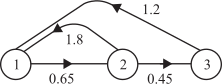
The following life cycle transition diagram shows changes in a female population of mammals with three age groups (1,2 and 3).
 

Question 25

On average, what percentage of the female population from group 2 will survive to group 3 ?

  1. 12%
  2. 18%
  3. 45%
  4. 50%
  5. 65%

 
Question 26

The associated Leslie matrix, \(L\), for the above transition diagram is

  1. \(L=\begin{bmatrix} 0 & 0 & 0 \\ 0 & 1.8 & 1.2 \\ 0 & 0.65 & 0.45\end{bmatrix}\)
     
  2. \(L=\begin{bmatrix}1 & 1.8 & 1.2 \\ 0 & 0.65 & 0 \\ 0 & 0 & 0.45\end{bmatrix}\)
     
  3. \(L=\begin{bmatrix}0 & 1.8 & 1.2 \\ 0.65 & 0 & 0 \\ 0.45 & 0 & 0\end{bmatrix}\)
     
  4. \(L=\begin{bmatrix}1.8 & 1.2 & 0 \\ 0 & 0.65 & 0.45 \\ 0 & 0 & 0\end{bmatrix}\)
     
  5. \(L=\begin{bmatrix}0 & 1.8 & 1.2 \\ 0.65 & 0 & 0 \\ 0 & 0.45 & 0\end{bmatrix}\)
Show Answers Only

\(\text{Question 25:}\ C\)

\(\text{Question 26:}\ E\)

Show Worked Solution

\(\text{Question 25}\)

\(0.45 = 45\%\ \text{of group 2 transition (survive) to group 3.}\)

\(\Rightarrow C\)
 

\(\text{Question 26}\)

\(\text{By elimination:}\)

\(\text{Row 1: Reproduction rate of each group}\ \ \Rightarrow\ \ \text{Eliminate A, B and D}\)

\(e_{3,2}\ \text{shows group 2 to group 3 survival rate} \)

\(\Rightarrow E\)

Filed Under: Transition Matrices - Regular Tagged With: Band 3, Band 4, smc-618-25-Interpret Diagram, smc-618-55-Leslie matrix, smc-618-61-3x3 Matrix

Matrices, GEN1 2022 VCAA 3 MC

Each day, members of a swim centre can choose to attend a morning session \((M)\), an afternoon session \((A)\) or no session \((N)\).

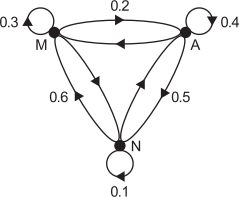
The transition diagram below shows the transition from day to day.

The transition diagram is incomplete.
 

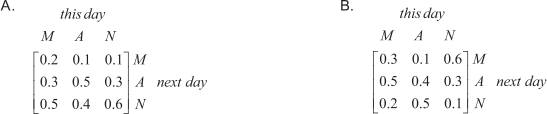
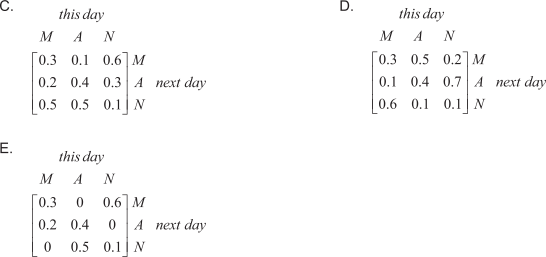
Which one of the following transition matrices represents this transition diagram?
 

Show Answers Only

\(C\)

Show Worked Solution

\(\text{By elimination}\)

\(\text{Option E: Eliminate as not all columns add to 1}\)

\(\text{Options A and D: Eliminate as N → M = 0.6, not 0.1 or 0.2}\)

\(\text{Option B: Eliminate as M → A = 0.2, not 0.5}\)

\(\text{Option C: Correct as N → M = 0.6,  M → A = 0.2,  A → N = 0.5 and leading diagonal 0.3, 0.4, 0.1 correct}\)

\(\Rightarrow C\)

Filed Under: Transition Matrices - Regular Tagged With: Band 4, smc-618-10-Diagram/Info to Matrix, smc-618-61-3x3 Matrix

MATRICES, FUR1 2021 VCAA 8 MC

A new colony of endangered marsupials is established on a remote island.

For one week, the marsupials can feed from only one of three feeding stations: `A`, `B` or `C`.

On Monday, 50% of the marsupials were observed feeding at station `A` and 50% were observed feeding at station `B`. No marsupials were observed feeding `C`.

The marsupials are expected to change their feeding stations each day this week according to the transition matrix `T`.

`qquadqquadqquadqquad \ text(this day)`

`P = {:(qquad\ A quadquadqquad \ B quadquad \ C ),([(0.4,0.1, 0.2),(0.2,0.5,0.2),(0.4,0.4,0.6)]{:(A),(B),(C):} qquad text(next day)):}`
 

Let  `S_n` represent the state matrix showing the percentage of marsupials observed feeding at each feeding station `n`  days after Monday of this week.

The matrix recurrence rule  `S_{n+1} = TS_n`  is used to model this situation.

From Tuesday to Wednesday, the percentage of marsupials who are not expected to change their feeding location is

  1. 44.5%
  2. 45%
  3. 50%
  4. 51.5%
  5. 52
Show Answers Only

`D`

Show Worked Solution

`text{Let} \ S_0 = text{Monday}`

♦♦♦ Mean mark 29%.

`S_1 = TS_0 = [(0.4,0.1,0.2),(0.2,0.5,0.2),(0.4,0.4,0.6)] [(50),(50),(0)] = [(25),(35),(40)]`
  

`S_2 = TS_1 = [(0.4,0.1,0.2),(0.2,0.5,0.2),(0.4,0.4,0.6)] [(25),(35),(40)]`
 

`text{Percentage not expected to change}`

`= 0.4 xx 25 + 0.5 xx 35 + 0.6 xx 40`

`= 51.5`

`=> D`

Filed Under: Transition Matrices - Regular Tagged With: Band 6, smc-618-24-Interpret Matrix, smc-618-61-3x3 Matrix

MATRICES, FUR2 2020 VCAA 3

An offer to buy the Westmall shopping centre was made by a competitor.

One market research project suggested that if the Westmall shopping centre were sold, each of the three centres (Westmall, Grandmall and Eastmall) would continue to have regular shoppers but would attract and lose shoppers on a weekly basis.

Let  `S_n`  be the state matrix that shows the expected number of shoppers at each of the three centres  `n`  weeks after Westmall is sold.

A matrix recurrence relation that generates values of  `S_n`  is

`S_(n+1) = T xx S_n`

`{:(quad qquad qquad qquad qquad qquad qquad qquad text(this week)),(qquad qquad qquad qquad qquad qquad quad \ W qquad quad G qquad quad \ E),(text(where)\ T = [(quad 0.80, 0.09, 0.10),(quad 0.12, 0.79, 0.10),(quad 0.08, 0.12, 0.80)]{:(W),(G),(E):}\ text(next week,) qquad qquad  S_0 = [(250\ 000), (230\ 000), (200\ 000)]{:(W),(G),(E):}):}`
 

  1. Calculate the state matrix, `S_1`, to show the expected number of shoppers at each of the three centres one week after Westmall is sold.   (1 mark)

    --- 3 WORK AREA LINES (style=lined) ---

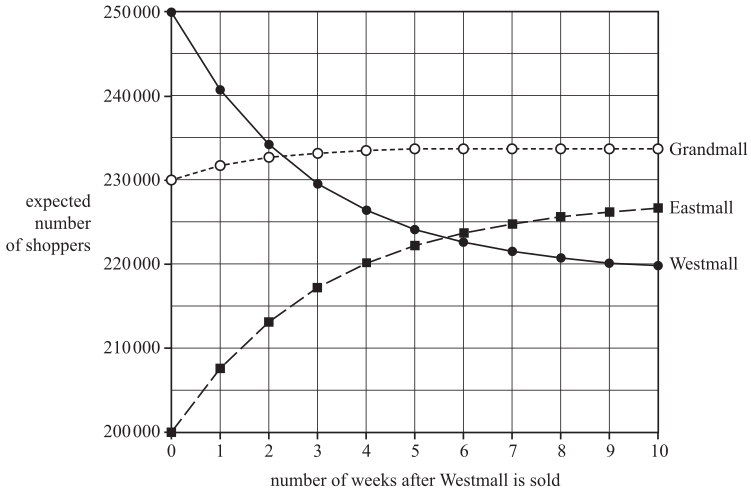
Using values from the recurrence relation above, the graph below shows the expected number of shoppers at Westmall, Grandmall and Eastmall for each of the 10 weeks after Westmall is sold.


  1. What is the difference in the expected weekly number of shoppers at Westmall from the time Westmall is sold to 10 weeks after Westmall is sold?
  2. Give your answer correct to the nearest thousand.   (1 mark)

    --- 2 WORK AREA LINES (style=lined) ---

  3. Grandmall is expected to achieve its maximum number of shoppers sometime between the fourth and the tenth week after Westmall is sold.
  4. Write down the week number in which this is expected to occur.   (1 mark)

    --- 4 WORK AREA LINES (style=lined) ---

  5. In the long term, what is the expected weekly number of shoppers at Westmall?
  6. Round your answer to the nearest whole number.   (1 mark)

    --- 3 WORK AREA LINES (style=lined) ---

Show Answers Only
  1. `S_1 =[(240\ 700),(231\ 700),(207\ 600)]`
  2. `30\ 000`
  3. `S_6 = T^6S_0 =  [(text(__)), (233\ 708), (text(__))]`
  4. `218\ 884`
Show Worked Solution
a.   `S_1` `= TS_0`
    `= [(0.80, 0.09, 0.10),(0.12, 0.79, 0.10),(0.08, 0.12, 0.80)][(250\ 000),(230\ 000),(200\ 000)]=[(240\ 700),(231\ 700),(207\ 600)]`


b.   `text(Using the graph)`
  `text(Difference)` `= 250\ 000-220\ 000`
    `= 30\ 000`


♦♦ Mean mark part (c) 27%.

c.  `text(Testing options:)`

`S_6 = T^6S_0 = [(0.80, 0.09, 0.10),(0.12, 0.79, 0.10),(0.08, 0.12, 0.80)]^6[(250\ 000),(230\ 000),(200\ 000)] = [(text(__)), (233\ 708), (text(__))]`
 

`:.\ text(Maximum shoppers in Grandmall expected in week 6.)`


♦ Mean mark part (d) 39%.

d.  `text(Test with high integer)\ n:`

`S_50 = T^50S_0 -> text(Westmall) = 218\ 884`

Filed Under: Transition Matrices - Regular Tagged With: Band 3, Band 4, Band 5, smc-618-30-State Matrix in discrete period, smc-618-40-Steady State, smc-618-61-3x3 Matrix

MATRICES, FUR1 2020 VCAA 10 MC

Consider the matrix recurrence relation below.
  

`S_0 = [(30),(20),(40)], quad S_(n+1) = TS_n qquad text(where)\ T = [(j, 0.3, l),(0.2, m, 0.3),(0.4, 0.2, n)]`
 

Matrix `T` is a regular transition matrix.

Given the information above and that  `S_1 = [(42),(28),(20)]`, which one of the following is true?

  1. `m >l`
  2. `j + l = 0.7`
  3. `j = n`
  4. `j > m`
  5. `l = m + n`
Show Answers Only

`E`

Show Worked Solution

`text(Transition matrix columns sum to 1)`

♦ Mean mark 41%.

`j = 1 – 0.2 – 0.4 = 0.4`

`m = 1 – 0.3 – 0.2 = 0.5`

`l + n = 0.7`
 

`[(0.4, 0.3, l),(0.2, 0.5, 0.3),(0.4, 0.2, n)][(30),(20),(40)]=[(42),(28),(20)]`
 

`42` `= 0.4 xx 30 + 0.3 xx 20 + l xx 40`
`24` `= 40l`
`l` `= 0.6`

 
`:. n = 0.1`

`=>  E`

Filed Under: Transition Matrices - Regular Tagged With: Band 5, smc-618-30-State Matrix in discrete period, smc-618-61-3x3 Matrix

MATRICES, FUR1 2020 VCAA 4 MC

In a particular supermarket, the three top-selling magazines are Angel (A), Bella (B) and Crystal (C).

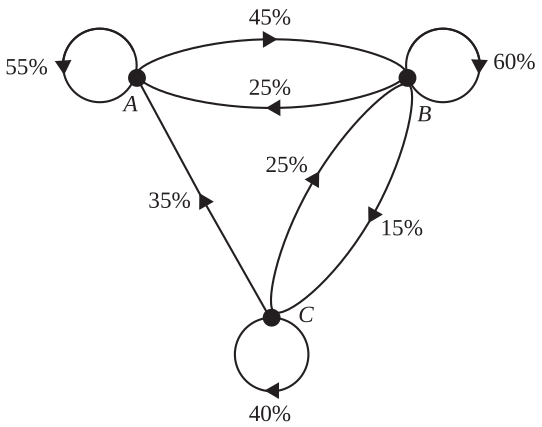
The transition diagram below shows the way shoppers at this supermarket change their magazine choice from week to week.
 

A transition matrix that provides the same information as the transition diagram is

A.  

`{:(qquadqquadquad this\ week),(qquadquadAqquadquad\ Bqquadquad\ C),([(0.55,0.70,0.35),(0.70,0.60,0.40),(0.35,0.40,0.40)]{:(A),(B),(C):}qquad n\ext\ week):}`


B.  

`{:(qquadqquadquad this\ week),(qquadquadAqquadquad\ Bqquadquad\ C),([(0.55,0.60,0.25),(0.45,0.15,0.35),(0,0.25,0.40)]{:(A),(B),(C):} qquad n\ext\ week):}`


C.  

`{:(qquadqquadquad this\ week),(qquadquadAqquadquad\ Bqquadquad\ C),([(0.55,0.25,0.35),(0.45,0.60,0.25),(0,0.15,0.40)]{:(A),(B),(C):} qquad n\ext\ week):}`


D.  

`{:(qquadqquadquad this\ week),(qquadquadAqquadquad\ Bqquadquad\ C),([(0.55,0.25,0.35),(0.45,0.60,0.25),(0.35,0.15,0.40)]{:(A),(B),(C):} qquad n\ext\ week):}`


E.  

`{:(qquadqquadquad this\ week),(qquadquadAqquadquad\ Bqquadquad\ C),([(0.55,0.25,0),(0.45,0.60,0.25),(0,0.15,0.75)]{:(A),(B),(C):} qquad n\ext\ week):}`


Show Answers Only

`C`

Show Worked Solution

`text(By Elimination):`

`25text(%)\ text(of)\ B\ text(moves to)\ A \ => \ e_12 = 0.25`

`:.\ text(Eliminate)\ A and B`
 

`C\ text(retains 40% from week to week)\ => \ e_33 = 0.4`

`:.\ text(Eliminate)\ E`

 
`0text(%)\ text(of)\ A\ text(moves to)\ C \ => \ e_31 = 0`

`:.\ text(Eliminate)\ D`

`=>  C`

Filed Under: Transition Matrices - Regular Tagged With: Band 3, smc-618-10-Diagram/Info to Matrix, smc-618-61-3x3 Matrix

MATRICES, FUR1 2019 VCAA 6 MC

A water park is open from 9 am until 5 pm.

There are three activities, the pool `(P)`, the slide `(S)` and the water jets `(W)`, at the water park.

Children have been found to change their activity at the water park each half hour, as shown in the transition matrix, `T`, below.
 

`{:(qquad qquad qquad quadtext(this half year)),(qquad qquad qquad quad P qquad qquad S qquad quad W), (T = [(0.80,0.20,0.40),(0.05,0.60,0.10),(0.15,0.20,0.50)] {:(P),(S),(W):} text( next half year)):}`
 

A group of children has come to the water park for the whole day.

The percentage of these children who are expected to be at the slide `(S)` at closing time is closest to

  1.  14%
  2.  20%
  3.  24%
  4.  25%
  5.  62%
Show Answers Only

`A`

Show Worked Solution

`text(Park is open 8 hours → 15 × 30-minute transitions.)`

`text(After 15 transitions, matrix approaches a steady state.)`
 

`[(0.80,0.20,0.40),(0.05,0.60,0.10),(0.15,0.20,0.50)]^15 ~~ [(0.62,0.62,0.62),(0.14,0.14,0.14),(0.24,0.24,0.24)]`
 

`=>  A`

Filed Under: Transition Matrices - Regular Tagged With: Band 4, smc-618-40-Steady State, smc-618-61-3x3 Matrix

MATRICES, FUR1 2017 VCAA 8 MC

Consider the matrix recurrence relation below.
 

`S_0 = [(40),(15),(20)], \ S_(n + 1) = TS_n`     where `T = [(0.3,0.2,V),(0.2,0.2,W),(X,Y,Z)]`
 

Matrix `T` is a regular transition matrix.

Given the above and that  `S_1 = [(29),(13),(33)]`, which of the following expressions is not true?

  1. `W > Z`
  2. `Y > X`
  3. `V > Y`
  4. `V + W + Z = 1`
  5. `X + Y + Z > 1`
Show Answers Only

`A`

Show Worked Solution

`TS_0 = S_1`

`[(0.3,0.2,V),(0.2,0.2,W),(X,Y,Z)][(40),(15),(20)] = [(29),(13),(33)]`

`(0.3 xx 40) + (0.2 xx 15) + 20V` `= 29`
`20V` `= 14`
`V` `= 0.7`

`text(Similarly)`

`8 + 3 + 20W` `= 13`
`20W` `= 2`
`W` `= 0.1`


`text(S)text(ince each column sums to 1:)`

`X` `= 1 – (0.3 + 0.2) = 0.5`
`Y` `= 1 – (0.2 + 0.2) = 0.6`
`Z` `= 1 – (0.7 + 0.1) = 0.2`


`:. W > Z\ \ text(is not true.)`

`=> A`

Filed Under: Transition Matrices - Regular Tagged With: Band 6, smc-618-30-State Matrix in discrete period, smc-618-61-3x3 Matrix

MATRICES, FUR1 2016 VCAA 7 MC

Each week, the 300 students at a primary school choose art (A), music (M) or sport (S) as an afternoon activity.

The transition matrix below shows how the students’ choices change from week to week.
 

`{:(qquadqquadqquadqquadtext(this week)),((qquadqquadqquadA,quadM,quadS)),(T=[(0.5,0.4,0.1),(0.3,0.4,0.4),(0.2,0.2,0.5)]{:(A),(M),(S):}quad{:text(next week):}):}`


Based on the information above, it can be concluded that, in the long term

  1. no student will choose sport.
  2. all students will choose to stay in the same activity each week.
  3. all students will have chosen to change their activity at least once.
  4. more students will choose to do music than sport.
  5. the number of students choosing to do art and music will be the same.
Show Answers Only

`D`

Show Worked Solution

`text(Consider)\ n\ text(large)\ (n = 50),\ text(and begin with)`

`text(the students spread equally among the sports.)`

`[(0.5,0.4,0.1),(0.3,0.4,0.4),(0.2,0.2,0.5)]^(50)[(100),(100),(100)]~~[(105),(109),(86)]`


`:.\ text(There will be 109 students in music)`

`text(and 86 in sport.)`

`=> D`

Filed Under: Transition Matrices - Regular Tagged With: Band 5, smc-618-40-Steady State, smc-618-61-3x3 Matrix

MATRICES, FUR1 2016 VCAA 6 MC

Families in a country town were asked about their annual holidays.

Every year, these families choose between staying at home (H), travelling (T) and camping (C).

The transition diagram below shows the way families in the town change their holiday preferences from year to year.


A transition matrix that provides the same information as the transition diagram is

A. `{:(qquadqquadqquad\ text(from)),((qquadH,qquadT,qquadC)),([(0.30,0.75,0.65),(0.75,0.50,0.20),(0.65,0.20,0.60)]{:(H),(T),(C):}quad{:text(to):}):}` B. `{:(qquadqquadqquad\ text(from)),((qquadH,qquadT,qquadC)),([(0.30,0.30,0.40),(0.45,0.50,0),(0.25,0.20,0.60)]{:(H),(T),(C):}quad{:text(to):}):}`
       
C. `{:(qquadqquadqquad\ text(from)),((qquadH,qquadT,qquadC)),([(0.30,0.30,0.40),(0.45,0.50,0.20),(0.25,0.20,0.60)]{:(H),(T),(C):}quad{:text(to):}):}` D. `{:(qquadqquadqquad\ text(from)),((qquadH,qquadT,qquadC)),([(0.30,0.30,0.40),(0.45,0.50,0.20),(0.25,0.20,0.40)]{:(H),(T),(C):}quad{:text(to):}):}`
       
E. `{:(qquadqquadqquad\ text(from)),((qquadH,qquadT,qquadC)),([(0.30,0.45,0.25),(0.30,0.50,0.20),(0.40,0,0.60)]{:(H),(T),(C):}quad{:text(to):}):}`    
Show Answers Only

`B`

Show Worked Solution

`text(By elimination,)`

`H -> T = 0.45`

`:.\ text(not)\ A\ text(or)\ E`

`C -> T = 0`

`:.\ text(not)\ C\ text(or)\ D`

`=> B`

Filed Under: Transition Matrices - Regular Tagged With: Band 3, smc-618-10-Diagram/Info to Matrix, smc-618-61-3x3 Matrix

MATRICES, FUR2 2006 VCAA 2

A new shopping centre called Shopper Heaven (`S`) is about to open. It will compete for customers with Eastown (`E`) and Noxland (`N`).

Market research suggests that each shopping centre will have a regular customer base but attract and lose customers on a weekly basis as follows.

80% of Shopper Heaven customers will return to Shopper Heaven next week
12% of Shopper Heaven customers will shop at Eastown next week
8% of Shopper Heaven customers will shop at Noxland next week

76% of Eastown customers will return to Eastown next week
9% of Eastown customers will shop at Shopper Heaven next week
15% of Eastown customers will shop at Noxland next week

85% of Noxland customers will return to Noxland next week
10% of Noxland customers will shop at Shopper Heaven next week
5% of Noxland customers will shop at Eastown next week

  1. Enter this information into transition matrix `T` as indicated below (express percentages as proportions, for example write 76% as 0.76).   (2 marks)

    --- 0 WORK AREA LINES (style=lined) ---


    `qquad{:(qquadqquadqquadtext(this week)),((qquadqquadqquad S,qquad E, quad N)),(T = [(qquadqquadqquadqquadqquadqquad),(),()]{:(S),(E),(N):}{:qquadtext(next week):}):}`
     

During the week that Shopper Heaven opened, it had 300 000 customers.

In the same week, Eastown had 120 000 customers and Noxland had 180 000 customers.

  1. Write this information in the form of a column matrix, `K_0`, as indicated below.   (1 mark)

    --- 0 WORK AREA LINES (style=lined) ---


    `qquadK_0 = [(quadqquadqquadqquadqquad),(),()]{:(S),(E),(N):}`
     

  2. Use `T` and `K_0` to write and evaluate a matrix product that determines the number of customers expected at each of the shopping centres during the following week.   (2 marks)

    --- 4 WORK AREA LINES (style=lined) ---

  3. Show by calculating at least two appropriate state matrices that, in the long term, the number of customers expected at each centre each week is given by the matrix   (2 marks)
  4. `qquadK = [(194\ 983),(150\ 513),(254\ 504)]`

    --- 5 WORK AREA LINES (style=lined) ---

Show Answers Only
  1.  
    `{:((qquadqquadqquad\ S,qquadE,qquadN)),(T = [(0.8,0.09,0.10),(0.12,0.76,0.05),(0.08,0.15,0.85)]{:(S),(E),(N):}):}`
  2.  
    `K_0 = [(300\ 000),(120\ 000),(180\ 000)]{:(S),(E),(N):}`
  3.  
    `TK_0 = [(268\ 800),(136\ 200),(195\ 000)]`
  4. `text(See Worked Solutions)`
Show Worked Solution
a.     `{:((qquadqquadqquad\ S,qquadE,qquadN)),(T = [(0.8,0.09,0.10),(0.12,0.76,0.05),(0.08,0.15,0.85)]{:(S),(E),(N):}):}`


b.     `K_0 = [(300\ 000),(120\ 000),(180\ 000)]{:(S),(E),(N):}`


c.   `text(Customers expected at each centre the next week,)`

`TK_0` `= [(0.80,0.09,0.10),(0.12,0.76,0.05),(0.08,0.15,0.85)][(300\ 000),(120\ 000),(180\ 000)]`
  `= [(268\ 800),(136\ 200),(195\ 000)]`


d.   `text(Consider)\ \ T^nK_0\ \ text(when)\ n\ text(large),`

`text(say)\ n=50, 51`

`T^50K_0` `= [(0.8,0.09,0.10),(0.12,0.76,0.05),(0.08,0.15,0.85)]^50[(300\ 000),(120\ 000),(180\ 000)]= [(194\ 983),(150\ 513),(254\ 504)]`


`T^51K_0` `= [(0.8,0.09,0.10),(0.12,0.76,0.05),(0.08,0.15,0.85)]^51[(300\ 000),(120\ 000),(180\ 000)]= [(194\ 983),(150\ 513),(254\ 504)]`
  ` = T^50K_0`

Filed Under: Transition Matrices - Regular Tagged With: Band 3, Band 4, Band 5, smc-618-10-Diagram/Info to Matrix, smc-618-30-State Matrix in discrete period, smc-618-61-3x3 Matrix

MATRICES, FUR2 2009 VCAA 3

In 2009, the school entered a Rock Eisteddfod competition.

When rehearsals commenced in February, all students were asked whether they thought the school would make the state finals. The students’ responses, ‘yes’, ‘no’ or ‘undecided’ are shown in the initial state matrix `S_0`.
 

`S_0 = [(160),(120),(220)]{:(text(yes)),(text(no)),(text(undecided)):}`
 

  1. How many students attend this school?   (1 mark)

    --- 2 WORK AREA LINES (style=lined) ---

Each week some students are expected to change their responses. The changes in their responses from one week to the next are modelled by the transition matrix `T` shown below.
 

`{:(qquadqquadqquadtext( response this week)),(qquadqquadquadtext( yes       no     undecided)),(T = [(0.85quad,0.35quad,0.60),(0.10quad,0.40quad,0.30),(0.05quad,0.25quad,0.10)]{:(text(yes)),(text(no)),(text(undecided)):}qquad{:(text(response)),(text(next week)):}):}`
 

The following diagram can also be used to display the information represented in the transition matrix `T`.

MATRICES, FUR2 2009 VCAA 3

    1. Complete the diagram above by writing the missing percentage in the shaded box.   (1 mark)

      --- 0 WORK AREA LINES (style=lined) ---

    2. Of the students who respond ‘yes’ one week, what percentage are expected to respond ‘undecided’ the next week when asked whether they think the school will make the state finals?   (1 mark)

      --- 1 WORK AREA LINES (style=lined) ---

    3. In total, how many students are not expected to have changed their response at the end of the first week?   (2 marks)

      --- 2 WORK AREA LINES (style=lined) ---

  1. Evaluate the product  `S_1 = TS_0`, where `S_1` is the state matrix at the end of the first week.   (1 mark)

    --- 3 WORK AREA LINES (style=lined) ---

  2. How many students are expected to respond ‘yes’ at the end of the third week when asked whether they think the school will make the state finals?   (1 mark)

    --- 3 WORK AREA LINES (style=lined) ---

Show Answers Only
  1. `500`
    1. `text(25%)`
    2. `text(5%)`
    3. `206`
  2. `S_1 = [(310),(130),(60)]`
  3. `361`
Show Worked Solution

a.   `text(Total students attending)`

`= 160 + 120 + 220`

`= 500`
 

b.i.   `text(25%)`
 

b.ii.   `text(5%)`
 

b.iii.   `text(Students not expected to change)`

`= 0.85 xx 160 + 0.4 xx 120 + 0.1 xx 220`

`= 206`
 

c.    `S_1` `=TS_0`
    `= [(0.85,0.35,0.60),(0.10,0.40,0.30),(0.05,0.25,0.10)][(160),(120),(220)]= [(310),(130),(60)]`


d.    `S_3` `= T^3 S_0` 
    `= [(0.85,0.35,0.60),(0.10,0.40,0.30),(0.05,0.25,0.10)]^3[(160),(120),(220)]= [(361),(91.1),(47.9)]` 

 
`:. 361\ text(students expected to respond “yes” at end of week 3.)`

Filed Under: Transition Matrices - Regular Tagged With: Band 3, Band 4, Band 5, smc-618-20-Matrix to Diagram, smc-618-30-State Matrix in discrete period, smc-618-61-3x3 Matrix

MATRICES, FUR2 2010 VCAA 2

The 300 players in Oscar’s league are involved in a training program. In week one, 90 players are doing heavy training (`H`), 150 players are doing moderate training (`M`) and 60 players are doing light training (`L`). The state matrix, `S_1`, shows the number of players who are undertaking each type of training in the first week
 

`S_1 = [(90),(150),(60)]{:(H),(M),(L):}`
 

The percentage of players that remain in the same training program, or change their training program from week to week, is shown in the transition diagram below.
 

MATRICES, FUR2 2010 VCAA 2
 

  1. What information does the 20% in the diagram above provide?   (1 mark)

    --- 2 WORK AREA LINES (style=lined) ---

The information in the transition diagram above can also be written as the transition matrix `T`.
 

`{:(qquadqquadqquadquad\ text(this week)),((qquadqquadqquadH,quadM,\ L)),(T = [(0.5,0.1,0.1),(0.2,0.6,0.5),(0.3,0.3,0.4)]{:(H),(M),(L):}qquad{:text(next week):}):}`
 

  1. Determine how many players will be doing heavy training in week two.   (1 mark)

    --- 3 WORK AREA LINES (style=lined) ---

  2. Determine how many fewer players will be doing moderate training in week three than in week one.   (1 mark)

    --- 4 WORK AREA LINES (style=lined) ---

  3. Show that, after seven weeks, the number of players (correct to the nearest whole number) who are involved in each type of training will not change.   (1 mark) 

    --- 4 WORK AREA LINES (style=lined) ---

Show Answers Only
  1. `text(It means that 20% of the players doing heavy training one)`


    `text(week will switch to moderate training the next.)`

  2. `text(66 players)`
  3. `text(6 fewer players)`
  4. `text(See Worked Solutions)`
Show Worked Solution

a.   `text(It means that 20% of the players doing heavy)`

`text(training one week will switch to moderate)`

`text(training the next.)`


b.    `S_2` `= TS_1`
    `= [(0.5,0.1,0.1),(0.2,0.6,0.5),(0.3,0.3,0.4)][(90),(150),(60)]`
    `= [(66),(138),(96)]`


`:. 66\ text(players will be in hard training)`

`text(in week 2.)`


c.   `text(150 in moderate training in week 1.)`

`text(In week 3,)`

`S_3` `= T^2S_1`
  `= [(0.5,0.1,0.1),(0.2,0.6,0.5),(0.3,0.3,0.4)]^2[(90),(150),(60)]`
  `= [(56.4),(144),(99.6)]`


`:.\ text(The reduction in players training moderately)`

`= 150-144`

`= 6`


d.   `text(Need to show steady numbers for consecutive)`

`text(weeks 8 and week 9,)`

`S_8 = T^7S_1 = [(50),(150),(100)]`

`S_9 = T^8S_1 = [(50),(150),(100)]`


`:. S_8 = S_9`

`text{(i.e. player numbers don’t change after week 7.)}`

Filed Under: Transition Matrices - Regular Tagged With: Band 3, Band 4, smc-618-25-Interpret Diagram, smc-618-30-State Matrix in discrete period, smc-618-61-3x3 Matrix

MATRICES, FUR1 2012 VCAA 8 MC

There are 30 children in a Year 6 class. Each week every child participates in one of three activities: cycling (C), orienteering (O) or swimming (S).

The activities that the children select each week change according to the transition matrix below.
 

`{:({:qquadqquadqquadqquadtext(this week):}),(qquadqquadqquad\ Cqquad\ OqquadquadS),(T = [(0.5,0.3, 0.3), (0.1,0.6,0.2), (0.4,0.1,0.5)]{:(C), (O), (S):}qquadtext(next week)):}`
 

From the transition matrix it can be concluded that

A.  in the first week of the program, ten children do cycling, ten children do orienteering and ten children do swimming.

B.  at least 50% of the children do not change their activities from the first week to the second week.

C.  in the long term, all of the children will choose the same activity.

D.  orienteering is the most popular activity in the first week.

E.  50% of the children will do swimming each week.

Show Answers Only

`B`

Show Worked Solution

`text(50% stay in cycling, 60% stay in orienteering)`

`text(and 50% stay in swimming.)`

`rArr B`

Filed Under: Transition Matrices - Regular Tagged With: Band 4, M/C, smc-618-24-Interpret Matrix, smc-618-61-3x3 Matrix

MATRICES, FUR1 2013 VCAA 3 MC

 A coffee shop sells three types of coffee, Brazilian (B), Italian (I) and Kenyan (K). The regular customers buy one cup of coffee each per day and choose the type of coffee they buy according to the following transition matrix, `T`.
 

`{:({:qquadqquadqquadtext(choose today):}),(qquadqquadqquad\ BquadqquadIquadqquadK),(T = [(0.8,0.1,0.1), (0,0.8,0.1), (0.2,0.1,0.8)]{:(B), (I), (K):} qquadtext(choose tomorrow)):}`
 

On a particular day, 84 customers bought Brazilian coffee, 96 bought Italian coffee and 81 bought Kenyan coffee.

If these same customers continue to buy one cup of coffee each per day, the number of these customers who are expected to buy each of the three types of coffee in the long term is
 

MATRICES, FUR1 2013 VCAA 3 MC abc

MATRICES, FUR1 2013 VCAA 3 MC de

Show Answers Only

`B`

Show Worked Solution

`text(Consider)\ n\ text(large)\ (n= 50),`

`[(B),(I),(K)]` `= [(0.8,0.1,0.1),(0,0.8,0.1),(0.2,0.1,0.8)]^50[(84),(96),(81)]`
  `= [(87),(58),(116)]`

`rArr B`

Filed Under: Transition Matrices - Regular Tagged With: Band 4, smc-618-40-Steady State, smc-618-61-3x3 Matrix

MATRICES, FUR1 2014 VCAA 7 MC

A transition matrix, `T`, and a state matrix, `S_2`, are defined as follows.
 

`T=[(0.5,0,0.5),(0.5,0.5,0),(0,0.5,0.5)]\ \ \ \ \ S_2=[(300),(200),(100)]`
 

If  `S_2 = TS_1`, the state matrix  `S_1` is


Show Answers Only

`D`

Show Worked Solution
`TS_1` `= S_2`
 `:. S_1` `= T^-1 S_2`
  `= [(0.5, 0, 0.5), (0.5, 0.5, 0), (0, 0.5, 0.5)]^-1 [(300), (200), (100)]`
  `= [(400), (0), (200)]`

 
`=>D`

Filed Under: Transition Matrices - Regular Tagged With: Band 4, smc-618-30-State Matrix in discrete period, smc-618-61-3x3 Matrix

Copyright © 2014–2025 SmarterEd.com.au · Log in