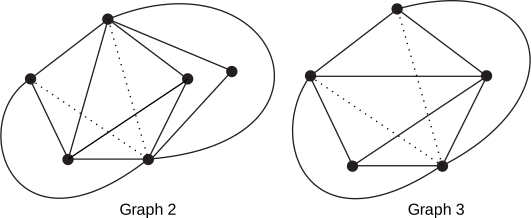
Euler's formula can be applied to which of the following graphs?


- Graph 4 only
- Graphs 1 and 2 only
- Graphs 1, 2, 3 and 4
- Graphs 3 and 4 only
- Graphs 2, 3 and 4 only
Aussie Maths & Science Teachers: Save your time with SmarterEd
Euler's formula can be applied to which of the following graphs?
Consider the following graph.
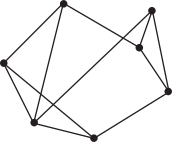
The number of faces is
\(\text{Method 1: Make the diagram planar}\)
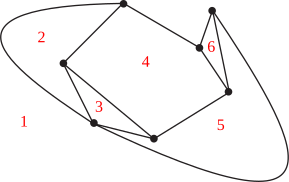
\(\text{Method 2: Euler’s Rule}\)
\(\text{Vertices}\ =7,\ \text{Edges}\ =11\)
| \(v+f\) | \(=e+2\) |
| \(7+f\) | \(=11+2\) |
| \(f\) | \(=6\) |
\(\Rightarrow B\)
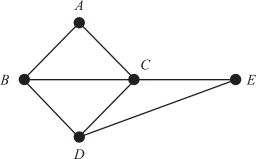
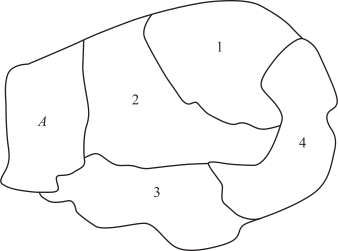
A country has five states, \(A, B, C, D\) and \(E\).
A graph can be drawn with vertices to represent each of the states.
Edges represent a border shared between two states.
--- 1 WORK AREA LINES (style=lined) ---
--- 0 WORK AREA LINES (style=lined) ---

--- 0 WORK AREA LINES (style=lined) ---
--- 0 WORK AREA LINES (style=lined) ---
Consider the graph below.
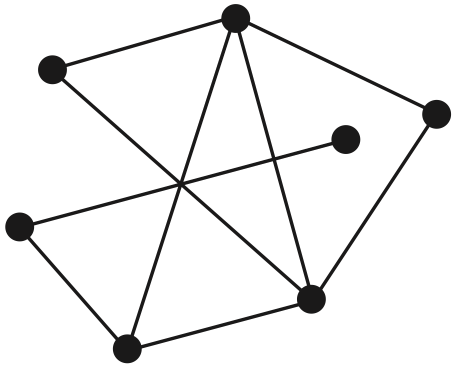
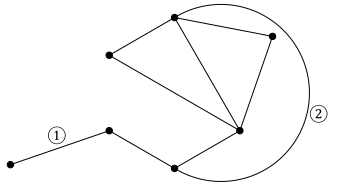
The number of edges that need to be removed for this graph to be planar is
\(\text{The graph can be drawn as follows with no crossing edges.}\)
\(\Rightarrow A\)
Consider the graph below.
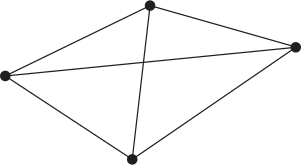
The number of faces is
`text{Redraw the graph so it is planar.}`
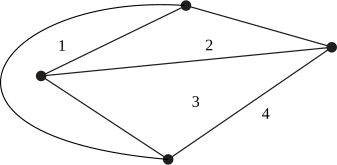
`=> C`
Four graphs are shown below.
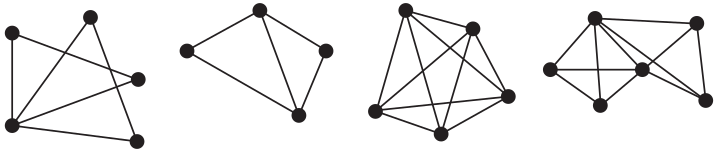
How many of these graphs are planar?
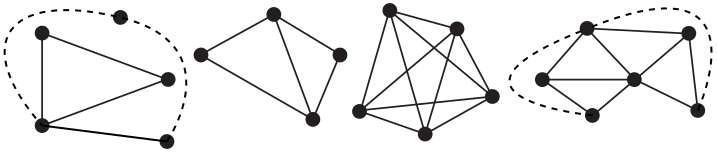
`text(Graph 1)\ =>\ text(planar)`
`text(Graph 2)\ =>\ text(planar)`
`text(Graph 3)\ =>\ text(not planar)`
`text(Graph 4)\ =>\ text(planar)`
`=> D`
Two graphs, labelled Graph 1 and Graph 2, are shown below.
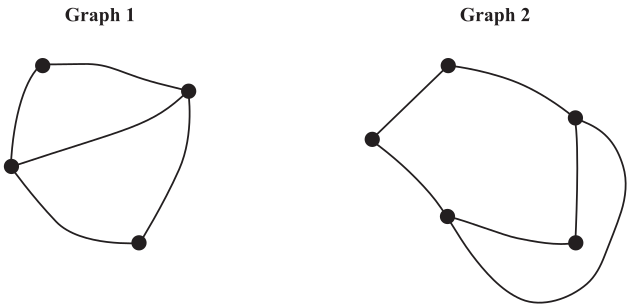
Which one of the following statements is not true?
Which one of the following graphs is not a planar graph?
| A. | 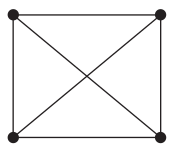 |
B. | 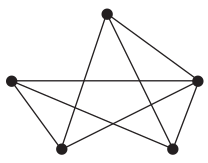 |
| C. | 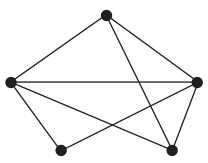 |
D. | 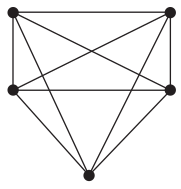 |
| E. | 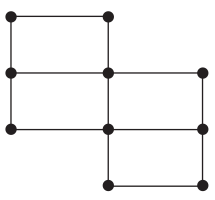 |
Consider the planar graph below.

Which one of the following graphs can be redrawn as the planar graph above?


Euler’s formula, relating vertices, faces and edges, does not apply to which one of the following graphs?


`text(Euler’s formula only applies to)`
`text(planar graphs.)`
`text(Consider option)\ D,`

`text(Only option)\ D\ text(cannot be redrawn)`
`text(as a planar graph.)`
`rArr D`
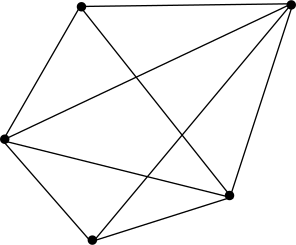
The graph above has
`text(Redrawing the graph in planar form,)`
`text(the graph can be seen to have 6 faces.)`
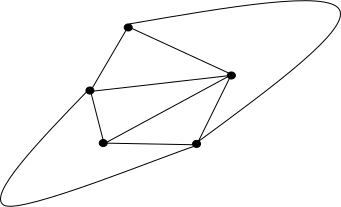
`text(Alternatively, using Euler’s rule:)`
| `v + f` | `= e + 2` |
| `5 + f` | `= 9 + 2` |
| `:. f` | `= 6` |
`=> C`
A network is represented by the following graph.

Which of the following graphs could not be used to represent the same network?


The graph below represents a friendship network. The vertices represent the four people in the friendship network: Kwan (`K`), Louise (`L`), Milly (`M`) and Narelle (`N`).
An edge represents the presence of a friendship between a pair of these people. For example, the edge connecting `K` and `L` shows that Kwan and Louise are friends.
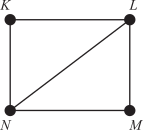
Which one of the following graphs does not contain the same information?