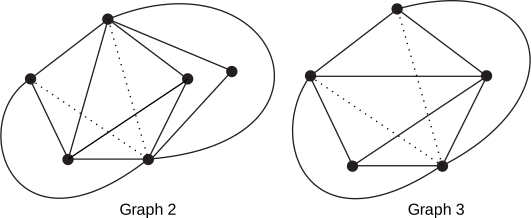
Euler's formula can be applied to which of the following graphs?


- Graph 4 only
- Graphs 1 and 2 only
- Graphs 1, 2, 3 and 4
- Graphs 3 and 4 only
- Graphs 2, 3 and 4 only
Aussie Maths & Science Teachers: Save your time with SmarterEd
Euler's formula can be applied to which of the following graphs?
Consider the following graph.
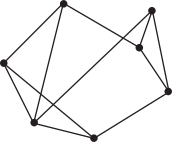
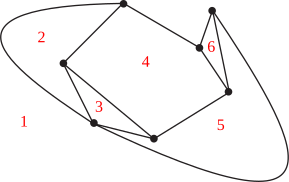
The number of faces is
\(\text{Method 1: Make the diagram planar}\)
\(\text{Method 2: Euler’s Rule}\)
\(\text{Vertices}\ =7,\ \text{Edges}\ =11\)
| \(v+f\) | \(=e+2\) |
| \(7+f\) | \(=11+2\) |
| \(f\) | \(=6\) |
\(\Rightarrow B\)
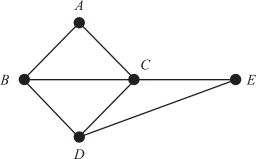
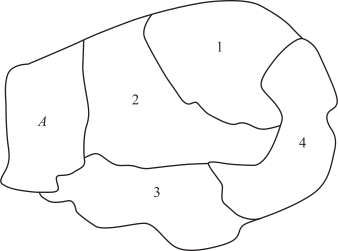
A country has five states, \(A, B, C, D\) and \(E\).
A graph can be drawn with vertices to represent each of the states.
Edges represent a border shared between two states.
--- 1 WORK AREA LINES (style=lined) ---
--- 0 WORK AREA LINES (style=lined) ---

--- 0 WORK AREA LINES (style=lined) ---
--- 0 WORK AREA LINES (style=lined) ---
A connected planar graph has seven vertices and nine edges.
The number of faces that this graph will have is
Consider the graph below.
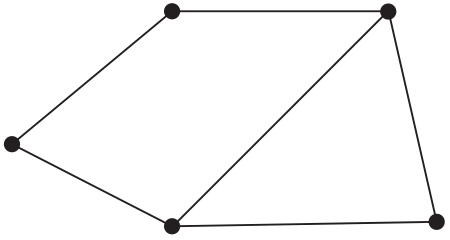
Euler’s formula will be verified for this graph.
What values of `e, v` and `f` will be used in this verification?
A planar graph has five faces.
This graph could have
Bus routes connect six towns.
The towns are Northend (`N`), Opera (`O`), Palmer (`P`), Quigley (`Q`), Rosebush (`R`) and Seatown (`S`).
The graph below gives the cost, in dollars, of bus travel along these routes.
Bai lives in Northend (`N`) and he will travel by bus to take a holiday in Seatown (`S`).
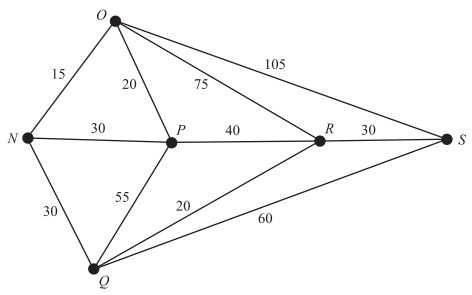
How much would Bai have to pay? (1 mark)
--- 2 WORK AREA LINES (style=lined) ---
--- 2 WORK AREA LINES (style=lined) ---
Complete the formula by writing the appropriate numbers in the boxes provided below. (1 mark)
--- 0 WORK AREA LINES (style=lined) ---

a. `$120`
b. `text(Quigley and Rosebush.)`
c.

| a. | `text(C)text(ost)` | `= 15 + 105` |
| `= $120` |
b. `text(Cheapest route is)\ N – Q – R – S`
`:.\ text(Other towns are Quigley and Rosebush.)`
| c. | |
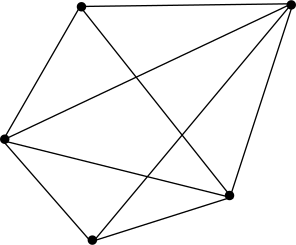
The graph above has
`text(Redrawing the graph in planar form,)`
`text(the graph can be seen to have 6 faces.)`
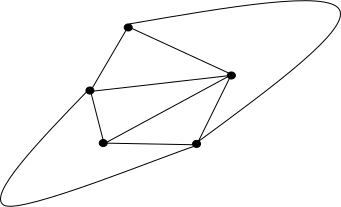
`text(Alternatively, using Euler’s rule:)`
| `v + f` | `= e + 2` |
| `5 + f` | `= 9 + 2` |
| `:. f` | `= 6` |
`=> C`
A connected planar graph has five vertices, `A`, `B`, `C`, `D` and `E`.
The degree of each vertex is given in the following table.

Which one of the following statements regarding this planar graph is true?
A. The sum of degrees of the vertices equals 15.
B. It contains more than one Eulerian path.
C. It contains an Eulerian circuit.
D. Euler’s formula `v + f = e + 2` could not be used.
E. The addition of one further edge could create an Eulerian path.
A connected planar graph has 12 edges.
This graph could have
A connected planar graph has 10 edges and 10 faces.
The number of vertices for this graph is
A planar graph has five vertices and six faces.
The number of edges is