SmarterEd

Aussie Maths & Science Teachers: Save your time with SmarterEd

  • Login
  • Get Help
  • About

Calculus, MET2 2020 VCAA 5

Let  `f: R to R, \ f(x)=x^{3}-x`.

Let  `g_{a}: R to R`  be the function representing the tangent to the graph of `f` at  `x=a`, where  `a in R`.

Let `(b, 0)` be the `x`-intercept of the graph of `g_{a}`.

  1. Show that  `b= {2a^{3}}/{3 a^{2}-1}`.   (3 marks)

    --- 7 WORK AREA LINES (style=lined) ---

  2. State the values of `a` for which `b` does not exist.    (1 mark)

    --- 2 WORK AREA LINES (style=lined) ---

  3. State the nature of the graph of `g_a` when `b` does not exist.   (1 mark)

    --- 2 WORK AREA LINES (style=lined) ---

  4. i.  State all values of `a` for which  `b=1.1`. Give your answer correct to four decimal places.   (1 mark)

    --- 2 WORK AREA LINES (style=lined) ---

  5. ii. The graph of `f` has an `x`-intercept at (1, 0).
  6.      State the values of  `a`  for which  `1 <= b <= 1.1`.
  7.      Give your answers correct to three decimal places.   (1 mark)

    --- 2 WORK AREA LINES (style=lined) ---

The coordinate `(b, 0)` is the horizontal axis intercept of `g_a`.

Let `g_b` be the function representing the tangent to the graph of `f` at  `x=b`, as shown in the graph below.
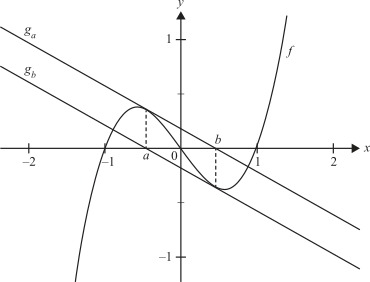


  1. Find the values of `a` for which the graphs of `g_a` and `g_b`, where `b` exists, are parallel and where  `b!=a`.   (3 marks)

    --- 8 WORK AREA LINES (style=lined) ---

Let  `p:R rarr R, \ p(x)=x^(3)+wx`, where  `w in R`.

  1. Show that  `p(-x)=-p(x)`  for all  `w in R`.   (1 mark)

    --- 3 WORK AREA LINES (style=lined) ---

A property of the graphs of `p` is that two distinct parallel tangents will always occur at `(t, p(t))` and `(-t,p(-t))` for all  `t!=0`.

  1. Find all values of `w` such that a tangent to the graph of `p` at `(t, p(t))`, for some  `t > 0`, will have an `x`-intercept at `(-t, 0)`.   (1 mark)

    --- 6 WORK AREA LINES (style=lined) ---

  2. Let  `T:R^(2)rarrR^(2),T([[x],[y]])=[[m,0],[0,n]][[x],[y]]+[[h],[k]]`, where  `m,n in R text(\{0})`  and  `h,k in R`.
     
    State any restrictions on the values of `m`, `n`, `h`, and `k`, given that the image of `p` under the transformation `T` always has the property that parallel tangents occur at  `x = -t`  and  `x = t`  for all  `t!=0`.   (1 mark)

    --- 2 WORK AREA LINES (style=lined) ---
Show Answers Only
  1. `text(See Worked Solutions.)`
  2. `a=+-sqrt3/3`
  3. `text(Horizontal line.)`
  4.  i. `a=-0.5052, 0.8084, 1.3468`
  5. ii. `a in (-0.505,-0.500]uu(0.808,1.347)`
  6. `a=+- sqrt5/5`
  7. `text(See Worked Solutions.)`
  8. `w=-5t^2`
  9. `h=0`
Show Worked Solution

a.   `f^{prime}(a) = 3a^2-1`

`g_a(x)\ \ text(has gradient)\ \ 3a^2-1\ \ text(and passes through)\ \ (a, a^3-a)`

`g_a(x)-(a^3-a)` `=(3a^2- 1)(x-a)`  
`g_a(x)` `=(3a^2-1)(x-a)+a^3-a`  

  
`x^{primeprime}-text(intercept occurs at)\ (b,0):`

`0=(3a^2-1)(b-a) + a^3-a`

`(3a^2-1)(b-a)` `=a-a^3`  
`3a^2b-3a^3-b+a` `=a-a^3`  
`b(3a^2-1)` `=a-a^3+3a^3-a`  
`:.b` `=(2a^3)/(3a^2-1)`  

 
b.   `b\ text{does not exist when:}`

♦ Mean mark part (b) 46%.

`(3a^2-1)=0`

`a=+-sqrt3/3`

♦♦ Mean mark part (c) 23%.
 

c.   `text{If}\ \ a=+-sqrt3/3,\ \ g_a^{prime}(x) = 0`

`=>\ text{the graph is a horizontal line (does not cross the}\ xtext{-axis).}`
 

d.i.  `text(Solve)\ {2a^{3}}/{3 a^{2}-1}=1.1\ text(for)\ a:`

`a=-0.5052\ text(or )\ =0.8084\ text(or)\ a=1.3468\ \ text{(to 4 d.p.)}`
  

d.ii.  `text(Solve)\ 1 <= (2a^(3))/(3a^(2)-1) < 1.1\ text(for)\ a:`

♦♦♦ Mean mark part (d)(ii) 13%.

`a in (-0.505,-0.500]uu(0.808,1.347)\ \ text{(to 3 d.p.)}`
 

e.   `f^{prime}(b) = 3b^2-1`

`g_b(x)\ \ text(has gradient)\ \ 3b^2-1\ \ text(and passes through)\ \ (b, b^3-b)`

`g_b(x)-(b^3-b)` `=(3b^2-1)(x-b)`  
`g_b(x)` `=(3b^2-1)(x-b)+b^3-b`  

 
`g_a(x)\ text{||}\ g_b(x)\ \ text{when}`

♦♦♦ Mean mark part (e) 13%.
`3a^2-1` `=3b^2-1`  
  `=3 cdot((2a^3)/(3a^2-1))-1`  

 
`=> a=+-1, +- sqrt5/5, 0`

`text(Test each solution so that)\ \ b!=a :`

`text(When)\ \ a=+-1, 0 \ => \ b=a`

`:. a=+- sqrt5/5`
 

f.    `p(-x)` `=(-x)^3-wx`
    `=-x^3-wx`
    `=-(x^3+wx)`
    `=-p(x)`

 
g. 
`p^{prime}(t) = 3t^2+w`

♦♦♦ Mean mark part (g) 3%.

`p(t)\ \ text(has gradient)\ \ 3t^2+w\ \ text(and passes through)\ \ (t, t^3+wt)`

`p(t)-(t^3+wt)` `=(3t^2+w)(x-t)`  
`p(t)` `=(3t^2+w)(x-t) + t^3+wt`  

 
`text{If}\ p(t)\ text{passes through}\ \ (-t, 0):`

`0=(3t^2+w)(-2t) + t^3+wt`

`=>w=-5t^2\ \ (t>0)`
 

h.   `text{Property of parallel tangents is retained under transformation}`

♦♦♦ Mean mark part (h) 2%.

`text{if rotational symmetry remains (odd function).}`

`=>h=0`

`text(No further restrictions apply to)\ m, n\ \ text{or}\ \ k.`

Filed Under: Tangents and Normals Tagged With: Band 4, Band 5, Band 6, smc-634-10-Polynomial, smc-634-50-Find tangent given curve, smc-634-80-Angle between tangents/axes, smc-634-81-Tangents and transformations

Calculus, MET2 2020 VCAA 4

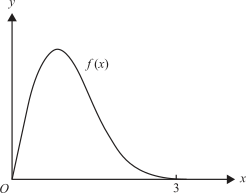
The graph of the function  `f(x)=2xe^((1-x^(2)))`, where  `0 <= x <= 3`, is shown below.
 

  1. Find the slope of the tangent to `f` at  `x=1`.   (1 mark)

    --- 2 WORK AREA LINES (style=lined) ---
  2. Find the obtuse angle that the tangent to `f` at  `x = 1`  makes with the positive direction of the horizontal axis. Give your answer correct to the nearest degree.   (1 mark)

    --- 2 WORK AREA LINES (style=lined) ---
  3. Find the slope of the tangent to `f` at a point  `x =p`. Give your answer in terms of  `p`.   (1 mark)

    --- 2 WORK AREA LINES (style=lined) ---
  4.  i. Find the value of `p` for which the tangent to `f` at  `x=1` and the tangent to `f` at  `x=p`  are perpendicular to each other. Give your answer correct to three decimal places.   (2 marks)

    --- 3 WORK AREA LINES (style=lined) ---

  5. ii. Hence, find the coordinates of the point where the tangents to the graph of `f` at  `x=1`  and  `x=p`  intersect when they are perpendicular. Give your answer correct to two decimal places.   (3 marks)

    --- 5 WORK AREA LINES (style=lined) ---

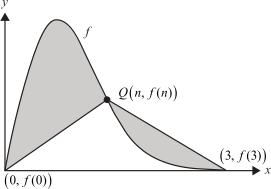
Two line segments connect the points `(0, f(0))`  and  `(3, f(3))`  to a single point  `Q(n, f(n))`, where  `1 < n < 3`, as shown in the graph below.


  1.   i. The first line segment connects the point `(0, f(0))` and the point `Q(n, f(n))`, where `1 < n < 3`.
  2.      Find the equation of this line segment in terms of  `n`.   (1 mark)

    --- 3 WORK AREA LINES (style=lined) ---

  3.  ii. The second line segment connects the point `Q(n, f(n))` and the point  `(3, f(3))`, where  `1 < n < 3`.
  4.      Find the equation of this line segment in terms of `n`.   (1 mark)

    --- 5 WORK AREA LINES (style=lined) ---

  5. iii. Find the value of `n`, where  `1 < n < 3`, if there are equal areas between the function `f` and each line segment.
  6.      Give your answer correct to three decimal places.   (3 marks)

    --- 3 WORK AREA LINES (style=lined) ---

Show Answers Only
  1. `-2`
  2. `117^@`
  3. `2(1-2p^(2))e^(1-p^(2))” or “(2e-4p^(2)e)e^(-p^(2))`
  4.  i. `0.655`
  5. ii. `(0.80, 2.39)`
  6.   i. `y_1=2e^((1-n^2))x`
  7.  ii. `y_2=(2n e^((1-n^2))-6e^(-8))/(n-3) (x-3) + 6e^(-8)`
  8. iii. `n= 1.088`
Show Worked Solution

a.   `f(x)=2xe^((1-x^(2)))`

`f^{′}(1)=-2`

♦ Mean mark part (b) 37%.


b.   `text{Solve:}\ tan theta =-2\ \ text{for}\ \ theta in (pi/2, pi)`

`theta = 117^@`
 

c.   `text{Slope of tangent}\ = f^{′}(p)`

`f^{′}(p)=2(1-2p^(2))e^(1-p^(2))\ \ text{or}\ \ (2e-4p^(2)e)e^(-p^(2))`
 

d.i.   `text{If tangents are perpendicular:}`

`f^{′}(p) xx-2 =-1\ \ =>\ \ f^^{′}(p)=1/2`

`text{Solve}\ \ 2(1-2p^(2))e^(1-p^(2))=1/2\ \ text{for}\ p:`

`p=0.655\ \ text{(to 3 d.p.)}`
 

d.ii.  `text{Equation of tangent at}\ \ x=1: \ y=4-2x`

♦ Mean mark part (d)(ii) 41%.

`text{Equation of tangent at}\ \ x=p: \ y= x/2 + 1.991…`

`text{Solve}\ \ 4-2x = x/2 + 1.991…\ \ text{for}\ x:`

`=> x = 0.8035…`

`=> y=4-2(0.8035…) = 2.392…`

`:.\ text{T}text{angents intersect at (0.80, 2.39)}`

♦ Mean mark part (e)(i) 44%.

 
e.i.
  `Q (n, 2n e^(1-n^2))`

`m_(OQ) = (2n e^((1-n^2)) – 0)/(n-0) = 2e^((1-n^2))`

`:.\ text{Equation of segment:}\ \ y_1=2e^((1-n^2))x`

♦♦ Mean mark part (e)(ii) 28%.
 

e.ii.  `P(3, f(3)) = (3, 6e^(-8))`

`m_(PQ) = (2n e^((1-n^2))-6e^(-8))/(n-3)`

`text{Equation of line segment:}`

`y_2-6e^(-8)` `=(2n e^((1-n^2))-6e^(-8))/(n-3) (x-3)`  
`y_2` `=(2n e^((1-n^2))-6e^(-8))/(n-3) (x-3) + 6e^(-8)`  
♦♦ Mean mark part (e)(iii) 28%.


e.iii.  `text{Find}\ n\ text{where shaded areas are equal.}`

`text{Solve}\ int_(0)^(n)(f(x)-y_(1))\ dx=int_(n)^(3)(y_(2)-f(x))\ dx\ \ text{for} n:`

`=> n= 1.088\ \ text{(to 3 d.p.)}`

Filed Under: Area Under Curves, Tangents and Normals Tagged With: Band 3, Band 4, Band 5, smc-634-20-Log/Exp Function, smc-634-50-Find tangent given curve, smc-634-80-Angle between tangents/axes, smc-634-90-Normals, smc-723-50-Log/Exponential

Algebra, MET2 2017 VCAA 4

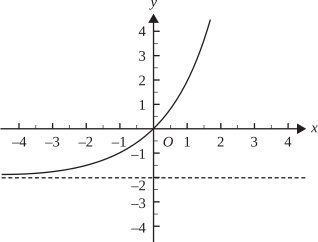
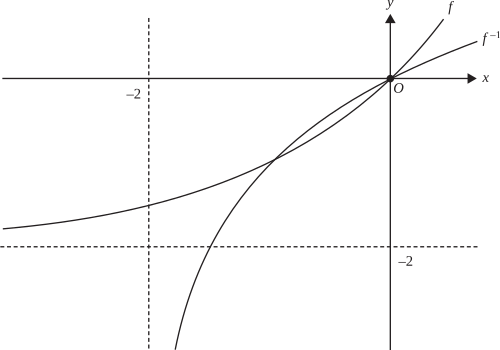
Let  `f : R → R :\  f (x) = 2^(x + 1)-2`. Part of the graph of  `f` is shown below.
 

  1. The transformation  `T: R^2 -> R^2, \ T([(x),(y)]) = [(x),(y)] + [(c),(d)]`  maps the graph of  `y = 2^x`  onto the graph of  `f`.


    State the values of `c` and `d`.   (2 marks)

    --- 5 WORK AREA LINES (style=lined) ---

  2. Find the rule and domain for  `f^(-1)`, the inverse function of  `f`.   (2 marks)

    --- 5 WORK AREA LINES (style=lined) ---

  3. Find the area bounded by the graphs of  `f` and  `f^(-1)`.   (3 marks)

    --- 3 WORK AREA LINES (style=lined) ---

  4. Part of the graphs of  `f` and  `f^(-1)` are shown below.


    Find the gradient of  `f` and the gradient of  `f^(-1)`  at  `x = 0`.   (2 marks)

    --- 2 WORK AREA LINES (style=lined) ---
The functions of  `g_k`, where  `k ∈ R^+`, are defined with domain `R` such that  `g_k(x) = 2e^(kx)-2`.

  1. Find the value of `k` such that  `g_k(x) = f(x)`.  (1 mark)

    --- 3 WORK AREA LINES (style=lined) ---
  2. Find the rule for the inverse functions  `g_k^(-1)` of  `g_k`, where  `k ∈ R^+`.   (1 mark)

    --- 5 WORK AREA LINES (style=lined) ---

  3. i. Describe the transformation that maps the graph of  `g_1` onto the graph of  `g_k`.   (1 mark)

    --- 3 WORK AREA LINES (style=lined) ---

    ii. Describe the transformation that maps the graph of  `g_1^(-1)` onto the graph of  `g_k^(-1)`.   (1 mark)

    --- 3 WORK AREA LINES (style=lined) ---

  4. The lines `L_1` and `L_2` are the tangents at the origin to the graphs of  `g_k`  and  `g_k^(-1)`  respectively.
  5. Find the value(s) of `k` for which the angle between `L_1` and `L_2` is 30°.   (2 marks)

    --- 6 WORK AREA LINES (style=lined) ---

  6. Let `p` be the value of `k` for which  `g_k(x) = g_k^(−1)(x)`  has only one solution.
  7.  i. Find `p`.   (2 marks)

    --- 4 WORK AREA LINES (style=lined) ---

  8. ii. Let  `A(k)`  be the area bounded by the graphs of  `g_k`  and  `g_k^(-1)`  for all  `k > p`.
  9.     State the smallest value of `b` such that  `A(k) < b`.   (1 mark)

    --- 4 WORK AREA LINES (style=lined) ---

Show Answers Only

a.  `c =-1, \ d =-2`

b.  `f^(-1)(x) = log_2 (x + 2)-1, \ x ∈ (-2,∞)`

c.  `3-2/(log_e(2))\ text(units)²`

d. `f^{prime}(0)= 2log_e(2) and f^(-1)^{prime}(0)= 1/(2log_e(2))`

e.  `k = log_e(2)`

f.  `g_k^(-1)(x)= 1/k log_e((x + 2)/2)`

g.i.  `text(Dilation by factor of)\ 1/k\ text(from the)\ ytext(-axis)`

g.ii.  `text(Dilation by factor of)\ 1/k\ text(from the)\ xtext(-axis)`

h.  `k=sqrt3/6\ or\ sqrt3/2`

i.i.  `p = 1/2`

i.ii.  `b=4`

Show Worked Solution

a.   `text(Using the matrix transformation:)`

`x^{prime}` `=x+c\ \ => x=x^{prime}-c`
`y^{prime}` `=y+d\ \ =>y= y^{prime}-d`
   
`y^{prime}-d` `=2^((x)^{prime}-c)`
`y^{prime}` `= 2^((x)^{prime}-c)+d`


`:. c = -1, \ d = -2`


b.   `text(Let)\ \ y = f(x)`

`text(Inverse : swap)\ x\ ↔ \ y`

`x` `= 2^(y + 1)-2`
`x + 2` `= 2^(y + 1)`
`y + 1` `= log_2(x + 2)`
`y` `= log_2(x + 2)-1`


`text(dom)(f^(-1)) = text(ran)(f)`

`:. f^(-1)(x) = log_2 (x + 2)-1, \ x ∈ (-2,∞)`


c.   `text(Intersection points occur when)\ \ f(x)=f^(-1)(x)`

MARKER’S COMMENT: Specifically recommends using  `f^(-1)(x)-f(x)`  in this type of integral to avoid errors in stating the integral.

`x` `= -1, 0`


`text(Area)` `= int_(-1)^0 (f^(-1)(x)-f(x))\ dx`
  `= 3-2/(log_e(2))\ text(units)²`


d.    `f^{prime}(0)` `= 2log_e(2)`
  `f^{(-1)^prime}(0)` `= 1/(2log_e(2))`


e.   `g_k(x) = 2e^(kx)-2`

`text(Solve:)\ \ g_k(x) = f(x)quad text(for)\ k ∈ R^+`

`:. k = log_e(2)`


f.   `text(Let)\ \ y = g_k(x)`

`text(Inverse : swap)\ x\ text(and)\ y`

`x` `= 2e^(ky)-2`
`e^(ky)` `=(x+2)/2`
`ky` `=log_e((x+2)/2)`
`:. g_k^(-1)(x)` `= 1/k log_e((x + 2)/2)`


♦♦ Mean mark part (g)(i) 31%.

g.i.    `g_1(x)` `= 2e^x-2`
  `g_k(x)` `= 2e^(kx)-2`

 
`:. text(Dilation by factor of)\ 1/k\ text(from the)\ ytext(-axis)`


♦♦ Mean mark part (g)(ii) 30%.

g.ii.    `g_1^(-1)(x)` `= log_e((x + 2)/2)`
  `g_k^(-1)(x)` `= 1/klog_e((x + 2)/2)`

 
`:. text(Dilation by factor of)\ 1/k\ text(from the)\ xtext(-axis)`


h.   `text(When)\ \ x=0,`

♦♦♦ Mean mark part (h) 13%.

`g_k^{prime}(0)=2k\ \ => m_(L_1)=2k`

`g_k^{(-1)^prime}(0)=1/(2k)\ \ => m_(L_2)=1/(2k)`


`text(Using)\ \ tan 30^@=|(m_1-m_2)/(1+m_1m_2)|,`

`text(Solve:)\ \ 1/sqrt3` `=+- ((2k-1/(2k)))/2\ \ text(for)\ k`

 
`:. k=sqrt3/6\ or\ sqrt3/2`


i.i   `text(By inspection, graphs will touch once if at)\ \ x=0,`

♦♦♦ Mean mark part (i)(i) 4%.

`m_(L_1)` `=m_(L_2)`
`2k` `=1/(2k)`
`k` `=1/2,\ \ (k>0)`

 
`:. p = 1/2`


i.ii  `text(As)\ k→oo, text(the graph of)\ g_k\ text(approaches)\ \ x=0`

♦♦♦ Mean mark part (i)(ii) 2%.

`text{(vertically) and}\ \ y=-2\ \ text{(horizontally).}`

`text(Similarly,)\ \ g_k^(-1)\ \ text(approaches)\ \ x=-2`

`text{(vertically) and}\ \ y=0\ \ text{(horizontally).}`


`:. lim_(k→oo) A(k) = 4`

`:.b=4`

Filed Under: Area Under Curves, Logs and Exponential Functions, Tangents and Normals, Transformations Tagged With: Band 4, Band 5, Band 6, page-break-before-question, smc-5204-50-Find intersection, smc-634-20-Log/Exp Function, smc-634-80-Angle between tangents/axes, smc-723-50-Log/Exponential, smc-723-80-Area between graphs, smc-753-20-Dilation (Only), smc-753-60-Matrix

Calculus, MET1 2017 VCAA 9

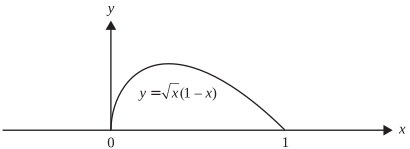
The graph of  `f: [0, 1] -> R,\ f(x) = sqrt x (1-x)`  is shown below.
 

  1. Calculate the area between the graph of `f` and the `x`-axis.   (2 marks)

    --- 6 WORK AREA LINES (style=lined) ---

  2. For `x` in the interval `(0, 1)`, show that the gradient of the tangent to the graph of `f` is  `(1-3x)/(2 sqrt x)`.   (1 mark)

    --- 4 WORK AREA LINES (style=lined) ---

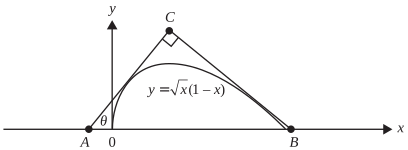
The edges of the right-angled triangle `ABC` are the line segments `AC` and `BC`, which are tangent to the graph of `f`, and the line segment `AB`, which is part of the horizontal axis, as shown below.

Let `theta` be the angle that `AC` makes with the positive direction of the horizontal axis, where  `45^@ <= theta < 90^@`.

  1. Find the equation of the line through `B` and `C` in the form  `y = mx + c`, for  `theta = 45^@`.   (2 marks)

    --- 7 WORK AREA LINES (style=lined) ---

  2. Find the coordinates of `C` when  `theta = 45^@`.   (4 marks)

    --- 10 WORK AREA LINES (style=lined) ---

Show Answers Only
  1. `4/15\ text(units)^2`
  2. `text(Proof)\ \ text{(See Workes Solutions)}`
  3. `y = -x + 1`
  4. `C (11/27, 16/27)`
Show Worked Solution
a.   `text(Area)` `= int_0^1 (sqrt x-x sqrt x)\ dx`
    `= int_0^1 (x^(1/2)-x^(3/2))\ dx`
    `= [2/3 x^(3/2)-2/5 x^(5/2)]_0^1`
    `= (2/3-2/5)-(0-0)`
    `= 10/15-6/15`
    `= 4/15\ text(units)^2`


♦♦ Mean mark part (b) 35%.
MARKER’S COMMENT: Establishing the common denominator in the working was required!
b.   `f (x)` `= x^(1/2)-x^(3/2)`
  `f^{′}(x)` `= 1/2 x^(-1/2)-3/2 x^(1/2)`
    `= 1/(2 sqrt x)-(3 sqrt x)/2`
    `= (1-3x)/(2 sqrt x)\ \ text(.. as required.)`


c.  `m_(AC) = tan 45^@=1`

♦♦♦ Mean mark part (c) 20%.
MARKER’S COMMENT: Most successful answers introduced a pronumeral such as `a=sqrtx` to solve.

`=> m_(BC) = -1\ \ (m_text(BC) _|_ m_(AC))`


`text(At point of tangency of)\ BC,\  f^{prime}(x) = -1`

`(1-3x)/(2 sqrt x)` `=-1`
`1-3x` `=-2sqrtx`
`3x-2sqrt x-1` `=0`


`text(Let)\ \ a=sqrtx,`

`3a^2-2a-1` `=0`
`(3a+1)(a-1)` `=0`
`a=1 or -1/3`   
`:. sqrt x` `=1` `or`   `sqrt x=- 1/3\ \ text{(no solution)}`
`x` `=1`    

 
`f(1)=sqrt1(1-1)=0\ \ =>B(1,0)`
 

`:.\ text(Equation of)\ \ BC, \ m=-1, text{through (1,0) is:}`

`y-0` `=-1(x-1)`
`y` `=-x+1`


d.  `text(Find Equation)\ AC:`

♦♦♦ Mean mark part (d) 17%.

`m_(AC) =1`

`text(At point of tangency of)\ AC,\  f^{prime}(x) = 1`

`(1-3x)/(2 sqrt x)` `=1`
`1-3x` `=2sqrtx`
`3x+2sqrt x-1` `=0`
`(3 sqrtx-1)(sqrtx+1)` `=0`
   
`:. sqrt x` `=1/3` `or`   `sqrt x=-1\ \ text{(no solution)}`
`x` `=1/9`    

 
`f(1/9)=sqrt(1/9)(1-1/9)=1/3 xx 8/9 = 8/27\ \ =>P(1/9,8/27)`
 

`:.\ text(Equation of)\ AC, m=1, text(through)\ \ P\ \ text(is):`

`y-8/27` `= 1 (x-1/9)`
`y` `= x + 5/27`

 
`C\ text(is at intersection of)\ AC and CB:`

`-x + 1` `= x + 5/27`
`2x` `= 22/27`
`:. x` `= 11/27`
`y` `= -11/27 + 1 = 16/27`

 
`:. C (11/27, 16/27)`

Filed Under: Area Under Curves, Tangents and Normals Tagged With: Band 4, Band 5, Band 6, smc-634-40-Other Function, smc-634-80-Angle between tangents/axes, smc-723-30-Square root, smc-723-70-Other

Calculus, MET1 2016 VCAA 2

Let  `f: (-∞,1/2] -> R`, where  `f(x) = sqrt(1-2x)`.

  1. Find  `f^{prime}(x)`.   (1 mark)

    --- 3 WORK AREA LINES (style=lined) ---

  2. Find the angle `theta` from the positive direction of the `x`-axis to the tangent to the graph of  `f` at  `x =-1`, measured in the anticlockwise direction.   (2 marks)

    --- 5 WORK AREA LINES (style=lined) ---

Show Answers Only
  1. `(-1)/(sqrt(1-2x))`
  2. `(5pi)/6`
Show Worked Solution
a.    `f(x)` `= (1-2x)^(1/2)`
  `f^{prime}(x)` `= 1/2(1-2x)^(-1/2) (-2)qquadtext([Using Chain Rule])`
    `= (-1)/(sqrt(1-2x))`


♦ Mean mark 40%.
b.    `tan theta` `= f^{prime}(-1)`
    `= (-1)/(sqrt(1-2(-1)))`
    `= (-1)/(sqrt3)`


`text(S)text(ince)\ theta ∈ [0,pi],`

`=> theta = (5pi)/6`

Filed Under: Tangents and Normals Tagged With: Band 4, Band 5, smc-634-40-Other Function, smc-634-80-Angle between tangents/axes

Copyright © 2014–2025 SmarterEd.com.au · Log in