SmarterEd

Aussie Maths & Science Teachers: Save your time with SmarterEd

  • Login
  • Get Help
  • About

Calculus, MET2 2020 VCAA 4

The graph of the function  `f(x)=2xe^((1-x^(2)))`, where  `0 <= x <= 3`, is shown below.
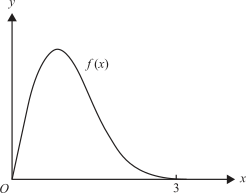
 

  1. Find the slope of the tangent to `f` at  `x=1`.   (1 mark)

    --- 2 WORK AREA LINES (style=lined) ---

  2. Find the obtuse angle that the tangent to `f` at  `x = 1`  makes with the positive direction of the horizontal axis. Give your answer correct to the nearest degree.   (1 mark)

    --- 2 WORK AREA LINES (style=lined) ---

  3. Find the slope of the tangent to `f` at a point  `x =p`. Give your answer in terms of  `p`.   (1 mark)

    --- 2 WORK AREA LINES (style=lined) ---

  4.  i. Find the value of `p` for which the tangent to `f` at  `x=1` and the tangent to `f` at  `x=p`  are perpendicular to each other. Give your answer correct to three decimal places.   (2 marks)

    --- 3 WORK AREA LINES (style=lined) ---

  5. ii. Hence, find the coordinates of the point where the tangents to the graph of `f` at  `x=1`  and  `x=p`  intersect when they are perpendicular. Give your answer correct to two decimal places.   (3 marks)

    --- 5 WORK AREA LINES (style=lined) ---

Two line segments connect the points `(0, f(0))`  and  `(3, f(3))`  to a single point  `Q(n, f(n))`, where  `1 < n < 3`, as shown in the graph below.
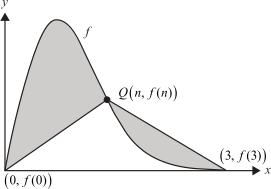


  1.   i. The first line segment connects the point `(0, f(0))` and the point `Q(n, f(n))`, where `1 < n < 3`.
  2.      Find the equation of this line segment in terms of  `n`.   (1 mark)

    --- 3 WORK AREA LINES (style=lined) ---

  3.  ii. The second line segment connects the point `Q(n, f(n))` and the point  `(3, f(3))`, where  `1 < n < 3`.
  4.      Find the equation of this line segment in terms of `n`.   (1 mark)

    --- 5 WORK AREA LINES (style=lined) ---

  5. iii. Find the value of `n`, where  `1 < n < 3`, if there are equal areas between the function `f` and each line segment.
  6.      Give your answer correct to three decimal places.   (3 marks)

    --- 3 WORK AREA LINES (style=lined) ---
Show Answers Only
  1. `-2`
  2. `117^@`
  3. `2(1-2p^(2))e^(1-p^(2))” or “(2e-4p^(2)e)e^(-p^(2))`
  4.  i. `0.655`
  5. ii. `(0.80, 2.39)`
  6.   i. `y_1=2e^((1-n^2))x`
  7.  ii. `y_2=(2n e^((1-n^2))-6e^(-8))/(n-3) (x-3) + 6e^(-8)`
  8. iii. `n= 1.088`
Show Worked Solution

a.   `f(x)=2xe^((1-x^(2)))`

`f^{′}(1)=-2`

♦ Mean mark part (b) 37%.


b.   `text{Solve:}\ tan theta =-2\ \ text{for}\ \ theta in (pi/2, pi)`

`theta = 117^@`
 

c.   `text{Slope of tangent}\ = f^{′}(p)`

`f^{′}(p)=2(1-2p^(2))e^(1-p^(2))\ \ text{or}\ \ (2e-4p^(2)e)e^(-p^(2))`
 

d.i.   `text{If tangents are perpendicular:}`

`f^{′}(p) xx-2 =-1\ \ =>\ \ f^^{′}(p)=1/2`

`text{Solve}\ \ 2(1-2p^(2))e^(1-p^(2))=1/2\ \ text{for}\ p:`

`p=0.655\ \ text{(to 3 d.p.)}`
 

d.ii.  `text{Equation of tangent at}\ \ x=1: \ y=4-2x`

♦ Mean mark part (d)(ii) 41%.

`text{Equation of tangent at}\ \ x=p: \ y= x/2 + 1.991…`

`text{Solve}\ \ 4-2x = x/2 + 1.991…\ \ text{for}\ x:`

`=> x = 0.8035…`

`=> y=4-2(0.8035…) = 2.392…`

`:.\ text{T}text{angents intersect at (0.80, 2.39)}`

♦ Mean mark part (e)(i) 44%.

 
e.i.
  `Q (n, 2n e^(1-n^2))`

`m_(OQ) = (2n e^((1-n^2)) – 0)/(n-0) = 2e^((1-n^2))`

`:.\ text{Equation of segment:}\ \ y_1=2e^((1-n^2))x`

♦♦ Mean mark part (e)(ii) 28%.
 

e.ii.  `P(3, f(3)) = (3, 6e^(-8))`

`m_(PQ) = (2n e^((1-n^2))-6e^(-8))/(n-3)`

`text{Equation of line segment:}`

`y_2-6e^(-8)` `=(2n e^((1-n^2))-6e^(-8))/(n-3) (x-3)`  
`y_2` `=(2n e^((1-n^2))-6e^(-8))/(n-3) (x-3) + 6e^(-8)`  
♦♦ Mean mark part (e)(iii) 28%.


e.iii.  `text{Find}\ n\ text{where shaded areas are equal.}`

`text{Solve}\ int_(0)^(n)(f(x)-y_(1))\ dx=int_(n)^(3)(y_(2)-f(x))\ dx\ \ text{for} n:`

`=> n= 1.088\ \ text{(to 3 d.p.)}`

Filed Under: Area Under Curves, Tangents and Normals Tagged With: Band 3, Band 4, Band 5, smc-634-20-Log/Exp Function, smc-634-50-Find tangent given curve, smc-634-80-Angle between tangents/axes, smc-634-90-Normals, smc-723-50-Log/Exponential

Calculus, MET2 2021 VCAA 3

Let  `q(x) = log_e (x^2-1)-log_e (1-x)`.

  1. State the maximal domain and the range of `q`.   (2 marks)

    --- 4 WORK AREA LINES (style=lined) ---

  2.  i. Find the equation of the tangent to the graph of `q` when  `x =-2`.   (1 mark)

    --- 2 WORK AREA LINES (style=lined) ---

  3. ii. Find the equation of the line that is perpendicular to the graph of `q` when  `x =-2`  and passes through the point  (-2, 0).   (1 mark)

    --- 2 WORK AREA LINES (style=lined) ---

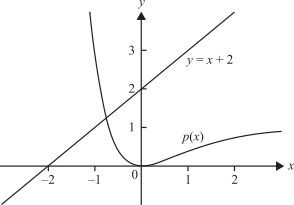
Let  `p(x) = e^{-2x}-2e^-x + 1.`

  1. Explain why `p` is not a one-to one function.   (1 mark)

    --- 2 WORK AREA LINES (style=lined) ---

  2. Find the gradient of the tangent to the graph of `p` at  `x = a`.   (1 mark)

    --- 2 WORK AREA LINES (style=lined) ---

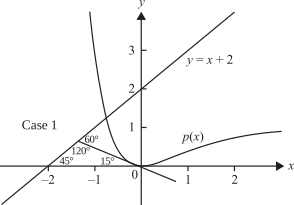
The diagram below shows parts of the graph of `p` and the line  `y = x + 2`.


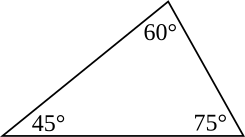
The line  `y = x + 2`  and the tangent to the graph of `p` at  `x = a`  intersect with an acute angle of `theta` between them.

  1. Find the value(s) of `a` for which  `theta = 60^@`. Give your answer(s) correct to two decimal places.   (3 marks)

    --- 8 WORK AREA LINES (style=lined) ---

  2. Find the `x`-coordinate of the point of intersection between the line  `y = x + 2` and the graph of `p`, and hence find the area bounded by  `y = x + 2`, the graph of `p` and the `x`-axis, both correct to three decimal places.   (3 marks)

    --- 5 WORK AREA LINES (style=lined) ---

Show Answers Only
  1. `text{Domain:} \ x ∈ (-∞, -1)`
    `text{Range:} \ y ∈ R`
  2. i.  `-x-2`
    ii. `x + 2`
  3. `text{Not a one-to-one function as it fails the horizontal line test.}`
  4. `-2e^{-2a} + 2e^{-a}`
  5. `-0.67`
  6. `1.038\ text(u)^2`
Show Worked Solution

a.    `text(Method 1)`

`x^2-1 > 0 \ \ => \ \ x > 1 \ \ ∪ \ \ x < -1`

`1-x > 0 \ \ => \ \ x < 1`
 
`:. \ x ∈ (-∞, -1)`
 

`text(Method 2)`

`text{Sketch graph by CAS}`

`text{Asymptote at} \ x = -1`

`text{Domain:} \ x ∈ (-∞, -1)`

`text{Range:} \ y ∈ R`


b.     i.   `text{By CAS (tanLine} \ (q (x), x, -2)):`

`y = -x-2`
 

ii.   `text{By CAS (normal} \ (q (x), x, -2)):`

`y = x + 2`
  

c.    `text{Sketch graph by CAS.}`

`p(x) \ text{is not a one-to-one function as it fails the horizontal line test}`

`text{(i.e. it is a many-to-one function)}`
 

d.   `p^{′}(x) = -2e^{-2x} + 2e^-x`

`p^{prime}(a) = -2e^{-2a} + 2e^{-a}`


e. 

 
`text{Case 1}`

`text{By CAS, solve:}`

`2e^{-a} -2e^{-2a} =-tan (15^@) \ \ text{for}\ a:`

`a = -0.11`
 

`text{Case 2}`

`text{Case 1}`

`text{By CAS, solve:}`

`2e^{-a}-2e^{-2a} = -tan 75^@\ \ text{for}\ a:`

`a = -0.67`
 

f.     `text{At intersection,}`

`x + 2 = e^{-2x} -2e^{-x} + 1`

`x = -0.750`
 

`text{Area}` `= int_{-2}^{-0.750} x + 2\ dx + int_{-0.750}^0 e^{-2x}-2e^{-x} + 1\ dx`
  `= 1.038 \ text(u)^2`

Filed Under: Area Under Curves, Tangents and Normals Tagged With: Band 4, Band 5, Band 6, smc-634-20-Log/Exp Function, smc-634-50-Find tangent given curve, smc-634-90-Normals, smc-723-50-Log/Exponential, smc-723-80-Area between graphs

Calculus, MET2 2011 VCAA 17 MC

The normal to the curve with equation  `y = x^(3/2) + x`  at the point  `(4,12)`  is parallel to the straight line with equation

A.   `4x = y`

B.   `4y + x = 7`

C.   `y = x/4 + 1`

D.   `x - 4y = −5`

E.   `4y + 4x = 20` 

Show Answers Only

`=> B`

Show Worked Solution

`text(Solution 1:)`

♦ Mean mark 48%.
`y` `= x^(3/2) + x`
`dy/dx` `=3/2 x^(1/2)+1`


`text(At)\ \ x=4,`

`m=3/2 sqrt4 +1 = 4`

`m_text(norm) = – 1/4`

`text(Consider the gradients of each option:)`

`m_text(option B) = -1/4`

`=>B`


`text(Solution 2:)`

`text(Equation of normal at)\ \ x = 4:`

`y = −1/4x + 13qquad[text(CAS: normal Line) (x^(3/2) + x, x, 4)]`

`m = −1/4`

`=> B`

Filed Under: Tangents and Normals Tagged With: Band 5, smc-634-90-Normals

Calculus, MET1 2006 VCAA 8

A normal to the graph of  `y = sqrt x`  has equation  `y = -4x + a`, where `a` is a real constant. Find the value of `a.`   (4 marks)

--- 10 WORK AREA LINES (style=lined) ---

Show Answers Only

`a = 18`

Show Worked Solution

`text(Normal) = text(line) _|_ text(to tangent)`

♦ Mean mark 40%.

`m_{text(norm)}=-4\ \ => \ m_tan=1/4`

`y=sqrt x\ \ => \ dy/dx=1/2 x^(-1/2)`

`text(Find)\ x\ text(when:)`

`1/(2 sqrt x)` `=1/4`
`sqrt x` `=2`
`x` `=4`


`:.\ text(Point of tangency is)\ \ (4, 2)`
 

`text(Find equation of normal:)`

`y-y_1` `= m (x-x_1)`
`y-2` `= -4(x-4)`
`:. y` `= -4x + 18`
`:. a` `= 18`

Filed Under: Tangents and Normals Tagged With: Band 5, smc-634-40-Other Function, smc-634-90-Normals

Calculus, MET1 2007 VCAA 9

The graph of  `f: R -> R`,  `f(x) = e^(x/2) + 1`  is shown. The normal to the graph of `f` where it crosses the `y`-axis is also shown.
 

MET1 2007 VCAA Q9
 

  1. Find the equation of the normal to the graph of `f` where it crosses the `y`-axis.   (2 marks)

    --- 6 WORK AREA LINES (style=lined) ---

  2. Find the exact area of the shaded region.   (3 marks)

    --- 5 WORK AREA LINES (style=lined) ---

Show Answers Only
  1. `y = -2x + 2`
  2. `(2sqrte-2)\ text(u)²`
Show Worked Solution

a.   `text(Normal is)\ ⊥\ text(to tangent)`

MARKER’S COMMENT: A common error was made in calculating the point of tangency. Be careful!

`text(Point of tangency:)\ (0,2)`

`text(Gradient of normal:)`

`f^{prime}(x)` `= 1/2 e^(x/2)`
`f^{prime}(0)` `= 1/2`

  
`:. m_text(norm) = -2`
  

`text(Equation of normal:)`

`y-y_1` `= m(x-x_1)`
`y-2` `=-2(x-0)`
`y` `=-2x+2`


♦ Mean mark 44%.
b.    `:.\ text(Area)` `= int_0^1 (e^(x/2) + 1-(-2x +2))\ dx`
    `= int_0^1 (e^(x/2) + 2x-1)\ dx`
    `= [2e^(x/2) + x^2-x]_0^1`
    `= (2e^(1/2) + 1^2-1)-(2e^0)`
    `= (2sqrte-2)\ text(u)²`

Filed Under: Area Under Curves, Tangents and Normals Tagged With: Band 4, Band 5, smc-634-20-Log/Exp Function, smc-634-90-Normals, smc-723-50-Log/Exponential, smc-723-80-Area between graphs

Calculus, MET2 2012 VCAA 9 MC

The normal to the graph of  `y = sqrt (b - x^2)`  has a gradient of 3 when  `x = 1.`

The value of `b` is

A.   `-10/9`

B.   `10/9`

C.   `4`

D.   `10`

E.   `11`

Show Answers Only

`D`

Show Worked Solution
`y` `=sqrt (b – x^2)`
`dy/dx` `=(-2x)/(2 sqrt(b-x^2))`
   

`text(When)\ \ x=1,`

`dy/dx` `=(-1)/sqrt(b-1)`
   

`text(S)text(ince)\ \ m_(norm) xx m_(tan) = -1,`

`dy/dx=- 1/3`


`(-1)/sqrt(b-1)` `=- 1/3`
`sqrt(b-1)` `=3`
`b-1` `=9`
`b` `=10`

 
`=>   D`

Filed Under: Tangents and Normals Tagged With: Band 4, smc-634-40-Other Function, smc-634-90-Normals

Copyright © 2014–2025 SmarterEd.com.au · Log in