SmarterEd

Aussie Maths & Science Teachers: Save your time with SmarterEd

  • Login
  • Get Help
  • About

Statistics, MET1-NHT 2018 VCAA 6

The discrete random variable `X` has the probability mass function
 

`text(Pr)(X = x) = {(kx), (k), (0):} qquad {:(x∈{1, 4, 6}), (x = 3), (text(otherwise)):}`
 

  1. Show that  `k = (1)/(12)`.  (2 marks)

    --- 5 WORK AREA LINES (style=lined) ---

  2. Find  `text(E)(X)`.  (1 mark)

    --- 5 WORK AREA LINES (style=lined) ---

  3. Evaluate  `text(Pr)(X ≥ 3 | X ≥ 2)`.  (1 mark)

    --- 5 WORK AREA LINES (style=lined) ---
Show Answers Only

  1. `text(Proof (See Worked Solution))`
  2. `(14)/(3)`
  3. `1`

Show Worked Solution

a.     `qquad X` `qquad 1 qquad` `qquad 3 qquad` `qquad 4 qquad` `qquad 6 qquad`
  `qquad Pr(X = x) qquad` `k` `k` `4k` `6k`


`k + k+4k + 6k` `= 1`
`12k` `= 1`
`k` `= (1)/(12)`


b.    `E(X)` `= ∑ x text(Pr)(X = x)`
  `= k + 3k + 16k + 36k`
  `= 56k`
  `= (56)/(12)`
  `= (14)/(3)`


c.    `text(Pr) (X ≥ 3 | X ≥ 2)` `= (text(Pr) (X ≥ 3 ∩ X ≥ 2))/(text(Pr) (X ≥ 2))`
  `= (text(Pr) (X ≥ 3))/(text(Pr) (X ≥ 2))`
  `= (k + 4k + 6k)/(k + 4k + 6k)`
  `= 1`

Filed Under: Probability density functions Tagged With: Band 4, Band 5, smc-637-10-E(X), smc-637-40-Conditional probability

Statistics, MET2-NHT 2019 VCAA 3

Concerts at the Mathsland Concert Hall begin `L` minutes after the scheduled starting time. `L` is a random variable that is normally distributed with a mean of 10 minutes and a standard deviation of four minutes.

  1. What proportion of concerts begin before the scheduled starting time, correct to four decimal places?   (1 mark)

    --- 2 WORK AREA LINES (style=lined) ---

  2. Find the probability that a concert begins more than 15 minutes after the scheduled starting time, correct to four decimal places.   (1 mark)

    --- 2 WORK AREA LINES (style=lined) ---

If a concert begins more than 15 minutes after the scheduled starting time, the cleaner is given an extra payment of $200. If a concert begins up to 15 minutes after the scheduled starting time, the cleaner is given an extra payment of $100. If a concert begins at or before the scheduled starting time, there is no extra payment for the cleaner.

Let `C` be the random variable that represents the extra payment for the cleaner, in dollars.

    1. Using your responses from part a. and part b., complete the following table, correct to three decimal places.   (1 mark)

      --- 0 WORK AREA LINES (style=lined) ---


    2. Calculate the expected value of the extra payment for the cleaner, to the nearest dollar.   (1 mark)

      --- 3 WORK AREA LINES (style=lined) ---

    3. Calculate the standard deviation of `C`, correct to the nearest dollar.   (1 mark)

      --- 3 WORK AREA LINES (style=lined) ---

The owners of the Mathsland Concert Hall decide to review their operation. They study information from 1000 concerts at other similar venues, collected as a simple random sample. The sample value for the number of concerts that start more than 15 minutes after the scheduled starting time is 43.

    1. Find the 95% confidence interval for the proportion of the concerts that begin more than 15 minutes after the scheduled starting time. Give values correct to three decimal places.   (1 mark)

      --- 3 WORK AREA LINES (style=lined) ---

    2. Explain why this confidence interval suggests that the proportion of concerts that begin more than 15 minutes after the scheduled starting time at the Mathsland Concert Hall is different from the proportion at the venue in the sample.   (1 mark)

      --- 3 WORK AREA LINES (style=lined) ---

The owners of the Mathsland Concert Hall decide that concerts must not begin before the scheduled starting time. They also make changes to reduce the number of concerts that begin after the scheduled starting time. Following these changes, `M` is the random variable that represents the number of minutes after the scheduled starting time that concerts begin. The probability density function for `M` is
 

`qquad qquad f(x) = {(8/(x + 2)^3), (0):} qquad {:(x ≥ 0), (x < 0):}`
 

where `x` is the the time, in minutes, after the scheduled starting time.

  1. Calculate the expected value of `M`.   (2 marks) 

    --- 3 WORK AREA LINES (style=lined) ---

    1. Find the probability that a concert now begins more than 15 minutes after the scheduled starting time.   (1 mark)

      --- 2 WORK AREA LINES (style=lined) ---

    2. Find the probability that each of the next nine concerts begins more than 15 minutes after the scheduled starting time and the 10th concert begins more than 15 minutes after the scheduled starting time. Give your answer correct to four decimal places.   (2 marks)

      --- 5 WORK AREA LINES (style=lined) ---
    3. Find the probability that a concert begins up to 20 minutes after the scheduled starting time, given that it begins more than 15 minutes after the scheduled starting time. Give your answer correct to three decimal places.   (2 marks)

      --- 5 WORK AREA LINES (style=lined) ---

Show Answers Only

  1. `0.0062`
  2. `0.1056`
  3. i.   

     ii.   `$110 \ \ text((nearest dollar))`
     iii.  `$32 \ \ text(nearest dollar))`
  4. i.   `(0.030, 0.056)`
    ii.   `text(The proportion of concerts that begin more than 15 minutes)` 


    `qquad text(late is not within the sample 95% confidence interval.)`

  5.  `2`
  6. i.   `(4)/(289)`
    ii.   `0.0122 \ \ text((to 4 decimal places))`
    iii.  `0.403 \ \ text((to 3 decimal places))`

Show Worked Solution

a.    `L\ ~\ N (10, 4^2)`

`text(Pr) (L < 0)` `= P(z < –2.5)`
  `= 0.0062`


b.    `text(Pr) (L > 15)` `= text(Pr) ( z > 1.25)`
  `= 0.1056`


c.i.

ii.  `E(C)` `= 0.8882 xx 100 + 0.1056 xx 200`
  `= 109.94`
  `= $110 \ \ text((nearest dollar))`


iii.  `E(C^2)` `= 100^2 xx 0.8882 + 200^2 xx 0.1056`
  `= 13\ 106`


`text(s.d.) (C)` `= sqrt(E(C^2) – [E(C)]^2)`
  `= sqrt(13\ 106 – (109.94)^2)`
  `= sqrt(1019.1 …)`
  `= 31.92 …`
  `= $32 \ \ text((nearest dollar))`


d.i.  `overset^p = (43)/(1000) \ \ , \ n = 1000`

`95% \ text(C. I.)` `= overset^p ± 1.96 sqrt((overset^p(1 – overset^p))/(n))`
  `= (0.030, 0.056)`

 
ii.
   `text(The proportion of concerts that begin more than 15 minutes)`

`text(late is not within the sample 95% confidence interval.)`


e.    `E(M)` `= int_0^∞ x ((8)/((x +2)^3))\ dx`
  `= 2`


f.i.    `text(Pr)(M > 15)` `=int_0^∞ x ((8)/((x +2)^3))\ dx`
  `= (4)/(289)`

 
ii.  `text(Pr)(M > 15) = (4)/(289) \ \ , \ \ text(Pr)(M ≤ 15) = (285)/(289)`
 

`:. \ text(Pr) text{(9 concerts}\ \ M ≤ 15 ,\ text{10th concert}\ \ M > 15)`

`= ((205)/(289))^9 xx (4)/(289)`

`= 0.0122 \ \ text((to 4 decimal places))`

 
iii.  `text(Pr)(15 < M < 20)= int_15^20 (8)/((x + 2)^3)\ dx = (195)/(34\ 969)`

 `text(Pr)(M > 15)= int_15^oo (8)/((x + 2)^3)\ dx = (4)/(289)`
 

`text(Pr)(M < 20 | M>15)` `= (text(Pr)(15 < M < 20))/(text(Pr)(M > 15))`
  `= ((195)/(34\ 969))/((4)/(289))`
  `= (195)/(484)`
  `= 0.403 \ \ text((to 3 decimal places))`

Filed Under: Normal Distribution, Probability density functions Tagged With: Band 4, Band 5, smc-637-10-E(X), smc-637-40-Conditional probability, smc-637-45-Other probability, smc-719-20-95% confidence intervals

Statistics, MET2 2019 VCAA 4

The Lorenz birdwing is the largest butterfly in Town A.

The probability density function that describes its life span, `X`, in weeks, is given by
 

`f(x) = {(4/625 (5x^3-x^4), quad 0 <= x <= 5),(0, quad text(elsewhere)):}`
 

  1. Find the mean life span of the Lorenz birdwing butterfly.  (2 marks)

    --- 3 WORK AREA LINES (style=lined) ---

  2. In a sample of 80 Lorenz birdwing butterflies, how many butterflies are expected to live longer than two weeks, correct to the nearest integer?  (2 marks)

    --- 3 WORK AREA LINES (style=lined) ---

  3. What is the probability that a Lorenz birdwing butterfly lives for at least four weeks, given that it lives for at least two weeks, correct to four decimal places?  (2 marks)

    --- 3 WORK AREA LINES (style=lined) ---

The wingspans of Lorenz birdwing butterflies in Town A are normally distributed with a mean of 14.1 cm and a standard deviation of 2.1 cm.

  1. Find the probability that a randomly selected Lorenz birdwing butterfly in Town A has a wingspan between 16 cm and 18 cm, correct to four decimal places.  (1 mark)

    --- 2 WORK AREA LINES (style=lined) ---

  2. A Lorenz birdwing butterfly is considered to be very small if its wingspan is in the smallest 5% of all the Lorenz birdwing butterflies in Town A.


    Find the greatest possible wingspan, in centimetres, for a very small Lorenz birdwing butterfly in Town A, correct to one decimal place.  (1 mark)

    --- 4 WORK AREA LINES (style=lined) ---

Each year, a detailed study is conducted on a random sample of 36 Lorenz birdwing butterflies in Town A.

A Lorenz birdwing butterfly is considered to be very large if its wingspan is greater than 17.5 cm. The probability that the wingspan of any Lorenz birdwing butterfly in Town A is greater than 17.5 cm is 0.0527, correct to four decimal places.

    1. Find the probability that three or more of the butterflies, in a random sample of 36 Lorenz birdwing butterflies from Town A, are very large, correct to four decimal places.  (1 mark)

      --- 2 WORK AREA LINES (style=lined) ---

    2. The probability that `n` or more butterflies, in a random sample of 36 Lorenz birdwing butterflies from Town A, are very large is less than 1%.


      Find the smallest value of `n`, where `n` is an integer.  (2 marks)

      --- 5 WORK AREA LINES (style=lined) ---

    3. For random samples of 36 Lorenz birdwing butterflies in Town A, `hat p` is the random variable that represents the proportion of butterflies that are very large.
    4. Find the expected value and the standard deviation of `hat p`, correct to four decimal places.  (2 marks)

      --- 2 WORK AREA LINES (style=lined) ---

    5. What is the probability that a sample proportion of butterflies that are very large lies within one standard deviation of 0.0527, correct to four decimal places? Do not use a normal approximation.  (2 marks)

      --- 5 WORK AREA LINES (style=lined) ---

  1. The Lorenz birdwing butterfly also lives in Town B.


    In a particular sample of Lorenz birdwing butterflies from Town B, an approximate 95% confidence interval for the proportion of butterflies that are very large was calculated to be (0.0234, 0.0866), correct to four decimal places.


    Determine the sample size used in the calculation of this confidence interval.  (2 marks)

    --- 5 WORK AREA LINES (style=lined) ---

Show Answers Only

  1. `10/3`
  2. `73`
  3. `0.2878`
  4. `0.1512`
  5. `10.6\ text(cm)`
    1. `0.2947`
    2. `7`
    3. `0.0372`
    4. `0.7380`
  6. `200`

Show Worked Solution

a.    `mu` `= 4/625 int_0^5 x(5x^3-x^4)\ dx`
    `= 4/625[x^5-1/6 x^6]_0^5`
    `= 10/3\ \ \ text{(by CAS)}`


b.    `text(Pr)(X > 2)` `= 4/625 int_2^5 5x^3-x^4\ dx`
    `= 4/625[5/4x^4-x^5/5]_2^5`
    `= 0.9129…`


`:.\ text(Expected number)` `= 80 xx 0.9129…`
  `~~ 73.03`
  `~~ 73`


c.    `text(Pr)(X = 4|X> 2)` `= (text(Pr)(X >= 4))/(text(Pr)(X >= 2))`
    `= 0.26272/0.91296`
    `= 0.2878`


d.   `W\ ~\ N (14.1, 2.1^2)`

`text(Pr)(16 < W < 18) = 0.1512\ \ \ text{(by CAS)}`


e.   `text(Solution 1:)`

`text(Pr)(W < w) = 0.05`

`text(Pr)(Z < z) = 0.05\ \ =>\ \ z = -1.6449\ \ text{(by CAS)}`

`(w-14.1)/2.1` `= -1.6449`
`w` `= 10.6\ text(cm)`

 
`text(Solution 2:)`

`text(invNorm)`

`text(Tail setting: left)`

`text(prob: 0.05)`

`sigma: 2.1`

`mu: 14.1`

`=> 10.6\ \ \ text{cm (by CAS)}`


f.i.   `L\ ~\ text(Bi)(n, p)\ ~\ text(Bi) (36, 0.0527)`

`text(Pr)(L >= 3) ~~ 0.2947`


f.ii.    `text(Pr)(L >= n) < 0.01`
 

`text(CAS: binomialCdf) (x, 36, 36, 0.0527)`

`text(Pr)(L >= 0) = 0.011 > 0.01`

`text(Pr)(L >= 7) = 0.002 < 0.01`

`:.\ text(Smallest)\ n = 7`


f.iii.    `E(hat p)` `= p = 0.0527`
  `sigma(hat p)` `= sqrt((p(1-p))/n) = sqrt((0.0527(1-0.0527))/36) ~~ 0.0372`


f.iv.        `hat p +- 1 sigma: (0.0527-0.0372, 0.0527 + 0.0372) = (0.0155, 0.0899)`

`text(Pr)(0.0155 < hat p < 0.0899)`

`= text(Pr)(36 xx 0.0155 < L < 36 xx 0.0899)`

`= text(Pr)(0.56 < L < 3.24)`

`= text(Pr)(1 <= L <= 3)`

`~~ 0.7380`


g.   `0.0234 = hat p-1.96 sqrt((hat p(1-hat p))/n) qquad text{… (1)}`

`0.0866 = hat p + 1.96 sqrt((hat p(1-hat p))/n) qquad text{… (2)}`

`text(Solve simultaneous equations:)`

`hat p ~~ 0.055, quad n ~~ 199.96`

`:.\ text(Sample size) = 200`

Filed Under: Binomial, Normal Distribution, Probability density functions Tagged With: Band 3, Band 4, Band 5, Band 6, smc-637-10-E(X), smc-637-40-Conditional probability, smc-637-45-Other probability, smc-638-20-binomCdf (CAS), smc-638-32-Find E(X)/var(X) given n p, smc-719-10-Single z-score, smc-719-20-95% confidence intervals

Probability, MET2 2017 VCAA 3

The time Jennifer spends on her homework each day varies, but she does some homework every day.

The continuous random variable `T`, which models the time, `t,` in minutes, that Jennifer spends each day on her homework, has a probability density function `f`, where


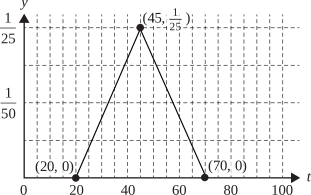
`f(t) = {{:(1/625 (t - 20)),(1/625 (70 - t)),(0):}qquad{:(20 <= t < 45),(45 <= t <= 70),(text(elsewhere)):}:}`


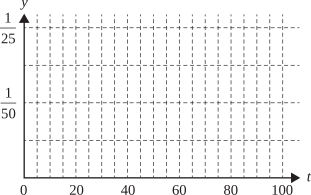
  1. Sketch the graph of `f` on the axes provided below.  (3 marks)

    --- 0 WORK AREA LINES (style=lined) ---


  2. Find  `text(Pr)(25 ≤ T ≤ 55)`.  (2 marks)

    --- 3 WORK AREA LINES (style=lined) ---

  3. Find  `text(Pr)(T ≤ 25 | T ≤ 55)`.  (2 marks)

    --- 5 WORK AREA LINES (style=lined) ---

  4. Find `a` such that  `text(Pr)(T ≥ a) = 0.7`, correct to four decimal places.  (2 marks)

    --- 5 WORK AREA LINES (style=lined) ---

  5. The probability that Jennifer spends more than 50 minutes on her homework on any given day is `8/25`. Assume that the amount of time spent on her homework on any day is independent of the time spent on her homework on any other day.


    1. Find the probability that Jennifer spends more than 50 minutes on her homework on more than three of seven randomly chosen days, correct to four decimal places.  (2 marks)

      --- 3 WORK AREA LINES (style=lined) ---

    2. Find the probability that Jennifer spends more than 50 minutes on her homework on at least two of seven randomly chosen days, given that she spends more than 50 minutes on her homework on at least one of those days, correct to four decimal places.  (2 marks)

      --- 3 WORK AREA LINES (style=lined) ---

Let `p` be the probability that on any given day Jennifer spends more than `d` minutes on her homework.

Let `q` be the probability that on two or three days out of seven randomly chosen days she spends more than `d` minutes on her homework.

  1. Express `q` as a polynomial in terms of `p`.  (2 marks)

    --- 6 WORK AREA LINES (style=lined) ---

    1. Find the maximum value of `q`, correct to four decimal places, and the value of `p` for which this maximum occurs, correct to four decimal places.  (2 marks)

      --- 3 WORK AREA LINES (style=lined) ---

    2. Find the value of `d` for which the maximum found in part g.i. occurs, correct to the nearest minute.  (2 marks)

      --- 5 WORK AREA LINES (style=lined) ---


Show Answers Only

  1.  

  2. `4/5`
  3. `1/41`
  4. `39.3649`
    1. `0.1534`
    2. `0.7626`
  5. `q =7p^2(1-p)^4(2p+3)`
    1. `p = 0.3539quadtext(and)quadq = 0.5665`
    2. `49\ text(min)`

Show Worked Solution

a.   

MARKER’S COMMENT: Many did not draw graph along `t`-axis between 0 and 20 and for  `t>70`.


b.   `text(Pr)(25 <= T <= 55)`

`= int_25^45 1/625 (t – 20)\ dt + int_45^55 1/625 (70 – t)\ dt`

`= 4/5`


c.   `text(Pr)(T ≤ 25 | T ≤ 55)`

`=(text(Pr)(T <= 25))/(text(Pr)( T <= 55))`

`= (int_20^25 1/625(t – 20)\ dt)/(1 – int_55^70 1/625(70 – t)\ dt)`

`= (1/50)/(1 – 9/50)`

`= 1/41`


d.   `text(Pr)(T ≥ a) = 0.7`

♦ Mean mark part (d) 36%.

`=>\ text(Pr)(T <= a) = 0.3`

`text(Solve:)`

`int_20^a 1/625(t – 20)\ dt` `= 0.3quadtext(for)quada ∈ (20, 45)`


`:. a == 39.3649`


e.i.   `text(Let)\ X =\ text(Number of days Jenn studies more than 50 min)`

`X ~\ text(Bi) (7, 8/25)`

`text(Pr)(X >= 4) = 0.1534`


e.ii.    `text(Pr)(X >= 2 | X >= 1)` `= (text(Pr)(X >= 2))/(text(Pr)(X >= 1))`
    `= (0.7113…)/(0.9327…)`
    `= 0.7626\ \ text{(to 4 d.p.)}`


f.   `text(Let)\ Y =\ text(Number of days Jenn spends more than)\ d\ text(min)`

`Y ~\ text(Bi)(7,p)`

♦ Mean mark part (f) 36%.

`q` `= text(Pr)(Y = 2) + text(Pr)(Y = 3)`
  `= ((7),(2))p^2(1 – p)^5 + ((7),(3))p^3(1 – p)^4`
  `= 21p^2(1 – p)^5 + 35p^3(1 – p)^4`
   `=7p^2(1-p)^4[3(1-p)+5p]`
  `=7p^2(1-p)^4(2p+3)`


g.i.   `text(Solve)\ \ q′(p) = 0,`

♦♦ Mean mark part (g)(i) 30%.

`p` `=0.35388…`
  `=0.3539\ \ text{(to 4 d.p.)}`

`:. q_text(max)= 0.5665\ \ text{(to 4 d.p.)}`


g.ii.   `text(Pr)(T > d) = p= 0.35388…`

♦♦♦ Mean mark part (g)(ii) 8%.

  `text(Solve:)`

`int_d^70 (1/625(70 – t))dt` `= 0.35388… quadtext(for)quadd ∈ (45,70)`


`:. d` `=48.967…`
  `=49\ text(mins)`

Filed Under: Binomial, Probability density functions Tagged With: Band 4, Band 5, Band 6, smc-637-40-Conditional probability, smc-637-45-Other probability, smc-637-50-Linear PDF, smc-638-20-binomCdf (CAS), smc-638-50-Conditional

Probability, MET1 2008 VCAA 4

The function
 

`f(x) = {{:(k),(0):}{:(sin(pix)qquadtext(if)qquadx ∈ [0,1]),(qquadqquadqquadqquadquadtext(otherwise)):}`
 

is a probability density function for the continuous random variable `X`.

  1. Show that  `k = pi/2`.  (2 marks)

    --- 5 WORK AREA LINES (style=lined) ---

  2. Find  `text(Pr)(X <= 1/4 | X <= 1/2)`.  (3 marks)

    --- 5 WORK AREA LINES (style=lined) ---

Show Answers Only

  1. `text(See Worked Solutions)`
  2. `1 – (sqrt2)/2`

Show Worked Solution

a.   `text(Total Area under curve) = 1\ text(u²)`

`int_0^1 k sin(pix)dx` `= 1`
`- k/pi [cos(pix)]_0^1` `= 1`
`- k/pi[cos(pi) – cos(0)]` `= 1`
`- k/pi[(−1) – (1)]` `= 1`
`2k` `= pi`
`:.k` `= pi/2`


b.   `text(Conditional Probability:)`

♦ Mean mark 47%.
MARKER’S COMMENT: Few students used the symmetry of the probability density function to calculate the denominator.

`text(Pr)(X <= 1/4 | X <= 1/2)`

`= (text(Pr)(X <= 1/4))/(text(Pr)(X <= 1/2))`
`= (pi/2 int_0^(1/4) sin(pix)dx)/(1/2)`
`= -pi/pi [cos(pix)]_0^(1/4)`
`= -1 [cos(pi/4) – cos(0)]`
`= -1 [1/(sqrt2) – 1]`
`= 1 – (sqrt2)/2`

Filed Under: Probability density functions Tagged With: Band 4, Band 5, smc-637-35-Sum probabilities = 1, smc-637-40-Conditional probability, smc-637-80-Trig PDF

Probability, MET1 2014 VCAA 8

A continuous random variable, `X`, has a probability density function given by
 

`f(x) = {{:(1/5e^(−x/5),x >= 0),(0, x < 0):}`
 

The median of `X` is  `m`.

  1. Determine the value of  `m`.  (2 marks)
  2. The value of `m` is a number greater than 1.


    Find `text(Pr)(X < 1 | X <= m)`.  (2 marks)

Show Answers Only
  1. `−5log_e(1/2)\ \ text(or)\ \ 5log_e(2)\ \ text(or)\ \ log_e 32`
  2. `2(1 – e^(−1/5))`
Show Worked Solution
a.    `1/5 int_0^m e^(−x/5)dx` `= 1/2`
  `1/5 xx (−5)[e^(−x/5)]_0^m` `= 1/2`
  `[-e^(- x/5)]_0^m` `= 1/2`
  `-e^(−m/5) + 1` `= 1/2`
  `e^(−m/5)` `= 1/2`
  `- m/5` `= log_e(1/2)`


`:. m = −5log_e(1/2)\ \ \ (text(or)\ \ 5log_e(2),\ text(or)\ \ log_e 32)`


b.   `text(Using Conditional Probability:)`

♦ Part (b) mean mark 38%.
MARKER’S COMMENT: A common error was assuming `m` obtained in part (a) was equivalent to `text(Pr)(X<=m)`.
`text(Pr)(X < 1 | X <= m)` `= (text(Pr)(X < 1))/(text(Pr)(X <= m))`
  `= (1/5 int_0^1 e^(−x/5)dx)/(1/2)`
  `= (1/5(−5)[e^(−x/5)]_0^1)/(1/2)`
  `= −2[(e^(−1/5)) – e^0]`
  `= 2(1 – e^(−1/5))`

Filed Under: Probability Density Functions (old) Tagged With: Band 4, Band 5, smc-637-20-Median (old), smc-637-40-Conditional probability, smc-637-70-Exp/Log PDF

Copyright © 2014–2025 SmarterEd.com.au · Log in