SmarterEd

Aussie Maths & Science Teachers: Save your time with SmarterEd

  • Login
  • Get Help
  • About

CORE, FUR1 2021 VCAA 6 MC

The relationship between resting pulse rate, in beats per minute, and age group (15-20 years, 21-30 years, 31-50 years, over 50 years) is best displayed using

  1. a histogram.
  2. a scatterplot.
  3. parallel boxplots.
  4. a time series plot.
  5. a back-to-back stem plot.
Show Answers Only

`C`

Show Worked Solution

`text{Resting pulse rate → numerical variable}`

Mean mark 51%.

`text{Age group → categorial (ordinal) variable}`
  

`text{S}text{ince there are four categories, data is best displayed}`

`text{using parallel box plots (back to back stem plot is only}`

`text{suitable if there are two categories).}`

`=> C`

Filed Under: Graphs - Stem/Leaf and Boxplots, Time Series Tagged With: Band 4, smc-643-20-Parallel Box-Plots, smc-643-50-Back-to-Back Stem and Leaf

CORE, FUR2 2017 VCAA 2

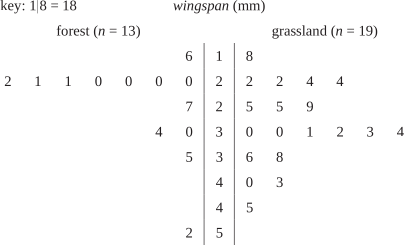
The back-to-back stem plot below displays the wingspan, in millimetres, of 32 moths and their place of capture (forest or grassland).


  1. Which variable, wingspan or place of capture, is a categorical variable?  (1 mark)

    --- 1 WORK AREA LINES (style=lined) ---

  2. Write down the modal wingspan, in millimetres, of the moths captured in the forest.  (1 mark)

    --- 1 WORK AREA LINES (style=lined) ---

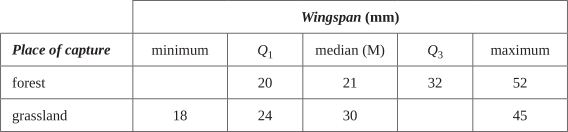
  3. Use the information in the back-to-back stem plot to complete the table below.  (2 marks)

    --- 0 WORK AREA LINES (style=lined) ---


  4. Show that the moth captured in the forest that had a wingspan of 52 mm is an outlier.  (2 marks)

    --- 5 WORK AREA LINES (style=lined) ---

  5. The back-to-back stem plot suggests that wingspan is associated with place of capture.
  6. Explain why, quoting the values of an appropriate statistic.  (2 marks)

    --- 4 WORK AREA LINES (style=lined) ---

Show Answers Only

  1. `text(Place of Capture)`
  2. `20\ text(mm)`
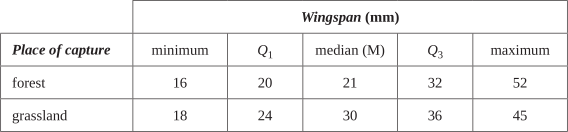
  3.    


  4. `text(See Worked Solution)`
  5. `text(See Worked Solution)`

Show Worked Solution

a.   `text(Place of Capture is categorical.)`


b.   `text(Modal wingspan in forest = 20 mm)`


c.   `Q_3\ text(in grassland: 19 data points)`

`:. Q_3\ text{is the 15th data point (lowest to highest) = 36}`


d.    `Q_1\ (text(forest))` `= (text(3rd + 4th))/2 = (20 + 20)/2 = 20`
  `Q_3\ (text(forest))` `= (text(10th + 11th))/2 = (30 + 34)/2 = 32`


`=> IQR = 32 – 20 = 12`

`Q_3 + 1.5 xx IQR` `= 32 + 1.5 xx 12`
  `= 50\ text(mm)`


`:.\ text(S)text(ince 52 mm > 50 mm, 52 min is an outlier.)`


e.   `text(Comparing the median wingspan of both places:)`

`M_text(forest) = 21,\ \ M_text(grassland) = 30`

`text(The higher median of grassland suggests that)`

`text(wingspan is associated with place of capture.)`

Filed Under: Graphs - Stem/Leaf and Boxplots Tagged With: Band 2, Band 3, Band 4, smc-643-50-Back-to-Back Stem and Leaf, smc-643-60-Outliers

CORE, FUR1 2006 VCAA 1-3 MC

The back-to-back ordered stemplot below shows the distribution of maximum temperatures (in °Celsius) of two towns, Beachside and Flattown, over 21 days in January.


Part 1

The variables

temperature (°Celsius), and

town (Beachside or Flattown), are

A.   both categorical variables.

B.   both numerical variables.

C.   categorical and numerical variables respectively.

D.   numerical and categorical variables respectively.

E.   neither categorical nor numerical variables.


Part 2

For Beachside, the range of maximum temperatures is

A.     `3°text(C)`

B.   `23°text(C)`

C.   `32°text(C)`

D.   `33°text(C)`

E.   `38°text(C)`


Part 3

The distribution of maximum temperatures for Flattown is best described as

A.   negatively skewed.

B.   positively skewed.

C.   positively skewed with outliers.

D.   approximately symmetric.

E.   approximately symmetric with outliers.

Show Answers Only

`text (Part 1:)\ D`

`text (Part 2:)\ B`

`text (Part 3:)\ E`

Show Worked Solution

`text (Part 1)`

`text(Temperature is numerical,)`

`text(Town is categorical.)`

`rArr D`


`text (Part 2)`

`text(Beachside’s maximum temperature range)`

`=38-15`

`=23°text(C)`

`rArr B`


`text (Part 3)`

`IQR\ text{(Beachside)}`  `=Q_3 – Q_1`
  `=40-33`
  `=7`
`Q_1 – 1.5 xx IQR` `=33 – 1.5 xx7`
  `=22.5°text(C)`

 
`:.\ text(Flattown’s maximum temperature readings of)`

`text(18° and 19° are outliers.)`

`rArr E`

Filed Under: Graphs - Stem/Leaf and Boxplots Tagged With: Band 3, Band 4, smc-643-50-Back-to-Back Stem and Leaf, smc-643-70-Distribution Description

CORE, FUR1 2007 VCAA 10 MC

The relationship between the variables

size of car (1 = small, 2 = medium, 3 = large)

and

salary level (1 = low, 2 = medium, 3 = high)

is best displayed using 

A.   a scatterplot.

B.   a histogram.

C.   parallel boxplots.

D.   a back-to-back stemplot.

E.   a percentaged segmented bar chart.

Show Answers Only

`E`

Show Worked Solution

`text(A segmented bar chart is required to effectively)`

♦ Mean mark 37%.

`text(display this information given the three)`

`text(sub-categories of each variable.)`

`rArr E`

Filed Under: Graphs - Histograms and Other, Graphs - Stem/Leaf and Boxplots Tagged With: Band 5, smc-643-20-Parallel Box-Plots, smc-643-50-Back-to-Back Stem and Leaf, smc-644-40-Segmented Bar Charts

CORE, FUR1 2014 VCAA 8 MC

A single back-to-back stem plot would be an appropriate graphical tool to investigate the association between a car’s speed, in kilometres per hour, and the

A.   driver’s age, in years. 

B.   car’s colour (white, red, grey, other). 

C.   car’s fuel consumption, in kilometres per litre.

D.   average distance travelled, in kilometres.

E.   driver’s sex (female, male).

Show Answers Only

`E`

Show Worked Solution

`text(In a back-to-back stem plot, the numerical speed)`

♦♦ Mean mark 28%.

`text(data has to be plotted against categorical data)`

`text(with two options.)`

`∴\ text{Driver’s sex (M or F)}`

`=>  E`

Filed Under: Graphs - Stem/Leaf and Boxplots Tagged With: Band 6, smc-643-50-Back-to-Back Stem and Leaf

CORE, FUR1 2009 VCAA 1-3 MC

The back-to-back ordered stem plot below shows the female and male smoking rates, expressed as a percentage, in 18 countries.


Part 1

For these 18 countries, the lowest female smoking rate is

A.     `5text(%)`  

B.     `7text(%)`  

C.     `9text(%)`  

D.   `15text(%)`  

E.   `19text(%)`  


Part 2

For these 18 countries, the interquartile range (IQR) of the female smoking rates is

A.     `4` 

B.     `6`

C.   `19`

D.   `22`

E.   `23`


Part 3

For these 18 countries, the smoking rates for females are generally

A.   lower and less variable than the smoking rates for males.

B.   lower and more variable than the smoking rates for males.

C.   higher and less variable than the smoking rates for males.

D.   higher and more variable than the smoking rates for males.

E.   about the same as the smoking rates for males.

Show Answers Only

`text(Part  1:) \ D`

`text(Part  2:) \ B`

`text(Part  3:) \ A`

Show Worked Solution

`text(Part  1)`

`text(Lowest female smoking rate is 15%.)`

`=>  D`


`text(Part  2)`

`text(18 data points.)`

`text(Split in half and take the middle point of each group.)`

`Q_L` `=5 text(th value = 19%)`
`Q_U` `= 14 text(th value = 25%)`
 `∴ IQR` `= 25text(% – 19%) =6text(%)` 

 
`=>  B`


`text(Part  3)`

`text{Smoking rates are lower and less variable (range of}`

`text{females rates vs male rates is 13% vs 30%).}`

`=>  A`

Filed Under: Graphs - Stem/Leaf and Boxplots Tagged With: Band 2, Band 3, smc-643-50-Back-to-Back Stem and Leaf, smc-643-70-Distribution Description

Copyright © 2014–2025 SmarterEd.com.au · Log in