SmarterEd

Aussie Maths & Science Teachers: Save your time with SmarterEd

  • Login
  • Get Help
  • About

Calculus, 2ADV C1 EQ-Bank 14

A drone travels vertically from its launch pad.

It's height above ground, \(h\) metres, at time \(t\) minutes is modelled by

\(h(t)=-0.2 t^3+3 t^2+5 t\)  for  \(0 \leq t \leq 12\)

  1. Find the velocity of the drone at time \(t\) minutes.   (1 mark)

    --- 3 WORK AREA LINES (style=lined) ---

  2. Determine the exact time interval during which the drone is descending.   (2 marks)

    --- 8 WORK AREA LINES (style=lined) ---
Show Answers Only

a.    \(\dfrac{dh}{dt}=-0.6 t^2+6 t+5\)

b.    \(\dfrac{15+10 \sqrt{3}}{3}<t \leqslant 12\)

Show Worked Solution

a.    \(h=-0.2 t^3+3 t^2+5 t\)

\(\text{Velocity of the drone}=\dfrac{d h}{d t}.\)

\(\dfrac{dh}{dt}=-0.6 t^2+6 t+5\)
 

b.    \(\text{Drone is descending when} \ \ \dfrac{dh}{dt}<0:\)

\(-0.6 t^2+6 t+5\) \(<0\)  
\(0.6 t^2-6 t-5\) \(>0\)  
\(6 t^2-60 t-50\) \(>0\)  

 
\(\text{Solve}\ \ 6 t^2-60 t-50=0:\)

\(t=\dfrac{60 \pm \sqrt{(-60)^2+4 \times 6 \times 50}}{2 \times 6}=\dfrac{60 \pm \sqrt{4800}}{12}=\dfrac{15 \pm 10 \sqrt{3}}{3}\)

 
\(\text{Since parabola is concave up:}\)

\(6 t^2-60 t-50>0\ \ \text{when}\ \ t>\dfrac{15+10 \sqrt{3}}{3} \quad\left( t=\dfrac{15-10 \sqrt{3}}{3}<0\right)\)

\(\therefore \text{Drone is descending for} \ \ \dfrac{15+10 \sqrt{3}}{3}<t \leqslant 12\)

Filed Under: Rates of Change Tagged With: Band 3, Band 4, smc-6438-10-Motion, smc-6438-18-Other Rate Problems

Calculus, 2ADV C1 EQ-Bank 15

The displacement \(x\) metres from the origin at time, \(t\) seconds, of a particle travelling in a straight line is given by

\(x=t^3-9 t^2+9 t, \quad t \geqslant 0\)

  1. Find the time(s) when the particle is at the origin.   (2 marks)

    --- 5 WORK AREA LINES (style=lined) ---

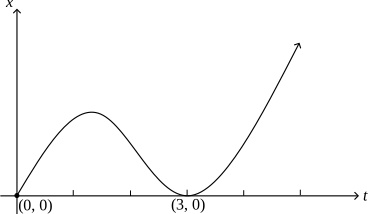
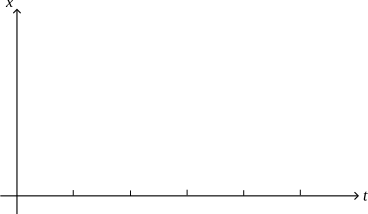
  2. On the graph below, sketch the displacement, \(x\) metres, with respect to time \(t\).   (2 marks)


    --- 0 WORK AREA LINES (style=lined) ---

  3. Find the velocity of the particle when  \(t=2\).   (2 marks)

    --- 6 WORK AREA LINES (style=lined) ---

Show Answers Only

a.  \(\text{Particle at origin when}\ \ t=0, t=3.\)

b.


c.   \(\dot{x}=-15\  \text{m s}^{-1}\)

Show Worked Solution

a.     \(x\) \(=t^3-9 t^2+9 t\)
    \(=t\left(t^2-9 t+9\right)\)
    \(=t(t-3)^2\)

 
\(\text{Particle at origin when}\ \ t=0, t=3.\)

 
b.


c.    \(x=t^3-9 t^2+9 t\)

\(\dot{x}= \dfrac{dx}{dt} = 3 t^2-18 t+9\)

\(\text {When } t=2:\)

\(\dot{x}=3 \times 2^2-18 \times 2+9=-15\  \text{m s}^{-1}\)

Filed Under: Rates of Change Tagged With: Band 3, Band 4, smc-6438-10-Motion, smc-6438-20-Polynomial Function

Calculus, 2ADV C1 EQ-Bank 17

The displacement `x` metres from the origin at time `t` seconds of a particle travelling in a straight line is given by

`x = 2t^3-t^2-3t + 11`  when  `t >= 0`

  1.  Calculate the velocity when  `t = 2`.   (1 mark)

    --- 2 WORK AREA LINES (style=lined) ---

  2.  When is the particle stationary?   (2 marks)

    --- 4 WORK AREA LINES (style=lined) ---

Show Answers Only

 a.    `17\ text(ms)^(−1)`

 b.    `(1 + sqrt19)/6`

Show Worked Solution

a.   `x =2t^3-t^2-3t + 11` 

`v = (dx)/(dt) = 6t^2-2t-3`

 
`text(When)\ t = 2:`

`v= 6 xx 2^2-2 · 2-3= 17\ text(ms)^(−1)`
 

b.   `text(Particle is stationary when)\ \ v = 0`

`6t^2-2t-3=0`

`:. t` `= (2 ±sqrt((−2)^2-4 · 6 · (−3)))/12`
  `= (2 ± sqrt76)/12`
  `= (1 ± sqrt19)/6`
  `= (1 + sqrt19)/6 qquad(t >= 0)`

Filed Under: Rates of Change, Rates of Change Tagged With: Band 3, Band 4, smc-1083-20-Polynomial Function, smc-6438-10-Motion, smc-6438-20-Polynomial Function

Calculus, 2ADV C1 2017 HSC 10 MC

A particle is moving along a straight line.

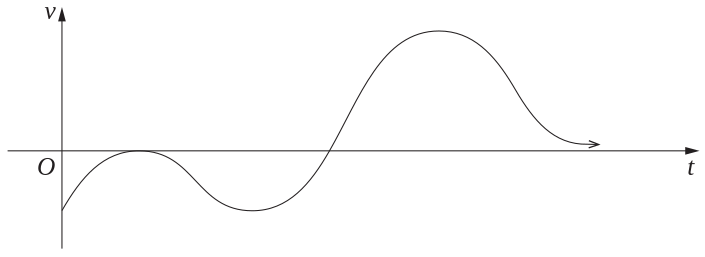
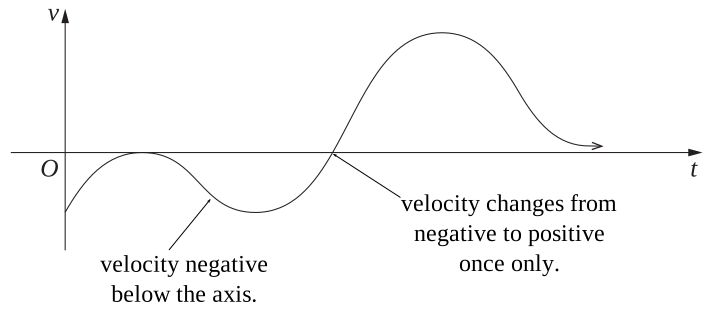
The graph shows the velocity, `v`, of the particle for time  `t >= 0`.
 

How many times does the particle change direction?

  1. 1
  2. 2
  3. 3
  4. 4
Show Answers Only

`A`

Show Worked Solution
♦♦♦ Mean mark 33%.

`=>A`

Filed Under: Motion, Rates of Change, Rates of Change Tagged With: Band 6, smc-1083-10-Motion Graphs, smc-1091-60-Other, smc-6438-10-Motion

Copyright © 2014–2026 SmarterEd.com.au · Log in