SmarterEd

Aussie Maths & Science Teachers: Save your time with SmarterEd

  • Login
  • Get Help
  • About

Calculus, 2ADV EQ-Bank 13

A quantity of radioactive material decays according to the equation

\(\dfrac{d M}{d t}=-k M\),

where \(M\) is the mass of the material in kilograms, \(t\) is the time in years and \(k\) is a constant.

  1. Verify that  \(M=A e^{-k t}\)  is a solution to this equation, where \(A\) is a constant.   (1 mark)

    --- 6 WORK AREA LINES (style=lined) ---

  2. The time for half of the material to decay is 300 years. The initial amount of material is 20 kg .
  3. Find the amount of material remaining after 1000 years.   (3 marks)

    --- 10 WORK AREA LINES (style=lined) ---
Show Answers Only

a.    \(M=A e^{-k t}\)

\(\dfrac{d M}{d t}=-k A e^{-k t}=-k M \ \left( \text{since} \ M=A e^{-k t}\right)\)
 

b.    \(1.98\text{ kg}\)

Show Worked Solution

a.    \(M=A e^{-k t}\)

\(\dfrac{d M}{d t}=-k A e^{-k t}=-k M \ \left( \text{since} \ M=A e^{-k t}\right)\)
 

b.    \(\text{When} \ t=0, M=20:\)

\(20=A e^{-k(0)}\ \ \Rightarrow\ \ A=20\)

\(M=20 e^{-k t}\)
 

\(\text{When }\ t=300, M=10:\)

\(10\) \(=20 e^{-300 k}\)
\(\dfrac{1}{2}\) \(=e^{-300 k}\)
\(-300 k\) \(=\ln \frac{1}{2}\)
\(-300k\) \(=- \ln2\)
\(k\) \(=\dfrac{\ln 2}{300}\)

 
\(\text{When } \ t=1000:\)

\(M=20 e^{-1000 k}=20 e^{-\tfrac{10}{3} \ln 2}=1.984 \ldots\) 

\(\therefore \ \text{The amount remaining after 1000 years} \approx 1.98\text{ kg}\)

Filed Under: Rates of Change Tagged With: Band 3, Band 4, smc-7135-20-Exponential G&D

Calculus, 2ADV C1 EQ-Bank 16

A block of ice is melting. The mass \(M\) kilograms of the ice block remaining at time \(t\) hours after it begins to melt is given by  \(M(t)=50(12-3t)^2, 0 \leqslant t \leqslant 4\).

  1. Find the rate of change of the ice block's mass at any time \(t\).   (1 mark)

    --- 3 WORK AREA LINES (style=lined) ---

  2. How long does it take for the ice block to completely melt?   (1 mark)

    --- 5 WORK AREA LINES (style=lined) ---

  3. At what time is the ice melting at a rate of 2100 kilograms per hour?   (2 marks)

    --- 5 WORK AREA LINES (style=lined) ---

Show Answers Only

a.    \(\dfrac{dM}{dt}=-300(12-3t)\)

b.    \(4\ \text{hours}\)

c.    \(t=\dfrac{5}{3}\ \text{hours}\)

Show Worked Solution

a.    \(M(t)=50(12-3t)^2\)

\(\dfrac{dM}{dt}=50 \times 2 \times (-3) \times(12-3t)=-300(12-3t)\)
 

b.    \(\text{Find}\ t\ \text{when}\ \ M(t)=0:\)

\(50(12-3t)^2=0 \ \Rightarrow \ t=4\)

\(\text{Ice block is completely melted at} \ \ t=4 \ \ \text {hours}\)
 

c.    \(\text{Find}\ t \ \text{when}\ \ \dfrac{d M}{d t}=-2100:\)

\(-300(12-3t)\) \(=-2100\)
\(12-3t\) \(=7\)
\(-3t\) \(=-5\)
\(t\) \(=\dfrac{5}{3}\ \text{hours}\)

Filed Under: Rates of Change Tagged With: Band 3, Band 4, smc-6438-18-Other Rate Problems, smc-6438-20-Polynomial Function

Calculus, 2ADV C1 EQ-Bank 11

An oil slick on the surface of water forms a circular shape. The radius \(r\) metres of the oil slick is increasing according to the formula  \(r(t)=3 \sqrt{t}\), where \(t\) is the time in minutes after the oil begins to spread,  \(t \geqslant 0\).

  1. Find the rate at which the radius is increasing at any time \(t\).   (1 mark)

    --- 3 WORK AREA LINES (style=lined) ---

  2. At what rate is the area of the oil slick increasing when \(t=16\) minutes?   (1 mark)

    --- 3 WORK AREA LINES (style=lined) ---

Show Answers Only

a.    \(\dfrac{d r}{d t}=\dfrac{3}{2 \sqrt{t}}\)

b.    \(\dfrac{d r}{d t}=\dfrac{3}{8} \ \text{metres/min}\)

Show Worked Solution

a.    \(r(t)=3 \sqrt{t}\)

\(\dfrac{d r}{d t}=\dfrac{1}{2} \times 3 \times t^{-\tfrac{1}{2}}=\dfrac{3}{2 \sqrt{t}}\)
 

b.    \(\text{Find} \ \dfrac{d r}{d t} \ \text{when} \ \ t=16:\)

\(\dfrac{d r}{d t}=\dfrac{3}{2 \times \sqrt{16}}=\dfrac{3}{8} \ \text{metres/min}\)

Filed Under: Rates of Change Tagged With: Band 3, smc-6438-18-Other Rate Problems, smc-6438-40-Square-Root Function

Calculus, 2ADV C1 EQ-Bank 20

A cylindrical water tank is being filled. The volume \(V\) litres of water in the tank at time \(t\) minutes after filling begins is given by  \(V(t)=500 \sqrt{(2 t+1)}, t \geqslant 0\).

  1. At what rate is water entering the tank at any time \(t\) ?   (1 mark)

    --- 5 WORK AREA LINES (style=lined) ---

  2. Find the rate at which the tank is being filled when \(t=12\) minutes.   (1 mark)

    --- 5 WORK AREA LINES (style=lined) ---

  3. At what time is the water flowing into the tank at a rate of 125 litres per minute?   (2 marks)

    --- 5 WORK AREA LINES (style=lined) ---

Show Answers Only

a.    \(\dfrac{dV}{dt}= \dfrac{500}{\sqrt{2t+1}} \)

b.    \(100\ \text{L/min} \)

c.    \(\dfrac{15}{2}\ \text{mins}\)

Show Worked Solution

a.    \(V(t)=500(2t+1)^{\frac{1}{2}}\)

\(\dfrac{dV}{dt}=\dfrac{1}{2} \times 2 \times 500(2t+1)^{-\frac{1}{2}} = \dfrac{500}{\sqrt{2t+1}} \)
 

b.    \(\text{When}\ \ t=12:\)

\(\dfrac{dV}{dt}= \dfrac{500}{\sqrt{25}} = 100\ \text{L/min} \)
 

c.    \(\text{Find}\ t\ \text{when}\ \dfrac{dV}{dt}=125:\)

\(125\) \(=\dfrac{500}{\sqrt{2t+1}}\)  
\(\sqrt{2t+1}\) \(=4\)  
\(2t+1\) \(=16\)  
\(t\) \(=\dfrac{15}{2}\ \text{mins}\)  

Filed Under: Rates of Change Tagged With: Band 3, Band 4, smc-6438-15-Flow Problems, smc-6438-40-Square-Root Function

Calculus, 2ADV C1 EQ-Bank 14

A drone travels vertically from its launch pad.

It's height above ground, \(h\) metres, at time \(t\) minutes is modelled by

\(h(t)=-0.2 t^3+3 t^2+5 t\)  for  \(0 \leq t \leq 12\)

  1. Find the velocity of the drone at time \(t\) minutes.   (1 mark)

    --- 3 WORK AREA LINES (style=lined) ---

  2. Determine the exact time interval during which the drone is descending.   (2 marks)

    --- 8 WORK AREA LINES (style=lined) ---

Show Answers Only

a.    \(\dfrac{dh}{dt}=-0.6 t^2+6 t+5\)

b.    \(\dfrac{15+10 \sqrt{3}}{3}<t \leqslant 12\)

Show Worked Solution

a.    \(h=-0.2 t^3+3 t^2+5 t\)

\(\text{Velocity of the drone}=\dfrac{d h}{d t}.\)

\(\dfrac{dh}{dt}=-0.6 t^2+6 t+5\)
 

b.    \(\text{Drone is descending when} \ \ \dfrac{dh}{dt}<0:\)

\(-0.6 t^2+6 t+5\) \(<0\)  
\(0.6 t^2-6 t-5\) \(>0\)  
\(6 t^2-60 t-50\) \(>0\)  

 
\(\text{Solve}\ \ 6 t^2-60 t-50=0:\)

\(t=\dfrac{60 \pm \sqrt{(-60)^2+4 \times 6 \times 50}}{2 \times 6}=\dfrac{60 \pm \sqrt{4800}}{12}=\dfrac{15 \pm 10 \sqrt{3}}{3}\)

 
\(\text{Since parabola is concave up:}\)

\(6 t^2-60 t-50>0\ \ \text{when}\ \ t>\dfrac{15+10 \sqrt{3}}{3} \quad\left( t=\dfrac{15-10 \sqrt{3}}{3}<0\right)\)

\(\therefore \text{Drone is descending for} \ \ \dfrac{15+10 \sqrt{3}}{3}<t \leqslant 12\)

Filed Under: Rates of Change Tagged With: Band 3, Band 4, smc-6438-10-Motion, smc-6438-18-Other Rate Problems

Calculus, 2ADV C1 EQ-Bank 18

The volume of water in a tank, \(V\) litres, at time \(t\) minutes is given by:

\(V(t)=2 t^3-15 t^2+24 t+50\)  for  \(0 \leqslant t \leqslant 6\)

  1. Find an expression for the rate at which water is flowing at time \(t\).   (1 mark)

    --- 2 WORK AREA LINES (style=lined) ---

  2. Calculate the rate of flow at  \(t=4\)  minutes and interpret this value.   (1 mark)

    --- 3 WORK AREA LINES (style=lined) ---

  3. Deduce when the water level in the tank is increasing.   (2 marks)

    --- 8 WORK AREA LINES (style=lined) ---

Show Answers Only

a.    \(\dfrac{dV}{d t}=6 t^2-30 t+24\)
 

b.    \(\text{At} \ \ t=4:\ \ \dfrac{dV}{d t}=0 \ \text{litres/minute}\)

\(\text{Interpretation: At \(\ t=4 \ \), water has stopped flowing either into or}\)

\(\text{out of the tank.}\)
 

c.    \(\text{If water level is increasing} \ \Rightarrow \ \dfrac{dV}{d t}>0:\)

\(\text {Find \(t\) when}\ \dfrac{dV}{d t}>0:\)

\(6 t^2-30t+24\) \(\gt 0\)  
\(6\left(t^2-5 t+4\right)\) \(\gt 0\)  
\((t-4)(t-1)\) \(\gt 0\)  


\(\therefore \ \text{Water level increases for}\ \ t \in [0,1) \cup (4, 6]\)

Show Worked Solution

a.    \(V=2 t^3-15 t^2+24 t+50\)

\(\dfrac{dV}{d t}=6 t^2-30 t+24\)
 

b.    \(\text{At} \ \ t=4:\)

\(\dfrac{dV}{d t}=6 \times 4^2-30 \times 4+24=0 \ \text{litres/minute}\)

\(\text{Interpretation: At \(\ t=4 \ \), water has stopped flowing either into or}\)

\(\text{out of the tank.}\)
 

c.    \(\text{If water level is increasing} \ \Rightarrow \ \dfrac{dV}{d t}>0:\)

\(\text {Find \(t\) when}\ \dfrac{dV}{d t}>0:\)

\(6 t^2-30t+24\) \(\gt 0\)  
\(6\left(t^2-5 t+4\right)\) \(\gt 0\)  
\((t-4)(t-1)\) \(\gt 0\)  


\(\therefore \ \text{Water level increases for}\ \ t \in [0,1) \cup (4, 6]\)

Filed Under: Rates of Change Tagged With: Band 3, Band 4, smc-6438-15-Flow Problems

Calculus, 2ADV C1 EQ-Bank 15

The displacement \(x\) metres from the origin at time, \(t\) seconds, of a particle travelling in a straight line is given by

\(x=t^3-9 t^2+9 t, \quad t \geqslant 0\)

  1. Find the time(s) when the particle is at the origin.   (2 marks)

    --- 5 WORK AREA LINES (style=lined) ---

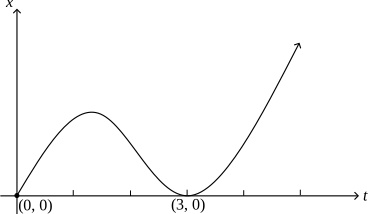
  2. On the graph below, sketch the displacement, \(x\) metres, with respect to time \(t\).   (2 marks)


    --- 0 WORK AREA LINES (style=lined) ---

  3. Find the velocity of the particle when  \(t=2\).   (2 marks)

    --- 6 WORK AREA LINES (style=lined) ---

Show Answers Only

a.  \(\text{Particle at origin when}\ \ t=0, t=3.\)

b.


c.   \(\dot{x}=-15\  \text{m s}^{-1}\)

Show Worked Solution

a.     \(x\) \(=t^3-9 t^2+9 t\)
    \(=t\left(t^2-9 t+9\right)\)
    \(=t(t-3)^2\)

 
\(\text{Particle at origin when}\ \ t=0, t=3.\)

 
b.


c.    \(x=t^3-9 t^2+9 t\)

\(\dot{x}= \dfrac{dx}{dt} = 3 t^2-18 t+9\)

\(\text {When } t=2:\)

\(\dot{x}=3 \times 2^2-18 \times 2+9=-15\  \text{m s}^{-1}\)

Filed Under: Rates of Change Tagged With: Band 3, Band 4, smc-6438-10-Motion, smc-6438-20-Polynomial Function

Calculus, 2ADV C1 EQ-Bank 19

Following a magpie plague in Raymond Terrace, a bird researcher estimated that the magpie population, \(M\), in hundreds, \(t\) months after 1st January, was given by  \(M=7+20t-3t^2\).

  1. Find the magpie population on 1st March.   (1 mark)

    --- 3 WORK AREA LINES (style=lined) ---

  2. At what rate was the population changing at this time?   (1 mark)

    --- 4 WORK AREA LINES (style=lined) ---

  3. In what month does the magpie population start to decrease?   (2 marks)

    --- 6 WORK AREA LINES (style=lined) ---

Show Answers Only

a.    \(\text{Population}\ =35 \times 100=3500\)

b.   \(M\ \text{is increasing at 800 per month}\)

c.   \(\text{Population starts to decrease in May.}\)

Show Worked Solution

a.    \(\text{Find}\ M\ \text{when}\ \ t=2:\)

\(M=7+20 \times 2-3 \times 2^2 = 35\)

\(\therefore \text{Population}\ =35 \times 100=3500\)
 

b.    \(M=7+20t-3t^2\)

\(\dfrac{dM}{dt}=20-6t\)

\(\text{Find}\ \dfrac{dM}{dt}\ \text{when}\ \ t=2: \)

\(\dfrac{dM}{dt}=20-6 \times 2 = 8\)

\(\therefore M\ \text{is increasing at 800 per month}\)
 

c.    \(\text{Find}\ t\ \text{when}\ \dfrac{dM}{dt}=0: \)

\(\dfrac{dM}{dt}=20-6t = 0\ \ \Rightarrow \ t= 3\ \dfrac{1}{3}\)

\(\dfrac{dM}{dt}<0\ \ \text{when}\ \ t>3\ \dfrac{1}{3} \)

\(\therefore\ \text{Population starts to decrease in May.}\)

Filed Under: Rates of Change, Rates of Change Tagged With: Band 3, Band 4, smc-1083-20-Polynomial Function, smc-6438-18-Other Rate Problems, smc-6438-20-Polynomial Function

Calculus, 2ADV C1 EQ-Bank 4 MC

The displacement of a particle is given by  \(x=3t^{3}-6t^{2}-15\) . The acceleration is zero at:

  1. \(t=\dfrac{2}{3}\)
  2. \(t=\dfrac{4}{3}\)
  3. \(t=\dfrac{5}{2}\)
  4. \(\text{never}\)
Show Answers Only

\(A\)

Show Worked Solution

\(x=3t^{3}-6t^{2}-15\)

\(v=9t^{2}-12t\)

\(a=18t-12\)

\(\text{Find}\ t\ \text{when}\ \ a=0:\)

\(18t-12=0\ \ \Rightarrow\ \ t=\dfrac{2}{3} \)

\(\Rightarrow A\)

Filed Under: Rates of Change, Rates of Change Tagged With: Band 4, smc-1083-20-Polynomial Function, smc-6438-60-EXT acceleration

Calculus, 2ADV C1 2019 HSC 8 MC

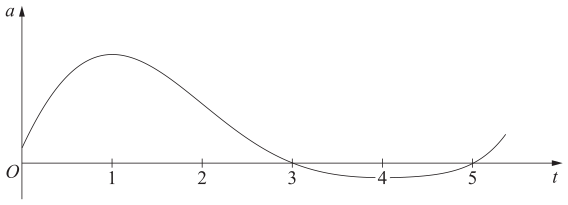
A particle is moving along a straight line. The graph shows the acceleration of the particle.


For what value of `t` is the velocity `v` a maximum?

  1. `1`
  2. `2`
  3. `3`
  4. `5`
Show Answers Only

`C`

Show Worked Solution

`text(Velocity increases when)\ \ a > 0.`

`:. v_text(max)\ \ text(occurs when)\ \ t = 3.`

`=>  C`

Filed Under: Rates of Change, Rates of Change Tagged With: Band 4, smc-1083-10-Motion Graphs, smc-6438-60-EXT acceleration

Calculus, 2ADV C1 EQ-Bank 17

The displacement `x` metres from the origin at time `t` seconds of a particle travelling in a straight line is given by

`x = 2t^3-t^2-3t + 11`  when  `t >= 0`

  1.  Calculate the velocity when  `t = 2`.   (1 mark)

    --- 2 WORK AREA LINES (style=lined) ---

  2.  When is the particle stationary?   (2 marks)

    --- 4 WORK AREA LINES (style=lined) ---

Show Answers Only

 a.    `17\ text(ms)^(−1)`

 b.    `(1 + sqrt19)/6`

Show Worked Solution

a.   `x =2t^3-t^2-3t + 11` 

`v = (dx)/(dt) = 6t^2-2t-3`

 
`text(When)\ t = 2:`

`v= 6 xx 2^2-2 · 2-3= 17\ text(ms)^(−1)`
 

b.   `text(Particle is stationary when)\ \ v = 0`

`6t^2-2t-3=0`

`:. t` `= (2 ±sqrt((−2)^2-4 · 6 · (−3)))/12`
  `= (2 ± sqrt76)/12`
  `= (1 ± sqrt19)/6`
  `= (1 + sqrt19)/6 qquad(t >= 0)`

Filed Under: Rates of Change, Rates of Change Tagged With: Band 3, Band 4, smc-1083-20-Polynomial Function, smc-6438-10-Motion, smc-6438-20-Polynomial Function

Calculus, 2ADV C1 EQ-Bank 23

A particle is moving along the `x`-axis. Its velocity `v` at time `t` is given by

`v = sqrt(20t-2t^2)`  metres per second

Find the acceleration of the particle when  `t = 4`.

Express your answer as an exact value in its simplest form.   (3 marks)

--- 6 WORK AREA LINES (style=lined) ---

Show Answers Only

`sqrt3/6\ \ text(ms)^(−2)`

Show Worked Solution

`v = sqrt(20t-2t^2)`

`a` `= (dv)/(dt)`
  `= 1/2 · (20t-2t^2)^(−1/2) · (20-4t)`

 
`text(When)\ \ t = 4:`

`a` `= 1/2(20 · 4-2 · 4^2)^(−1/2)(20-16)`
  `= 2/(sqrt48)`
  `= 2/(4sqrt3) xx sqrt3/sqrt3`
  `= sqrt3/6\ \ text(ms)^(−2)`

Filed Under: Rates of Change, Rates of Change Tagged With: Band 4, smc-1083-40-Square Root Function, smc-6438-60-EXT acceleration

Calculus, 2ADV C1 2008 HSC 6b

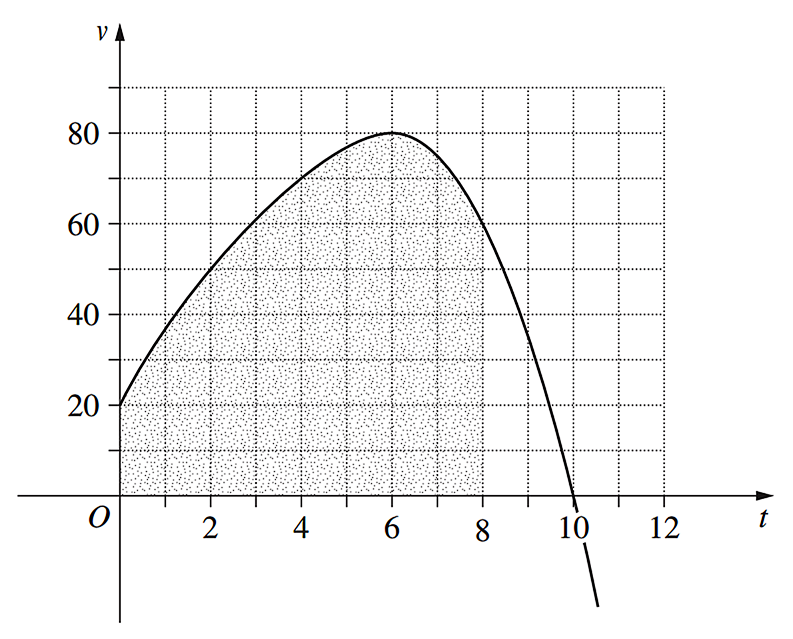
The graph shows the velocity of a particle,  `v`  metres per second, as a function of time,  `t`  seconds.

  1. What is the initial velocity of the particle?   (1 mark)

    --- 1 WORK AREA LINES (style=lined) ---

  2. When is the velocity of the particle equal to zero?   (1 mark)

    --- 1 WORK AREA LINES (style=lined) ---

  3. When is the acceleration of the particle equal to zero?   (1 mark)

    --- 1 WORK AREA LINES (style=lined) ---

Show Answers Only
  1. `20\ text(m/s)`
  2. `t=10\ text(seconds)`
  3. `t=6\ text(seconds)`
Show Worked Solution

i.    `text(Find)\ v\ text(when)  t=0:`

`v=20\ \ text(m/s)`

ii.    `text(Particle comes to rest at)\  t=10\ text{seconds  (from graph)}`

iii.  `text(Acceleration is zero when)\ t=6\ text{seconds  (from graph)}`

Filed Under: Rates of Change, Rates of Change Tagged With: Band 2, Band 3, smc-1083-10-Motion Graphs, smc-6438-60-EXT acceleration

Calculus, 2ADV C1 2018 HSC 12d

The displacement of a particle moving along the `x`-axis is given by

`x = t^3/3-2t^2 + 3t,`

where `x` is the displacement from the origin in metres and `t` is the time in seconds, for `t >= 0`.

  1. What is the initial velocity of the particle?   (1 mark)

    --- 2 WORK AREA LINES (style=lined) ---

  2. At which times is the particle stationary?   (2 marks)

    --- 3 WORK AREA LINES (style=lined) ---

  3. Find the position of the particle when the acceleration is zero.   (2 marks)

    --- 4 WORK AREA LINES (style=lined) ---

Show Answers Only

i.    `3\ text(ms)^(-1)`

ii.   `t = 1 or 3\ text(seconds)`

iii.  `2/3\ text(m)`

Show Worked Solution

i.    `x = t^3/3-2t^2 + 3t`

`v = (dx)/(dt) = t^2-4t + 3`
 

`text(Find)\ v\ text(when)\ \ t = 0:`

`v= 0-0 + 3= 3\ text(ms)^(-1)`
 

ii.  `text(Particle is stationary when)\ \ v = 0`

`t^2-4t + 3 = 0`

`(t-3) (t-1) = 0`

`t = 1 or 3\ text(seconds)`
 

iii.  `a = (dv)/(dt) = 2t-4`
 

`text(Find)\ t\ text(when)\ \ a = 0:`

`2t-4= 0\ \ =>\ \ t=2`

`x(2)= 2^3/3-2(2^2) + 3(2)= 8/3-8 + 6= 2/3`

Filed Under: Motion, Rates of Change, Rates of Change Tagged With: Band 3, smc-1083-20-Polynomial Function, smc-6438-60-EXT acceleration

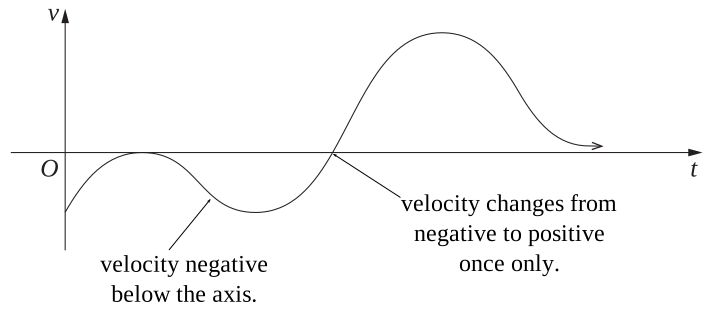
Calculus, 2ADV C1 2017 HSC 10 MC

A particle is moving along a straight line.

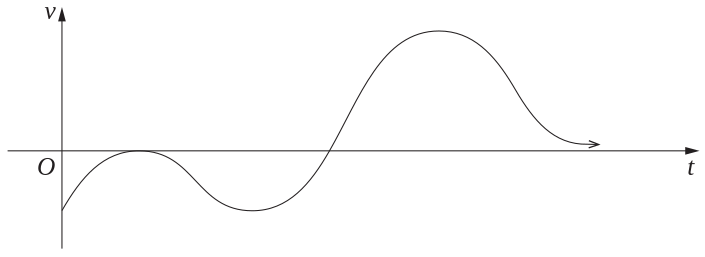
The graph shows the velocity, `v`, of the particle for time  `t >= 0`.
 

How many times does the particle change direction?

  1. 1
  2. 2
  3. 3
  4. 4
Show Answers Only

`A`

Show Worked Solution
♦♦♦ Mean mark 33%.

`=>A`

Filed Under: Motion, Rates of Change, Rates of Change Tagged With: Band 6, smc-1083-10-Motion Graphs, smc-1091-60-Other, smc-6438-10-Motion

Calculus, 2ADV C1 2006 HSC 8a

A particle is moving in a straight line. Its displacement, `x` metres, from the origin, `O`, at time `t` seconds, where  `t ≥ 0`, is given by  `x = 1-7/(t + 4)`.

  1. Find the initial displacement of the particle.   (1 mark)

    --- 2 WORK AREA LINES (style=lined) ---

  2. Find the velocity of the particle as it passes through the origin.   (3 marks)

    --- 7 WORK AREA LINES (style=lined) ---

  3. Show that the acceleration of the particle is always negative.   (1 mark)

    --- 4 WORK AREA LINES (style=lined) ---

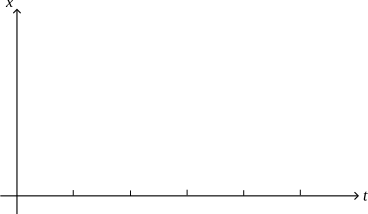
  4. Sketch the graph of the displacement of the particle as a function of time.   (2 marks)

    --- 10 WORK AREA LINES (style=lined) ---
Show Answers Only

i.    `text(–3/4 m)`

ii.   `1/7\ text(ms)^-1`

iii.  `text(Proof)\ \ text{(See Worked Solutions)}`

iv.   

Show Worked Solution

i.    `x = 1-7/(t + 4)`

`text(When)\ \ t = 0:`

`x= 1-7/4= -3/4\ \text(m)`

`:.\ text(Initial displacement is)\ 3/4\ text(metres to the left of the origin.)`


ii.  `x = 1-7/(t+4) = 1-7(t + 4)^-1`

`dot x` `= (-1)  -7(t + 4)^-2 xx d/(dt)(t + 4)`
  `= 7 (t + 4)^-2 xx 1`
  `= 7/(t + 4)^2`

 
`text(Find)\ t\ text(when)\ x = 0:`

`0` `= 1-7/(t + 4)`
`7/(t + 4)` `= 1`
`7` `= (t + 4)`
`t` `= 3`


`text(When)\ t = 3:`

`dot x= 7/(3 + 4)^2= 1/7\ text(ms)^-1`

`:.\ text(The velocity of the particle through the origin is)\ 1/7\ text(ms)^-1.`


iii.  `dot x` `= 7(t + 4)^-2`
`ddot x` `= (d dot x)/(dt) = -14 (t +4)^-3`

 
`text(Given)\ t >= 0:`

`=>  (t + 4)^-3 >= 0`

`=> -14 (t + 4)^-3 <= 0`

`:. ddot x\ text(is always negative.)`
 

iv.  2UA HSC 2006 8a

Filed Under: Motion, Rates of Change, Rates of Change Tagged With: Band 4, Band 5, smc-1083-30-Quotient Function, smc-6438-60-EXT acceleration

Calculus, 2ADV C1 2014 HSC 13c

The displacement of a particle moving along the `x`-axis is given by

 `x = t-1/(1 + t)`,

where `x` is the displacement from the origin in metres, `t` is the time in seconds, and  `t >= 0`.

  1. Show that the acceleration of the particle is always negative.    (2 marks)

    --- 5 WORK AREA LINES (style=lined) ---
  2. What value does the velocity approach as `t` increases indefinitely?    (1 mark)

    --- 3 WORK AREA LINES (style=lined) ---
Show Answers Only

i.    `text(Proof)\ \ text{(See Worked Solutions)}`

ii.   `1`

Show Worked Solution

i.    `x= t-1/(1 + t)= t-(1 + t)^(-1)`

`dot x= 1-(-1) (1 + t)^(-2)= 1 + 1/((1 + t)^2)`

`ddot x= -2(1 + t)^(-3)= – 2/((1 + t)^3)`

`text(S)text(ince)\ \ t >= 0\ \ =>\ \ -2/((1 + t)^3) < 0`

`:.\ text(Acceleration is always negative.)`
 

ii.   `text(Velocity)\ (dot x) = 1 + 1/((1 + t)^2)`

`text(As)\ t -> oo,\ 1/((1 + t)^2) -> 0`

`:.\ text(As)\ t -> oo,\ dot x -> 1`

Filed Under: Motion, Rates of Change, Rates of Change Tagged With: Band 4, smc-1083-30-Quotient Function, smc-6438-60-EXT acceleration

Calculus, 2ADV C1 2014 HSC 9 MC

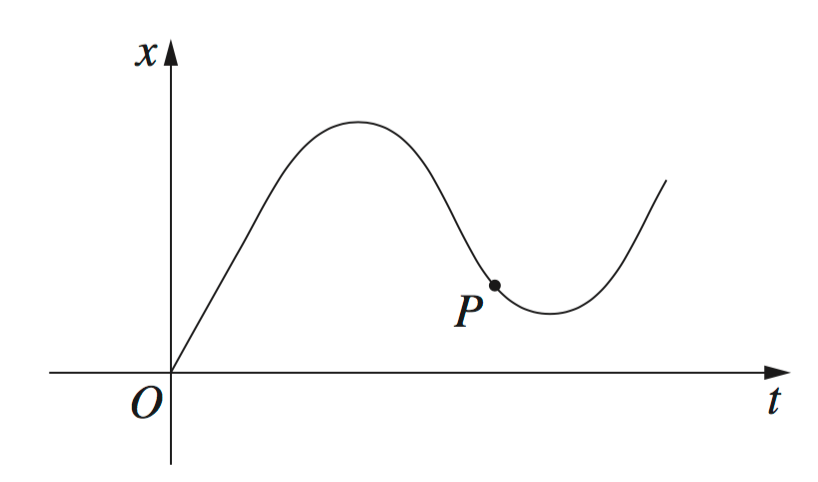
The graph shows the displacement  `x`  of a particle moving along a straight line as a function of time  `t`.

2014 9 mc

 Which statement describes the motion of the particle at the point  `P`? 

  1. The velocity is negative and the acceleration is positive.
  2. The velocity is negative and the acceleration is negative.
  3. The velocity is positive and the acceleration is positive.
  4. The velocity is positive and the acceleration is negative.
Show Answers Only

`A`

Show Worked Solution

`text(At)\ P,\ text(the particle is moving back towards)\ O`

`text{after hitting a max (positive) displacement}`

`:.\ text(Velocity is negative.)`

`text(Its displacement hits a minimum just after)\ P`

`text(and increases again.)`

`:.\ text{Acceleration is working against (negative) velocity}`

`text(and must be positive.)`

`=>  A` 

Filed Under: Motion, Rates of Change, Rates of Change Tagged With: Band 4, smc-1083-10-Motion Graphs, smc-6438-60-EXT acceleration

Copyright © 2014–2026 SmarterEd.com.au · Log in