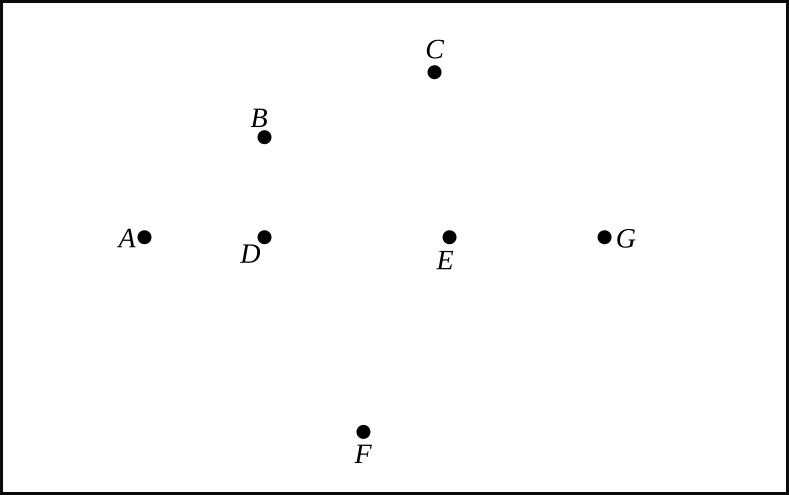
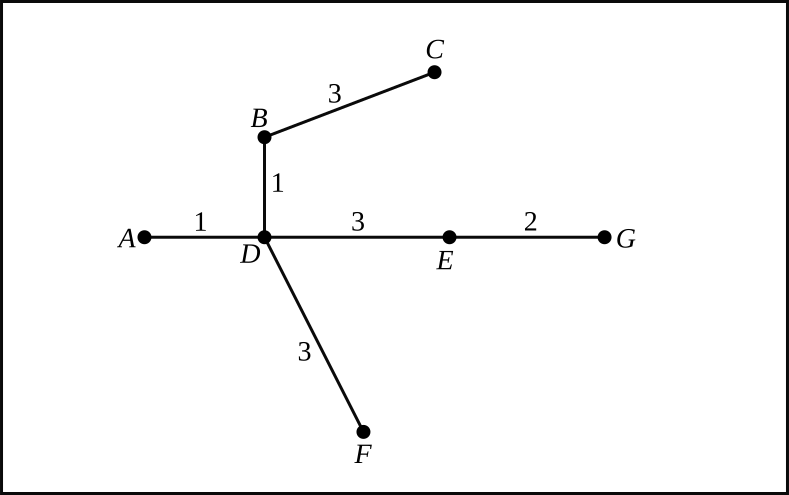
The diagram shows a network of houses and roads, and the time taken to travel along the roads in minutes.
Aussie Maths & Science Teachers: Save your time with SmarterEd
The diagram shows a network of houses and roads, and the time taken to travel along the roads in minutes.
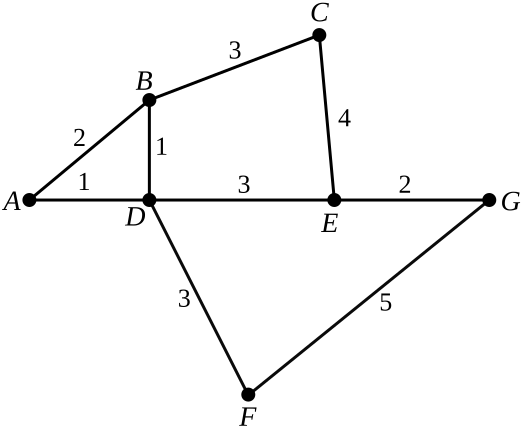
The diagram shows a network with weighted edges. --- 0 WORK AREA LINES (style=lined) --- --- 3 WORK AREA LINES (style=lined) ---
In a separate diagram or on the diagram above, show the minimum spanning tree. (2 marks)
--- 0 WORK AREA LINES (style=lined) ---
`text(One strategy – Using Kruskal’s algorithm:)`
`text(Edges 1 – 5: AB, BC, DG, DH and EI)`
`text(Edges 6 – 8: CD, EF and HI)`
`(text(note AC cannot be chosen → creates a cycle))`
`text(NB: There is more than one minimal spanning tree in this)`
`text{circuit (having a weight of 19).}`
Highlight the minimal spanning tree of this network on the diagram above, or in a separate diagram. (2 marks)
--- 0 WORK AREA LINES (style=lined) ---
Complete the minimal spanning tree of the network above on the diagram below. (2 marks)
--- 0 WORK AREA LINES (style=lined) ---
The diagram below is a connected network.
Complete the diagram below to show the minimal spanning tree of this network. (2 marks)
--- 0 WORK AREA LINES (style=lined) ---
`text(or)`
`text(One Strategy – Kruskul’s algorithm)`
`text(There are 6 vertices, so we need 5 edges.)`
`text{Edge 1: BC (least weight) – could have chosen ED}`
`text{Edge 2: DE (next least weight)}`
`text{Edge 3: AF (could have been CD)}`
`text(Edge 4: CD)`
`text{Edge 5: CF or EF (reject CE as it creates a cycle)}`
`text(or)`
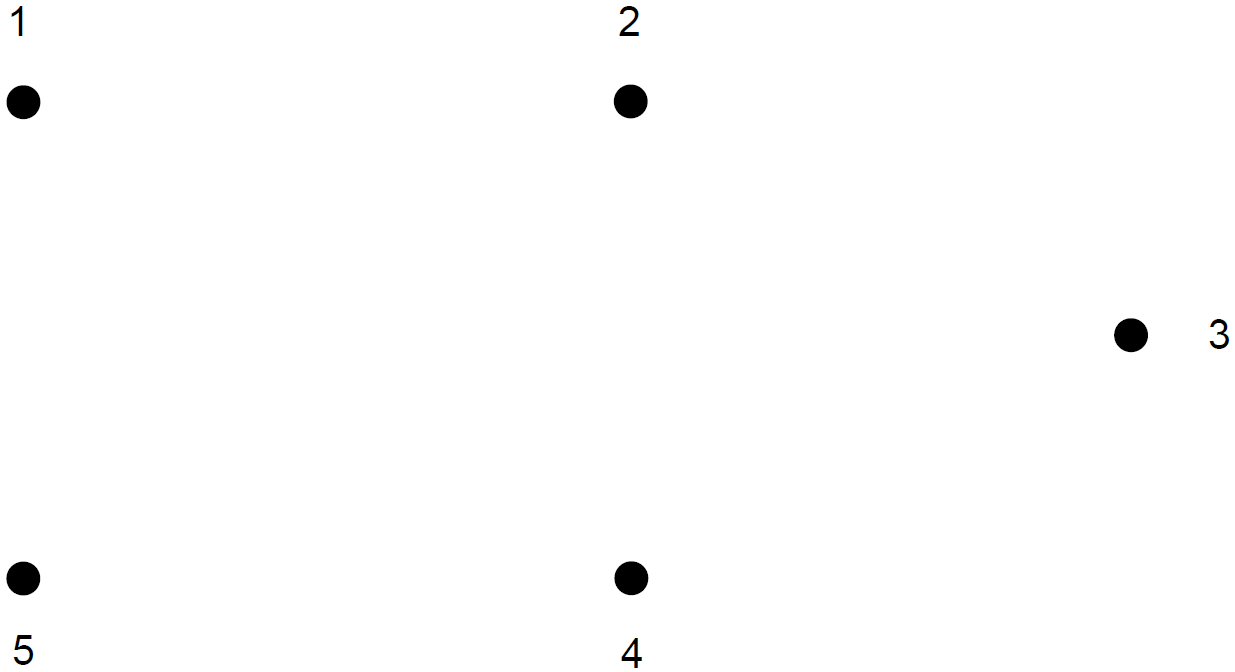
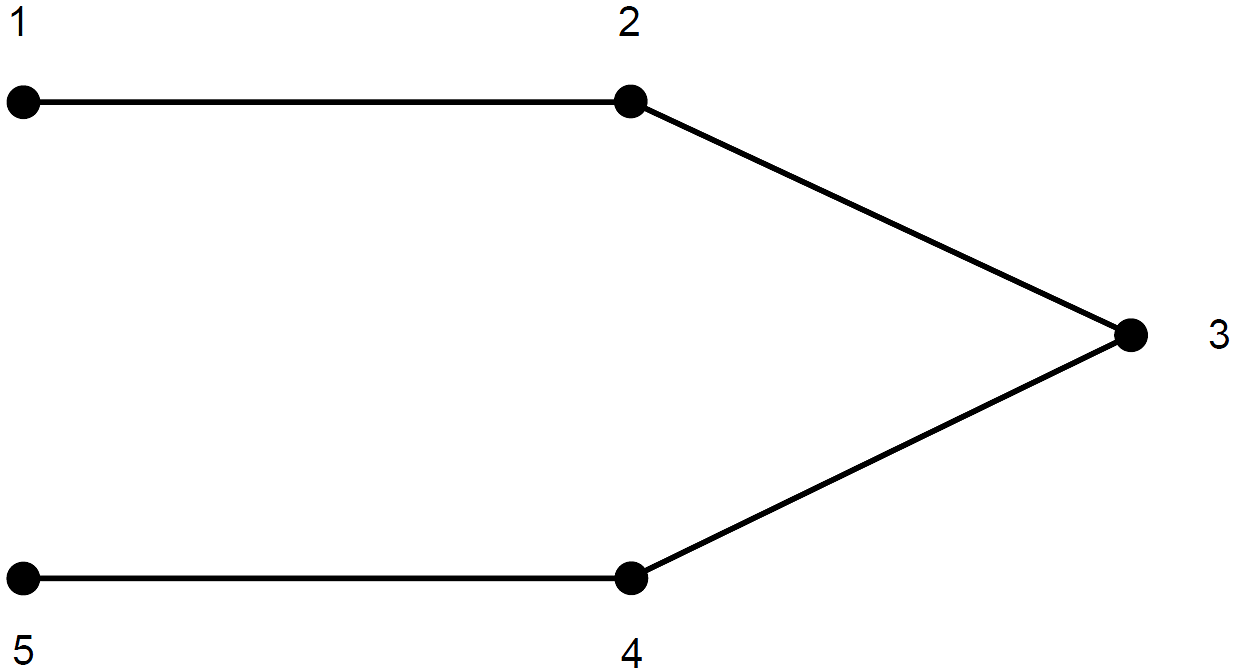
A new housing estate is being developed.
There are five houses under construction in one location.
These houses are numbered as points 1 to 5 below.
The builders require the five houses to be connected by electrical cables to enable the workers to have a supply of power on each site.
--- 1 WORK AREA LINES (style=lined) ---
--- 0 WORK AREA LINES (style=lined) ---
`A`
`text(Using Prim’s algorithm:)`
`text(Starting at vertex)\ A,`
`text(1st edge:)\ A → J\ (6)`
`text(2nd edge:)\ A → B\ (8)`
`text(3rd edge:)\ B → C\ (9)`
`text(4th edge:)\ J → I\ (10)`
`text(3rd edge:)\ B → D\ (10)\ \ text(etc…)`
`=> A`
`C`