A table tennis club consists of 6 males and 5 females.
How many committees of 4 players can be chosen that contain no more than 2 females?
- 250
- 265
- 305
- 330
Aussie Maths & Science Teachers: Save your time with SmarterEd
A table tennis club consists of 6 males and 5 females.
How many committees of 4 players can be chosen that contain no more than 2 females?
\(\Rightarrow B\)
\(\text{Combinations (0 females)}={ }^6 C_4=15\)
\(\text{Combinations (1 female)}={ }^5 C_1 \times{ }^6 C_3=100\)
\(\text{Combinations (2 females)}={ }^5 C_2 \times{ }^6 C_2=150\)
\(\text{Total combinations }=15+100+150=265\)
\(\Rightarrow B\)
Twelve students sit in a classroom, with seven students in the first row and the other five students in the second row. Three students are chosen randomly from the class.
The probability that exactly two of the three students chosen are in the first row is
\(B\)
\(\text{Pr(Exactly 2 from R1)}\ =\dfrac{\displaystyle \binom{7}{2}\binom{5}{1}}{\displaystyle \binom{12}{3}}=\dfrac{21}{44}\)
\(\Rightarrow B\)
The diagram shows triangle `A B C` with points chosen on each of the sides. On side `A B`, 3 points are chosen. On side `A C`, 4 points are chosen. On side `B C`, 5 points are chosen.
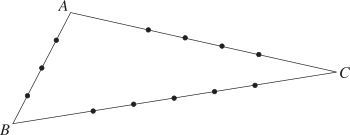
How many triangles can be formed using the chosen points as vertices?
`C`
`text{1 point taken from each side:}`
`text{Triangles} = 3 xx 4xx5=60`
`text{2 points taken from one side:}`
`text{Triangles}=((3),(2))((9),(1))+((4),(2))((8),(1))+((5),(2))((7),(1))=145`
`:.\ text{Total triangles} =60+145=205`
`=>C`
A committee containing 5 men and 3 women is to be formed from a group of 10 men and 8 women.
In how many different ways can the committee be formed? (1 mark)
`14\ 112`
`text(Different combinations)`
`= \ ^10C_5 · \ ^8C_3`
`= 14\ 112`
Out of 10 contestants, six are to be selected for the final round of a competition. Four of those six will be placed 1st, 2nd, 3rd and 4th.
In how many ways can this process be carried out?
`C`
| `text(Combinations)` | `= \ ^10 C_6 xx \ ^6P_4` |
| `= \ ^10 C_6 xx 6 xx 5 xx 4 xx 3` | |
| `= (10!)/(6!4!) xx (6!)/(2!)` | |
| `= (10!)/(4!2!)` |
`=>C`
Three squares are chosen at random from the 3 × 3 grid below, and a cross is placed in each chosen square.
What is the probability that all three crosses lie in the same row, column or diagonal?
`B`
`P= text(favourable events)/text(total possible events)= (3 + 3 + 2)/(\ ^9C_3)= 2/21`
`=>B`
A team of 11 students is to be formed from a group of 18 students. Among the 18 students are 3 students who are left-handed.
What is the number of possible teams containing at least 1 student who is left-handed?
`B`
`text(Teams with at least 1 left-hander)`
`=\ ^18C_11 -\ ^15C_11`
`= 30\ 459`
`=> B`
A bag contains 12 red marbles and 12 yellow marbles. Six marbles are selected at random without replacement.
--- 4 WORK AREA LINES (style=lined) ---
a. `0.36`
b. `0.32`
a. `\ ^12C_3= text(# Ways of selecting 3 R or Y from 12.)`
`\ ^24C_6=text(# Ways of selecting 6 from 24.)`
| `P text{(exactly 3R)}` | `=(\ ^12C_3 xx \ ^12C_3)/(\ ^24C_6)` |
| `=(220 xx 220)/(134\ 596)` | |
| `=0.36\ \ text{(to 2 d.p.)}` |
b. `text(Solution 1)`
| `text(S)text(ince)\ \ P text{(> 3 Red)` | `=Ptext{(< 3 Red)}` |
| `P text{(> 3 Red)` | `=1/2[1-Ptext{(exactly 3R)}]` |
| `=1/2(1-0.36)` | |
| `=0.32` |
`text(Solution 2)`
| `P (> 3R)` | `=P (4R) + P (5R) + P (6R)` |
| `=(\ ^12C_4 \ ^12C_2 + \ ^12C_5 \ ^12C_1 + \ ^12C_6 xx \ ^12C_0)/(\ ^24C_6)` | |
| `=(43\ 098)/(134\ 596)` | |
| `=0.32\ \ text{(to 2 d.p.)}` |
Katie is one of ten members of a social club. Each week one member is selected at random to win a prize.
--- 2 WORK AREA LINES (style=lined) ---
--- 5 WORK AREA LINES (style=lined) ---
--- 8 WORK AREA LINES (style=lined) ---
a. `0.52`
b. `text(See Worked Solutions)`
c. `text(30 weeks)`
a. `Ptext{(wins at least 1 prize)}`
`= 1-Ptext{(wins no prize)}`
`= 1-(9/10)^7`
`= 0.5217…`
`= 0.52\ \ \ text{(2 d.p.)}`
b. `text(In 1st 20 weeks:)`
`Ptext{(winning exactly 1 prize)}=\ ^(20)C_1 · (1/10) · (9/10)^19= 0.2701…`
`Ptext{(winning exactly 2 prizes)}=\ ^(20)C_2 · (1/10)^2 · (9/10)^18= 0.2851…`
`:.\ text(Katie has a greater chance of winning exactly 2 prizes.)`
c. `Ptext{(winning exactly 3 prizes)}=\ ^nC_3 · (1/10)^3 · (9/10)^(n-3)`
`Ptext{(winning exactly 2 prizes)}=\ ^nC_2 · (1/10)^2 · (9/10)^(n-2)`
`text(If greater chance of winning exactly 3 than exactly 2:)`
| `\ ^nC_3 · (1/10)^3 · (9/10)^(n-3)` | `>\ ^nC_2 · (1/10)^2 · (9/10)^(n-2)` |
| `(n!)/(3!(n-3)) · 1/10` | `> (n!)/(2!(n-2)!) · 9/10` |
| `(2!(n-2)!)/(3!(n-3)!)` | `> 9` |
| `(n-2)/3` | `> 9` |
| `n-2` | `> 27` |
| `n` | `> 29` |
`:.\ text(Katie must participate for 30 weeks.)`
A four-person team is to be chosen at random from nine women and seven men.
--- 2 WORK AREA LINES (style=lined) ---
a. `1820`
b. `9/130`
a. `text(#Team combinations)`
`=\ ^(16)C_4 = (16!)/((16-4)!\ 4!)= 1820`
b. `text{P(team has 4 women)}`
`= (\ ^9C_4)/1820= 126/1820 = 9/130`
Sophie has five coloured blocks: one red, one blue, one green, one yellow and one white. She stacks two, three, four or five blocks on top of one another to form a vertical tower.
--- 1 WORK AREA LINES (style=lined) ---
--- 2 WORK AREA LINES (style=lined) ---
a. `60`
b. `320`
a. `text(Towers)= \ ^5P_3= 60`
b. `text(Number of different towers)`
`= \ ^5P_2 + \ ^5P_3 + \ ^5P_4 + \ ^5P_5`
`= 20 + 60 + 120 + 120`
`= 320`
Two players `A` and `B` play a series of games against each other to get a prize. In any game, either of the players is equally likely to win.
To begin with, the first player who wins a total of 5 games gets the prize.
--- 3 WORK AREA LINES (style=lined) ---
--- 10 WORK AREA LINES (style=lined) ---
a. `text{Proof (See Worked Solutions)}`
b. `\ ^4C_4(1/2)^5 +\ ^5C_4(1/2)^6 +\ ^6C_4(1/2)^7`
c. `text{Proof (See Worked Solutions.)}`
a. `text(To win in exactly 7 games, player)\ A\ text(must win the 7th game.)`
`:.P(A\ text{wins in 7 games)}`
`=\ ^6C_4 · (1/2)^4(1/2)^2 xx 1/2`
`=\ ^6C_4(1/2)^7`
b. `Ptext{(wins in at most 7 games)}`
`=Ptext{(wins in 5, 6 or 7 games)}`
`=\ ^4C_4(1/2)^4 xx 1/2 +\ ^5C_4(1/2)^4(1/2) xx 1/2 +\ ^6C_4(1/2)^7`
`=\ ^4C_4(1/2)^5 +\ ^5C_4(1/2)^6 +\ ^6C_4(1/2)^7`
c. `text(Prove that)`
`\ ^nC_n · 2^n +\ ^(n + 1)C_n · 2^(n-1) + … +\ ^(2n)C_n = 2^(2n)`
`P(A\ text(wins in)\ (n + 1)\ text{games)}`
`=\ ^nC_n(1/2)^(n + 1) +\ ^(n + 1)C_n(1/2)^(n + 2) + … +\ ^(2n)C_n(1/2)^(2n + 1)`
`text{One player must have won after (2n + 1) games are played.}`
`text(S)text(ince each player has an equal chance,)`
`\ ^nC_n(1/2)^(n + 1) +\ ^(n + 1)C_n(1/2)^(n + 2) + … +\ ^(2n)C_n(1/2)^(2n + 1) = 1/2`
`text(Multiply both sides by)\ 2^(2n + 1):`
`\ ^nC_n2^(-(n + 1)) · 2^(2n + 1) +\ ^(n + 1)C_n · 2^(-(n + 2)) · 2^(2n + 1) + …`
`… +\ ^(2n)C_n · 2^(-(2n + 1)) · 2^(2n + 1) = 2^(-1) · 2^(2n + 1)`
`:. \ ^nC_n · 2^n +\ ^(n + 1)C_n · 2^(n-1) + … +\ ^(2n)C_n = 2^(2n)`
A rowing team consists of 8 rowers and a coxswain.
The rowers are selected from 12 students in Year 10.
The coxswain is selected from 4 students in Year 9.
In how many ways could the team be selected?
`C`
| `\ ^(12)C_8` | `=\ text(Combinations of rowers)` |
| `\ ^4C_1` | `=\ text(Combinations of coxswains)` |
`:.\ text(Number of ways to select team)`
`=\ ^12C_8 xx\ ^4C_1`
`=> C`
Alex’s playlist consists of 40 different songs that can be arranged in any order.
--- 2 WORK AREA LINES (style=lined) ---
a. `40!`
b. `6 xx 37!`
a. `text(#Arrangements) = 40!`
b. `text(#Arrangements) = 40! = 3! xx 37! = 6 xx 37!`
In how many ways can a committee of 3 men and 4 women be selected from a group of 8 men and 10 women? (1 mark)
--- 2 WORK AREA LINES (style=lined) ---
`11\ 760`
| `text(# Combinations)` | `=\ ^8C_3 xx\ ^10C_4` |
| `= (8!)/(5!3!) xx (10!)/(6!4!)` | |
| `= 56 xx 210` | |
| `= 11\ 760` |