Eight guests are to be seated at a round table. If two of these guests refuse to sit next to each other, how many seating arrangements are possible? (2 marks)
--- 5 WORK AREA LINES (style=lined) ---
Aussie Maths & Science Teachers: Save your time with SmarterEd
Eight guests are to be seated at a round table. If two of these guests refuse to sit next to each other, how many seating arrangements are possible? (2 marks)
--- 5 WORK AREA LINES (style=lined) ---
Four girls and four boys are to be seated around a circular table. In how many ways can the eight children be seated if: --- 2 WORK AREA LINES (style=lined) --- --- 3 WORK AREA LINES (style=lined) --- --- 3 WORK AREA LINES (style=lined) ---
A group with 5 students and 3 teachers is to be arranged in a circle.
In how many ways can this be done if no more than 2 students can sit together?
\(\text{Fix 1st teacher in a seat}\)
\(\text{Split remaining 5 students into 3 groups (2 × 2 students and 1 × 1 student)}\)
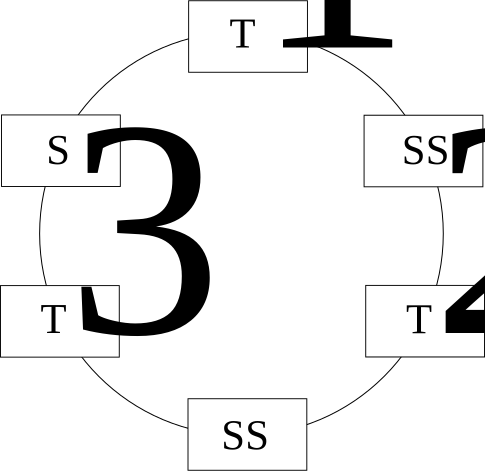
\(\text{Combinations of other teachers = 2! }\)
\(\text{Combinations of students within groups = 5! }\)
\(\text{Combinations of student groups between teachers = 3 }\)
\(\therefore\ \text{Total combinations}\ = 2! \times 5! \times 3 = 3! \times 5! \)
\(\Rightarrow B\)
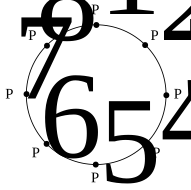
Eight points `P_1, P_2, ..., P_8`, are arranged in order around a circle, as shown below.
--- 1 WORK AREA LINES (style=lined) ---
--- 2 WORK AREA LINES (style=lined) ---
--- 2 WORK AREA LINES (style=lined) ---
--- 6 WORK AREA LINES (style=lined) ---
a. `text{Fix 9 (or any odd number) on the circle}.`
`text(Arrangements) \ = 5 ! = 120`
b. `text(Fix) \ 9 \ text(on circle).`
`text(Consider arrangements with no odd numbers together):`
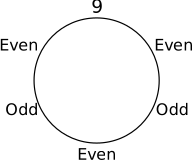
`text{Combinations (clockwise from top)}`
`= 1 xx 3 xx 2 xx 2 xx 1 xx 1= 12`
`:. \ text(Arrangements with at least 2 odds together)`
`= 120-12= 108`
Six men and six women are to be seated at a round table.
In how many different ways can they be seated if men and women alternate?
In how many ways can 6 people from a group of 15 people be chosen and then arranged
in a circle?
A family of eight is seated randomly around a circular table.
What is the probability that the two youngest members of the family sit together?