The graph shows the salvage value of a car over 5 years.
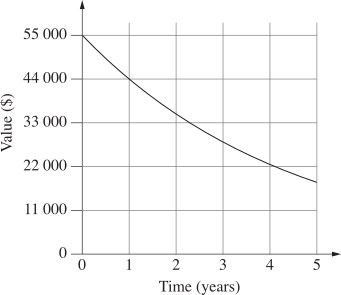
The salvage values are based on the declining-balance method.
By what amount will the car’s value depreciate during the 10th year? (4 marks)
--- 12 WORK AREA LINES (style=lined) ---
Aussie Maths & Science Teachers: Save your time with SmarterEd
The graph shows the salvage value of a car over 5 years.
The salvage values are based on the declining-balance method.
By what amount will the car’s value depreciate during the 10th year? (4 marks)
--- 12 WORK AREA LINES (style=lined) ---
The graph shows the decreasing value of an asset.
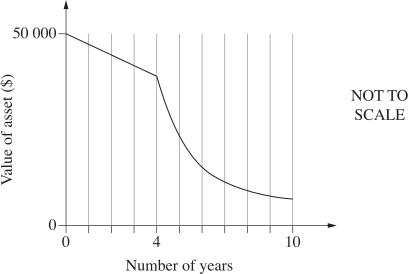
For the first 4 years, the value of the asset depreciated by $1500 per year, using a straight-line method of depreciation.
After the end of the 4th year, the method of depreciation changed to the declining-balance method at the rate of 35% per annum.
What is the total depreciation at the end of 10 years? (4 marks)
--- 10 WORK AREA LINES (style=lined) ---
Three years ago an appliance was valued at $2467. Its value has depreciated by 15% each year, based on the declining-balance method.
What is the salvage value today, to the nearest dollar?
An asset is depreciated using the declining-balance method with a rate of depreciation of 8% per half year. The asset was bought for `$10\ 000`.
What is the salvage value of the asset after 5 years?
A new car is bought for $24 950. Each year the value of the car depreciates by 14%.
Using the declining-balance method, calculate the salvage value of the car at the end of 10 years. (2 marks)
A new car is bought for $24 950. Each year the value of the car is depreciated by the same percentage.
The table shows the value of the car, based on the declining-balance method of depreciation, for the first three years.
\begin{array} {|c|c|}
\hline
\rule{0pt}{2.5ex}\textit{End of year}\rule[-1ex]{0pt}{0pt} & \textit{Value}\\
\hline
\rule{0pt}{2.5ex}1\rule[-1ex]{0pt}{0pt} & \$21\ 457.00 \\
\hline
\rule{0pt}{2.5ex}2\rule[-1ex]{0pt}{0pt} & \$18\ 453.02 \\
\hline
\rule{0pt}{2.5ex}3\rule[-1ex]{0pt}{0pt} & \$15\ 869.60 \\
\hline
\end{array}
What is the value of the car at the end of 10 years? (3 marks)
--- 6 WORK AREA LINES (style=lined) ---
A car is purchased for $23 900.
The value of the car is depreciated by 11.5% each year using the declining-balance method.
What is the value of the car after three years? (2 marks)
--- 4 WORK AREA LINES (style=lined) ---
A sports car worth $150 000 is bought in December 2005.
In December each year, beginning in 2006, the value of the sports car is depreciated by 10% using the declining balance method of depreciation.
In which year will the depreciated value first fall below $120 000? (2 marks)
--- 5 WORK AREA LINES (style=lined) ---
Tai uses the declining balance method of depreciation to calculate tax deductions for her business. Tai’s computer is valued at $6500 at the start of the 2003 financial year. The rate of depreciation is 40% per annum.
--- 1 WORK AREA LINES (style=lined) ---
--- 3 WORK AREA LINES (style=lined) ---
A plasma TV depreciated in value by 15% per annum. Two years after it was purchased it had depreciated to a value of $2023, using the declining balance method.
What was the purchase price of the plasma TV? (2 marks)
--- 4 WORK AREA LINES (style=lined) ---
A car is bought for $19 990. It will depreciate at 18% per annum.
Using the declining balance method, what will be the salvage value of the car after 3 years, to the nearest dollar?
Norman and Pat each bought the same type of tractor for $60 000 at the same time. The value of their tractors depreciated over time.
The salvage value `S`, in dollars, of each tractor, is its depreciated value after `n` years.
Norman drew a graph to represent the salvage value of his tractor.

--- 2 WORK AREA LINES (style=lined) ---
--- 2 WORK AREA LINES (style=lined) ---
--- 3 WORK AREA LINES (style=lined) ---
--- 4 WORK AREA LINES (style=lined) ---
Pat used the declining balance formula for calculating the salvage value of her tractor. The depreciation rate that she used was 20% per annum.
--- 4 WORK AREA LINES (style=lined) ---
--- 2 WORK AREA LINES (style=lined) ---
Jim buys a photocopier for $22 000.
Its value is depreciated using the declining balance method at the rate of 15% per annum.
What is its value at the end of 3 years? (2 marks)