A jar contains 12 red, 10 black and 13 white lollies.
Alex picks out a red lolly and eats it. He then randomly picks a second lolly.
What is the probability that the second lolly is also red?
- `(11)/(34)`
- `(11)/(35)`
- `(12)/(34)`
- `(12)/(35)`
Aussie Maths & Science Teachers: Save your time with SmarterEd
A jar contains 12 red, 10 black and 13 white lollies.
Alex picks out a red lolly and eats it. He then randomly picks a second lolly.
What is the probability that the second lolly is also red?
`A`
| `P(E)` | `=text{favourable outcomes}/text{total outcomes}` | |
| `=(12-1)/((12-1)+10+13)=11/34` |
`=>A`
In a bag, there are six playing cards, 2, 4, 6, 8, Queen and King. The Queen and King are known as picture cards.
Two of these cards are chosen randomly. All the possible outcomes are shown.

--- 2 WORK AREA LINES (style=lined) ---
a. `P text{(at least 1 picture card)} = 9/15=3/5`
| b. | `P text{(no picture card)}` | `= 1-9/15` |
| `= 6/15=2/5` |
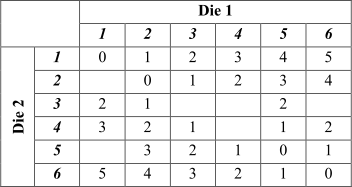
Barbara plays a game of chance, in which two unbiased six-sided dice are rolled. The score for the game is obtained by finding the difference between the two numbers rolled. For example, if Barbara rolls a 2 and a 5, the score is 3.
The table shows some of the scores.
--- 3 WORK AREA LINES (style=lined) ---
a.
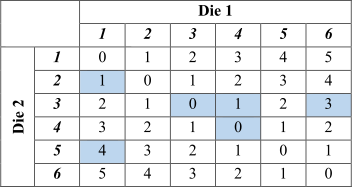
b. `frac{5}{6}`
a.
| b. | `Ptext{(not zero)}` | `= frac{text(numbers) ≠ 0}{text(total numbers)}` |
| `= frac{30}{36}= frac{5}{6}` |
\(\text{Alternate solution (b)}\)
| b. | `Ptext{(not zero)}` | `= 1-Ptext{(zero)}` |
| `= 1-frac{6}{36}` | ||
| `= frac{5}{6}` |
The two spinners shown are used in a game.
Each arrow is spun once. The score is the total of the two numbers shown by the arrows.
A table is drawn up to show all scores that can be obtained in this game.
--- 1 WORK AREA LINES (style=lined) ---
--- 2 WORK AREA LINES (style=lined) ---
a. `5`
b. `1/2`
c. `2/3`
a. `X=3+2=5`
b. `P(text{score}<4)=6/12=1/2`
c. `P(3)=2/3`
Kay randomly selected a marble from a bag of marbles, recorded its colour and returned it to the bag. She repeated this process a number of times.
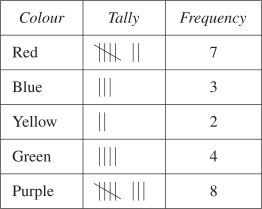
Based on these results, what is the best estimate of the probability that Kay will choose a green marble on her next selection?
`C`
| `text{P(Green)}` | `= text(# Green chosen) / text(Total Selections)` |
| `= 4/24= 1/6` |
`=> C`
Two dice are rolled. What is the probability that only one of the dice shows a six?
`C`
`text(Method 1: Using an array)`
`P text{(only 1 six)}=10/36=5/18`
\begin{align}
\textbf{Die B }
\begin{array}{c}
\textbf{Die A} \\
\begin{array}{c|c|c|c|c|c|c}
\ & 1 & 2 & 3 & 4 & 5 & 6 \\
\hline
\ 1 & 1,1 & 1,2 & 1,3 & 1,4 & 1,5 & \fcolorbox{red}{white}{1,6} \\
\hline
\ 2 & 2,1 & 2,2 & 2,3 & 2,4 & 2,5 & \fcolorbox{red}{white}{2,6} \\
\hline
\ 3 & 3,1 & 3,2 & 3,3 & 3,4 & 3,5 & \fcolorbox{red}{white}{3,6} \\
\hline
\ 4 & 4,1 & 4,2 & 4,3 & 4,4 & 4,5 & \fcolorbox{red}{white}{4,6} \\
\hline
\ 5 & 5,1 & 5,2 & 5,3 & 5,4 & 5,5 & \fcolorbox{red}{white}{5,6} \\
\hline
\ 6 & \fcolorbox{red}{white}{6,1} & \fcolorbox{red}{white}{6,2} & \fcolorbox{red}{white}{6,3} & \fcolorbox{red}{white}{6,4} & \fcolorbox{red}{white}{6,5} & 6,6 \\
\end{array}
\end{array}
\end{align}
`text(Method 2:)`
`text{P (Only 1 six)}`
`= P text{(6, not 6)} + P text{(not 6, 6)}`
`= 1/6 xx 5/6 + 5/6 xx 1/6`
`= 10/36= 5/18`
`=> C`
Two unbiased dice, each with faces numbered 1, 2, 3, 4, 5, 6, are rolled.
What is the probability of a 6 appearing on at least one of the dice?
`B`
`text(Method 1: Using an array`
`P text{(at least 1 six)}=11/36`
\begin{align}
\textbf{Die B }
\begin{array}{c}
\textbf{Die A} \\
\begin{array}{c|c|c|c|c|c|c}
\ & 1 & 2 & 3 & 4 & 5 & 6 \\
\hline
\ 1 & 1,1 & 1,2 & 1,3 & 1,4 & 1,5 & \fcolorbox{red}{white}{1,6} \\
\hline
\ 2 & 2,1 & 2,2 & 2,3 & 2,4 & 2,5 & \fcolorbox{red}{white}{2,6} \\
\hline
\ 3 & 3,1 & 3,2 & 3,3 & 3,4 & 3,5 & \fcolorbox{red}{white}{3,6} \\
\hline
\ 4 & 4,1 & 4,2 & 4,3 & 4,4 & 4,5 & \fcolorbox{red}{white}{4,6} \\
\hline
\ 5 & 5,1 & 5,2 & 5,3 & 5,4 & 5,5 & \fcolorbox{red}{white}{5,6} \\
\hline
\ 6 & \fcolorbox{red}{white}{6,1} & \fcolorbox{red}{white}{6,2} & \fcolorbox{red}{white}{6,3} & \fcolorbox{red}{white}{6,4} & \fcolorbox{red}{white}{6,5} & \fcolorbox{red}{white}{6,6} \\
\end{array}
\end{array}
\end{align}
`text(Method 2: Using )P text{(E)} = 1-P\text{(not E)}`
`P text{(at least 1 six)}`
`=1-P text{(no six)} xx P text{(no six)} `
`=1-5/6 xx 5/6=11/36`
`=> B`
Two unbiased dice, each with faces numbered 1, 2, 3, 4, 5, 6, are rolled.
What is the probability of obtaining a sum of 6?
`D`
`text(Total outcomes)=6xx6=36`
`text{Outcomes that sum to 6}=text{(1,5) (5,1) (2,4) (4,2) (3,3)} =5`
`:.\ P\text{(sum of 6)} =5/36`
`=> D`