A game involves throwing a die and spinning a spinner.
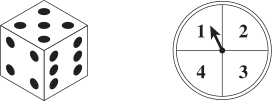
The sum of the two numbers obtained is the score.
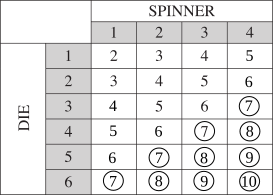
The table of scores below is partially completed.
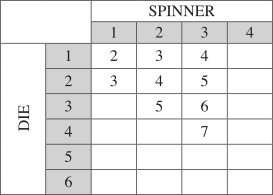
What is the probability of getting a score of 7 or more?
- `1/6`
- `1/4`
- `5/18`
- `5/12`
Aussie Maths & Science Teachers: Save your time with SmarterEd
A game involves throwing a die and spinning a spinner.
The sum of the two numbers obtained is the score.
The table of scores below is partially completed.
What is the probability of getting a score of 7 or more?
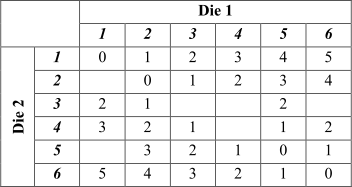
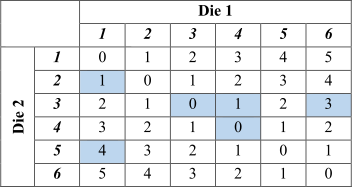
Barbara plays a game of chance, in which two unbiased six-sided dice are rolled. The score for the game is obtained by finding the difference between the two numbers rolled. For example, if Barbara rolls a 2 and a 5, the score is 3.
The table shows some of the scores.
--- 3 WORK AREA LINES (style=lined) ---
a.
b. `frac{5}{6}`
a.
| b. | `Ptext{(not zero)}` | `= frac{text(numbers) ≠ 0}{text(total numbers)}` |
| `= frac{30}{36}= frac{5}{6}` |
\(\text{Alternate solution (b)}\)
| b. | `Ptext{(not zero)}` | `= 1-Ptext{(zero)}` |
| `= 1-frac{6}{36}` | ||
| `= frac{5}{6}` |
The two spinners shown are used in a game.
Each arrow is spun once. The score is the total of the two numbers shown by the arrows.
A table is drawn up to show all scores that can be obtained in this game.
--- 1 WORK AREA LINES (style=lined) ---
--- 2 WORK AREA LINES (style=lined) ---
a. `5`
b. `1/2`
c. `2/3`
a. `X=3+2=5`
b. `P(text{score}<4)=6/12=1/2`
c. `P(3)=2/3`
Two unbiased dice, each with faces numbered 1, 2, 3, 4, 5, 6, are rolled.
What is the probability of a 6 appearing on at least one of the dice?
`B`
`text(Method 1: Using an array`
`P text{(at least 1 six)}=11/36`
\begin{align}
\textbf{Die B }
\begin{array}{c}
\textbf{Die A} \\
\begin{array}{c|c|c|c|c|c|c}
\ & 1 & 2 & 3 & 4 & 5 & 6 \\
\hline
\ 1 & 1,1 & 1,2 & 1,3 & 1,4 & 1,5 & \fcolorbox{red}{white}{1,6} \\
\hline
\ 2 & 2,1 & 2,2 & 2,3 & 2,4 & 2,5 & \fcolorbox{red}{white}{2,6} \\
\hline
\ 3 & 3,1 & 3,2 & 3,3 & 3,4 & 3,5 & \fcolorbox{red}{white}{3,6} \\
\hline
\ 4 & 4,1 & 4,2 & 4,3 & 4,4 & 4,5 & \fcolorbox{red}{white}{4,6} \\
\hline
\ 5 & 5,1 & 5,2 & 5,3 & 5,4 & 5,5 & \fcolorbox{red}{white}{5,6} \\
\hline
\ 6 & \fcolorbox{red}{white}{6,1} & \fcolorbox{red}{white}{6,2} & \fcolorbox{red}{white}{6,3} & \fcolorbox{red}{white}{6,4} & \fcolorbox{red}{white}{6,5} & \fcolorbox{red}{white}{6,6} \\
\end{array}
\end{array}
\end{align}
`text(Method 2: Using )P text{(E)} = 1-P\text{(not E)}`
`P text{(at least 1 six)}`
`=1-P text{(no six)} xx P text{(no six)} `
`=1-5/6 xx 5/6=11/36`
`=> B`