SmarterEd

Aussie Maths & Science Teachers: Save your time with SmarterEd

  • Login
  • Get Help
  • About

Recursion, GEN1 2022 VCAA 22 MC

Tim deposited $6000 into an investment account earning compound interest calculated monthly.

A rule for the balance, \(T_n\), in dollars, after \(n\) years is given by  \(T_n=6000 \times 1.003^{12n}\).

Let \(R_n\) be a new recurrence relation that models the balance of Tim's account after \(n\) months.

This recurrence relation is

  1. \(R_0=6000,\ \ \ R_{n+1}=R_n+18\)
  2. \(R_0=6000,\ \ \ R_{n+1}=R_n+36\)
  3. \(R_0=6000,\ \ \ R_{n+1}=1.003\,R_n\)
  4. \(R_0=6000,\ \ \ R_{n+1}=1.0036\,R_n\)
  5. \(R_0=6000,\ \ \ R_{n+1}=1.036\,R_n\)
Show Answers Only

\(C\)

Show Worked Solution

\(\text{Eliminate option A and B as they are linear.}\)

\(\text{Option D has a monthly interest rate = 0.36% (eliminate)}\)

\(\text{Option E has a monthly interest rate = 3.6% (eliminate)}\)
 

\(\text{Consider option C:}\)

\(T_1 = 6000 \times 1.003^{12 \times 1}\ \ \text{(after 1 year)}\)

\(R_1\) \(= 6000 \times 1.003\) \(= 1.003 \times R_0\)
\(R_2\) \(= 6000 \times 1.003 \times 1.003\) \(= 1.003 \times R_1\)
\(R_3\) \(= 6000 \times 1.003 \times 1.003 \times 1.003\) \(= 1.003 \times R_2\)

  
\(\therefore  R_{n+1} = 1.003\,R_n\ \text{where } n\ \text{is in months.}\)

\(\Rightarrow C\)

Filed Under: Recursion - Financial Tagged With: Band 4, smc-717-10-Compound interest, smc-717-70-Find RR

CORE, FUR2 2020 VCAA 10

Samuel now invests $500 000 in an annuity from which he receives a regular monthly payment.

The balance of the annuity, in dollars, after  `n`  months,  `A_n` , can be modelled by a recurrence relation of the form

`A_0 = 500\ 000, qquad A_(n+1) = kA_n - 2000`

  1. Calculate the balance of this annuity after two months if  `k = 1.0024`.   (1 mark)

    --- 2 WORK AREA LINES (style=lined) ---

  2. Calculate the annual compound interest rate percentage for this annuity if  `k = 1.0024`.   (1 mark)

    --- 2 WORK AREA LINES (style=lined) ---

  3. For what value of  `k`  would this investment act as a simple perpetuity?   (1 mark)

    --- 3 WORK AREA LINES (style=lined) ---

Show Answers Only
  1. `$498\ 398.08`
  2. `2.88 text(%)`
  3. `1.004`
Show Worked Solution
a.   `A_1 = 1.0024 xx 500\ 000-2000 = $499\ 200`
  `A_2 = 1.0024 xx 499\ 200-2000 = $498\ 398.08`


♦ Mean mark 48%.
b.   `text(Monthly interest rate)` `= (1.0024-1) xx 100 = 0.24text(%)`
  `text(Annual interest rate)` `= 12 xx 0.24 = 2.88text(%)`


♦ Mean mark 36%.
c.   `text(Perpetuity would occur when)`
  `k xx 500\ 000-2000` `= 500\ 000`
  `k` `= (502\ 000)/(500\ 000)`
    `= 1.004`

Filed Under: Annuities and Perpetuities, Recursion - Financial Tagged With: Band 4, Band 5, smc-2512-70-Recurrence relations, smc-717-30-Annuity, smc-717-40-Perpetuity, smc-717-70-Find RR

CORE, FUR2 2020 VCAA 8


Samuel has a reducing balance loan.

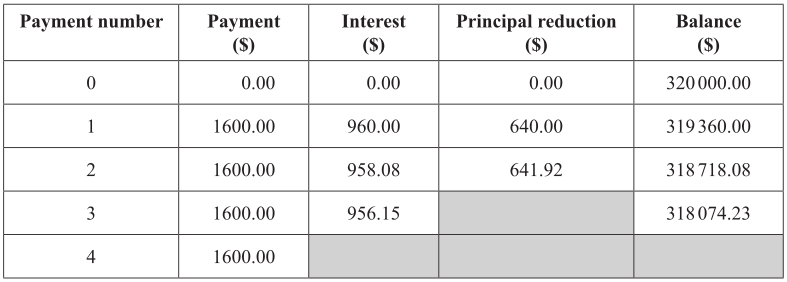
The first five lines of the amortisation table for Samuel’s loan are shown below.


Interest is calculated monthly and Samuel makes monthly payments of $1600.

Interest is charged on this loan at the rate of 3.6% per annum.

  1. Using the values in the amortisation table
    1. calculate the principal reduction associated with payment number 3.   (1 mark)

      --- 3 WORK AREA LINES (style=lined) ---

    2. Calculate the balance of the loan after payment number 4 is made.
    3. Round your answer to the nearest cent.   (1 mark)

      --- 4 WORK AREA LINES (style=lined) ---

  2. Let `S_n` be the balance of Samuel’s loan after `n` months.
  3. Write down a recurrence relation, in terms of `S_0, S_(n+1)`  and  `S_n`, that could be used to model the month-to-month balance of the loan.   (1 mark)

    --- 3 WORK AREA LINES (style=lined) ---

Show Answers Only

  1.  i. `$643.85`
  2. ii. `$317\ 428.45`
  3. `text(See Worked Solutions)`

Show Worked Solution

a.i.   `text(Principal reduction)` `=\ text(Payment – interest)`
    `= 1600-956.15`
    `= $643.85`


♦ Mean mark part a.ii. 39%.

a.ii.   `text(Interest)` `= 318\ 074.23 xx (0.036/12)`
    `= $954.22`

 
`:.\ text(Balance after payment 4)`

`= 318\ 074.23-1600 + 954.22`

`= $317\ 428.45`


♦♦ Mean mark part b. 30%.

b.   `S_0 = 320\ 000,\ S_(n+1)` `= S_n(1 + 0.036/12)-1600`
  `S_(n+1)` `= 1.003 S_n-1600`

Filed Under: Borrowing and Loans, Recursion - Financial Tagged With: Band 3, Band 5, smc-603-70-Recurrence relation, smc-717-20-Loans, smc-717-70-Find RR

CORE, FUR1 2020 VCAA 25 MC

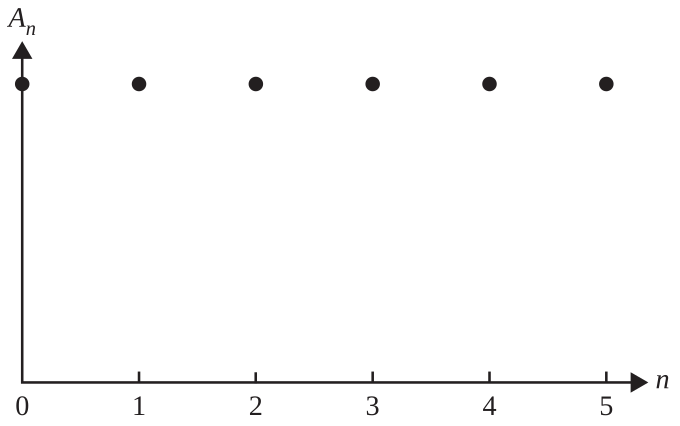
The graph below represents the value of an annuity investment, `A_n`, in dollars, after `n` time periods.


A recurrence relation that could match this graphical representation is

  1. `A_0 = 200\ 000, qquad A_(n+1) = 1.015A_n - 2500`
  2. `A_0 = 200\ 000, qquad A_(n+1) = 1.025A_n - 5000`
  3. `A_0 = 200\ 000, qquad A_(n+1) = 1.03A_n - 5500`
  4. `A_0 = 200\ 000, qquad A_(n+1) = 1.04A_n - 6000`
  5. `A_0 = 200\ 000, qquad A_(n+1) = 1.05A_n - 8000`
Show Answers Only

`B`

Show Worked Solution

`text(The value doesn’t change.)`

`text(Consider option B:)`

`A_1` `= 1.025 xx 200\ 000 – 5000`
  `= 200\ 000`
  `= A_0`

 
`=>  B`

Filed Under: Recursion - Financial Tagged With: Band 4, smc-717-70-Find RR, smc-717-90-RR and graphs

Financial Maths, GEN2 2019 NHT 7

Tisha plays drums in the same band as Marlon.

She would like to buy a new drum kit and has saved $2500.

  1. Tisha could invest this money in an account that pays interest compounding monthly.


    The balance of this investment after `n` months, `T_n` could be determined using the recurrence relation below
     
          `T_0 = 2500, \ \ \ \ T_(n+1) = 1.0036 xx T_n` 
     
    Calculate the total interest that would be earned by Tisha's investment in the first five months.


    Round your answer to the nearest cent.   (2 marks)

    --- 4 WORK AREA LINES (style=lined) ---

Tisha could invest the $2500 in a different account that pays interest at the rate of 4.08% per annum, compounding monthly. She would make a payment of $150 into this account every month.

  1. Let `V_n` be the value of Tisha's investment after `n` months.


    Write down a recurrence relation, in terms of `V_0`, `V_n` and `V_(n + 1)`, that would model the change in the value of this investment.   (1 mark)

    --- 2 WORK AREA LINES (style=lined) ---

  2. Tisha would like to have a balance of $4500, to the nearest dollar, after 12 months.


    What annual interest rate would Tisha require?


    Round your answer to two decimal places.   (1 mark)

    --- 2 WORK AREA LINES (style=lined) ---

Show Answers Only
  1. `$45.33`
  2. `V_0 = 2500, \ V_(n+1) = 1.0034 xx V_n + 150`
  3. `5.87%`
Show Worked Solution

a.    `T_1 = 1.0036 xx 2500 = 2509`

`T_2 = 1.0036 xx 2509 = 2518.0324`

`vdots`

`T_5 = 2545.33`

`:. \ text(Total interest) ` `= 2545.33-2500`
  `= $45.33`


b.    `text(Monthly interest) = (4.08)/(12) = 0.34%`

`:. \ V_0 = 2500, \ V_(n+1) = 1.0034 xx V_n + 150`


c.    `text(By TVM Solver:)`

`N` `= 12`  
`I text(%)` `=?`  
`PV` `=-2500`  
`PMT` `=-150`  
`FV` `=4500`  
`text(PY)` `= text(CY)=12`  

 
`=> I = 5.87%`

Filed Under: Annuities and Perpetuities, Recursion - Financial Tagged With: Band 4, Band 5, smc-2512-10-Annuity, smc-2512-50-CAS solver, smc-2512-70-Recurrence relations, smc-717-10-Compound interest, smc-717-70-Find RR

CORE, GEN1 2019 NHT 18 MC

A truck was purchased for $134 000.

Using the reducing balance method, the value of the truck is depreciated by 8.5% each year.

Which one of the following recurrence relations could be used to determine the value of the truck after `n` years, `V_n`?

  1. `V_0 = 134\ 000,quadqquad V_(n + 1) = 0.915 xx V_n`
  2. `V_0 = 134\ 000,quadqquad V_(n + 1) = 1.085 xx V_n`
  3. `V_0 = 134\ 000,quadqquad V_(n + 1) = V_n - 11\ 390`
  4. `V_0 = 134\ 000,quadqquad V_(n + 1) = 0.915 xx V_n - 8576`
  5. `V_0 = 134\ 000,quadqquad V_(n + 1) = 1.085 xx V_n - 8576`
Show Answers Only

`A`

Show Worked Solution

`text(Each year, value decreases by 8.5%)`

`:. V_1` `= V_0 – 0.085 xx V_0`
  `= 0.915 xx V_0`

 
`=>\ A`

Filed Under: Recursion - Financial Tagged With: Band 4, smc-717-60-Depreciation (reducing balance), smc-717-70-Find RR

CORE, FUR2 2018 VCAA 4


Julie deposits some money into a savings account that will pay compound interest every month.

The balance of Julie’s account, in dollars, after `n` months, `V_n` , can be modelled by the recurrence relation shown below.

`V_0 = 12\ 000, qquad V_(n + 1) = 1.0062 V_n` 

  1. How many dollars does Julie initially invest?   (1 mark)

    --- 1 WORK AREA LINES (style=lined) ---

  2. Recursion can be used to calculate the balance of the account after one month.
    1. Write down a calculation to show that the balance in the account after one month, `V_1`, is  $12 074.40.   (1 mark)

      --- 3 WORK AREA LINES (style=lined) ---

    2. After how many months will the balance of Julie’s account first exceed $12 300?   (1 mark)

      --- 3 WORK AREA LINES (style=lined) ---

  3. A rule of the form  `V_n = a xx b^n`  can be used to determine the balance of Julie's account after `n` months.
    1. Complete this rule for Julie’s investment after `n` months by writing the appropriate numbers in the boxes provided below.   (1 mark)

      --- 0 WORK AREA LINES (style=lined) ---

    2. Balance = 
       
       × 
       
       `n`
    3. What would be the value of  `n`  if Julie wanted to determine the value of her investment after three years?   (1 mark)

      --- 1 WORK AREA LINES (style=lined) ---

Show Answers Only

  1. `$12\ 000`
    1. `text(Proof)\ \ text{(See Worked Solutions)}`
    2. `4\ text(months)`
    1. `text(balance) = 12\ 000 xx 1.0062^n`
    2. `36`

Show Worked Solution

a.   `$12\ 000`
 

b.i.   `V_1` `= 1.0062 xx V_0`
    `= 1.0062 xx 12000`
    `= $12\ 074.40\ text(… as required.)`


b.ii.   `V_2` `= 1.0062 xx 12\ 074.40 = 12\ 149.26`
  `V_3` `= 1.0062 xx 12\ 149.26 = 12\ 224.59`
  `V_4` `= 1.0062 xx 12\ 224.59 = 12\ 300.38`

 
`:.\ text(After 4 months)`

 
c.i.
  `text(balance) = 12\ 000 xx 1.0062^n`

 
c.ii.
  `n = 12 xx 3 = 36`

Filed Under: Interest Rates and Investing, Recursion - Financial Tagged With: Band 2, Band 3, Band 4, smc-604-95-Recurrence relations, smc-717-10-Compound interest, smc-717-70-Find RR

CORE, FUR2 2017 VCAA 6

Alex sends a bill to his customers after repairs are completed.

If a customer does not pay the bill by the due date, interest is charged.

Alex charges interest after the due date at the rate of 1.5% per month on the amount of an unpaid bill.

The interest on this amount will compound monthly.

  1. Alex sent Marcus a bill of $200 for repairs to his car.


    Marcus paid the full amount one month after the due date.


    How much did Marcus pay?   (1 mark)

    --- 3 WORK AREA LINES (style=lined) ---

Alex sent Lily a bill of $428 for repairs to her car.

Lily did not pay the bill by the due date.

Let `A_n` be the amount of this bill `n` months after the due date.

  1. Write down a recurrence relation, in terms of `A_0`, `A_(n + 1)` and `A_n`, that models the amount of the bill.   (2 marks)

    --- 1 WORK AREA LINES (style=lined) ---

  2. Lily paid the full amount of her bill four months after the due date.


    How much interest was Lily charged?


    Round your answer to the nearest cent.   (1 mark)

    --- 3 WORK AREA LINES (style=lined) ---

Show Answers Only
  1. `$203`
  2. `A_o = 428,qquadA_(n + 1) = 1.015A_n`
  3. `$26.26\ \ (text(nearest cent))`
Show Worked Solution
a.    `text(Amount paid)` `= 200 + 200 xx 1.5text(%)`
    `= 1.015 xx 200`
    `= $203`

♦ Mean mark part (b) 47%.
MARKER’S COMMENT: A recurrence relation has the initial value written first. Know why  `A_n=428 xx 1.015^n`  is incorrect.


b.   `A_o = 428,qquadA_(n + 1) = 1.015A_n`


c.    `text(Total paid)\ (A_4)` `= 1.015^4 xx 428`
    `= $454.26`

♦♦ Mean mark part (c) 29%.

`:.\ text(Total Interest)` `= 454.26-428`
  `= $26.26\ \ (text(nearest cent))`

Filed Under: Interest Rates and Investing, Recursion - Financial Tagged With: Band 4, Band 5, Band 6, smc-604-20-Compound interest, smc-604-95-Recurrence relations, smc-717-10-Compound interest, smc-717-70-Find RR

CORE, FUR1 2017 VCAA 19-20 MC

Shirley would like to purchase a new home. She will establish a loan for $225 000 with interest charged at the rate of 3.6% per annum, compounding monthly.

Each month, Shirley will pay only the interest charged for that month.

Part 1

After three years, the amount that Shirley will owe is

  1.    $73 362
  2.  $170 752
  3.  $225 000
  4.  $239 605
  5.  $245 865

 
Part 2

Let `V_n` be the value of Shirley’s loan, in dollars, after `n` months.

A recurrence relation that models the value of `V_n` is

  1. `V_0 = 225\ 000,qquadV_(n + 1) = 1.003 V_n`
  2. `V_0 = 225\ 000,qquadV_(n + 1) = 1.036 V_n`
  3. `V_0 = 225\ 000,qquadV_(n + 1) = 1.003 V_n - 8100`
  4. `V_0 = 225\ 000,qquadV_(n + 1) = 1.003 V_n - 675`
  5. `V_0 = 225\ 000,qquadV_(n + 1) = 1.036 V_n - 675`
Show Answers Only

`text(Part 1:)\ C`

`text(Part 2:)\ D`

Show Worked Solution

`text(Part 1)`

`text(If the loan payments are interest only,)`

`text(the principal outstanding after 3 years)`

`text(remains $225 000.)`

`=> C`
 

`text(Part 2)`

`text(Monthly interest rate)`

`= 3.6/12 = 0.3text(%) = 0.003`
 

`text(Monthly payment)`

`= 225\ 000 xx 0.3text(%)`

`= $675`
 

`:.\ text(Recurrence Relation is)`

`V_(n + 1) = 1.003V_n – 675`

`=> D`

Filed Under: Borrowing and Loans, Recursion - Financial Tagged With: Band 3, Band 4, smc-603-40-Loans - Other, smc-603-70-Recurrence relation, smc-717-20-Loans, smc-717-70-Find RR

CORE, FUR1 SM-Bank 2 MC

Derek invests $48 000 in an investment that guarantees an annual interest rate of 4.8%, compounded monthly.

Let  `V_n`  be the value of the investment after `n` months.

Which recurrence relation below models the investment?

  1. `V_0 = 48\ 000,qquadV_(n + 1) = 1.048V_n`
  2. `V_0 = 48\ 000,qquadV_(n + 1) = 1.0048V_n`
  3. `V_0 = 48\ 000,qquadV_(n + 1) = 1.48V_n`
  4. `V_0 = 48\ 000,qquadV_(n + 1) = 1.004V_n`
  5. `V_0 = 48\ 000,qquadV_(n + 1) = 1.04V_n`
Show Answers Only

`D`

Show Worked Solution

`text(Monthly interest rate)`

`= (4.8%)/12`

`= 0.4%`

`= 0.004`
 

`:. V_(n + 1) = 1.004V_n`

`=> D`

Filed Under: Interest Rates and Investing, Recursion - Financial Tagged With: Band 4, smc-604-95-Recurrence relations, smc-717-10-Compound interest, smc-717-70-Find RR

CORE, FUR2 SM-Bank 3

Luke purchased a new pizza oven for his restaurant for $23 500.

He can depreciate the pizza oven using the reducing balance method at a rate of 12.5% per year.

  1. If `V_n` represents the value of the pizza oven after `n` years, write a recurrence relation that models its value.   (1 mark)

    --- 6 WORK AREA LINES (style=lined) ---

  2. During what year will the pizza oven's value drop below $15 000?   (1 mark)

    --- 5 WORK AREA LINES (style=lined) ---

Luke has been advised that he can use flat rate depreciation at 10% of the purchase price.

  1. After 4 years, show which depreciation method gives the pizza oven the highest value?   (1 mark)

    --- 6 WORK AREA LINES (style=lined) ---

Show Answers Only
  1. `V_0 = 23\ 500,qquadV_(n + 1) = 0.875V_n`
  2. `text(year 4)`
  3. `text(See Worked Solutions)`
Show Worked Solution
a.    `V_0` `= 23\ 500`
  `V_1` `= 23\ 500-(12.5text(%) xx 23\ 500)`
    `= 0.875 V_0`
  `V_2` `= 0.875(0.875V_0)`
    `= 0.875 V_1`

  
`:.\ text(Recurrence relationship:)`

`V_0 = 23\ 500,qquadV_(n + 1) = 0.875V_n`
  

b.    `V_1` `= 0.875 xx 23\ 500 = 20\ 562.50`
  `V_2` `= 0.875 xx 20\ 562.50 = 17\ 992.1875`
  `V_3` `= 0.875 xx 17\ 992.1875 = 15\ 743.16…`
  `V_4` `= 0.875 xx 15\ 743.16… = 13\ 775.26…`

  
`:.\ text(The value drops below $15 000 in year 4.)`

  
c.
  `text(Value after 4 years using reducing balance)`

`= 13\ 775.26`

`text(Depreciation each year for flat rate)`

`= 10text(%) xx 23\ 500`

`= $2350`

`text(Value of pizza oven after 4 years,)`

`= 23\ 500-(4 xx 2350)`

`= $14\ 100`
 

`:.\ text(The flat rate depreciation method)`

`text(values the pizza oven highest.)`

Filed Under: Depreciation, Recursion - Financial Tagged With: Band 4, smc-602-40-Comparing methods, smc-602-50-Recurrence relation, smc-717-60-Depreciation (reducing balance), smc-717-70-Find RR

CORE*, FUR2 2016 VCAA 6

Ken’s first caravan had a purchase price of $38 000.

After eight years, the value of the caravan was $16 000.

  1. Show that the average depreciation in the value of the caravan per year was $2750.   (1 mark)

    --- 2 WORK AREA LINES (style=lined) ---

  2. Let `C_n` be the value of the caravan `n` years after it was purchased.


    Assume that the value of the caravan has been depreciated using the flat rate method of depreciation.


    Write down a recurrence relation, in terms of `C_(n +1)` and `C_n`, that models the value of the caravan.   (1 mark)

    --- 2 WORK AREA LINES (style=lined) ---

  3. The caravan has travelled an average of 5000 km in each of the eight years since it was purchased.


    Assume that the value of the caravan has been depreciated using the unit cost method of depreciation.


    By how much is the value of the caravan reduced per kilometre travelled?   (1 mark)

    --- 5 WORK AREA LINES (style=lined) ---

Show Answers Only
  1. `text(Proof)\ text{(See Worked Solutions)}`
  2. `text(See Worked Solutions)`
  3. `$0.55`
Show Worked Solution
a.    `text(Average depreciation)`

`= {(38\ 000-16\ 000)}/8`

`= $2750`


♦♦ Mean mark (a) 39%.
MARKER’S COMMENT: A “show that” question should include an equation
  

b.    `C_0` `= 38\ 000,`
  `C_(n+1)` `= C_n-2750`

♦♦ Mean mark (b) 33%.
MARKER’S COMMENT: A lack of attention to detail and careless errors were common!
  

c.    `text(Total kms travelled)` `= 8 xx 5000`
    `= 40\ 000`

 
`:.\ text(Depreciation per km)`

`= {(38\ 000-16\ 000)}/(40\ 000)`

`= $0.55`


♦♦ Mean mark (c) 29%.
  

Filed Under: Depreciation, Recursion - Financial Tagged With: Band 5, Band 6, smc-602-40-Comparing methods, smc-717-50-Depreciation (SL), smc-717-70-Find RR

Copyright © 2014–2025 SmarterEd.com.au · Log in