SmarterEd

Aussie Maths & Science Teachers: Save your time with SmarterEd

  • Login
  • Get Help
  • About

Probability, MET2 2023 VCAA 4

A manufacturer produces tennis balls.

The diameter of the tennis balls is a normally distributed random variable \(D\), which has a mean of 6.7 cm and a standard deviation of 0.1 cm.

  1. Find  \(\Pr(D>6.8)\), correct to four decimal places.   (1 mark)

    --- 1 WORK AREA LINES (style=lined) ---

  2. Find the minimum diameter of a tennis ball that is larger than 90% of all tennis balls produced.
  3. Give your answer in centimetres, correct to two decimal places.   (1 mark)

    --- 2 WORK AREA LINES (style=lined) ---

Tennis balls are packed and sold in cylindrical containers. A tennis ball can fit through the opening at the top of the container if its diameter is smaller than 6.95 cm.

  1. Find the probability that a randomly selected tennis ball can fit through the opening at the top of the container.
  2. Give your answer correct to four decimal places.   (1 mark)

    --- 2 WORK AREA LINES (style=lined) ---

  3. In a random selection of 4 tennis balls, find the probability that at least 3 balls can fit through the opening at the top of the container.
  4. Give your answer correct to four decimal places.   (2 marks)

    --- 2 WORK AREA LINES (style=lined) ---

A tennis ball is classed as grade A if its diameter is between 6.54 cm and 6.86 cm, otherwise it is classed as grade B.

  1. Given that a tennis ball can fit through the opening at the top of the container, find the probability that it is classed as grade A.
  2. Give your answer correct to four decimal places.   (2 marks)

    --- 4 WORK AREA LINES (style=lined) ---

  3. The manufacturer would like to improve processes to ensure that more than 99% of all tennis balls produced are classed as grade A.
  4. Assuming that the mean diameter of the tennis balls remains the same, find the required standard deviation of the diameter, in centimetres, correct to two decimal places.   (2 marks)

    --- 5 WORK AREA LINES (style=lined) ---

  5. An inspector takes a random sample of 32 tennis balls from the manufacturer and determines a confidence interval for the population proportion of grade A balls produced.
  6. The confidence interval is (0.7382, 0.9493), correct to four decimal places.
  7. Find the level of confidence that the population proportion of grade A balls is within the interval, as a percentage correct to the nearest integer.   (2 marks)

    --- 5 WORK AREA LINES (style=lined) ---

A tennis coach uses both grade A and grade B balls. The serving speed, in metres per second, of a grade A ball is a continuous random variable, \(V\), with the probability density function
 

\(f(v) = \begin {cases}
\dfrac{1}{6\pi}\sin\Bigg(\sqrt{\dfrac{v-30}{3}}\Bigg)         &\ \ 30 \leq v \leq 3\pi^2+30 \\
0         &\ \ \text{elsewhere}
\end{cases}\)
 

  1. Find the probability that the serving speed of a grade A ball exceeds 50 metres per second.
  2. Give your answer correct to four decimal places.   (1 mark)

    --- 2 WORK AREA LINES (style=lined) ---

  3. Find the exact mean serving speed for grade A balls, in metres per second.   (1 mark)

    --- 3 WORK AREA LINES (style=lined) ---

The serving speed of a grade B ball is given by a continuous random variable, \(W\), with the probability density function \(g(w)\).

A transformation maps the graph of \(f\) to the graph of \(g\), where \(g(w)=af\Bigg(\dfrac{w}{b}\Bigg)\).

  1. If the mean serving speed for a grade B ball is \(2\pi^2+8\) metres per second, find the values of \(a\) and \(b\).   (2 marks)

    --- 5 WORK AREA LINES (style=lined) ---
Show Answers Only

a.    \(0.1587\)

b.    \(d\approx6.83\)

c.    \(0.9938\)

d.    \(0.9998\)

e.    \(0,8960\)

f.    \(0.06\)

g.    \(90\%\)

h.    \(0.1345\)

i.    \(3(\pi^2+4)\)

j.    \(a=\dfrac{3}{2}, b=\dfrac{2}{3}\)

Show Worked Solution

a.    \(\text{Normal distribution:}\to \mu=6.7, \sigma=0.1\)

\(D\sim N(6.7, 0.1^2)\)

\(\text{Using CAS: }[\text{normCdf}(6.8, \infty, 6.7, 0.1)]\)

\(\Pr(D>6.8)=0.15865…\approx0.1587\)
 

b.    \(\Pr(D<d)=0.90\)  

\(\Pr\Bigg(Z<\dfrac{d-6.7}{0.1}\Bigg)=0.90\)

\(\text{Using CAS: }[\text{invNorm}(0.9, 6.7, 0.1)]\)

\(\therefore\ d=6.828155…\approx6.83\ \text{cm}\)


c.   \(\text{Normal distribution:}\to \mu=6.7, \sigma=0.1\)

\(D\sim N(6.7, 0.1^2)\)

\(\text{Using CAS: }[\text{normCdf}(-\infty, 6.95, 6.7, 0.1)]\)

\(\Pr(D<6.95)=0.99379…\approx0.9938\)
 

d.    \(\text{Binomial:}\to  n=4, p=0.99379…\)

\(X=\text{number of balls}\)

\(X\sim \text{Bi}(4, 0.999379 …)\)

\(\text{Using CAS: }[\text{binomCdf}(4, 0.999379 …, 3, 4)]\)

\(\Pr(X\geq 3)=0.99977 …\approx 0.9998\)


e.    \(\Pr(\text{Grade A|Fits})\) \(=\Pr(6.54<D<6.86|D<6.95)\)
    \(=\dfrac{\Pr(6.54<D<6.86)}{\Pr(D<6.95)}\)
  \(\text{Using CAS: }\) \(=\Bigg[\dfrac{\text{normCdf}(6.54, 6.86, 6.7, 0.1)}{\text{normCdf}(-\infty, 6.95, 6.7, 0.1)}\Bigg]\)
    \(=\dfrac{0.89040…}{0.99977…}\)
    \(=0.895965…\approx 0.8960\)


f.    \(\text{Normally distributed → symmetrical}\)

\(\text{Pr ball diameter outside the 99% interval}=1-0.99=0.01\)

\(D\sim N(6.7, \mu^2)\)

\(\Pr(6.54<D<6.86)>0.99\)

\(\therefore\ \Pr(D<6.54)<\dfrac{1-0.99}{2}\)

\(\text{Find z score using CAS: }\Bigg[\text{invNorm}\Bigg(\dfrac{1-0.99}{2},0,1\Bigg)\Bigg]=-2.575829…\)

\(\text{Then solve:} \ \dfrac{6.54-6.7}{\sigma}<-2.575829…\)

\(\therefore\ \sigma<0.0621\approx 0.06\)


♦♦ Mean mark (f) 35%.
MARKER’S COMMENT: Incorrect responses included using \(\Pr(D<6.86)=0.99\). Many answers were accepted in the range \(0<\sigma\leq0.06\) as max value of SD was not asked for provided sufficient working was shown.

g.   \(\hat{p}=\dfrac{0.7382+0.9493}{2}=0.84375\)

\(\text{Solve the following simultaneous equations for }z, \hat{p}=0.84375\)

\(0.84375-z\sqrt{\dfrac{0.84375(1-0.84375)}{32}}\) \(=0.7382\)      \((1)\)
\(0.84375+z\sqrt{\dfrac{0.84375(1-0.84375)}{32}}\) \(=0.9493\) \((2)\)
\(\text{Equation}(2)-(1)\)    
\(2z\sqrt{\dfrac{0.84375(1-0.84375)}{32}}\) \(=0.2111\)  
\(z=\dfrac{0.10555}{\sqrt{\dfrac{0.84375(1-0.84375)}{32}}}\) \(=1.64443352\)  

 
\(\text{Alternatively using CAS: Solve the following simultaneous equations for }z, \hat{p}\)

\(\hat{p}-z\sqrt{\dfrac{\hat{p}(1-\hat{p})}{32}}\) \(=0.7382\)
\(\text{and}\)  
\(\hat{p}+z\sqrt{\dfrac{\hat{p}(1-\hat{p})}{32}}\) \(=0.9493\)

\(\rightarrow \ z=1.64444…\ \text{and}\ \hat{p}=0.84375\)
 

\(\therefore\ \text{Using CAS: normCdf}(-1.64443352, 1.64443352, 0 , 1)\)

\(\text{Level of Confidence} =0.89999133…=90\%\)


♦♦ Mean mark (g) 25%.
MARKER’S COMMENT: \(\hat{p}\) was often calculated incorrectly with \(\hat{p}=0.8904\) frequently seen.

h.   \(\text{Using CAS: Evaluate }\to \displaystyle \int_{50}^{3\pi^2+30} \frac{1}{6\pi}\sin\Bigg(\sqrt{\dfrac{v-30}{3}}\Bigg)\,dx=0.1345163712\approx 0.1345\)

i.   \(\text{Using CAS: Evaluate }\to \displaystyle \int_{30}^{3\pi^2+30} v.\dfrac{1}{6\pi}\sin\Bigg(\sqrt{\dfrac{v-30}{3}}\Bigg)\,dx=3(\pi^2+4)=3\pi^2+12\)

j.  \(\text{When the function is dilated in both directions, }a\times b=1\)
 

\(\text{Method 1 : Simultaneous equations}\)

\(g(w) = \begin {cases}
\dfrac{b}{6\pi}\sin\Bigg(\sqrt{\dfrac{\dfrac{w}{b}-30}{3}}\Bigg)         &\ \ 30b \leq v \leq b(3\pi^2+30) \\
\\ 0         &\ \ \text{elsewhere}
\end{cases}\)

\(\text{Using CAS: Define }g(w)\ \text{and solve the simultaneous equations below for }a, b.\)
 

\(\displaystyle \int_{30.b}^{b.(3\pi^2+30)} g(w)\,dw=1\)

\(\displaystyle \int_{30.b}^{b.(3\pi^2+30)} w.g(w)\,dw=2\pi^2+8\)

\(\therefore\ b=\dfrac{2}{3}\ \text{and}\ a=\dfrac{3}{2}\)

 
\(\text{Method 2 : Transform the mean}\)


\(\text{Area}\) \(=1\)
\(\therefore\ a\) \(=\dfrac{1}{b}\)
\(\to\ b\) \(=\dfrac{E(W)}{E(V)}\)
  \(=\dfrac{2\pi^2+8}{3\pi^2+12}\)
  \(=\dfrac{2(\pi^2+4)}{3(\pi^2+4)}\)
  \(=\dfrac{2}{3}\)
 
\(\therefore\ a\) \(=\dfrac{3}{2}\)

♦♦♦ Mean mark (j) 10%.

Filed Under: Normal Distribution, Probability density functions Tagged With: Band 3, Band 4, Band 5, Band 6, smc-637-45-Other probability, smc-637-80-Trig PDF, smc-719-10-Single z-score, smc-719-20-95% confidence intervals, smc-719-30-Other z-score intervals, smc-719-50-Conditional probability

Probability, MET2 2023 VCAA 15 MC

Let X be a normal random variable with mean of 100 and standard deviation of 20. Let Y be a normal random variable with mean of 80 and standard deviation of 10.

Which of the diagrams below best represents the probability density functions for X and Y, plotted on the same set of axes?
 

A.   
         B.   
         
C.   D.
         
E.
     
Show Answers Only

\(A\)

Show Worked Solution

\(X\sim N(100, 20^2)\ \ \ Y\sim N(80, 10^2)\)

\(\text{Mean }X>\text{Mean }Y \ \text{ie peak of }X\ \text{is to the right.}\)

\(\longrightarrow\ \text{Eliminate B and E}\)

\(\text{SD }X>\text{SD }Y\ \therefore\ X\ \text{has a greater spread ie curve flatter.} \)

\(\longrightarrow\ \text{Eliminate C and D}\)

 
\(\Rightarrow A\)

Filed Under: Normal Distribution, Probability density functions Tagged With: Band 4, smc-719-10-Single z-score

Statistics, MET2 2020 VCAA 14 MC

The random variable `X` is normally distributed.

The mean of `X` is twice the standard deviation of `X`.

If  `text{Pr}(X>5.2)=0.9`, then the standard deviation of `X` is closest to

  1.   `7.238`
  2. `14.476`
  3.   `3.327`
  4.   `1.585`
  5.   `3.169`
Show Answers Only

`A`

Show Worked Solution

♦ Mean mark 44%.

`X∼N(2sigma,sigma^(2))`

`text(Pr)(X > 5.2)=0.9`

`text(Pr)(Z < (5.2-2sigma)/(sigma))=0.1`

`”Solve (by CAS): “(5.2-2sigma)/(sigma)=-1.281…`

`sigma=7.238″ (to 3 d.p.)”`

`=>A`

Filed Under: Normal Distribution Tagged With: Band 5, smc-719-10-Single z-score

Statistics, MET2 2020 VCAA 11 MC

The lengths of plastic pipes that are cut by a particular machine are a normally distributed random variable, `X`, with a mean of 250 mm.

`Z` is the standard normal random variable.

If  `text{Pr}(X<259)=1-text{Pr}(Z>1.5)`, then the standard deviation of the lengths of plastic pipes, in millimetres, is

  1. 1.5
  2. 3
  3. 6
  4. 9
  5. 12
Show Answers Only

`C`

Show Worked Solution

`X\ ~\ N(250, sigma^2)`

`text(Pr)(X < 259)=text(Pr)(Z < (259-250)/(sigma))=text(Pr)(Z < 1.5)`

`(259-250)/sigma` `=1.5`  
`1.5 sigma` `=9`  
`sigma` `=6`  

 
`=>C`

Filed Under: Normal Distribution Tagged With: Band 4, smc-719-10-Single z-score

Probability, MET2 2021 VCAA 4

A teacher coaches their school's table tennis team.

The teacher has an adjustable ball machine that they use to help the players practise.

The speed, measured in metres per second, of the balls shot by the ball machine is a normally distributed random variable `W`.

The teacher sets the ball machine with a mean speed of 10 metres per second and standard deviation of 0.8 metres per second.

  1. Determine  `text(Pr) (W ≥11)`, correct to three decimal places.   (1 mark)

    --- 3 WORK AREA LINES (style=lined) ---

  2. Find the value of `k`, in metres per second, which 80% of ball speeds are below. Give your answer in metres per second, correct to one decimal place.   (1 mark) 

    --- 1 WORK AREA LINES (style=lined) ---

The teacher adjusts the height setting for the ball machine. The machine now shoots balls high above the table tennis table.

Unfortunately, with the new height setting, 8% of balls do not land on the table.

Let  `overset^P`  be the random variable representing the sample proportion of the balls that do not land on the table in random samples of 25 balls.

  1. Find the mean and the standard deviation of  `overset^P`.   (2 marks)

    --- 2 WORK AREA LINES (style=lined) ---

  2. Use the binomial distribution to find  `text(Pr) (overset^P > 0.1)`, correct to three decimal places.   (2 marks) 

    --- 5 WORK AREA LINES (style=lined) ---
The teacher can also adjust the spin setting on the ball machine.

The spin, measured in revolutions per second, is a continuous random variable  `X` with the probability density function
 

       `f(x) = {(x/500, 0 <= x < 20), ({50-x}/{750}, 20 <= x <= 50), (\ 0, text(elsewhere)):}`
 

  1. Find the maximum possible spin applied by the ball machine, in revolutions per second.   (1 mark)

    --- 1 WORK AREA LINES (style=lined) ---

Show Answers Only

  1. `0.106`
  2. `0.8`
  3. `sqrt46/125`
  4. `0.323`
  5. `50 \ text{revolutions per second}`
  6. This content is no longer in the Study Design.
  7. This content is no longer in the Study Design.
  8. This content is no longer in the Study Design.

Show Worked Solution

a.   `W\ ~\ N (10,0.8^2)`

`text{By CAS: norm Cdf} \ (11, ∞, 10, 0.8)`

`text(Pr) (W >= 11) = 0.106`
 

b.    `text(Pr) (W < k) = 0.8 \ \ \ text{By CAS: inv Norm} \ (0.8, 10, 0.8)`
 

c.    `E(overset^P) =  0.08 = 2/25`

♦ Mean mark part (c) 45%.

`text(s.d.) (overset^P) = sqrt{{0.08 xx 0.92}/{25}} = sqrt46/125`
 

d.    `X\ ~\ text(Bi) (25, 0.08)`

♦ Mean mark part (d) 49%.

`text{By CAS: binomCdf} \ (25, 0.08, 3, 25)`

`text(Pr) (overset^P > 0.1)` `= text(Pr) (X > 0.1 xx 25)`
  `= text(Pr) (X > 2.5)`
  `= text(Pr) (X >= 3)`
  `= 0.323`


e.    `text{Maximum spin = 50 revolutions per second}`

♦♦ Mean mark part (e) 21%.


f.    This content is no longer in the Study Design.

g.    This content is no longer in the Study Design.

h.    This content is no longer in the Study Design.

Filed Under: Binomial, Probability density functions Tagged With: Band 4, Band 5, Band 6, smc-637-30-Var(X), smc-637-50-Linear PDF, smc-638-20-binomCdf (CAS), smc-719-10-Single z-score

Statistics, MET2 2019 VCAA 4

The Lorenz birdwing is the largest butterfly in Town A.

The probability density function that describes its life span, `X`, in weeks, is given by
 

`f(x) = {(4/625 (5x^3-x^4), quad 0 <= x <= 5),(0, quad text(elsewhere)):}`
 

  1. Find the mean life span of the Lorenz birdwing butterfly.  (2 marks)

    --- 3 WORK AREA LINES (style=lined) ---

  2. In a sample of 80 Lorenz birdwing butterflies, how many butterflies are expected to live longer than two weeks, correct to the nearest integer?  (2 marks)

    --- 3 WORK AREA LINES (style=lined) ---

  3. What is the probability that a Lorenz birdwing butterfly lives for at least four weeks, given that it lives for at least two weeks, correct to four decimal places?  (2 marks)

    --- 3 WORK AREA LINES (style=lined) ---

The wingspans of Lorenz birdwing butterflies in Town A are normally distributed with a mean of 14.1 cm and a standard deviation of 2.1 cm.

  1. Find the probability that a randomly selected Lorenz birdwing butterfly in Town A has a wingspan between 16 cm and 18 cm, correct to four decimal places.  (1 mark)

    --- 2 WORK AREA LINES (style=lined) ---

  2. A Lorenz birdwing butterfly is considered to be very small if its wingspan is in the smallest 5% of all the Lorenz birdwing butterflies in Town A.


    Find the greatest possible wingspan, in centimetres, for a very small Lorenz birdwing butterfly in Town A, correct to one decimal place.  (1 mark)

    --- 4 WORK AREA LINES (style=lined) ---

Each year, a detailed study is conducted on a random sample of 36 Lorenz birdwing butterflies in Town A.

A Lorenz birdwing butterfly is considered to be very large if its wingspan is greater than 17.5 cm. The probability that the wingspan of any Lorenz birdwing butterfly in Town A is greater than 17.5 cm is 0.0527, correct to four decimal places.

    1. Find the probability that three or more of the butterflies, in a random sample of 36 Lorenz birdwing butterflies from Town A, are very large, correct to four decimal places.  (1 mark)

      --- 2 WORK AREA LINES (style=lined) ---

    2. The probability that `n` or more butterflies, in a random sample of 36 Lorenz birdwing butterflies from Town A, are very large is less than 1%.


      Find the smallest value of `n`, where `n` is an integer.  (2 marks)

      --- 5 WORK AREA LINES (style=lined) ---
    3. For random samples of 36 Lorenz birdwing butterflies in Town A, `hat p` is the random variable that represents the proportion of butterflies that are very large.
    4. Find the expected value and the standard deviation of `hat p`, correct to four decimal places.  (2 marks)

      --- 2 WORK AREA LINES (style=lined) ---

    5. What is the probability that a sample proportion of butterflies that are very large lies within one standard deviation of 0.0527, correct to four decimal places? Do not use a normal approximation.  (2 marks)

      --- 5 WORK AREA LINES (style=lined) ---
  1. The Lorenz birdwing butterfly also lives in Town B.


    In a particular sample of Lorenz birdwing butterflies from Town B, an approximate 95% confidence interval for the proportion of butterflies that are very large was calculated to be (0.0234, 0.0866), correct to four decimal places.


    Determine the sample size used in the calculation of this confidence interval.  (2 marks)

    --- 5 WORK AREA LINES (style=lined) ---

Show Answers Only

  1. `10/3`
  2. `73`
  3. `0.2878`
  4. `0.1512`
  5. `10.6\ text(cm)`
    1. `0.2947`
    2. `7`
    3. `0.0372`
    4. `0.7380`
  6. `200`

Show Worked Solution

a.    `mu` `= 4/625 int_0^5 x(5x^3-x^4)\ dx`
    `= 4/625[x^5-1/6 x^6]_0^5`
    `= 10/3\ \ \ text{(by CAS)}`


b.    `text(Pr)(X > 2)` `= 4/625 int_2^5 5x^3-x^4\ dx`
    `= 4/625[5/4x^4-x^5/5]_2^5`
    `= 0.9129…`


`:.\ text(Expected number)` `= 80 xx 0.9129…`
  `~~ 73.03`
  `~~ 73`


c.    `text(Pr)(X = 4|X> 2)` `= (text(Pr)(X >= 4))/(text(Pr)(X >= 2))`
    `= 0.26272/0.91296`
    `= 0.2878`


d.   `W\ ~\ N (14.1, 2.1^2)`

`text(Pr)(16 < W < 18) = 0.1512\ \ \ text{(by CAS)}`


e.   `text(Solution 1:)`

`text(Pr)(W < w) = 0.05`

`text(Pr)(Z < z) = 0.05\ \ =>\ \ z = -1.6449\ \ text{(by CAS)}`

`(w-14.1)/2.1` `= -1.6449`
`w` `= 10.6\ text(cm)`

 
`text(Solution 2:)`

`text(invNorm)`

`text(Tail setting: left)`

`text(prob: 0.05)`

`sigma: 2.1`

`mu: 14.1`

`=> 10.6\ \ \ text{cm (by CAS)}`


f.i.   `L\ ~\ text(Bi)(n, p)\ ~\ text(Bi) (36, 0.0527)`

`text(Pr)(L >= 3) ~~ 0.2947`


f.ii.    `text(Pr)(L >= n) < 0.01`
 

`text(CAS: binomialCdf) (x, 36, 36, 0.0527)`

`text(Pr)(L >= 0) = 0.011 > 0.01`

`text(Pr)(L >= 7) = 0.002 < 0.01`

`:.\ text(Smallest)\ n = 7`


f.iii.    `E(hat p)` `= p = 0.0527`
  `sigma(hat p)` `= sqrt((p(1-p))/n) = sqrt((0.0527(1-0.0527))/36) ~~ 0.0372`


f.iv.        `hat p +- 1 sigma: (0.0527-0.0372, 0.0527 + 0.0372) = (0.0155, 0.0899)`

`text(Pr)(0.0155 < hat p < 0.0899)`

`= text(Pr)(36 xx 0.0155 < L < 36 xx 0.0899)`

`= text(Pr)(0.56 < L < 3.24)`

`= text(Pr)(1 <= L <= 3)`

`~~ 0.7380`


g.   `0.0234 = hat p-1.96 sqrt((hat p(1-hat p))/n) qquad text{… (1)}`

`0.0866 = hat p + 1.96 sqrt((hat p(1-hat p))/n) qquad text{… (2)}`

`text(Solve simultaneous equations:)`

`hat p ~~ 0.055, quad n ~~ 199.96`

`:.\ text(Sample size) = 200`

Filed Under: Binomial, Normal Distribution, Probability density functions Tagged With: Band 3, Band 4, Band 5, Band 6, smc-637-10-E(X), smc-637-40-Conditional probability, smc-637-45-Other probability, smc-638-20-binomCdf (CAS), smc-638-32-Find E(X)/var(X) given n p, smc-719-10-Single z-score, smc-719-20-95% confidence intervals

Statistics, MET2 2019 VCAA 14 MC

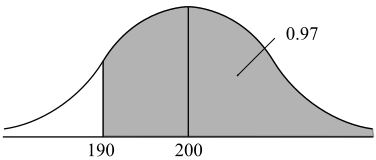
The weights of packets of lollies are normally distributed with a mean of 200 g.

If 97% of these packets of lollies have a weight of more than 190 g, then the standard deviation of the distribution, correct to one decimal place, is

  1.  3.3 g
  2.  5.3 g
  3.  6.1 g
  4.  9.4 g
  5. 12.1 g
Show Answers Only

`B`

Show Worked Solution

`text(Pr)(X > 190)` `= text(Pr)(Z > (190 – 200)/sigma) = 0.97`
`text(Pr)(Z < (-10)/sigma)` `= 0.03`
`text(z-score)` `= -1.8808\ \ text{(by CAS)}`
`-1.8808` `= (-10)/sigma`
`sigma` `= 5.31…`

 
`=>   B`

Filed Under: Normal Distribution Tagged With: Band 4, smc-719-10-Single z-score

Probability, MET1 2018 VCAA 4

Let `X` be a normally distributed random variable with a mean of 6 and a variance of 4. Let `Z` be a random variable with the standard normal distribution.

  1.  Find  `text(Pr)(X > 6)`.  (1 mark)

    --- 2 WORK AREA LINES (style=lined) ---
  2.  Find  `b`  such that  `text(Pr)(X > 7) = text(Pr)(Z < b)`.  (1 mark)

    --- 4 WORK AREA LINES (style=lined) ---

Show Answers Only

  1. `0.5`
  2. `−1/2`

Show Worked Solution

a.   `text(Mean)\ (X) = 6`

`:. text(Pr)(X > 6) = 0.5`
 

♦ Mean mark part (b) 41%.

b.    `text(Pr)(X > 7)` `= text(Pr)(X < 5)`
    `= text(Pr)(Z < (5 – 6)/2)`
    `= text(Pr)(Z < −1/2)`

 
`:. b = −1/2`

Filed Under: Normal Distribution Tagged With: Band 3, Band 5, smc-719-10-Single z-score

Probability, MET2 2007 VCAA 18 MC

The heights of the children in a queue for an amusement park ride are normally distributed with mean 130 cm and standard deviation 2.7 cm. 35% of the children are not allowed to go on the ride because they are too short.

The minimum acceptable height correct to the nearest centimetre is

  1. 126
  2. 127
  3. 128
  4. 129
  5. 130
Show Answers Only

`D`

Show Worked Solution

`X = text(height)`

`X ∼ N (130, 2.7^2)`

vcaa-2007-meth2-18

`text(Pr)(X < a)` `= 0.35\ \ \ [text(CAS: invNorm)(0.35, 130, 2.7)]`
`a` `= 128.96`

 
`=>   D`

Filed Under: Normal Distribution Tagged With: Band 4, smc-719-10-Single z-score

Probability, MET2 2007 VCAA 7 MC

The random variable `X` has a normal distribution with mean 11 and standard deviation 0.25.

If the random variable `Z` has the standard normal distribution, then the probability that `X` is less than 10.5 is equal to

  1. `text(Pr) (Z > 2)`
  2. `text(Pr) (Z < – 1.5)`
  3. `text(Pr) (Z < 1)`
  4. `text(Pr) (Z >= 1.5)`
  5. `text(Pr) (Z < – 4)`
Show Answers Only

`A`

Show Worked Solution
`text(Pr) (X < 10.5)` `= text(Pr) (Z < (10.5 – 11)/0.25)`
  `= text(Pr) (Z < – 2)`
  `= text(Pr) (Z > 2)`

 
`=> A`

Filed Under: Normal Distribution Tagged With: Band 3, smc-719-10-Single z-score

Probability, MET2 2009 VCAA 6 MC

The continuous random variable `X` has a normal distribution with mean 14 and standard deviation 2.

If the random variable `Z` has the standard normal distribution, then the probability that `X` is greater than 17 is equal to

  1. `text(Pr) (Z > 3)`
  2. `text(Pr) (Z < 2)`
  3. `text(Pr) (Z < 1.5)`
  4. `text(Pr) (Z < – 1.5)`
  5. `text(Pr) (Z > 2)`
Show Answers Only

`D`

Show Worked Solution
`text(Pr) (X > 17)` `= text(Pr) (Z > (17 – 14)/2)`
  `= text(Pr) (Z > 1.5)`
  `= text(Pr) (Z < – 1.5)`

`=>   D`

Filed Under: Normal Distribution Tagged With: Band 4, smc-719-10-Single z-score

Probability, MET2 2011 VCAA 2*

In a chocolate factory the material for making each chocolate is sent to one of two machines, machine A or machine B.

The time, `X` seconds, taken to produce a chocolate by machine A, is normally distributed with mean 3 and standard deviation 0.8.

The time, `Y` seconds, taken to produce a chocolate by machine B, has the following probability density function
 

`f(y) = {{:(0,y < 0),(y/16,0 <= y <= 4),(0.25e^(−0.5(y-4)),y > 4):}`
 

  1. Find correct to four decimal places

    1. `text(Pr)(3 <= X <= 5)`   (1 mark)

      --- 3 WORK AREA LINES (style=lined) ---

    2. `text(Pr)(3 <= Y <= 5)`   (3 marks)

      --- 3 WORK AREA LINES (style=lined) ---

  2. Find the mean of `Y`, correct to three decimal places.   (3 marks)

    --- 5 WORK AREA LINES (style=lined) ---

  3. It can be shown that  `text(Pr)(Y <= 3) = 9/32`. A random sample of 10 chocolates produced by machine B is chosen. Find the probability, correct to four decimal places, that exactly 4 of these 10 chocolate took 3 or less seconds to produce.   (2 marks)

    --- 5 WORK AREA LINES (style=lined) ---

All of the chocolates produced by machine A and machine B are stored in a large bin. There is an equal number of chocolates from each machine in the bin.

It is found that if a chocolate, produced by either machine, takes longer than 3 seconds to produce then it can easily be identified by its darker colour.

  1. A chocolate is selected at random from the bin. It is found to have taken longer than 3 seconds to produce.
  2. Find, correct to four decimal places, the probability that it was produced by machine A.   (3 marks)

    --- 6 WORK AREA LINES (style=lined) ---

Show Answers Only

a.i.  `0.4938`

a.ii. `0.4155`

b.    `4.333`

c.    `0.1812`

d.    `0.4103`

Show Worked Solution

a.i.   `X ∼\ N(3,0.8^2)`

`text(Pr)(3 <= X <= 5) = 0.4938\ \ text{(4 d.p.)}`


a.ii.    `text(Pr)(3 <= Y <= 5)` `= text(Pr)(3 <= Y <= 4) + (4 < Y <= 5)`
    `= int_3^4 (y/16)dy + int_4^5(1/4 e^(−1/2(y-4)))dy`
    `= 0.4155\ \ text{(4 d.p.)}`


b.    `text(E)(Y)` `= int_0^4 y(y/16)dy + int_4^∞ 0.25ye^(−1/2(y-4))dy`
    `= 4.333\ \ text{(3 d.p.)}`


c.   `text(Solution 1)`

`text(Let)\ \ W = #\ text(chocolates from)\ B\ text(that take less)`

`text(than 3 seconds)`

`W ∼\ text(Bi)(10, 9/32)`

`text(Using CAS: binomPdf)(10, 9/32,4)`

`text(Pr)(W = 4) = 0.1812\ \ text{(4 d.p.)}`
 

`text(Solution 2)`

`text(Pr)(W = 4)`  `=((10),(4)) (9/32)^4 (23/32)^6` 
  `=0.1812`

♦♦♦ Mean mark part (e) 19%.
MARKER’S COMMENT: Students who used tree diagrams were the most successful.


d.   
`text(Pr)(A | L)` `= (text(Pr)(AL))/(text(Pr)(L))`
  `= (0.5 xx 0.5)/(0.5 xx 0.5 + 0.5 xx 23/32)`
  `= 0.4103\ \ text{(4 d.p.)}`

Filed Under: Binomial, Conditional Probability and Set Notation, Normal Distribution, Probability density functions Tagged With: Band 4, Band 5, Band 6, smc-2736-10-Conditional probability, smc-637-10-E(X), smc-637-45-Other probability, smc-637-70-Exp/Log PDF, smc-638-10-binomial expansion (non-calc), smc-638-20-binomCdf (CAS), smc-646-20-Multi-stage events, smc-719-10-Single z-score, smc-719-30-Other z-score intervals

Probability, MET2 2016 VCAA 3*

A school has a class set of 22 new laptops kept in a recharging trolley. Provided each laptop is correctly plugged into the trolley after use, its battery recharges.

On a particular day, a class of 22 students uses the laptops. All laptop batteries are fully charged at the start of the lesson. Each student uses and returns exactly one laptop. The probability that a student does not correctly plug their laptop into the trolley at the end of the lesson is 10%. The correctness of any student’s plugging-in is independent of any other student’s correctness.

  1. Determine the probability that at least one of the laptops is not correctly plugged into the trolley at the end of the lesson. Give your answer correct to four decimal places.   (2 marks)

    --- 5 WORK AREA LINES (style=lined) ---

  2. A teacher observes that at least one of the returned laptops is not correctly plugged into the trolley.
  3. Given this, find the probability that fewer than five laptops are not correctly plugged in. Give your answer correct to four decimal places.   (2 marks)

    --- 5 WORK AREA LINES (style=lined) ---

The time for which a laptop will work without recharging (the battery life) is normally distributed, with a mean of three hours and 10 minutes and standard deviation of six minutes. Suppose that the laptops remain out of the recharging trolley for three hours.

  1. For any one laptop, find the probability that it will stop working by the end of these three hours. Give your answer correct to four decimal places.   (2 marks)

    --- 5 WORK AREA LINES (style=lined) ---

A supplier of laptops decides to take a sample of 100 new laptops from a number of different schools. For samples of size 100 from the population of laptops with a mean battery life of three hours and 10 minutes and standard deviation of six minutes, `hat P` is the random variable of the distribution of sample proportions of laptops with a battery life of less than three hours.

  1. Find the probability that `text(Pr) (hat P >= 0.06 | hat P >= 0.05)`. Give your answer correct to three decimal places. Do not use a normal approximation.   (3 marks)

    --- 6 WORK AREA LINES (style=lined) ---

It is known that when laptops have been used regularly in a school for six months, their battery life is still normally distributed but the mean battery life drops to three hours. It is also known that only 12% of such laptops work for more than three hours and 10 minutes.

  1. Find the standard deviation for the normal distribution that applies to the battery life of laptops that have been used regularly in a school for six months, correct to four decimal places.   (2 marks)

    --- 5 WORK AREA LINES (style=lined) ---

The laptop supplier collects a sample of 100 laptops that have been used for six months from a number of different schools and tests their battery life. The laptop supplier wishes to estimate the proportion of such laptops with a battery life of less than three hours.

  1. Suppose the supplier tests the battery life of the laptops one at a time.
  2. Find the probability that the first laptop found to have a battery life of less than three hours is the third one.   (1 mark)

    --- 2 WORK AREA LINES (style=lined) ---

The laptop supplier finds that, in a particular sample of 100 laptops, six of them have a battery life of less than three hours.

  1. Determine the 95% confidence interval for the supplier’s estimate of the proportion of interest. Give values correct to two decimal places.   (1 mark)

    --- 2 WORK AREA LINES (style=lined) ---

  2. The supplier also provides laptops to businesses. The probability density function for battery life, `x` (in minutes), of a laptop after six months of use in a business is


    `qquad qquad f(x) = {(((210-x)e^((x-210)/20))/400, 0 <= x <= 210), (0, text{elsewhere}):}`
     

  3. Find the mean battery life, in minutes, of a laptop with six months of business use, correct to two decimal places.   (1 mark)

--- 2 WORK AREA LINES (style=lined) ---

Show Answers Only

  1. `0.9015`
  2. `0.9311`
  3. `0.0478`
  4. `0.658`
  5. `8.5107`
  6. `1/8`
  7. `p in (0.01, 0.11)`
  8. `170.01\ text(min)`

Show Worked Solution

a.   `text(Solution 1)`

`text(Let)\ \ X = text(number not correctly plugged),`

`X ~ text(Bi) (22, .1)`

`text(Pr) (X >= 1) = 0.9015\ \ [text(CAS: binomCdf)\ (22, .1, 1, 22)]`


`text(Solution 2)`

`text(Pr) (X>=1)` `=1-text(Pr) (X=0)`
  `=1-0.9^22`
  `=0.9015\ \ text{(4 d.p.)}`


 b.   `text(Pr) (X < 5 | X >= 1)`

MARKER’S COMMENT: Early rounding was a common mistake, producing 0.9312.

`= (text{Pr} (1 <= X <= 4))/(text{Pr} (X >= 1))`

`= (0.83938…)/(0.9015…)\ \ [text(CAS: binomCdf)\ (22, .1, 1,4)]`

`= 0.9311\ \ text{(4 d.p.)}`


c.   `text(Let)\ \ Y = text(battery life in minutes)`

MARKER’S COMMENT: Some working must be shown for full marks in questions worth more than 1 mark.

`Y ~ N (190, 6^2)`

`text(Pr) (Y <= 180)= 0.0478\ \ text{(4 d.p.)}`

`[text(CAS: normCdf)\ (−oo, 180, 190,6)]`


d.   `text(Let)\ \ W = text(number with battery life less than 3 hours)`

♦ Mean mark part (d) 33%.

`W ~ Bi (100, .04779…)`

`text(Pr) (hat P >= .06 | hat P >= .05)` `= text(Pr) (X_2 >= 6 | X_2 >= 5)`
  `= (text{Pr} (X_2 >= 6))/(text{Pr} (X_2 >= 5))`
  `= (0.3443…)/(0.5234…)`
  `= 0.658\ \ text{(3 d.p.)}`


e.   `text(Let)\ \ B = text(battery life), B ~ N (180, sigma^2)`

`text(Pr) (B > 190)` `= .12`
`text(Pr) (Z < a)` `= 0.88`
`a` `dot = 1.17499…\ \ [text(CAS: invNorm)\ (0.88, 0, 1)]`
`-> 1.17499` `= (190-180)/sigma\ \ [text(Using)\ Z = (X-u)/sigma]`
`:. sigma` `dot = 8.5107`


f.    `text(Pr) (MML)` `= 1/2 xx 1/2 xx 1/2`
    `= 1/8`


g.   `text(95% confidence int:) qquad quad [(text(CAS:) qquad qquad 1-text(Prop)\ \ z\ \ text(Interval)), (x = 6), (n = 100)]`

`p in (0.01, 0.11)`


h.    `mu` `= int_0^210 (x* f(x)) dx`
  `:. mu` `dot = 170.01\ text(min)`

Filed Under: Binomial, Normal Distribution, Probability density functions Tagged With: Band 3, Band 4, Band 5, Band 6, smc-637-10-E(X), smc-637-70-Exp/Log PDF, smc-638-20-binomCdf (CAS), smc-719-10-Single z-score, smc-719-20-95% confidence intervals

Probability, MET2 2016 VCAA 16 MC

The random variable, `X`, has a normal distribution with mean 12 and standard deviation 0.25

If the random variable, `Z`, has the standard normal distribution, then the probability that `X` is greater than 12.5 is equal to

  1. `text(Pr) (Z < text{− 4)}`
  2. `text(Pr) (Z < text{− 1.5)}`
  3. `text(Pr) (Z < 1)`
  4. `text(Pr) (Z >= 1.5)`
  5. `text(Pr) (Z > 2)`
Show Answers Only

`E`

Show Worked Solution

`text(Pr) (X > 12.5)`

`= text(Pr) (Z > (12.5 – 12)/.25)`

`= text(Pr) (Z > 2)`
 

`=>   E`

Filed Under: Normal Distribution Tagged With: Band 3, smc-719-10-Single z-score

Probability, MET2 2011 VCAA 13 MC

In an orchard of 2000 apple trees it is found that 1735 trees have a height greater than 2.8 metres. The heights are distributed normally with a mean `mu` and standard deviation 0.2 metres.

The value of `mu` is closest to

  1. `3.023`
  2. `2.577`
  3. `2.230`
  4. `1.115`
  5. `0.223` 
Show Answers Only

`=> A`

Show Worked Solution

met2-2011-vcaa-13-mc-answer

`X = text(height), X ∼\ N(μ,0.2^2)`

`text(Pr)(X <= 2.8)` `= 1 – 1735/2000`
  `= 0.1325`
`text(Pr)(Z < a)` `= .1325`
`:. a` `= −1.1147qquad[text(CAS: inv Norm)]`


`text(Relate)\ X\ text(and)\ Z\ text(scores:)`

`−1.1147` `= (2.8 – μ)/0.2`
`:. μ` `= 3.023`

 
`=> A`

Filed Under: Normal Distribution Tagged With: Band 5, smc-719-10-Single z-score

Probability, MET2 2011 VCAA 12 MC

The continuous random variable `X` has a normal distribution with mean 30 and standard deviation 5. For a given number `a, text(Pr)(X > a) = 0.20`.

Correct to two decimal places, `a` is equal to

  1. `23.59`
  2. `24.00`
  3. `25.79`
  4. `34.21`
  5. `36.41`
Show Answers Only

`=> D`

Show Worked Solution

met2-2011-vcaa-12-mc-answer1

`X ∼\ N(30,5^2)`

`text(Pr)(X < a)` `= 0.8qquad[text(CAS: inv Norm) (.8,30,5)]`
`:. a` `= 34.21`

`=> D`

Filed Under: Normal Distribution Tagged With: Band 4, smc-719-10-Single z-score

Probability, MET1 2006 VCAA 5

Let `X` be a normally distributed random variable with a mean of 72 and a standard deviation of 8. Let `Z` be the standard normal random variable. Use the result that `text(Pr) (Z < 1) = 0.84`, correct to two decimal places, to find

  1. the probability that `X` is greater than `80`  (1 mark)

    --- 4 WORK AREA LINES (style=lined) ---

  2. the probability that  `64 < X < 72`  (1 mark)

    --- 4 WORK AREA LINES (style=lined) ---

  3. the probability that  `X < 64`  given that  `X < 72`  (2 marks)

    --- 4 WORK AREA LINES (style=lined) ---

Show Answers Only

  1. `0.16`
  2. `0.34`
  3. `8/25`

Show Worked Solution

a.   vcaa-2006-meth-5ai

`text(Pr) (X > 80)`

`= text(Pr) (Z > (80 – 72)/8)`

`= text(Pr) (Z > 1)`

`= 0.16`


b.   `text(Pr) (64 < X < 72)`

♦ Mean mark 45%.

`= text(Pr) (72 < X < 80)\ \ \ text(due to symmetry)`

`= 0.5 – 0.16`

`= 0.34`


♦ Mean mark 40%.
MARKER’S COMMENT: Notation was poor, showing a lack of understanding in this area.

c.   `text(Conditional probability)`

`text(Pr) (X < 64 | X < 72)` `= (text{Pr} (X < 64))/(text{Pr} (X < 72))`
  `= 0.16/0.50`
  `= 8/25 or 0.32`

Filed Under: Normal Distribution Tagged With: Band 4, Band 5, smc-719-10-Single z-score, smc-719-30-Other z-score intervals, smc-719-50-Conditional probability

Statistics, MET1 2010 VCAA 5

Let `X` be a normally distributed random variable with mean 5 and variance 9 and let `Z` be the random variable with the standard normal distribution.

  1. Find  `text(Pr) (X > 5)`.  (1 mark)

    --- 2 WORK AREA LINES (style=lined) ---

  2. Find `b` such that  `text(Pr) (X > 7) = text(Pr) (Z < b)`.  (2 marks)

    --- 4 WORK AREA LINES (style=lined) ---

Show Answers Only

  1. `0.5`
  2. `-2/3`

Show Worked Solution

a.   `text(Pr) (X > 5) = 0.5`


♦ Part (b) mean mark 43%.

b.   `text(Pr) (X > 7)` `= text(Pr) (Z > (7 – 5)/3)`
    `= text(Pr) (Z > 2/3)`
    `= text(Pr) (Z < -2/3)`

 
`:. b=-2/3`

Filed Under: Normal Distribution Tagged With: Band 4, Band 5, smc-719-10-Single z-score

Probability, MET1 2015 VCAA 6

Let the random variable `X` be normally distributed with mean 2.5 and standard deviation 0.3

Let `Z` be the standard normal random variable, such that  `Z ∼\ text(N)(0, 1)`.

  1. Find `b` such that  `text(Pr)(X > 3.1) = text(Pr)(Z < b)`.  (1 mark)

    --- 3 WORK AREA LINES (style=lined) ---

  2. Using the fact that, correct to two decimal places,  `text(Pr)(Z < –1) = 0.16`, find  `text(Pr)(X < 2.8 | X > 2.5)`.
  3. Write the answer correct to two decimal places.  (2 marks) 

    --- 5 WORK AREA LINES (style=lined) ---

Show Answers Only

  1. `−2`
  2. `0.68`

Show Worked Solution
♦ Part (a) mean mark 50%.

a.    `text(Pr)(X > 3.1)` `= text(Pr)(Z > (3.1 – 2.5)/0.3)`
    `= text(Pr)(Z > 2)`
    `= text(Pr)(Z < − 2)`

`:. b = −2`


♦ Part (b) mean mark 48%.
MARKER’S COMMENT: Students who drew a diagram of a “normal” curve with relevent shaded areas were more successful.

b.    met1-2015-vcaa-q6-answer

`text(Pr)(X < 2.8 | X > 2.5)`

`= (text(Pr)(2.5 < X < 2.8))/(text(Pr)(X > 2.5))`
`= 0.34/0.5`
`= 34/50`
`= 68/100`
`= 0.68`

Filed Under: Normal Distribution Tagged With: Band 5, smc-719-10-Single z-score, smc-719-50-Conditional probability

Probability, MET2 2014 VCAA 4*

Patricia is a gardener and she owns a garden nursery. She grows and sells basil plants and coriander plants.

The heights, in centimetres, of the basil plants that Patricia is selling are distributed normally with a mean of 14 cm and a standard deviation of 4 cm. There are 2000 basil plants in the nursery.

  1. Patricia classifies the tallest 10 per cent of her basil plants as super.
  2. What is the minimum height of a super basil plant, correct to the nearest millimetre?   (1 mark)

    --- 5 WORK AREA LINES (style=lined) ---

Patricia decides that some of her basil plants are not growing quickly enough, so she plans to move them to a special greenhouse. She will move the basil plants that are less than 9 cm in height.

  1. How many basil plants will Patricia move to the greenhouse, correct to the nearest whole number?   (2 marks)

    --- 4 WORK AREA LINES (style=lined) ---

The heights of the coriander plants, `x` centimetres, follow the probability density function  `h(x)`,

`h(x) = {(pi/100 sin ((pi x)/50), 0 < x < 50), (\ \ \ \ \ \0, text(otherwise)):}`

  1. State the mean height of the coriander plants.   (1 mark)

    --- 2 WORK AREA LINES (style=lined) ---

Patricia thinks that the smallest 15 per cent of her coriander plants should be given a new type of plant food

  1. Find the maximum height, correct to the nearest millimetre, of a coriander plant if it is to be given the new type of plant food.   (2 marks)

    --- 1 WORK AREA LINES (style=lined) ---

Patricia also grows and sells tomato plants that she classifies as either tall or regular. She finds that 20 per cent of her tomato plants are tall.

A customer, Jack, selects `n` tomato plants at random.

  1. Let `q` be the probability that at least one of Jack’s `n` tomato plants is tall.
  2. Find the minimum value of `n` so that `q` is greater than 0.95.   (2 marks)

    --- 5 WORK AREA LINES (style=lined) ---

Show Answers Only

  1. `191\ text(mm)`
  2. `211\ text(plants)`
  3. `25\ text(cm)`
  4. `127\ text(mm)`
  5. `14\ text(plants)`

Show Worked Solution

a.   `text(Let)\ \ X = text(plant height,)`

♦ Mean mark 43%.

`X ∼\ text(N)(14,4^2)`

`text(Pr)(X > a)` `= 0.1`
`a` `= 19.1\ text(cm)quadtext([CAS: invNorm)\ (.9,14,4)]`
  `=191\ text{mm  (nearest mm)}`


`:.\ text(Min super plant height is 191 mm.)`


b.   `text(Pr)(X < 9) = 0.10565…\ qquadtext([CAS: normCdf)\ (−∞,9,14,4)]`

`:.\ text(Number moved to greenhouse)`

`= 0.10565… xx 2000`

`= 211\ text(plants)`


c.    `text(E)(X)` `= int_0^50  (x xx pi/100 sin((pix)/50))dx`
    `= 25\ text(cm)`


d.    `text(Solve:)\ \ int_0^a h(x)\ dx` `= 0.15\ \ text(for)\ \ a ∈ (0,50)`

♦♦ Mean mark 33%.

`:.a` `=12.659…\ text(cm)`
  `=127\ text{mm  (nearest mm)}`


e.   `text(Let)\ \ Y =\ text(Number of tall plants,)`

♦♦ Mean mark 30%.

`Y ∼\ text(Bi) (n,0.2)`

`text(Pr)(Y >= 1)` `> 0.95`
`1-text(Pr)(Y = 0)` `> 0.95`
`0.05` `> 0.8^n`
`n` `> 13.4\ \ text([by CAS])`


`:. n_text(min) = 14\ text(plants)`

Filed Under: Binomial, Normal Distribution, Probability density functions Tagged With: Band 4, Band 5, smc-637-10-E(X), smc-637-80-Trig PDF, smc-638-40-Inverse Binom N (CAS), smc-719-10-Single z-score

Probability, MET2 2014 VCAA 5 MC

The random variable `X` has a normal distribution with mean 12 and standard deviation 0.5.

If `Z` has the standard normal distribution, then the probability that `X` is less than 11.5 is equal to

  1. `text(Pr)(Z > – 1)`
  2. `text(Pr)(Z < – 0.5)`
  3. `text(Pr)(Z > 1)`
  4. `text(Pr)(Z >= 0.5)`
  5. `text(Pr)(Z < 1)`
Show Answers Only

`C`

Show Worked Solution
`text(Pr)(X < 11.5)` `= text(Pr)(Z < (11.5 – 12)/0.5)`
  `= text(Pr)(Z < −1)`
  `= text(Pr)(Z > 1)`

`=>   C`

Filed Under: Normal Distribution Tagged With: Band 4, smc-719-10-Single z-score

Statistics, MET2 2013 VCAA 22 MC

Butterflies of a particular species die `T` days after hatching, where `T` is a normally distributed random variable with a mean of 120 days and a standard deviation of `sigma` days.

If, from a population of 2000 newly hatched butterflies, 150 are expected to die in the first 90 days, then the value of `sigma` is closest to

  1. 7 days
  2. 13 days
  3. 17 days
  4. 21 days
  5. 37 days
Show Answers Only

`D`

Show Worked Solution

`T = text(days until death after hatching,)`

`T ∼ N (120,sigma^2)`

`text(Pr)(T <= 90)` `= 150/2000`


`−1.4395` `= (90 – 120)/sigma`
`:. sigma` `= 20.8`

 
`=>   D`

Filed Under: Normal Distribution Tagged With: Band 5, smc-719-10-Single z-score

Statistics, MET2 2012 VCAA 11 MC

The weights of bags of flour are normally distributed with mean 252 g and standard deviation 12 g. The manufacturer says that 40% of bags weigh more than `x` g.

The maximum possible value of `x` is closest to

  1. `249.0`
  2. `251.5`
  3. `253.5`
  4. `254.5`
  5. `255.0`
Show Answers Only

`E`

Show Worked Solution

met2-2011-vcaa-11-mc-answer

`X = text(weight), X ∼ N(252, 12^2)`

`Pr(X < x)` `= 0.6`
`:. x` `= 255.04`

 
`[text(CAS: invNorm) (0.6,252,12)]`

`=>   E`

Filed Under: Normal Distribution Tagged With: Band 4, smc-719-10-Single z-score

Copyright © 2014–2025 SmarterEd.com.au · Log in