SmarterEd

Aussie Maths & Science Teachers: Save your time with SmarterEd

  • Login
  • Get Help
  • About

Calculus, MET2 2022 VCAA 1

The diagram below shows part of the graph of `y=f(x)`, where `f(x)=\frac{x^2}{12}`.
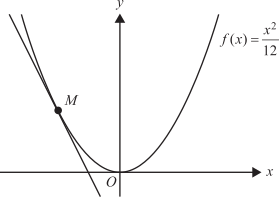
 

  1. State the equation of the axis of symmetry of the graph of `f`.   (1 mark)

    --- 2 WORK AREA LINES (style=lined) ---

  2. State the derivative of `f` with respect to `x`.   (1 mark)

    --- 2 WORK AREA LINES (style=lined) ---

The tangent to `f` at point `M` has gradient `-2` .

  1. Find the equation of the tangent to `f` at point `M`.   (2 marks)

    --- 6 WORK AREA LINES (style=lined) ---

The diagram below shows part of the graph of `y=f(x)`, the tangent to `f` at point `M` and the line perpendicular to the tangent at point `M`.


  1.  i. Find the equation of the line perpendicular to the tangent passing through point `M`.   (1 mark)

    --- 5 WORK AREA LINES (style=lined) ---

  2. ii. The line perpendicular to the tangent at point `M` also cuts `f` at point `N`, as shown in the diagram above.
  3.     Find the area enclosed by this line and the curve `y=f(x)`.   (2 marks)

    --- 8 WORK AREA LINES (style=lined) ---

  4. Another parabola is defined by the rule `g(x)=\frac{x^2}{4 a^2}`, where `a>0`.
  5. A tangent to `g` and the line perpendicular to the tangent at `x=-b`, where `b>0`, are shown below.

  1. Find the value of `b`, in terms of `a`, such that the shaded area is a minimum.   (4 marks)

    --- 8 WORK AREA LINES (style=lined) ---
Show Answers Only

a.    `x=0`

b.    ` f^{\prime}(x)=1/6x`

c.    `x=-12`

di.    `y=1/2x + 18`

dii.   Area`= 375` units²

e.    `b = 2a^2`

Show Worked Solution

a.   Axis of symmetry:  `x=0`
  

b.    `f(x)`  `=\frac{x^2}{12}`  
  ` f^{\prime}(x)` `= 1/6x`  

  
c.  
At `M` gradient `= -2`

`1/6x` `= -2`  
`x` `= -12`  

 
When  `x = -12`
 

`f(x) = (-12)^2/12 = 12`
 
Equation of tangent at `(-12 , 12)`:

`y-y_1` `=m(x-x_1)`  
`y-12` `= -2(x + 12)`  
`y` `= -2x-12`  


d.i  
Gradient of tangent `= -2`

`:.`  gradient of normal `= 1/2` 

Equation at `M(- 12 , 12)`

`y -y_1` `=m(x-x_1)`  
`y-12` `= 1/2(x + 12)`  
`y` `=1/2x + 18`  


d.ii 
Points of intersection of `f(x)` and normal are at  `M` and `N`.

So equate ` y = x^2/12` and  `y = 1/2x + 18` to find `N`

`x^2/12` `=1/2x + 18`  
`x^2-6x-216` `=0`  
`(x + 12)(x-18)` `=0`  

   
`:.\  x = -12` or `x = 18`

Area `= \int_{-12}^{18}\left(\frac{1}{2} x+18-\frac{x^2}{12}\right) d x`  
  `= [x^2/4 + 18x-x^3/36]_(-12)^18`  
  `= [18^2/4 +18^2-18^3/36] – [12^2/4 + 18 xx (-12)-(-12)^3/36]`  
  `= 375` units²  


e.   `g(x) = x^2/(4a^2)`   `a > 0`

At `x = -b`   `y = (-b)^2/(4a^2) = b^2/4a^2`

`g^{\prime}(x) = (2x)/(4a^2) = x/(2a^2)`

Gradient of tangent `= (-b)/(2a^2)`

Gradient of normal `= (2a^2)/b`

Equation of normal at `(- b , b^2/(4a^2))`

`y-y_1` `= m(x-x_1)`  
`y-b^2/(4a^2)` `= (2a^2)/b(x-(-b))`  
`y` `= (2a^2x)/b + 2a^2 + b^2/(4a^2)`  
`y` `= (2a^2x)/b +(8a^4 + b^2)/(4a^2)`  

 
Points of intersection of normal and parabola (Using CAS)

solve `((2a^2x)/b +(8a^4 + b^2)/(4a^2) = x^2/(4a^2),x)`

`x =-b`  or  `x = (8a^4+b^2)/b`

 
Calculate area using CAS

`A = \int_{-b}^{(8a^4+b^2)/b}\left(\frac{2a^2x}{b} +\frac{8a^4 + b^2}{4a^2}-frac{x^2}{4a^2} \right) dx`

`A = frac{64a^12 + 48a^8b^2 + 12a^4b^4 + b^6}{3a^2b^3}`
 
Using CAS Solve derivative of `A = 0`  with respect to `b` to find `b`

solve`(d/(db)(frac{64a^12 + 48a^8b^2 + 12a^4b^4 + b^6}{3a^2b^3})=0,b)`

 
`b =-2a^2`   and  `b = 2a^2`

Given `b > 0`

`b = 2a^2`


♦♦ Mean mark (e) 33%.
MARKER’S COMMENT: Common errors: Students found `\int_{-b}^{\frac{8 a^4+b^2}{b}}\left(y_n\right) d x` and failed to subtract `g(x)` or had incorrect terminals.

Filed Under: Area Under Curves, Maxima and Minima, Tangents and Normals Tagged With: Band 2, Band 4, Band 5, Band 6, smc-634-10-Polynomial, smc-634-50-Find tangent given curve, smc-641-10-Area, smc-723-10-Quadratic, smc-723-80-Area between graphs

Calculus, MET2 2020 VCAA 16 MC

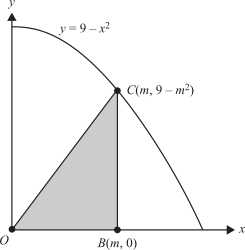
A right-angled triangle, `OBC`, is formed using the horizontal axis and the point  `C(m, 9 - m^2)`, where  `m ∈ (0, 3)`, on the parabola  `y = 9 - x^2`, as shown below.
 

The maximum area of the triangle  `OBC`  is

  1. `sqrt3/3`
  2. `(2sqrt3)/3`
  3. `sqrt3`
  4. `3sqrt3`
  5. `9sqrt3`
Show Answers Only

`D`

Show Worked Solution
`A` `=1/2 m (9-m^2)`  
  `=9/2m – m^3/2`  

  
`text(Solve:)\ (dA)/(dm)=0\ \ text(for)\ \ m`

`m=sqrt3`
 

`:. A_max` `=(9sqrt3)/2 – (3sqrt3)/2`  
  `=3sqrt3`  

 
`=>D`

Filed Under: Area Under Curves Tagged With: Band 4, smc-723-10-Quadratic

Calculus, MET2 2021 VCAA 2

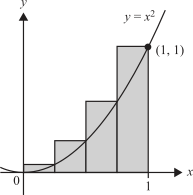
Four rectangles of equal width are drawn and used to approximate the area under the parabola  `y = x^2`  from  `x = 0`  to  `x = 1`.

The heights of the rectangles are the values of the graph of  `y = x^2` at the right endpoint of each rectangle, as shown in the graph below.
 

  1. State the width of each of the rectangles shown above.  (1 mark)
  2. Find the total area of the four rectangles shown above.  (1 mark)
  3. Find the area between the graph of  `y = x^2`, the `x`-axis and the line  `x=1`.  (2 marks)
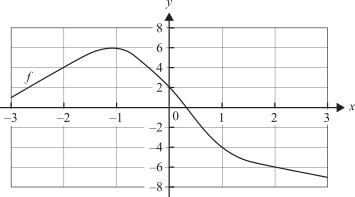
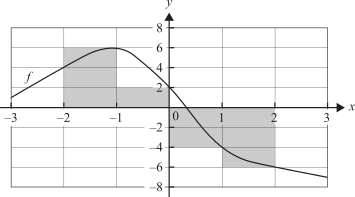
  4. The graph of `f` is shown below.


    Approximate  `int_(-2)^2 f(x)\ dx`  using four rectangles of equal width and the right endpoint of each rectangle.  (1 mark)

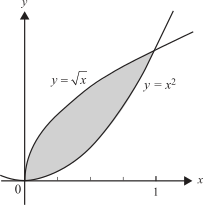
Parts of the graphs of  `y = x^2`  and  `y = sqrtx`  are shown below.


  1. Find the area of the shaded region.  (1 mark)
  2. The graph of  `y=x^2` is transformed to the graph of  `y = ax^2`, where  `a ∈ (0, 2]`.
  3. Find the values of `a` such that the area defined by region(s) bounded by the graphs of  `y = ax^2`  and  `y = sqrtx`  and the lines  `x = 0`  and  `x = a`  is equal to `1/3`. Give your answer correct to two decimal places.  (4 marks)
Show Answers Only
  1. `0.25`
  2. `15/32\ text(u)^2`
  3. `1/3\ text(u)^2`
  4. `-2`
  5. `1/3\ text(u)^2`
  6. `1.13`
Show Worked Solution

a.   `0.25`


b.    `text{Area}` `= 1/4 (1/16 + 1/4 + 9/16 + 1)`
    `= 15/32\ text(u)^2`


c.    `text{Area}` `= int_0^1 x^2 dx`
    `= 1/3\ text(u)^2`


d.

♦♦♦ Mean mark part (d) 16%.

`int_-2^2 f(x)\ dx` `≈ 6 + 2 – 4 – 6`
  `≈ -2`


e.   `text{Area}` `= int_0^1 (sqrtx – x^2) dx`
    `= 1/3\ text(u)^2`

 
f.   `text{Case 1:} \ a ≤ 1`

♦♦♦ Mean mark part (f) 18%.

`int_0^a (sqrtx – ax^2) dx = 1/3`

`a =  0.77 \ \ text{or} \ \ a = 1.00`
  

`text{Case 2:} \ a > 1`

`sqrtx = ax^2 \ => \ x = a^{- 3/2}`

`text{Solve for}\ a\ text{(by CAS)}:`

`int_0^{a^{- 3/2}} (sqrtx – ax^2) dx + int_{a^{- 3/2}}^a (sqrtx – ax^2) dx = 1/3`

`:. a = 1.13`

Filed Under: Area Under Curves (old) Tagged With: Band 3, Band 4, Band 6, smc-723-10-Quadratic, smc-723-70-Other, smc-723-80-Area between graphs, smc-723-90-Approximations

Calculus, MET2 2011 VCAA 20 MC

A part of the graph of  `g: R -> R, g(x) = x^2 - 4`  is shown below.

met2-2011-vcaa-20-mc

The area of the region marked `A` is the same area of the region marked `B`.

The exact value of `a` is

A.   `0`

B.   `6`

C.   `sqrt6`

D.   `12`

E.   `2sqrt3` 

Show Answers Only

`=> E`

Show Worked Solution

`text(S)text(ince Area)\ A = text(Area)\ B,`

`int_0^a (x^2-4)\ dx` `=0`
`[x^3/3 – 4x]_0^a` `=0`
`a^3/3 – 4a` `=0`
`a^2` `=12`
`:.a` `=2sqrt3,\ \ text(for)\ a > 0`

`=> E`

Filed Under: Area Under Curves Tagged With: Band 4, smc-723-10-Quadratic

Calculus, MET2 2011 VCAA 19 MC

A part of the graph of  `f: R -> R, f(x) = x^2`  is shown below. Zoe finds the approximate area of the shaded region by drawing rectangles as shown in the second diagram.

met2-2011-vcaa-19-mc

Zoe's approximation is  `ptext(%)` more than the exact value of the area.

The value of `p` is closest to

A.   `10`

B.   `15`

C.   `20`

D.   `25`

E.   `30`

Show Answers Only

`=> D`

Show Worked Solution
`A_text(exact)` `= int_0^6 x^2 dx`
  `= 72`
♦ Mean mark 43%.
`A_text(approx)`

`= 1[f(1) + f(2) + f(3) + …`

       `+ f(4) + f(5) + f(6)]`

  `= 91`


`p text(%)` `= text(increase)/text(exact area) xx 100`
  `= (91 – 72)/72 xx 100`
  `= 26.4 text(%)`

`=> D`

Filed Under: Area Under Curves (old) Tagged With: Band 5, smc-723-10-Quadratic, smc-723-90-Approximations

Calculus, MET1 2006 VCAA 11

Part of the graph of the function  `f: R-> R, f(x) = -x^2 + ax + 12`  is shown below. If the shaded area is 45 square units, find the values of `a, m` and `n` where `m` and `n` are the `x`-axis intercepts of the graph of `y = f(x).`  (5 marks)

vcaa-2006-meth-11a

Show Answers Only

`m = 6;\ \ \ n = – 2`

Show Worked Solution

`text(Shaded Area) = 45`

`45` `= int_0^3 (– x^2 + ax + 12)\ dx`
`45` `= [– 1/3x^3 + 1/2 ax^2 + 12x]_0^3`
`45` `= – 9 + 9/2a + 36`
`9/2 a` `= 18`
`:. a` `= 36/9`
  `= 4`


`f(x) = – x^2 + 4x + 12`

`text(Factorise to find)\ x text(-intercepts:)`

`- (x^2 – 4x – 12)` `=0`
`(x – 6) (x + 2)` `=0`


`:. m = 6, and n = – 2`

Filed Under: Area Under Curves Tagged With: Band 4, smc-723-10-Quadratic

Calculus, MET2 2013 VCAA 4

Part of the graph of a function `g: R -> R, \ g (x) = (16-x^2)/4` is shown below.

VCAA 2013 4a

  1. Points `B` and `C` are the positive `x`-intercept and `y`-intercept of the graph `g`, respectively, as shown in the diagram above. The tangent to the graph of `g` at the point `A` is parallel to the line segment `BC.`
    1. Find the equation of the tangent to the graph of `g` at the point `A.`   (2 marks)

      --- 5 WORK AREA LINES (style=lined) ---

    2. The shaded region shown in the diagram above is bounded by the graph of `g`, the tangent at the point `A`, and the `x`-axis and `y`-axis.
    3. Evaluate the area of this shaded region.   (3 marks)

      --- 6 WORK AREA LINES (style=lined) ---

  2. Let `Q` be a point on the graph of  `y = g(x)`.
  3. Find the positive value of the `x`-coordinate of `Q`, for which the distance `OQ` is a minimum and find the minimum distance.   (3 marks)

    --- 6 WORK AREA LINES (style=lined) ---

The tangent to the graph of `g` at a point `P` has a negative gradient and intersects the `y`-axis at point  `D(0, k)`, where  `5 <= k <= 8.`
 

VCAA 2013 4c
 

  1. Find the gradient of the tangent in terms of `k.`   (2 marks)

    --- 8 WORK AREA LINES (style=lined) ---
  2.   i. Find the rule `A(k)` for the function of `k` that gives the area of the shaded region.   (2 marks)

    --- 5 WORK AREA LINES (style=lined) ---

  3.  ii. Find the maximum area of the shaded region and the value of `k` for which this occurs.   (2 marks)

    --- 5 WORK AREA LINES (style=lined) ---

  4. iii. Find the minimum area of the shaded region and the value of `k` for which this occurs.  (2 marks)

    --- 3 WORK AREA LINES (style=lined) ---

Show Answers Only
    1. `A: y = 5-x`
    2. `text(See Worked Solutions)`
  1. `2sqrt3\ text(units when)\ x = 2sqrt2`
  2. `gprime(2sqrt(k-4)) =-sqrt(k-4)`
    1. `A(k) = (k^2)/(2sqrt(k-4))-32/3, k ∈ [5,8]`
    2. `A_text(max) = 16/3quadtext(when)quadk = 8`
    3. `A_text(min) = (64sqrt3)/9-32/3quadtext(when)quadk = 16/3`
Show Worked Solution

a.i.   `B(4,0), C(0,4), A(a,(16-a^2)/4)`

`m_(BC) = m_text(tan) = (4-0)/(0-4) = -1`

`g(x)` `= (16-x^2)/4`
`g^{prime}(x)` `=-x/2`

 
`text(S)text(ince)\ \ g^{prime}(a) = -1,`

`=>a = 2`

`text(T)text(angent passes through)\ \ (2,3),`

`y-3` `=-(x-2)`
`y` `=-x + 5`

 
`text(Alternatively, using technology:)`

`[text(CAS: tangent Line)]\ (g(x),x,2)`
 

a.ii.   `text(Solution 1)`

♦ Mean mark 37%.
MARKER’S COMMENT: A common incorrect answer:
`int_0^5((-x+5)-g(x))dx=35/12`.  Know why it’s wrong!

  `D(5,0), E(0,5)`

`text(Area)` `= DeltaEOD-int_0^4 g(x)\ dx`
  `= 1/2 xx 5 xx 5-32/3`
  `= 11/6\ text(u²)`

 
`text(Solution 2)`

`text(Area)` `= int_0^5 (-x+5)\ dx-int_0^4 g(x)\ dx`
  `= 11/6\ text(u²)`


b.   `Q(x, (16-x^2)/4), O(0,0)`

♦♦♦ Mean mark 20%.
`z` `= OQ`
  `= sqrt(x^2 + ((16-x^2)/4)^2), x > 0`

 
`text(Max or min when)\ \ (dz)/(dx)=0,`

`text(Solve:)\ (dz)/dx = 0quadtext(for)quadx > 0`

`=> x = 2sqrt2`

`=>z(2sqrt2) = 2sqrt3`

`:. text(Min distance of)\ \ 2sqrt3\ \ text(units when)\ \ x = 2sqrt2`
 

c.   `text(Let)\ \ P(p, (16-p^2)/4)`

♦♦♦ Mean mark 8%.

`m_text(tan)\ text(at)\ P =-p/2`

`m_(PD) = ((16-p^2)/4-k)/(p-0)`
 

`text(Equating gradients,)`

`text(Solve:)\ \ ((16-p^2)/4-k)/p=-p/2\ \ text(for)\ p,`

`=> p=2sqrt(k-4)`
 

 `:.\ text(Gradient of tangent:)`

`g^{prime}(2sqrt(k-4)) =-sqrt(k-4)`
 

d.i.   `text(Equation of tangent:)`

♦♦♦ Mean mark 8%.

`y = -sqrt(k-4)x + k`

`text(CAS: tangent Line)\ (g(x),x,2sqrt(k-4))`

`xtext(-int of tangent:)\ x = k/(sqrt(k-4))`
 

`:. A(k)` `= 1/2 xx (k/(sqrt(k-4))) xx k-int_0^4 g(x)\ dx`
  `= (k^2)/(2sqrt(k-4))-32/3, \ \ k ∈ [5,8]`


d.ii.   `text(Solve:)\ \ A(k)=0quadtext(for)quadk ∈ [5,8]`

♦♦♦ Mean mark 5%.

`=> k=16/3`

  `text(Sketch the graph of)\ \ A(k)\ \ text(for)\ \ 5<=k<=8`


 met2-2013-vcaa-sec4-answer

`:. A_text(max) = 16/3quadtext(when)quadk = 8`
 

d.iii.   `A_text(min)\ text(occurs at the turning point)\ (k=16/3).`

♦♦♦ Mean mark 3%.
 `A_text(min)` `=A(16/3)`
  `=(64sqrt3)/9-32/3`

Filed Under: Area Under Curves, Maxima and Minima, Tangents and Normals Tagged With: Band 4, Band 5, Band 6, smc-634-10-Polynomial, smc-634-50-Find tangent given curve, smc-641-10-Area, smc-723-10-Quadratic, smc-723-80-Area between graphs

Copyright © 2014–2025 SmarterEd.com.au · Log in