SmarterEd

Aussie Maths & Science Teachers: Save your time with SmarterEd

  • Login
  • Get Help
  • About

EXAMCOPY MattTest Indenting

Consider the function `f`, where `f:\left(-\frac{1}{2}, \frac{1}{2}\right) \rightarrow R, f(x)=\log _e\left(x+\frac{1}{2}\right)-\log _e\left(\frac{1}{2}-x\right).`

Part of the graph of `y=f(x)` is shown below.
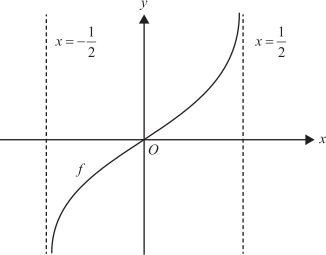
 

  1. State the range of `f(x)`.   (1 mark)

    --- 1 WORK AREA LINES (style=lined) ---

  2. Matt 1
    1. lskdjflsdkfj 
    2. sldkjfsldkfj 
    1. Something
    1. abc
    2. def
  3. slkflskdfj
    1. slkdfjlsdkfj
    2. sdlkjfsdlkfj
    1. lskjdflksd
    2. sdkjflsdkfj
  4. See the items below
    1. first
    2. second
    3. third
    4. fourth
    5. fifth
    1. Find `f^{\prime}(0)`.   (2 marks)

      --- 3 WORK AREA LINES (style=lined) ---

    2. State the maximal domain over which `f` is strictly increasing.   (1 mark)

      --- 2 WORK AREA LINES (style=lined) ---

    1. slkdjflskdfj 
    2. slkdfjlsdkfj
  5. lsksdlkfj
    1. sdflkjsd
    2. sdlfkj
    1. sdfsdlkf
  6. slkdfsldkfj
    1. slkdfjsldkfj
  7. Show that `f(x)+f(-x)=0`.   (1 mark)

    --- 3 WORK AREA LINES (style=lined) ---

  8. Find the domain and the rule of `f^{-1}`, the inverse of `f`.   (3 marks)

    --- 4 WORK AREA LINES (style=lined) ---

  9. Let `h` be the function `h:\left(-\frac{1}{2}, \frac{1}{2}\right) \rightarrow R, h(x)=\frac{1}{k}\left(\log _e\left(x+\frac{1}{2}\right)-\log _e\left(\frac{1}{2}-x\right)\right)`, where `k \in R` and `k>0`.
  1. The inverse function of `h` is defined by `h^{-1}: R \rightarrow R, h^{-1}(x)=\frac{e^{k x}-1}{2\left(e^{k x}+1\right)}`.
  2. The area of the regions bound by the functions `h` and `h^{-1}` can be expressed as a function, `A(k)`.
  3. The graph below shows the relevant area shaded.
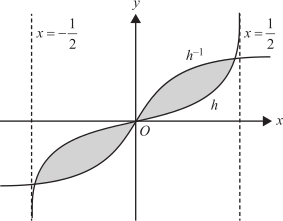
     

  1. You are not required to find or define `A(k)`.
  1. Determine the range of values of `k` such that `A(k)>0`.   (1 mark)

    --- 2 WORK AREA LINES (style=lined) ---

  2. Explain why the domain of `A(k)` does not include all values of `k`.   (1 mark)

    --- 2 WORK AREA LINES (style=lined) ---
Show Answers Only
a.     `R`
b.i `f^{\prime}(0)=4`
b.ii `\left(-\frac{1}{2}, \frac{1}{2}\right)`
c. `0`
d. `x \in \mathbb{R}`
e.i  ` k > 4`
e.ii No bounded area for `0<k \leq 4`
Show Worked Solution

a.   `R` is the range.

b.i    `f(x)`
`= \log _e\left(x+\frac{1}{2}\right)-\log _e\left(\frac{1}{2}-x\right)`  
  `f^{\prime}(x)` `= \frac{1}{x+\frac{1}{2}}+\frac{1}{\frac{1}{2}-x}`  
    `= \frac{2}{2 x+1}-\frac{2}{2 x-1}`  
  `f^{\prime}(0)` `= \frac{2}{2 xx 0+1}-\frac{2}{2 xx 0-1}`  
    `= 4`  

 
b.ii 
`\left(-\frac{1}{2}, \frac{1}{2}\right)`

c.   `f(x)+f(-x)` `= \log _e\left(x+\frac{1}{2}\right)-\log _e\left(\frac{1}{2}-x\right)+\log _e\left(-x+\frac{1}{2}\right)-\log _e\left(\frac{1}{2}+x\right)`  
  `= 0`  

 
d.  
To find the inverse swap `x` and `y` in `y=f(x)`

`x` `= \log _e\left(y+\frac{1}{2}\right)-\log _e\left(\frac{1}{2}-y\right)`  
`x` `= \log _e\left(\frac{y+\frac{1}{2}}{\frac{1}{2}-y}\right)`  
`e^x` `=\frac{y+\frac{1}{2}}{\frac{1}{2}-y}`  
`y+\frac{1}{2}` `= e^x\left(-y+\frac{1}{2}\right)`  
`y+\frac{1}{2}` `= -e^x y+\frac{e^x}{2}`  
`y\left(e^x+1\right)` `= \frac{e^x-1}{2}`  
`:.\ f^(-1)(x)` `= \frac{e^x-1}{2(e^x + 1)}`  

 
  `:.`  Domain: `x \in \mathbb{R}`
  

e.i   The vertical dilation factor of  `f(x)` is  `1/k`

For `A(k)>=0` , `h^{\prime}(0)<1`

`\frac{1}{k}(4)<1`   [Using CAS]

`:.\  k > 4`


♦♦♦♦ Mean mark (e.i) 10%.
MARKER’S COMMENT: Incorrect responses included `k>0` and `4<k<33`.

e.ii  When `h \geq h^{-1}` for  `x>0` (or `h \leq h^{-1}` for  `x<0`) there is no bounded area.

`:.`  There will be no bounded area for `0<k \leq 4`.


♦♦♦♦ Mean mark (e.ii) 10%.

Filed Under: Test category Tagged With: Band 3, Band 4, Band 6, smc-2745-40-Log graphs, smc-2745-50-Find Domain/Range, smc-5204-80-Area between curves, smc-723-50-Log/Exponential, smc-723-80-Area between graphs, smc-723-95-Transformations

EXAMCOPY Functions, MET2 2022 VCAA 4

Consider the function `f`, where `f:\left(-\frac{1}{2}, \frac{1}{2}\right) \rightarrow R, f(x)=\log _e\left(x+\frac{1}{2}\right)-\log _e\left(\frac{1}{2}-x\right).`

Part of the graph of `y=f(x)` is shown below.
 

  1. State the range of `f(x)`.   (1 mark)

    --- 1 WORK AREA LINES (style=lined) ---

  2.  i. Find `f^{\prime}(0)`.   (2 marks)

    --- 3 WORK AREA LINES (style=lined) ---

  3. ii. State the maximal domain over which `f` is strictly increasing.   (1 mark)

    --- 2 WORK AREA LINES (style=lined) ---

  4. Show that `f(x)+f(-x)=0`.   (1 mark)

    --- 3 WORK AREA LINES (style=lined) ---

  5. Find the domain and the rule of `f^{-1}`, the inverse of `f`.   (3 marks)

    --- 4 WORK AREA LINES (style=lined) ---

  6. Let `h` be the function `h:\left(-\frac{1}{2}, \frac{1}{2}\right) \rightarrow R, h(x)=\frac{1}{k}\left(\log _e\left(x+\frac{1}{2}\right)-\log _e\left(\frac{1}{2}-x\right)\right)`, where `k \in R` and `k>0`.
  7. The inverse function of `h` is defined by `h^{-1}: R \rightarrow R, h^{-1}(x)=\frac{e^{k x}-1}{2\left(e^{k x}+1\right)}`.
  8. The area of the regions bound by the functions `h` and `h^{-1}` can be expressed as a function, `A(k)`.
  9. The graph below shows the relevant area shaded.
     

  1. You are not required to find or define `A(k)`.
  1. Determine the range of values of `k` such that `A(k)>0`.   (1 mark)

    --- 2 WORK AREA LINES (style=lined) ---

  2. Explain why the domain of `A(k)` does not include all values of `k`.   (1 mark)

    --- 2 WORK AREA LINES (style=lined) ---
Show Answers Only
a.     `R`
b.i `f^{\prime}(0)=4`
b.ii `\left(-\frac{1}{2}, \frac{1}{2}\right)`
c. `0`
d. `x \in \mathbb{R}`
e.i  ` k > 4`
e.ii No bounded area for `0<k \leq 4`
Show Worked Solution

a.   `R` is the range.

b.i    `f(x)`
`= \log _e\left(x+\frac{1}{2}\right)-\log _e\left(\frac{1}{2}-x\right)`  
  `f^{\prime}(x)` `= \frac{1}{x+\frac{1}{2}}+\frac{1}{\frac{1}{2}-x}`  
    `= \frac{2}{2 x+1}-\frac{2}{2 x-1}`  
  `f^{\prime}(0)` `= \frac{2}{2 xx 0+1}-\frac{2}{2 xx 0-1}`  
    `= 4`  

 
b.ii 
`\left(-\frac{1}{2}, \frac{1}{2}\right)`

c.   `f(x)+f(-x)` `= \log _e\left(x+\frac{1}{2}\right)-\log _e\left(\frac{1}{2}-x\right)+\log _e\left(-x+\frac{1}{2}\right)-\log _e\left(\frac{1}{2}+x\right)`  
  `= 0`  

 
d.  
To find the inverse swap `x` and `y` in `y=f(x)`

`x` `= \log _e\left(y+\frac{1}{2}\right)-\log _e\left(\frac{1}{2}-y\right)`  
`x` `= \log _e\left(\frac{y+\frac{1}{2}}{\frac{1}{2}-y}\right)`  
`e^x` `=\frac{y+\frac{1}{2}}{\frac{1}{2}-y}`  
`y+\frac{1}{2}` `= e^x\left(-y+\frac{1}{2}\right)`  
`y+\frac{1}{2}` `= -e^x y+\frac{e^x}{2}`  
`y\left(e^x+1\right)` `= \frac{e^x-1}{2}`  
`:.\ f^(-1)(x)` `= \frac{e^x-1}{2(e^x + 1)}`  

 
  `:.`  Domain: `x \in \mathbb{R}`
  

e.i   The vertical dilation factor of  `f(x)` is  `1/k`

For `A(k)>=0` , `h^{\prime}(0)<1`

`\frac{1}{k}(4)<1`   [Using CAS]

`:.\  k > 4`


♦♦♦♦ Mean mark (e.i) 10%.
MARKER’S COMMENT: Incorrect responses included `k>0` and `4<k<33`.

e.ii  When `h \geq h^{-1}` for  `x>0` (or `h \leq h^{-1}` for  `x<0`) there is no bounded area.

`:.`  There will be no bounded area for `0<k \leq 4`.


♦♦♦♦ Mean mark (e.ii) 10%.

Filed Under: Test category Tagged With: Band 3, Band 4, Band 6, smc-2745-40-Log graphs, smc-2745-50-Find Domain/Range, smc-5204-80-Area between curves, smc-723-50-Log/Exponential, smc-723-80-Area between graphs, smc-723-95-Transformations

Functions, MET2 2022 VCAA 4

Consider the function `f`, where `f:\left(-\frac{1}{2}, \frac{1}{2}\right) \rightarrow R, f(x)=\log _e\left(x+\frac{1}{2}\right)-\log _e\left(\frac{1}{2}-x\right).`

Part of the graph of `y=f(x)` is shown below.
 

  1. State the range of `f(x)`.   (1 mark)

    --- 1 WORK AREA LINES (style=lined) ---

  2.  i. Find `f^{\prime}(0)`.   (2 marks)

    --- 4 WORK AREA LINES (style=lined) ---

  3. ii. State the maximal domain over which `f` is strictly increasing.   (1 mark)

    --- 1 WORK AREA LINES (style=lined) ---

  4. Show that `f(x)+f(-x)=0`.   (1 mark)

    --- 3 WORK AREA LINES (style=lined) ---

  5. Find the domain and the rule of `f^{-1}`, the inverse of `f`.   (3 marks)

    --- 6 WORK AREA LINES (style=lined) ---

  6. Let `h` be the function `h:\left(-\frac{1}{2}, \frac{1}{2}\right) \rightarrow R, h(x)=\frac{1}{k}\left(\log _e\left(x+\frac{1}{2}\right)-\log _e\left(\frac{1}{2}-x\right)\right)`, where `k \in R` and `k>0`.
  7. The inverse function of `h` is defined by `h^{-1}: R \rightarrow R, h^{-1}(x)=\frac{e^{k x}-1}{2\left(e^{k x}+1\right)}`.
  8. The area of the regions bound by the functions `h` and `h^{-1}` can be expressed as a function, `A(k)`.
  9. The graph below shows the relevant area shaded.
     

  1. You are not required to find or define `A(k)`.
  2.  i. Determine the range of values of `k` such that `A(k)>0`.   (1 mark)

    --- 2 WORK AREA LINES (style=lined) ---
  3. ii. Explain why the domain of `A(k)` does not include all values of `k`.   (1 mark

    --- 2 WORK AREA LINES (style=lined) ---
Show Answers Only
a.     `R`
b.i `f^{\prime}(0)=4`
b.ii `\left(-\frac{1}{2}, \frac{1}{2}\right)`
c. `0`
d. `x \in \mathbb{R}`
e.i  ` k > 4`
e.ii No bounded area for `0<k \leq 4`
Show Worked Solution

a.   `R` is the range.

b.i    `f(x)`
`= \log _e\left(x+\frac{1}{2}\right)-\log _e\left(\frac{1}{2}-x\right)`  
  `f^{\prime}(x)` `= \frac{1}{x+\frac{1}{2}}+\frac{1}{\frac{1}{2}-x}`  
    `= \frac{2}{2 x+1}-\frac{2}{2 x-1}`  
  `f^{\prime}(0)` `= \frac{2}{2 xx 0+1}-\frac{2}{2 xx 0-1}`  
    `= 4`  

 
b.ii 
`\left(-\frac{1}{2}, \frac{1}{2}\right)`

c.   `f(x)+f(-x)`

`= \log _e\left(x+\frac{1}{2}\right)-\log _e\left(\frac{1}{2}-x\right)+\log _e\left(-x+\frac{1}{2}\right)-\log _e\left(\frac{1}{2}+x\right)`  
`= 0`  

 
d.  
To find the inverse swap `x` and `y` in `y=f(x)`

`x` `= \log _e\left(y+\frac{1}{2}\right)-\log _e\left(\frac{1}{2}-y\right)`  
`x` `= \log _e\left(\frac{y+\frac{1}{2}}{\frac{1}{2}-y}\right)`  
`e^x` `=\frac{y+\frac{1}{2}}{\frac{1}{2}-y}`  
`y+\frac{1}{2}` `= e^x\left(-y+\frac{1}{2}\right)`  
`y+\frac{1}{2}` `= -e^x y+\frac{e^x}{2}`  
`y\left(e^x+1\right)` `= \frac{e^x-1}{2}`  
`:.\ f^(-1)(x)` `= \frac{e^x-1}{2(e^x + 1)}`  

 
  `:.`  Domain: `x \in \mathbb{R}`
  

e.i   The vertical dilation factor of  `f(x)` is  `1/k`

For `A(k)>=0` , `h^{\prime}(0)<1`

`\frac{1}{k}(4)<1`   [Using CAS]

`:.\  k > 4`


♦♦♦♦ Mean mark (e.i) 10%.
MARKER’S COMMENT: Incorrect responses included `k>0` and `4<k<33`.

e.ii  When `h \geq h^{-1}` for  `x>0` (or `h \leq h^{-1}` for  `x<0`) there is no bounded area.

`:.`  There will be no bounded area for `0<k \leq 4`.


♦♦♦♦ Mean mark (e.ii) 10%.

Filed Under: Area Under Curves, Differentiation (L&E), Graphs and Applications, L&E Differentiation, Logs and Exponential Functions Tagged With: Band 3, Band 4, Band 6, smc-2745-40-Log graphs, smc-2745-50-Find Domain/Range, smc-5204-80-Area between curves, smc-723-50-Log/Exponential, smc-723-80-Area between graphs, smc-723-95-Transformations

Calculus, MET2 2023 VCAA 5

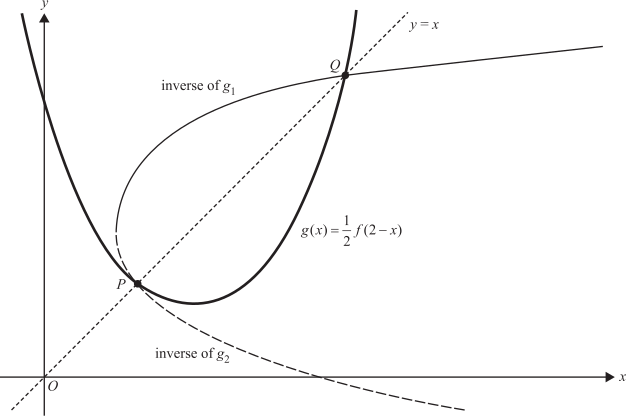
Let \(f:R \to R, f(x)=e^x+e^{-x}\) and \(g:R \to R, g(x)=\dfrac{1}{2}f(2-x)\).

  1. Complete a possible sequence of transformations to map \(f\) to \(g\).   (2 marks)
    •    Dilation of factor \(\dfrac{1}{2}\) from the \(x\) axis.

    --- 2 WORK AREA LINES (style=lined) ---
Two functions \(g_1\) and \(g_2\) are created, both with the same rule as \(g\) but with distinct domains, such that \(g_1\) is strictly increasing and \(g_2\) is strictly decreasing.

  1. Give the domain and range for the inverse of \(g_1\).   (2 marks)

    --- 3 WORK AREA LINES (style=lined) ---
Shown below is the graph of \(g\), the inverse of \(g_1\) and \(g_2\), and the line \(y=x\).
 

The intersection points between the graphs of \(y=x, y=g(x)\) and the inverses of \(g_1\) and \(g_2\), are labelled \(P\) and \(Q\).

    1. Find the coordinates of \(P\) and \(Q\), correct to two decimal places.   (1 mark)

      --- 2 WORK AREA LINES (style=lined) ---
    1. Find the area of the region bound by the graphs of \(g\), the inverse of \(g_1\) and the inverse of \(g_2\).
    2. Give your answer correct to two decimal places.   (2 marks)

      --- 4 WORK AREA LINES (style=lined) ---
Let \(h:R\to R, h(x)=\dfrac{1}{k}f(k-x)\), where \(k\in (o, \infty)\).

  1. The turning point of \(h\) always lies on the graph of the function \(y=2x^n\), where \(n\) is an integer.
  2. Find the value of \(n\).  (1 mark)

    --- 2 WORK AREA LINES (style=lined) ---
Let \(h_1:[k, \infty)\to R, h_1(x)=h(x)\).

The rule for the inverse of \(h_1\) is \(y=\log_{e}\Bigg(\dfrac{1}{k}x+\dfrac{1}{2}\sqrt{k^2x^2-4}\Bigg)+k\)

  1. What is the smallest value of \(k\) such that \(h\) will intersect with the inverse of \(h_1\)?\
  2. Give your answer correct to two decimal places.   (1 mark)

    --- 3 WORK AREA LINES (style=lined) ---
It is possible for the graphs of \(h\) and the inverse of \(h_1\) to intersect twice. This occurs when \(k=5\).

  1. Find the area of the region bound by the graphs of \(h\) and the inverse of \(h_1\), where \(k=5\).
  2. Give your answer correct to two decimal places.   (2 marks)

    --- 5 WORK AREA LINES (style=lined) ---
Show Answers Only

a.    \(\text{Reflect in the }y\text{-axis}\)

\(\text{Then translate 2 units to the right}\)

\(\text{OR}\)

\(\text{Translate 2 units to the left}\)

\(\text{Then reflect in the }y\text{-axis}\)

\(\text{OR}\)

\(\text{Translate 2 units to the right only }(f \ \text{even function})\)

b.    \(\text{See worked solution}\)

c.i.  \(P(1.27, 1.27\), Q(4.09, 4.09)\)

c.ii. \(2\displaystyle \int_{1.27…}^{4.09…} (x-g(x))\,dx=5.56\)

d.    \(n=-1\)

e. \(k\approx 1.27\)

f. \(A=43.91\)

Show Worked Solution

a.    \(\text{Reflect in the }y\text{-axis}\)

\(\text{Then translate 2 units to the right}\)

\(\text{OR}\)

\(\text{Translate 2 units to the left}\)

\(\text{Then reflect in the }y\text{-axis}\)

\(\text{OR}\)

\(\text{Translate 2 units to the right only }(f \ \text{even function})\)

b.    \(\text{Some options include:}\)

•  \(\text{Domain}\to [1, \infty)\ \ \ \text{Range}\to [2, \infty)\)
\(\text{or}\)
•  \(\text{Domain}\to (1, \infty)\ \ \ \text{Range}\to (2, \infty)\)
 

\(\text{If functions split at turning point } (2, 1)\ \text{then possible options:}\)

• \(\text{Domain}\ g_1\to [2, \infty)\ \ \ \text{Range}\to [1, \infty)\)
   \(\text{and }\)
  \(\text{Domain}\ g_1^{-1}\to [1, \infty)\ \ \ \text{Range}\to [2, \infty)\)

\(\text{or}\)

•  \(\text{Domain}\ g_1\to (2, \infty)\ \ \ \text{Range}\to (1, \infty)\)
   \(\text{and }\)
   \(\text{Domain}\ g_1^{-1}\to (1, \infty)\ \ \ \text{Range}\to (2, \infty)\)


♦ Mean mark 50%.
MARKER’S COMMENT: Note: maximal domain not requested so there were many correct answers. Many students seemed to be confused by notation. Often domain and range reversed.

c.i.  \(\text{By CAS:}\  P(1.27, 1.27), Q(4.09, 4.09)\)

c.ii.   \(\text{Area}\) \(=2\displaystyle \int_{1.27…}^{4.09…} (x-g(x))\,dx\)
    \(=2\displaystyle \int_{1.27…}^{4.09…} \Bigg(x-\dfrac{1}{2}\Big(e^{2-x}+e^{x-2}\Big)\Bigg)\,dx\)
    \(\approx 5.56\)

♦♦ Mean mark (c)(ii) 30%.
MARKER’S COMMENT: Some students set up the integral but did not provide an answer.
Others did not double the integral. Some incorrectly used \(\displaystyle \int_{1.27…}^{4.09…}(g_1^-1-g(x))\,dx\).
Others had correct answer but incorrect integral.

d.    \((0, 2)\ \text{turning pt of }f(x)\)

\(\text{and }h(x) \text{is the transformation from }f(x)\)

\(\therefore \Bigg(k, \dfrac{2}{k}\Bigg)\ \text{turning tp of }h(x)\)

\(\text{so the coordinates have the relationship}\)

\(y=\dfrac{2}{x}=2x^{-1}\)

\(\therefore\ n=-1\)


♦♦♦ Mean mark (d) 10%.
MARKER’S COMMENT: Question not well done. \(n=1\) a common error.

e.    \(\text{Smallest }k\ \text{is when inverse of the curves }h_1\ \text{and}\ h\)

\(\text{touch with the line }y=x.\)

\(\therefore\ h(x)\) \(=\dfrac{1}{k}\Big(e^{k-x}+e^{x-k}\Big)\)
  \(=x\)


\(\text{and}\ h'(x)\) \(=\dfrac{1}{k}\Big(-e^{k-x}+e^{x-k}\Big)\)
  \(=1\)

\(\text{at point of intersection, where }k>0.\)

\(\text{Using CAS graph both functions to solve or solve as simultaneous equations.}\)

\(\rightarrow\ k\approx 1.2687\approx 1.27\)


♦♦♦♦ Mean mark (e) 0%.
MARKER’S COMMENT: Question poorly done with many students not attempting.

f.    \(\text{When}\ k=5\)

\(h_1^{-1}(x)=\log_e\Bigg(\dfrac{5}{2}x+\dfrac{1}{2}\sqrt{25x^2-4}\Bigg)+5\)

\(\text{and }h(x)=\dfrac{1}{5}\Big(e^{5-x}+e^{x-5}\Big)\)

\(\text{Using CAS: values of }x\ \text{at of intersection of fns are}\)

\(x\approx 1.45091…\ \text{and}\ 8.78157…\)

\(\text{Area}\) \(=\displaystyle \int_{1.45091…}^{8.78157…}h_1^{-1}(x)- h(x)\,dx\)
  \(=\displaystyle \int_{1.45091…}^{8.78157…} \log_e\Bigg(\dfrac{5}{2}x+\dfrac{1}{2}\sqrt{25x^2-4}\Bigg)+5-\dfrac{1}{5}\Big(e^{5-x}+e^{x-5}\Big)\,dx\)
  \(=43.91\) 

♦♦♦ Mean mark (f) 15%.
MARKER’S COMMENT: Errors were made with terminals. Common error using \(x=2.468\), which was the \(x\) value of the pt of intersection of \(h\) and \(y=x\).

Filed Under: Area Under Curves, Integration (L&E), L&E Integration, Logs and Exponential Functions, Transformations Tagged With: Band 4, Band 5, Band 6, smc-5204-50-Find intersection, smc-5204-80-Area between curves, smc-723-50-Log/Exponential, smc-723-95-Transformations, smc-740-20-Exponential (definite), smc-748-20-Exponential (definite)

Calculus, MET2 2020 VCAA 4

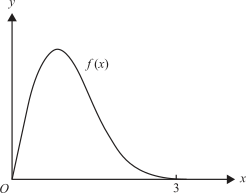
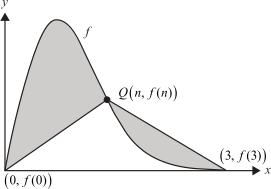
The graph of the function  `f(x)=2xe^((1-x^(2)))`, where  `0 <= x <= 3`, is shown below.
 

  1. Find the slope of the tangent to `f` at  `x=1`.   (1 mark)

    --- 2 WORK AREA LINES (style=lined) ---
  2. Find the obtuse angle that the tangent to `f` at  `x = 1`  makes with the positive direction of the horizontal axis. Give your answer correct to the nearest degree.   (1 mark)

    --- 2 WORK AREA LINES (style=lined) ---
  3. Find the slope of the tangent to `f` at a point  `x =p`. Give your answer in terms of  `p`.   (1 mark)

    --- 2 WORK AREA LINES (style=lined) ---
  4.  i. Find the value of `p` for which the tangent to `f` at  `x=1` and the tangent to `f` at  `x=p`  are perpendicular to each other. Give your answer correct to three decimal places.   (2 marks)

    --- 3 WORK AREA LINES (style=lined) ---
  5. ii. Hence, find the coordinates of the point where the tangents to the graph of `f` at  `x=1`  and  `x=p`  intersect when they are perpendicular. Give your answer correct to two decimal places.   (3 marks)

    --- 5 WORK AREA LINES (style=lined) ---
Two line segments connect the points `(0, f(0))`  and  `(3, f(3))`  to a single point  `Q(n, f(n))`, where  `1 < n < 3`, as shown in the graph below.


  1.   i. The first line segment connects the point `(0, f(0))` and the point `Q(n, f(n))`, where `1 < n < 3`.
  2.      Find the equation of this line segment in terms of  `n`.   (1 mark)

    --- 3 WORK AREA LINES (style=lined) ---
  3.  ii. The second line segment connects the point `Q(n, f(n))` and the point  `(3, f(3))`, where  `1 < n < 3`.
  4.      Find the equation of this line segment in terms of `n`.   (1 mark)

    --- 5 WORK AREA LINES (style=lined) ---

  5. iii. Find the value of `n`, where  `1 < n < 3`, if there are equal areas between the function `f` and each line segment.
  6.      Give your answer correct to three decimal places.   (3 marks)

    --- 3 WORK AREA LINES (style=lined) ---

Show Answers Only
  1. `-2`
  2. `117^@`
  3. `2(1-2p^(2))e^(1-p^(2))” or “(2e-4p^(2)e)e^(-p^(2))`
  4.  i. `0.655`
  5. ii. `(0.80, 2.39)`
  6.   i. `y_1=2e^((1-n^2))x`
  7.  ii. `y_2=(2n e^((1-n^2))-6e^(-8))/(n-3) (x-3) + 6e^(-8)`
  8. iii. `n= 1.088`
Show Worked Solution

a.   `f(x)=2xe^((1-x^(2)))`

`f^{′}(1)=-2`

♦ Mean mark part (b) 37%.


b.   `text{Solve:}\ tan theta =-2\ \ text{for}\ \ theta in (pi/2, pi)`

`theta = 117^@`
 

c.   `text{Slope of tangent}\ = f^{′}(p)`

`f^{′}(p)=2(1-2p^(2))e^(1-p^(2))\ \ text{or}\ \ (2e-4p^(2)e)e^(-p^(2))`
 

d.i.   `text{If tangents are perpendicular:}`

`f^{′}(p) xx-2 =-1\ \ =>\ \ f^^{′}(p)=1/2`

`text{Solve}\ \ 2(1-2p^(2))e^(1-p^(2))=1/2\ \ text{for}\ p:`

`p=0.655\ \ text{(to 3 d.p.)}`
 

d.ii.  `text{Equation of tangent at}\ \ x=1: \ y=4-2x`

♦ Mean mark part (d)(ii) 41%.

`text{Equation of tangent at}\ \ x=p: \ y= x/2 + 1.991…`

`text{Solve}\ \ 4-2x = x/2 + 1.991…\ \ text{for}\ x:`

`=> x = 0.8035…`

`=> y=4-2(0.8035…) = 2.392…`

`:.\ text{T}text{angents intersect at (0.80, 2.39)}`

♦ Mean mark part (e)(i) 44%.

 
e.i.
  `Q (n, 2n e^(1-n^2))`

`m_(OQ) = (2n e^((1-n^2)) – 0)/(n-0) = 2e^((1-n^2))`

`:.\ text{Equation of segment:}\ \ y_1=2e^((1-n^2))x`

♦♦ Mean mark part (e)(ii) 28%.
 

e.ii.  `P(3, f(3)) = (3, 6e^(-8))`

`m_(PQ) = (2n e^((1-n^2))-6e^(-8))/(n-3)`

`text{Equation of line segment:}`

`y_2-6e^(-8)` `=(2n e^((1-n^2))-6e^(-8))/(n-3) (x-3)`  
`y_2` `=(2n e^((1-n^2))-6e^(-8))/(n-3) (x-3) + 6e^(-8)`  
♦♦ Mean mark part (e)(iii) 28%.


e.iii.  `text{Find}\ n\ text{where shaded areas are equal.}`

`text{Solve}\ int_(0)^(n)(f(x)-y_(1))\ dx=int_(n)^(3)(y_(2)-f(x))\ dx\ \ text{for} n:`

`=> n= 1.088\ \ text{(to 3 d.p.)}`

Filed Under: Area Under Curves, Tangents and Normals Tagged With: Band 3, Band 4, Band 5, smc-634-20-Log/Exp Function, smc-634-50-Find tangent given curve, smc-634-80-Angle between tangents/axes, smc-634-90-Normals, smc-723-50-Log/Exponential

Calculus, MET2 2021 VCAA 3

Let  `q(x) = log_e (x^2-1)-log_e (1-x)`.

  1. State the maximal domain and the range of `q`.   (2 marks)

    --- 4 WORK AREA LINES (style=lined) ---

  2.  i. Find the equation of the tangent to the graph of `q` when  `x =-2`.   (1 mark)

    --- 2 WORK AREA LINES (style=lined) ---

  3. ii. Find the equation of the line that is perpendicular to the graph of `q` when  `x =-2`  and passes through the point  (-2, 0).   (1 mark)

    --- 2 WORK AREA LINES (style=lined) ---

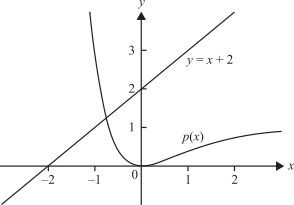
Let  `p(x) = e^{-2x}-2e^-x + 1.`

  1. Explain why `p` is not a one-to one function.   (1 mark)

    --- 2 WORK AREA LINES (style=lined) ---

  2. Find the gradient of the tangent to the graph of `p` at  `x = a`.   (1 mark)

    --- 2 WORK AREA LINES (style=lined) ---

The diagram below shows parts of the graph of `p` and the line  `y = x + 2`.


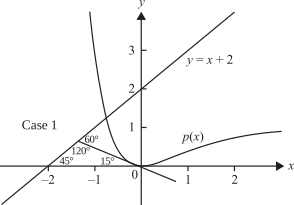
The line  `y = x + 2`  and the tangent to the graph of `p` at  `x = a`  intersect with an acute angle of `theta` between them.

  1. Find the value(s) of `a` for which  `theta = 60^@`. Give your answer(s) correct to two decimal places.   (3 marks)

    --- 8 WORK AREA LINES (style=lined) ---

  2. Find the `x`-coordinate of the point of intersection between the line  `y = x + 2` and the graph of `p`, and hence find the area bounded by  `y = x + 2`, the graph of `p` and the `x`-axis, both correct to three decimal places.   (3 marks)

    --- 5 WORK AREA LINES (style=lined) ---

Show Answers Only
  1. `text{Domain:} \ x ∈ (-∞, -1)`
    `text{Range:} \ y ∈ R`
  2. i.  `-x-2`
    ii. `x + 2`
  3. `text{Not a one-to-one function as it fails the horizontal line test.}`
  4. `-2e^{-2a} + 2e^{-a}`
  5. `-0.67`
  6. `1.038\ text(u)^2`
Show Worked Solution

a.    `text(Method 1)`

`x^2-1 > 0 \ \ => \ \ x > 1 \ \ ∪ \ \ x < -1`

`1-x > 0 \ \ => \ \ x < 1`
 
`:. \ x ∈ (-∞, -1)`
 

`text(Method 2)`

`text{Sketch graph by CAS}`

`text{Asymptote at} \ x = -1`

`text{Domain:} \ x ∈ (-∞, -1)`

`text{Range:} \ y ∈ R`


b.     i.   `text{By CAS (tanLine} \ (q (x), x, -2)):`

`y = -x-2`
 

ii.   `text{By CAS (normal} \ (q (x), x, -2)):`

`y = x + 2`
  

c.    `text{Sketch graph by CAS.}`

`p(x) \ text{is not a one-to-one function as it fails the horizontal line test}`

`text{(i.e. it is a many-to-one function)}`
 

d.   `p^{′}(x) = -2e^{-2x} + 2e^-x`

`p^{prime}(a) = -2e^{-2a} + 2e^{-a}`


e. 

 
`text{Case 1}`

`text{By CAS, solve:}`

`2e^{-a} -2e^{-2a} =-tan (15^@) \ \ text{for}\ a:`

`a = -0.11`
 

`text{Case 2}`

`text{Case 1}`

`text{By CAS, solve:}`

`2e^{-a}-2e^{-2a} = -tan 75^@\ \ text{for}\ a:`

`a = -0.67`
 

f.     `text{At intersection,}`

`x + 2 = e^{-2x} -2e^{-x} + 1`

`x = -0.750`
 

`text{Area}` `= int_{-2}^{-0.750} x + 2\ dx + int_{-0.750}^0 e^{-2x}-2e^{-x} + 1\ dx`
  `= 1.038 \ text(u)^2`

Filed Under: Area Under Curves, Tangents and Normals Tagged With: Band 4, Band 5, Band 6, smc-634-20-Log/Exp Function, smc-634-50-Find tangent given curve, smc-634-90-Normals, smc-723-50-Log/Exponential, smc-723-80-Area between graphs

Calculus, MET1 2020 VCAA 8

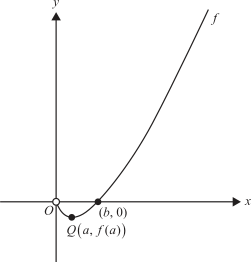
Part of the graph of  `y = f(x)`, where  `f:(0, ∞) -> R, \ f(x) = xlog_e(x)`, is shown below.


The graph of `f` has a minimum at the point `Q(a, f(a))`, as shown above.

  1. Find the coordinates of the point `Q`.   (2 marks)

    --- 6 WORK AREA LINES (style=lined) ---

  2. Using  `(d(x^2log_e(x)))/(dx) = 2x log_e(x) + x`, show that  `xlog_e(x)`  has an antiderivative  `(x^2log_e(x))/2-(x^2)/4`.   (1 mark)

    --- 3 WORK AREA LINES (style=lined) ---

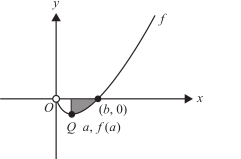
  3. Find the area of the region that is bounded by `f`, the lines  `x = a`  and the horizontal axis for  `x ∈ [a, b]`, where `b` is the `x`-intercept of `f`.   (2 marks)

    --- 7 WORK AREA LINES (style=lined) ---

  4. Let  `g: (a, ∞) -> R, \ g(x) = f(x) + k`  for  `k ∈ R`.


    i. Find the value of `k` for which  `y = 2x`  is a tangent to the graph of `g`.   (1 mark)

    --- 6 WORK AREA LINES (style=lined) ---

    ii. Find all values of `k` for which the graphs of `g` and `g^(-1)` do not intersect.   (2 marks)

    --- 5 WORK AREA LINES (style=lined) ---

Show Answers Only
  1. `Q(1/e, -1/e)`
  2. `text(See Worked Solutions)`
  3. `1/4-3/(4e^2)\ text(u)^2`
  4. i.  `e`
  5. ii.  `k ∈ (1, ∞)`
Show Worked Solution

a.   `y = xlog_e x`

`(dy)/(dx)` `= x · 1/x + log_e x`
  `= 1 + log_e x`

 
`text(Find)\ x\ text(when)\ (dy)/(dx) = 0:`

`1 + log_e x` `= 0`
`log_e x` `= -1`
`x` `= 1/e`
`y` `= 1/e log_e (e^(-1))`
  `= -1/e`

 
`:. Q(1/e, -1/e)`


b.    `int 2x log_e(x) + x\ dx` `= x^2 log_e (x) + c`
  `2 int x log_e(x)\ dx` `= x^2 log_e (x)-intx\ dx + c`
  `:. int x log_e(x)\ dx` `= (x^2 log_e (x))/2-(x^2)/4 \ \ (c = 0)`


c.   

`text(When)\ \ x log_e x = 0 \ => \ x = 1`

`=> b = 1`

`:.\ text(Area)` `= −int_(1/e)^1 x log_e(x)\ dx`
  `= [(x^2)/4-(x^2 log_e(x))/2]_(1/e)^1`
  `= (1/4-0)-(1/(4e^2)-(log_e(e^(-1)))/(2e^2))`
  `= 1/4-(1/(4e^2) + 1/(2e^2))`
  `= 1/4-3/(4e^2) \ text(u)^2`


d.i.   `text(When)\ \ f^{prime}(x) = m_text(tang) = 2,`

`1 + log_e(x)` `= 2`
`x` `= e`

 
`text(T)text(angent meets)\ \ g(x)\ \ text(at)\ \ (e, 2e)`

`g(e)` `= f(e) + k`
`2e` `= e log_e e + k`
`:.k` `= e`


d.ii. `text(Find the value of)\ k\ text(when)\ \ y = x\ \ text(is a tangent to)\ g(x):`

`text(When)\ \ f^{prime}(x) = 1,`

`1 + log_e(x)` `= 1`
`x` `= 1`

 
`text(T)text(angent occurs at)\ (1, 1)`

`g(1) = f(1) + k \ => \ k = 1`
 

`:.\ text(Graphs don’t intersect for)\ k ∈ (1, ∞)`

Filed Under: Area Under Curves, Tangents and Normals Tagged With: Band 4, Band 5, Band 6, smc-723-50-Log/Exponential

Calculus, MET2-NHT 2019 VCAA 5

Let  `f: R → R, \ f(x) = e^((x/2))`  and  `g: R → R, \ g(x) = 2log_e(x)`.

  1. Find  `g^-1 (x)`.   (1 mark)

    --- 4 WORK AREA LINES (style=lined) ---

  2. Find the coordinates of point  `A`, where the tangent to the graph of  `f` at  `A` is parallel to the graph of  `y = x`.   (2 marks)

    --- 5 WORK AREA LINES (style=lined) ---

  3. Show that the equation of the line that is perpendicular to the graph of  `y = x`  and goes through point  `A` is  `y = -x + 2log_e(2) + 2`.   (1 mark)

    --- 3 WORK AREA LINES (style=lined) ---

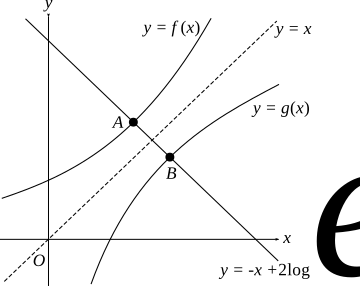
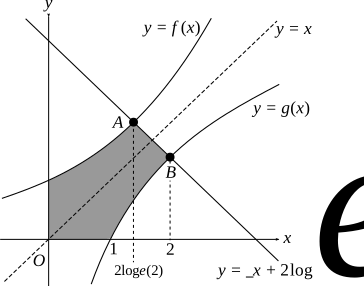
Let `B` be the point of intersection of the graphs of `g` and  `y =-x + 2log_e(2) + 2`, as shown in the diagram below.


  1. Determine the coordinates of point `B`.   (1 mark)

    --- 4 WORK AREA LINES (style=lined) ---

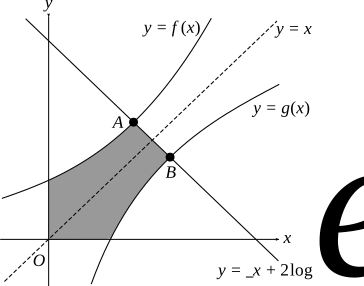
  2. The shaded region below is enclosed by the axes, the graphs of  `f` and `g`, and the line  `y =-x + 2log_e(2) + 2`.


    Find the area of the shaded region.   (2 marks)

    --- 4 WORK AREA LINES (style=lined) ---
Let  `p : R→ R, \ p(x) = e^(kx)`  and  `q : R→ R, \ q(x) = (1)/(k) log_e(x)`.

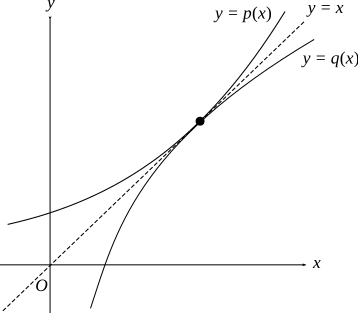
  1. The graphs of `p`, `q` and  `y = x`  are shown in the diagram below. The graphs of `p` and `q` touch but do not cross.


     Find the value of  `k`.   (2 marks)

    --- 6 WORK AREA LINES (style=lined) ---

  2. Find the value of  `k, k > 0`, for which the tangent to the graph of `p` at its `y`-intercept and the tangent to the graph of `q` at its `x`-intercept are parallel.   (1 mark)

    --- 5 WORK AREA LINES (style=lined) ---

Show Answers Only
  1. `e^{(x)/(2)}`
  2. `(2log_e 2, 2)`
  3. `text(Proof(See Worked Solution))`
  4. `(2, 2log_e 2)`
  5. `6-2(log_e 2)^2-4 log_e 2`
  6. `(1)/(e)`
  7. `k =1`
Show Worked Solution

a.    `g(x) = 2log_e x`

`text(Inverse: swap) \ x ↔ y`

`x` `= 2log_e y`
`log_e y` `= (x)/(2)`
`y` `= e^{(x)/(2)}`


b.    `f(x) = e^{(x)/(2)}`

`f′(x) = (1)/(2) e^{(x)/(2)}`
 
`text(S) text(olve) \ \ f′(x) = 1 \ text(for) \ x:`

`x = 2log_e 2`

`y = e^(log_e 2) = 2`
 
`:. \ A\ text(has coordinates)\  (2log_e 2, 2)`


c.    `m_(⊥) = -1`

`text(Equation of line) \ \ m = -1 \ \ text(through)\ \ (2log_e 2, 2) :`

`y-2` `= -(x-2log_e 2)`
`y` `= -x +  2log_e 2 + 2`


d.    `text(Method 1)`

`text(S) text(olve for) \ x :`

`-x + 2log_e 2 + 2 = 2log_e x`

`=> x = 2 , \ y = 2log_e 2`

`:. B ≡ (2, 2log_e 2)`
 

`text(Method 2)`

`text(S) text(ince) \ \ f(x) = g^-1 (x)`

`B \ text(is the reflection of) \ \ A(2log_e 2, 2) \ \ text(in the) \ \ y=x \ \ text(axis)`

`:. \ B ≡ (2, 2log_e 2)`


e.


`y = g(x) \ \ text(intersects) \ x text(-axis at) \ \ x = 1`

`text(Dividing shaded area into 3 sections:)`

`A` `= int_0^1 f(x)\ dx \ + \ int_1^(2log_e 2) f(x)-g(x)\ dx`  
  ` \ + \ int_(2log_e 2)^2 (-x + 2log_e 2 + 2)-g(x)\ dx`  
  `= 6-2(log_e 2)^2-4 log_e 2`  


f.   `p(x) = e^(kx) \ , \ q(x) = (1)/(k) log_e x`

`p′(x) = k e^(kx) \ , \ q′(x) = (1)/(kx)`
 
`text(S) text(ince graphs touch on) \ y = x`

`k e^(kx) = 1\ …\ (1)`

`(1)/(kx) = 1\ …\ (2)`

`text(Substitute) \ x = (1)/(k) \ text{from (2) into (1)}`

`k e^(k xx 1/k)` `= 1`
`:. k` `= (1)/(e)`


g.   `text(Consider)\ \ p(x):`

`text(When) \ \ x = 0 , \ p(0) = 1 , \ p′(0) = k`
 

 `text(Consider) \ \ q(x):`

`text(When) \ \ y= 0, \ (1)/(k) log_e x = 0 \ => \ x = 1`

`q′(1) = (1)/(k)`

`text(If lines are parallel), \ k = (1)/(k)`
 
`:. \ k = 1`

Filed Under: Area Under Curves, Logs and Exponential Functions Tagged With: Band 4, Band 5, Band 6, smc-5204-50-Find intersection, smc-723-50-Log/Exponential

Calculus, MET2-NHT 2019 VCAA 18 MC

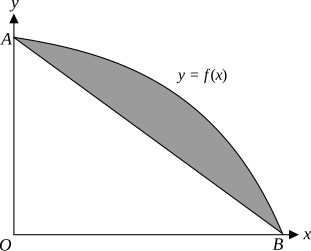
Part of the graph of the function `f`, where  `f(x) = 8 - 2^(x-1)`, is shown below. It intersects the axes at the points `A` and `B`. The line segment joining `A` and `B` is also shown on the graph.


The area of the shaded region is

  1.  `16 - (15)/(log_e (2))`
  2.  `17 - (15)/(2log_e (2))`
  3.  `(7)/(log_e (2)) - (159)/(16)`
  4.  `16 - (15)/(2log_e (2))`
  5.  `(17)/(2log_e (2)) - 15`
Show Answers Only

`B`

Show Worked Solution

`text(When) \ \ x = 0 \ => \ y = 8 – (1)/(2) = 15/2`

`text(When) \ \ y = 0,\ => \ 8 – 2^(x-1)=0 \ => x=4`

`text(Area)_(AOB)` `= (1)/(2) xx 4 xx (15)/(2)`
  `= 15 \ text(u²)`


`text(Shaded Area)` `= int_0^4 8 – 2^(x -1)\ dx – (15)/(2)`
  `= 17 – (15)/(2 log_e 2)`

 
`=> \ B`

Filed Under: Area Under Curves Tagged With: Band 5, smc-723-50-Log/Exponential, smc-723-80-Area between graphs

Calculus, MET2-NHT 2019 VCAA 15 MC

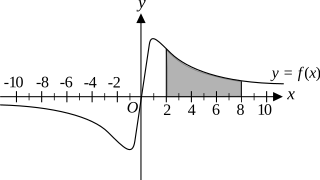
The area bounded by the graph of  `y = f(x)`, the line  `x = 2`, the line  `x = 8`  and the `x`-axis, as shaded in the diagram below, is  `3log_e(13)`

The value of  `int_4^10 3 f(x - 2)\ dx`  is

  1.  `3log_e(13)`
  2.  `9log_e(13)`
  3.  `6log_e(39)`
  4.  `log_e(13)`
  5.  `9log_e(11)`
Show Answers Only

`B`

Show Worked Solution

`A_1 = int_2^8 f(x)\ dx = 3 log_e 13`

`f(x – 2) = f(x) \ text(shifted 2 units to right.)`

`:. \ int_2^8 f(x)\ dx = int_4^10 f(x – 2)\ dx`

`:. \ 3 int_4^10 f(x – 2)\ dx` `= 3 xx 3log_e 13`
  `= 9 log_e 13`

 
`=> \ B`

Filed Under: Area Under Curves Tagged With: Band 5, smc-723-50-Log/Exponential

Calculus, MET1 2018 VCAA 8

Let  `f: R -> R, \ f(x) = x^2e^(kx)`, where `k` is a positive real constant.

  1.  Show that  `f^{′}(x) = xe^(kx)(kx + 2)`.   (1 mark)

    --- 3 WORK AREA LINES (style=lined) ---

  2. Find the value of `k` for which the graphs of  `y = f(x)`  and  `y = f^{′}(x)`  have exactly one point of intersection.   (3 marks)

    --- 6 WORK AREA LINES (style=lined) ---

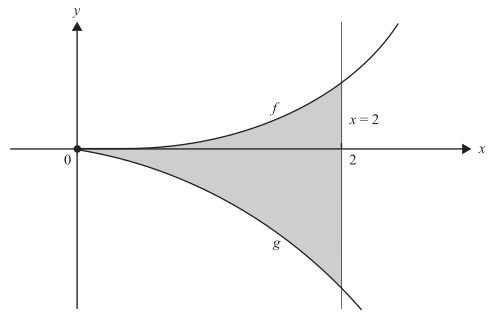
Let  `g(x) = −(2xe^(kx))/k`. The diagram below shows sections of the graphs of `f` and `g` for  `x >= 0`.


Let `A` be the area of the region bounded by the curves  `y = f(x), \ y = g(x)` and the line  `x = 2`.

  1. Write down a definite integral that gives the value of `A`.   (1 mark)

    --- 3 WORK AREA LINES (style=lined) ---

  2. Using your result from part a., or otherwise, find the value of `k` such that  `A = 16/k`.   (3 marks)

    --- 8 WORK AREA LINES (style=lined) ---

Show Answers Only
  1. `text(See Worked Solutions)`
  2. `text(One point of intersection)\ x = 0\ text(when)\ k = 1.`
  3. `int_0^2 (x^2e^(kx) + (2xe^(kx))/k)dx`
  4. `1/2 ln 4\ \ text(or)\ \ ln2`
Show Worked Solution

a.   `f(x) = x^2e^(kx)`

`f^{′}(x)` `= 2x · e^(kx) + x^2 · k · e^(kx)`
  `= xe^(kx)(kx + 2)\ \ …text(as required)`


b.  `text(Intersection occurs when:)`

♦♦♦ Mean mark 7%.
MARKER’S COMMENT: Most students found the correct quadratic equation but solved for `k`.

`x^2e^(kx)` `= xe^(kx)(kx + 2)`
`x^2-x(kx + 2)` `= 0,\ \ e^(kx) != 0`
`x^2-kx^2-2x` `= 0`
`x^2(1-k)-2x` `= 0`
`x[x(1-k)-2]` `= 0`


`:.x = 0\ \ text(or)\ \ x(1-k)-2` `= 0`
`x` `= 2/(1-k)`

 
`text(S)text(ince)\ \ x = 2/(1-k)\ \ text(is undefined when)\ \ k = 1,`

`=>\ text(One point of intersection only at)\ \ x = 0\ \ text(when)\ \ k = 1.`


c.    `A` `= int_0^2 f(x)\ dx-int_0^2 g(x)\ dx`
    `= int_0^2 x^2e^(kx)\ dx-int_0^2 −(2xe^(kx))/k \ dx`
    `= int_0^2 (x^2e^(kx) + (2xe^(kx))/k)dx`

♦♦ Mean mark 29%.


d.    `int_0^2(x^2e^(kx) + (2xe^(kx))/k)\ dx` `= 16/k`
  `1/k int_0^2(kx^2e^(kx) + 2xe^(kx))\ dx` `= 16/k`
  `1/k int_0^2(xe^(kx)(kx + 2))\ dx` `= 16/k`
  `1/k[x^2e^(kx)]_0^2` `= 16/k\ \ \ text{(using part a)}`
  `[2^2 · e^(2k)-0]` `= 16`
  `e^(2k)` `= 4`
  `2k` `= ln 4`
  `k` `= 1/2 ln 4\ \ text(or)\ \ ln2`

Filed Under: Area Under Curves Tagged With: Band 3, Band 4, Band 5, Band 6, smc-723-50-Log/Exponential, smc-723-80-Area between graphs

Algebra, MET2 2017 VCAA 4

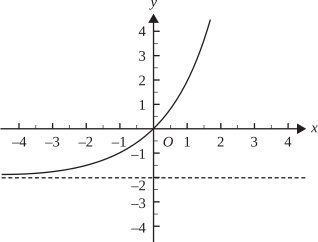
Let  `f : R → R :\  f (x) = 2^(x + 1)-2`. Part of the graph of  `f` is shown below.
 

  1. The transformation  `T: R^2 -> R^2, \ T([(x),(y)]) = [(x),(y)] + [(c),(d)]`  maps the graph of  `y = 2^x`  onto the graph of  `f`.


    State the values of `c` and `d`.   (2 marks)

    --- 5 WORK AREA LINES (style=lined) ---

  2. Find the rule and domain for  `f^(-1)`, the inverse function of  `f`.   (2 marks)

    --- 5 WORK AREA LINES (style=lined) ---

  3. Find the area bounded by the graphs of  `f` and  `f^(-1)`.   (3 marks)

    --- 3 WORK AREA LINES (style=lined) ---

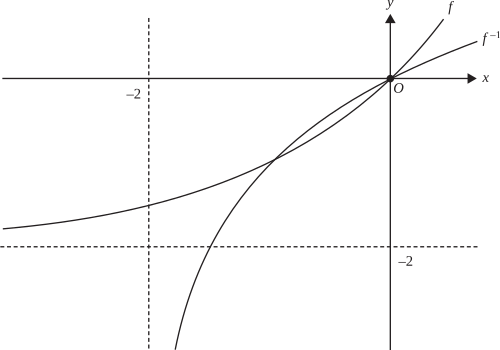
  4. Part of the graphs of  `f` and  `f^(-1)` are shown below.


    Find the gradient of  `f` and the gradient of  `f^(-1)`  at  `x = 0`.   (2 marks)

    --- 2 WORK AREA LINES (style=lined) ---

The functions of  `g_k`, where  `k ∈ R^+`, are defined with domain `R` such that  `g_k(x) = 2e^(kx)-2`.

  1. Find the value of `k` such that  `g_k(x) = f(x)`.  (1 mark)

    --- 3 WORK AREA LINES (style=lined) ---

  2. Find the rule for the inverse functions  `g_k^(-1)` of  `g_k`, where  `k ∈ R^+`.   (1 mark)

    --- 5 WORK AREA LINES (style=lined) ---

  3. i. Describe the transformation that maps the graph of  `g_1` onto the graph of  `g_k`.   (1 mark)

    --- 3 WORK AREA LINES (style=lined) ---

    ii. Describe the transformation that maps the graph of  `g_1^(-1)` onto the graph of  `g_k^(-1)`.   (1 mark)

    --- 3 WORK AREA LINES (style=lined) ---

  4. The lines `L_1` and `L_2` are the tangents at the origin to the graphs of  `g_k`  and  `g_k^(-1)`  respectively.
  5. Find the value(s) of `k` for which the angle between `L_1` and `L_2` is 30°.   (2 marks)

    --- 6 WORK AREA LINES (style=lined) ---

  6. Let `p` be the value of `k` for which  `g_k(x) = g_k^(−1)(x)`  has only one solution.
  7.  i. Find `p`.   (2 marks)

    --- 4 WORK AREA LINES (style=lined) ---

  8. ii. Let  `A(k)`  be the area bounded by the graphs of  `g_k`  and  `g_k^(-1)`  for all  `k > p`.
  9.     State the smallest value of `b` such that  `A(k) < b`.   (1 mark)

    --- 4 WORK AREA LINES (style=lined) ---

Show Answers Only

a.  `c =-1, \ d =-2`

b.  `f^(-1)(x) = log_2 (x + 2)-1, \ x ∈ (-2,∞)`

c.  `3-2/(log_e(2))\ text(units)²`

d. `f^{prime}(0)= 2log_e(2) and f^(-1)^{prime}(0)= 1/(2log_e(2))`

e.  `k = log_e(2)`

f.  `g_k^(-1)(x)= 1/k log_e((x + 2)/2)`

g.i.  `text(Dilation by factor of)\ 1/k\ text(from the)\ ytext(-axis)`

g.ii.  `text(Dilation by factor of)\ 1/k\ text(from the)\ xtext(-axis)`

h.  `k=sqrt3/6\ or\ sqrt3/2`

i.i.  `p = 1/2`

i.ii.  `b=4`

Show Worked Solution

a.   `text(Using the matrix transformation:)`

`x^{prime}` `=x+c\ \ => x=x^{prime}-c`
`y^{prime}` `=y+d\ \ =>y= y^{prime}-d`
   
`y^{prime}-d` `=2^((x)^{prime}-c)`
`y^{prime}` `= 2^((x)^{prime}-c)+d`


`:. c = -1, \ d = -2`


b.   `text(Let)\ \ y = f(x)`

`text(Inverse : swap)\ x\ ↔ \ y`

`x` `= 2^(y + 1)-2`
`x + 2` `= 2^(y + 1)`
`y + 1` `= log_2(x + 2)`
`y` `= log_2(x + 2)-1`


`text(dom)(f^(-1)) = text(ran)(f)`

`:. f^(-1)(x) = log_2 (x + 2)-1, \ x ∈ (-2,∞)`


c.   `text(Intersection points occur when)\ \ f(x)=f^(-1)(x)`

MARKER’S COMMENT: Specifically recommends using  `f^(-1)(x)-f(x)`  in this type of integral to avoid errors in stating the integral.

`x` `= -1, 0`


`text(Area)` `= int_(-1)^0 (f^(-1)(x)-f(x))\ dx`
  `= 3-2/(log_e(2))\ text(units)²`


d.    `f^{prime}(0)` `= 2log_e(2)`
  `f^{(-1)^prime}(0)` `= 1/(2log_e(2))`


e.   `g_k(x) = 2e^(kx)-2`

`text(Solve:)\ \ g_k(x) = f(x)quad text(for)\ k ∈ R^+`

`:. k = log_e(2)`


f.   `text(Let)\ \ y = g_k(x)`

`text(Inverse : swap)\ x\ text(and)\ y`

`x` `= 2e^(ky)-2`
`e^(ky)` `=(x+2)/2`
`ky` `=log_e((x+2)/2)`
`:. g_k^(-1)(x)` `= 1/k log_e((x + 2)/2)`


♦♦ Mean mark part (g)(i) 31%.

g.i.    `g_1(x)` `= 2e^x-2`
  `g_k(x)` `= 2e^(kx)-2`

 
`:. text(Dilation by factor of)\ 1/k\ text(from the)\ ytext(-axis)`


♦♦ Mean mark part (g)(ii) 30%.

g.ii.    `g_1^(-1)(x)` `= log_e((x + 2)/2)`
  `g_k^(-1)(x)` `= 1/klog_e((x + 2)/2)`

 
`:. text(Dilation by factor of)\ 1/k\ text(from the)\ xtext(-axis)`


h.   `text(When)\ \ x=0,`

♦♦♦ Mean mark part (h) 13%.

`g_k^{prime}(0)=2k\ \ => m_(L_1)=2k`

`g_k^{(-1)^prime}(0)=1/(2k)\ \ => m_(L_2)=1/(2k)`


`text(Using)\ \ tan 30^@=|(m_1-m_2)/(1+m_1m_2)|,`

`text(Solve:)\ \ 1/sqrt3` `=+- ((2k-1/(2k)))/2\ \ text(for)\ k`

 
`:. k=sqrt3/6\ or\ sqrt3/2`


i.i   `text(By inspection, graphs will touch once if at)\ \ x=0,`

♦♦♦ Mean mark part (i)(i) 4%.

`m_(L_1)` `=m_(L_2)`
`2k` `=1/(2k)`
`k` `=1/2,\ \ (k>0)`

 
`:. p = 1/2`


i.ii  `text(As)\ k→oo, text(the graph of)\ g_k\ text(approaches)\ \ x=0`

♦♦♦ Mean mark part (i)(ii) 2%.

`text{(vertically) and}\ \ y=-2\ \ text{(horizontally).}`

`text(Similarly,)\ \ g_k^(-1)\ \ text(approaches)\ \ x=-2`

`text{(vertically) and}\ \ y=0\ \ text{(horizontally).}`


`:. lim_(k→oo) A(k) = 4`

`:.b=4`

Filed Under: Area Under Curves, Logs and Exponential Functions, Tangents and Normals, Transformations Tagged With: Band 4, Band 5, Band 6, page-break-before-question, smc-5204-50-Find intersection, smc-634-20-Log/Exp Function, smc-634-80-Angle between tangents/axes, smc-723-50-Log/Exponential, smc-723-80-Area between graphs, smc-753-20-Dilation (Only), smc-753-60-Matrix

Calculus, MET1 SM-Bank 6

The diagram shows the function  `f:(2, oo)→R`,  where  `f(x)= log_e(x - 2).`

In the diagram, the shaded region is bounded by  `f(x)`, the `x`-axis and the line  `x = 7`.

Find the exact value of the area of the shaded region.  (4 marks)

Show Answers Only

`5log_e 5 – 4\ \ \ text(u²)`

Show Worked Solution

`text(Shaded Area)\ (A_1)` `= text(Rectangle) – A_2`
`text(Area of Rectangle)` `= 7 xx log_e 5`


`text(Finding the Area of)\ A_2`

`y` `= log_e(x – 2)`
`x – 2` `= e^y`
`x` `= e^y + 2`
`:. A_2` `= int_0^(log_e5) x\ dy`
  `= int_0^(log_e5) e^y + 2\ dy`
  `= [e^y + 2y]_0^(log_e5)`
  `= [(e^(log_e 5) + 2log_e5) – (e^0 + 0)]`
  `= (5 + 2log_e 5) – 1`
  `= 4 + 2log_e 5`


`:. A_1` `= 7 log_e5 – (4 + 2log_e 5)`
  `= 5log_e 5 – 4\ \ \ text(u²)`

Filed Under: Area Under Curves Tagged With: Band 6, smc-723-50-Log/Exponential, smc-723-80-Area between graphs

Calculus, MET1 SM-Bank 5

The diagram shows the graph of the function  `f: (0,oo) →R,`  where  `f(x) = 1/x`.

The area under  `f(x)`  between  `x = a` and  `x = 1`  is `A_1`. The area under the curve between  `x = 1` and  `x = b` is `A_2`.

The areas `A_1` and `A_2` are each equal to 1 square unit.

Find the values of `a` and `b`.  (3 marks)

Show Answers Only

`a = 1/e`

`b = e`

Show Worked Solution
`int_a^1 1/x dx` `= 1`
`[ln x]_a^1` `= 1`
`ln 1 – ln a` `= 1`
`ln a` `= −1`
`:. a` `= e^(−1) = 1/e`


`int_1^b 1/x dx` `= 1`
`[ln x]_1^b` `= 1`
`ln b – ln 1` `= 1`
`ln b` `= 1`
`:. b` `= e`

Filed Under: Area Under Curves Tagged With: Band 4, smc-723-50-Log/Exponential

Calculus, MET1 SM-Bank 4

The curves  `y = e^(2x)` and  `y = e^(−x)` intersect at the point `(0,1)` as shown in the diagram.

Find the exact area enclosed by the curves and the line  `x = 2`.  (3 marks)

Show Answers Only

`1/2 e^4 + e^(−2) – 3/2\ \ \ text(u²)`

Show Worked Solution

Note: there’s marker’s comment in this part

`text(Area)` `= int_0^2 e^(2x)\ \ dx – int_0^2 e^(−x)\ \ dx`
  `= int_0^2 (e^(2x) – e^(−x))dx`
  `= [1/2 e^(2x) + e^(−x)]_0^2`
  `= [(1/2 e^4 – e^(−2)) – (1/2 e^0 + e^0)]`
  `= 1/2 e^4 + e^(−2) – 3/2\ \ \ text(u²)`

Filed Under: Area Under Curves Tagged With: Band 4, smc-723-50-Log/Exponential, smc-723-80-Area between graphs

Calculus, MET1 SM-Bank 1

Part of the graph of a function  `f: R→R, \ f(x) = 2/x`  is shown below.

The diagram shows the area under `f(x)` from  `x = 1`  to  `x = d`.

What value of `d` makes the shaded area equal to 2?   (2 marks)

--- 6 WORK AREA LINES (style=lined) ---

Show Answers Only

`e`

Show Worked Solution

`int_1^d 2/x\ dx = 2`

`[2log_e x]_1^d = 2`

`2log_e d-2log_e 1` `= 2`
`2log_e d` `= 2`
`log_e d` `= 1`
`:. d` `= e`

Filed Under: Area Under Curves Tagged With: Band 5, smc-723-50-Log/Exponential

Calculus, MET2 2009 VCAA 22 MC

Consider the region bounded by the `x`-axis, the `y`-axis, the line with equation  `y = 3`  and the curve with equation  `y = log_e (x - 1).`

The exact value of the area of this region is

A.   `e^-3 - 1`

B.   `16 + 3 log_e (2)`

C.   `3e^3 - e^-3 + 2`

D.   `e^3 + 2`

E.   `3e^2`

Show Answers Only

`D`

Show Worked Solution
♦ Mean mark 45%.

vcaa-2009-22i

`text(Solution 1)`

`text(Area)` `= 3 (e^3 + 1) – int_2^(e^3 + 1) (log_e (x – 1))\ dx`
  `= 3 (e^3 + 1) – (2e^3 + 1)`
  `= e^3 + 2`

`=>   D`


`text(Solution 2)`

`text(Inverse of)\ \ y = log_e (x – 1)\ \ text(is)`

`y=e^x+1`

`text(Area)` `=int_0^3 (e^x+1)\ dx`
  `=[e^x+x]_0^3`
  `=[(e^3+3)-e^0]`
  `=e^3 +2\ \ text(u²)`

Filed Under: Area Under Curves Tagged With: Band 5, smc-723-50-Log/Exponential, smc-723-80-Area between graphs

Calculus, MET2 2011 VCAA 14 MC

met2-2011-vcaa-14-mc2 

To find the area of the shaded region in the diagram shown, four different students proposed the following calculations.

  1. `int_0^1 e^(2x)\ dx`
  2. `e^2 - int_0^1 e^(2x)\ dx`
  3. `int_1^(e^2) e^(2y)\ dy`
  4. `int_1^(e^2) (log_e(x))/2 \ dx`

Which of the following is correct?

A.   ii. only

B.   ii. and iii. only

C.   i., ii., iii. and iv.

D.   ii. and iv. only

E.   i. and iv. only 

Show Answers Only

`=> D`

Show Worked Solution
`text(Area)` `=\ text(Area of rect) – text(Area under curve)`
  `= e^2 – int_0^1 e^(2x)\ dx`

`:.\ text(Statement ii is correct.)`


`text(Consider the shaded area between the curve and)\ y text(-axis:)`

`y` `=e^(2x)`
`log_e y` `=2x`
`x` `=(log_e(y))/2`

`text(Area)\ = int_1^(e^2) (log_e(x))/2 \ dx`

`:.\ text(Statement iv is correct.)`

`=> D`

Filed Under: Area Under Curves Tagged With: Band 5, smc-723-50-Log/Exponential, smc-723-80-Area between graphs

Calculus, MET1 2007 VCAA 10

The area of the region bounded by the curve with equation  `y = kx^(1/2)`,  where `k` is a positive constant, the `x`-axis and the line with equation  `x = 9`  is 27.  Find `k`.  (3 marks)

Show Answers Only

`3/2`

Show Worked Solution

`text(Sketch:)`
 

met1-2007-vcaa-q10-answer
 

`text(Area)` `= 27`
`27` `= k int_0^9(x ^(1/2))\ dx`
`27` `= 2/3k [x^(3/2)]_0^9`
`27` `= 2/3k [27 – 0]`
`:. k` `= 3/2`

Filed Under: Area Under Curves Tagged With: Band 4, smc-723-50-Log/Exponential

Calculus, MET1 2007 VCAA 9

The graph of  `f: R -> R`,  `f(x) = e^(x/2) + 1`  is shown. The normal to the graph of `f` where it crosses the `y`-axis is also shown.
 

MET1 2007 VCAA Q9
 

  1. Find the equation of the normal to the graph of `f` where it crosses the `y`-axis.   (2 marks)

    --- 6 WORK AREA LINES (style=lined) ---

  2. Find the exact area of the shaded region.   (3 marks)

    --- 5 WORK AREA LINES (style=lined) ---

Show Answers Only
  1. `y = -2x + 2`
  2. `(2sqrte-2)\ text(u)²`
Show Worked Solution

a.   `text(Normal is)\ ⊥\ text(to tangent)`

MARKER’S COMMENT: A common error was made in calculating the point of tangency. Be careful!

`text(Point of tangency:)\ (0,2)`

`text(Gradient of normal:)`

`f^{prime}(x)` `= 1/2 e^(x/2)`
`f^{prime}(0)` `= 1/2`

  
`:. m_text(norm) = -2`
  

`text(Equation of normal:)`

`y-y_1` `= m(x-x_1)`
`y-2` `=-2(x-0)`
`y` `=-2x+2`


♦ Mean mark 44%.
b.    `:.\ text(Area)` `= int_0^1 (e^(x/2) + 1-(-2x +2))\ dx`
    `= int_0^1 (e^(x/2) + 2x-1)\ dx`
    `= [2e^(x/2) + x^2-x]_0^1`
    `= (2e^(1/2) + 1^2-1)-(2e^0)`
    `= (2sqrte-2)\ text(u)²`

Filed Under: Area Under Curves, Tangents and Normals Tagged With: Band 4, Band 5, smc-634-20-Log/Exp Function, smc-634-90-Normals, smc-723-50-Log/Exponential, smc-723-80-Area between graphs

Calculus, MET1 2008 VCAA 5

The area of the region bounded by the `y`-axis, the `x`-axis, the curve  `y = e^(2x)`  and the line  `x = C`, where `C` is a positive real constant, is `5/2`.  Find `C`.  (3 marks)

Show Answers Only

`1/2 ln6`

Show Worked Solution

met1-2008-vcaa-q5-answer3 

`text(Area)` `= 5/2`
`int_0^C e^(2x) dx` `= 5/2`
`[1/2 e^(2x)]_0^C` `= 5/2`
`e^(2C) – e^0` `= 5`
`e^(2C)` `= 6`
`2C` `= ln6`
`:. C` `= 1/2 ln6`

Filed Under: Area Under Curves Tagged With: Band 4, smc-723-50-Log/Exponential

Calculus, MET1 2010 VCAA 9

Part of the graph of  `f: R^+ -> R, \ f(x) = x log_e (x)`  is shown below.

vcaa-2010-meth-9a

  1. Find the derivative of  `x^2 log_e (x)`.   (1 mark)

    --- 3 WORK AREA LINES (style=lined) ---

  2. Use your answer to part a. to find the area of the shaded region in the form  `a log_e (b) + c`  where `a, b` and `c` are non-zero real constants.   (3 marks)

    --- 8 WORK AREA LINES (style=lined) ---

Show Answers Only
  1. `x + 2x log_e (x)`
  2. `(9/2 log_e (3)-2)\ text(u²)`
Show Worked Solution

a.   `text(Using Product Rule:)`

`(fg)^{′}` `= f g^{′} + f^{′} g`
`d/(dx) (x^2 log_e (x))` `= x^2 (1/x) + 2x log_e (x)`
  `= x + 2x log_e (x)`


b.   `text{Integrating the answer from part (a):}`

`int (x + 2x log_e (x))\ dx` `= x^2 log_e (x)`
`1/2 x^2 + 2 int x log_e (x)\ dx` `= x^2 log_e (x)`
`2 int x log_e (x)\ dx` `= x^2 log_e (x)-1/2 x^2`
`:. int x log_e (x)\ dx` `= 1/2 x^2 log_e (x)-1/4 x^2`
♦♦ Mean mark 33%.
MARKER’S COMMENT: The most common error was not dividing everything through by 2. Be careful!


`:.\ text(Area)` `= int_1^3 (x log_e (x)) dx`
  `= [1/2 x^2 log_e (x)-1/4 x^2]_1^3`
  `= (9/2 log_e (3)-9/4)-(0-1/4)`
  `= (9/2 log_e (3)-2)\ \ text(u²)`

Filed Under: Area Under Curves Tagged With: Band 3, Band 5, smc-723-50-Log/Exponential

Calculus, MET1 2013 VCAA 10

Let  `f: [0, oo) -> R,\ \ f(x) = 2e^(-x/5).`

A right-angled triangle `OQP` has vertex `O` at the origin, vertex `Q` on the `x`-axis and vertex `P` on the graph of `f`, as shown. The coordinates of `P` are `(x, f(x)).`
 

 vcaa-2013-meth-10

  1. Find the area, `A`, of the triangle `OPQ` in terms of `x`.   (1 mark)

    --- 3 WORK AREA LINES (style=lined) ---

  2. Find the maximum area of triangle `OQP` and the value of `x` for which the maximum occurs.   (3 marks)

    --- 6 WORK AREA LINES (style=lined) ---

  3. Let `S` be the point on the graph of `f` on the `y`-axis and let `T` be the point on the graph of `f` with the `y`-coordinate `1/2`.


    Find the area of the region bounded by the graph of `f` and the line segment `ST`.   (3 marks)


    vcaa-2013-meth-10i

    --- 9 WORK AREA LINES (style=lined) ---

Show Answers Only
  1. `x e^(-x/5)`
  2. `5/e\ text(u²)`
  3. `25/4 log_e (4)-15/2\ text(u²)`
Show Worked Solution
a.   `text(Area)` `= 1/2 xx b xx h`
    `= 1/2x(2e^(-x/5))`
  `:. A` `= xe^(-x/5)`


b.   `text(Stationary point when)\ \ (dA)/(dx) = 0,`

♦ Mean mark 35%.
`x(-1/5 e^(-x/5)) + e^(-x/5)` `= 0`
`e^(-x/5)[1-x/5]` `= 0`
`:. x` `= 5\ \ text{(as}\ \ e^(-x/5) >0,\ \ text(for all)\ x text{)}`
`text(When)\ \ x = 5,\ \ A` `= xe^(-x/5)`
  `= 5e^-1`

`:. A_max = 5/e\ text(u²,   when)\ \ x = 5`


c.   `text(Find)\ \ S:\ \ F(0) = 2.`

♦♦ Mean mark 32%.

`:. S(0, 2)`
 

`text(Find)\ \ T:\ \ \ ` `2e^(-x/5)` `= 1/2`
  `e^(-x/5)` `= 1/4`
  `-x/5` `= log_e (1/4)`
  `x` `= 5 log_e (4)`

`:. T(5log_e(4), 1/2)`


vcaa-2013-meth-10ii

`:.\ text(Area)` `= text(Area)\ SOAT-int_0^(5 log_e(4)) (2e^(-x/5)) dx`
  `=1/2h(a+b) + 10 [e^(-x/5)]_0^(5 log_e (4))`
  `= 5/2 log_e (4) (2 + 1/2) + 10 [e^(-log_e (4))-e^0]`
  `= 25/4 log_e (4) +10 (1/4-1)`
  `= 25/4 log_e (4)-15/2\ text(u²)`

Filed Under: Area Under Curves, Maxima and Minima Tagged With: Band 4, Band 5, smc-641-10-Area, smc-723-50-Log/Exponential, smc-723-80-Area between graphs

Calculus, MET2 2010 VCAA 1

  1. Part of the graph of the function  `g: (-4, oo) -> R,\ g(x) = 2 log_e (x + 4) + 1`  is shown on the axes below


    1. Find the rule and domain of  `g^-1`, the inverse function of  `g`.   (3 marks)

      --- 4 WORK AREA LINES (style=lined) ---

    2. On the set of axes above sketch the graph of  `g^-1`. Label the axes intercepts with their exact values.   (3 marks)

      --- 0 WORK AREA LINES (style=lined) ---

    3. Find the values of `x`, correct to three decimal places, for which  `g^-1(x) = g(x)`.   (2 marks)

      --- 3 WORK AREA LINES (style=lined) ---

    4. Calculate the area enclosed by the graphs of  `g`  and  `g^-1`. Give your answer correct to two decimal places.   (2 marks)

      --- 3 WORK AREA LINES (style=lined) ---

  2. The diagram below shows part of the graph of the function with rule
  3.         `f (x) = k log_e (x + a) + c`, where `k`, `a` and `c` are real constants.
     

    • The graph has a vertical asymptote with equation  `x =-1`.
    • The graph has a y-axis intercept at 1.
    • The point `P` on the graph has coordinates  `(p, 10)`, where `p` is another real constant.
       

      VCAA 2010 1b

    1. State the value of `a`.   (1 mark)

      --- 1 WORK AREA LINES (style=lined) ---

    2. Find the value of `c`.   (1 mark)

      --- 1 WORK AREA LINES (style=lined) ---

    3. Show that  `k = 9/(log_e (p + 1)`.   (2 marks)

      --- 4 WORK AREA LINES (style=lined) ---

    4. Show that the gradient of the tangent to the graph of `f` at the point `P` is  `9/((p + 1) log_e (p + 1))`.   (1 mark)

      --- 3 WORK AREA LINES (style=lined) ---

    5. If the point  `(-1, 0)`  lies on the tangent referred to in part b.iv., find the exact value of `p`.   (2 marks)

      --- 4 WORK AREA LINES (style=lined) ---

Show Answers Only
  1.   i. `g^-1(x) = e^((x-1)/2)-4,\ \ x in R`
  2.  ii. 
     
  3. iii. `3.914 or 5.503`
  4. iv. `52.63\ text(units²)`
  5.   i. `1`
  6.  ii. `1`
  7. iii. `text(Proof)\ \ text{(See Worked Solutions)}`
  8.  iv. `text(Proof)\ \ text{(See Worked Solutions)}`
  9.   v. `e^(9/10)-1`
Show Worked Solution

a.i.   `text(Let)\ \ y = g(x)`

`text(Inverse:  swap)\ \ x harr y,\ \ text(Domain)\ (g^-1) = text(Range)\ (g)`

`x = 2 log_e (y + 4) + 1`

`:. g^{-1} (x) = e^((x-1)/2)-4,\ \ x in R`


ii.  


 iii.  `text(Intercepts of a function and its inverse occur)`

  `text(on the line)\ \ y=x.`

`text(Solve:)\ \ g(x) = g^{-1} (x)\ \ text(for)\ \ x`

`:. x dot = -3.914 or x = 5.503\ \ text{(3 d.p.)}`


  iv.   `text(Area)` `= int_(-3.91432…)^(5.50327…) (g(x)-g^-1 (x))\ dx`
    `= 52.63\ text{u²   (2 d.p.)}`


b.i.   `text(Vertical Asymptote:)`

`x =-1`

`:. a = 1`


  ii.   `text(Solve)\ \ f(0) = 1\ \ text(for)\ \ c,`

`c = 1`


iii.  `f(x)= k log_e (x + 1) + 1`

`text(S)text(ince)\ \ f(p)=10,`

`k log_e (p + 1) + 1` `= 10`
`k log_e (p + 1)` `= 9`
`:. k` `= 9/(log_e (p + 1))\ text(… as required)`


  iv.   `f^{′}(x)` `= k/(x + 1)`
  `f^{′}(p)` `= k/(p + 1)`
    `= (9/(log_e(p + 1))) xx 1/(p + 1)\ \ \ text{(using part (iii))}`
    `= 9/((p + 1)log_e(p + 1))\ text(… as required)`


  v.   `text(Two points on tangent line:)`

♦♦ Mean mark 33%.
MARKER’S COMMENT: Many students worked out the equation of the tangent which was unnecessary and time consuming.

`(p, 10),\ \ (-1, 0)`

`f^{′} (p)` `= (10-0)/(p-(-1))`
  `=10/(p+1)`

`text(Solve:)\ \ 9/((p + 1)log_e(p + 1))=10/(p+1)\ \ \ text(for)\ p,`

`:.p= e^(9/10)-1`

Filed Under: Area Under Curves, Graphs and Applications, Logs and Exponential Functions Tagged With: Band 3, Band 4, Band 5, smc-2745-40-Log graphs, smc-2745-50-Find Domain/Range, smc-5204-70-Sketch graph, smc-5204-80-Area between curves, smc-723-50-Log/Exponential, smc-723-80-Area between graphs

Calculus, MET2 2012 VCAA 5

The shaded region in the diagram below is the plan of a mine site for the Black Possum mining company.

All distances are in kilometres.

Two of the boundaries of the mine site are in the shape of the graphs of the functions

`f: R -> R,\ f(x) = e^x and g: R^+ -> R,\ g(x) = log_e (x).`

VCAA 2012 5a

    1. Evaluate `int_(−2)^0 f(x)\ dx`.   (1 mark)

      --- 2 WORK AREA LINES (style=lined) ---

    2. Hence, or otherwise, find the area of the region bounded by the graph of `g`, the `x` and `y` axes, and the line `y = –2`.   (1 mark)

      --- 2 WORK AREA LINES (style=lined) ---

    3. Find the total area of the shaded region.   (1 mark)

      --- 2 WORK AREA LINES (style=lined) ---

  1. The mining engineer, Victoria, decides that a better site for the mine is the region bounded by the graph of `g` and that of a new function  `k: (– oo, a) -> R,\ k(x) = – log_e(a-x)`, where `a` is a positive real number.
    1. Find, in terms of `a`, the `x`-coordinates of the points of intersection of the graphs of `g` and `k`.   (2 marks)

      --- 3 WORK AREA LINES (style=lined) ---

    2. Hence, find the set of values of `a`, for which the graphs of `g` and `k` have two distinct points of intersection.   (1 mark)

      --- 3 WORK AREA LINES (style=lined) ---

  2. For the new mine site, the graphs of `g` and `k` intersect at two distinct points, `A` and `B`. It is proposed to start mining operations along the line segment `AB`, which joins the two points of intersection.
  3. Victoria decides that the graph of `k` will be such that the `x`-coordinate of the midpoint of `AB` is `sqrt 2`.
  4. Find the value of `a` in this case.   (2 marks)

    --- 4 WORK AREA LINES (style=lined) ---

Show Answers Only
    1. `1-1/(e^2)`
    2. `1-1/(e^2)\ text(units²)`
    3. `e-1/(e^2)\ text(units²)`
    1. `(a ± sqrt(a^2-4))/2`
    2. `a > 2`
  1. `2sqrt2`
Show Worked Solution
ai.    `int_(−2)^0 f(x)\ dx` `=[e^x]_(-2)^0`
    `= e^0-e^(-2)`
    `=1-1/e^2`


a.ii.   `text(S)text(ince)\ \ g(x) = f^(−1)(x),`

♦ Mean mark part (a)(ii) 45%.

`=>\ text(Area is the same as)\ int_(−2)^0f(x)\ dx,`

`:. text(Area) = 1-1/(e^2)\ text(u²)`


♦ Mean mark part (a)(iii) 36%.
a.iii.    `text(Area)` `=int_0^1 (e^x)\ dx + text{Area from part (a)(ii)}`
    `= [e^x]_0^1 + (1-1/(e^2))`
    `= e-1/(e^2)\ text(u²)`


b.i.    `g(x)` `= k(x)`
  `log_e (x)` `=- log_e(a-x)`
  `log_e (x)+log_e(a-x)` `=0`
  `log_e(x(a-x))` `=0`
  `ax-x^2` `=1`
  `x^2-ax+1` `=0`

 
`:.x= (a ± sqrt(a^2-4))/2`


♦♦♦ Mean mark (b.ii.) 11%.

b.ii.   `text(For 2 solutions:)`

`b^2-4ac` `>0`
`a^2-4` `>0`
`:. a` `>2,\  \ (a>0)`


c.   `xtext(-coordinate of Midpoint)= sqrt2`

♦♦♦ Mean mark (c) 15%.
`((a + sqrt(a^2-4))/2 +(a-sqrt(a^2-4))/2)/2` `= sqrt2`
`a + sqrt(a^2-4) +a-sqrt(a^2-4)`  `=4 sqrt2`
`a` `=2sqrt2quadtext(for)quada > 2`

Filed Under: Area Under Curves Tagged With: Band 3, Band 4, Band 5, Band 6, smc-723-50-Log/Exponential, smc-723-80-Area between graphs

Calculus, MET2 2013 VCAA 14 MC

Consider the graph of  `y = 2^x + c`, where `c` is a real number. The area of the shaded rectangles is used to find an approximation to the area of the region that is bounded by the graph, the `x`-axis and the lines  `x = 1`  and  `x = 5.`

If the total area of the shaded rectangles is 44, then the value of `c` is

A.   `14`

B.   `-4`

C.   `14/5`

D.   `7/2`

E.   `-16/5`

Show Answers Only

`D`

Show Worked Solution

`text(Finding the shaded area:)`

`44`  `=(2^1 + c) 1 + (2^2 + c) 1 + (2^3 + c) 1 + (2^4 + c) 1`
`44` `=(2+c) + (4+c) + (8+c) + (16+c)`
`14` `=4c`
`:. c` `=7/2`

 
`=>   D`


Filed Under: Area Under Curves (old) Tagged With: Band 4, smc-723-50-Log/Exponential, smc-723-90-Approximations

Copyright © 2014–2025 SmarterEd.com.au · Log in