Suppose that \(\displaystyle \int_{3}^{10} f(x)\,dx=C\) and \(\displaystyle \int_{7}^{10} f(x)\,dx=D\). The value of \(\displaystyle \int_{7}^{3} f(x)\,dx\) is
- \(C+D\)
- \(C+D-3\)
- \(C-D\)
- \(D-C\)
- \(CD-3\)
Aussie Maths & Science Teachers: Save your time with SmarterEd
Suppose that \(\displaystyle \int_{3}^{10} f(x)\,dx=C\) and \(\displaystyle \int_{7}^{10} f(x)\,dx=D\). The value of \(\displaystyle \int_{7}^{3} f(x)\,dx\) is
\(D\)
\(\text{Given }\displaystyle \int_{3}^{10} f(x)\,dx=C\ \ \text{and}\ \displaystyle \int_{7}^{10} f(x)\,dx=D\)
\(\text{We can deduce:}\)
| \(\displaystyle \int_{3}^{10} f(x)\,dx\) | \(=\displaystyle \int_{3}^{7} f(x)\,dx+\displaystyle \int_{7}^{10} f(x)\,dx\) |
| \(C\) | \(=\displaystyle \int_{3}^{7} f(x)\,dx+D\) |
| \(C-D\) | \(=\displaystyle \int_{3}^{7} f(x)\,dx\) |
| \(\therefore\ \displaystyle \int_{7}^{3} f(x)\,dx\) | \(=D-C\) |
\(\Rightarrow D\)
A tilemaker wants to make square tiles of size 20 cm × 20 cm.
The front surface of the tiles is to be painted with two different colours that meet the following conditions:
An example is shown below.
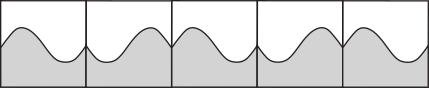
There are two types of tiles: Type A and Type B.
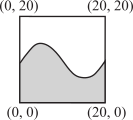
For Type A, the colours on the tiles are divided using the rule `f(x)=4 \sin \left(\frac{\pi x}{10}\right)+a`, where `a \in R`.
The corners of each tile have the coordinates (0,0), (20,0), (20,20) and (0,20), as shown below.
--- 2 WORK AREA LINES (style=lined) ---
ii. Find the value of `a` so that a Type A tile meets Condition 1. (1 mark)
--- 2 WORK AREA LINES (style=lined) ---
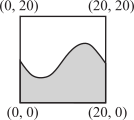
Type B tiles, an example of which is shown below, are divided using the rule `g(x)=-\frac{1}{100} x^3+\frac{3}{10} x^2-2 x+10`.
--- 8 WORK AREA LINES (style=lined) ---
a.i. `400` cm²
a.ii. `a = 10`
b. `200` cm²
c. See worked solution
| a.i Area | `= 20 xx 20` | |
| `= 400` cm² |
a.ii `a = 10`
| b. Area | `=\int_0^{20} \frac{-x^3}{100}+\frac{3 x^2}{10}-2 x+10\ d x` | |
| `=\left[\frac{-x^4}{400}+\frac{x^3}{10}-x^2+10 x\right]_0^{20}` | ||
| `=\left[-\frac{20^4}{400}+\frac{20^3}{10}-20^2+10 xx 20\right]-\left[0\right]` | ||
| `= – 400 +800 -400 +200` | ||
| `= 200` cm² |
`:.` The area of the coloured section of the Type B tile is 200 cm² which is half the 400 cm² area of the tile.
| c. |
`f(0)` | `=4 \sin \left(\frac{\pi(0)}{10}\right)+10 = 10` | |
| `f(20)` | `=4 \sin (2 \pi)+10 = 10` | ||
| `g(0)` | `=\frac{-0}{100}+\frac{3(0)}{10}-2(0)+10=10` | ||
| `g(20)` | `=-\frac{8000}{100}+\frac{200}{10}-2(20)+10 = 10` |
→`\ f(0) = f(20) = g(0) = g(20) =10`
`:.` The endpoints for `f(x)` are `(0,10)` and `(20,10)` and for `g(x)` are also `(0,10)` and `(20,10)`.
So the tiles can be placed in any order to make the continuous pattern.
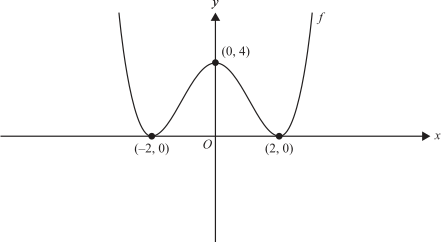
Let `f:R rarr R, \ f(x)=a(x+2)^(2)(x-2)^(2)`, where `a in R`. Part of the graph of `f` is shown below.
--- 2 WORK AREA LINES (style=lined) ---
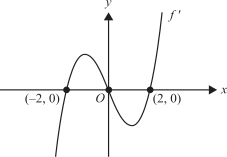
Part of the graph of the derivative function `f^{′}` is shown below.
--- 1 WORK AREA LINES (style=lined) ---
--- 4 WORK AREA LINES (style=lined) ---
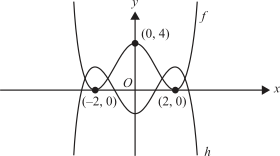
Let `h:R rarr R, \ h(x)=-(1)/(4)(x+2)^(2)(x-2)^(2)+2`. Parts of the graph of `f` and `h` are shown below.
--- 2 WORK AREA LINES (style=lined) ---
--- 3 WORK AREA LINES (style=lined) ---
a. `text(S)text(ince)\ f(x)\ text{passes through (0, 4):}`
| `4` | `=a(2)^2(-2)^2` | |
| `4` | `=16a` | |
| `:.a` | `=1/4\ \ text(… as required)` |
| b. `f(x)` | `=(1)/(4)(x+2)^(2)(x-2)^(2)` | |
| `=(1)/(4)x^4-2x^2+4` |
c.i. `f^{′}(x)=x(x-2)(x+2)=x^(3)-4x`
c.ii. `text{Solve}\ \ f^{″}(x)=0\ \ \text{for}\ x:`
`3x^2-4=0`
`=> \ x=(2sqrt3)/(3)`
`f^{′}((2sqrt3)/(3))=-(16sqrt3)/(9)`
d. `text{Reflect in the x-axis then translate 2 units up, or}`
`text{translate 2 units down then reflect in the x-axis.}`
e.i. `text{By CAS, solve}\ \ f(x)=h(x)\ \ text{for}\ x:}`
`x in{-sqrt6,-sqrt2,sqrt2,sqrt6}`
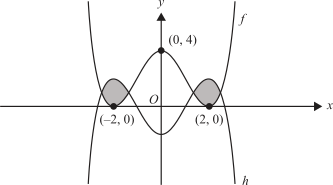
e.ii. `2int_(sqrt2)^(sqrt6)(h(x)-f(x))\ dx” or”`
`int_(-sqrt6)^(-sqrt2)(h(x)-f(x))\ dx+int_(sqrt2)^(sqrt6)(h(x)-f(x))\ dx`
e.iii. `text(Area = 2.72 u²)`
f. `text{By CAS, solve}\ -2 <= h(x)-f(x) <= 2\ \ \text{for}\ x:`
`-2.61 <= x <= -1.08, \ 1.08 <= x <= 2.61,” or”`
`-sqrt(4+2sqrt2) <= x <= -sqrt(4-2sqrt2), \ sqrt(4-2sqrt2) <= x <= sqrt(4+2sqrt2)`
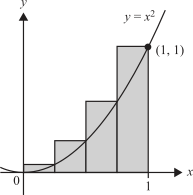
Four rectangles of equal width are drawn and used to approximate the area under the parabola `y = x^2` from `x = 0` to `x = 1`.
The heights of the rectangles are the values of the graph of `y = x^2` at the right endpoint of each rectangle, as shown in the graph below.
Approximate `int_(-2)^2 f(x)\ dx` using four rectangles of equal width and the right endpoint of each rectangle. (1 mark)
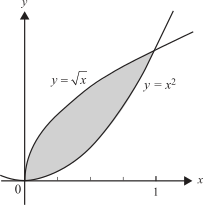
Parts of the graphs of `y = x^2` and `y = sqrtx` are shown below.
a. `0.25`
| b. | `text{Area}` | `= 1/4 (1/16 + 1/4 + 9/16 + 1)` |
| `= 15/32\ text(u)^2` |
| c. | `text{Area}` | `= int_0^1 x^2 dx` |
| `= 1/3\ text(u)^2` |
d.
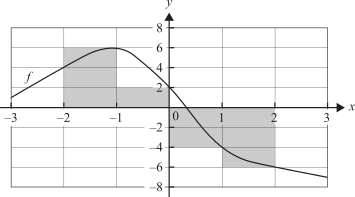
| `int_-2^2 f(x)\ dx` | `≈ 6 + 2 – 4 – 6` |
| `≈ -2` |
| e. | `text{Area}` | `= int_0^1 (sqrtx – x^2) dx` |
| `= 1/3\ text(u)^2` |
f. `text{Case 1:} \ a ≤ 1`
`int_0^a (sqrtx – ax^2) dx = 1/3`
`a = 0.77 \ \ text{or} \ \ a = 1.00`
`text{Case 2:} \ a > 1`
`sqrtx = ax^2 \ => \ x = a^{- 3/2}`
`text{Solve for}\ a\ text{(by CAS)}:`
`int_0^{a^{- 3/2}} (sqrtx – ax^2) dx + int_{a^{- 3/2}}^a (sqrtx – ax^2) dx = 1/3`
`:. a = 1.13`
If `int_1^4 f(x)\ dx = 4` and `int_2^4 f(x)\ dx = -2`, then `int_1^2(f(x) + x)\ dx` is equal to
A. `2`
B. `6`
C. `8`
D. `7/2`
E. `15/2`
`E`
| `int_1^2 f(x) + x\ dx` | `= int_1^2 x\ dx + int_1^2 f(x)\ dx` |
| `= [(x^2)/2]_1^2 + int_1^4 f(x)\ dx – int_2^4 f(x)\ dx` | |
| `= (2 – 1/2) + 4 – (-2)` | |
| `= 15/2` |
`=> E`
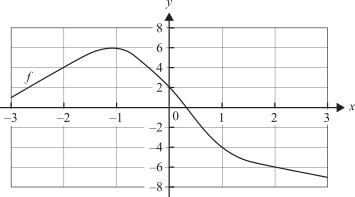
The graph of a function `f`, where `f(−x) = f (x)`, is shown below.
The graph has `x`-intercepts at `(a, 0)`, `(b, 0)`, `(c, 0)` and `(d, 0)` only.
The area bound by the curve and the `x`-axis on the interval `[a, d]` is
`D`
`text(S)text(ince)\ \ f(x)\ \ text(is an odd function,)`
`=> b=-c`
`:. 2int_a^b f(x)\ dx – 2int_b^(b + c) f(x)\ dx`
`= 2int_a^b f(x)\ dx – 2int_b^(0) f(x)\ dx`
`=> D`
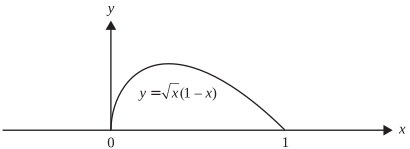
The graph of `f: [0, 1] -> R,\ f(x) = sqrt x (1-x)` is shown below.
--- 6 WORK AREA LINES (style=lined) ---
--- 4 WORK AREA LINES (style=lined) ---
The edges of the right-angled triangle `ABC` are the line segments `AC` and `BC`, which are tangent to the graph of `f`, and the line segment `AB`, which is part of the horizontal axis, as shown below.
Let `theta` be the angle that `AC` makes with the positive direction of the horizontal axis, where `45^@ <= theta < 90^@`.
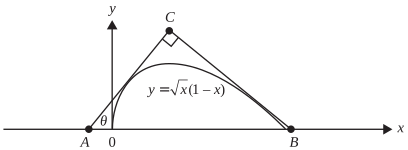
--- 7 WORK AREA LINES (style=lined) ---
--- 10 WORK AREA LINES (style=lined) ---
| a. | `text(Area)` | `= int_0^1 (sqrt x-x sqrt x)\ dx` |
| `= int_0^1 (x^(1/2)-x^(3/2))\ dx` | ||
| `= [2/3 x^(3/2)-2/5 x^(5/2)]_0^1` | ||
| `= (2/3-2/5)-(0-0)` | ||
| `= 10/15-6/15` | ||
| `= 4/15\ text(units)^2` |
| b. | `f (x)` | `= x^(1/2)-x^(3/2)` |
| `f^{′}(x)` | `= 1/2 x^(-1/2)-3/2 x^(1/2)` | |
| `= 1/(2 sqrt x)-(3 sqrt x)/2` | ||
| `= (1-3x)/(2 sqrt x)\ \ text(.. as required.)` |
c. `m_(AC) = tan 45^@=1`
`=> m_(BC) = -1\ \ (m_text(BC) _|_ m_(AC))`
`text(At point of tangency of)\ BC,\ f^{prime}(x) = -1`
| `(1-3x)/(2 sqrt x)` | `=-1` |
| `1-3x` | `=-2sqrtx` |
| `3x-2sqrt x-1` | `=0` |
`text(Let)\ \ a=sqrtx,`
| `3a^2-2a-1` | `=0` |
| `(3a+1)(a-1)` | `=0` |
| `a=1 or -1/3` |
| `:. sqrt x` | `=1` | `or` | `sqrt x=- 1/3\ \ text{(no solution)}` |
| `x` | `=1` |
`f(1)=sqrt1(1-1)=0\ \ =>B(1,0)`
`:.\ text(Equation of)\ \ BC, \ m=-1, text{through (1,0) is:}`
| `y-0` | `=-1(x-1)` |
| `y` | `=-x+1` |
d. `text(Find Equation)\ AC:`
`m_(AC) =1`
`text(At point of tangency of)\ AC,\ f^{prime}(x) = 1`
| `(1-3x)/(2 sqrt x)` | `=1` |
| `1-3x` | `=2sqrtx` |
| `3x+2sqrt x-1` | `=0` |
| `(3 sqrtx-1)(sqrtx+1)` | `=0` |
| `:. sqrt x` | `=1/3` | `or` | `sqrt x=-1\ \ text{(no solution)}` |
| `x` | `=1/9` |
`f(1/9)=sqrt(1/9)(1-1/9)=1/3 xx 8/9 = 8/27\ \ =>P(1/9,8/27)`
`:.\ text(Equation of)\ AC, m=1, text(through)\ \ P\ \ text(is):`
| `y-8/27` | `= 1 (x-1/9)` |
| `y` | `= x + 5/27` |
`C\ text(is at intersection of)\ AC and CB:`
| `-x + 1` | `= x + 5/27` |
| `2x` | `= 22/27` |
| `:. x` | `= 11/27` |
| `y` | `= -11/27 + 1 = 16/27` |
`:. C (11/27, 16/27)`