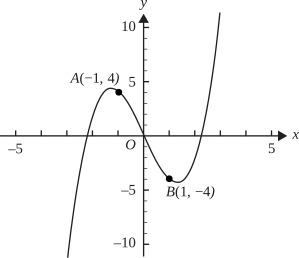
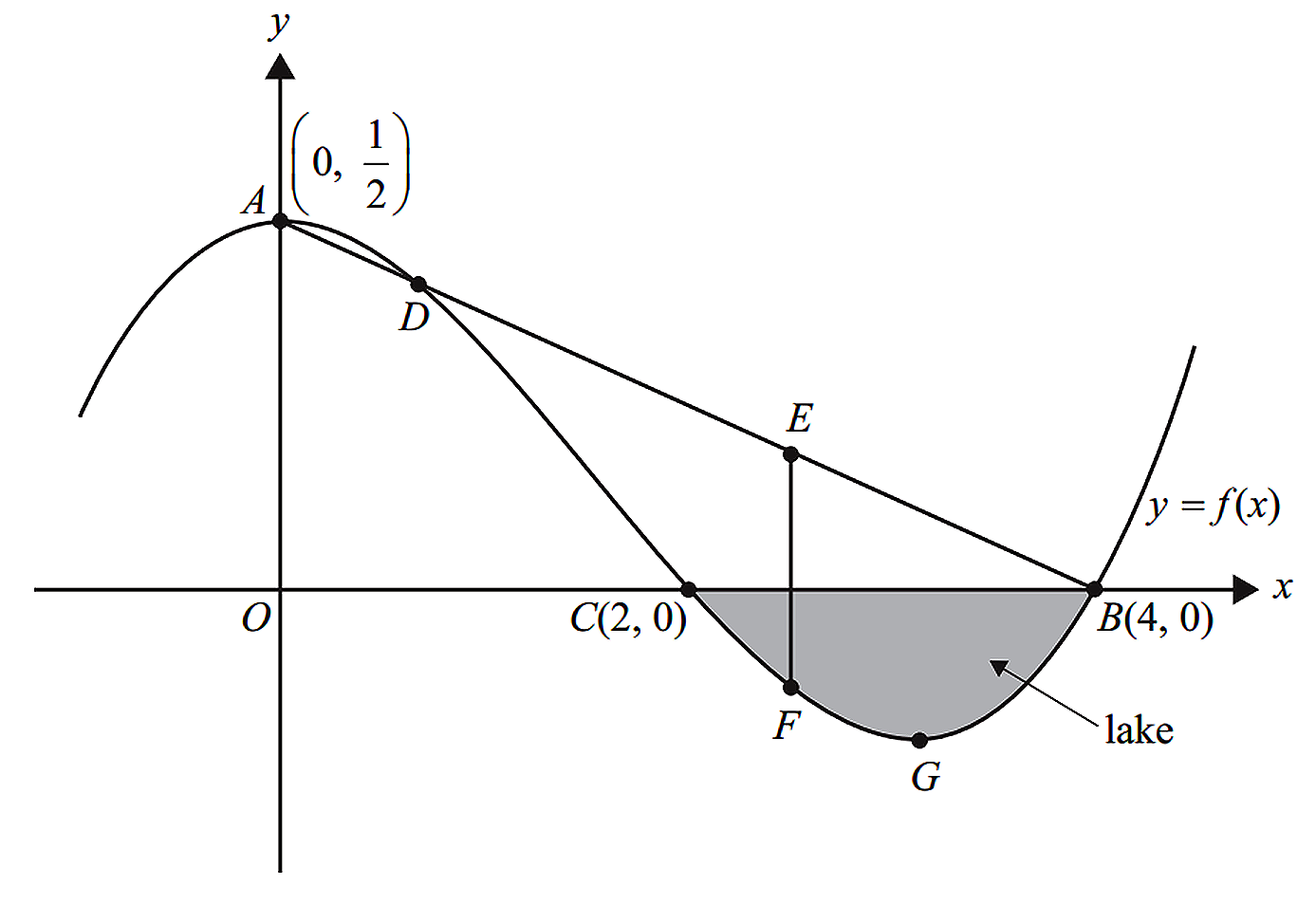
Let \(f: R \rightarrow R, f(x)=x^3-x^2-16 x-20\).
- Verify that \(x=5\) is a solution of \(f(x)=0\). (1 mark)
--- 3 WORK AREA LINES (style=lined) ---
- Express \(f(x)\) in the form \((x+d)^2(x-5)\), where \(d \in R\). (2 marks)
--- 8 WORK AREA LINES (style=lined) ---
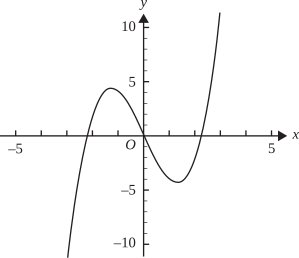
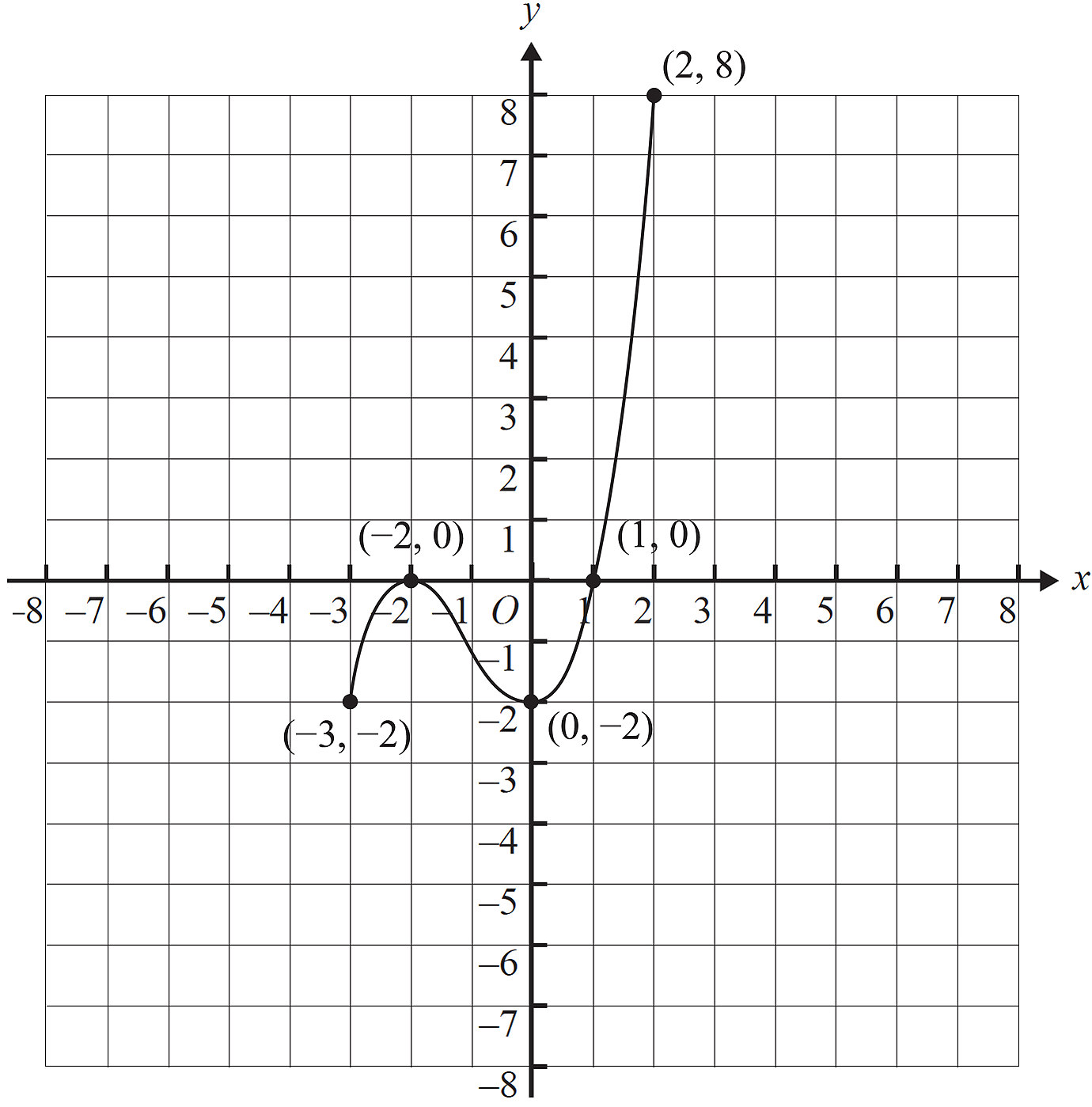
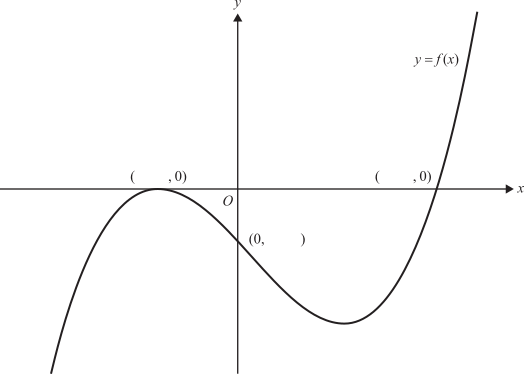
- Consider the graph of \(y=f(x)\), as shown below.
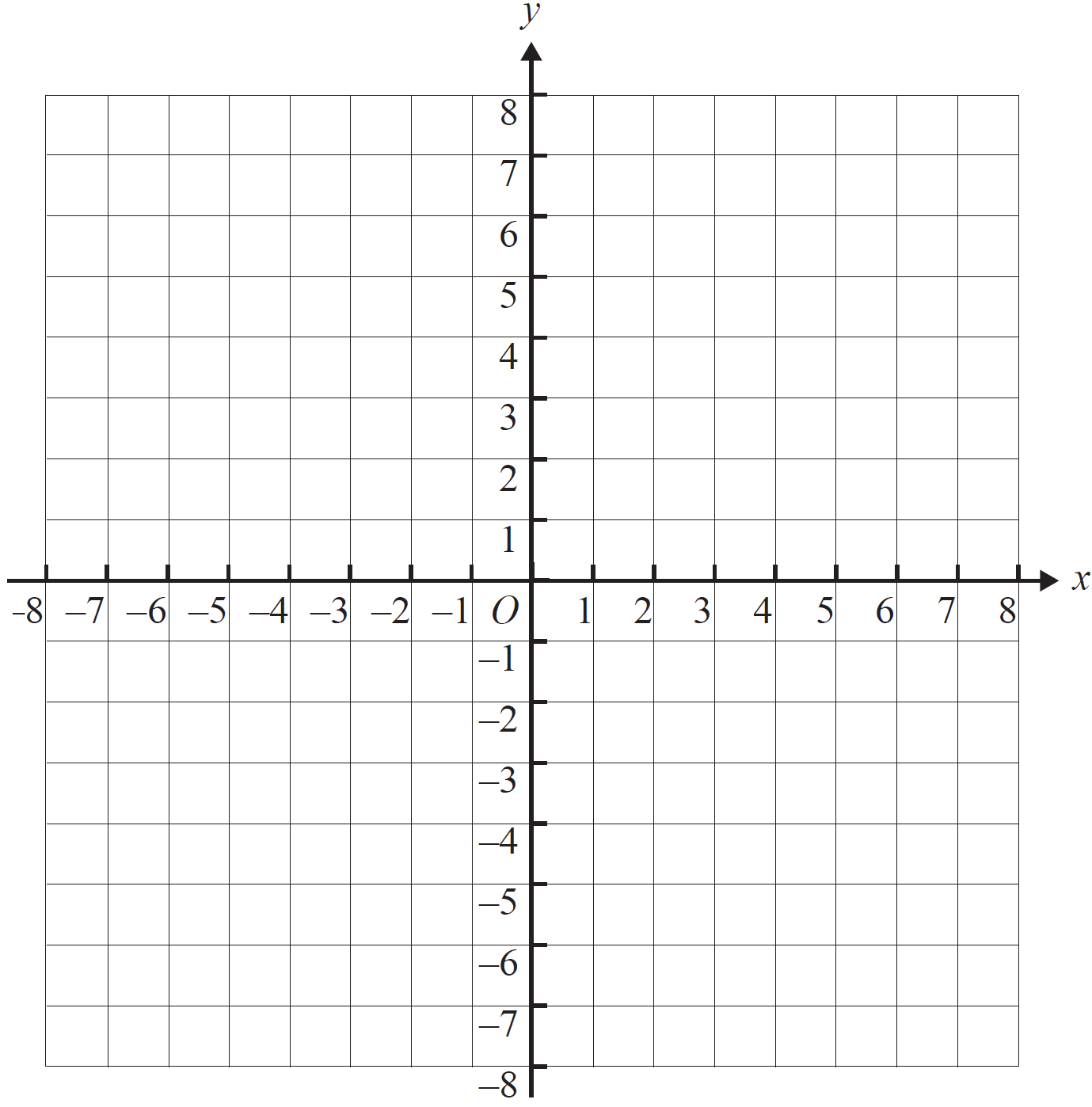
- Complete the coordinate pairs of all axial intercepts of \(y=f(x)\). (1 mark)
--- 0 WORK AREA LINES (style=lined) ---
- Let \(g: R \rightarrow R, g(x)=x+2\).
- State the coordinates of the stationary point of inflection for the graph of \(y=f(x) g(x)\). (1 mark)
--- 3 WORK AREA LINES (style=lined) ---
- Write down the values of \(x\) for which \(f(x) g(x) \geq 0\). (1 mark)
--- 3 WORK AREA LINES (style=lined) ---
- State the coordinates of the stationary point of inflection for the graph of \(y=f(x) g(x)\). (1 mark)
a. \(f(5)=5^3-5^2-16 \times 5-20 =0\)
b. \(f(x)=(x+2)^2(x-5)\)
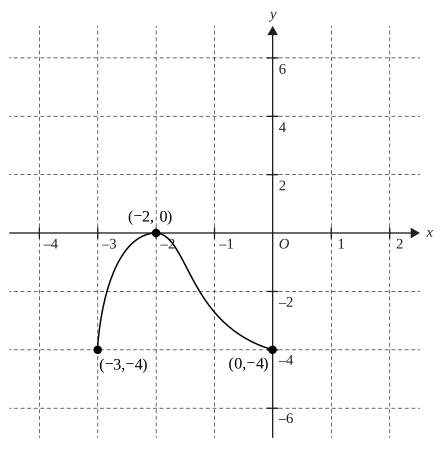
c.
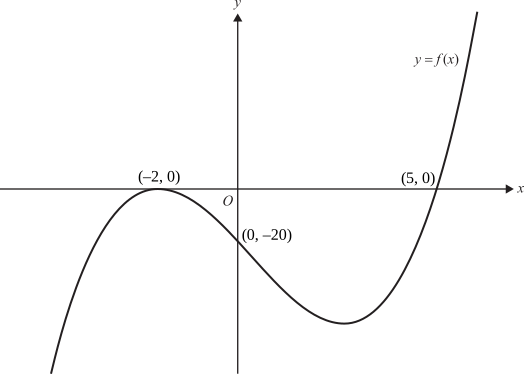
d.i. \((-2,0)\)
d.ii. \(x \in(-\infty,-2] \cup[5, \infty)\)
a. \(f(x)=x^3-x^2-16 x-20\)
\(f(5)=5^3-5^2-16 \times 5-20=125-25-80-20=0\)
\(\therefore x=5\ \ \text{is a solution of}\ f(x)\).
b. \(\text{By long division:}\)
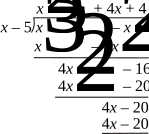
\(f(x)=\left(x^2+4 x+4\right)(x-5)=(x+2)^2(x-5)\)
c.
| d.i. | \(y\) | \(=f(x) \cdot g(x)\) |
| \(=(x+2)^2(x-5)(x+2)\) | ||
| \(=(x+2)^3(x-5)\) |
\((x+2)^3\ \text{factor}\ \Rightarrow\ \text{SP of inflection at} \ (-2,0)\)
♦♦ Mean mark (d.ii) 27%.
d.ii.
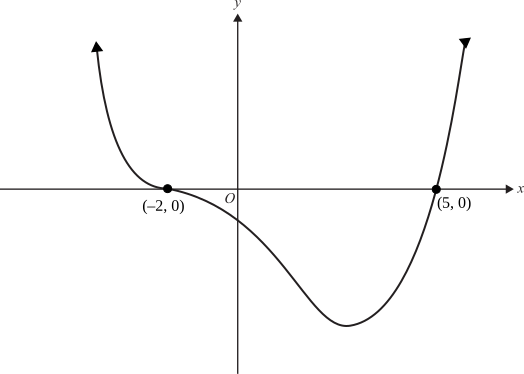
\(\text{By inspection of graph:}\)
\(f(x) g(x) \geqslant 0 \ \ \text{when}\ \ x \leqslant-2\ \cup\ x \geqslant 5\)
\(x \in(-\infty,-2] \cup[5, \infty) \ \text{also correct.}\)