SmarterEd

Aussie Maths & Science Teachers: Save your time with SmarterEd

  • Login
  • Get Help
  • About

EXAMCOPY MattTest Indenting

Consider the function `f`, where `f:\left(-\frac{1}{2}, \frac{1}{2}\right) \rightarrow R, f(x)=\log _e\left(x+\frac{1}{2}\right)-\log _e\left(\frac{1}{2}-x\right).`

Part of the graph of `y=f(x)` is shown below.
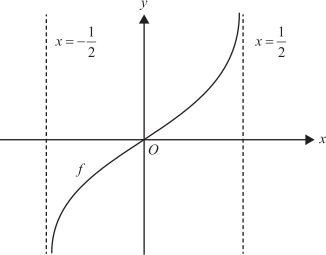
 

  1. State the range of `f(x)`.   (1 mark)

    --- 1 WORK AREA LINES (style=lined) ---

  2. Matt 1
    1. lskdjflsdkfj 
    2. sldkjfsldkfj 
    1. Something
    1. abc
    2. def
  3. slkflskdfj
    1. slkdfjlsdkfj
    2. sdlkjfsdlkfj
    1. lskjdflksd
    2. sdkjflsdkfj
  4. See the items below
    1. first
    2. second
    3. third
    4. fourth
    5. fifth
    1. Find `f^{\prime}(0)`.   (2 marks)

      --- 3 WORK AREA LINES (style=lined) ---

    2. State the maximal domain over which `f` is strictly increasing.   (1 mark)

      --- 2 WORK AREA LINES (style=lined) ---

    1. slkdjflskdfj 
    2. slkdfjlsdkfj
  5. lsksdlkfj
    1. sdflkjsd
    2. sdlfkj
    1. sdfsdlkf
  6. slkdfsldkfj
    1. slkdfjsldkfj
  7. Show that `f(x)+f(-x)=0`.   (1 mark)

    --- 3 WORK AREA LINES (style=lined) ---

  8. Find the domain and the rule of `f^{-1}`, the inverse of `f`.   (3 marks)

    --- 4 WORK AREA LINES (style=lined) ---

  9. Let `h` be the function `h:\left(-\frac{1}{2}, \frac{1}{2}\right) \rightarrow R, h(x)=\frac{1}{k}\left(\log _e\left(x+\frac{1}{2}\right)-\log _e\left(\frac{1}{2}-x\right)\right)`, where `k \in R` and `k>0`.
  1. The inverse function of `h` is defined by `h^{-1}: R \rightarrow R, h^{-1}(x)=\frac{e^{k x}-1}{2\left(e^{k x}+1\right)}`.
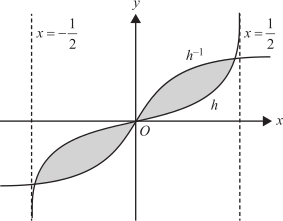
  2. The area of the regions bound by the functions `h` and `h^{-1}` can be expressed as a function, `A(k)`.
  3. The graph below shows the relevant area shaded.
     

  1. You are not required to find or define `A(k)`.
  1. Determine the range of values of `k` such that `A(k)>0`.   (1 mark)

    --- 2 WORK AREA LINES (style=lined) ---

  2. Explain why the domain of `A(k)` does not include all values of `k`.   (1 mark)

    --- 2 WORK AREA LINES (style=lined) ---
Show Answers Only
a.     `R`
b.i `f^{\prime}(0)=4`
b.ii `\left(-\frac{1}{2}, \frac{1}{2}\right)`
c. `0`
d. `x \in \mathbb{R}`
e.i  ` k > 4`
e.ii No bounded area for `0<k \leq 4`
Show Worked Solution

a.   `R` is the range.

b.i    `f(x)`
`= \log _e\left(x+\frac{1}{2}\right)-\log _e\left(\frac{1}{2}-x\right)`  
  `f^{\prime}(x)` `= \frac{1}{x+\frac{1}{2}}+\frac{1}{\frac{1}{2}-x}`  
    `= \frac{2}{2 x+1}-\frac{2}{2 x-1}`  
  `f^{\prime}(0)` `= \frac{2}{2 xx 0+1}-\frac{2}{2 xx 0-1}`  
    `= 4`  

 
b.ii 
`\left(-\frac{1}{2}, \frac{1}{2}\right)`

c.   `f(x)+f(-x)` `= \log _e\left(x+\frac{1}{2}\right)-\log _e\left(\frac{1}{2}-x\right)+\log _e\left(-x+\frac{1}{2}\right)-\log _e\left(\frac{1}{2}+x\right)`  
  `= 0`  

 
d.  
To find the inverse swap `x` and `y` in `y=f(x)`

`x` `= \log _e\left(y+\frac{1}{2}\right)-\log _e\left(\frac{1}{2}-y\right)`  
`x` `= \log _e\left(\frac{y+\frac{1}{2}}{\frac{1}{2}-y}\right)`  
`e^x` `=\frac{y+\frac{1}{2}}{\frac{1}{2}-y}`  
`y+\frac{1}{2}` `= e^x\left(-y+\frac{1}{2}\right)`  
`y+\frac{1}{2}` `= -e^x y+\frac{e^x}{2}`  
`y\left(e^x+1\right)` `= \frac{e^x-1}{2}`  
`:.\ f^(-1)(x)` `= \frac{e^x-1}{2(e^x + 1)}`  

 
  `:.`  Domain: `x \in \mathbb{R}`
  

e.i   The vertical dilation factor of  `f(x)` is  `1/k`

For `A(k)>=0` , `h^{\prime}(0)<1`

`\frac{1}{k}(4)<1`   [Using CAS]

`:.\  k > 4`


♦♦♦♦ Mean mark (e.i) 10%.
MARKER’S COMMENT: Incorrect responses included `k>0` and `4<k<33`.

e.ii  When `h \geq h^{-1}` for  `x>0` (or `h \leq h^{-1}` for  `x<0`) there is no bounded area.

`:.`  There will be no bounded area for `0<k \leq 4`.


♦♦♦♦ Mean mark (e.ii) 10%.

Filed Under: Test category Tagged With: Band 3, Band 4, Band 6, smc-2745-40-Log graphs, smc-2745-50-Find Domain/Range, smc-5204-80-Area between curves, smc-723-50-Log/Exponential, smc-723-80-Area between graphs, smc-723-95-Transformations

EXAMCOPY Functions, MET2 2022 VCAA 4

Consider the function `f`, where `f:\left(-\frac{1}{2}, \frac{1}{2}\right) \rightarrow R, f(x)=\log _e\left(x+\frac{1}{2}\right)-\log _e\left(\frac{1}{2}-x\right).`

Part of the graph of `y=f(x)` is shown below.
 

  1. State the range of `f(x)`.   (1 mark)

    --- 1 WORK AREA LINES (style=lined) ---

  2.  i. Find `f^{\prime}(0)`.   (2 marks)

    --- 3 WORK AREA LINES (style=lined) ---

  3. ii. State the maximal domain over which `f` is strictly increasing.   (1 mark)

    --- 2 WORK AREA LINES (style=lined) ---

  4. Show that `f(x)+f(-x)=0`.   (1 mark)

    --- 3 WORK AREA LINES (style=lined) ---

  5. Find the domain and the rule of `f^{-1}`, the inverse of `f`.   (3 marks)

    --- 4 WORK AREA LINES (style=lined) ---

  6. Let `h` be the function `h:\left(-\frac{1}{2}, \frac{1}{2}\right) \rightarrow R, h(x)=\frac{1}{k}\left(\log _e\left(x+\frac{1}{2}\right)-\log _e\left(\frac{1}{2}-x\right)\right)`, where `k \in R` and `k>0`.
  7. The inverse function of `h` is defined by `h^{-1}: R \rightarrow R, h^{-1}(x)=\frac{e^{k x}-1}{2\left(e^{k x}+1\right)}`.
  8. The area of the regions bound by the functions `h` and `h^{-1}` can be expressed as a function, `A(k)`.
  9. The graph below shows the relevant area shaded.
     

  1. You are not required to find or define `A(k)`.
  1. Determine the range of values of `k` such that `A(k)>0`.   (1 mark)

    --- 2 WORK AREA LINES (style=lined) ---

  2. Explain why the domain of `A(k)` does not include all values of `k`.   (1 mark)

    --- 2 WORK AREA LINES (style=lined) ---
Show Answers Only
a.     `R`
b.i `f^{\prime}(0)=4`
b.ii `\left(-\frac{1}{2}, \frac{1}{2}\right)`
c. `0`
d. `x \in \mathbb{R}`
e.i  ` k > 4`
e.ii No bounded area for `0<k \leq 4`
Show Worked Solution

a.   `R` is the range.

b.i    `f(x)`
`= \log _e\left(x+\frac{1}{2}\right)-\log _e\left(\frac{1}{2}-x\right)`  
  `f^{\prime}(x)` `= \frac{1}{x+\frac{1}{2}}+\frac{1}{\frac{1}{2}-x}`  
    `= \frac{2}{2 x+1}-\frac{2}{2 x-1}`  
  `f^{\prime}(0)` `= \frac{2}{2 xx 0+1}-\frac{2}{2 xx 0-1}`  
    `= 4`  

 
b.ii 
`\left(-\frac{1}{2}, \frac{1}{2}\right)`

c.   `f(x)+f(-x)` `= \log _e\left(x+\frac{1}{2}\right)-\log _e\left(\frac{1}{2}-x\right)+\log _e\left(-x+\frac{1}{2}\right)-\log _e\left(\frac{1}{2}+x\right)`  
  `= 0`  

 
d.  
To find the inverse swap `x` and `y` in `y=f(x)`

`x` `= \log _e\left(y+\frac{1}{2}\right)-\log _e\left(\frac{1}{2}-y\right)`  
`x` `= \log _e\left(\frac{y+\frac{1}{2}}{\frac{1}{2}-y}\right)`  
`e^x` `=\frac{y+\frac{1}{2}}{\frac{1}{2}-y}`  
`y+\frac{1}{2}` `= e^x\left(-y+\frac{1}{2}\right)`  
`y+\frac{1}{2}` `= -e^x y+\frac{e^x}{2}`  
`y\left(e^x+1\right)` `= \frac{e^x-1}{2}`  
`:.\ f^(-1)(x)` `= \frac{e^x-1}{2(e^x + 1)}`  

 
  `:.`  Domain: `x \in \mathbb{R}`
  

e.i   The vertical dilation factor of  `f(x)` is  `1/k`

For `A(k)>=0` , `h^{\prime}(0)<1`

`\frac{1}{k}(4)<1`   [Using CAS]

`:.\  k > 4`


♦♦♦♦ Mean mark (e.i) 10%.
MARKER’S COMMENT: Incorrect responses included `k>0` and `4<k<33`.

e.ii  When `h \geq h^{-1}` for  `x>0` (or `h \leq h^{-1}` for  `x<0`) there is no bounded area.

`:.`  There will be no bounded area for `0<k \leq 4`.


♦♦♦♦ Mean mark (e.ii) 10%.

Filed Under: Test category Tagged With: Band 3, Band 4, Band 6, smc-2745-40-Log graphs, smc-2745-50-Find Domain/Range, smc-5204-80-Area between curves, smc-723-50-Log/Exponential, smc-723-80-Area between graphs, smc-723-95-Transformations

Functions, MET2 2022 VCAA 4

Consider the function `f`, where `f:\left(-\frac{1}{2}, \frac{1}{2}\right) \rightarrow R, f(x)=\log _e\left(x+\frac{1}{2}\right)-\log _e\left(\frac{1}{2}-x\right).`

Part of the graph of `y=f(x)` is shown below.
 

  1. State the range of `f(x)`.   (1 mark)

    --- 1 WORK AREA LINES (style=lined) ---

  2.  i. Find `f^{\prime}(0)`.   (2 marks)

    --- 4 WORK AREA LINES (style=lined) ---

  3. ii. State the maximal domain over which `f` is strictly increasing.   (1 mark)

    --- 1 WORK AREA LINES (style=lined) ---

  4. Show that `f(x)+f(-x)=0`.   (1 mark)

    --- 3 WORK AREA LINES (style=lined) ---

  5. Find the domain and the rule of `f^{-1}`, the inverse of `f`.   (3 marks)

    --- 6 WORK AREA LINES (style=lined) ---

  6. Let `h` be the function `h:\left(-\frac{1}{2}, \frac{1}{2}\right) \rightarrow R, h(x)=\frac{1}{k}\left(\log _e\left(x+\frac{1}{2}\right)-\log _e\left(\frac{1}{2}-x\right)\right)`, where `k \in R` and `k>0`.
  7. The inverse function of `h` is defined by `h^{-1}: R \rightarrow R, h^{-1}(x)=\frac{e^{k x}-1}{2\left(e^{k x}+1\right)}`.
  8. The area of the regions bound by the functions `h` and `h^{-1}` can be expressed as a function, `A(k)`.
  9. The graph below shows the relevant area shaded.
     

  1. You are not required to find or define `A(k)`.
  2.  i. Determine the range of values of `k` such that `A(k)>0`.   (1 mark)

    --- 2 WORK AREA LINES (style=lined) ---
  3. ii. Explain why the domain of `A(k)` does not include all values of `k`.   (1 mark

    --- 2 WORK AREA LINES (style=lined) ---
Show Answers Only
a.     `R`
b.i `f^{\prime}(0)=4`
b.ii `\left(-\frac{1}{2}, \frac{1}{2}\right)`
c. `0`
d. `x \in \mathbb{R}`
e.i  ` k > 4`
e.ii No bounded area for `0<k \leq 4`
Show Worked Solution

a.   `R` is the range.

b.i    `f(x)`
`= \log _e\left(x+\frac{1}{2}\right)-\log _e\left(\frac{1}{2}-x\right)`  
  `f^{\prime}(x)` `= \frac{1}{x+\frac{1}{2}}+\frac{1}{\frac{1}{2}-x}`  
    `= \frac{2}{2 x+1}-\frac{2}{2 x-1}`  
  `f^{\prime}(0)` `= \frac{2}{2 xx 0+1}-\frac{2}{2 xx 0-1}`  
    `= 4`  

 
b.ii 
`\left(-\frac{1}{2}, \frac{1}{2}\right)`

c.   `f(x)+f(-x)`

`= \log _e\left(x+\frac{1}{2}\right)-\log _e\left(\frac{1}{2}-x\right)+\log _e\left(-x+\frac{1}{2}\right)-\log _e\left(\frac{1}{2}+x\right)`  
`= 0`  

 
d.  
To find the inverse swap `x` and `y` in `y=f(x)`

`x` `= \log _e\left(y+\frac{1}{2}\right)-\log _e\left(\frac{1}{2}-y\right)`  
`x` `= \log _e\left(\frac{y+\frac{1}{2}}{\frac{1}{2}-y}\right)`  
`e^x` `=\frac{y+\frac{1}{2}}{\frac{1}{2}-y}`  
`y+\frac{1}{2}` `= e^x\left(-y+\frac{1}{2}\right)`  
`y+\frac{1}{2}` `= -e^x y+\frac{e^x}{2}`  
`y\left(e^x+1\right)` `= \frac{e^x-1}{2}`  
`:.\ f^(-1)(x)` `= \frac{e^x-1}{2(e^x + 1)}`  

 
  `:.`  Domain: `x \in \mathbb{R}`
  

e.i   The vertical dilation factor of  `f(x)` is  `1/k`

For `A(k)>=0` , `h^{\prime}(0)<1`

`\frac{1}{k}(4)<1`   [Using CAS]

`:.\  k > 4`


♦♦♦♦ Mean mark (e.i) 10%.
MARKER’S COMMENT: Incorrect responses included `k>0` and `4<k<33`.

e.ii  When `h \geq h^{-1}` for  `x>0` (or `h \leq h^{-1}` for  `x<0`) there is no bounded area.

`:.`  There will be no bounded area for `0<k \leq 4`.


♦♦♦♦ Mean mark (e.ii) 10%.

Filed Under: Area Under Curves, Differentiation (L&E), Graphs and Applications, L&E Differentiation, Logs and Exponential Functions Tagged With: Band 3, Band 4, Band 6, smc-2745-40-Log graphs, smc-2745-50-Find Domain/Range, smc-5204-80-Area between curves, smc-723-50-Log/Exponential, smc-723-80-Area between graphs, smc-723-95-Transformations

Calculus, MET2 2023 VCAA 5

Let \(f:R \to R, f(x)=e^x+e^{-x}\) and \(g:R \to R, g(x)=\dfrac{1}{2}f(2-x)\).

  1. Complete a possible sequence of transformations to map \(f\) to \(g\).   (2 marks)
    •    Dilation of factor \(\dfrac{1}{2}\) from the \(x\) axis.

    --- 2 WORK AREA LINES (style=lined) ---

Two functions \(g_1\) and \(g_2\) are created, both with the same rule as \(g\) but with distinct domains, such that \(g_1\) is strictly increasing and \(g_2\) is strictly decreasing.

  1. Give the domain and range for the inverse of \(g_1\).   (2 marks)

    --- 3 WORK AREA LINES (style=lined) ---

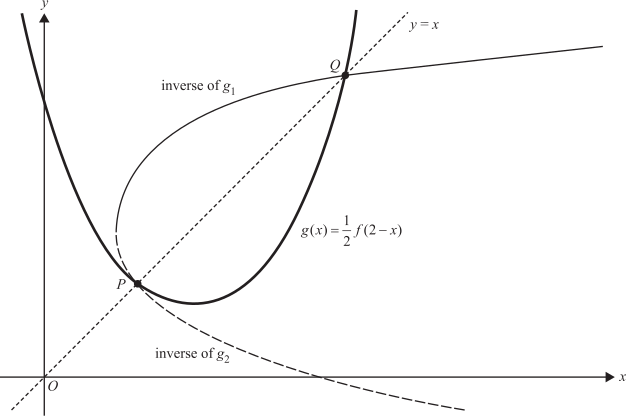
Shown below is the graph of \(g\), the inverse of \(g_1\) and \(g_2\), and the line \(y=x\).
 

The intersection points between the graphs of \(y=x, y=g(x)\) and the inverses of \(g_1\) and \(g_2\), are labelled \(P\) and \(Q\).

    1. Find the coordinates of \(P\) and \(Q\), correct to two decimal places.   (1 mark)

      --- 2 WORK AREA LINES (style=lined) ---

    1. Find the area of the region bound by the graphs of \(g\), the inverse of \(g_1\) and the inverse of \(g_2\).
    2. Give your answer correct to two decimal places.   (2 marks)

      --- 4 WORK AREA LINES (style=lined) ---

Let \(h:R\to R, h(x)=\dfrac{1}{k}f(k-x)\), where \(k\in (o, \infty)\).

  1. The turning point of \(h\) always lies on the graph of the function \(y=2x^n\), where \(n\) is an integer.
  2. Find the value of \(n\).  (1 mark)

    --- 2 WORK AREA LINES (style=lined) ---

Let \(h_1:[k, \infty)\to R, h_1(x)=h(x)\).

The rule for the inverse of \(h_1\) is \(y=\log_{e}\Bigg(\dfrac{1}{k}x+\dfrac{1}{2}\sqrt{k^2x^2-4}\Bigg)+k\)

  1. What is the smallest value of \(k\) such that \(h\) will intersect with the inverse of \(h_1\)?\
  2. Give your answer correct to two decimal places.   (1 mark)

    --- 3 WORK AREA LINES (style=lined) ---

It is possible for the graphs of \(h\) and the inverse of \(h_1\) to intersect twice. This occurs when \(k=5\).

  1. Find the area of the region bound by the graphs of \(h\) and the inverse of \(h_1\), where \(k=5\).
  2. Give your answer correct to two decimal places.   (2 marks)

    --- 5 WORK AREA LINES (style=lined) ---

Show Answers Only

a.    \(\text{Reflect in the }y\text{-axis}\)

\(\text{Then translate 2 units to the right}\)

\(\text{OR}\)

\(\text{Translate 2 units to the left}\)

\(\text{Then reflect in the }y\text{-axis}\)

\(\text{OR}\)

\(\text{Translate 2 units to the right only }(f \ \text{even function})\)

b.    \(\text{See worked solution}\)

c.i.  \(P(1.27, 1.27\), Q(4.09, 4.09)\)

c.ii. \(2\displaystyle \int_{1.27…}^{4.09…} (x-g(x))\,dx=5.56\)

d.    \(n=-1\)

e. \(k\approx 1.27\)

f. \(A=43.91\)

Show Worked Solution

a.    \(\text{Reflect in the }y\text{-axis}\)

\(\text{Then translate 2 units to the right}\)

\(\text{OR}\)

\(\text{Translate 2 units to the left}\)

\(\text{Then reflect in the }y\text{-axis}\)

\(\text{OR}\)

\(\text{Translate 2 units to the right only }(f \ \text{even function})\)

b.    \(\text{Some options include:}\)

•  \(\text{Domain}\to [1, \infty)\ \ \ \text{Range}\to [2, \infty)\)
\(\text{or}\)
•  \(\text{Domain}\to (1, \infty)\ \ \ \text{Range}\to (2, \infty)\)
 

\(\text{If functions split at turning point } (2, 1)\ \text{then possible options:}\)

• \(\text{Domain}\ g_1\to [2, \infty)\ \ \ \text{Range}\to [1, \infty)\)
   \(\text{and }\)
  \(\text{Domain}\ g_1^{-1}\to [1, \infty)\ \ \ \text{Range}\to [2, \infty)\)

\(\text{or}\)

•  \(\text{Domain}\ g_1\to (2, \infty)\ \ \ \text{Range}\to (1, \infty)\)
   \(\text{and }\)
   \(\text{Domain}\ g_1^{-1}\to (1, \infty)\ \ \ \text{Range}\to (2, \infty)\)


♦ Mean mark 50%.
MARKER’S COMMENT: Note: maximal domain not requested so there were many correct answers. Many students seemed to be confused by notation. Often domain and range reversed.

c.i.  \(\text{By CAS:}\  P(1.27, 1.27), Q(4.09, 4.09)\)

c.ii.   \(\text{Area}\) \(=2\displaystyle \int_{1.27…}^{4.09…} (x-g(x))\,dx\)
    \(=2\displaystyle \int_{1.27…}^{4.09…} \Bigg(x-\dfrac{1}{2}\Big(e^{2-x}+e^{x-2}\Big)\Bigg)\,dx\)
    \(\approx 5.56\)

♦♦ Mean mark (c)(ii) 30%.
MARKER’S COMMENT: Some students set up the integral but did not provide an answer.
Others did not double the integral. Some incorrectly used \(\displaystyle \int_{1.27…}^{4.09…}(g_1^-1-g(x))\,dx\).
Others had correct answer but incorrect integral.

d.    \((0, 2)\ \text{turning pt of }f(x)\)

\(\text{and }h(x) \text{is the transformation from }f(x)\)

\(\therefore \Bigg(k, \dfrac{2}{k}\Bigg)\ \text{turning tp of }h(x)\)

\(\text{so the coordinates have the relationship}\)

\(y=\dfrac{2}{x}=2x^{-1}\)

\(\therefore\ n=-1\)


♦♦♦ Mean mark (d) 10%.
MARKER’S COMMENT: Question not well done. \(n=1\) a common error.

e.    \(\text{Smallest }k\ \text{is when inverse of the curves }h_1\ \text{and}\ h\)

\(\text{touch with the line }y=x.\)

\(\therefore\ h(x)\) \(=\dfrac{1}{k}\Big(e^{k-x}+e^{x-k}\Big)\)
  \(=x\)


\(\text{and}\ h'(x)\) \(=\dfrac{1}{k}\Big(-e^{k-x}+e^{x-k}\Big)\)
  \(=1\)

\(\text{at point of intersection, where }k>0.\)

\(\text{Using CAS graph both functions to solve or solve as simultaneous equations.}\)

\(\rightarrow\ k\approx 1.2687\approx 1.27\)


♦♦♦♦ Mean mark (e) 0%.
MARKER’S COMMENT: Question poorly done with many students not attempting.

f.    \(\text{When}\ k=5\)

\(h_1^{-1}(x)=\log_e\Bigg(\dfrac{5}{2}x+\dfrac{1}{2}\sqrt{25x^2-4}\Bigg)+5\)

\(\text{and }h(x)=\dfrac{1}{5}\Big(e^{5-x}+e^{x-5}\Big)\)

\(\text{Using CAS: values of }x\ \text{at of intersection of fns are}\)

\(x\approx 1.45091…\ \text{and}\ 8.78157…\)

\(\text{Area}\) \(=\displaystyle \int_{1.45091…}^{8.78157…}h_1^{-1}(x)- h(x)\,dx\)
  \(=\displaystyle \int_{1.45091…}^{8.78157…} \log_e\Bigg(\dfrac{5}{2}x+\dfrac{1}{2}\sqrt{25x^2-4}\Bigg)+5-\dfrac{1}{5}\Big(e^{5-x}+e^{x-5}\Big)\,dx\)
  \(=43.91\) 

♦♦♦ Mean mark (f) 15%.
MARKER’S COMMENT: Errors were made with terminals. Common error using \(x=2.468\), which was the \(x\) value of the pt of intersection of \(h\) and \(y=x\).

Filed Under: Area Under Curves, Integration (L&E), L&E Integration, Logs and Exponential Functions, Transformations Tagged With: Band 4, Band 5, Band 6, smc-5204-50-Find intersection, smc-5204-80-Area between curves, smc-723-50-Log/Exponential, smc-723-95-Transformations, smc-740-20-Exponential (definite), smc-748-20-Exponential (definite)

Calculus, MET2 2020 VCAA 2

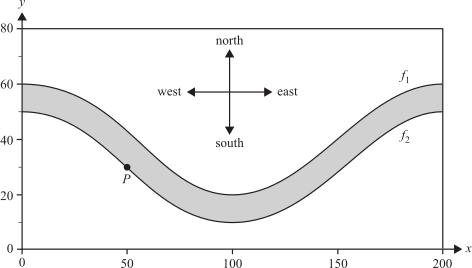
An area of parkland has a river running through it, as shown below. The river is shown shaded.

The north bank of the river is modelled by the function  `f_(1):[0,200]rarr R, \ f_(1)(x)=20 cos((pi x)/(100))+40`.

The south bank of the river is modelled by the function  `f_(2):[0,200]rarr R, \ f_(2)(x)=20 cos((pi x)/(100))+30`.

The horizontal axis points east and the vertical axis points north.

All distances are measured in metres.
 

A swimmer always starts at point `P`, which has coordinates  (50, 30).

Assume that no movement of water in the river affects the motion or path of the swimmer, which is always a straight line.

  1. The swimmer swims north from point `P`.
  2. Find the distance, in metres, that the swimmer needs to swim to get to get to the north bank of the river.   (1 mark)

    --- 2 WORK AREA LINES (style=lined) ---

  3. The swimmer swims east from point `P`.
  4. Find the distance, in metres, that the swimmer needs to swim to get to the north bank of the river.   (2 marks)

    --- 4 WORK AREA LINES (style=lined) ---

  5. On another occasion, the swimmer swims the minimum distance from point `P` to the north bank of the river.
  6. Find this minimum distance. Give your answer in metres, correct to one decimal place.   (2 marks)

    --- 5 WORK AREA LINES (style=lined) ---

  7. Calculate the surface area of the section of the river shown on the graph in square metres.   (1 mark)

    --- 3 WORK AREA LINES (style=lined) ---

  8. A horizontal line is drawn through point `P`. The section of the river that is south of the line is declared a no "no swimming" zone.
  9. Find the area of the "no swimming" zone, correct to the nearest square metre.   (3 marks)

    --- 6 WORK AREA LINES (style=lined) ---

  10. Scientists observe that the north bank of the river is changing over time. It is moving further north from its current position. They model its predicted new location using the function with rule  `y=kf_(1)(x)`, where `k >= 1`.
  11. Find the values of  `k` for which the distance north across the river, for all parts of the river, is strictly less than 20 m.   (2 marks)

    --- 6 WORK AREA LINES (style=lined) ---

Show Answers Only
  1. `10\ text{m}`
  2. `16 2/3\ text{m}`
  3. `8.5\ text{m}`
  4. `2000\ text{m}^2`
  5. `837\ text{m²}`
  6. `k in [1, 7/6)`
Show Worked Solution

a.   `text{Since swimmer swims due north,}`

`text{Distance}\ = 40-30=10\ text{m}`


b.  `text{Solve} \ f_(1)(x)=30 \ text{or} \ x in[50,100]`

`=> x=200/3`

`:.\ text{Distance to swim (east) to reach north bank}`

`=200/3-50`

`=16 2/3\ text{m}`
 

c.   `text{Let swimmer arrive at north bank at the point}\ \ (x,f_(1)(x))`

`text{By Pythagoras,}`

♦ Mean mark part (c) 39%.

`d(x)=sqrt((x-50)^(2)+(f_(1)(x)-30)^(2))`

`text{Solve} \ d/dx(d(x))=0 \ text{for} \ x:`

`x=54.47…`

`:. d_min=8.5\ text{m (to 1 d.p.)}`


d.   `text{Shaded Area}`

`=int_(0)^(200)(f_(1)(x)-f_(2)(x))\ dx`

`=2000\ text{m}^2`


e.   `text{Find}\ \ f_(1)(x) = 30 \ text{for} x in [50,150]:`

♦♦ Mean mark part (e) 35%.

`=>x=200/3, 400/3`

`text{Find}\ \ f_(2)(x) = 30 \ text{for} \ x in [50,150]:`

`=>x=50, 150`

`:.\ text{Area}` `=int_(50)^(150)(30-f_(2)(x))\ dx-int_((200)/(3))^((400)/(3))(30-f_(1)(x))\ dx`  
  `=837\ text{m² (to nearest m²)}`  

♦♦♦Mean mark part (f) 15%.


f.   `text{Let}\ \ D(x)=\ text{vertical distance between banks}`

`D(x)` `=kf_(1)(x)-f_(2)(x)`  
  `=20k cos((pi x)/(100))+40k-(20 cos((pi x)/(100))+30)`   
  `=(20k-20)cos((pi x)/(100)) +40k-30`  

  
`text{Given}\ \ D(x)<20 \ text{for}\ x in[0,200]`

`text{Maximum} \ cos((pi x)/(100)) = 1\  text{when}\ \ x=0, 200`

`text{Solve} \ 20k-20+40k-30<20\ \ text{for}\ k:`

`=> k<7/6`

`:. k in [1,7/6)`

Filed Under: Area Under Curves, Maxima and Minima Tagged With: Band 4, Band 5, Band 6, smc-641-50-Distance, smc-723-60-Trig, smc-723-80-Area between graphs, smc-723-95-Transformations

Calculus, MET2 2020 VCAA 9 MC

If   `int_(4)^(8)f(x)\ dx=5`, then  `int_(0)^(2)f(2(x+2))\ dx`  is equal to

  1. `12`
  2. `10`
  3. `8`
  4. `1/2`
  5. `5/2`
Show Answers Only

`E`

Show Worked Solution

`int_(4)^(8)f(x)\ dx=5`

♦♦ Mean mark 35%.

`text{Dilate by a factor of} \ (1)/(2)\ text{from the} \ y text{-axis}`

`int_(2)^(4)f(2x)\ dx=(5)/(2)`

`text{Translating 2 units to the left does not change the area}`

`int_(0)^(2)f(2(x+2))\ dx=(5)/(2)`

`=>E`

Filed Under: Area Under Curves Tagged With: Band 5, smc-723-95-Transformations

Calculus, MET2 2021 VCAA 5

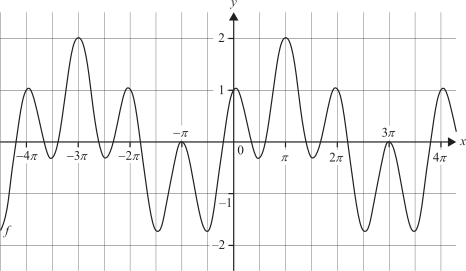
Part of the graph of  `f: R to R , \ f(x) = sin (x/2) + cos(2x)`  is shown below.
 

  1. State the period of `f`.   (1 mark)

    --- 2 WORK AREA LINES (style=lined) ---

  2. State the minimum value of `f`, correct to three decimal places.   (1 mark)

    --- 2 WORK AREA LINES (style=lined) ---

  3. Find the smallest positive value of `h` for which  `f(h-x) = f(x)`.   (1 mark)

    --- 3 WORK AREA LINES (style=lined) ---

Consider the set of functions of the form  `g_a : R to R, \ g_a (x) = sin(x/a) + cos(ax)`, where `a` is a positive integer.
  1. State the value of `a` such that  `g_a (x) = f(x)`  for all `x`.   (1 mark)

    --- 3 WORK AREA LINES (style=lined) ---

  2. i.  Find an antiderivative of `g_a` in terms of `a`.   (1 mark)

    --- 2 WORK AREA LINES (style=lined) ---

  3. ii. Use a definite integral to show that the area bounded by `g_a` and the `x`-axis over the interval  `[0, 2a pi]`  is equal above and below the `x`-axis for all values of `a`.  (3 marks)

    --- 4 WORK AREA LINES (style=lined) ---

  4. Explain why the maximum value of `g_a` cannot be greater than 2 for all values of `a` and why the minimum value of `g_a` cannot be less than –2 for all values of `a`.   (1 mark)

    --- 3 WORK AREA LINES (style=lined) ---

  5. Find the greatest possible minimum value of `g_a`.   (1 mark)

    --- 5 WORK AREA LINES (style=lined) ---

Show Answers Only
  1. `4 pi`
  2. `-1.722`
  3. `2 pi`
  4. `text{See Worked Solutions}`
  5. i.  `text{See Worked Solutions}`
    ii. `text{See Worked Solutions}`
  6. `text{See Worked Solutions}`
  7. `-sqrt2`
Show Worked Solution

a.    `text{By inspection, graph begins to repeat after 4pi.}`

`text{Period}\ = 4 pi`
 

b.    `text{By CAS: Sketch}\ \ f(x) = sin (x/2) + cos(2x)`

`f_min = -1.722`

♦ Mean mark part (c) 21%.
 

c.     `text{If} \ \ f(x)\ \ text{is reflected in the} \ y text{-axis and translated} \ 2 pi \ text{to the right} => text{same graph}`

`f(x) = f(-x + h) = f(2 pi-x)`

`:. h = 2 pi`
 

d.    `f(x) = sin(x/2) + cos(2x)`

`g_a(x) = sin(x/a) + cos(2a)`

`g_a(x) = f(x) \ \ text{when} \ \ a = 2`
 

e.i.  `int g_a (x)\ dx`

♦ Mean mark part (e)(i) 50%.

`= -a cos (x/a) + {sin (ax)}/{a} , \ (c = 0)`
 

e.ii.   `int_0^{2a pi} g_a(x)\ dx`

♦ Mean mark part (e)(ii) 29%.

`= {sin (2a^2 pi)}/{a}`

`= 0 \ \ (a ∈ ZZ^+)`
 

`text{When integral = 0, areas above and below the} \ x text{-axis are equal.}`
 

f.    `g_a (x) = sin(x/a) + cos (ax)`

♦ Mean mark part (f) 13%.

`-1 <= sin(x/a) <= 1 \ \ text{and}\ \ -1 <= cos(ax) <= 1`

`:. -2 <= g_a (x) <= 2`
 

g.    `text{Sketch}\ \ g_a (x) \ \ text{by CAS}`

♦ Mean mark part (g) 2%.

`text{Minimum access at}\ \ a = 1`

`g_a(x)_min = – sqrt2`

Filed Under: Area Under Curves, Trig Graphing Tagged With: Band 4, Band 5, Band 6, smc-2757-30-Find period, smc-2757-85-Max/min (non-calc), smc-723-60-Trig, smc-723-95-Transformations

Copyright © 2014–2025 SmarterEd.com.au · Log in