SmarterEd

Aussie Maths & Science Teachers: Save your time with SmarterEd

  • Login
  • Get Help
  • About

Calculus, MET2 2023 SM-Bank 1

The function \(g\) is defined as follows.

\(g:(0,7] \rightarrow R, g(x)=3\, \log _e(x)-x\)

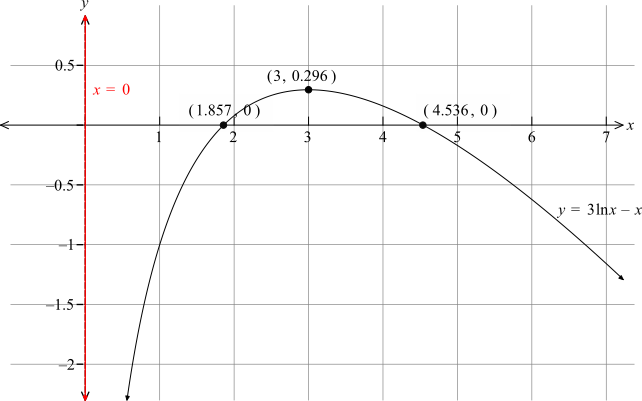
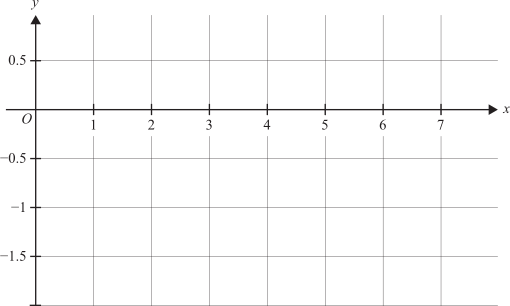
  1. Sketch the graph of \(g\) on the axes below. Label the vertical asymptote with its equation, and label any axial intercepts, stationary points and endpoints in coordinate form, correct to three decimal places.   (3 marks)

    --- 0 WORK AREA LINES (style=lined) ---


  2.  i. Find the equation of the tangent to the graph of \(g\) at the point where \(x=1\).   (1 mark)

    --- 2 WORK AREA LINES (style=lined) ---

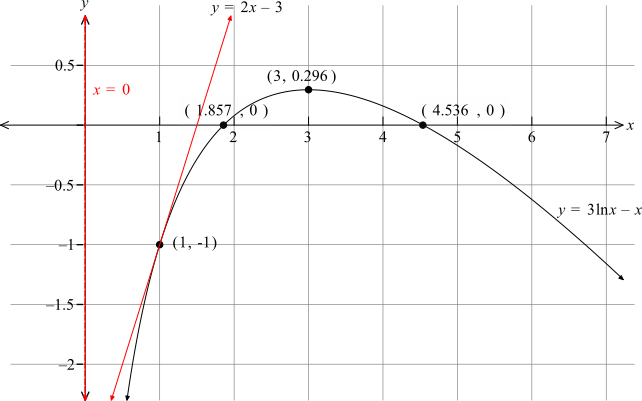
  3. ii. Sketch the graph of the tangent to the graph of \(g\) at \(x=1\) on the axes in part a.   (1 mark)

    --- 0 WORK AREA LINES (style=lined) ---

Newton's method is used to find an approximate \(x\)-intercept of \(g\), with an initial estimate of \(x_0=1\).

  1. Find the value of \(x_1\).   (1 mark)

    --- 3 WORK AREA LINES (style=lined) ---

  2. Find the horizontal distance between \(x_3\) and the closest \(x\)-intercept of \(g\), correct to four decimal places.   (1 mark)

    --- 3 WORK AREA LINES (style=lined) ---

  3.  i. Find the value of \(k\), where \(k>1\), such that an initial estimate of  \(x_0=k\)  gives the same value of  \(x_1\)  as found in part \(c\). Give your answer correct to three decimal places.   (2 marks)

    --- 4 WORK AREA LINES (style=lined) ---

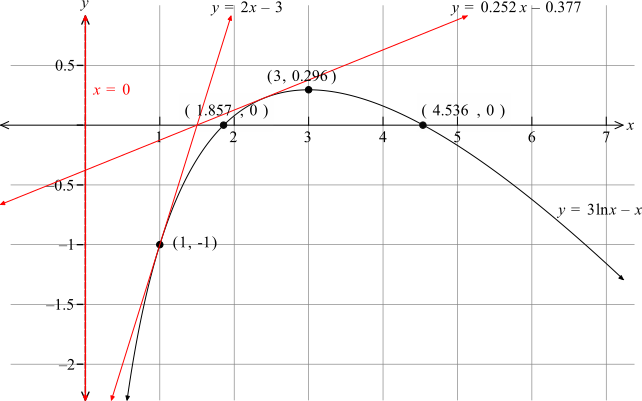
  4. ii. Using this value of \(k\), sketch the tangent to the graph of \(g\) at the point where  \(x=k\)  on the axes in part a.   (1 mark)

    --- 0 WORK AREA LINES (style=lined) ---

Show Answers Only
a.    
  
b.i

\(y=2x-3\)
  
b.ii
  
c. \(\dfrac{3}{2}=1.5\)
  
d. \(0.0036\)
  
e.i \(k=2.397\)
  
e.ii
Show Worked Solution

a.

b.i    \(g(x)\) \(=3\log_{e}x-x\)
  \(g(1)\) \(=3\log_{e}1-1=-1\)
  \(g^{\prime}(x)\) \(=\dfrac{3}{x}-1\)
  \(g^{\prime}(1)\) \(=\dfrac{3}{1}-1=2\)

  
\(\text{Equation of tangent at }(1, -1)\ \text{with }m=2\)

\(y+1=2(x-1)\ \ \rightarrow \ \ y=2x-3\)

b.ii

 
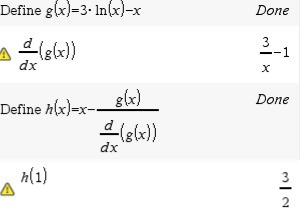
c. 
  \(\text{Newton’s Method}\)

\(x_1\) \(=x_0-\dfrac{g(x)}{g'(x)}\)
  \(=1-\left(\dfrac{-1}{2}\right)\)
  \(=\dfrac{3}{2}=1.5\)

\(\text{Using CAS:}\)


d.    \(\text{Using CAS}\)
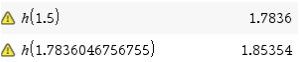
\(x\text{-intercept}:\ x=1.85718\)

\(\therefore\ \text{Horizontal distance}=1.85718-1.85354=0.0036\)


e.i.  \(\text{Using CAS}\)

\(k-\dfrac{3\log_{e}x-x}{\dfrac{3}{x}-1}\) \(=1.5\)
\(k>1\ \therefore\ \ k\) \(=2.397\)

 
e.ii

Filed Under: Curve Sketching, Differentiation (L&E), L&E Differentiation, Tangents and Normals, Trapezium Rule and Newton Tagged With: Band 4, Band 5, Band 6, smc-5145-50-Newton's method, smc-634-20-Log/Exp Function, smc-724-30-Log/Exponential, smc-739-30-Logs, smc-745-20-Logs

Calculus, MET1-NHT 2019 VCAA 4

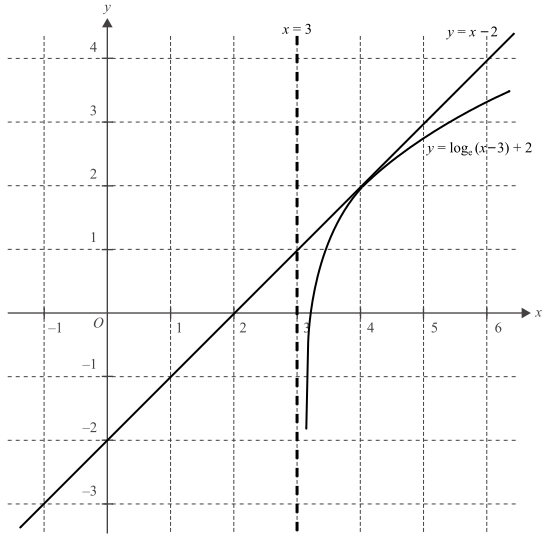
A function `g` has rule  `g(x) = log_e (x-3) + 2`.

  1. State the maximal domain of `g` and the range of `g` over its maximal domain.   (2 marks)

    --- 4 WORK AREA LINES (style=lined) ---

  2. i.  Find the equation of the tangent to the graph of `g` at `(4, 2)`.   (2 marks)

    --- 5 WORK AREA LINES (style=lined) ---


    ii. On the axes below, sketch the graph of the function `g`, labelling any asymptote with its equation.

  3.     Also draw the tangent to the graph of `g` at  `(4, 2)`.   (4 marks)
      

--- 4 WORK AREA LINES (style=lined) ---

Show Answers Only
  1. `x in (3, oo)`


    `y in R`

  2. i.  `y = x-2`
    ii. 
     
Show Worked Solution
a.   `text(Domain)` `: \ x in (3, oo)`
  `text(Range)` `: \ y in R`


b.i.   `g(x)` `= log_e (x-3) + 2`
  `g^{prime} (x)` `= 1/(x-3)`
  `g^{prime} (4)` `= 1`

 
`text(Equation of tangent),\ m = 1\ \ text(through)\ (4, 2):`

`y-2` `= 1(x-4)`
`y` `= x-2`


b.ii.  

Filed Under: Curve Sketching Tagged With: Band 3, Band 4, smc-724-30-Log/Exponential

Calculus, MET1 SM-Bank 21

The rule for function  `f` is  `f(x) = e^(-x^2)`.  The diagram shows the graph  `y = f(x)`.

 Inverse Functions, EXT1 2010 HSC 3b

The graph has two points of inflection. 

  1. Find the `x` coordinates of these points.   (2 marks)

    --- 10 WORK AREA LINES (style=lined) ---

  2. Explain why the domain of `f(x)` must be restricted if `f(x)` is to have an inverse function.    (1 mark)

    --- 4 WORK AREA LINES (style=lined) ---

  3. Find the rule for the inverse function `f^(-1)` if the domain of `f(x)` is restricted to  `x ≥ 0.`   (2 marks)

    --- 6 WORK AREA LINES (style=lined) ---

  4. Find the domain for `f^(-1)`.    (1 mark)

    --- 2 WORK AREA LINES (style=lined) ---

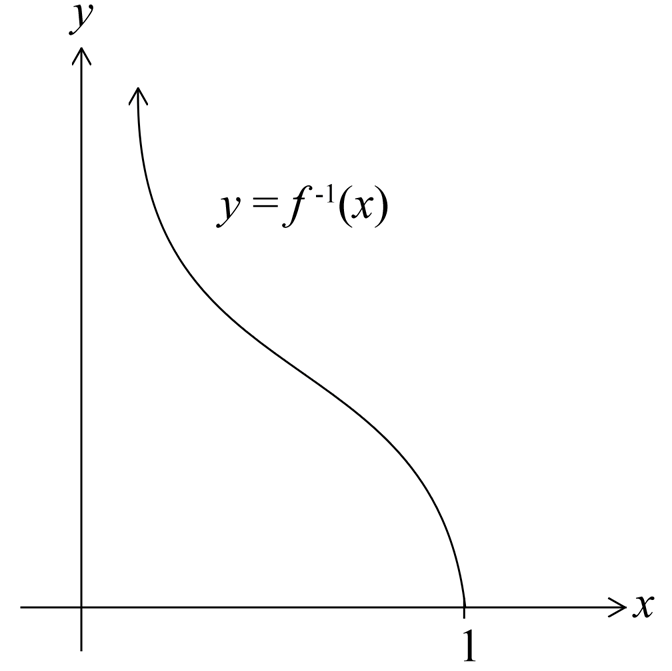
  5. Sketch the curve  `y = f^(-1) (x)`.   (1 mark)

    --- 6 WORK AREA LINES (style=blank) ---

Show Answers Only
  1. `x = +- 1/sqrt2`
  2. `text(There can only be 1 value of)\ y\ text(for each value of)\ x.`
  3. `f^(-1)x = sqrt(ln(1/x))`
  4. `0 <= x <= 1`
  5. Inverse Functions, EXT1 2010 HSC 3b Answer

Show Worked Solution
a.    `y` `= e^(-x^2)`
  `dy/dx` `= -2x * e^(-x^2)`
  `(d^2y)/(dx^2)` `= -2x (-2x * e^(-x^2)) + e ^(-x^2) (-2)`
    `= 4x^2 e^(-x^2)-2e^(-x^2)`
    `= 2e^(-x^2) (2x^2-1)`

 
`text(P.I. when)\ \ (d^2y)/(dx^2) = 0`

`2e^(-x^2) (2x^2-1)` `= 0` 
 `2x^2-1` `= 0` 
 `x^2` `= 1/2`
 `x` `= +- 1/sqrt2` 
COMMENT: It is also valid to show that `f(x)` is an even function and if a P.I. exists at `x=a`, there must be another P.I. at `x=–a`.
`text(When)\ \ ` `x < 1/sqrt2,` `\ (d^2y)/(dx^2) < 0`
  `x > 1/sqrt2,` `\ (d^2y)/(dx^2) > 0`

 
`=>\ text(Change of concavity)`

`:.\ text(P.I. at)\ \ x = 1/sqrt2`
 

`text(When)\ \ ` `x <-1/sqrt2,` `\ (d^2y)/(dx^2) > 0`
  `x >-1/sqrt2,` `\ (d^2y)/(dx^2) < 0`

 
`=>\ text(Change of concavity)`

`:.\ text(P.I. at)\ \ x =-1/sqrt2`


b.   `text(In)\ f(x), text(there are 2 values of)\ y\ text(for)`
  `text(each value of)\ x.`
  `:.\ text(The domain of)\ f(x)\ text(must be restricted)`
  `text(for)\ \ f^(-1) (x)\ text(to exist).`


c.  `y = e^(-x^2)`

`text(Inverse: swap)\  x harr y` 

`x` `= e^(-y^2),\ \ \ x >= 0`
`lnx` `= ln e^(-y^2)`
`-y^2` `= lnx`
`y^2` `= -lnx`
  `=ln(1/x)`
`y` `= +- sqrt(ln (1/x))`


`text(Restricting)\ \ x>=0,\ \ =>y>=0`

`:.  f^(-1) (x)=sqrt(ln (1/x))`


d.   `f(0) = e^0 = 1`

`:.\ text(Range of)\ \ f(x)\ \ text(is)\ \ 0 < y <= 1`

`:.\ text(Domain of)\ \ f^(-1) (x)\ \ text(is)\ \ 0 < x <= 1`


e. 

Inverse Functions, EXT1 2010 HSC 3b Answer

Filed Under: Curve Sketching, Logs and Exponential Functions Tagged With: Band 4, Band 5, smc-5204-70-Sketch graph, smc-724-30-Log/Exponential, smc-724-40-Inverse functions

Calculus, MET1 2012 VCAA 10

Let  `f: R -> R,\ f(x) = e^(-mx) + 3x`,  where `m` is a positive rational number.

  1.  i. Find, in terms of `m`, the `x`-coordinate of the stationary point of the graph of  `y = f(x).`   (2 marks)

    --- 5 WORK AREA LINES (style=lined) ---

  2. ii. State the values of `m` such that the `x`-coordinate of this stationary point is a positive number.   (1 mark)

    --- 4 WORK AREA LINES (style=lined) ---

  3. For a particular value of `m`, the tangent to the graph of  `y = f(x)`  at  `x =-6`  passes through the origin.
  4. Find this value of `m`.   (3 marks)

    --- 10 WORK AREA LINES (style=lined) ---

Show Answers Only
  1.  i. `1/m log_e(m/3)`
  2. ii. `m > 3`
  3. `1/6`
Show Worked Solution

a.i.   `text(SP’s occur when)\ \ f^{prime}(x)=0`

`-me^(-mx) + 3` `= 0`
`me^(-mx)` `3`
`-mx` `= log_e (3/m)`
`:. x` `=-1/m log_e (3/m)`
  `= 1/m log_e (m/3), \ m>0`


♦♦♦ Part (a.ii.) mean mark 18%.
  ii.    `1/m log_e (m/3)` `> 0`
  `log_e (m/3)` `> 0`
  `m/3` `> 1`
  `:. m` `> 3`


b.   `text(Point of tangency:)\ \ (-6, e^(-6m)-18)`

♦♦ Mean mark (b) 33%.
MARKER’S COMMENT: Many confused `m` with the more common use of `m` for gradient in  `y=mx+c`.

`text(At)\ \ x=-6,`

`m_tan= f^{prime} (-6)= -me^(-6m) + 3`

`:.\ text(Equation of tangent:)`

`y-y_1` `= m (x-x_1)`
`y-(e^(-6m)-18)` `= (-me^(-6m) + 3) (x-(-6))`


`text(S)text{ince tangent passes through (0, 0):}`

`-e^(-6m) + 18` `= (-me^(-6m) + 3)(6)`
`-e^(-6m) + 18` `=-6 me^(-6m) + 18`
`e^(-6m)-6me^(-6m)` `= 0`
`e^(-6m) (1-6m)` `= 0`
`1-6m` `=0`
`:.m` `=1/6`

Filed Under: Curve Sketching, Tangents and Normals Tagged With: Band 4, Band 5, Band 6, smc-634-20-Log/Exp Function, smc-634-50-Find tangent given curve, smc-724-30-Log/Exponential

Copyright © 2014–2025 SmarterEd.com.au · Log in