SmarterEd

Aussie Maths & Science Teachers: Save your time with SmarterEd

  • Login
  • Get Help
  • About

Calculus, MET2 2019 VCAA 2

An amusement park is planning to build a zip-line above a hill on its property.

The hill is modelled by  `y = (3x(x-30)^2)/2000,  x in [0, 30]`, where  `x`  is the horizontal distance, in metres, from an origin and  `y`  is the height, in metres, above this origin, as shown in the graph below.
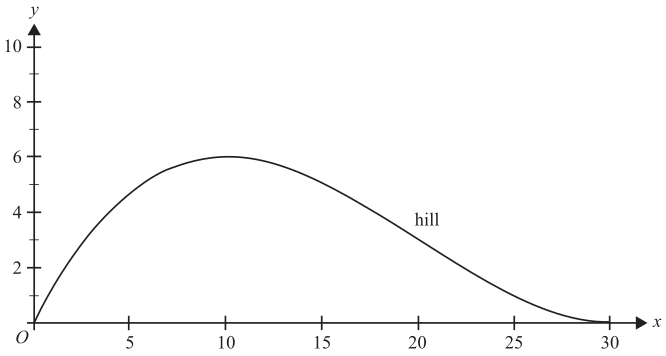
  

  1. Find  `(dy)/(dx)`.   (1 mark)

    --- 1 WORK AREA LINES (style=lined) ---

  2. State the set of values for which the gradient of the hill is strictly decreasing.   (1 mark)

    --- 2 WORK AREA LINES (style=lined) ---

The cable for the zip-line is connected to a pole at the origin at a height of 10 m and is straight for  `0 <= x <= a`, where  `10 <= a <= 20`. The straight section joins the curved section at  `A(a, b)`. The cable is then exactly 3 m vertically above the hill from  `a <= x <= 30`, as shown in the graph below.
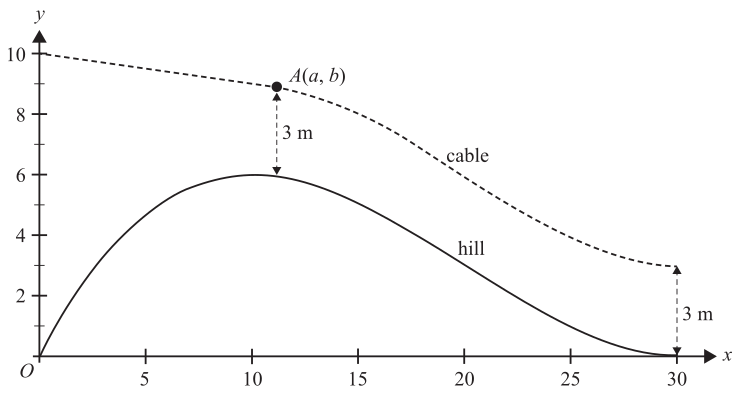
  1. State the rule, in terms of `x`, for the height of the cable above the horizontal axis for  `x in [a, 30]`.   (1 mark)

    --- 2 WORK AREA LINES (style=lined) ---

  2. Find the values of `x` for which the gradient of the cable is equal to the average gradient of the hill for  `x in [10, 30]`.   (3 marks)

    --- 5 WORK AREA LINES (style=lined) ---

The gradients of the straight and curved sections of the cable approach the same value at  `x = a`, so there is a continuous and smooth join at `A`.

    1. State the gradient of the cable at `A`, in terms of `a`.   (1 mark)

      --- 2 WORK AREA LINES (style=lined) ---

    2. Find the coordinates of `A`, with each value correct to two decimal places.   (3 marks)

      --- 6 WORK AREA LINES (style=lined) ---

    3. Find the value of the gradient at `A`, correct to one decimal place.   (1 mark)

      --- 2 WORK AREA LINES (style=lined) ---

Show Answers Only
  1. `(9(x-10)(x-30))/2000`
  2. `x in [0, 20]`
  3. `h(x) = 3 + (3x(x-30)^2)/2000`
  4. `x = (60 +- 10 sqrt 3)/3`
    1. `(9(a-10)(a-30))/2000`
    2. `A(11.12, 8.95)`
    3. `-0.1`
Show Worked Solution

a.   `d/(dx)((3x(x-30)^2)/2000) = (9(x-10)(x-30))/2000\ \ text{(by CAS)}`
 

b.   `text(Sketch)\ \ dy/dx\ \ text{(by CAS)}:`

`(dy)/(dx)\ \ text(strictly decreasing for)\ \ x in [0, 20]`
 

c.   `text(Cable height is a vertical shift of +3 of)\ \ y:`

`h(x) = 3 + (3x(x-30)^2)/2000\ \ text(for)\ \ x in [a, 30]`
 

d.   `text(Let)\ \ f(x) = (9(x-10)(x-30))/2000`

`text(Average gradient) = (f(30)-f(10))/(30-10) = -3/10\ \ text{(by CAS)}`

`text(Solve for)\ \ x\ \ text{(by CAS):}`

`(9(x-10)(x-30))/2000 = -3/10`

`x = (60 +- 10 sqrt 3)/3`
 

e.i.   `text(S)text(ince)\ \ h(x)\ \ text(is a vertical shift of)\ \ f(x),`

`=> h^{′}(a) = f^{′}(a)`

`h^{′}(a) = (9(a-10)(a-30))/2000`
 

e.ii.   `h(a) = (3a(a-30)^2)/2000 + 3`

`:. A(a, (3a(a-30)^2)/2000 + 3),\ B(0, 10)`
 

`m_(AB) = ((3a(a-30)^2)/2000 + 3-10)/a = (3a(a-30)^2-14000)/(2000 a)`

 
`text(Equating gradients:)`

`text(Solve): \ f^{′}(a) = m_(AB)\ \ text{(by CAS)}`

`(9(a-10)(a-30))/2000 = (3a(a-30)^2-14000)/(2000 a)`

`a ~~ 11.12, quad b ~~ 8.95`

`:. A(11.12, 8.95)`


e.iii.    `M_A` `= h^{′}(11.12)`
    `~~ -0.1\ text{(by CAS)}`

Filed Under: Curve Sketching Tagged With: Band 4, smc-724-10-Cubic, smc-724-70-Applied context

Calculus, MET2 2009 VCAA 2

VCAA 2009 2a

A train is travelling at a constant speed of `w` km/h along a straight level track from `M` towards `Q.`

The train will travel along a section of track `MNPQ.`

Section `MN` passes along a bridge over a valley.

Section `NP` passes through a tunnel in a mountain.

Section `PQ` is 6.2 km long.

From `M` to `P`, the curve of the valley and the mountain, directly below and above the train track, is modelled by the graph of
 

`y = 1/200 (ax^3 + bx^2 + c)` where `a, b` and `c` are real numbers.
 

All measurements are in kilometres.

  1. The curve defined from `M` to `P` passes through `N (2, 0)`. The gradient of the curve at `N` is – 0.06 and the curve has a turning point at  `x = 4`.
  2.  i. From this information write down three simultaneous equations in `a`, `b` and `c`.   (3 marks)

    --- 3 WORK AREA LINES (style=lined) ---

  3. ii. Hence show that  `a = 1`, `b = – 6` and `c = 16`.   (2 marks)

    --- 4 WORK AREA LINES (style=lined) ---

  4. Find, giving exact values
  5.   i. the coordinates of `M and P`.   (2 marks)

    --- 4 WORK AREA LINES (style=lined) ---

  6.  ii. the length of the tunnel.   (1 mark)

    --- 2 WORK AREA LINES (style=lined) ---

  7. iii. the maximum depth of the valley below the train track.   (1 mark)

    --- 2 WORK AREA LINES (style=lined) ---

The driver sees a large rock on the track at a point `Q`, 6.2 km from `P`. The driver puts on the brakes at the instant that the front of the train comes out of the tunnel at `P`.

From its initial speed of `w` km/h, the train slows down from point `P` so that its speed `v` km/h is given by

`v = k log_e ({(d + 1)}/7)`,

where `d` km is the distance of the front of the train from `P` and `k` is a real constant.

  1. Find the value of `k` in terms of `w`.   (1 mark)

    --- 4 WORK AREA LINES (style=lined) ---

  2. Find the exact distance from the front of the train to the large rock when the train finally stops.   (2 marks)

    --- 4 WORK AREA LINES (style=lined) ---

Show Answers Only

a.i.    `1/200 (8a + 4b + c) = 0`

a.ii.   `1/200 (12a + 4b) = (– 3)/50`

a.iii.  `1/200 (48a + 8b) = 0`

`text(Proof)\ \ text{(See Worked Solutions)}`

    1. `M (2 + 2 sqrt 3, 0),\ \ P (2-2 sqrt 3, 0)`
    2. `2 sqrt 3\ text(km)`
    3. `2/25\ text(km)`
  1. `(– w)/(log_e (7))`
  2. `120`
  3. `0.2\ text(km)`
Show Worked Solution

 a.i.   `N (2, 0),`

`1/200 (8a + 4b + c) = 0\ \ text{… (1)}`
 

`(dy)/(dx) (x = 2) = (– 3)/50,`

`1/200 (12a + 4b) = (– 3)/50\ \ text{… (2)}`
 

`(dy)/(dx)(x = 4) = 0,`

`1/200 (48a + 8b) = 0\ \ text{… (3)}`
 

  ii.   `text(Using the above equations,)`

♦ Mean mark part (a)(ii) 41%.
`12a + 4b` `=-12` `\ \ \ …\ (2^{′})`
`24 a + 4b` `=0` `\ \ \ …\ (3^{′})`

 
`text{Solve simultaneous equations (By CAS):}`

`a=1, \ b=-6, \ c=16`
 

`\text{Solving manually:}`

`(3^{′})-(2^{′}):`

`12a=12 \ \Rightarrow\ \ a=1`

`text(Substitute)\ \ a = 1\ \ text(into)\ \ (3^{′}):`

`124(1)+4b=0 \ \Rightarrow\ \ b=-1`

`text(Substitute)\ \ a = 1,\ \ b = – 6\ \ text(into)\ \ (1):`

`8(1) + 4 (– 6) + c=0\ \ \Rightarrow\ \ c=16`
 

b.i.   `text(For)\ \ x text(-intercepts),`

`text(Solve:)\ \ x^3 + -6x^2 + 16` `= 0\ \ text(for)\ x,`
 `x= 2-2 sqrt 3, 2, 2 + 2 sqrt 3`  

 
`:. M (2 + 2 sqrt 3, 0),\ \ P (2-2 sqrt 3, 0)`
 

  ii.   `N (2, 0)`

♦ Mean mark part (a) 41%.
`bar (NP)` `=\ text(Tunnel length)`
  `= 2-(2-2 sqrt 3)`
  `= 2 sqrt 3\ text(km)`


   iii.  `text(Solve)\ \ frac (dy) (dx) = 0\ \ text(for)\ \ x in (2, 2 + 2 sqrt 3)`

♦ Mean mark part (b) 50%.

`x = 4`

`text(When)\ \ x=4,\ \ y = – 2/25\ text(km) = 80\ text{m (below track)}`

`:.\ text(Max depth below is)\ \ 80\ text(m.)`
 

c.  `text(Solution 1)`

♦ Mean mark part (c) 35%.

`text(Let)\ \ v(d) = k log_e ({(d + 1)}/7)`

`text(S)text(ince)\ \ v=w\ \ text(when)\ \ d=0\ \ text{(given),}`

`k log_e ({(0 + 1)}/7)` `=w`
`k` `=w/log_e (1/7)`
  `=(-w)/log_e7`

 
`text(Solution 2)`

`text(Solve:)\ \ v (0)` `= w\ \ text(for)\ \ k`
`:. k` `= (– w)/(log_e (7))`


d.  `v (2.5) = k log_e(1/2)`

♦ Mean mark part (d) 40%.
`text(Solve)\ \ v(2.5)` `= (120 log_e (2))/(log_e (7))\ \ text(for)\ \ k,`
`:. k` `= (– 120)/(log_e (7))`
`(– w)/(log_e (7))` `= (– 120)/(log_e (7))`
`:. w` `= 120`


e.   `text(Define)\ \ v (d) = (– 120)/(log_e (7)) log_e ((d + 1)/7)`

♦♦ Mean mark part (e) 32%.
`text(Solve:)\ \ v(d)` `= 0\ \ text(for)\ d,`
`:. d` `= 6\ text(km from)\ \ P`

 
`:.\ text(Distance between train and)\ \ Q`

`= 6.2-6`

`= 0.2\ text(km)`

Filed Under: Curve Sketching, Graphs and Applications Tagged With: Band 4, Band 5, smc-2745-40-Other applications, smc-724-10-Cubic, smc-724-70-Applied context

Calculus, MET2 2013 VCAA 3

Tasmania Jones is in Switzerland. He is working as a construction engineer and he is developing a thrilling train ride in the mountains. He chooses a region of a mountain landscape, the cross-section of which is shown in the diagram below.

VCAA 2013 2a

The cross-section of the mountain and the valley shown in the diagram (including a lake bed) is modelled by the function with rule

`f(x) = (3x^3)/64-(7x^2)/32 + 1/2.`

Tasmania knows that  `A (0, 1/2)`  is the highest point on the mountain and that `C(2, 0)` and `B(4, 0)` are the points at the edge of the lake, situated in the valley. All distances are measured in kilometres.

  1. Find the coordinates of `G`, the deepest point in the lake.   (3 marks)

    --- 5 WORK AREA LINES (style=lined) ---

Tasmania’s train ride is made by constructing a straight railway line `AB` from the top of the mountain, `A`, to the edge of the lake, `B`. The section of the railway line from `A` to `D` passes through a tunnel in the mountain.

  1. Write down the equation of the line that passes through `A` and `B.`   (2 marks)

    --- 4 WORK AREA LINES (style=lined) ---

  2.  i. Show that the `x`-coordinate of `D`, the end point of the tunnel, is `2/3.`   (1 mark)

    --- 3 WORK AREA LINES (style=lined) ---

  3. ii. Find the length of the tunnel `AD.`   (2 marks)

    --- 2 WORK AREA LINES (style=lined) ---

In order to ensure that the section of the railway line from `D` to `B` remains stable, Tasmania constructs vertical columns from the lake bed to the railway line. The column `EF` is the longest of all possible columns. (Refer to the diagram above.)

  1.  i. Find the `x`-coordinate of `E.`   (2 marks)

    --- 3 WORK AREA LINES (style=lined) ---

  2. ii. Find the length of the column `EF` in metres, correct to the nearest metre.   (2 marks)

    --- 2 WORK AREA LINES (style=lined) ---

Tasmania’s train travels down the railway line from `A` to `B`. The speed, in km/h, of the train as it moves down the railway line is described by the function.

`V: [0, 4] -> R, \ V(x) = k sqrt x-mx^2,`

where `x` is the `x`-coordinate of a point on the front of the train as it moves down the railway line, and `k` and `m` are positive real constants.

The train begins its journey at `A (0, 1/2)`. It increases its speed as it travels down the railway line.

The train then slows to a stop at `B(4, 0)`, that is  `V(4) = 0.`

  1. Find `k` in terms of `m.`   (1 mark)

    --- 3 WORK AREA LINES (style=lined) ---

  2. Find the value of `x` for which the speed, `V`, is a maximum.   (2 marks)

    --- 3 WORK AREA LINES (style=lined) ---

Tasmania is able to change the value of `m` on any particular day. As `m` changes, the relationship between `k` and `m` remains the same.

  1. If, on one particular day, `m = 10`, find the maximum speed of the train, correct to one decimal place.   (2 marks)

    --- 4 WORK AREA LINES (style=lined) ---

  2. If, on another day, the maximum value of `V` is 120, find the value of `m.`   (2 marks)

    --- 4 WORK AREA LINES (style=lined) ---

Show Answers Only
  1. `G(28/9,−50/243)`
  2. `y = −1/8x + 1/2`
  3.  i. `text(See Worked Solutions)`
  4. ii. `sqrt65/12`
  5.  i. `(2(sqrt31 + 7))/9`
  6. ii. `336\ text(m)`
  7. `8\ text(m)`
  8. `2^(2/3)`
  9. `75.6\ text(km/h)`
  10. `10 xx 2^(2/3)`
Show Worked Solution

a.   `G\ text(occurs when)\ \ f^{′}(x)=0.`

`text(Solve:)\ \ (3x^3)/64-(7x^2)/32 + 1/2=0\ \ text(for)\ x`

`x= 28/9quadtext(for)quadx ∈ (2,4)`

`f(28/9) = −50/243`

`:. G(28/9,−50/243)`
 

b.    `m_(AB)` `= (1/2-0)/(0-4)`
    `= −1/8`

 
`text(Equation using point gradient formula,)`

`y-y_1` `= m(x-x_1)`
`y-1/2` `= −1/8(x-0)`
`:. y` `= −1/8x + 1/2`

 
c.i.
 `text{Solution 2 (using technology)}`

`text(Solve:)\ \ ` `3/64x^3-7/32x^2 + 1/2` `= −1/8x + 1/2\ \ text(for)\ x`

`x=0, 2/3 or 4`

`:.x=2/3,\ \ (0<x<4)`
 

`text(Solution 1)`

`text(Intersection occurs when:)`

`3/64x^3-7/32x^2 + 1/2` `= −1/8x + 1/2`
`3x^3-14x^2 + 8x` `= 0`
`x(3x^2-14x + 8)` `= 0`
`x(x-4)(3x-2)` `= 0`

 
`x = 2/3,\ \ (0<x<4)`

`:. x text(-coordinate of)\ D = 2/3`
 

c.ii.   `D (2/3, 5/12)qquadA(0,1/2)`

  `text(By Pythagoras,)`

`AD` `= sqrt((2/3-0)^2 + (5/12-1/2)^2)`
  `= sqrt65/12`


d.i.  `text(Let)\ \ z =\ EF`

♦♦♦ Mean mark part (d)(i) 24%.
MARKER’S COMMENT: Many students unfamiliar with this type of question.
 `z` `= (−1/8x + 1/2)-((3x^2)/64-7/32 x^2 + 1/2)`
  `=-1/8x-(3x^2)/64 + 7/32 x^2`

 
`text(Solve:)\ \ d/dx (-1/8x-(3x^2)/64 + 7/32 x^2) =0\ \ text(for)\ x`

`x= (2(sqrt31 + 7))/9,\ \ \ x > 0`
 

♦♦♦ Mean mark part (d)(ii) 22%.
d.ii.    `z((2sqrt31 + 14)/9)` `= 0.3360…\ text(km)`
    `= 336\ text{m  (nearest m)}`


e.    `V(4)` `= 0quadtext{(given)}`
  ` 0` `= k sqrt4-m xx 4^2`
  `:.k` `= 8m`


f.  `V(x) = 8msqrtx-mx^2`

`text(Solve:)\ \ V^{′}(x)` `= 0quadtext(for)quadx`

`x= 2^(2/3)`
 

g.  `text(When)\ \ m=10,\ \ k=8 xx 10=80`

♦ Mean mark 43%.

`:.V(x) = 80sqrtx-10x^2`

`text(Solve:)\ \ V^{′}(x)` `= 0quadtext(for)quadx`

`x= 2^(2/3)`

`V(2^(2/3))` `=75.59…`
  `= 75.6\ text(km/h)`


h.   `text(Maximum occurs at)\ x = 2^(2/3)`

♦ Mean mark 38%.

`V(x) = 8msqrtx-mx^2`

`text(Solve:)\ \ V(2^(2/3))` `= 120quadtext(for)quadm`
`:. m` `= 10 xx 2^(2/3)`

Filed Under: Curve Sketching, Maxima and Minima Tagged With: Band 3, Band 4, Band 5, Band 6, smc-641-60-Other themes, smc-724-10-Cubic, smc-724-70-Applied context

Copyright © 2014–2025 SmarterEd.com.au · Log in