Consider the unit circle `x^2 + y^2 = 1` and the tangent to the circle at the point `P`, shown in the diagram below.
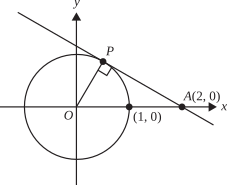
- Show that the equation of the line that passes through the points `A` and `P` is given by `y = -x/sqrt3 + 2/sqrt3`. (2 marks)
--- 5 WORK AREA LINES (style=lined) ---
Let `T : R^2 -> R^2, T ([(x),(y)]) = [(1, 0),(0, q)][(x),(y)]`, where `q ∈ R text{\}{0}`, and let the graph of the function `h` be the transformation of the line that passes through the points `A` and `P` under `T`.
-
- Find the values of `q` for which the graph of `h` intersects with the unit circle at least once. (1 mark)
--- 3 WORK AREA LINES (style=lined) ---
- Let the graph of `h` intersect the unit circle twice.
- Find the values of `q` for which the coordinates of the points of intersection have only positive values. (1 mark)
--- 4 WORK AREA LINES (style=lined) ---
- Find the values of `q` for which the graph of `h` intersects with the unit circle at least once. (1 mark)
- For `0 < q <= 1`, let `P^{′}` be the point of intersection of the graph of `h` with the unit circle, where `P^{′}` is always the point of intersection that is closest to `A`, as shown in the diagram below.
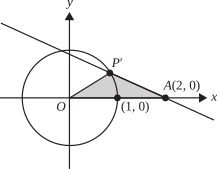
Let `g` be the function that gives the area of triangle `OAP^{′}` in terms of `theta`.
-
- Define the function `g`. (2 marks)
--- 3 WORK AREA LINES (style=lined) ---
- Determine the maximum possible area of triangle `OAP^{′}`. (2 marks)
--- 4 WORK AREA LINES (style=lined) ---
- Define the function `g`. (2 marks)