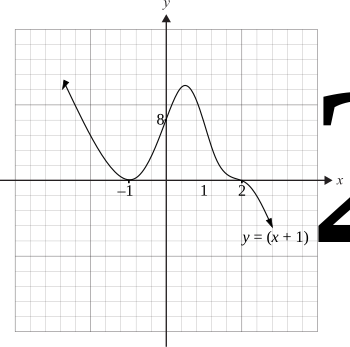
Graph the polynomial \(P(x)=(x+1)^2(2-x)^3\) on the grid below, clearly identifying all axis intercepts. (3 marks)
--- 5 WORK AREA LINES (style=lined) ---
Aussie Maths & Science Teachers: Save your time with SmarterEd
Graph the polynomial \(P(x)=(x+1)^2(2-x)^3\) on the grid below, clearly identifying all axis intercepts. (3 marks)
--- 5 WORK AREA LINES (style=lined) ---
\(P(x)=(x+1)^2(2-x)^3 \ \ \Rightarrow\ \ \text{zeros at} \ \ x=-1,2\)
\(\text{At} \ \ x=-1, m (\text{multiplicity})=2 \ \ \Rightarrow\ \ \text{curve is a tangent to} \ x \text{-axis}\)
\(\text{At} \ \ x=2, m=3 \ \ \Rightarrow\ \ \text{curve has horizontal POI.}\)
\(\text{At} \ \ x=0, P(x)=(1)^2(2)^3=8\)
\(P(x)\) is a polynomial where \(P(\alpha)=0\) and \(P^{\prime}(\alpha)=0\).
--- 7 WORK AREA LINES (style=lined) ---
--- 12 WORK AREA LINES (style=lined) ---
a. \(P(\alpha)=0\ \ \Rightarrow\ \ (x-a)\ \text{is a factor of \(P(x)\)}\)
\(P(x)=(x-\alpha) \cdot Q(x)\)
\(P^{\prime}(x)=Q(x)+(x-a) \cdot Q(x)\)
\(\text{Since}\ \ P^{\prime}(\alpha)=0:\)
\(Q(\alpha)=0 \ \ \Rightarrow\ \ (x-\alpha) \ \text{is a factor of} \ \ Q(\alpha)\)
\(\text{Let} \ \ Q(x)=(x-\alpha) \cdot R(x)\)
\(P(x)=(x-\alpha)^2 \cdot R(x)\)
\(\therefore \ (x-\alpha)^2 \ \text{is a factor of} \ P(x).\)
b. \(b=6, c=9\)
a. \(P(\alpha)=0\ \ \Rightarrow\ \ (x-a)\ \text{is a factor of \(P(x)\)}\)
\(P(x)=(x-\alpha) \cdot Q(x)\)
\(P^{\prime}(x)=Q(x)+(x-a) \cdot Q(x)\)
\(\text{Since}\ \ P^{\prime}(\alpha)=0:\)
\(Q(\alpha)=0 \ \ \Rightarrow\ \ (x-\alpha) \ \text{is a factor of} \ \ Q(\alpha)\)
\(\text{Let} \ \ Q(x)=(x-\alpha) \cdot R(x)\)
\(P(x)=(x-\alpha)^2 \cdot R(x)\)
\(\therefore \ (x-\alpha)^2 \ \text{is a factor of} \ P(x).\)
b. \(\text{Since the curve is tangent at} \ \ x=-1\)
\(x=-1 \ \ \text{is a double root}\)
\(P(x)=x^3+b x^2+c x+4\)
\(P(-1)=-1+b-c+4=0 \ \ \Rightarrow\ \ b-c=-3\ \ldots\ (1)\)
\(P^{\prime}(x)=3 x^2+26 x+c\)
\(P^{\prime}(-1)=3-2 b+c=0 \ \ \Rightarrow\ \ -2 b+c=-3\ \ldots\ (2)\)
\(\text{Add} \ (1)+(2):\)
\(-b=-6 \ \ \Rightarrow\ \ b=6\)
\(\text{Substitute \(\ b=6\ \) into (1):}\)
\(-6-c=-3 \ \ \Rightarrow\ \ c=9\).
\(\therefore b=6, c=9\)
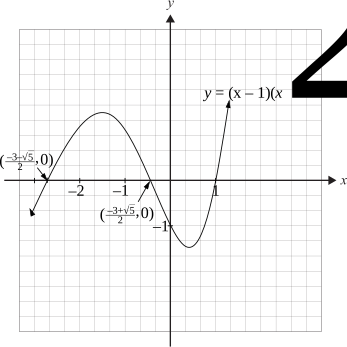
Graph the polynomial \(p(x)=(x-1)\left(x^2+3 x+1\right)\), clearly identifying all axis intercepts. (3 marks)
--- 5 WORK AREA LINES (style=lined) ---
\(p(x)=(x-1)\left(x^2+3 x+1\right)\)
\(\text{Zeros:} \ \ x=1, x=\dfrac{-3 \pm \sqrt{9-4 \cdot 1 \cdot 1}}{2}=\dfrac{-3 \pm \sqrt{5}}{2}\ \ (\approx-2.62,-0.38)\)
\(\text{At}\ \ x=1, m(\text{multiplicity})=1 \ \Rightarrow \ \text{curve crosses}\ x\text {-axis}\)
\(\text{At} \ \ x=\dfrac{-3 \pm \sqrt{5}}{2}, m=1 \ \Rightarrow \ \text{curve crosses} \ x\text {-axis}\)
\(p(0)=(-1)(1)=-1\)
Let \(P(x)=x^3+a x^2+b x-4\) where \(a\) and \(b\) are real numbers.
If \(x=2\) is a double root of \(P(x)=0\), find the values of \(a\) and \(b\). (3 marks)
--- 10 WORK AREA LINES (style=lined) ---
\(P(x)=x^3+a x^2+b x-4\)
\(P^{\prime}(x)=3 x^2+2 a x+b\)
\(\text{Since} \ \ x=2\ \ \text{is a double root,}\)
\(P(2)=0:\)
| \(8+4 a+2 b-4\) | \(=0\) |
| \(2 a+b\) | \(=-2\ \ldots\ (1)\) |
\(P^{\prime}(2)=0:\)
| \(12+4 a+b\) | \(=0\) |
| \(4 a+b\) | \(=-12\ \ldots\ (2)\) |
\([(1) \times 2]-(2):\)
\(b=8\)
\(\text{Substitute} \ \ b=8 \ \ \text{into (1):}\)
| \(2a+8\) | \(=-2\) |
| \(a\) | \(=-5\) |
The polynomial \(P(x)=2 x^3-m x^2+n x+27\) has a double root and \(P(-3)=P^{\prime}(-3)=0\). Find the values of \(m\) and \(n\) and hence find the other root of \(P(x)\). (3 marks) --- 8 WORK AREA LINES (style=lined) --- \(m=-15, n=36\) \(\gamma= -\dfrac{3}{2}\) \(P(x)=2 x^3-m x^2+n x+27\) \(P^{′}(x)=6x^2-2m x+n\) \(9m=-135\ \ \Rightarrow m=-15\) \(6 \times -15+n=-54\ \ \Rightarrow \ n=36\) \(P(x)=2 x^3+15 x^2+36 x+27\) \(\text{Using product of roots:}\)
\(P(-3)\)
\(=2 \times (-3)^{3}-(-3)^2m-3n+27\)
\(0\)
\(=-54-9m-3n+27\)
\(9m+3n\)
\(=-27\ \ …\ (1)\)
\(P^{′}(-3)\)
\(=6 \times (-3)^2+6m+n\)
\(6m+n\)
\(=-54\)
\(18m+3n\)
\(=-162\ …\ (2)\)
\( (2)-(1):\)
\(\alpha \beta \gamma\)
\(=\dfrac{-d}{a}\)
\((-3)^{2} \gamma\)
\(=\dfrac{-27}{2} \)
\(\gamma\)
\(=\dfrac{-27}{2 \times 9} = -\dfrac{3}{2}\)
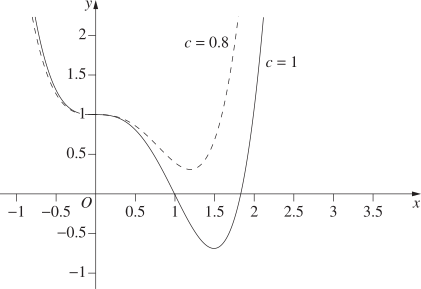
Consider the hyperbola \(y=\dfrac{1}{x}\) and the circle \((x-c)^2+y^2=c^2\), where \(c\) is a constant. --- 4 WORK AREA LINES (style=lined) --- --- 10 WORK AREA LINES (style=lined) --- i. \(\text{See Worked Solutions}\) ii. \(\sqrt[4]{\dfrac{16}{27}}\approx 0.877\) i. \(y=\dfrac{1}{x}\ …\ (1) \) \((x-c)^2+y^2=c^2\ …\ (2) \) \(\text{Substitute (1) into (2):}\) ii. \(\text{Graphs show that for some value of}\ \ 0.8 \leq c \leq 1,\) \(P(x)\ \text{has a minimum that touches the}\ x\text{-axis once.}\)
\((x-c)^2+\Big{(}\dfrac{1}{x}\Big{)}^2 \)
\(=c^2\)
\(x^2-2cx+c^2+\dfrac{1}{x^2}\)
\(=c^2\)
\(x^4-2cx^3+1\)
\(=0\)
\(P(x)\)
\(=x^4-2cx^3+1\)
\(P^{′}(x)\)
\(=4x^3-6cx^2\)
\(\text{Find}\ x\ \text{when}\ P^{′}(x)=0: \)
\(4x^3-6cx^2\)
\(=0\)
\(2x^2(2x-3c)\)
\(=0\)
\(x\)
\(=\dfrac{3c}{2}\ \ (x \neq 0)\)
\(\text{Find}\ c\ \text{when}\ P(\frac{3c}{2})=0: \)
\(\Big{(} \dfrac{3c}{2} \Big{)}^4-2c\Big{(} \dfrac{3c}{2} \Big{)}^3+1 \)
\(=0\)
\(\dfrac{81c^4}{16}-\dfrac{54c^4}{8}+1\)
\(=0\)
\(\dfrac{(108-81)c^4}{16}\)
\(=1\)
\(\dfrac{27c^4}{16}\)
\(=1\)
\(c^4\)
\(=\dfrac{16}{27}\)
\(c\)
\(=\sqrt[4]{\dfrac{16}{27}}\approx 0.877\)
The monic polynomial, `P`, has degree 3 and roots `alpha, \beta, \gamma`.
It is given that
`alpha^(2)+beta^(2)+gamma^(2)=85\ \ and`
`P^(')(alpha)+P^(')(beta)+P^(')(gamma)=87.`
Find `alpha beta+beta gamma+gamma alpha`. (3 marks)
--- 9 WORK AREA LINES (style=lined) ---
`-2`
`P(x)=x^3-(alpha+beta+gamma)x^2+(alphabeta+alphagamma+betagamma)x-alphabetagamma`
`P^(′)(x)=3x^2-2(alpha+beta+gamma)x+alphabeta+alphagamma+betagamma`
`P^(′)(alpha)+P^(′)(beta)+P^(′)(gamma)`
`=3alpha^2-2(alpha+beta+gamma)alpha+alphabeta+alphagamma+betagamma`
`+ 3beta^2-2(alpha+beta+gamma)beta+alphabeta+alphagamma+betagamma`
`+ 3gamma^2-2(alpha+beta+gamma)gamma+alphabeta+alphagamma+betagamma`
`=3(alpha^(2)+beta^(2)+gamma^(2))-2(alpha^(2)+beta^(2)+gamma^(2))`
`-2(alphabeta+alphagamma+alphabeta+betagamma+alphagamma+betagamma)+3(alphabeta+alphagamma+betagamma)`
`=(alpha^(2)+beta^(2)+gamma^(2))-(alphabeta+alphagamma+betagamma)`
`text{Substituting in given values:}`
| `85-(alphabeta+alphagamma+betagamma)` | `=87` | |
| `:.alphabeta+alphagamma+betagamma` | `=-2` |
The polynomial `2x^3 + bx^2 + cx + d` has roots `1` and `-3`, with one of them being a double root.
What is a possible value of `b`?
`D`
`f(x) = 2x^3 + bx^2 + cx + d`
`f^{′}(x) = 6x^2 + 2bx + c`
`text(Roots at 1 and −3:)`
`f(1) = 0`
| `2 + b + c + d` | `= 0` |
| `b + c + d` | `= -2\ \ text{… (1)}` |
`f(-3) = 0`
| `-54 + 9b-3c + d` | `= 0` |
| `9b-3c + d` | `= 54\ \ text{… (2)}` |
`(2)-(1)`
| `8b-4c` | `= 56` |
| `2b-c` | `= 14\ \ text{… (3)}` |
`text(If double root at 1:)`
`f^{′}(1) = 0`
| `6 + 2b + c` | `= 0` |
| `2b + c` | `= -6\ \ text{… (4)}` |
`(3) + (4)`
`4b= 8\ \ =>\ \ b=2`
`text(If double root at – 3:)`
`f^{′}(-3) = 0`
| `54-6b + c` | `= 0` |
| `-6b + c` | `= -54\ \ text{… (5)}` |
`(3) + (5)`
`-4b=-40\ \ =>\ \ b=10`
`=> D`
The polynomial `p(x) = x^3 + ax^2 + b` has a zero at `r` and a double zero at 4.
Find the values of `a`, `b` and `r`. (3 marks)
--- 6 WORK AREA LINES (style=lined) ---
`a =− 6, b = 32, r = -2`
`p(x) = x^3 + ax^2 + b`
`p^{′}(x) = 3x^2 + 2ax`
`text(Double root at 4:)`
| `p^{′}(4)` | `=0` |
| `3 xx 16 + 8a` | `= 0` |
| `a` | `= −6` |
| `p(4)` | `=0` |
| `64 + 16a + b` | `= 0` |
| `64-96 + b` | `= 0` |
| `b` | `= 32` |
`text(Roots of)\ p(x)\ text(are)\ \ 4, 4, r:`
| ` 4 + 4 +r` | `= -a/1 = 6` |
| `:. r` | `= -2` |
Let `P(x)` be a polynomial.
--- 6 WORK AREA LINES (style=lined) ---
--- 8 WORK AREA LINES (style=lined) ---
i. `text(Proof)\ \ text{(See Worked Solutions)}`
ii. `2`
| i. | `P(x)` | `= (x-alpha)^2 · Q(x)` |
| `P^{′}(x)` | `= 2 (x-alpha) · Q (x) + (x-alpha)^2 *Q^{′}(x)` | |
| `= (x-alpha) [2 Q (x) + (x-alpha) *Q^{′}(x)]` |
| `P (alpha)` | `= 0 xx Q(x) = 0` |
| `P^{′}(alpha)` | `= 0 [2Q (x) + 0 xx Q^{′}(x)] = 0` |
`:. P(alpha) = P^{′}(alpha) = 0\ text(… as required.)`
| ii. | `P(x)` | `= x^4-3x^3 + x^2 + 4` |
| `P^{′}(x)` | `= 4x^3-9x^2 + 2x` | |
| `= x (4x^2-9x + 2)` | ||
| `= x (4x-1) (x-2)` |
`:. P^{′}(x) = 0\ \ text(when)\ \ x = 0, 1/4 or 2`
`=>\ text(Multiple roots may exist at)\ \ x=0, 1/4 or 2.`
`text(Test each root in)\ \ P(x):`
| `P(0)` | `= 0-0 + 0 + 4 = 4` |
| `P(1/4)` | `= (1/4)^4-3(1/4)^3 + (1/4)^2 + 4= 4 \frac{5}{256}` |
| `P(2)` | `= 16-3(8) + 4 + 4 = 0` |
`(x-2)^2\ \text(is a factor of)\ P(x)`
`:. alpha = 2`
Suppose `p(x) = ax^3 + bx^2 + cx + d` with `a, b, c` and `d` real, `a != 0.`
--- 6 WORK AREA LINES (style=lined) ---
--- 4 WORK AREA LINES (style=lined) ---
a. `text(See Worked Solutions)`
b. `3`
a. `p(x) = ax^3 + bx^2 + cx + d`
`p^{′}(x) = 3ax^2 + 2bx + c`
`=> p(x)\ text(will cut the)\ xtext(-axis once only if)\ \ Delta(p^{′}(x)) < 0`
| `(2b)^2-4(3a)c` | `< 0` |
| `4b^2-12ac` | `< 0` |
| `b^2-3ac` | `< 0` |
b. `p(-b/(3a)) = 0`
| `p^{′}(−b/(3a))` | `=3a(- b/(3a))^2 + 2b (- b/(3a))+c` |
| `=- b^2/(3a)+c` | |
| `=0\ \ \ (text{given}\ \ b^2-3ac = 0)` |
`:.\ text(Multiplicity at least 2.)`
`p^{″}(x) = 6ax + 2b`
`p^{″}(−b/(3a))=6a(−b/(3a)) + 2b=0`
`:. text(Multiplicity of)\ \ x=− b/(3a)\ \ text(is 3.)`
Which polynomial has a multiple root at `x = 1?`
`=> C`
`\text{By trial and error}`
`text(Consider option)\ C:`
| `P(1)` | `= 1-1-1 + 1 = 0` |
| `P^{′}(x)` | `= 5x^4-3x^2-2x` |
| `P^{′}(1)` | `= 5-3-2 = 0` |
`:.\ text(Multiple root at)\ x = 1`
`=> C`
The polynomial `x^3 + x^2-5x + 3` has a double root at `x = alpha.`
What is the value of `alpha ?`
`C`
`P^{′}(x)= 3x^2 + 2x-5= (3x + 5) (x-1)`
`:. text(Only possible double roots occur when)`
`x=1\ \ text(or)\ \ x=-5/3`
`P(1)=1+1-5+3=0`
`:. x = 1\ \ text(is double root.)`
`=> C`
Let `P(x) = x^3 + ax^2 + bx + 5`, where `a` and `b` are real numbers.
Find the values of `a` and `b` given that `(x-1)^2` is a factor of `P(x).` (3 marks)
--- 6 WORK AREA LINES (style=lined) ---
`a = 3,\ b = -9`
| `P(x)` | `= x^3 + ax^2 + bx + 5` |
| `P(1)` | `= 1 + a + b + 5=0` |
| `:.b` | `= -a-6\ \ \ \ …\ (1)` |
| `P^{′}(x)` | `= 3x^2 + 2ax + b` |
| `P^{′}(1)` | `= 3 + 2a + b=0` |
| `2a+b` | `= -3\ \ \ \ …\ (2)` |
`text(Substitute)\ \ b=-a-6\ \ text{from (1) into (2):}`
`2a+(-a-6)=-3`
`:.a = 3,\ \ \ b = -3-6=-9`
The polynomial `P(x) = ax^4 + bx^3 + cx^2 + e` has remainder `-3` when divided by `x-1`. The polynomial has a double root at `x = -1.`
--- 7 WORK AREA LINES (style=lined) ---
--- 2 WORK AREA LINES (style=lined) ---
a. `text(Proof)\ \ text{(See Worked Solutions)}`
b. `-9`
| a. | `P(x)` | `= ax^4 + bx^3 + cx^2 + e` |
| `P^{′}(x)` | `=4ax^3 + 3bx^2 + 2cx` |
`P(1)=-3:`
`a+b+c+e=-3\ \ \ …\ (1)`
`P(-1)=0:`
`a-b+c+e=0\ \ \ …\ (2)`
`P^{′}(-1)=0`
`-4a+3b-2c=0\ \ \ …\ (3)`
`(1)-(2)`
`2b=-3\ \ =>\ \ b=-3/2`
`text(Substitute into)\ (3):`
`:.4a+2c=3b=-9/2\ \ \ \ text(… as required)`
| b. `P^{′}(1)` | `= 4a + 3b + 2c` |
| `= -9/2-9/2` | |
| `=-9` |
Let `P(x) =x^5-10x^2 +15x-6`.
Show that `x = 1` is a root of `P(x)` of multiplicity three. (2 marks)
--- 7 WORK AREA LINES (style=lined) ---
`text{See Worked Solutions}`
`P(x) =x^5-10x^2 +15x-6`
`P(1) = 1-10 + 15-6 = 0`
| `P^{′}(x)` | `= 5x^4-20x + 15` |
| `P^{′}(1)` | `= 5-20 + 15 = 0` |
| `P^{″}(x)` | `= 20x^3-20` |
| `P^{″}(1)` | `= 20-20 = 0` |
| `P^{‴}(x)` | `= 60x^2` |
| `P^{‴}(1)` | `= 60 ≠ 0` |
`:.x = 1\ text(is a root of)\ P(x)\ text(of multiplicity 3.)`
`D`
`y = x(1-x)^3 (3-x)^2`
`text(By elimination)`
`text(Consider when)\ \ x < 0:`
`y = text{(–ve)} xx text{(+ve)} xx text{(+ve)} < 0`
`:.\ text(Cannot be)\ A\ text(or)\ C`
`text(Consider the cubic factor)\ (1-x)^3:`
`text(The graph must have a stationary point at)\ x = 1`
`:.\ text(Cannot be)\ B`
`=> D`