SmarterEd

Aussie Maths & Science Teachers: Save your time with SmarterEd

  • Login
  • Get Help
  • About

Calculus, MET2 2024 VCAA 2

A model for the temperature in a room, in degrees Celsius, is given by

\(f(t)=\left\{
\begin{array}{cc}12+30 t & \quad \quad 0 \leq t \leq \dfrac{1}{3} \\
22 & t>\dfrac{1}{3}
\end{array}\right.\)

where \(t\) represents time in hours after a heater is switched on.

  1. Express the derivative \(f^{\prime}(t)\) as a hybrid function.   (2 marks)

    --- 3 WORK AREA LINES (style=lined) ---

  1. Find the average rate of change in temperature predicted by the model between \(t=0\) and \(t=\dfrac{1}{2}\).
  2. Give your answer in degrees Celsius per hour.   (1 mark)

    --- 2 WORK AREA LINES (style=lined) ---

  1. Another model for the temperature in the room is given by \(g(t)=22-10 e^{-6 t}, t \geq 0\).
  2.  i. Find the derivative \(g^{\prime}(t)\).   (1 mark)

    --- 2 WORK AREA LINES (style=lined) ---

  3. ii. Find the value of \(t\) for which \(g^{\prime}(t)=10\).
  4.     Give your answer correct to three decimal places.   (1 mark)

    --- 2 WORK AREA LINES (style=lined) ---

  1. Find the time \(t \in(0,1)\) when the temperatures predicted by the models \(f\) and \(g\) are equal.
  2. Give your answer correct to two decimal places.   (1 mark)

    --- 2 WORK AREA LINES (style=lined) ---

  1. Find the time \(t \in(0,1)\) when the difference between the temperatures predicted by the two models is the greatest.
  2. Give your answer correct to two decimal places.   (1 mark)

    --- 4 WORK AREA LINES (style=lined) ---

  1. The amount of power, in kilowatts, used by the heater \(t\) hours after it is switched on, can be modelled by the continuous function \(p\), whose graph is shown below.

\(p(t)=\left\{
\begin{array}{cl}1.5 & 0 \leq t \leq 0.4 \\
0.3+A e^{-10 t} & t>0.4
\end{array}\right.\)
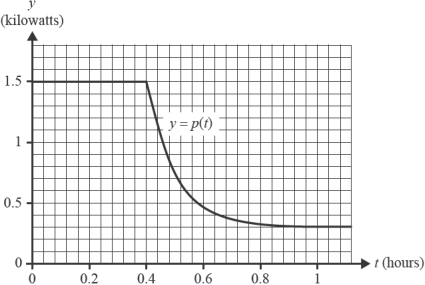
The amount of energy used by the heater, in kilowatt hours, can be estimated by evaluating the area between the graph of \(y=p(t)\) and the \(t\)-axis.
 

  1.   i. Given that \(p(t)\) is continuous for \(t \geq 0\), show that \(A=1.2 e^4\).   (1 mark)

    --- 4 WORK AREA LINES (style=lined) ---

  2.  ii. Find how long it takes, after the heater is switched on, until the heater has used 0.5 kilowatt hours of energy.
  3.     Give your answer in hours.   (1 mark)

    --- 3 WORK AREA LINES (style=lined) ---

  4. iii. Find how long it takes, after the heater is switched on, until the heater has used 1 kilowatt hour of energy.
  5.     Give your answer in hours, correct to two decimal places.   (2 marks)

    --- 3 WORK AREA LINES (style=lined) ---

Show Answers Only

a.    \(f^{\prime}(t)=\left\{
\begin{array}{cc}30  & \quad \quad 0 \leq t <\dfrac{1}{3} \\
0 & t>\dfrac{1}{3}
\end{array}\right.\)

b.    \(20^{\circ}\text{C/h}\)

ci.    \(g^{\prime}(t)=60e^{-6t}\)

cii.   \(0.299\ \text{(3 d.p.)}\)

d.    \(0.27\ \text{(2 d.p.)}\)

e.    \(0.12\ \text{(2 d.p.)}\)

fi.   \(\text{Because function is continuous}\)

\(0.3+Ae^{-10t}\) \(=1.5\)
\(Ae^{-10\times 0.4}\) \(=1.2\)
\(A\) \(=\dfrac{1.2}{e^{-10\times 0.4}}\)
  \(=1.2e^4\)

fii.  \(\dfrac{1}{3}\ \text{hours}\)

fiii. \(1.33\ \text{(2 d.p.)}\)

Show Worked Solution

a.    \(f^{\prime}(t)=\left\{
\begin{array}{cc}30  & \quad \quad 0 \leq t < \dfrac{1}{3} \\
0 & t>\dfrac{1}{3}
\end{array}\right.\)

b.    \(\text{When }\ t=0, f(t)=12\ \ \text{and when }\ t=\dfrac{1}{2}, f(t)=22\)

\(\therefore\ \text{Average rate of change}\) \(=\dfrac{22-12}{\frac{1}{2}}\)
  \(=20^{\circ}\text{C/h}\)


ci.    \(g(t)\) \(=22-10 e^{-6 t}\)
  \(g^{\prime}(t)\) \(=60e^{-6t},\ \ t\geq 0\)


cii.   \(60e^{-6t}\) \(=10\)
  \(-6t\,\ln{e}\) \(=\ln{\dfrac{1}{6}}\)
  \(t\) \(=\dfrac{\ln{\frac{1}{6}}}{-6}\)
      \(=0.2986…\approx 0.299\ \text{(3 d.p.)}\)


d.     \(\left\{
\begin{array}{cc}12+30 t & \ \  0 \leq t \leq \dfrac{1}{3} \\
22 & t>\dfrac{1}{3}
\end{array}\right.\)
\(=22-10e^{-6t}\)

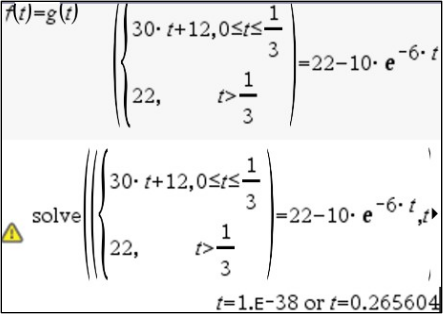
\(\text{Using CAS:}\)

\(\text{Temps equal when}\ t\approx 0.27\ \text{(2 d.p.)}\)


e.     \(\text{Difference }(D)\) \(=|g(t)-f(t)|\)
    \(=\left(22-10e^{-6t}\right)-(12+30t)\)
  \(\dfrac{dD}{dt}\) \(=60e^{-6t}-30\)

\(\text{Max time diff when}\ \dfrac{dD}{dt}=0\)

\(\therefore\ 60e^{-6t}-30\) \(=0\)
\(e^{-6t}\) \(=0.5\)
\(-6t\) \(=\ln{0.5}\)
\(t\) \(=0.1155\dots\)
  \(\approx 0.12\ \text{(2 d.p.)}\)


fi.   \(\text{Because function is continuous}\)

\(0.3+Ae^{-10t}\) \(=1.5\)
\(Ae^{-10\times 0.4}\) \(=1.2\)
\(A\) \(=\dfrac{1.2}{e^{-10\times 0.4}}\)
  \(=1.2e^4\)

  
fii.  \(\text{Using CAS:}\)
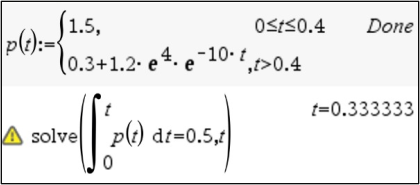
\(\text{Or, considering the graph, the area from 0 to 0.4 }=0.6\ \rightarrow t<0.4\)

\(\therefore\ \text{Solving}\ 1.5t=0.5\ \rightarrow\ t=\dfrac{1}{3}\)

\(\therefore\ \text{It takes }\dfrac{1}{3}\ \text{hours for heater to use 0.5  kilowatts.}\)
  

fiii. \(\text{Using CAS:}\)

\(1.5\times 4+\displaystyle\int_{0.4}^{t}0.3+1.2e^4.e^{-10t}dt\) \(=1\)
\(\Bigg[0.3t+0.12e^4.e^{-10t}\Bigg]_{0.4}^{t}\) \(=0.4\)
\(t\) \(=1.3333\dots\)
  \(\approx 1.33\ \text{(2 d.p.)}\)


Filed Under: Differentiation (L&E), Graphs and Applications, L&E Differentiation, L&E Integration, Standard Differentiation Tagged With: Band 3, Band 4, Band 5, smc-739-10-Exponential, smc-745-10-Exponential, smc-746-40-Average ROC, smc-746-60-Composite function, smc-748-20-Exponential (definite)

Calculus, MET1 2023 VCAA 1a

Let  \(y=\dfrac{x^2-x}{e^x}\).

Find and simplify \(\dfrac{dy}{dx}\).   (2 marks)

--- 4 WORK AREA LINES (style=lined) ---

Show Answers Only

\(-\Bigg(\dfrac{x^2-3x+1}{e^x}\Bigg) \)

Show Worked Solution

\(\text{Using the quotient rule:}\)

\(\dfrac{dy}{dx}\) \(=\dfrac{e^x(2x-1)-(x^2-x)e^x}{(e^x)^2}\)
  \(=\dfrac{e^x(-x^2+3x-1)}{e^{2x}}\)
  \(=\dfrac{-x^2+3x-1}{e^x}\)

Filed Under: Differentiation (L&E), L&E Differentiation Tagged With: Band 4, smc-739-10-Exponential, smc-739-50-Quotient Rule, smc-745-10-Exponential, smc-745-40-Quotient Rule

Calculus, MET1 2021 VCAA 1a

Differentiate  `y = 2e^(-3x)` with respect to  `x`.   (1 mark)

--- 3 WORK AREA LINES (style=lined) ---

Show Answers Only

`-6e^(-3x)`

Show Worked Solution
`y` `=2e^(-3x)`  
`dy/dx` `=-3 xx 2e^(-3x)`  
  `=-6e^(-3x)`  

Filed Under: Differentiation (L&E), L&E Differentiation Tagged With: Band 3, smc-739-10-Exponential, smc-739-60-Chain Rule, smc-745-10-Exponential, smc-745-50-Chain Rule

Calculus, MET1 2013 VCAA 1b

Let  `f(x) = e^(x^2)`.

Find  `f^{\prime} (3)`.   (3 marks)

--- 4 WORK AREA LINES (style=lined) ---

Show Answers Only

`6e^9`

Show Worked Solution

`text(Using Chain Rule:)`

`f^{\prime} (x)` `= 2xe^(x^2)`
`f^{\prime} (3)` `= 2 (3) e^((3)^2)`
  `= 6e^9`

Filed Under: Differentiation (L&E), L&E Differentiation Tagged With: Band 3, smc-739-10-Exponential, smc-739-60-Chain Rule, smc-745-10-Exponential, smc-745-50-Chain Rule

Calculus, MET1 2020 VCAA 1b

Evaluate  `f^{\prime}(1)`, where  `f: R -> R, \ f(x) = e^(x^2-x + 3)`.   (2 marks)

--- 4 WORK AREA LINES (style=lined) ---

Show Answers Only

`e^3`

Show Worked Solution
`f(x)` `= e^(x^2-x + 3)`
`f^{\prime}(x)` `= (2x-1)e^(x^2-x + 3)`
`f^{\prime}(1)` `= (2-1)e^(1-1 + 3)`
  `= e^3`

Filed Under: Differentiation (L&E), L&E Differentiation Tagged With: Band 3, smc-739-10-Exponential, smc-739-60-Chain Rule, smc-745-10-Exponential, smc-745-50-Chain Rule

Calculus, MET1-NHT 2018 VCAA 1a

Let  `f(x) = (e^x)/((x^2-3))`.

Find  `f^{prime}(x)`.   (2 marks)

--- 4 WORK AREA LINES (style=lined) ---

Show Answers Only

`{e^x(x^2-2x-3)}/{(x^2-3)^2}`

Show Worked Solution

`text(Let) \ \ u = e^x \ \ => \ \ u^{prime} = e^x`

 `v = (x^2-3) \ \ => \ \ v^{prime} = 2x`

`f^{prime}(x)` `= {e^x(x^2-3)-2x e^x}/{(x^2-3)^2}`
  `= {e^x(x^2-2x-3)}/{(x^2-3)^2}`

Filed Under: Differentiation (L&E), L&E Differentiation Tagged With: Band 3, smc-739-10-Exponential, smc-739-50-Quotient Rule, smc-745-10-Exponential, smc-745-40-Quotient Rule

Calculus, MET1-NHT 2019 VCAA 1a

Let  `y = (2e^(2x)-1)/e^x`.

Find  `(dy)/(dx)`.   (2 marks)

--- 3 WORK AREA LINES (style=lined) ---

Show Answers Only

`(dy)/(dx) = 2e^x + e^(-x)`

Show Worked Solution

`text(Method 1)`

`y` `= 2e^x-e^(-x)`
`(dy)/(dx)` `= 2e^x + e^(-x)`


`text(Method 2)`

`(dy)/(dx)` `= (4e^(2x) ⋅ e^x-(2e^(2x)-1) e^x)/(e^x)^2`
  `= (4e^(3x)-2e^(3x) + e^x)/e^(2x) `
  `= (2e^(2x) + 1)/e^x`

Filed Under: Differentiation (L&E), L&E Differentiation Tagged With: Band 3, smc-739-10-Exponential, smc-739-50-Quotient Rule, smc-745-10-Exponential, smc-745-40-Quotient Rule

Calculus, MET1 2018 VCAA 1b

Let  `f(x) = (e^x)/(cos(x))`.

Evaluate  `f^{prime}(pi)`.   (2 marks)

--- 7 WORK AREA LINES (style=lined) ---

Show Answers Only

`text(See Worked Solutions)`

Show Worked Solution

`f^{prime}(x) = (e^x)/(cos(x))`

`u` `= e^x` `v` `= cos(x)`
`u^{prime}` `= e^x` `v^{prime}` `=-sin(x)`
`f^{prime}(x)` `= (u^{prime}v-uv^{prime})/(v^2)`
  `= (e^x · cos(x) + e^x sin(x))/(cos^2(x))`


`f^{prime}(pi)` `= (e^pi · cospi + e^pi sinpi)/(cos^2 pi)`
  `= (e^pi(-1) + e^pi · 0)/((-1)^2)`
  `= -e^pi`

Filed Under: Differentiation (L&E), Differentiation (Trig), L&E Differentiation, Trig Differentiation Tagged With: Band 4, smc-736-20-cos, smc-736-50-Quotient Rule, smc-736-70-Log/Exp overlap, smc-739-10-Exponential, smc-739-50-Quotient Rule, smc-739-80-Trig overlap, smc-744-20-cos, smc-744-50-Quotient Rule, smc-744-70-Log/Exp Overlap, smc-745-10-Exponential, smc-745-40-Quotient Rule, smc-745-60-Trig Overlap

Calculus, MET1 2008 VCAA 1b

Let  `f(x) = xe^(3x)`.  Evaluate  `f^{prime}(0)`.   (3 marks)

--- 4 WORK AREA LINES (style=lined) ---

Show Answers Only

`1`

Show Worked Solution

`text(Using Product Rule:)`

`(gh)^{prime} = g^{prime}h + gh^{prime}`

`f^{prime}(x)` `= x(3e^(3x)) + 1 xx e^(3x)`
`:.f^{prime}(0)` `= 0 + e^0`
  `= 1`

Filed Under: Differentiation (L&E), L&E Differentiation Tagged With: Band 4, smc-739-10-Exponential, smc-739-40-Product Rule, smc-745-10-Exponential, smc-745-30-Product Rule, smc-745-50-Chain Rule

Calculus, MET1 2015 ADV 11e

Differentiate  `(e^x + x)^5`.   (2 marks)

--- 4 WORK AREA LINES (style=lined) ---

Show Answers Only

`5(e^x + 1)(e^x + x)^4`

Show Worked Solution
`y` `= (e^5 + x)^5`
`(dy)/(dx)` `= 5(e^x + x)^4 xx d/(dx)(e^x + x)`
  `= 5(e^x + x)^4 xx (e^x + 1)`
  `= 5(e^x + 1)(e^x + x)^4`

Filed Under: Differentiation (L&E), L&E Differentiation Tagged With: Band 4, smc-739-10-Exponential, smc-739-60-Chain Rule, smc-745-10-Exponential, smc-745-50-Chain Rule

Calculus, MET1 2007 ADV 2ai

Differentiate with respect to `x`:

`(2x)/(e^x + 1).`   (2 marks)

--- 6 WORK AREA LINES (style=lined) ---

Show Answers Only

`(2(e^x + 1-xe^x))/((e^x + 1)^2)`

Show Worked Solution

`y = (2x)/(e^x + 1)`

`u` `= 2x` `v` `= e^x + 1`
`u^{\prime}` `= 2` `v^{\prime}` `= e^x`
`(dy)/(dx)` `= (u^{\prime}v – uv^{\prime})/(v^2)`
  `= (2(e^x + 1)-2x(e^x))/((e^x + 1)^2)`
  `= (2e^x + 2-2x · e^x)/((e^x + 1)^2)`
  `= (2(e^x + 1-xe^x))/((e^x + 1)^2)`

Filed Under: Differentiation (L&E), L&E Differentiation Tagged With: Band 3, smc-739-10-Exponential, smc-739-50-Quotient Rule, smc-745-10-Exponential, smc-745-40-Quotient Rule

Calculus, MET1 2009 ADV 2a

Differentiate  `(e^x + 1)^2`  with respect to `x`.   (2 marks)

--- 2 WORK AREA LINES (style=lined) ---

Show Answers Only

`2e^x(e^x + 1)`

Show Worked Solution
  `y` `= (e^x + 1)^2`
  `(dy)/(dx)` `= 2(e^x + 1)^1 xx d/(dx) (e^x + 1)`
    `= 2e^x(e^x + 1)`

Filed Under: Differentiation (L&E), L&E Differentiation Tagged With: Band 3, smc-739-10-Exponential, smc-739-60-Chain Rule, smc-745-10-Exponential

Calculus, MET1 2016 VCAA 1b

Let  `f(x) = x^2e^(5x)`.

Evaluate  `f^{\prime}(1)`.   (2 marks)

--- 4 WORK AREA LINES (style=lined) ---

Show Answers Only

`7e^5`

Show Worked Solution

`text(Using Product Rule:)`

`(fg)^{\prime}` `= f^{\prime}g + fg^{\prime}`
`f^{′}(x)` `= 2xe^(5x) + 5x^2 e^(5x)`
`f^{′}(1)` `= 2(1)e^(5(1)) + 5(1)^2 e^(5(1))`
  `= 7e^5`

Filed Under: Differentiation (L&E), L&E Differentiation Tagged With: Band 3, smc-739-10-Exponential, smc-739-40-Product Rule, smc-739-60-Chain Rule, smc-745-10-Exponential, smc-745-30-Product Rule

Calculus, MET2 2009 VCAA 7 MC

For  `y = e^(2x) cos (3x)`  the rate of change of `y` with respect to `x` when  `x = 0`  is

  1. `0`
  2. `2`
  3. `3`
  4. `– 6`
  5. `– 1`
Show Answers Only

`B`

Show Worked Solution
`y` `= e^(2x) cos (3x)`
`dy/dx` `=e^(2x) xx -3sin(3x) + 2e^(2x) xx cos (3x)`
  `=e^(2x)(-3sin(3x) + 2cos(3x))`

 
`text(When)\ \ x = 0,`

`dy/dx= 2`

`=>   B`

Filed Under: Differentiation (L&E), L&E Differentiation Tagged With: Band 3, smc-739-10-Exponential, smc-739-40-Product Rule, smc-739-60-Chain Rule, smc-739-80-Trig overlap, smc-745-10-Exponential, smc-745-30-Product Rule, smc-745-60-Trig Overlap

Calculus, MET1 2010 VCAA 1a

Differentiate  `x^3 e^(2x)`  with respect to `x`.   (2 marks)

--- 3 WORK AREA LINES (style=lined) ---

Show Answers Only

`3x^2 e^(2x) + 2x^3 e^(2x)`

Show Worked Solution

    `text(Using Product rule:)`

`(fg)^{prime}` `= f^{prime}g + fg^{prime}`
`d/(dx) (x^3 e^(2x))` `= 3x^2 e^(2x) + 2x^3 e^(2x)`

Filed Under: Differentiation (L&E), L&E Differentiation Tagged With: Band 3, Band 4, smc-739-10-Exponential, smc-739-40-Product Rule, smc-745-10-Exponential, smc-745-30-Product Rule

Copyright © 2014–2025 SmarterEd.com.au · Log in