SmarterEd

Aussie Maths & Science Teachers: Save your time with SmarterEd

  • Login
  • Get Help
  • About

Proof, EXT2 EQ-Bank 34

Consider a sequence of rectangles with side lengths \(a_{ n }\) and \(b_{ n }\).

The first rectangle has  \(a_1=2\)  and  \(b_1=1\).

For integers  \(n \geq 1,\ \ a_{n+1}=\dfrac{a_n+b_n}{2}\)  and  \(b_{n+1}=\dfrac{2}{a_{n+1}}.\)

  1. Show that every rectangle in the sequence has an area of 2 square units.   (1 mark)

    --- 2 WORK AREA LINES (style=lined) ---

  2. Use the relationship between the arithmetic mean and the geometric mean to prove that  \(a_n \geq \sqrt{2}\)  for any integer  \(n \geq 1\).   (2 marks)

    --- 2 WORK AREA LINES (style=lined) ---

  3. Use mathematical induction to prove that  \(a_n-\sqrt{2} \leq \dfrac{1}{2^{n-1}}(2-\sqrt{2})\)  for any integer  \(n \geq 1\).    (4 marks)

    --- 15 WORK AREA LINES (style=lined) ---

  4. Use the squeeze theorem to show that the rectangles approach a square as \(n\) approaches infinity.   (2 marks)

    --- 5 WORK AREA LINES (style=lined) ---
Show Answers Only


Show Worked Solution

a.    \(\text{Since}\ \ a_1 b_1=2\ \ \text{and}\ \ a_{n+1} b_{n+1}=a_{n+1} \times \dfrac{2}{a_{n+1}}=2\)

\(\Rightarrow\ \text{Each rectangle has area 2.}\)
 

b.    \(a_1=2\ \ \Rightarrow\ \ a_1 \geq \sqrt{2}\ \ \text{(true for 1st rectangle)}\)

\(\text{AM/GM inequality:}\ \ \dfrac{a_n+b_n}{2} \geq \sqrt{a_nb_n} \)

\(a_nb_n=2\ \ \text{(from part (a))}\)

\(\dfrac{a_n+b_n}{2} \geq \sqrt{2}\ …\ (1)\)

\(\text{Since}\ \ a_{n+1}=\dfrac{a_n+b_n}{2}:\)

\(\ a_{n+1} \geq \sqrt{2}\ \ \ \text{(using (1) above)}\)

\(\therefore a_n \geq \sqrt{2}\)
  

c.    \(\text{Prove}\ \ a_n-\sqrt{2} \leq \dfrac{1}{2^{n-1}}(2-\sqrt{2}),\ \ \text{for}\ \ n \geq 1\)

\(\text{If}\ \ n=1:\)

\(\ a_1-\sqrt{2}=2-\sqrt{2} \leq \dfrac{1}{2^{0}}(2-\sqrt{2})\).

\(\Rightarrow\ \text{True for}\ \ n=1.\)
 

\(\text{Assume true for}\ \ n=k:\)

\(a_k-\sqrt{2} \leq \dfrac{1}{2^{k-1}}(2-\sqrt{2})\ …\ (1) \)

\(\text{Prove true for}\ \ n=k+1:\)

\(\text{i.e.}\ \ a_{k+1}-\sqrt{2} \leq \dfrac{1}{2^k}(2-\sqrt{2})\)

\(\text{By definition,} \ \ a_{k+1}=\dfrac{1}{2}\left(a_k+b_k\right)\)

\(a_{k+1}-\sqrt{2}\) \(=\dfrac{1}{2}\left(a_k-\sqrt{2}\right)+\dfrac{1}{2}\left(b_k-\sqrt{2}\right) \)  
  \(\leq \dfrac{1}{2}\left(\dfrac{1}{2^{k-1}}(2-\sqrt{2})\right)+\dfrac{1}{2}\left(b_k-\sqrt{2}\right)\ \ \text{(see (1) above)}\ \)  

 
\(\text{Since}\ \ a_k \geq \sqrt{2}\ \ \text{and}\ \ a_kb_k=2:\)

\(\ b_k \leq \sqrt{2}\ \ \text{and}\ \ b_k-\sqrt{2} \leq 0\)

\(a_{k+1}-\sqrt{2} \leq \dfrac{1}{2^k}(2-\sqrt{2})+\dfrac{1}{2}\left(b_k-\sqrt{2}\right) \leq \dfrac{1}{2^k}(2-\sqrt{2})\)

\(\Rightarrow\ \text{True for}\ \ n=k+1.\)

\(\therefore\ \text{Since true for}\ \ n=1,\ \text{by PMI, true for integers}\ \ n \geq 1.\)
  

d.    \(\text {Combining parts (b) and (c):}\)

\(0 \leq a_n-\sqrt{2} \leq \dfrac{1}{2^{n-1}}(2-\sqrt{2}).\)

\(\text{As}\ \ n \rightarrow \infty, \ \dfrac{1}{2^{n-1}} \rightarrow 0\)

\(\Rightarrow a_n-\sqrt{2} \rightarrow 0\ \ \text{(by squeeze theorem)}\)

\(\text{Since rectangles have an area = 2:}\)

\(\text{As}\ \ n \rightarrow \infty,\ b_n \rightarrow \sqrt{2}\)

\(\text{i.e. rectangles approach a square.}\)

Filed Under: Induction, Inequalities Tagged With: Band 4, Band 5, Band 6, smc-7423-50-Arithmetic/Geometric Mean, smc-7424-10-Inequalities

Proof, EXT2 P1 2022 HSC 16c

It is given that for positive numbers `x_(1),x_(2),x_(3),dots,x_(n)` with arithmetic mean `A`,

               `(x_(1)xxx_(2)xxx_(3)xx cdots xxx_(n))/(A^(n)) <= 1`    (Do NOT prove this.)

Suppose a rectangular prism has dimensions `a, b, c` and surface area `S`.

  1. Show that  `abc <= ((S)/(6))^((3)/(2))`.  (2 marks)

    --- 8 WORK AREA LINES (style=lined) ---

  2. Using part (i), show that when the rectangular prism with surface area `S` is a cube, it has maximum volume.  (2 marks)

    --- 8 WORK AREA LINES (style=lined) ---

Show Answers Only
  1. `text{Proof (See Worked Solutions)}`
  2. `text{Proof (See Worked Solutions)}`
Show Worked Solution

i.    `text{Show}\ \ abc <= ((S)/(6))^((3)/(2))`

`S=2(ab+bc+ac)`

`A=(ab+bc+ac)/3`

`text{Using given relationship, where}\ x_1=ab, x_2=bc, …`


♦♦♦ Mean mark (i) 26%.
`(ab xx bc xx ca)/((ab+bc+ac)/3)^3` `<=1`  
`(ab xx bc xx ca)` `<=((ab+bc+ac)/3)^3`  
`(abc)^2` `<=((2(ab+bc+ac))/6)^3`  
`abc` `<=(S/6)^(3/2)`  


ii.   `text{If prism is a cube,}\ a=b=c`

`=> V=a^3, \ \ S=6a^2`

`(S/6)^(3/2)=((6a^2)/6)^(3/2)=a^3`
 

`text{In the case of a cube:}`

`V=(S/6)^(3/2)`


♦♦♦ Mean mark (ii) 26%.

`text{Also,}\ \ V<=(S/6)^(3/2)\ \ \ text{(using part (i))}`

`:.\ text{For rectangular prisms with a given surface area, a cube}`

`text{has the maximum volume.}`

Filed Under: Inequalities, Proof and Inequalities Tagged With: Band 5, Band 6, smc-1208-30-Proof using given equation, smc-1208-50-Arithmetic/Geometric Mean, smc-1208-60-Other Proofs, smc-7423-30-Proof using given equation, smc-7423-50-Arithmetic/Geometric Mean

Proof, EXT2 P1 2018 HSC 15c

Let `n` be a positive integer and let `x` be a positive real number.

  1.  Show that  `x^n-1-n(x-1) = (x-1)(1 + x + x^2 + … + x^(n-1)-n)`.   (1 mark)

    --- 3 WORK AREA LINES (style=lined) ---

  2.  Hence, show that  `x^n >= 1 + n(x-1)`.   (2 marks)

    --- 6 WORK AREA LINES (style=lined) ---

  3.  Deduce that for positive real numbers `a` and `b`,
  4.       `a^nb^(1-n)>=na + (1-n)b`   (2 marks)

    --- 6 WORK AREA LINES (style=lined) ---

Show Answers Only

i.    `text(See Worked Solutions)`

ii.   `text(See Worked Solutions)`

iii.  `text(See Worked Solutions)`

Show Worked Solution
i.    `text(RHS)` `= (x-1)underbrace{(1 + x + x^2 + … + x^(n-1)-n)}_{text(GP where)\ \ a = 1,\ r = x}`
    `= (x-1) ((1(x^n-1))/(x-1)-n)`
    `= x^n-1-n(x-1)`
    `=\ text(LHS)`


ii.   `text(Let)\ P(x) = (x-1)(1 + x + x^2 + … + x^(n-1)-n)`

♦♦♦ Mean mark (ii) 11%.

`text(If)\ \ x = 1, P(x) = 0`
 

`text(If)\ \ 0 < x < 1, \ (x-1) < 0, \ (1 + x + x^2 + … + x^(n-1)-n) < 0`

`=> P(x) > 0`
 

`text(If)\ \ x > 1, \ (x-1) > 0, \ (1 + x + … + x^(n-1)-n) > 0`

`=> P(x) > 0`
 

`x^n-1-n(x-1) >= 0`

`:. x^n >= 1 + n(x-1)`


iii.   `x^n >= 1 + n(x-1)\ \ text(for)\ \ x ∈ R^+`

♦♦ Mean mark (iii) 23%.

`text(S)text(ince)\ a,b ∈ R^+`

`(a/b)^n` `>= 1 + n(a/b-1)`
`(a^n)/(b^n) xx b` `>= b + na-nb,\ \ \ \ (b > 0)`
`a^n b^(1-n)` `>= na + (1-n)b`

Filed Under: Inequalities, Inequalities EXT2, Proof and Inequalities Tagged With: Band 4, Band 5, Band 6, smc-1208-80-Geometric Series, smc-7423-50-Arithmetic/Geometric Mean

Proof, EXT2 P1 2017 HSC 10 MC

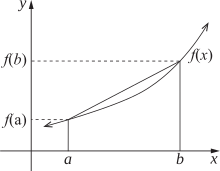
Suppose  `f(x)`  is a differentiable function such that

`(f(a) + f(b))/2 >= f((a + b)/2)`, for all `a` and `b`.

Which statement is always true?

  1. `int_0^1 f(x)\ dx >= (f(0) + f(1))/2`
  2. `int_0^1 f(x)\ dx <= (f(0) + f(1))/2`
  3. `f^{′}(1/2) >= 0`
  4. `f^{′}(1/2) <= 0`
Show Answers Only

`B`

Show Worked Solution

`text(Representing the equation graphically)`

♦ Mean mark 41%.

`text{(one of many possibilities)}`


`f(x)\ text(is an increasing function between)`

`a\ text(and)\ b\ text(such that:)`

`(f(a) + f(b))/2 >= f((a + b)/2)`
 

`text(If)\ \ a = 0\ text(and)\ \ b = 1,`

`int_0^1 f(x)\ dx` `<=\ text(Area of trapezium)`
  `<= 1/2(1) (f(0) + f(1))`
  `<= (f(0) + f(1))/2`

`=> B`

Filed Under: Harder Integration Examples, Inequalities, Inequalities EXT2, Proof and Inequalities Tagged With: Band 5, smc-1208-50-Arithmetic/Geometric Mean, smc-7423-50-Arithmetic/Geometric Mean

Copyright © 2014–2026 SmarterEd.com.au · Log in