SmarterEd

Aussie Maths & Science Teachers: Save your time with SmarterEd

  • Login
  • Get Help
  • About

Proof, EXT2 EQ-Bank 21

Prove that  \(\lim\limits_{x \to 0}x^2\, \sin \left(\dfrac{1}{x}\right)=0\).   (2 marks)

--- 5 WORK AREA LINES (style=lined) ---

Show Answers Only

\(-1 \leqslant \sin \left(\dfrac{1}{x}\right) \leqslant 1\)

\(-x^2 \leqslant x^2\, \sin \left(\dfrac{1}{x}\right) \leqslant x^2\)
 

\(\text{By squeeze theorem:}\)

\(\text{Since} \ \ \lim\limits_{x \to 0}-x^2=0\ \ \text{and}\ \ \lim\limits _{x \rightarrow 0} x^2=0\)

\(\Rightarrow \lim\limits _{x \rightarrow 0} x^2\, \sin \left(\dfrac{1}{x}\right)=0\)

Show Worked Solution

\(-1 \leqslant \sin \left(\dfrac{1}{x}\right) \leqslant 1\)

\(-x^2 \leqslant x^2\, \sin \left(\dfrac{1}{x}\right) \leqslant x^2\)
 

\(\text{By squeeze theorem:}\)

\(\text{Since} \ \ \lim\limits_{x \to 0}-x^2=0\ \ \text{and}\ \ \lim\limits _{x \rightarrow 0} x^2=0\)

\(\Rightarrow \lim\limits _{x \rightarrow 0} x^2\, \sin \left(\dfrac{1}{x}\right)=0\)

Filed Under: Inequalities Tagged With: Band 4, smc-7423-75-Squeeze Theorem

Proof, EXT2 EQ-Bank 34

Consider a sequence of rectangles with side lengths \(a_{ n }\) and \(b_{ n }\).

The first rectangle has  \(a_1=2\)  and  \(b_1=1\).

For integers  \(n \geq 1,\ \ a_{n+1}=\dfrac{a_n+b_n}{2}\)  and  \(b_{n+1}=\dfrac{2}{a_{n+1}}.\)

  1. Show that every rectangle in the sequence has an area of 2 square units.   (1 mark)

    --- 2 WORK AREA LINES (style=lined) ---

  2. Use the relationship between the arithmetic mean and the geometric mean to prove that  \(a_n \geq \sqrt{2}\)  for any integer  \(n \geq 1\).   (2 marks)

    --- 2 WORK AREA LINES (style=lined) ---

  3. Use mathematical induction to prove that  \(a_n-\sqrt{2} \leq \dfrac{1}{2^{n-1}}(2-\sqrt{2})\)  for any integer  \(n \geq 1\).    (4 marks)

    --- 15 WORK AREA LINES (style=lined) ---

  4. Use the squeeze theorem to show that the rectangles approach a square as \(n\) approaches infinity.   (2 marks)

    --- 5 WORK AREA LINES (style=lined) ---

Show Answers Only


Show Worked Solution

a.    \(\text{Since}\ \ a_1 b_1=2\ \ \text{and}\ \ a_{n+1} b_{n+1}=a_{n+1} \times \dfrac{2}{a_{n+1}}=2\)

\(\Rightarrow\ \text{Each rectangle has area 2.}\)
 

b.    \(a_1=2\ \ \Rightarrow\ \ a_1 \geq \sqrt{2}\ \ \text{(true for 1st rectangle)}\)

\(\text{AM/GM inequality:}\ \ \dfrac{a_n+b_n}{2} \geq \sqrt{a_nb_n} \)

\(a_nb_n=2\ \ \text{(from part (a))}\)

\(\dfrac{a_n+b_n}{2} \geq \sqrt{2}\ …\ (1)\)

\(\text{Since}\ \ a_{n+1}=\dfrac{a_n+b_n}{2}:\)

\(\ a_{n+1} \geq \sqrt{2}\ \ \ \text{(using (1) above)}\)

\(\therefore a_n \geq \sqrt{2}\)
  

c.    \(\text{Prove}\ \ a_n-\sqrt{2} \leq \dfrac{1}{2^{n-1}}(2-\sqrt{2}),\ \ \text{for}\ \ n \geq 1\)

\(\text{If}\ \ n=1:\)

\(\ a_1-\sqrt{2}=2-\sqrt{2} \leq \dfrac{1}{2^{0}}(2-\sqrt{2})\).

\(\Rightarrow\ \text{True for}\ \ n=1.\)
 

\(\text{Assume true for}\ \ n=k:\)

\(a_k-\sqrt{2} \leq \dfrac{1}{2^{k-1}}(2-\sqrt{2})\ …\ (1) \)

\(\text{Prove true for}\ \ n=k+1:\)

\(\text{i.e.}\ \ a_{k+1}-\sqrt{2} \leq \dfrac{1}{2^k}(2-\sqrt{2})\)

\(\text{By definition,} \ \ a_{k+1}=\dfrac{1}{2}\left(a_k+b_k\right)\)

\(a_{k+1}-\sqrt{2}\) \(=\dfrac{1}{2}\left(a_k-\sqrt{2}\right)+\dfrac{1}{2}\left(b_k-\sqrt{2}\right) \)  
  \(\leq \dfrac{1}{2}\left(\dfrac{1}{2^{k-1}}(2-\sqrt{2})\right)+\dfrac{1}{2}\left(b_k-\sqrt{2}\right)\ \ \text{(see (1) above)}\ \)  

 
\(\text{Since}\ \ a_k \geq \sqrt{2}\ \ \text{and}\ \ a_kb_k=2:\)

\(\ b_k \leq \sqrt{2}\ \ \text{and}\ \ b_k-\sqrt{2} \leq 0\)

\(a_{k+1}-\sqrt{2} \leq \dfrac{1}{2^k}(2-\sqrt{2})+\dfrac{1}{2}\left(b_k-\sqrt{2}\right) \leq \dfrac{1}{2^k}(2-\sqrt{2})\)

\(\Rightarrow\ \text{True for}\ \ n=k+1.\)

\(\therefore\ \text{Since true for}\ \ n=1,\ \text{by PMI, true for integers}\ \ n \geq 1.\)
  

d.    \(\text {Combining parts (b) and (c):}\)

\(0 \leq a_n-\sqrt{2} \leq \dfrac{1}{2^{n-1}}(2-\sqrt{2}).\)

\(\text{As}\ \ n \rightarrow \infty, \ \dfrac{1}{2^{n-1}} \rightarrow 0\)

\(\Rightarrow a_n-\sqrt{2} \rightarrow 0\ \ \text{(by squeeze theorem)}\)

\(\text{Since rectangles have an area = 2:}\)

\(\text{As}\ \ n \rightarrow \infty,\ b_n \rightarrow \sqrt{2}\)

\(\text{i.e. rectangles approach a square.}\)

Filed Under: Induction, Inequalities Tagged With: Band 4, Band 5, Band 6, smc-7423-50-Arithmetic/Geometric Mean, smc-7424-10-Inequalities

Proof, EXT2 P1 2025 HSC 16a

Consider the equation

\(z^n \cos\left[n \theta\right]+z^{n-1} \cos \left[(n-1) \theta\right]+z^{n-2} \cos \left[(n-2) \theta\right]+\cdots+z\, \cos\left[\theta\right]=1\)

where  \(z \in \mathbb{C} , \theta \in \mathbb{R} \), and \(n\) is a positive integer.

Using a proof by contradiction and the triangle inequality, or otherwise, prove that all the solutions to the equation lie outside the circle  \(\abs{z}=\dfrac{1}{2}\)  on the complex plane.   (4 marks)

--- 16 WORK AREA LINES (style=lined) ---

Show Answers Only

\(\text{Proof by contradiction}\)

\(\text{Assume}\ \exists\ z \in \mathbb{C},\ \text{where}\ \abs{z} \in\left[0, \dfrac{1}{2}\right],\ \text{and}\)

\(z^n \cos \left[n \theta \right]+z^{n-1} \cos \left[(n-1) \theta \right] + \ldots +z\, \cos \theta=1\)
 

\(\text{Using the triangle inequality}\ \ \left(\abs{x}+\abs{y} \geqslant \abs{x+y}\right):\)

   \(\left|z^n \cos \left[n \theta\right] \right|+\left|z^{n-1} \cos \left[(n-1) \theta\right] \right|+\ldots+|z\, \cos \theta|\)

\(\geqslant\left|z^n \cos \left[n \theta \right] +z^{n-1} \cos \left[(n-1) \theta \right]+\ldots+z\, \cos \theta\right|\)
 

\(1 \leqslant\left|z^n \cos \left[n \theta \right]\right|+\left|z^{n-1} \cos \left[(n-1) \theta \right]\right|+\ldots+|z\, \cos \theta|\)

\(1 \leqslant|z|^n+|z|^{n-1}+\cdots+|z| \quad (\text{since}-1 \leqslant \cos (k \theta) \leqslant 1)\)

\(1 \leqslant (\frac{1}{2})^n+(\frac{1}{2})^{n-1}+\cdots+(\frac{1}{2}) \)

\(1 \leqslant \underbrace{2^{-n}+2^{-n+1}+\cdots+2^{-1}}_{\text{GP:}\  a=2^{-n}, r=2}\)

\(1 \leqslant \dfrac{2^{-n}\left(2^n-1\right)}{2-1}\)

\(1 \leqslant 1-2^{-n}\)

\(2^{-n} \leqslant 0 \ \ \text {(which is not true)}\)

\(\therefore \ \text{By contradiction, the original statement is correct}\)

Show Worked Solution

\(\text{Proof by contradiction}\)

\(\text{Assume}\ \exists\ z \in \mathbb{C},\ \text{where}\ \abs{z} \in\left[0, \dfrac{1}{2}\right],\ \text{and}\)

\(z^n \cos \left[n \theta \right]+z^{n-1} \cos \left[(n-1) \theta \right] + \ldots +z\, \cos \theta=1\)

♦♦♦ Mean mark 10%.

\(\text{Using the triangle inequality}\ \ \left(\abs{x}+\abs{y} \geqslant \abs{x+y}\right):\)

   \(\left|z^n \cos \left[n \theta\right] \right|+\left|z^{n-1} \cos \left[(n-1) \theta\right] \right|+\ldots+|z\, \cos \theta|\)

\(\geqslant\left|z^n \cos \left[n \theta \right] +z^{n-1} \cos \left[(n-1) \theta \right]+\ldots+z\, \cos \theta\right|\)
 

\(1 \leqslant\left|z^n \cos \left[n \theta \right]\right|+\left|z^{n-1} \cos \left[(n-1) \theta \right]\right|+\ldots+|z\, \cos \theta|\)

\(1 \leqslant|z|^n+|z|^{n-1}+\cdots+|z| \quad (\text{since}-1 \leqslant \cos (k \theta) \leqslant 1)\)

\(1 \leqslant (\frac{1}{2})^n+(\frac{1}{2})^{n-1}+\cdots+(\frac{1}{2}) \)

\(1 \leqslant \underbrace{2^{-n}+2^{-n+1}+\cdots+2^{-1}}_{\text{GP:}\  a=2^{-n}, r=2}\)

\(1 \leqslant \dfrac{2^{-n}\left(2^n-1\right)}{2-1}\)

\(1 \leqslant 1-2^{-n}\)

\(2^{-n} \leqslant 0 \ \ \text {(which is not true)}\)

\(\therefore \ \text{By contradiction, the original statement is correct}\)

Filed Under: Converse, Contradiction and Contrapositive Proof, Inequalities, Language and Illustrations of Proofs, Proof and Inequalities Tagged With: Band 6, smc-1207-10-Contradiction, smc-1208-55-Triangle inequality, smc-7422-20-Contradiction, smc-7422-85-X-topic, smc-7423-55-Triangle Inequality

Proof, EXT2 P1 2025 HSC 14d

Positive real numbers \(a, b, c\) and \(d\) are chosen such that  \(\dfrac{1}{a}, \dfrac{1}{b}, \dfrac{1}{c}\)  and  \(\dfrac{1}{d}\)  are consecutive terms in an arithmetic sequence with common difference \(k\), where  \(k \in \mathbb{R} , k>0\).

Show that  \(b+c<a+d\).   (3 marks)

--- 12 WORK AREA LINES (style=lined) ---

Show Answers Only

\(\text{AP:} \ \dfrac{1}{a}, \dfrac{1}{b}, \dfrac{1}{c}, \dfrac{1}{d} \ \ \text{where common difference}=k\ \ (k>0)\)

\(\text{Show} \ \ b+c<a+d\)

\(\dfrac{1}{a}<\dfrac{1}{a}+k(k>0)\)

\(\dfrac{1}{a}<\dfrac{1}{b}\)

\(\text{Similarly for}\ \ \dfrac{1}{b}<\dfrac{1}{c}\  \ldots\  \text{such that}\)

\(\dfrac{1}{a}<\dfrac{1}{b}<\dfrac{1}{c}<\dfrac{1}{d} \ \ \Rightarrow\ \ a>b>c>d\ \ldots\ (1)\)

\(\dfrac{1}{b}=\dfrac{1}{a}+k \ \ \Rightarrow \ \ k=\dfrac{1}{b}-\dfrac{1}{a}=\dfrac{a-b}{a b}\ \ \Rightarrow \ \ a-b=kab\)

\(\text {Similarly:}\)

\(\dfrac{1}{d}=\dfrac{1}{c}+k \ \ \Rightarrow \ \ k=\dfrac{c-d}{cd}\ \ \Rightarrow\ \ c-d=kcd\)
 

\(\text{Using \(\ a>b>c>d\ \)  (see (1) above):}\)

\(a-b>c-d\)

\(b+c<a+d\)

Show Worked Solution

\(\text{AP:} \ \dfrac{1}{a}, \dfrac{1}{b}, \dfrac{1}{c}, \dfrac{1}{d} \ \ \text{where common difference}=k\ \ (k>0)\)

\(\text{Show} \ \ b+c<a+d\)

\(\dfrac{1}{a}<\dfrac{1}{a}+k(k>0)\)

\(\dfrac{1}{a}<\dfrac{1}{b}\)

\(\text{Similarly for}\ \ \dfrac{1}{b}<\dfrac{1}{c}\  \ldots\  \text{such that}\)

\(\dfrac{1}{a}<\dfrac{1}{b}<\dfrac{1}{c}<\dfrac{1}{d} \ \ \Rightarrow\ \ a>b>c>d\ \ldots\ (1)\)

♦ Mean mark 39%.

\(\dfrac{1}{b}=\dfrac{1}{a}+k \ \ \Rightarrow \ \ k=\dfrac{1}{b}-\dfrac{1}{a}=\dfrac{a-b}{a b}\ \ \Rightarrow \ \ a-b=kab\)

\(\text {Similarly:}\)

\(\dfrac{1}{d}=\dfrac{1}{c}+k \ \ \Rightarrow \ \ k=\dfrac{c-d}{cd}\ \ \Rightarrow\ \ c-d=kcd\)
 

\(\text{Using \(\ a>b>c>d\ \)  (see (1) above):}\)

\(a-b>c-d\)

\(b+c<a+d\)

Filed Under: Inequalities, Proof and Inequalities Tagged With: Band 5, smc-1208-10-Proofs given \(\ \large a \gt b\), smc-1208-30-Proof using given equation, smc-7423-10-Proofs given \(\ \large a \gt b\), smc-7423-30-Proof using given equation

Proof, EXT2 P1 2025 HSC 13c

  1. For positive real numbers \(a\) and \(b\), prove that  \(\dfrac{a+b}{2} \geq \sqrt{a b}\).   (2 marks)

    --- 5 WORK AREA LINES (style=lined) ---

  2. Hence, or otherwise, show that  \(\dfrac{2 n+1}{2 n+2}<\dfrac{\sqrt{2 n+1}}{\sqrt{2 n+3}}\)  for any integer \(n \geq 0\).   (2 marks)

    --- 5 WORK AREA LINES (style=lined) ---

Show Answers Only

i.    \(\text {Using}\ \ (\sqrt{a}-\sqrt{b})^2 \geqslant 0:\)

\(a-2 \sqrt{a b}+b\) \(\geqslant 0\)
\(a+b\) \(\geqslant 2 \sqrt{a b}\)
\(\dfrac{a+b}{2}\) \(\geqslant \sqrt{a b}\)

 
ii.
    \(\text{Show}\ \ \dfrac{2 n+1}{2 n+2}<\dfrac{\sqrt{2 n+1}}{\sqrt{2 n+3}}\)

\(\text{Using part (i):}\)

\(\text{Let} \ \ a=2 n+1, b=2 n+3\)

\(\dfrac{2 n+1+2 n+3}{2}\) \(\geqslant \sqrt{2 n+1} \sqrt{2 n+3}\)
\(2 n+2\) \(\geqslant \sqrt{2 n+1} \sqrt{2 n+3}\)
\(\dfrac{1}{2 n+2}\) \(\leqslant \dfrac{1}{\sqrt{2 n+1} \sqrt{2 n+3}}\)
\(\dfrac{2 n+1}{2 n+2}\) \(\leqslant \dfrac{\sqrt{2 n+1}}{\sqrt{2 n+3}}\)

 
\(\text{Consider part (i):}\ (\sqrt{a}-\sqrt{b})^2 \geqslant 0\)

\(\Rightarrow \ \text{Equality only holds when} \ \ a=b\)

\(\text{Since}\ \ a=2 n+1 \neq b=2 n+3\)

\(\dfrac{2 n+1}{2 n+2}<\dfrac{\sqrt{2 n+1}}{\sqrt{2 n+3}}\)

Show Worked Solution

i.    \(\text {Using}\ \ (\sqrt{a}-\sqrt{b})^2 \geqslant 0:\)

\(a-2 \sqrt{a b}+b\) \(\geqslant 0\)
\(a+b\) \(\geqslant 2 \sqrt{a b}\)
\(\dfrac{a+b}{2}\) \(\geqslant \sqrt{a b}\)

 
ii.
    \(\text{Show}\ \ \dfrac{2 n+1}{2 n+2}<\dfrac{\sqrt{2 n+1}}{\sqrt{2 n+3}}\)

\(\text{Using part (i):}\)

\(\text{Let} \ \ a=2 n+1, b=2 n+3\)

\(\dfrac{2 n+1+2 n+3}{2}\) \(\geqslant \sqrt{2 n+1} \sqrt{2 n+3}\)
\(2 n+2\) \(\geqslant \sqrt{2 n+1} \sqrt{2 n+3}\)
\(\dfrac{1}{2 n+2}\) \(\leqslant \dfrac{1}{\sqrt{2 n+1} \sqrt{2 n+3}}\)
\(\dfrac{2 n+1}{2 n+2}\) \(\leqslant \dfrac{\sqrt{2 n+1}}{\sqrt{2 n+3}}\)
♦ Mean mark (ii) 43%.

\(\text{Consider part (i):}\ (\sqrt{a}-\sqrt{b})^2 \geqslant 0\)

\(\Rightarrow \ \text{Equality only holds when} \ \ a=b\)

\(\text{Since}\ \ a=2 n+1 \neq b=2 n+3\)

\(\dfrac{2 n+1}{2 n+2}<\dfrac{\sqrt{2 n+1}}{\sqrt{2 n+3}}\)

Filed Under: Inequalities, Proof and Inequalities Tagged With: Band 3, Band 5, smc-1208-20-Proofs using \(\ \large (a \pm b)^2 \gt 0\), smc-7423-20-Proofs using \(\ \large (a \pm b)^2 \gt 0\)

Proof, EXT2 P1 2024 HSC 13d

It is known that for all positive real numbers \(x, y\)

\(x+y \geq 2 \sqrt{x y} .\)     (Do NOT prove this.)

Show that if \(a, b, c\) are positive real numbers with  \(\dfrac{1}{a}+\dfrac{1}{b}+\dfrac{1}{c}=1\),

then  \(a \sqrt{b c}+b \sqrt{a c}+c \sqrt{a b} \leq a b c\).   (3 marks)

--- 10 WORK AREA LINES (style=lined) ---

Show Answers Only

\(\text{If }\dfrac{1}{a}+\dfrac{1}{b}+\dfrac{1}{c}=1, \ \ \ a, b, c \in \mathbb{R} ^{+}\)

\(\text {Prove} \ \ a \sqrt{b c}+b \sqrt{a c}+c \sqrt{a b} \leqslant a b c\)

\(\dfrac{1}{a}+\dfrac{1}{b}+\dfrac{1}{c}\) \(=1\)  
\(\dfrac{b c+a c+a b}{a b c}\) \(=1\)  
\(ab+bc+ac\) \(=abc\ …\ (1)\)  

 
\(x+y \geqslant 2 \sqrt{x y}, \quad x, y \in \mathbb{R}^{+} \text{(given)}\)

\(a+b \geqslant 2 \sqrt{a b} \ \Rightarrow \ \sqrt{a b} \leqslant \dfrac{1}{2}(a+b)\)

\(\text{Similarly,}\)

\(\sqrt{bc} \leqslant \dfrac{1}{2}(b+c) \ \text{and}\ \ \sqrt{a c} \leqslant \dfrac{1}{2}(a+c)\)

  \(a \sqrt{b c}+b \sqrt{a c}+c \sqrt{a b}\) \(\leqslant a \times \dfrac{1}{2}(b+c)+b \times \dfrac{1}{2}(a+c)+c \times \dfrac{1}{2}(a+b)\)
    \(\leqslant \dfrac{1}{2} a b+\dfrac{1}{2} a c+\dfrac{1}{2} a b+\dfrac{1}{2} b c+\dfrac{1}{2} a c+\dfrac{1}{2} b c\)
    \(\leqslant a b+b c+a c\)
    \(\leqslant a b c\ \  \text{(see (1) above)}\)

Show Worked Solution

\(\text{If }\dfrac{1}{a}+\dfrac{1}{b}+\dfrac{1}{c}=1, \ \ \ a, b, c \in \mathbb{R} ^{+}\)

\(\text {Prove} \ \ a \sqrt{b c}+b \sqrt{a c}+c \sqrt{a b} \leqslant a b c\)

\(\dfrac{1}{a}+\dfrac{1}{b}+\dfrac{1}{c}\) \(=1\)  
\(\dfrac{b c+a c+a b}{a b c}\) \(=1\)  
\(ab+bc+ac\) \(=abc\ …\ (1)\)  

 
\(x+y \geqslant 2 \sqrt{x y}, \quad x, y \in \mathbb{R}^{+} \text{(given)}\)

\(a+b \geqslant 2 \sqrt{a b} \ \Rightarrow \ \sqrt{a b} \leqslant \dfrac{1}{2}(a+b)\)

\(\text{Similarly,}\)

\(\sqrt{bc} \leqslant \dfrac{1}{2}(b+c) \ \text{and}\ \ \sqrt{a c} \leqslant \dfrac{1}{2}(a+c)\)

  \(a \sqrt{b c}+b \sqrt{a c}+c \sqrt{a b}\) \(\leqslant a \times \dfrac{1}{2}(b+c)+b \times \dfrac{1}{2}(a+c)+c \times \dfrac{1}{2}(a+b)\)
    \(\leqslant \dfrac{1}{2} a b+\dfrac{1}{2} a c+\dfrac{1}{2} a b+\dfrac{1}{2} b c+\dfrac{1}{2} a c+\dfrac{1}{2} b c\)
    \(\leqslant a b+b c+a c\)
    \(\leqslant a b c\ \  \text{(see (1) above)}\)

Filed Under: Inequalities, Proof and Inequalities Tagged With: Band 4, smc-1208-10-Proofs given \(\ \large a \gt b\), smc-1208-30-Proof using given equation, smc-7423-10-Proofs given \(\ \large a \gt b\), smc-7423-30-Proof using given equation

Proof, EXT2 P1 2023 HSC 16b

  1. Prove that  \(x>\ln x\), for  \(x>0\).  (2 marks)

    --- 8 WORK AREA LINES (style=lined) ---

  2. Using part (i), or otherwise, prove that for all positive integers \(n\),

\(  e^{n^2+n}>(n !)^2 .\)  (3 marks)

--- 11 WORK AREA LINES (style=lined) ---

Show Answers Only

i.   \(\text{See Worked Solutions}\)

ii.  \(\text{See Worked Solutions}\)

Show Worked Solution

i.    \(\text{Prove}\ \ x > \ln x\ \ \text{for} \ \ x>0: \)

\(\Rightarrow \ \text{Show}\ \ f(x) = x-\ln x > 0 \)

\(\text{SP’s occur when}\ \ f^{′}(x) = 1-\dfrac{1}{x} = 0\)

\(\text{SP at}\ (1,1) \)

\(f^{″} = x^{-2}>0,\ \ \forall x>0 \)

\(\text{SP at (1, 1) is a global minimum for}\ x>0 \)

\(\Rightarrow f(x) \geq 1 > 0 \)

\(\therefore x > \ln x\ \ \text{for} \ \ x>0 \)
 

♦ Mean mark (i) 39%.

ii.    \(x > \ln x\ \ \text{for} \ \ x>0 \ \ \Rightarrow \ \ e^x > x\ \ \text{(by definition)} \)

\(\text{Choose any positive integer}\ n: \)

\(e^n\) \(>n \)  
\(e^{n-1}\) \(>n-1 \)  
\(\ \ \vdots \)    
\(e^2\) \(>2\)  
\(e^1\) \(>1\)  

 
\(\text{Multiply each side of the equations above:}\)

\(e^n \times e^{n-1} \times \cdots \times e^{1} \) \(>n(n-1)(n-2) \cdots (2)(1) \)  
\(e^{n+(n-1)+(n-2)+ \cdots + 2+1}\) \(>n!\)  
\(e^{\frac{n(n+1)}{2}} \) \(>n!\ \ (\text{using AP formula}\ \ S_n=\frac{n}{2}(a+l) ) \)  
\(e^{\frac{n(n+1)}{2} \times 2}\) \(>(n!)^2\)  
\(e^{n^2+n}\) \(>(n!)^2\ \ …\ \text{as required}\)  
♦♦ Mean mark (ii) 28%.

Filed Under: Inequalities, Proof and Inequalities Tagged With: Band 5, smc-1208-30-Proof using given equation, smc-7423-30-Proof using given equation

Proof, EXT2 P1 2023 HSC 12b

Prove that for all real numbers \(x\) and \(y\), where \(x^2+y^2 \neq 0\),

\(\dfrac{(x+y)^2}{x^2+y^2} \leq 2 \text {. }\)  (2 marks)

--- 6 WORK AREA LINES (style=lined) ---

Show Answers Only

\(\text{Proof (See Worked Solutions)}\)

Show Worked Solution
\((x-y)^2 \) \(\geq 0 \)  
\(x^2-2xy+y^2 \) \(\geq 0\)  
\(x^2+y^2\) \(\geq 2xy \)  
\( \dfrac{2xy}{x^2+y^2}\) \( \leq 1\ \text{… (1)}\)  


\(\dfrac{(x+y)^2}{x^2+y^2}\) \(=\dfrac{x^2+2xy+y^2}{x^2+y^2}\)  
  \(=\dfrac{x^2+y^2}{x^2+y^2}+\underbrace{\dfrac{2xy}{x^2+y^2}}_{\text{see (1) above}} \)  
  \(\leq 1+1\)  
  \(\leq 2\)  

Filed Under: Inequalities, Proof and Inequalities Tagged With: Band 4, smc-1208-20-Proofs using \(\ \large (a \pm b)^2 \gt 0\), smc-7423-20-Proofs using \(\ \large (a \pm b)^2 \gt 0\)

Proof, EXT2 P1 2022 HSC 16c

It is given that for positive numbers `x_(1),x_(2),x_(3),dots,x_(n)` with arithmetic mean `A`,

               `(x_(1)xxx_(2)xxx_(3)xx cdots xxx_(n))/(A^(n)) <= 1`    (Do NOT prove this.)

Suppose a rectangular prism has dimensions `a, b, c` and surface area `S`.

  1. Show that  `abc <= ((S)/(6))^((3)/(2))`.  (2 marks)

    --- 8 WORK AREA LINES (style=lined) ---

  2. Using part (i), show that when the rectangular prism with surface area `S` is a cube, it has maximum volume.  (2 marks)

    --- 8 WORK AREA LINES (style=lined) ---

Show Answers Only
  1. `text{Proof (See Worked Solutions)}`
  2. `text{Proof (See Worked Solutions)}`
Show Worked Solution

i.    `text{Show}\ \ abc <= ((S)/(6))^((3)/(2))`

`S=2(ab+bc+ac)`

`A=(ab+bc+ac)/3`

`text{Using given relationship, where}\ x_1=ab, x_2=bc, …`


♦♦♦ Mean mark (i) 26%.
`(ab xx bc xx ca)/((ab+bc+ac)/3)^3` `<=1`  
`(ab xx bc xx ca)` `<=((ab+bc+ac)/3)^3`  
`(abc)^2` `<=((2(ab+bc+ac))/6)^3`  
`abc` `<=(S/6)^(3/2)`  


ii.   `text{If prism is a cube,}\ a=b=c`

`=> V=a^3, \ \ S=6a^2`

`(S/6)^(3/2)=((6a^2)/6)^(3/2)=a^3`
 

`text{In the case of a cube:}`

`V=(S/6)^(3/2)`


♦♦♦ Mean mark (ii) 26%.

`text{Also,}\ \ V<=(S/6)^(3/2)\ \ \ text{(using part (i))}`

`:.\ text{For rectangular prisms with a given surface area, a cube}`

`text{has the maximum volume.}`

Filed Under: Inequalities, Proof and Inequalities Tagged With: Band 5, Band 6, smc-1208-30-Proof using given equation, smc-1208-50-Arithmetic/Geometric Mean, smc-1208-60-Other Proofs, smc-7423-30-Proof using given equation, smc-7423-50-Arithmetic/Geometric Mean

Complex Numbers, EXT2 N1 2022 HSC 15d

The complex number `z` satisfies `|z-(4)/(z)|=2`.  

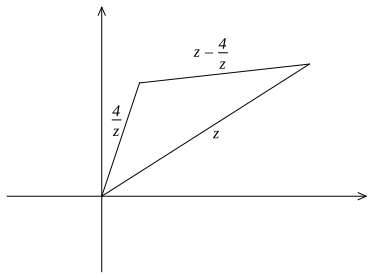
Using the triangle inequality, or otherwise, show that `|z| <= sqrt5+1`.   (3 marks)

--- 8 WORK AREA LINES (style=lined) ---
Show Answers Only

`text{Proof (See Worked Solutions)}`

Show Worked Solution


♦♦♦ Mean mark 27%.

`text{Triangle Inequality:}\ \ absx+absy>=abs(x+y)`

`absz` `<=abs(z-z/4)+abs(4/z)`  
`absz` `<=2+4/absz\ \ \ (text{using}\ |z-(4)/(z)|=2)`  
`absz^2` `<=2absz+4`  
`absz^2-2absz-4` `<=0`  
`absz` `<=(2+sqrt(2^2+4xx4))/2\ \ \ (absz>=0)`  
`absz` `<=(2+sqrt20)/2`  
`absz` `<=1+sqrt5\ \ text{… as required}`  

Filed Under: Geometric Representations, Inequalities Tagged With: Band 5, smc-1208-55-Triangle inequality, smc-7428-60-Triangle Inequality

Proof, EXT2 P1 2022 HSC 12a

For real numbers  `a,b >= 0`  prove that  `(a+b)/(2) >= sqrt(ab)`.  (2 marks)

--- 4 WORK AREA LINES (style=lined) ---

Show Answers Only

`text{Proof (See Worked Solutions)}`

Show Worked Solution

`text{S}text{ince}\ \ (sqrta-sqrtb)^2>=0:`

`a-2sqrt(ab)+b` `>=0`  
`a+b` `>=2sqrt(ab)`  
`:.(a+b)/2` `>=sqrt(ab)\ \ text{… as required}`  

Mean mark 93%.

Filed Under: Inequalities, Proof and Inequalities Tagged With: Band 2, smc-1208-20-Proofs using \(\ \large (a \pm b)^2 \gt 0\), smc-7423-20-Proofs using \(\ \large (a \pm b)^2 \gt 0\)

Vectors, EXT2 V1 2021 HSC 16a

  1. The point  `P(x, y, z)`  lies on the sphere of radius 1 centred at the origin `O`.
  2. Using the position vector of `P, overset->{OP} = x underset~i + y underset~j + z underset~k` , and the triangle inequality, or otherwise, show that `| x | + | y | + |z | ≥ 1`.  (2 marks)

    --- 4 WORK AREA LINES (style=lined) ---

  3. Given the vectors  `underset~a = ((a_1),(a_2),(a_3))`  and  `underset~b = ((b_1),(b_2),(b_3))` , show that 
  4.    `|a_1 b_1 + a_2 b_2 + a_3 b_3 | ≤ sqrt{a_1^2 + a_2^2 + a_3^2 }\ sqrt{b_1^2 + b_2^2 + b_3^2}`.  (3 marks)

    --- 5 WORK AREA LINES (style=lined) ---

  5. As in part (i), the point  `P (x, y, z)`  lies on the sphere of radius 1 centred at the origin `O`.
  6. Using part (ii), or otherwise, show that  `| x | + | y | + | z | ≤ sqrt3`.  (2 marks)

    --- 3 WORK AREA LINES (style=lined) ---

Show Answers Only
  1. `text{See Worked Solution}`
  2. `text{See Worked Solution}`
  3. `text{See Worked Solution}`
Show Worked Solution
i.      `text{Triangle inequality:} \ |x| + |y| ≥ |x + y|`
♦ Mean mark (i) 50%.
`|x| + |y| + |z|` ` = |x_underset~i| + |y_underset~j| + |z_underset~k|`
  `≥ |x_underset~i + y_underset~j| + |z_underset~k|`
  `≥ |x_underset~i + y_underset~j + z_underset~k|`
  `≥ 1\ \ (|overset->{OP}| = | x_underset~i + y_underset~j + z_underset~k | = 1)`


ii.   `text{Using the dot product:}`

♦ Mean mark (ii) 42%.

`underset~a * underset~b = a_1 b_1 + a_2 b_2 + a_3 b_3`

`underset~a * underset~b = |underset~a| |underset~b| cos theta`


`a_1 b_1 + a_2 b_2 + a_3 b_3` `= sqrt{a_1^2 + a_2^2 + a_3^2} * sqrt{b_1^2 + b_2^2 + b_3^2} * cos theta`
`|a_1 b_1 + a_2 b_2 + a_3 b_3|` `= sqrt{a_1^2 + a_2^2 + a_3^2} * sqrt{b_1^2 + b_2^2 + b_3^2} * |cos theta|`


`text{S} text{ince} \ -1 ≤ cos theta ≤ 1 \ => \ |cos theta| ≤ 1`

`:. \ | a_1 b_1 + a_2 b_2 + a_3 b_3 | ≤ sqrt{a_1^2 + a_2^3 + a_3^2} * sqrt{b_1^2 + b_2^2 + b_3^2}`


iii.  `text{Using part (ii) with vectors:}`

♦♦♦ Mean mark (iii) 14%.

`underset~a = ((1),(1),(1)) \ , \ underset~b = (( | x| ),( |y| ),( |z| ))`

`|\ |x| + |y| + |z|\ |` `≤ sqrt{1^2 + 1^2 + 1^2} * sqrt{ x^2 + y^2 + z^2}`
`|x| + |y| + |z|` `≤ sqrt3`

Filed Under: Inequalities, Proof and Inequalities, Vectors and Geometry, Vectors and Geometry Tagged With: Band 5, Band 6, smc-1208-55-Triangle inequality, smc-1210-50-Circle/Sphere, smc-7423-55-Triangle Inequality, smc-7426-50-Circle/Sphere

Proof, EXT2 P1 2021 HSC 15a

For all non-negative real numbers `x` and `y, \ sqrt(xy) <= (x + y)/2`.  (Do NOT prove this.)

  1. Using this fact, show that for all non-negative real numbers `a`, `b` and `c`,
  2.     `sqrt(abc) <= (a^2 + b^2 + 2c)/4`.   (2 marks)

    --- 6 WORK AREA LINES (style=lined) ---

  3. Using part (i), or otherwise, show that for all non-negative real numbers `a`, `b` and `c`,  
  4.     `sqrt(abc) <= (a^2 + b^2 + c^2 + a + b + c)/6`.   (2 marks)

    --- 8 WORK AREA LINES (style=lined) ---

Show Answers Only

i.    `text(See Worked Solution)`

ii.   `text(See Worked Solution)`

Show Worked Solution

i.   `text(Show)\ \ sqrt(abc) <= (a^2 + b^2 + 2c)/4`

♦ Mean mark (i) 50%.

`sqrt(abc) = sqrt((ab)c) <= (ab + c)/2\ …\ (1)`
 

`text(Let)\ \ x = a^2\ \ text(and)\ \ y = b^2:`

`sqrt(xy) = sqrt(a^2b^2) ` `<= (a^2 + b^2)/2`
`ab` `<= (a^2 + b^2)/2\ …\ (2)`

 
`text{Substitute (2) into (1):}`

`sqrt(abc) <= ((a^2 + b^2)/2 + c)/2`

`sqrt(abc) <= (a^2 + b^2 + 2c)/4`


ii.   `text(Show)\ sqrt(abc) <= (a^2 + b^2 + c^2 + a + b + c)/6`

♦♦♦ Mean mark part (ii) 26%.

`text{Similarly (to part a):}`

`text(If)\ \ x = b^2\ \ text(and)\ \ y = c^2`

  `sqrt(abc) <= (b^2 + c^2 + 2a)/4`

`text(If)\ \ x = c^2\ \ text(and)\ \ y = a^2`

  `sqrt(abc) <= (c^2 + a^2 + 2b)/4`

`:.3sqrt(abc)` `<= (a^2 + b^2 + 2c + b^2 + c^2 + 2a + c^2 + a^2 + 2b)/4`
`3sqrt(abc)` `<= (2(a^2 + b^2 + c^2 + a + b + c))/4`
`sqrt(abc)` `<= (a^2 + b^2 + c^2 + a + b + c)/6`

Filed Under: Inequalities, Proof and Inequalities Tagged With: Band 5, Band 6, smc-1208-30-Proof using given equation, smc-1208-60-Other Proofs, smc-7423-30-Proof using given equation

Proof, EXT2 P1 2021 HSC 5 MC

Which of the following statements is FALSE?
  1. `∀ a, b ∈ RR,`                                             `a < b \ => \ a^3 < b^3`
  2. `∀ a, b ∈ RR,`                                             `a < b \ => e^{-a} > e^{-b}`
  3. `∀ a, b ∈ (0, + ∞),`                               `a < b \ => \ text{ln} \ a < text{ln} \ b`
  4. `∀ a, b ∈ RR, text{with} \ a,b ≠ 0,`                    `a < b \ => \ 1/a > 1/b`
Show Answers Only

`D`

Show Worked Solution

`text{By contradiction:}`

♦ Mean mark 50%.

`text{Consider} \ D`

`text{Let} \ \ a = -1 \ \ text{and} \ \ b = 1,`

`a < b \ -> \ -1 < 1 \ \ text{(TRUE)}`

`1/a > 1/b \ -> \ -1 > 1 \ \ text{(FALSE)}`
 

`=>\ D \ text{is false}`

Filed Under: Contradiction, Contrapositive and Other Proofs, Converse, Contradiction and Contrapositive Proof, Inequalities, Language and Illustrations of Proofs, Proof and Inequalities Tagged With: Band 5, smc-1207-10-Contradiction, smc-1208-10-Proofs given \(\ \large a \gt b\), smc-5116-10-Contradiction, smc-7421-10-Language of Proof, smc-7422-10-Language of proof, smc-7422-20-Contradiction, smc-7423-10-Proofs given \(\ \large a \gt b\)

Proof, EXT2 P1 2020 HSC 13c

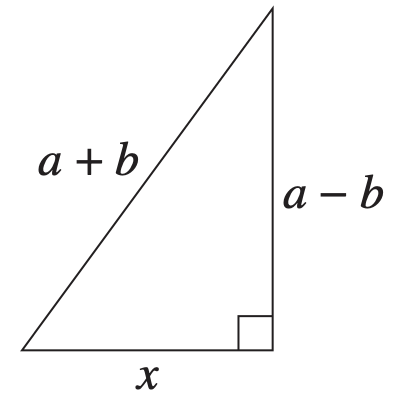
  1. By considering the right-angled triangle below, or otherwise, prove that
     
         `frac{a + b}{2} ≥ sqrt(ab)`, where  `a > b ≥ 0`.  (2 marks)


    --- 5 WORK AREA LINES (style=lined) ---

  2. Prove that  `p^2 + 4q^2 ≥ 4 pq`.  (1 marks)

    --- 4 WORK AREA LINES (style=lined) ---

Show Answers Only
  1. `text{See Worked Solutions}`
  2. `text{See Worked Solutions}`
Show Worked Solution

i.   `text{Strategy 1}`

`text{Using Pythagoras:}`

`x` `= sqrt{(a + b)^2-(a-b)^2}`
  `= sqrt(4ab)`
  `= 2 sqrt(ab)`

  
`a + b \ text{is a hypotenuse}`

`a + b` `≥ x`
`a + b` `≥ 2sqrt(ab)`
`frac{a + b}{2}` `≥ sqrt(ab)`


`text{Strategy 2}`

`(sqrta-sqrtb)^2` `≥ 0`
`a-2 sqrt(a) sqrt(b) + b` `≥ 0`
`a + b` `≥ 2 sqrt(ab)`
`frac{a + b}{2}` `≥ sqrt(ab)`


ii.    `text{Let} \ \ a = p  ,  b = 2 q`

`text(Using part i:)`

`frac{p + 2q}{2}` `≥ sqrt(2 pq)`
`p + 2q` `≥ 2 sqrt(2 pq)`
`p^2 + 4pq + 4 q^2` `≥ 8 pq`
`p^2 + 4 q^2` `≥ 4 pq`

Filed Under: Inequalities, Proof and Inequalities Tagged With: Band 3, smc-1208-20-Proofs using \(\ \large (a \pm b)^2 \gt 0\), smc-7423-20-Proofs using \(\ \large (a \pm b)^2 \gt 0\)

Proof, EXT2 P1 EQ-Bank 29

If  `x,  y,  z  ∈ R`  and  `x  ≠ y ≠ z`, then   

  1. Prove  `x^2 + y^2 + z^2 > yz + zx + xy`   (2 marks)

    --- 5 WORK AREA LINES (style=lined) ---

  2. If  `x + y + z = 1`, show  `yz+zx+xy<1/3`   (2 marks)

    --- 6 WORK AREA LINES (style=lined) ---

Show Answers Only

a.    `text{Proof (See Worked Solutions)}`

b.    `text{Proof (See Worked Solutions)}`

Show Worked Solution

a.    `x^2 + y^2 + z^2-yz-zx-xy > 0`

`text(Multiply) × 2`

`2x^2 + 2y^2 + 2z^2-2yz-2zx-2xy > 0`

`(x^2-2xy + y^2) + (y^2-2yz + z^2) + (z^2 -2xz + x^2) > 0`

`(x-y)^2 + (y-z)^2 + (z-x)^2 > 0`

`text(Square of any rational number) > 0`

`:.\ text(Statement is true.)`


b.     `(x + y + z)^2` `= x^2 + xy + xz + yx + y^2 + yz + zx + zy + z^2`
  `1` `= x^2 + y^2 + z^2 + 2xy + 2yz + 2xz`

 
`text{Consider statement in part (a):}`

`x^2 + y^2 + z^2-yz-zx-xy > 0`

`=> (x + y + z)^2-(x^2 + y^2 + z^2-yz-zx-xy)<1`

`3xy + 3yz + 3zx` `< 1`
`:. \ yz + zx + xy` `< (1)/(3)`

Filed Under: Inequalities, Proof and Inequalities Tagged With: Band 4, Band 5, smc-1208-20-Proofs using \(\ \large (a \pm b)^2 \gt 0\), smc-1208-30-Proof using given equation, smc-7423-20-Proofs using \(\ \large (a \pm b)^2 \gt 0\), smc-7423-30-Proof using given equation

Proof, EXT2 P1 2018 HSC 15c

Let `n` be a positive integer and let `x` be a positive real number.

  1.  Show that  `x^n-1-n(x-1) = (x-1)(1 + x + x^2 + … + x^(n-1)-n)`.   (1 mark)

    --- 3 WORK AREA LINES (style=lined) ---

  2.  Hence, show that  `x^n >= 1 + n(x-1)`.   (2 marks)

    --- 6 WORK AREA LINES (style=lined) ---

  3.  Deduce that for positive real numbers `a` and `b`,
  4.       `a^nb^(1-n)>=na + (1-n)b`   (2 marks)

    --- 6 WORK AREA LINES (style=lined) ---

Show Answers Only

i.    `text(See Worked Solutions)`

ii.   `text(See Worked Solutions)`

iii.  `text(See Worked Solutions)`

Show Worked Solution
i.    `text(RHS)` `= (x-1)underbrace{(1 + x + x^2 + … + x^(n-1)-n)}_{text(GP where)\ \ a = 1,\ r = x}`
    `= (x-1) ((1(x^n-1))/(x-1)-n)`
    `= x^n-1-n(x-1)`
    `=\ text(LHS)`


ii.   `text(Let)\ P(x) = (x-1)(1 + x + x^2 + … + x^(n-1)-n)`

♦♦♦ Mean mark (ii) 11%.

`text(If)\ \ x = 1, P(x) = 0`
 

`text(If)\ \ 0 < x < 1, \ (x-1) < 0, \ (1 + x + x^2 + … + x^(n-1)-n) < 0`

`=> P(x) > 0`
 

`text(If)\ \ x > 1, \ (x-1) > 0, \ (1 + x + … + x^(n-1)-n) > 0`

`=> P(x) > 0`
 

`x^n-1-n(x-1) >= 0`

`:. x^n >= 1 + n(x-1)`


iii.   `x^n >= 1 + n(x-1)\ \ text(for)\ \ x ∈ R^+`

♦♦ Mean mark (iii) 23%.

`text(S)text(ince)\ a,b ∈ R^+`

`(a/b)^n` `>= 1 + n(a/b-1)`
`(a^n)/(b^n) xx b` `>= b + na-nb,\ \ \ \ (b > 0)`
`a^n b^(1-n)` `>= na + (1-n)b`

Filed Under: Inequalities, Inequalities EXT2, Proof and Inequalities Tagged With: Band 4, Band 5, Band 6, smc-1208-80-Geometric Series, smc-7423-50-Arithmetic/Geometric Mean

Proof, EXT2 P1 2018 HSC 9 MC

It is given that `a`, `b` are real and `p`, `q` are purely imaginary.

Which pair of inequalities must always be true?

  1. `a^2p^2 + b^2q^2 <= 2abpq,qquada^2b^2 + p^2q^2 <= 2abpq`
  2. `a^2p^2 + b^2q^2 <= 2abpq,qquada^2b^2 + p^2q^2 >= 2abpq`
  3. `a^2p^2 + b^2q^2 >= 2abpq,qquada^2b^2 + p^2q^2 <= 2abpq`
  4. `a^2p^2 + b^2q^2 >= 2abpq,qquada^2b^2 + p^2q^2 >= 2abpq`
Show Answers Only

`B`

Show Worked Solution

`a, b ->\ text(real)qquad\ p, q ->\ text(purely imaginary)`

`=> ab, pq, (ab-pq)\ text(are real)`

`=> ap, bq, (ap-bq)\ text(are purely imaginary.)`
 

`(ab-pq)^2` `>= 0`
`a^2b^2 + p^2q^2` `>= 2abpq\ \ (text(Eliminate A and C))`


`(ap-bq)^2` `<= 0`
`a^2p^2 + b^2q^2` `<= 2abpq`

 
`=>B`

Filed Under: Inequalities, Inequalities EXT2, Proof and Inequalities Tagged With: Band 4, smc-1048-30-Other, smc-1208-20-Proofs using \(\ \large (a \pm b)^2 \gt 0\), smc-7423-20-Proofs using \(\ \large (a \pm b)^2 \gt 0\)

Proof, EXT2 P1 2017 HSC 10 MC

Suppose  `f(x)`  is a differentiable function such that

`(f(a) + f(b))/2 >= f((a + b)/2)`, for all `a` and `b`.

Which statement is always true?

  1. `int_0^1 f(x)\ dx >= (f(0) + f(1))/2`
  2. `int_0^1 f(x)\ dx <= (f(0) + f(1))/2`
  3. `f^{′}(1/2) >= 0`
  4. `f^{′}(1/2) <= 0`
Show Answers Only

`B`

Show Worked Solution

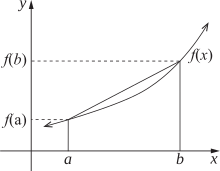
`text(Representing the equation graphically)`

♦ Mean mark 41%.

`text{(one of many possibilities)}`


`f(x)\ text(is an increasing function between)`

`a\ text(and)\ b\ text(such that:)`

`(f(a) + f(b))/2 >= f((a + b)/2)`
 

`text(If)\ \ a = 0\ text(and)\ \ b = 1,`

`int_0^1 f(x)\ dx` `<=\ text(Area of trapezium)`
  `<= 1/2(1) (f(0) + f(1))`
  `<= (f(0) + f(1))/2`

`=> B`

Filed Under: Harder Integration Examples, Inequalities, Inequalities EXT2, Proof and Inequalities Tagged With: Band 5, smc-1208-50-Arithmetic/Geometric Mean, smc-7423-50-Arithmetic/Geometric Mean

Proof, EXT2 P1 2017 HSC 13a

Show that  `(r + s)/2 >= sqrt (rs)`  for  `r >= 0`  and  `s >= 0`.  (1 mark)

Show Answers Only

`text(Proof)\ \ text{(See Worked Solutions)}`

Show Worked Solution
`(sqrt r – sqrt s)^2` `>= 0`
`r – 2 sqrt r sqrt s + s` `>= 0`
`r + s` `>= 2 sqrt r sqrt s`
`(r + s)/2` `>= sqrt (rs)`

Filed Under: Inequalities, Inequalities EXT2, Proof and Inequalities Tagged With: Band 3, smc-1208-20-Proofs using \(\ \large (a \pm b)^2 \gt 0\), smc-7423-20-Proofs using \(\ \large (a \pm b)^2 \gt 0\)

Proof, EXT2 P1 2016 HSC 14c

Show that  `x sqrt x + 1 >= x + sqrt x,`  for  `x >= 0.`  (3 marks)

--- 8 WORK AREA LINES (style=lined) ---

Show Answers Only

`text(See Worked Solutions)`

Show Worked Solution

`text(Show)\ \ xsqrtx + 1 >= x + sqrtx,quadtext(for)\ x >= 0`

♦ Mean mark 39%.
`(text(LHS))^2` `= x^3 + 2xsqrtx + 1`
  `= 2xsqrtx + (x + 1)(x^2 – x + 1)`


`(x – 1)^2` `>= 0`
`x^2 – 2x + 1` `>= 0`
`:. x^2 + 1` `>= 2x`


`:.\ (text(LHS))^2` `>= 2xsqrtx + (x + 1)(2x – x)`
  `>= 2xsqrtx + x(x + 1)`
  `>= x^2 +2xsqrtx+x`
  `>= (x + sqrtx)^2`
  `>= (text(RHS))^2`


`:.\ text(LHS ≥ RHS for)\ \ x >= 0`

Filed Under: Inequalities, Inequalities EXT2, Proof and Inequalities Tagged With: Band 5, smc-1208-20-Proofs using \(\ \large (a \pm b)^2 \gt 0\), smc-7423-20-Proofs using \(\ \large (a \pm b)^2 \gt 0\)

Proof, EXT2 P1 2015 HSC 15c

For positive real numbers `x` and `y`, `sqrt (xy) <= (x + y)/2`.     (Do NOT prove this.)

  1. Prove  `sqrt (xy) <= sqrt ((x^2 + y^2)/2)`,  for positive real numbers  `x`  and  `y.`   (1 mark)

    --- 4 WORK AREA LINES (style=lined) ---

  2. Prove  `root4(abcd) <= sqrt ((a^2 + b^2 + c^2 + d^2)/4)`,  for positive real numbers  `a, b, c`  and  `d.`   (2 marks)

    --- 6 WORK AREA LINES (style=lined) ---

Show Answers Only

a.    `text(Proof)\ \ text{(See Worked Solutions)}`

b.    `text(Proof)\ \ text{(See Worked Solutions)}`

Show Worked Solution

a.    `text(S)text(ince)\ \ (x – y)^2 = x^2 + y^2 – 2xy`

`and \ (x – y)^2 >= 0`

`0` `≤x^2 + y^2 – 2xy`
`2xy` `≤x^2 + y^2`
`:.sqrt (xy)` `≤sqrt ((x^2 + y^2)/2)`


b.    `sqrt(ab) <= sqrt((a^2 + b^2)/2),\ \ \ \ text{(part (i))}`

♦♦ Mean mark 29%. 

`sqrt(cd) <= sqrt((c^2 + d^2)/2),\ \ \ \ text{(part (i))}`

`sqrt(ab) sqrt(cd)` `<=sqrt((a^2 + b^2)/2)*sqrt((c^2 + d^2)/2)`
  `<=sqrt(((a^2 + b^2)/2) * ((c^2 + d^2)/2))`
 
`sqrt (xy) <= (x + y)/2\ \ \ \ text{(given):}`
 `sqrt(ab) sqrt(cd)`  `<=1/2((a^2 + b^2+c^2+d^2)/2)`
`sqrt(abcd)` `<=(a^2 + b^2+c^2+d^2)/4`
`:.root4(abcd)`  `<=sqrt((a^2 + b^2+c^2+d^2)/4)`

Filed Under: Inequalities, Inequalities EXT2, Proof and Inequalities Tagged With: Band 4, Band 5, smc-1208-20-Proofs using \(\ \large (a \pm b)^2 \gt 0\), smc-7423-20-Proofs using \(\ \large (a \pm b)^2 \gt 0\)

Proof, EXT2 P1 2015 HSC 15b

Suppose that  `x >= 0`  and `n` is a positive integer.

  1. Show that  `1-x <= 1/(1 + x) <= 1.`   (2 marks) 

    --- 5 WORK AREA LINES (style=lined) ---

  2. Hence, or otherwise, show that  `1-1/(2n) <= n ln (1 + 1/n) <= 1.`   (2 marks)

    --- 7 WORK AREA LINES (style=lined) ---

  3. Hence, explain why  `lim_(n -> oo) (1 + 1/n)^n = e.`   (1 mark)

    --- 5 WORK AREA LINES (style=lined) ---

Show Answers Only

a.    `text(Proof)\ \ text{(See Worked Solutions)}`

b.    `text(Proof)\ \ text{(See Worked Solutions)}`

c.    `text(Proof)\ \ text{(See Worked Solutions)}`

Show Worked Solution
a.     `1-x^2` `<=1\ \ \ text(for)\ x>=0`
  `(1-x)(1+x)` `<=1`
  `(1-x)` `<=1/(1+x)`


`text(S)text(ince)\ \ 1 + x >= 1\ \ text(when)\ \ x >= 0`

`=>1/(1 + x) <= 1`

`:. 1-x <= 1/(1 + x) <= 1.`
 

♦♦ Mean mark (b) 21%.
STRATEGY: The conversion of the middle term from a fraction into a logarithm should flag the need for integration of each term.
b.     `int_0^(1/n) (1-x)\ dx` `<= int_0^(1/n) (dx)/(1 + x) <= int_0^(1/n) 1\ dx`
  `[x-x^2/2]_0^(1/n)` `<= [ln (1 + x)]_0^(1/n) <= [x]_0^(1/n)`
  `1/n-1/(2n^2)` `<= ln (1 + 1/n) <= 1/n`
  `1-1/(2n) ` `<= n ln (1 + 1/n) <= 1,\ \ \ \ \ (n>=1)`


c.     `lim_(n -> oo) (1-1/(2n))` `<= lim_(n -> oo){n ln (1 + 1/n)} <= lim_(n -> oo) (1)`
  `1` `<= lim_(n -> oo) {l ln (1 + 1/n)} <= 1`
♦♦ Mean mark (c) 29%.
`:. lim_(n -> oo) (n ln (1 + 1/n))`  `=1`
`lim_(n -> oo) ln (1 + 1/n)^n` `=1`
`:.lim_(n -> oo) (1 + 1/n)^n` `=e`

Filed Under: Inequalities, Inequalities EXT2, Proof and Inequalities Tagged With: Band 4, Band 5, Band 6, smc-1208-60-Other Proofs, smc-1208-70-Calculus, smc-7423-70-Calculus, smc-7423-80-Other Proofs

Proof, EXT2 P1 2006 HSC 8a

Suppose  `0 <= t <= 1/sqrt 2.`

  1. Show that  `0 <= (2t^2)/(1 - t^2) <= 4t^2.`   (2 marks)

    --- 4 WORK AREA LINES (style=lined) ---

  2. Hence show that  `0 <= 1/(1 + t) + 1/(1 - t) - 2 <= 4t^2.`   (1 mark)

    --- 3 WORK AREA LINES (style=lined) ---

  3. By integrating the expressions in the inequality in part (ii) with respect to  `t`  from  `t = 0`  to  `t = x\ \  text{(where}\ \ 0 <= x <= 1/sqrt2\ \ text{)}`, show that
     
        `0 <= log_e ((1 + x)/(1 - x)) - 2x <= (4x^3)/3.`   (2 marks)

    --- 4 WORK AREA LINES (style=lined) ---

  4. Hence show that for  `0 <= x <= 1/sqrt 2`
     
        `1 <= ((1 + x)/(1 - x)) e^(-2x) <= e^((4x^3)/3).`   (1 mark)

    --- 3 WORK AREA LINES (style=lined) ---

Show Answers Only

a.    `text(Proof)\ \ text{(See Worked Solutions)}`

b.    `text(Proof)\ \ text{(See Worked Solutions)}`

c.    `text(Proof)\ \ text{(See Worked Solutions)}`

d.    `text(Proof)\ \ text{(See Worked Solutions)}`

Show Worked Solution
a.     `0` `<= t <= 1/sqrt 2`
  `0` `<= t^2 <= 1/2`
  `0` `>= -t^2 >= -1/2`
  `1` `>= 1 – t^2 >= 1/2`
  `1` `<= 1/(1 – t^2) <= 2`
  `2t^2` `<= (2t^2)/(1 – t^2) <= 4t^2,\ \ \ \ (2t^2>0)`
  `:. 0` `<= (2t^2)/(1 – t^2) <= 4t^2`


b.    `1/(1 + t) + 1/(1 – t) – 2`

`=((1-t)+(1+t)-2(1-t^2))/(1-t^2)`

`=(2t^2)/(1-t^2)`


`text{Substituting into part (i)}`

`:. 0 <= 1/(1 + t) + 1/(1 – t) – 2 <= 4t^2`


c.     `int_0^x 0\ dt` `<= int_0^x (1/(1 + t) + 1/(1 – t) – 2)\ dt <= int_0^x 4t^2\ dt`
  `0` `<= [log_e (1 + t) – log_e (1 – t) – 2t]_0^x <= [(4t^3)/3]_0^x`
  `0` `<= [log_e (1 + x) – log_e (1 – x) – 2x]<= [(4x^3)/3]`
  `0` `<= log_e ((1 + x)/(1 – x)) – 2x <= (4x^3)/3`


d.    `text(S)text(ince)\ \ e^a>e^b\ \ text(when)\ \ a>b` 

`e^0` `<= e^([ln ((1 + x)/(1 – x)) – 2x]) <= e^((4x^3)/3)`
`1` `<= e^(ln ((1 + x)/(1 – x))) xx e^(-2x) <= e^((4x^3)/3)`
`1` `<= ((1 + x)/(1 – x)) e^(-2x) <= e^((4x^3)/3)`


Filed Under: Inequalities, Inequalities EXT2, Proof and Inequalities Tagged With: Band 4, Band 5, smc-1208-30-Proof using given equation, smc-1208-70-Calculus, smc-7423-30-Proof using given equation, smc-7423-70-Calculus

Proof, EXT2 P1 2007 HSC 7a

  1. Show that  `sin x < x`  for  `x > 0.`   (2 marks)

    --- 5 WORK AREA LINES (style=lined) ---

  2. Let  `f(x) = sin x - x + x^3/6`.


    Show that the graph of  `y = f(x)`  is concave up for  `x > 0.`   (2 marks)

    --- 4 WORK AREA LINES (style=lined) ---

  3. By considering the first two derivatives of  `f(x)`,show that  `sin x > x - x^3/6`  for  `x > 0.`   (2 marks)

    --- 6 WORK AREA LINES (style=lined) ---

Show Answers Only
  1. `text(Proof)\ \ text{(See Worked Solutions)}`
  2. `text(Proof)\ \ text{(See Worked Solutions)}`
  3. `text(Proof)\ \ text{(See Worked Solutions)}`
Show Worked Solution
i.    `text(Let)\ \ g(x)` `=sin x-x`
  `g′(x)` `=cosx-1<=1\ \ \ text(for all)\ x>0`
MARKER’S COMMENT: A geometric proof using arc length and a right angled triangle caused problems as few students could deal with the case  `x>pi`.


`=>g(x)\ \ text(is a decreasing function)`

`text(When)\ \ x=0,\ \ g(0)=0`


`text(Considering)\ \ g(x)\ \ text(when)\ \ x>0,`

`g(x)` `<0`
`sinx -x` `<0`
`sin x` `<x\ \ \ text(for all)\ x>0`


ii. `f(x)` `=sin x – x + x^3/6`
  `f prime (x)` `=cos x – 1 + x^2/2`
  `f ″ (x)` `=x – sin x`
  `:.\ f″ (x)` `> 0\ \ \ \ text{(using part (i))}`


`:. f(x)\ \ text(is concave up for)\ \ x > 0.`


iii.  `f″(x)>0\ \ \ \ text{(part (ii))}`

`=>f′(x)\ \ text(is an increasing function)`

`text(When)\ \ x=0,\ \ f′(0)=0`

`=>f′(x)>0\ \ \ text(for)\ \ x>0`


`:. f(x)\ \ text(has a positive gradient that steepens)`

`text(for)\ \ x>0, and f(0)=0`
 

`f(x)` `>0`
`sin x – x + x^3/6` `>0`

 
`:.sin x > x – x^3/6\ \ \ text(for)\ \ x>0`

Filed Under: Inequalities, Inequalities EXT2, Proof and Inequalities Tagged With: Band 4, Band 5, Band 6, smc-1208-70-Calculus, smc-7423-70-Calculus

Proof, EXT2 P1 2011 HSC 5b

If  `p, q`  and  `r`  are positive real numbers and  `p + q >= r`, prove that

`p/(1 + p) + q/(1 + q) - r/(1 + r) >= 0.`  (3 marks)

--- 8 WORK AREA LINES (style=lined) ---

Show Answers Only

`text(Proof)\ \ text{(See Worked Solutions)}`

Show Worked Solution

`text(If)\ \ p + q >= r,\ \ text(then)\ \ p + q – r >= 0`

♦ Mean mark 41%.
`text(LHS)` `= p/(1 + p) + q/(1 + q) – r/(1 + r)`
  `= (p(1 + q)(1 + r) + q(1 + p)(1 + r) – r(1 + p)(1 + q))/((1 + p)(1 + q)(1 + r))`
  `= (p(1 + q + r + qr) + q(1 + p + r + pr) – r(1 + p + q + pq))/((1 + p)(1 + q)(1 + r))`
  `= (p + pq + pr + pqr + q + pq + qr + pqr – r – pr – qr – pqr)/((1 + p)(1 + q)(1 + r))`
  `= ((p + q – r) + pq(2 + r))/((1 + p)(1 + q)(1 + r))`
  `>=(pq(2 + r))/((1 + p)(1 + q)(1 + r))\ \ \ \ text{(S}text{ince}\ \ p + q – r >= 0 text{)}`
  `>= 0\ \ \ \ \ \ \ text{(S}text{ince}\ \ p > 0,\ q > 0,\ r > 0text{)}`

Filed Under: Inequalities, Inequalities EXT2, Proof and Inequalities Tagged With: Band 5, smc-1208-30-Proof using given equation, smc-7423-30-Proof using given equation

Proof, EXT2 P1 2012 HSC 16c

Let  `n`  be an integer where  `n > 1`. Integers from  `1`  to  `n`  inclusive are selected randomly one by one with repetition being possible. Let  `P(k)`  be the probability that exactly  `k`  different integers are selected before one of them is selected for the second time, where  `1 ≤ k ≤ n`.

  1. Explain why  `P(k) = ((n − 1)!k)/(n^k(n − k)!)`.   (2 marks)

    --- 6 WORK AREA LINES (style=lined) ---

  2. Suppose  `P(k) ≥ P(k − 1)`. Show that  `k^2- k- n ≤ 0`.   (2 marks)

    --- 5 WORK AREA LINES (style=lined) ---

  3. Show that if  `sqrt(n + 1/4) > k − 1/2`  then the integers  `n`  and  `k`  satisfy  `sqrtn > k − 1/2`.   (2 marks)

    --- 6 WORK AREA LINES (style=lined) ---

  4. Hence show that if  `4n + 1`  is not a perfect square, then  `P(k)`  is greatest when  `k`  is the closest integer to  `sqrtn`. 


    You may use part (iii) and also that  `k^2 − k − n >0`  if  `P(k)< P(k − 1)`.   (2 marks)

    --- 6 WORK AREA LINES (style=lined) ---

Show Answers Only

a.    `text{Proof (See Worked Solutions.)}`

b.    `text{Proof (See Worked Solutions.)}`

c.    `text{Proof (See Worked Solutions.)}`

d.    `text{Proof (See Worked Solutions.)}`

Show Worked Solution

a.    `text(Let)\ P(1)=text{(After 1st number chosen, the second draw matches)}`

`P(1) =n/n xx 1/n=1/n`

`text(Let)\ P(2)=text{(After 1st two numbers chosen, the third draw matches)}`

`P(2) = n/n xx (n − 1)/n xx 2/n`

♦♦♦ Mean mark part (i) 7%.

`P(3)=n/n xx (n-1)/n xx (n-2)/n xx 3/n`

`vdots`

 
`=>text{On the}\ (k+1)text(th draw)`

`P(k)` `= n/n xx (n − 1)/n xx (n − 2)/n xx …\ xx (n − k+1)/n xx k/n`
  `=((n-1)!)/n^k xx k/(1 xx 2 xx … xx (n-k))`
  `=((n-1)!\ k)/(n^k (n-k)!)`

♦ Mean mark part (ii) 38%.


b.     `P(k)` `≥ P(k − 1)`
  `((n − 1)!\ k)/(n^k(n − k)!)` `≥ ((n − 1)!  (k − 1))/(n^(k − 1)(n − k + 1)!)`
  `k(n − k + 1)` `≥ n(k − 1)`
  `kn − k^2 + k` `≥ nk − n`
  `:.k^2 − k − n` `≤ 0`


♦♦♦ Mean mark part (iii) 10%.
c.     `sqrt(n + 1/4)` `> k − 1/2`
  `n + 1/4` `> (k − 1/2)^2`
  `n + 1/4` `> k^2 − k + 1/4`
  `n` `>k^2 − k`
  `n` `> k(k − 1)`


`text(S)text(ince)\ n\ text(and)\ k\ text(are integers such that)\ 1 ≤ k ≤ n.`

`=>n\ text(is at least the next integer after)\ k.`

`=>(k −1)\ text(is the integer before)\ k.`

`:.n` `>k^2 − k +1/4`
`n`  `>(k-1/2)^2`
`:.sqrt n` `>k-1/2`


d.  `text(Find the largest integer)\ \ k\ \ text(for which)\ \ P(k) ≥ P(k − 1)`

`P(k) ≥ P(k − 1)\ \ text(when)\ \ k^2 − k − n ≤ 0\ \ \ text{(part (b))}`


`text(Solving)\ \ k^2 − k − n ≤ 0`

♦♦♦ Mean mark part (iii) 1%.

`(1 – sqrt(4n + 1))/2 ≤ k ≤ (1 + sqrt(4n+1))/2`

`text(Given)\ \ n>0,\ \ (1 – sqrt(4n + 1))/2<0`

`:.1 ≤ k ≤ (1 + sqrt(4n+1))/2`

`text(S)text(ince)\ \ 4n+1\ \ text(is not a perfect square and)\ \ k\ \ text(is an integer)`

`k<` ` (1 + sqrt(1 + 4n))/2`
`k<` ` 1/2 + sqrt(n + 1/4)`
`k-1/2<` `sqrt(n + 1/4)`
`k-1/2<` `sqrt n\ \ \ \ \ text{(from part (iii))}`
`k<` `1/2+sqrt n`


`:. P(k)\ text(is greatest when)\ \ k\ \ text(is the closest integer to)\ n.`

Filed Under: Inequalities, Inequalities EXT2, Proof and Inequalities Tagged With: Band 5, Band 6, smc-1208-10-Proofs given \(\ \large a \gt b\), smc-7423-10-Proofs given \(\ \large a \gt b\)

Proof, EXT2 P1 2012 HSC 15a

  1. Prove that  `sqrt(ab) ≤ (a + b)/2`, where  `a ≥ 0`  and  `b ≥ 0`.   (1 mark)

    --- 3 WORK AREA LINES (style=lined) ---

  2. If  `1 ≤ x ≤ y`,  show that  `x(y − x + 1) ≥ y`.   (2 marks)

    --- 5 WORK AREA LINES (style=lined) ---

  3. Let  `n`  and  `j`  be positive integers with  `1 ≤ j ≤ n`.
     
    Prove that  `sqrtn ≤ sqrt(j(n − j + 1)) ≤ (n + 1)/2.`   (2 marks)

    --- 4 WORK AREA LINES (style=lined) ---

  4. For integers  `n ≥ 1`, prove that
     
        `(sqrtn)^n ≤ n! ≤ ((n + 1)/2)^n`.   (1 mark)

    --- 3 WORK AREA LINES (style=lined) ---

Show Answers Only

a.    `text{Proof (See Worked Solutions)}`

b.    `text{Proof (See Worked Solutions)}`

c.    `text{Proof (See Worked Solutions)}`

d.    `text{Proof (See Worked Solutions)}`

Show Worked Solution
a.     `(sqrta − sqrtb)^2` `≥ 0`
  `a − 2sqrt(ab) + b` `≥ 0`
  `a + b` `≥ 2sqrt(ab)`
  `sqrt(ab)` `≤ (a + b)/2`


b.    `text(Solution 1)`

♦♦ Mean mark part (ii) 28%.

`text(S)text(ince)\ \ 1 ≤ x ≤ y`

`y-x` `>=0`
`y(x-1)-x(x-1)` `>=0,\ \ \ \ (x-1>=0)`
`xy-x^2+x-y` `>=0`
`:.xy-x^2+x` `>=y`


`text(Solution 2)`

`x( y − x + 1)` `= xy − x^2 + x`
  `= -y + xy − x^2 + x + y`
  `= y(x − 1) − x(x − 1)+ y`
  `= (x − 1)( y − x) + y`


`text(S)text(ince)\ \ x − 1 ≥ 0\ \ text(and)\ \  y − x ≥ 0`

`=>(x − 1)( y − x) + y` `>=y`
`:.x(y − x + 1)` `>=y`


c.    `text(Let)\ c = n − j + 1, \ c > 0\ text(as)\ n ≥ j.`

♦ Mean mark part (iii) 39%.


`=> sqrt(j(n − j + 1))\ \ text(can be written as)\ \ sqrt(jc).`

`sqrt(jc)` `≤ (j + c)/2\ \ \ \ text{(part (i))}`
`sqrt(j(n − j + 1))` `≤ (j + n-j+1)/2`
`=>sqrt(j(n − j + 1))` `≤ (n+1)/2`
`j(n − j +1)` `≥ n\ \ \ \ text{(part (ii))}`
`=>sqrt(j(n − j + 1))` `≥ sqrt n`


`:.sqrtn ≤ sqrt(j(n − j + 1)) ≤ (n + 1)/2`


d.    `text{From (iii)}\ n ≤ j(n− j +1) ≤ (n + 1)/2`

♦♦♦ Mean mark part (iv) just 2%!

`text(Let)\ j\ text(take on the values from 1 to)\ n.`

`j = 1:` `sqrtn ≤ sqrt(1(n)) ≤ (n + 1)/2`
`j = 2:` `sqrtn ≤ sqrt(2(n−1)) ≤ (n + 1)/2`
  `vdots`
`j = n:` `sqrtn ≤ sqrt(n(1)) ≤ (n + 1)/2`


`text{Multiply the corresponding parts of each line}`

`(sqrtn)^n ≤ sqrt(n! xx n!) ≤ ((n + 1)/2)^n`

`(sqrtn)^n ≤ n! ≤ ((n + 1)/2)^n`

Filed Under: Inequalities, Inequalities EXT2, Proof and Inequalities Tagged With: Band 4, Band 5, Band 6, smc-1208-10-Proofs given \(\ \large a \gt b\), smc-1208-20-Proofs using \(\ \large (a \pm b)^2 \gt 0\), smc-7423-10-Proofs given \(\ \large a \gt b\), smc-7423-20-Proofs using \(\ \large (a \pm b)^2 \gt 0\)

Proof, EXT2 P1 2013 HSC 16a

  1. Find the minimum value of  `P(x) = 2x^3 - 15x^2 + 24x + 16`, for  `x >= 0.`  (2 marks)

    --- 6 WORK AREA LINES (style=lined) ---

  2. Hence, or otherwise, show that for  `x >= 0`,
     
        `(x + 1) (x^2 + (x + 4)^2) >= 25x^2.`  (1 mark)

    --- 5 WORK AREA LINES (style=lined) ---

  3. Hence, or otherwise, show that for  `m >= 0`  and  `n >= 0`,
     
        `(m + n)^2 + (m + n + 4)^2 >= (100mn)/(m + n + 1).`  (2 marks)

    --- 6 WORK AREA LINES (style=lined) ---

Show Answers Only

a.    `0`

b.    `text(Proof)\ \ text{(See Worked Solutions)}`

c.    `ctext(Proof)\ \ text{(See Worked Solutions)}`

Show Worked Solution
♦ Mean mark 43%.

STRATEGY: The best responses carefully considered the domain restrictions, notably `P(0).`
a.     `P(x)` `= 2x^3 – 15x^2 + 24x + 16,\ \ \ x >= 0`
  `P prime(x)` `= 6x^2 – 30x +24`
    `= 6 (x^2 – 5x + 4)`
    `= 6 (x – 1) (x – 4)`
  `P″(x)` ` = 12x – 30`


`text(MAX or MIN when)\ \ P prime (x)=0`

`text(i.e. when)\ \ x=1  or  4`

`P″(1) = -6 < 0\ \ \ \ P″(4) = 18 > 0`

`:.text(Minimum turning point of)\ \ P(x)\ \ text(at)\ \ x = 4,`

`P(4) = 128 – 240 + 96 + 16 = 0`

 
`text(Checking limits:)`

`P(0) = 16`

`text(As)\ \ x->oo,\ \ y->oo`

`:.text(Minimum value of)\ \ P(x)\ \ text(is)\ \ 0\ \ text(when)\ \ x = 4.`


♦ Mean mark 47%.

b.    `text(LHS)` `= (x + 1) (x^2 + (x + 4)^2)`
  `= (x + 1) (2x^2 + 8x + 16)`
  `= 2x^3 + 8x^2 + 16x + 2x^2 + 8x + 16`
  `= 2x^3 + 10x^2 + 24x + 16`
  `= (2x^3 – 15x^2 + 24x + 16) + 25x^2`
  `= P(x) + 25x^2`


`text(The minimum value of)\ \ P(x)\ \ text(for)\ \ x>= 0\ \ text(is)\ \ 0,`

`=>P(x) + 25x^2` `>= 25x^2`
`:.(x + 1) (x^2 + (x + 4)^2)` `>= 25x^2,\ \ \ text(for)\ x >= 0`


♦♦ Mean mark 19%.

STRATEGY: The best responses carefully considered the domain restrictions, notably `P(0).`
c.     `(m + n)^2 + (m + n + 4)^2`
  `= (m + n)^2 + (m + n)^2 + 8(m + n) + 16`
  `= 2 (m + n)^2 + 8 (m + n) + 16`


`text(Let)\ \ x = m + n`

`(m + n)^2 + (m + n + 4)^2 = 2x^2 + 8x + 16`

`text{Using part (ii)}`

`(x + 1) (2x^2 + 8x + 16)` `>= 25x^2`
`2x^2 + 8x + 16` `>= (25x^2)/(x + 1),\ \ \ x >= 0`
`(m + n)^2 + (m + n + 4)^2` `>= (25 (m + n)^2)/(m + n + 1)`


`text(Consider)\ \ (m – n)^2`

`text(S)text(ince)\ \ (m – n)^2` `>= 0`
`m^2 + n^2` `>= 2mn`
`(m+n)^2-2mn` `>= 2mn`
`(m + n)^2` `>= 4mn`
`:.(m + n)^2 + (m + n + 4)^2` `>= (100mn)/(m + n + 1)`

Filed Under: Inequalities, Inequalities EXT2, Proof and Inequalities Tagged With: Band 5, Band 6, smc-1208-10-Proofs given \(\ \large a \gt b\), smc-7423-10-Proofs given \(\ \large a \gt b\)

Proof, EXT2 P1 2014 HSC 16b

Suppose `n` is a positive integer. 

  1. Show that 
     
        `-x^(2n) ≤ 1/(1 + x^2) − (1 − x^2 + x^4 − x^6 + … + (-1)^(n − 1) x^(2n − 2)) ≤ x^(2n)`.  (3 marks)

    --- 6 WORK AREA LINES (style=lined) ---

  2. Use integration to deduce that
     
    `-1/(2n + 1) ≤ pi/4 − (1 − 1/3 + 1/5 − … + (-1)^(n − 1) 1/(2n − 1)) ≤ 1/(2n + 1)`.  (2 marks)

    --- 6 WORK AREA LINES (style=lined) ---

  3. Explain why   `pi/4 = 1 − 1/3 + 1/5 − 1/7 + …`.  (1 mark)

    --- 5 WORK AREA LINES (style=lined) ---

Show Answers Only

a.    `text{Proof (See Worked Solutions)}`

b.    `text{Proof (See Worked Solutions)}`

c.    `text{Proof (See Worked Solutions)}`

Show Worked Solution

a.    `text(Let)\ \ S_n=1 − x^2 + x^4 − x^6 + … + (-1)^(n − 1) x^(2n − 2)`

`=>text(GP where)\ \ a=1, r=-x^2`

♦♦ Mean mark 12%.
STRATEGY: Applying the GP formula and simplifying the middle term is worth 2 full marks in this question.
`:.S_n` `=(1(1-(-x^2)^n))/(1-(-x^2))`
  `= (1 − (-x^2)^n)/(1 + x^2)`


`:.1/(1 + x^2) − (1 − x^2 + x^4 − x^6 + … + (-1)^(n − 1) x^(2n − 2))​`

`=1/(1 + x^2)-(1 − (-x^2)^n)/(1 + x^2)`

`=((-x^2)^n)/(1 + x^2)`

`=((-1)^nx^(2n))/(1 + x^2)`


`text(S)text(ince)\ \ (1 + x^2)>=1,\ \ \ -x^(2n) ≤ ((-1)^nx^(2n))/(1 + x^2) ≤ x^(2n)`

`:.\ text(We can conclude)`

`-x^(2n) ≤ 1/(1 + x^2) − (1 − x^2 + x^4 − x^6 + … + (-1)^(n − 1) x^(2n − 2))\ ≤ x^(2n)` 


b.    `text{Integrating part (i) between 0 and 1}`

♦ Mean mark 43%.
`int_0^1 -x^(2n)\ dx` `=(-1)/(2n + 1)[x^(2n + 1)]_0^1`
  `=(-1)/(2n + 1)`
`int_0^1 1/(1 + x^2)` `=[tan^(-1) x]_0^1`
  `=pi/4`
`int_0^1 (1 − x^2 + x^4 − x^6 + … + (-1)^(n − 1) x^(2n − 2))\ dx` 
`=[x − (x^3)/3 + (x^5)/5 −… + ((-1)^(n − 1)x^(2n − 1))/(2n − 1)]_0^1`
`=1 − 1/3 + 1/5 − … + ((-1)^(n − 1))/(2n − 1)`
`int_0^1 x^(2n)\ dx` `=1/(2n + 1)[x^(2n + 1)]_0^1`
  `=1/(2n + 1)`

 
`:.\ text(We can conclude)`

`(-1)/(2n + 1) ≤ pi/4 − (1 − 1/3 + 1/5 − … + (-1)^(n − 1) 1/(2n − 1)) ≤ 1/(2n + 1)`


c.    `(-1)/(2n + 1) ≤ pi/4 − (1 − 1/3 + 1/5 − … + ((-1)^(n − 1))/(2n − 1)) ≤ 1/(2n + 1)`

`text(As)\ n → ∞,`

`=>(-1)/(2n + 1) → 0^-\ \ text(and)\ \ 1/(2n + 1) → 0^+`

`=> pi/4 − (1 − 1/3 + 1/5 − … + 1/(2n − 1)) → 0`

♦♦ Mean mark 28%.

`:. pi/4 = 1 -1/3 + 1/5 − 1/7 + …`

Filed Under: Inequalities, Inequalities EXT2, Proof and Inequalities Tagged With: Band 5, Band 6, smc-1208-70-Calculus, smc-1208-80-Geometric Series, smc-7423-70-Calculus

Proof, EXT2 P1 2014 HSC 15a

Three positive real numbers `a`, `b` and `c` are such that  `a + b + c = 1`  and  `a ≤ b ≤ c`.

By considering the expansion of  `(a + b + c)^2`, or otherwise, show that 

`qquad 5a^2 + 3b^2 +c^2 ≤ 1`.  (2 marks)

--- 5 WORK AREA LINES (style=lined) ---

Show Answers Only

`text{Proof (See Worked Solutions)}`


Show Worked Solution

`a + b+ c = 1,\ \ a ≤ b ≤ c`

♦♦ Mean mark 13%.

`(a + b+ c)^2 = 1`

`a^2 + b^2 + c^2 + 2ab+ 2bc + 2ac = 1`

`text(S)text(ince)\ a ≤ b\ \ =>a^2 ≤ ab`

`text(S)text(ince)\ b ≤ c\ \ =>b^2 ≤ bc`

`text(S)text(ince)\ a ≤ c\ \ =>a^2 ≤ ac`
 

`=> a^2 + b^2 + c^2 + 2a^2 + 2b^2 + 2a^2` `≤ 1`
`:.5a^2 + 3b^2 + c^2` `≤ 1\ \ \ text(… as required)`

Filed Under: Inequalities, Inequalities EXT2, Proof and Inequalities Tagged With: Band 6, smc-1208-10-Proofs given \(\ \large a \gt b\), smc-1208-30-Proof using given equation, smc-7423-10-Proofs given \(\ \large a \gt b\), smc-7423-30-Proof using given equation

Copyright © 2014–2026 SmarterEd.com.au · Log in