SmarterEd

Aussie Maths & Science Teachers: Save your time with SmarterEd

  • Login
  • Get Help
  • About

Vectors, EXT2 2026 HSC 14a

A remote-controlled helicopter moves along the path

\(\underset{\sim}{r}(t)=\left(5-\dfrac{t}{4}\right)\underset{\sim}{i}+4\underset{\sim}{j}+\left(51+\dfrac{t}{4}\right)\underset{\sim}{k}\)

where \(t\) is the time in seconds, until it comes within 3 m of a radio transmitter located at \((2, 2, 51)\), after which the helicopter loses all power and begins to fall to the ground.
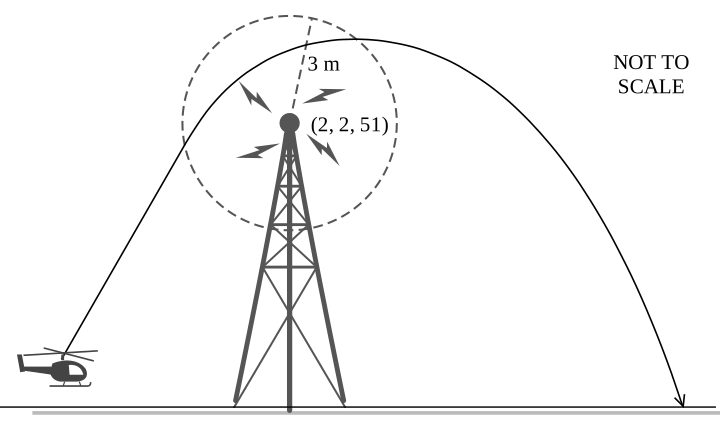
Let the acceleration due to gravity be 10 m s\(^{-2}\).

From the time it loses power, how long does it take for the helicopter to reach the ground?   (4 marks)

--- 16 WORK AREA LINES (style=lined) ---

Show Answers Only

\(3.25\ \text{seconds}\)

Show Worked Solution

\(\text{Find when the helicopter is 3 m from}\ (2, 2, 51):\)

\(\underset{\sim}{r}(t)-\left(2\underset{\sim}{i}+2\underset{\sim}{j}+51\underset{\sim}{k}\right)=\left(3-\dfrac{t}{4}\right)\underset{\sim}{i}+2\underset{\sim}{j}+\dfrac{t}{4}\underset{\sim}{k}\)

  \(\left(3-\dfrac{t}{4}\right)^2+2^2+\left(\dfrac{t}{4}\right)^2\) \(=3^2\)
  \(9-\dfrac{3t}{2}+\dfrac{t^2}{16}+4+\dfrac{t^2}{16}\) \(=9\)
  \(\dfrac{t^2}{8}-\dfrac{3t}{2}+4\) \(=0\)
  \(t^2-12t+32\) \(=0\)
  \((t-4)(t-8)\) \(=0\)

 
\(\text{Helicopter first comes within 3 m when}\ \ t=4.\)
 

\(\underset{\sim}{r}(4)=4\underset{\sim}{i}+4\underset{\sim}{j}+52\underset{\sim}{k}\ \ \Rightarrow\ \ \text{height}=52\ \text{m}\)

\(\underset{\sim}{\dot{r}}(t)=-\dfrac{1}{4}\underset{\sim}{i}+\dfrac{1}{4}\underset{\sim}{k}\ \ \Rightarrow\ \ \text{initial vertical velocity}=\dfrac{1}{4}\ \text{m s}^{-1}\)
 

\(\text{Vertical motion after losing power (let}\ T=0\ \text{when power is lost):}\)

  \(\ddot{z}\) \(=-10\)
  \(\dot{z}\) \(=-10T+\dfrac{1}{4}\)
  \(z\) \(=-5T^2+\dfrac{T}{4}+52\)

 
\(\text{Reaches ground when}\ \ z=0:\)

  \(-5T^2+\dfrac{T}{4}+52\) \(=0\)
  \(20T^2-T-208\) \(=0\)
  \((4T-13)(5T+16)\) \(=0\)

 
\(T=\dfrac{13}{4}\ \ \ (T>0)\)

\(\therefore\ \text{Helicopter takes 3.25 seconds to reach the ground.}\)

Filed Under: Equations of Lines and Curves Tagged With: Band 5, smc-7425-50-Circles/Spheres, smc-7425-80-3D vectors, smc-7425-85-X-topic

Vectors, EXT2 V1 2024 HSC 15a

Consider the three vectors  \(\underset{\sim}{a}=\overrightarrow{O A}, \underset{\sim}{b}=\overrightarrow{O B}\)  and  \(\underset{\sim}{c}=\overrightarrow{O C}\), where \(O\) is the origin and the points \(A, B\) and \(C\) are all different from each other and the origin.

The point \(M\) is the point such that  \(\dfrac{1}{2}(\underset{\sim}{a}+\underset{\sim}{b})=\overrightarrow{O M}\).

  1. Show that \(M\) lies on the line passing through \(A\) and \(B\).   (1 mark)

    --- 2 WORK AREA LINES (style=lined) ---

  2. The point \(G\) is the point such that  \(\dfrac{1}{3}(\underset{\sim}{a}+\underset{\sim}{b}+\underset{\sim}{c})=\overrightarrow{O G}\).
  3. Show that \(G\) lies on the line passing through \(M\) and \(C\), and lies between \(M\) and \(C\).   (2 marks)

    --- 5 WORK AREA LINES (style=lined) ---

  4. The complex numbers \(x, w\) and \(z\) are all different and all have modulus 1.
  5. Using part (ii), or otherwise, show that  \(\dfrac{1}{3}(x+w+z)\) is never a cube root of \(x w z\).   (2 marks)

    --- 5 WORK AREA LINES (style=lined) ---

Show Answers Only

i.    \(\text{Equation of line through \(A\) and \(B\)}\)

\(\Rightarrow \ell_1=\overrightarrow{O A}+\lambda \overrightarrow{A B}\)

  \(\overrightarrow{O M}\) \(=\dfrac{1}{2} \underset{\sim}{a}+\dfrac{1}{2} \underset{\sim}{b}\)
    \(=\underset{\sim}{a}-\dfrac{1}{2} \underset{\sim}{a}+\dfrac{1}{2} \underset{\sim}{b}\)
    \(=\overrightarrow{O A}+\dfrac{1}{2}(\underset{\sim}{b}-\underset{\sim}{a})\)
    \(=\overrightarrow{O A}+\dfrac{1}{2} \overrightarrow{A B}\)

 
\(\therefore \overrightarrow{OM} \ \text{lies on} \ \ell_1\).
 

ii.    \(\text{Equation of line through \(M\) and \(C\)}\)

\(\Rightarrow \ell_2=\overrightarrow{OC}+\lambda \overrightarrow{CM}\)

  \(\overrightarrow{O G}\) \(=\dfrac{1}{3}(\underset{\sim}{a}+\underset{\sim}{b}+\underset{\sim}{c})\)
    \(=\underset{\sim}{c}-\dfrac{2}{3} \underset{\sim}{c}+\dfrac{1}{3} \underset{\sim}{a}+\dfrac{1}{3} \underset{\sim}{b}\)
    \(=\overrightarrow{OC}+\dfrac{2}{3}\left(\dfrac{1}{2} \underset{\sim}{a}+\dfrac{1}{2} \underset{\sim}{b}-\underset{\sim}{c}\right)\)
    \(=\overrightarrow{OC}+\dfrac{2}{3} \overrightarrow{CM}\)

 
\(\therefore \overrightarrow{O G} \ \ \text{lies on} \ \ \ell_2\)

\(\ \ \overrightarrow{O G} \neq \overrightarrow{O C}  \ \ \text{and} \ \ \overrightarrow{O G} \neq \overrightarrow{O M}\)

\(\therefore G \ \ \text{lies between} \ \ C \ \text{and} \ M\).
 

iii.  \(\text{Place}\ x, w,\ \text{and}\ z\ \text{on unit circle.}\)
 

\(\abs{w}=\abs{x}=\abs{z}=1\)

\(\text{Using part (ii):}\)

\(G \equiv \dfrac{1}{3}(x+w+z)\)

\(G \ \text{lies on} \ CM \Rightarrow G \ \text{is inside the unit circle.}\)

\(\Rightarrow\left|\dfrac{1}{3}(x+w+z)\right|<1\)

\(\text{Since}\ \ \abs{xwz}=\abs{x}\abs{w}\abs{z}=1\)

\(\Rightarrow \ \text{All cube roots have modulus = 1.}\)

\(\therefore \dfrac{1}{3}(x+w+z) \ \ \text{cannot be a cube root of  \(xwz\).}\)

Show Worked Solution

i.    \(\text{Equation of line through \(A\) and \(B\)}\)

\(\Rightarrow \ell_1=\overrightarrow{O A}+\lambda \overrightarrow{A B}\)

  \(\overrightarrow{O M}\) \(=\dfrac{1}{2} \underset{\sim}{a}+\dfrac{1}{2} \underset{\sim}{b}\)
    \(=\underset{\sim}{a}-\dfrac{1}{2} \underset{\sim}{a}+\dfrac{1}{2} \underset{\sim}{b}\)
    \(=\overrightarrow{O A}+\dfrac{1}{2}(\underset{\sim}{b}-\underset{\sim}{a})\)
    \(=\overrightarrow{O A}+\dfrac{1}{2} \overrightarrow{A B}\)

 
\(\therefore \overrightarrow{OM} \ \text{lies on} \ \ell_1\).
 

ii.    \(\text{Equation of line through \(M\) and \(C\)}\)

\(\Rightarrow \ell_2=\overrightarrow{OC}+\lambda \overrightarrow{CM}\)

  \(\overrightarrow{O G}\) \(=\dfrac{1}{3}(\underset{\sim}{a}+\underset{\sim}{b}+\underset{\sim}{c})\)
    \(=\underset{\sim}{c}-\dfrac{2}{3} \underset{\sim}{c}+\dfrac{1}{3} \underset{\sim}{a}+\dfrac{1}{3} \underset{\sim}{b}\)
    \(=\overrightarrow{OC}+\dfrac{2}{3}\left(\dfrac{1}{2} \underset{\sim}{a}+\dfrac{1}{2} \underset{\sim}{b}-\underset{\sim}{c}\right)\)
    \(=\overrightarrow{OC}+\dfrac{2}{3} \overrightarrow{CM}\)

 
\(\therefore \overrightarrow{O G} \ \ \text{lies on} \ \ \ell_2\)

\(\ \ \overrightarrow{O G} \neq \overrightarrow{O C}  \ \ \text{and} \ \ \overrightarrow{O G} \neq \overrightarrow{O M}\)

\(\therefore G \ \ \text{lies between} \ \ C \ \text{and} \ M\).

♦ Mean mark (ii) 43%.

iii.  \(\text{Place}\ x, w,\ \text{and}\ z\ \text{on unit circle.}\)
 

♦♦♦ Mean mark (iii) 10%.

\(\abs{w}=\abs{x}=\abs{z}=1\)

\(\text{Using part (ii):}\)

\(G \equiv \dfrac{1}{3}(x+w+z)\)

\(G \ \text{lies on} \ CM \Rightarrow G \ \text{is inside the unit circle.}\)

\(\Rightarrow\left|\dfrac{1}{3}(x+w+z)\right|<1\)

\(\text{Since}\ \ \abs{xwz}=\abs{x}\abs{w}\abs{z}=1\)

\(\Rightarrow \ \text{All cube roots have modulus = 1.}\)

\(\therefore \dfrac{1}{3}(x+w+z) \ \ \text{cannot be a cube root of  \(xwz\).}\)

Filed Under: Equations of Lines and Curves, Vectors and Vector Equations of Lines Tagged With: Band 4, Band 5, Band 6, smc-1196-25-Point lies on line, smc-1196-70-2D vectors, smc-1196-85-Complex Numbers, smc-7425-25-Point lies on line, smc-7425-70-2D vectors, smc-7425-85-X-topic

Copyright © 2014–2026 SmarterEd.com.au · Log in