SmarterEd

Aussie Maths & Science Teachers: Save your time with SmarterEd

  • Login
  • Get Help
  • About

Vectors, EXT2 EQ-Bank 12

A curve has a vector equation

   \(r=(2 \sin t-1)\mathbf{i}+(2 \cos t+3) \mathbf{j} \)

  1. Write the Cartesian equation of this curve.   (2 marks)

    --- 7 WORK AREA LINES (style=lined) ---

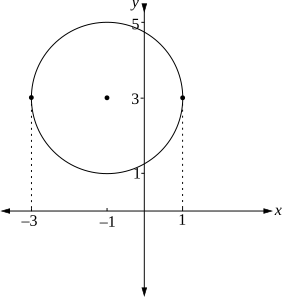
  2. Sketch the curve on the Cartesian plane below.   (1 mark)

    --- 8 WORK AREA LINES (style=lined) ---

Show Answers Only

a.    \((x+1)^2+(y-3)^2=4\)

b.    \((x+1)^2+(y-3)^2=2^2\)

\(\Rightarrow \ \text{Circle with centre} \ (-1,3), \ \text{radius}=2\)
 

Show Worked Solution

a.    \(r=(2 \sin t-1) \mathbf{i}+(2 \cos t+3) \mathbf{j}\)

\(x=2 \sin t-1 \ \Rightarrow \ \sin t=\dfrac{x+1}{2}\)

\(y=2 \cos t+3 \ \Rightarrow \ \cos t=\dfrac{y-3}{2}\)

\(\text{Using} \ \ \sin ^2 t+\cos ^2 t=1:\)

\(\dfrac{(x+1)^2}{4}+\dfrac{(y-3)^2}{4}\) \(=1\)  
\((x+1)^2+(y-3)^2\) \(=4\)  

  
b.
    \((x+1)^2+(y-3)^2=2^2\)

\(\Rightarrow \ \text{Circle with centre} \ (-1,3), \ \text{radius}=2\)


Filed Under: Equations of Lines and Curves Tagged With: Band 3, smc-7426-50-Circle/Sphere, smc-7426-85-Parametric

Vectors, EXT2 EQ-Bank 26

Let \(S\) be a sphere with equation

\begin{align*}
\left|r-\left(\begin{array}{c} 2 \\ -3 \\ 3
\end{array}\right)\right|=15
\end{align*}

Show the point  \(P(1,-1,2)\) lies outside the sphere \(S\).   (2 marks)

--- 6 WORK AREA LINES (style=lined) ---

Show Answers Only

\(\text{Centre of circle} \ (C)=(2,-3,3)\)

\(\text{Radius}=15 \ \text{(given)}\)

\(\text{Find distance from} \ C \text { to } P(1,-1,2):\)

\(\operatorname{dist}=\sqrt{(1-2)^2+(-1+3)^2+(2-3)^2}=\sqrt{6}\)

\(\text{Since \(\ \sqrt{6}<15, P\) lies inside sphere.}\)

Show Worked Solution

\(\text{Centre of circle} \ (C)=(2,-3,3)\)

\(\text{Radius}=15 \ \text{(given)}\)

\(\text{Find distance from} \ C \text { to } P(1,-1,2):\)

\(\operatorname{dist}=\sqrt{(1-2)^2+(-1+3)^2+(2-3)^2}=\sqrt{6}\)

\(\text{Since \(\ \sqrt{6}<15, P\) lies inside sphere.}\)

Filed Under: Equations of Lines and Curves Tagged With: Band 4, smc-7426-50-Circle/Sphere

Vectors, EXT2 EQ-Bank 34

A sphere of radius  \(r=3\)  is centred at \(C(6,-3,2)\).

A line passes through \(A(3,-1,6)\) and \(B(5,-1,-5)\).

Show that this line is a tangent to the sphere.    (4 marks)

--- 12 WORK AREA LINES (style=lined) ---

Show Answers Only

\(\text{See Worked Solutions}\)

Show Worked Solution

\(\text{The sphere centred at} \ \ C(6,-3,2) \ \ \text {with radius} \ \ r=3\)

\((x-6)^2+(y+3)^2+(z-2)^2=3^2=9\)
 

\(\text{The line}\ A B\ \text{has direction}\)

\(\overrightarrow{O B}-\overrightarrow{O A}=\left[\begin{array}{c}5-3 \\ -1-(-1) \\ -5-6\end{array}\right]=\left[\begin{array}{c}2 \\ 0 \\ -11\end{array}\right]\)
 

\(\text{Line \(A B\) has parametric equation:}\)

\(\left[\begin{array}{l}x \\ y \\ z\end{array}\right]=\overrightarrow{O A}+\lambda \overrightarrow{A B}=\left[\begin{array}{c}3 \\ -1 \\ 6\end{array}\right]+\lambda\left[\begin{array}{c}2 \\ 0 \\ -11\end{array}\right]=\left[\begin{array}{c}3+2 \lambda \\ -1 \\ 6-11 \lambda\end{array}\right]\)
 

\(\text{Substitute into the equation for the sphere:}\)

\((3+2 \lambda-6)^2+(-1+3)^2+(6-11 \lambda-2)^2\) \(=9\)
\((2 \lambda-3)^2+4+(4-11 \lambda)^2\) \(=9\)
\(9-12 \lambda+4 \lambda^2+4+16-88 \lambda+121 \lambda^2\) \(=9\)
\(125 \lambda^2-100 \lambda+20\) \(=0\)
\(5\left(25 \lambda^2-20 \lambda+4\right)\) \(=0\)
\(5(5 \lambda-2)^2\) \(=0\)


\(\text{There is only one}\ \lambda\ \text{that solves this equation.}\)

\(\text{i.e. one common point on the line and the sphere.}\)

\(\therefore\ \text{The line is a tangent to the sphere.}\)

Filed Under: Equations of Lines and Curves Tagged With: Band 5, smc-7425-50-Circles/Spheres

Vectors, EXT2 EQ-Bank 27

Line 1 is given by the equations  \(x=-1+2 s, \ y=1-2 s\)  and  \(z=1+2 s\), where \(s\) is a parameter.

Line 2 is given by the equations  \(x=1+2 t, \ y=-1-t\)  and  \(z=4+3 t\), where \(t\) is a parameter.

Show that Line 1 and Line 2 are skew.   (3 marks)

--- 10 WORK AREA LINES (style=lined) ---

Show Answers Only


Show Worked Solution

\(\text{Skew lines do not intersect and are not parallel.}\)

\(\text{Solving for \(s\) and \(t\) in \(x\) and \(y\):}\)

\(\text{From} \ x: \quad\) \(-1+2 s\) \(=1+2 t\ \ldots\ (1)\)
\(\text{From} \ y: \quad\) \(1-2 s\) \(=-1-t\ \ldots\ (2)\)
\((1)+(2)\) \(0\) \(=t\)


\(\text{Substitute}\ \ t=0\ \ \text{into (1):}\)

\(-1+2 s=1\ \ \Rightarrow\ \ s=1\)
 

\(\text{Substitute}\ \ s=1\ \ \text{and}\ \ t=0\ \ \text{into}\ z:\)

\(z=1+2=3\ \text{(line 1)}, \ z=4\ \text{(line 2)}\)

\(\Rightarrow\ \text{Lines 1 and 2 do not intersect.}\)
 

\(\text{Direction vectors:}\)

\(\text{Line 1 = }\left( \begin{array}{r}2 \\ -2 \\ 2\end{array}\right),\ \ \text{Line 2 = } \left(\begin{array}{r}2 \\ -1 \\ 3\end{array}\right).\)

\(\left(\begin{array}{r}2 \\ -2 \\ 2\end{array}\right) \neq k\left(\begin{array}{r}2 \\ -1 \\ 3\end{array}\right) \ \text{for any}\ \ k \in R\)

\(\Rightarrow\ \text{Lines 1 and 2 are not parallel.}\)

\(\therefore\ \text{Lines 1 and 2 are skew as they do not intersect and are not parallel.}\)

Filed Under: Equations of Lines and Curves Tagged With: Band 4, smc-7425-40-Skew lines

Vectors, EXT2 V1 2025 SPEC2 18 MC

The lines given by  \({\underset{\sim}{r}}_1(\lambda)=2 \underset{\sim}{i}+r \underset{\sim}{j}-3 \underset{\sim}{k}+\lambda(\underset{\sim}{i}-\underset{\sim}{j}+4 \underset{\sim}{k})\) and  \({\underset{\sim}{r}}_2(\mu)=\underset{\sim}{i}+s \underset{\sim}{k}+\mu(\underset{\sim}{i}+\underset{\sim}{j}-\underset{\sim}{k})\) intersect at the point \((4,3, t)\), where \(\lambda, \mu \in R\)  and \(r, s\) and \(t\) are real constants.

The values of \(r, s\) and \(t\) respectively are

  1. 2, 3 and 5
  2. 5, 3 and 5
  3. 5, 5 and 8
  4. 5, 8 and 5
Show Answers Only

\(D\)

Show Worked Solution
\({\underset{\sim}{r}}_1(\lambda)=2\underset{\sim}{i}+r\underset{\sim}{j}-3\underset{\sim}{k}+\lambda\left(\underset{\sim}{i}-\underset{\sim}{j}+4\underset{\sim}{k}\right)\)

\({\underset{\sim}{r}}_2(\mu)=\underset{\sim}{i}+0 \underset{\sim}{j}+s \underset{\sim}{k}+\mu(\underset{\sim}{i}+\underset{\sim}{j}-\underset{\sim}{k})\)

♦ Mean mark 49%.

\(\text{Since intersection occurs at}\ (4,3, t):\)

\(4=2+\lambda \ \Rightarrow \ \lambda=2\)

\(3=r-\lambda \ \Rightarrow \ 3=r-2\ \Rightarrow\ r=5\)

\(t=-3+4 \lambda=-3+4(2)=5\)

\(4=1+\mu \ \Rightarrow \ \mu=3\)

\(t=s-\mu \ \Rightarrow \ 5=s-3\ \Rightarrow\ s=8\)

\(\Rightarrow D\)

Filed Under: Equations of Lines and Curves, Vectors and Vector Equations of Lines Tagged With: Band 5, smc-1196-20-Intersection, smc-7425-20-Intersection

Vectors, EXT2 V1 2025 SPEC1 2

Consider the following two lines, \(L_1\) and \(L_2\).

\(L_1\) passes through the point \(A_1(2,3,1)\) and has direction  \(\underset{\sim}{u}=\underset{\sim}{i}+2 \underset{\sim}{j}-\underset{\sim}{k}\).

\(L_2\) passes through the point \(A_2(1,3,2)\) and has direction  \(\underset{\sim}{v}=-\underset{\sim}{i}-\underset{\sim}{j}+\underset{\sim}{k}\).

Find the coordinates of the point of intersection of the two lines.   (3 marks)

--- 10 WORK AREA LINES (style=lined) ---

Show Answers Only

\(\text{Intersection at}\ (3,5,0).\)

Show Worked Solution

\(\underset{\sim}{u}=\underset{\sim}{i}+2 \underset{\sim}{j}-\underset{\sim}{k} \ \ \text {passes through} \ A_1(2,3,1)\)

\(L_1:(2+t) \underset{\sim}{i}+(3+2 t) \underset{\sim}{j}+(1-t) \underset{\sim}{k}\)

\(\underset{\sim}{v}=\underset{\sim}{-i}-\underset{\sim}{j}+\underset{\sim}{k} \ \ \text {passes through}\  A_2(1,3,2)\)

\(L_2:(1-s) \underset{\sim}{i}+(3-s)\underset{\sim}{j}+(2+s) \underset{\sim}{k}\)

\(\text{Equating components for intersection:}\)

\(2+t=1-s \ \ \Rightarrow \ \ s+t=-1\ \ldots\ (1)\)

\(3+2 t=3-s \ \ \Rightarrow \ \ s+2 t=0\ \ldots\ (2)\)

\(\text{Subtract: (2) – (1)}\)

\(t=1 \ \Rightarrow \ s=-2\)

\(\text{Point of intersection:}\)

\((2+1,3+2,1-1) \equiv(3,5,0)\)

Filed Under: Equations of Lines and Curves, Vectors and Vector Equations of Lines Tagged With: Band 4, smc-1196-20-Intersection, smc-7425-20-Intersection

Vectors, EXT2 V1 2025 HSC 16c

Consider the point \(B\) with three-dimensional position vector \(\underset{\sim}{b}\) and the line  \(\ell: \underset{\sim}{a}+\lambda \underset{\sim}{d}\), where \(\underset{\sim}{a}\) and \(\underset{\sim}{d}\) are three-dimensional vectors, \(\abs{\underset{\sim}{d}}=1\) and \(\lambda\) is a parameter.

Let \(f(\lambda)\) be the distance between a point on the line \(\ell\) and the point \(B\).

  1. Find \(\lambda_0\), the value of \(\lambda\) that minimises \(f\), in terms of \(\underset{\sim}{a}, \underset{\sim}{b}\) and \(\underset{\sim}{d}\).   (2 marks)

    --- 12 WORK AREA LINES (style=lined) ---

  2. Let \(P\) be the point with position vector  \(\underset{\sim}{a}+\lambda_0 \underset{\sim}{d}\).
  3. Show that \(PB\) is perpendicular to the direction of the line \(\ell\).   (1 mark)

    --- 7 WORK AREA LINES (style=lined) ---

  4. Hence, or otherwise, find the shortest distance between the line \(\ell\) and the sphere of radius 1 unit, centred at the origin \(O\), in terms of \(\underset{\sim}{d}\) and \(\underset{\sim}{a}\).
  5. You may assume that if \(B\) is the point on the sphere closest to \(\ell\), then \(O B P\) is a straight line.   (3 marks)

    --- 16 WORK AREA LINES (style=lined) ---

Show Answers Only

i.    \(\lambda_0=\underset{\sim}{d}(\underset{\sim}{b}-\underset{\sim}{a})\)

ii.   \(\text{See Worked Solutions.}\)

iii.  \(d_{\min }= \begin{cases}\sqrt{\abs{\underset{\sim}{a}}^2-(\underset{\sim}{a} \cdot \underset{\sim}{d})^2}-1, & \sqrt{\abs{\underset{\sim}{a}}^2-(\underset{\sim}{a} \cdot \underset{\sim}{d})^2}>1 \\ 0, & \sqrt{\abs{\underset{\sim}{a}}^2-(\underset{\sim}{a} \cdot \underset{\sim}{d})^2} \leqslant 1 \ \ \text{(i.e. it touches sphere) }\end{cases}\)

Show Worked Solution

i.    \(\ell=\underset{\sim}{a}+\lambda \underset{\sim}{d}, \quad\abs{\underset{\sim}{d}}=1\)

\(\text{Vector from point \(B\) to a point on \(\ell\)}:\ \underset{\sim}{a}+\lambda \underset{\sim}{d}-\underset{\sim}{b}\)

\(f(\lambda)=\text{distance between \(\ell\) and \(B\)}\)

\(f(\lambda)=\abs{\underset{\sim}{a}-\underset{\sim}{b}+\lambda \underset{\sim}{d}}\)

\(\text{At} \ \ \lambda_0, f(\lambda) \ \ \text{is a min}\ \Rightarrow \ f(\lambda)^2 \ \ \text {is also a min}\)

♦♦ Mean mark (i) 33%.
\(f(\lambda)^2\) \(=\abs{\underset{\sim}{a}-\underset{\sim}{b}+\lambda \underset{\sim}{d}}^2\)
  \(=(\underset{\sim}{a}-\underset{\sim}{b}+\lambda \underset{\sim}{d})(\underset{\sim}{a}-\underset{\sim}{b}+\lambda \underset{\sim}{d})\)
  \(=(\underset{\sim}{a}-\underset{\sim}{b})\cdot (\underset{\sim}{a}-\underset{\sim}{b})+2\lambda (\underset{\sim}{a}-\underset{\sim}{b}) \cdot \underset{\sim}{d}+\lambda^2 \underset{\sim}{d} \cdot  \underset{\sim}{d}\)
  \(=\lambda^2|\underset{\sim}{d}|^2+2 \underset{\sim}{d} \cdot (\underset{\sim}{a}-\underset{\sim}{b}) \lambda +\abs{\underset{\sim}{a}-\underset{\sim}{b}}^2\)
  \(=\lambda^2+2 \underset{\sim}{d} \cdot (\underset{\sim}{a}-\underset{\sim}{b}) \lambda+\abs{\underset{\sim}{a}-\underset{\sim}{b}}^2\)


\(f(\lambda)^2 \ \ \text{is a concave up quadratic.}\)

\(f(\lambda)_{\text {min}}^2 \ \ \text{occurs at the vertex.}\)

\(\lambda_0=-\dfrac{b}{2 a}=-\dfrac{2 \underset{\sim}{d} \cdot (\underset{\sim}{a}-\underset{\sim}{b})}{2}=\underset{\sim}{d} \cdot (\underset{\sim}{b}-\underset{\sim}{a})\)
 

ii.    \(P \ \text{has position vector} \ \ \underset{\sim}{a}+\lambda_0 \underset{\sim}{d}\)

\(\text{Show} \ \ \overrightarrow{PB} \perp \ell:\)

♦♦♦ Mean mark (ii) 22%.

\(\overrightarrow{PB}=\underset{\sim}{b}-\underset{\sim}{p}=\underset{\sim}{b}-\underset{\sim}{a}-\lambda_0 \underset{\sim}{d}\)

\(\overrightarrow{P B} \cdot \underset{\sim}{d}\) \(=\left(\underset{\sim}{b}-\underset{\sim}{a}-\lambda_0 \underset{\sim}{d}\right) \cdot \underset{\sim}{d}\)
  \(=(\underset{\sim}{b}-\underset{\sim}{a}) \cdot \underset{\sim}{d}-\lambda_0 \underset{\sim}{d} \cdot \underset{\sim}{d}\)
  \(=\lambda_0-\lambda_0\abs{\underset{\sim}{d}}^2\)
  \(=0\)


\(\therefore \overrightarrow{PB}\ \text{is perpendicular to the direction of the line}\ \ell. \)
 

iii.   \(\text{Shortest distance between} \ \ell \ \text{and sphere (radius\(=1\))}\)

\(=\ \text{(shortest distance \(\ell\) to \(O\))}-1\)

♦♦♦ Mean mark (iii) 4%.

\(f\left(\lambda_0\right)=\text{shortest distance \(\ell\) to point \(B\)}\)

\(\text{Set} \ \ \underset{\sim}{b}=0 \ \Rightarrow \ f\left(\lambda_0\right)=\text{shortest distance \(\ell\) to \(0\)}\)

\(\Rightarrow \lambda_0=\underset{\sim}{d} \cdot (\underset{\sim}{b}-\underset{\sim}{a})=-\underset{\sim}{d} \cdot \underset{\sim}{a}\)

\(f\left(\lambda_0\right)\) \(=\abs{\underset{\sim}{a}-\underset{\sim}{b}-(\underset{\sim}{d} \cdot \underset{\sim}{a})\cdot \underset{\sim}{d}}=\abs{\underset{\sim}{a}-(\underset{\sim}{d} \cdot \underset{\sim}{a})\cdot \underset{\sim}{d}}\)
\(f\left(\lambda_0\right)^2\) \(=\abs{\underset{\sim}{a}}^2-2( \underset{\sim}{a}\cdot \underset{\sim}{d})^2+(\underset{\sim}{d} \cdot \underset{\sim}{a})^2\abs{\underset{\sim}{d}}^2\)
  \(=\abs{\underset{\sim}{a}}^2-(\underset{\sim}{a} \cdot \underset{\sim}{d})^2\)
\(f\left(\lambda_0\right)\) \(=\sqrt{\abs{\underset{\sim}{a}}^2-(\underset{\sim}{a} \cdot \underset{\sim}{d})^2}\)


\(\text {Shortest distance of \(\ell\) to sphere \(\left(d_{\min }\right)\):}\)

\(d_{\min }= \begin{cases}\sqrt{\abs{\underset{\sim}{a}}^2-(\underset{\sim}{a} \cdot \underset{\sim}{d})^2}-1, & \sqrt{\abs{\underset{\sim}{a}}^2-(\underset{\sim}{a} \cdot \underset{\sim}{d})^2}>1 \\ 0, & \sqrt{\abs{\underset{\sim}{a}}^2-(\underset{\sim}{a} \cdot \underset{\sim}{d})^2} \leqslant 1 \ \ \text{(i.e. it touches sphere) }\end{cases}\)

Filed Under: Equations of Lines and Curves, Vectors and Vector Equations of Lines Tagged With: Band 5, Band 6, smc-1196-40-Perpendicular, smc-1196-48-Spheres, smc-1196-80-3D vectors, smc-7425-35-Perpendicular, smc-7425-50-Circles/Spheres, smc-7425-80-3D vectors

Vectors, EXT2 V1 2025 HSC 10 MC

Which of the following gives the same curve as  \(\left(\begin{array}{c}\cos (t) \\ -t \\ \sin (t)\end{array}\right)\) for  \(t \in \mathbb{R}\) ?

  1. \(\left(\begin{array}{c}\cos (2 t) \\ 2 t \\ \sin (2 t)\end{array}\right)\)
  2. \(\left(\begin{array}{c}\cos \left(t^2+\dfrac{\pi}{2}\right) \\ t^2+\dfrac{\pi}{2} \\ \sin \left(t^2+\dfrac{\pi}{2}\right)\end{array}\right)\)
  3. \(\left(\begin{array}{c}\cos \left(t^2\right) \\ -t^2 \\ \sin \left(t^2\right)\end{array}\right)\)
  4. \(\left(\begin{array}{c}\cos \left(2 t+\dfrac{\pi}{2}\right) \\ 2 t+\dfrac{\pi}{2} \\ -\sin \left(2 t+\dfrac{\pi}{2}\right)\end{array}\right)\)
Show Answers Only

\(D\)

Show Worked Solution

\(\text{Find which option is a re-parametrisation of the given curve.}\)

\(\text{Consider option D:}\)

\(\text{Let}\ \ u=- \left(2t + \dfrac{\pi}{2}\right)\)

\(\text{Since}\ t \in \mathbb{R}\ \ \Rightarrow \ \ u \in \mathbb{R}\)

\(\cos \left(2 t+\dfrac{\pi}{2}\right) = \cos\left(- \left(2 t+\dfrac{\pi}{2}\right) \right) = \cos\,u\)

\(2 t+\dfrac{\pi}{2} = -\left( -\left(2 t+\dfrac{\pi}{2} \right) \right) = -u\)

\(-\sin \left(2 t+\dfrac{\pi}{2}\right) = \sin\left(- \left(2 t+\dfrac{\pi}{2}\right) \right) = \sin\,u\)

\(\Rightarrow D\)

♦ Mean mark 52%.

Filed Under: Equations of Lines and Curves, Vectors and Vector Equations of Lines Tagged With: Band 5, smc-1196-45-Curves, smc-7425-45-Curves

Vectors, EXT2 V1 2025 HSC 1 MC

Points \(A\) and \(B\) are \((-3,1)\) and \((1,4)\) respectively.

Which of the following is a vector equation of the line \(A B\) with parameter \(\lambda\) ?

  1. \(\displaystyle \binom{x}{y}=\binom{1}{4}+\lambda\binom{3}{4}\)
  2. \(\displaystyle\binom{x}{y}=\binom{3}{4}+\lambda\binom{1}{4}\)
  3. \(\displaystyle\binom{x}{y}=\binom{4}{3}+\lambda\binom{-3}{1}\)
  4. \(\displaystyle\binom{x}{y}=\binom{-3}{1}+\lambda\binom{4}{3}\)
Show Answers Only

\(D\)

Show Worked Solution

\(\overrightarrow{AB}=\displaystyle \binom{1}{4}-\binom{-3}{1}=\binom{4}{3}\)

\(\text{Line} \ \ AB:\)

\(\displaystyle \binom{x}{y}=\binom{-3}{1}+\lambda\binom{4}{3}\)

\(\Rightarrow D\)

Filed Under: Equations of Lines and Curves, Vectors and Vector Equations of Lines Tagged With: Band 2, smc-1196-10-Find line given 2 points, smc-1196-70-2D vectors, smc-7425-10-Find line given 2 points, smc-7425-70-2D vectors

Vectors, EXT2 V1 2024 HSC 15a

Consider the three vectors  \(\underset{\sim}{a}=\overrightarrow{O A}, \underset{\sim}{b}=\overrightarrow{O B}\)  and  \(\underset{\sim}{c}=\overrightarrow{O C}\), where \(O\) is the origin and the points \(A, B\) and \(C\) are all different from each other and the origin.

The point \(M\) is the point such that  \(\dfrac{1}{2}(\underset{\sim}{a}+\underset{\sim}{b})=\overrightarrow{O M}\).

  1. Show that \(M\) lies on the line passing through \(A\) and \(B\).   (1 mark)

    --- 2 WORK AREA LINES (style=lined) ---

  2. The point \(G\) is the point such that  \(\dfrac{1}{3}(\underset{\sim}{a}+\underset{\sim}{b}+\underset{\sim}{c})=\overrightarrow{O G}\).
  3. Show that \(G\) lies on the line passing through \(M\) and \(C\), and lies between \(M\) and \(C\).   (2 marks)

    --- 5 WORK AREA LINES (style=lined) ---

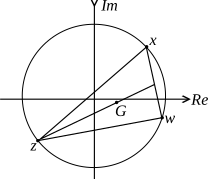
  4. The complex numbers \(x, w\) and \(z\) are all different and all have modulus 1.
  5. Using part (ii), or otherwise, show that  \(\dfrac{1}{3}(x+w+z)\) is never a cube root of \(x w z\).   (2 marks)

    --- 5 WORK AREA LINES (style=lined) ---

Show Answers Only

i.    \(\text{Equation of line through \(A\) and \(B\)}\)

\(\Rightarrow \ell_1=\overrightarrow{O A}+\lambda \overrightarrow{A B}\)

  \(\overrightarrow{O M}\) \(=\dfrac{1}{2} \underset{\sim}{a}+\dfrac{1}{2} \underset{\sim}{b}\)
    \(=\underset{\sim}{a}-\dfrac{1}{2} \underset{\sim}{a}+\dfrac{1}{2} \underset{\sim}{b}\)
    \(=\overrightarrow{O A}+\dfrac{1}{2}(\underset{\sim}{b}-\underset{\sim}{a})\)
    \(=\overrightarrow{O A}+\dfrac{1}{2} \overrightarrow{A B}\)

 
\(\therefore \overrightarrow{OM} \ \text{lies on} \ \ell_1\).
 

ii.    \(\text{Equation of line through \(M\) and \(C\)}\)

\(\Rightarrow \ell_2=\overrightarrow{OC}+\lambda \overrightarrow{CM}\)

  \(\overrightarrow{O G}\) \(=\dfrac{1}{3}(\underset{\sim}{a}+\underset{\sim}{b}+\underset{\sim}{c})\)
    \(=\underset{\sim}{c}-\dfrac{2}{3} \underset{\sim}{c}+\dfrac{1}{3} \underset{\sim}{a}+\dfrac{1}{3} \underset{\sim}{b}\)
    \(=\overrightarrow{OC}+\dfrac{2}{3}\left(\dfrac{1}{2} \underset{\sim}{a}+\dfrac{1}{2} \underset{\sim}{b}-\underset{\sim}{c}\right)\)
    \(=\overrightarrow{OC}+\dfrac{2}{3} \overrightarrow{CM}\)

 
\(\therefore \overrightarrow{O G} \ \ \text{lies on} \ \ \ell_2\)

\(\ \ \overrightarrow{O G} \neq \overrightarrow{O C}  \ \ \text{and} \ \ \overrightarrow{O G} \neq \overrightarrow{O M}\)

\(\therefore G \ \ \text{lies between} \ \ C \ \text{and} \ M\).
 

iii.  \(\text{Place}\ x, w,\ \text{and}\ z\ \text{on unit circle.}\)
 

\(\abs{w}=\abs{x}=\abs{z}=1\)

\(\text{Using part (ii):}\)

\(G \equiv \dfrac{1}{3}(x+w+z)\)

\(G \ \text{lies on} \ CM \Rightarrow G \ \text{is inside the unit circle.}\)

\(\Rightarrow\left|\dfrac{1}{3}(x+w+z)\right|<1\)

\(\text{Since}\ \ \abs{xwz}=\abs{x}\abs{w}\abs{z}=1\)

\(\Rightarrow \ \text{All cube roots have modulus = 1.}\)

\(\therefore \dfrac{1}{3}(x+w+z) \ \ \text{cannot be a cube root of  \(xwz\).}\)

Show Worked Solution

i.    \(\text{Equation of line through \(A\) and \(B\)}\)

\(\Rightarrow \ell_1=\overrightarrow{O A}+\lambda \overrightarrow{A B}\)

  \(\overrightarrow{O M}\) \(=\dfrac{1}{2} \underset{\sim}{a}+\dfrac{1}{2} \underset{\sim}{b}\)
    \(=\underset{\sim}{a}-\dfrac{1}{2} \underset{\sim}{a}+\dfrac{1}{2} \underset{\sim}{b}\)
    \(=\overrightarrow{O A}+\dfrac{1}{2}(\underset{\sim}{b}-\underset{\sim}{a})\)
    \(=\overrightarrow{O A}+\dfrac{1}{2} \overrightarrow{A B}\)

 
\(\therefore \overrightarrow{OM} \ \text{lies on} \ \ell_1\).
 

ii.    \(\text{Equation of line through \(M\) and \(C\)}\)

\(\Rightarrow \ell_2=\overrightarrow{OC}+\lambda \overrightarrow{CM}\)

  \(\overrightarrow{O G}\) \(=\dfrac{1}{3}(\underset{\sim}{a}+\underset{\sim}{b}+\underset{\sim}{c})\)
    \(=\underset{\sim}{c}-\dfrac{2}{3} \underset{\sim}{c}+\dfrac{1}{3} \underset{\sim}{a}+\dfrac{1}{3} \underset{\sim}{b}\)
    \(=\overrightarrow{OC}+\dfrac{2}{3}\left(\dfrac{1}{2} \underset{\sim}{a}+\dfrac{1}{2} \underset{\sim}{b}-\underset{\sim}{c}\right)\)
    \(=\overrightarrow{OC}+\dfrac{2}{3} \overrightarrow{CM}\)

 
\(\therefore \overrightarrow{O G} \ \ \text{lies on} \ \ \ell_2\)

\(\ \ \overrightarrow{O G} \neq \overrightarrow{O C}  \ \ \text{and} \ \ \overrightarrow{O G} \neq \overrightarrow{O M}\)

\(\therefore G \ \ \text{lies between} \ \ C \ \text{and} \ M\).

♦ Mean mark (ii) 43%.

iii.  \(\text{Place}\ x, w,\ \text{and}\ z\ \text{on unit circle.}\)
 

♦♦♦ Mean mark (iii) 10%.

\(\abs{w}=\abs{x}=\abs{z}=1\)

\(\text{Using part (ii):}\)

\(G \equiv \dfrac{1}{3}(x+w+z)\)

\(G \ \text{lies on} \ CM \Rightarrow G \ \text{is inside the unit circle.}\)

\(\Rightarrow\left|\dfrac{1}{3}(x+w+z)\right|<1\)

\(\text{Since}\ \ \abs{xwz}=\abs{x}\abs{w}\abs{z}=1\)

\(\Rightarrow \ \text{All cube roots have modulus = 1.}\)

\(\therefore \dfrac{1}{3}(x+w+z) \ \ \text{cannot be a cube root of  \(xwz\).}\)

Filed Under: Equations of Lines and Curves, Vectors and Vector Equations of Lines Tagged With: Band 4, Band 5, Band 6, smc-1196-25-Point lies on line, smc-1196-70-2D vectors, smc-1196-85-Complex Numbers, smc-7425-25-Point lies on line, smc-7425-70-2D vectors, smc-7425-85-X-topic

Vectors, EXT2 V1 2024 HSC 13a

The point \(A\) has position vector  \(8 \underset{\sim}{i}-6 \underset{\sim}{j}+5 \underset{\sim}{k}\). The line \(\ell\) has vector equation

\(x \underset{\sim}{i}+y \underset{\sim}{j}+z \underset{\sim}{k}=t(\underset{\sim}{i}+\underset{\sim}{j}+2 \underset{\sim}{k})\).

The point \(B\) lies on \(\ell\) and has position vector  \(p \underset{\sim}{i}+p \underset{\sim}{j}+2 p \underset{\sim}{k}\).

  1. Show that  \(\abs{A B}^2=6 p^2-24 p+125\).   (1 mark)

    --- 4 WORK AREA LINES (style=lined) ---

  2. Hence, or otherwise, determine the shortest distance between the point \(A\) and the line \(\ell\).  (2 marks)

    --- 6 WORK AREA LINES (style=lined) ---

Show Answers Only

i.     \(A\left(\begin{array}{c}8 \\ -6 \\ 5\end{array}\right), \quad \ell: \left(\begin{array}{l}x \\ y \\ z\end{array}\right)+t\left(\begin{array}{l}1 \\ 1 \\ 2\end{array}\right), \quad B\left(\begin{array}{c}p \\ p \\ 2 p\end{array}\right)\)
 

\(\overrightarrow{A B}=\left(\begin{array}{l}p \\ p \\ 2 p\end{array}\right)-\left(\begin{array}{c}8 \\ -6 \\ 5\end{array}\right)=\left(\begin{array}{c}p-8 \\ p+6 \\ 2 p-5\end{array}\right)\)
 

  \(\abs{AB}^2\) \(=(p-8)^2+(p+6)^2+(2 p-5)^2\)
    \(=p^2-16 p+64+p^2+12 p+36+4 p^2-20 p+25\)
    \(=6 p^2-24 p+125\)


ii.    \(\abs{AB}_{\text {min}}=\sqrt{101} \text { units}\)

Show Worked Solution

i.     \(A\left(\begin{array}{c}8 \\ -6 \\ 5\end{array}\right), \quad \ell: \left(\begin{array}{l}x \\ y \\ z\end{array}\right)+t\left(\begin{array}{l}1 \\ 1 \\ 2\end{array}\right), \quad B\left(\begin{array}{c}p \\ p \\ 2 p\end{array}\right)\)
 

\(\overrightarrow{A B}=\left(\begin{array}{l}p \\ p \\ 2 p\end{array}\right)-\left(\begin{array}{c}8 \\ -6 \\ 5\end{array}\right)=\left(\begin{array}{c}p-8 \\ p+6 \\ 2 p-5\end{array}\right)\)
 

  \(\abs{AB}^2\) \(=(p-8)^2+(p+6)^2+(2 p-5)^2\)
    \(=p^2-16 p+64+p^2+12 p+36+4 p^2-20 p+25\)
    \(=6 p^2-24 p+125\)


ii.    \(\text{Find shortest distance between \(A\) and \(\ell\).}\)

\(\Rightarrow \text { Find \(p\) when \(\abs{A B}\) is a minimum:}\)

\(\text{Minimum occurs when}\ \ p=\dfrac{-b}{2 a}=\dfrac{24}{2 \times 6}=2\)

\(\therefore \abs{AB}_{\text {min}}=\sqrt{6(2)^2-24(2)+125}=\sqrt{101} \text { units}\)

♦ Mean mark (ii) 45%.

Filed Under: Equations of Lines and Curves, Vectors and Vector Equations of Lines Tagged With: Band 3, Band 5, smc-1196-40-Perpendicular, smc-7425-35-Perpendicular

Vectors, EXT2 V1 2024 HSC 12e

The line \(\ell\) passes through the points \(A(3,5,-4)\) and \(B(7,0,2)\).

  1. Find a vector equation of the line \(\ell\).   (1 mark)

    --- 4 WORK AREA LINES (style=lined) ---

  2. Determine, giving reasons, whether the point \(C(10,5,-2)\) lies on the line \(\ell\).   (2 marks)

    --- 7 WORK AREA LINES (style=lined) ---

Show Answers Only

i.    \(\text{ Equation of line:} \ \left(\begin{array}{c}3 \\ 5 \\ -4\end{array}\right)+\lambda\left(\begin{array}{c}4 \\ -5 \\ 6\end{array}\right),\ (\lambda \in \mathbb{R} )\)

ii.    \(\text{If \(C\) lies on the line}, \ \exists \lambda \in \mathbb{R}\  \ \text{such that:}\)

\(\left(\begin{array}{c}10 \\ 5 \\ -2\end{array}\right)=\left(\begin{array}{c}3 \\ -5 \\ 6\end{array}\right)+\lambda\left(\begin{array}{c}4 \\ -5 \\ 6\end{array}\right)\)

 
\(\text{Find \(\lambda\) for \(x\)-component: }\)

\(10=3+4 \lambda \ \Rightarrow \ \lambda=\dfrac{7}{4}\)

\(\text{Check \(\lambda=\dfrac{7}{4}\) for \(y\)-component:}\)

\(5=-5+\dfrac{7}{4}(-5) \ \ \Rightarrow\ \ \text{not correct}\)

\(\therefore C\  \text{does not lie on the line.}\)

Show Worked Solution

i.     \(A(3,5,-4), \quad B(7,0,2)\)

\(\overrightarrow{A B}=\left(\begin{array}{l}7 \\ 0 \\ 2\end{array}\right)-\left(\begin{array}{c}3 \\ 5 \\ -4\end{array}\right)=\left(\begin{array}{c}4 \\ -5 \\ 6\end{array}\right)\)

\(\therefore \text{ Equation of line:} \ \left(\begin{array}{c}3 \\ 5 \\ -4\end{array}\right)+\lambda\left(\begin{array}{c}4 \\ -5 \\ 6\end{array}\right),\ (\lambda \in \mathbb{R} )\)
 

ii.    \(\text{If \(C\) lies on the line}, \ \exists \lambda \in \mathbb{R}\  \ \text{such that:}\)

\(\left(\begin{array}{c}10 \\ 5 \\ -2\end{array}\right)=\left(\begin{array}{c}3 \\ -5 \\ 6\end{array}\right)+\lambda\left(\begin{array}{c}4 \\ -5 \\ 6\end{array}\right)\)

 
\(\text{Find \(\lambda\) for \(x\)-component: }\)

\(10=3+4 \lambda \ \Rightarrow \ \lambda=\dfrac{7}{4}\)

\(\text{Check \(\lambda=\dfrac{7}{4}\) for \(y\)-component:}\)

\(5=-5+\dfrac{7}{4}(-5) \ \ \Rightarrow\ \ \text{not correct}\)

\(\therefore C\  \text{does not lie on the line.}\)

Filed Under: Equations of Lines and Curves, Vectors and Vector Equations of Lines Tagged With: Band 3, smc-1196-10-Find line given 2 points, smc-1196-25-Point lies on line, smc-7425-10-Find line given 2 points, smc-7425-25-Point lies on line

Vectors, EXT2 V1 2023 HSC 5 MC

Which of the following is a true statement about the lines  \(\ell_1={\displaystyle\left(\begin{array}{cc}-1 \\ 2 \\ 5\end{array}\right)+\lambda\left(\begin{array}{c}-1 \\ 3 \\ 1\end{array}\right)}\)  and  \(\ell_2=\left(\begin{array}{c}3 \\ -10 \\ 1\end{array}\right)+\mu\left(\begin{array}{c}1 \\ -3 \\ -1\end{array}\right) ?\)

  1. \(\ell_1\) and \(\ell_2\) are the same line.
  2. \(\ell_1\) and \(\ell_2\) are not parallel and they intersect.
  3. \(\ell_1\) and \(\ell_2\) are parallel and they do not intersect.
  4. \(\ell_1\) and \(\ell_2\) are not parallel and they do not intersect.
Show Answers Only

\(A\)

Show Worked Solution

\(\text{Since}\ \ \left(\begin{array}{c}-1 \\ 3 \\ 1\end{array}\right) = -1 \left(\begin{array}{c}1 \\ -3 \\ -1\end{array}\right), \ \ell_1\ \text{is parallel to}\ \ell_2 \)

\(\text{Test if point}\ (3,-10,1)\ \text{lies on}\ \ell_1: \)

\(\text{i.e.}\ \ \exists \lambda\ \ \text{such that} \)

♦ Mean mark 49%.

\( \left(\begin{array}{cc}3 \\ -10 \\ 1\end{array}\right) = \left(\begin{array}{cc}-1 \\ 2 \\ 5\end{array}\right) + \lambda \left(\begin{array}{cc}-1 \\ 3 \\ 1\end{array}\right)\)

\(\lambda = -4\ \ \text{satisfies equation} \)

\(\therefore\ \ell_1\ \text{and}\ \ell_2\ \text{are the same line.}\)

\(\Rightarrow A\)

Filed Under: Equations of Lines and Curves, Vectors and Vector Equations of Lines Tagged With: Band 5, smc-1196-25-Point lies on line, smc-1196-30-Parallel, smc-7425-25-Point lies on line, smc-7425-30-Parallel

Vectors, EXT2 V1 2023 HSC 15c

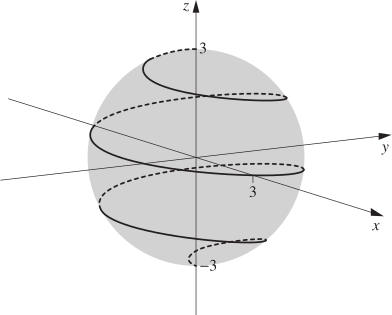
A curve \( \mathcal{C}\) spirals 3 times around the sphere centred at the origin and with radius 3, as shown.

A particle is initially at the point \((0,0,-3)\) and moves along the curve \(\mathcal{C}\) on the surface of the sphere, ending at the point \((0,0,3)\).
 

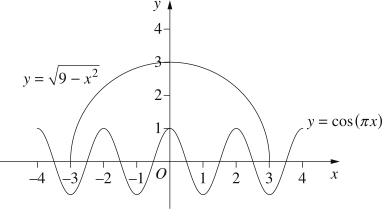
By using the diagram below, which shows the graphs of the functions  \(f(x)=\cos (\pi x)\)  and  \(g(x)=\sqrt{9-x^2}\), and considering the graph  \(y=f(x)g(x)\), give a possible set of parametric equations that describe the curve \( \mathcal{C}\).  (3 marks)
 

--- 6 WORK AREA LINES (style=lined) ---

Show Answers Only

\(x= \cos{(\pi t)}\sqrt{9-t^2} \)

\(y= -\sin{(\pi t)}\sqrt{9-t^2} \)

\( z=t \)

Show Worked Solution

\(\text{Since the curve lies on a sphere with radius 3:}\)

\(x^2+y^2+z^2=3^3 \)

\(\text{Considering the graph}\ \ y=\cos (\pi t)\sqrt{9-t^2}\ \ \text{(as per hint)} \)

\(\Big(\cos (\pi t)\sqrt{9-t^2}\Big)^2+\Big(\sin (\pi t)\sqrt{9-t^2}\Big)^2+t^2=3^2 \ \ …\ (1) \)

\(\text{Since}\ z\ \text{increases and}\ x\ \text{and}\ y\ \text{change signs} \)

\( \Rightarrow z=t \)
 

\(\text{In order to satisfy the equation in (1): } \)

\( x,y\ \text{must be one of }\ \ \pm \cos{(\pi t)}\sqrt{9-t^2}\ \ \text{or}\ \ \pm \sin{(\pi t)}\sqrt{9-t^2} \)
 

\(\text{At}\ \ z=0,\ t=0, \ x=3\ \ \text{(from graph):} \)

\( \Rightarrow x= \cos{(\pi t)}\sqrt{9-t^2} \)
 

\(\text{At}\ \ z=0+\epsilon,\ t=0+\epsilon, \ y \lt 0\ \ \text{(from graph):} \)

\( \Rightarrow y= -\sin{(\pi t)}\sqrt{9-t^2} \)

♦♦♦ Mean mark 22%.

Filed Under: Equations of Lines and Curves, Vectors and Geometry Tagged With: Band 6, smc-1210-50-Circle/Sphere, smc-1210-85-Parametric, smc-7426-50-Circle/Sphere

Vectors, EXT2 V1 2023 HSC 11c

Find a vector equation of the line through the points  \(A(-3,1,5)\)  and  \(B(0,2,3)\).  (2 marks)

Show Answers Only

\[\underset{\sim}{v}=\left(\begin{array}{c} -3 \\1 \\ 5 \end{array}\right) + \lambda \left(\begin{array}{c} 3 \\ 1 \\ -2 \end{array}\right),\ \ \ \text{for some}\ \ \lambda \in \mathbb{R} \]

Show Worked Solution

\[\overrightarrow{AB}=\left(\begin{array}{c} 0-(-3) \\2-1 \\ 3-5 \end{array}\right) = \left(\begin{array}{c} 3 \\ 1 \\ -2 \end{array}\right)\]

\[\therefore \underset{\sim}{v}=\left(\begin{array}{c} -3 \\1 \\ 5 \end{array}\right) + \lambda \left(\begin{array}{c} 3 \\ 1 \\ -2 \end{array}\right),\ \ \ \text{for some}\ \ \lambda \in \mathbb{R} \]

Filed Under: Equations of Lines and Curves, Vectors and Vector Equations of Lines Tagged With: Band 3, smc-1196-10-Find line given 2 points, smc-7425-10-Find line given 2 points

Vectors, EXT2 V1 2022 HSC 11e

Let `ℓ_(1)` be the line with equation `([x],[y])=([-1],[7])+lambda([3],[2]),lambda inRR`.

The line `ℓ_(2)` passes through the point  `A(-6,5)`  and is parallel to `ℓ_(1)`.

Find the equation of the line `ℓ_(2)` in the form  `y=mx+c`.  (2 marks)

Show Answers Only

`y=2/3x+9`

Show Worked Solution

`m_(ℓ_(1))=2/3`

`text{Equation of}\ ℓ_(2)\ text{has}\ m=2/3\ text{and passes through}\ (-6,5):`

`y-5` `=2/3(x+6)`  
`y` `=2/3x+9`  

Filed Under: Equations of Lines and Curves, Vectors and Vector Equations of Lines Tagged With: Band 3, smc-1196-30-Parallel, smc-1196-50-Vector to Cartesian, smc-1196-70-2D vectors, smc-7425-30-Parallel, smc-7425-55-Vector to Cartesian, smc-7425-70-2D vectors

Vectors, EXT2 V1 2021 HSC 12c

Two lines are given by  `text(r)_1 = ((-2),(1),(3)) + lambda((1),(0),(2))`  and  `text(r)_2 = ((4),(-2),(q)) + mu ((p),(3),(-1))` , where `p` and `q` are real numbers. These lines intersect and are perpendicular.

Find the values of `p` and `q`.  (3 marks)

--- 8 WORK AREA LINES (style=lined) ---

Show Answers Only

`p = 2 \ , \ q = 20`

Show Worked Solution

`text{S} text{ince vectors are perpendicular}`

`((1),(0),(2)) ((p),(3),(-1))` `= 0`
`p – 2` `= 0`
`p` `= 2`
 

`text{S} text{ince lines intersect, equate}\ y text{-coordinates:} `

`1 + lambda 0` `= -2 + 3 mu`
`mu` `= 1`


`text{Find} \ lambda \ text{by equating}\ xtext{-coordinates:}`

`-2 + lambda` `= 4 + 1 xx 2`
`lambda` `= 8`

 
`text{Equating}\ ztext{-coordinates:}`

`3 + 8 xx 2` `= q – 1 xx 1`
`q` `= 20`

Filed Under: Equations of Lines and Curves, Vectors and Vector Equations of Lines Tagged With: Band 3, smc-1196-20-Intersection, smc-1196-80-3D vectors, smc-7425-20-Intersection, smc-7425-80-3D vectors

Vectors, EXT2 V1 2021 HSC 7 MC

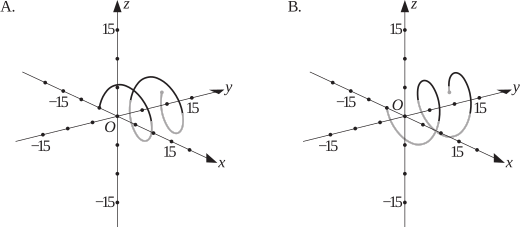
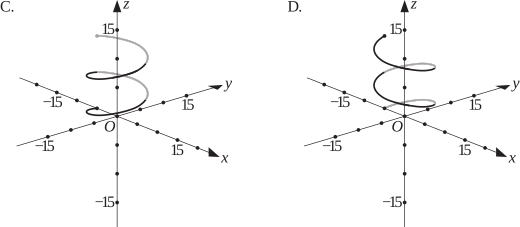
Which diagram best shows the curve described by the position vector

`underset~r (t) = -5 text{cos}(t) underset~i + 5 text{sin}(t) underset~j + t underset~k`  for  `0 ≤ t ≤ 4 pi` ?


Show Answers Only

`D`

Show Worked Solution

`text{By elimination}`

`text{Check graph coordinates for specific values of}\ t:`

`text{When} \ \ t = 4 pi \ , \ underset~r = -5 underset~i + 0 underset~j + 4 pi underset~k`

`-> \ text{Eliminate A and B}`

`text{When} \ t = pi/4 \ , \ underset~r = (-5)/sqrt(2) underset~i + 5/sqrt(2) underset~j + pi/4 underset~k`

`-> \ text{Eliminate C}`
 

`=>\ D`

Filed Under: Equations of Lines and Curves, Vectors and Vector Equations of Lines Tagged With: Band 4, smc-1196-45-Curves, smc-1196-80-3D vectors, smc-7425-45-Curves, smc-7425-80-3D vectors

Vectors, EXT2 V1 2021 HSC 3 MC

Which of the following is a vector equation of the line joining the points  `A (4, 2, 5)`  and  `B (–2, 2, 1)`?

  1. `underset~r = ((4), (2), (5)) + λ ((1),(2),(3))`
  2. `underset~r = ((4), (2), (5)) + λ ((3),(0),(2))`
  3. `underset~r = ((1), (2), (3)) + λ ((4),(2),(5))`
  4. `underset~r = ((3), (0), (2)) + λ ((4),(2),(5))`
Show Answers Only

`B`

Show Worked Solution
`overset->{AB}` `= ((-2),(2),(1)) – ((4),(2),(5)) = ((-6),(0),(-4))`  
`underset~r` `= ((4),(2),(5)) + λ_1 ((-6),(0),(-4))`  
  `= ((4), (2), (5)) + λ_2 ((3),(0),(2))`  

 
`=>\ B`

Filed Under: Equations of Lines and Curves, Vectors and Vector Equations of Lines Tagged With: Band 2, smc-1196-10-Find line given 2 points, smc-1196-80-3D vectors, smc-7425-10-Find line given 2 points, smc-7425-80-3D vectors

Vectors, EXT2 V1 2020 HSC 13b

Consider the two lines in three dimensions given by
 

`underset~r = ((3),(-1),(7)) + λ_1 ((1),(2),(1))`  and  `underset~r = ((3),(-6),(2)) + λ_2 ((-2),(1),(3))`.
 

By equating components, find the point of intersection of the two lines.   (3 marks)

--- 8 WORK AREA LINES (style=lined) ---

Show Answers Only

`((1),(-5),(5))`

Show Worked Solution

`underset~(r_1) = ((3),(-1),(7)) + λ_1 ((1),(2),(1)) = ((3 + λ_1),(-1 + 2λ_1),(7 + λ_1))`

`underset~(r_2) = ((3),(-6),(2)) + λ_2 ((-2),(1),(3)) = ((3 – 2λ_2),(-6 + λ_2),(2 + 3λ_2))`

 
`text{Intersection occurs when:}`

`3 + λ_1 ` `= 3 – 2λ_2 \ … \ (1)`
`-1 + 2λ_1` `= -6 + λ_2 \ … \ (2)`
`7 + λ_1` `= 2 + 3λ_2 \ … \ (3)`

 
`text{Subtract} \ (3) – (1):`

`4` `= -1 + 5 λ_2`
`λ_2` `=1`

 
`text{Substitute} \ \ λ_2 = 1\ \ text{into} \ (1):`

`3 + λ_1` `= 1`
`λ_1` `= -2`


`text{Test that}\  \ λ_1 = -2 \ , \  λ_2 = 1\ \ text{satisfies} \ (2):`

`-1 + 2 xx  – 2` `= -6 + 1`
`-5` `= -5`

 
`∃ \ λ_1,  λ_2, \ text{that satisfy all equations}`

`=> \ text{3 lines intersect at a point}`

`:.\ text{Point of intersection}`

`= ((3),(-6),(2)) + 1 ((-2),(1),(3)) = ((1),(-5),(5))`

Filed Under: Equations of Lines and Curves, Vectors and Vector Equations of Lines Tagged With: Band 3, smc-1196-20-Intersection, smc-1196-80-3D vectors, smc-7425-20-Intersection, smc-7425-80-3D vectors

Vectors, EXT2 V1 2020 HSC 3 MC

 What is the Cartesian equation of the line  `underset~r = ((1),(3)) + lambda ((-2),(4))`?

  1. `2y + x = 7`
  2. `y - 2x = -5`
  3. `y + 2x = 5`
  4. `2y - x = -1`
Show Answers Only

`C`

Show Worked Solution

`((x),(y)) = ((1),(3)) + λ ((-2),(4))`
 

`x = 1 – 2λ \ => \ λ = frac{1- x}{2}`

`y = 3 + 4λ \ => \ λ = frac{y- 3}{4}`
 

`frac{y – 3}{4}` `= frac{1 – x}{2}`
`y – 3` `= 2 – 2x`
`y + 2x` `= 5`

  
`=> \ C`

Filed Under: Equations of Lines and Curves, Vectors and Vector Equations of Lines Tagged With: Band 3, smc-1196-50-Vector to Cartesian, smc-7425-55-Vector to Cartesian

Vectors, EXT2 V1 EQ-Bank 16

Show that the points `A(2, 1, text{−1}), \ B(4, 2, text{−3})` and `C(text{−4}, text{−2}, 5)` are collinear.   (2 marks)

Show Answers Only

`text(Proof)\ \ text{(See Worked Solutions)}`

Show Worked Solution

`vec(AB) = ((4), (2), (text{−3})) – ((2), (1), (text{−1})) = ((2), (1), (text{−2}))`

`vec(AC) = ((text{−4}), (text{−2}), (5)) – ((2), (1), (text{−1})) = ((text{−6}), (text{−3}), (6)) = -3((2), (1), (text{−2}))`


`text(S) text(ince)\ vec(AB)\ text(||)\ vec(AC) and A\ text(lies on both lines,)`

`A, B, C\ \ text(are collinear).`

Filed Under: Equations of Lines and Curves, Vectors and Vector Equations of Lines Tagged With: Band 3, smc-1196-25-Point lies on line, smc-1196-80-3D vectors, smc-7425-25-Point lies on line, smc-7425-80-3D vectors

Vectors, EXT2 V1 EQ-Bank 15

  1. Find the equation of the vector line `underset~v` that passes through  `Atext{(5, 2, 3)}` and `B(7, 6, 1)`.   (1 mark)

    --- 3 WORK AREA LINES (style=lined) ---

  2. A sphere has centre `underset~c` at `text{(2, 3, 5)}` and a radius of `5sqrt2`  units.
    Find the points where the vector line `underset~v` meets the sphere.   (3 marks)

    --- 9 WORK AREA LINES (style=lined) ---

Show Answers Only

a.    `underset~v = ((5),(2),(3)) + lambda((1),(2),(−1))`

b.    `((2),(–4),(6)), \ ((7),(6),(1))`

Show Worked Solution

a.    `overset(->)(BA) = ((7-5),(6-2),(1-3)) = ((2),(4),(−2)) = 2((1),(2),(−1))`

`underset~v = ((5),(2),(3)) + lambda((1),(2),(−1))`
 

b.    `text(General point)\ underset~v:`

`x = 5 + lambda`

`y = 2 + 2lambda`

`z = 3-lambda`
 

`text(Equation of sphere,)\ underset~c = (2, 3, 5),\ text(radius)\ 5sqrt2:`

`(x-2)^2 + (y-3)^2 + (z -5)^2` `= (5sqrt2)^2`
`(lambda + 3)^2 + (2lambda-1)^2 + (−lambda-2)^2` `= 50`
`lambda^2 + 6lambda + 9 + 4lambda^2-4lambda + 1 + lambda^2 + 4lambda + 4` `= 50`
`6lambda^2 + 6lambda + 14` `= 50`
`6lambda^2 + 6lambda-36` `= 0`
`6(lambda + 3)(lambda-2)` `= 0`
`lambda` `= –3\ text(or)\ 2`

 
`text(When)\ \ lambda = –3,`

`text(Intersection) = ((5),(2),(3))-3((1),(2),(−1)) = ((2),(–4),(6))`

`text(When)\ \ lambda = 2,`

`text(Intersection) = ((5),(2),(3)) + 2((1),(2),(−1)) = ((7),(6),(1))`

Filed Under: Equations of Lines and Curves, Vectors and Vector Equations of Lines Tagged With: Band 3, smc-1196-10-Find line given 2 points, smc-1196-48-Spheres, smc-1196-80-3D vectors, smc-7425-10-Find line given 2 points, smc-7425-50-Circles/Spheres, smc-7425-80-3D vectors

Vectors, EXT2 V1 EQ-Bank 14

A sphere is represented by the equation

`x^2-4x + y^2 + 8y + z^2-3z + 2 = 0`

  1. Determine the centre  `underset~c`  and radius of the sphere.   (2 marks)

    --- 4 WORK AREA LINES (style=lined) ---

  2. Find the vector equation of the sphere.   (1 mark)

    --- 2 WORK AREA LINES (style=lined) ---

Show Answers Only

a.    `underset~c = ((2),(-4),({3}/{2})) \ , \ text(radius) = (9)/(2)`

b.    `| \ underset~r-((2),(-4),({3}/{2})) | = (9)/(2)`

Show Worked Solution

a.    `x^2-4x + y^2 + 8y + z^2-3z + 2 = 0`

`(x-2)^2 + (y+4)^2 + (z-{3}/{2})^2 + 2-(89)/(4) = 0`

`(x-2)^2 + (y+4)^2 + (z-{3}/{2})^2 = (81)/(4)`

`:. \ underset~c = ((2),(-4),({3}/{2})) \ , \ text(radius) = (9)/(2)`
  

b.    `text(Vector equation:)`

`| \ underset~r-((2),(-4),({3}/{2})) | = (9)/(2)`

Filed Under: Equations of Lines and Curves, Vectors and Vector Equations of Lines Tagged With: Band 3, smc-1196-48-Spheres, smc-1196-80-3D vectors, smc-7425-50-Circles/Spheres, smc-7425-80-3D vectors

Vectors, EXT2 V1 EQ-Bank 22

Consider the two vector line equations

`underset~(v_1) = ((1),(4),(−2)) + lambda_1((3),(0),(−1)), qquad underset~(v_2) = ((3),(2),(2)) + lambda_2((4),(2),(−6))`

  1. Show that `underset~(v_1)` and `underset~(v_2)` intersect and determine the point of intersection.   (2 marks)

    --- 6 WORK AREA LINES (style=lined) ---

  2. What is the acute angle between the vector lines, to the nearest minute.   (2 marks)

    --- 5 WORK AREA LINES (style=lined) ---

Show Answers Only

a.    `text(See Worked Solutions)`

b.    `40°29’\ \ (text(nearest minute))`

Show Worked Solution

a.    `text(Solve simultaneously:)`

`1 + 3lambda_1` `= 3 + 4lambda_2` `\ \ …\ (1)`
`4 + 0lambda_1` `= 2 + 2lambda_2` `\ \ …\ (2)`
`−2 – lambda_1` `= 2 – 6lambda_2` `\ \ …\ (3)`

 
`=> lambda_2 = 1\ \ \ text{(from (2))}`

`=>lambda_1 = 2\ \ \ text{(from (1) and (3))}`

`:.\ text(vector lines intersect)`
  

`text(P.O.I.) = ((1),(4),(−2)) + 2((3),(0), (−1)) = ((7),(4),(−4))`
 

b.    `underset~(v_1) = underset~(a_1) + lambda_1*underset~(b_1)`

`underset~(v_2) = underset~(a_2) + lambda_2*underset~(b_2)`

`costheta` `= (underset~(b_1) · underset~(b_2))/(|underset~b_1||underset~b_2|)`
  `= (12 + 0 + 6)/(sqrt10 sqrt56)`
  `= 0.7606…`


`theta` `= 40.479…`
  `= 40°29’\ \ (text(nearest minute))`

Filed Under: Equations of Lines and Curves, Vectors and Vector Equations of Lines Tagged With: Band 3, Band 4, smc-1196-20-Intersection, smc-1196-80-3D vectors, smc-7425-20-Intersection, smc-7425-80-3D vectors

Vectors, EXT2 V1 EQ-Bank 19

  1. What vector line equation, `underset~r`, corresponds to the Cartesian equation
  2. `qquad (x + 2)/5 = (y-5)/4`   (1 mark)

    --- 2 WORK AREA LINES (style=lined) ---

  3. Express   `underset~v`  in Cartesian form where,
  4. `qquad underset~v = ((1),(−4)) + lambda((3),(1))`   (1 mark)

    --- 4 WORK AREA LINES (style=lined) ---

Show Answers Only

 a.    `underset~r = ((−2),(5)) + lambda((5),(4))`

 b.    `y = (x-13)/3`

Show Worked Solution

a.    `underset~r = ((−2),(5)) + lambda((5),(4))`

COMMENT: Ensure you know the format for conversion from Cartesian to vector form (part i)!


b.    `((x),(y)) = ((1),(−4)) + lambda((3),(1))`

`x = 1 + 3lambda \ \ => \ lambda = (x-1)/3`
`y = −4 + lambda\ \ => \ lambda = y + 4`

 
`y + 4 = (x-1)/3`

`:. y = (x-13)/3`

Filed Under: Equations of Lines and Curves, Vectors and Vector Equations of Lines Tagged With: Band 3, smc-1196-50-Vector to Cartesian, smc-1196-60-Cartesian to Vector, smc-1196-70-2D vectors, smc-7425-55-Vector to Cartesian, smc-7425-60-Cartesian to Vector, smc-7425-70-2D vectors

Vectors, EXT2 V1 EQ-Bank 18

Determine the equation of the line vector `underset~r`, given it passes through the point `(7, 1, 0)` and is parallel to the line joining `P(2, −1, 2)` and `Q(3, 4, 1)`.   (2 marks)

--- 5 WORK AREA LINES (style=lined) ---

Show Answers Only

`underset~r = ((7),(1),(0)) + lambda((1),(5),(−1))`

Show Worked Solution

`overset(->)(PQ) = ((3),(4),(1)) – ((2),(−1),(2)) = ((1),(5),(−1))`
 

`:. underset~r = ((7),(1),(0)) + lambda((1),(5),(−1))`

Filed Under: Equations of Lines and Curves, Vectors and Vector Equations of Lines Tagged With: Band 3, smc-1196-30-Parallel, smc-7425-30-Parallel

Vectors, EXT2 V1 EQ-Bank 17

Find the value of `n` given

`underset~v = ((5),(2),(n)) + lambda_1((2),(1),(3))` 

is perpendicular to

`underset~u = ((2),(0),(1)) + lambda_2((2),(n),(1))`.   (2 marks)

--- 6 WORK AREA LINES (style=lined) ---

Show Answers Only

`−7`

Show Worked Solution

`text(Given)\ \ underset~v ⊥ underset~u:`

`((2),(1),(3)) · ((2),(n),(1)) = 0`

`4 + n + 3` `= 0`
`n` `= −7`

Filed Under: Equations of Lines and Curves, Vectors and Vector Equations of Lines Tagged With: Band 3, smc-1196-40-Perpendicular, smc-1196-80-3D vectors, smc-7425-35-Perpendicular, smc-7425-80-3D vectors

Vectors, EXT2 V1 EQ-Bank 23

  1. Find values of `a, b, c` and `d` such that  `underset~v = ((a),(b)) + 2((c),(d))`  is a vector equation of a line that passes through `((3),(1))` and `((−3),(−3))`.   (2 marks)

    --- 5 WORK AREA LINES (style=lined) ---

  2. Determine whether  `underset~u = ((4),(6)) + lambda((−2),(3))`  is perpendicular to `underset~v`.   (1 mark)

    --- 4 WORK AREA LINES (style=lined) ---

  3. Express `underset~u` in Cartessian form.   (1 mark)

    --- 5 WORK AREA LINES (style=lined) ---

Show Answers Only

a.    `a = 3, b = 1, c = −3, d = −2,\ text{or}\ a = −3, b = −3, c = 3, d = 2`

b.    `text(See worked solutions)`

c.    `y = −3/2x + 12`

Show Worked Solution

a.    `text(Method 1)`

`overset(->)(OA) = underset~a = ((3),(1)),\ \ overset(->)(OB) = underset~b = ((−3),(−3))`

`overset(->)(AB)` `= overset(->)(OB)-overset(->)(OA)`
  `= ((−3),(−3))-((3),(1))`
  `= ((−6),(−4))`


`underset~v` `= underset~a + lambdaunderset~b`
  `= ((3),(1)) + lambda((−6),(−4))`
  `= ((3),(1)) + 2((−3),(−2))`

 
`:. a = 3, b = 1, c = −3, d = −2`
 

`text(Method 2)`

`overset(->)(BA)` `= overset(->)(OA)-overset(->)(OB)`
  `= ((3),(1))-((−3),(−3))`
  `= ((6),(4))`

 
`underset~v = ((−3),(−3)) + 2((3),(2))`

`:. a = −3, b = −3, c = 3, d = 2`
 

b.   `underset~u = ((4),(6)) + lambda((−2),(3))`

`underset~v = ((3),(1)) + 2((−3),(−2))`

`((−2),(3)) · ((−3),(−2)) = 6-6 = 0`

`:. underset~u ⊥ underset~v`
 

c.   `((x),(y))= ((4),(6)) + lambda((−2),(3))`

`x = 4-2lambda\ \ \ …\ (1)`

`y = 6 + 3lambda\ \ \ …\ (2)`

`text(Substitute)\ \ lambda = (4-x)/2\ \ text{from (1) into (2):}`

`y` `= 6 + 3((4-x)/2)`
`y` `= 6 + 6-(3x)/2`
`y` `= −3/2x + 12`

Filed Under: Equations of Lines and Curves, Vectors and Vector Equations of Lines Tagged With: Band 3, Band 4, smc-1196-10-Find line given 2 points, smc-1196-40-Perpendicular, smc-1196-50-Vector to Cartesian, smc-1196-70-2D vectors, smc-7425-10-Find line given 2 points, smc-7425-35-Perpendicular, smc-7425-55-Vector to Cartesian, smc-7425-70-2D vectors

Vectors, EXT2 V1 EQ-Bank 13

Consider the vectors  `underset~u = a underset~i - b underset~j + c underset~k`  and  `underset~v = underset~i - 8underset~j + 4underset~k`.

Find all possible values of `a, b` and `c` if `underset~u` is parallel to `underset~v` and  has a magnitude of 3.   (3 marks)

Show Answers Only

`1/3 , 8/3 , 4/3`

`text(or)`

` -1/3 , – 8/3 , – 4/3`

Show Worked Solution
`|underset~v|` `= sqrt(1 + 64 + 16) = 9`
`underset~overset^v` `= underset~v /|underset~v| =  (1)/(9) underset~i – (8)/(9) underset~j + (4)/(9) underset~k \ \ text{(magnitude of 1)}`

 
`text(S) text(ince) \ underset~u  \ text(has a magnitude of 3:)`

`underset~u` `= ± 3 ((1)/(9) underset~i – (8)/(9) underset~j + (4)/(9) underset~k)`
  `= ± (1/3 underset~i – 8/3 underset~j + 4/3 underset~k)`


`:. \ a, b, c` `= 1/3 , – 8/3 , 4/3\ \ text{or}\ \ -1/3 , 8/3 , – 4/3`

Filed Under: Equations of Lines and Curves, Vectors and Vector Equations of Lines Tagged With: Band 3, smc-1196-30-Parallel, smc-7425-30-Parallel

Vectors, EXT1 V1 EQ-Bank 5 MC

Which pair of line segments intersect at exactly one point

A.    `{(underset ~u = ((3), (2)) + lambda ((text{−1}),(2)) text{,} quad qquad 0 <= lambda <= 1), (underset ~v = ((2), (1)) + lambda ((2), (text{−4})) text{,} quad qquad 0 <= lambda <= 1):}`
   
B.    `{(underset ~u = ((4), (1)) + lambda ((3), (text{−1})) text{,} quad qquad 0 <= lambda <= 1), (underset ~v = ((3), (2)) + lambda ((2), (2)) text{,} quad qquad 0 <= lambda <= 1):}`
   
C.    `{(underset ~u = ((4), (0)) + lambda ((text{−3}),(6)) text{,} quad qquad 0 <= lambda <= 1), (underset ~v = ((0), (1)) + lambda ((1), (text{−2})) text{,} quad qquad 0 <= lambda <= 1):}`
   
D.    `{(underset ~u = ((0), (2)) + lambda ((3), (text{−2})) text{,} quad qquad 0 <= lambda <= 1), (underset ~v = ((0), (1)) + lambda ((1), (1)) text{,} quad qquad 0 <= lambda <= 1):}`
Show Answers Only

`D`

Show Worked Solution

`text(S) text(ince)\ ((2), (text{−4})) = -2((text{−1}), (2)) and ((text{−3}), (6)) = -3((text{−1}), (2))`

`=> A and C\ text(are parallel lines.)`
 

`text(Consider)\ D:`

`3 lambda_1` `= lambda_2` `\ text{… (1)}`
`2 – 2 lambda_1` `= 1 + lambda_2` `\ text{… (2)}`

 
`text(Substitute)\ text{(1) into (2)}`

`2 – 2 lambda_1` `= 1 + 3 lambda_1`
`lambda_1` `= 1/5`
`lambda_2` `= 3/5`

 
`text(Similarly,)\ lambda_1, lambda_2\ text(in)\ B\ \ text(can be calculated)`

`text(and found to be outside)\ \ 0 <= lambda <= 1.`

`=> D`

Filed Under: Equations of Lines and Curves, Vectors and Vector Equations of Lines Tagged With: Band 4, smc-1196-20-Intersection, smc-7425-20-Intersection

Vectors, EXT2 V1 EQ-Bank 24

  1. Determine the point of intersection of `underset ~a` and `underset ~b` given.

`qquad underset ~a = ((3), (5), (1)) + lambda ((1), (3), (text{−2})),`  and

`qquad underset ~b = ((text{−2}), (2), (text{−1})) + mu ((1), (text{−1}), (2))`   (2 marks)

  1. Determine if the point `(2, text{−2}, 5)` lies on `underset ~b`.   (1 mark)
Show Answers Only

a.    `((1), (text{−1}), (5))`

b.    `text(See Worked Solutions)`

Show Worked Solution

a.    `text(At point of intersection:)`

`3 + lambda` `= -2 + mu\ \ text{… (1)}`
`5 + 3 lambda` `= 2-mu\ \ text{… (2)}`
`1-2 lambda` `= -1 + 2 mu\ \ text{… (3)}`

 
`(1) + (2)`

`8 + 4 lambda` `= 0`
`lambda` `= -2,\ \ mu = 3`

 
`text{Intersection (using}\ lambda = –2 text{)}:`
 

`((x), (y), (z)) = ((3-2 xx 1), (5-2 xx 3), (1-2 xx text{−2})) = ((1), (text{−1}), (5))`


b.    `text(If)\ (2, text{−2}, text{−10})\ text(lies on)\ underset ~b, ∃ mu\ \ text(that satisfies:)`

`-2 + mu` `= 2\ \ text{… (1)}\ => \ mu = 4`
`2-mu` `= ­text{−2}\ \ text{… (2)}\ => \ mu = 4`
`-1 + 2 mu` `= 5\ \ text{… (3)}\ => \ mu = 3`

 
`=>\  text(No solution)`

`:. (2, text{−2}, 5)\ \ text(does not lie on)\ underset ~b.`

Filed Under: Equations of Lines and Curves, Vectors and Vector Equations of Lines Tagged With: Band 3, Band 4, smc-1196-20-Intersection, smc-1196-25-Point lies on line, smc-7425-20-Intersection, smc-7425-25-Point lies on line

Vectors, EXT2 V1 EQ-Bank 11

  1. Find the equation of line vector  `underset ~r`, given it passes through  `(1, 3, –2)`  and  `(2, –1, 2)`.   (2 marks)

    --- 4 WORK AREA LINES (style=lined) ---

  2. Determine if  `underset ~r`  passes through  `(4, –9, 10)`.   (1 mark)

    --- 4 WORK AREA LINES (style=lined) ---

Show Answers Only

a.    `underset ~r = ((1), (3), (-2)) + lambda ((1), (-4), (4)) or`

`underset ~r = ((2), (-1), (2)) + lambda ((-1), (4), (-4))`

b.    text(See Worked Solutions)`

Show Worked Solution

a.    `text(Method 1)`

`text(Let)\ \ A(1, 3, –2) and B(2, –1, 2)`

`vec (AB)` `= ((2), (-1), (2))-((1), (3), (-2)) = ((1), (-4), (4))`
`underset ~r` `= ((1), (3), (-2)) + lambda ((1), (-4), (4))`

 
`text (Method 2)`

`vec (BA)` `= ((1), (3), (-2))-((2), (-1), (2)) = ((-1), (4), (-4))`
`underset ~r` `= ((2), (-1), (2)) + lambda ((-1), (4), (-4))`


b.    `text(If)\ \ (4, –9, 10)\ \ text(lies on the vector line,)`

`∃ lambda\ \ text(that satisfies:)`

`1 + lambda` `= 4\ \ text{… (1)}`
`3-4 lambda` `= -9\ \ text{… (2)}`
`-2 + 4 lambda` `= 10\ \ text{… (3)}`

 
`lambda = 3\ \ text(satisfies all equations)`

`:. (4, –9, 10)\ \ text(lies on the line.)`

Filed Under: Equations of Lines and Curves, Vectors and Vector Equations of Lines Tagged With: Band 2, Band 3, smc-1196-10-Find line given 2 points, smc-1196-25-Point lies on line, smc-1196-80-3D vectors, smc-7425-10-Find line given 2 points, smc-7425-25-Point lies on line, smc-7425-80-3D vectors

Vectors, EXT2 V1 EQ-Bank 30

Use the vector form of the linear equations

`3x-2y = 4`  and  `3y + 2x-6 = 0`

to show they are perpendicular.   (3 marks)

--- 6 WORK AREA LINES (style=lined) ---

Show Answers Only

`text(Proof)\ text{(See Worked Solutions)}`

Show Worked Solution
`3x-2y` `= 4`
`3x` `= 2y + 4`
`3/2 x` `=y+2`
`x/(2/3)` `= y + 2`

 
`underset ~(v_1) = ((0), (-2)) + lambda ((2/3), (1))`

`3y + 2x-6` `= 0`
`2x` `= -3y + 6`
`-2/3 x` `= y-2`
`x/(-3/2)` `= y-2`

 
`underset ~(v_2) = ((0), (2)) + lambda ((-3/2), (1))`

`((2/3), (1)) ((-3/2), (1)) = -1 + 1 = 0`

`:. underset ~(v_1) _|_ underset ~(v_2)`

Filed Under: Equations of Lines and Curves, Vectors and Vector Equations of Lines Tagged With: Band 4, smc-1196-40-Perpendicular, smc-1196-60-Cartesian to Vector, smc-1196-70-2D vectors, smc-7425-35-Perpendicular, smc-7425-60-Cartesian to Vector, smc-7425-70-2D vectors

Vectors, EXT2 V1 EQ-Bank 29

Find the value of `x` and `y`, given

`underset ~r = ((5), (-1), (2)) + lambda ((x), (y), (-3))`

and  `underset ~r`  is perpendicular to both `underset ~v` and `underset ~w`, where

`underset ~v = ((1), (2), (1)) + mu_1 ((3), (-3), (-1))`  and  `underset ~w = ((-3), (1), (1)) + mu_2 ((-4), (-1), (-2))`.   (2 marks)

--- 6 WORK AREA LINES (style=lined) ---

Show Answers Only

`x = 1, y = 2`

Show Worked Solution

`text(S) text(ince)\ underset ~r\ text(is perpendicular to)\ underset ~v and underset ~w:`
 

`((x), (y), (-3))((3), (-3), (-1)) = 0`

`3x-3y + 3` `= 0`
`x-y` `= -1\ text{… (1)}`

 
`((x), (y), (-3))((-4), (-1), (-2)) = 0`

`-4x-y + 6` `= 0`
`4x + y` `= 6\ text{… (2)}`

 
`(1) + (2)`

`5x` `= 5`
`x` `= 1`
`y` `= 2`

Filed Under: Equations of Lines and Curves, Vectors and Vector Equations of Lines Tagged With: Band 4, smc-1196-40-Perpendicular, smc-1196-80-3D vectors, smc-7425-35-Perpendicular, smc-7425-80-3D vectors

Copyright © 2014–2026 SmarterEd.com.au · Log in