SmarterEd

Aussie Maths & Science Teachers: Save your time with SmarterEd

  • Login
  • Get Help
  • About

Mechanics, EXT2 EQ-Bank 24

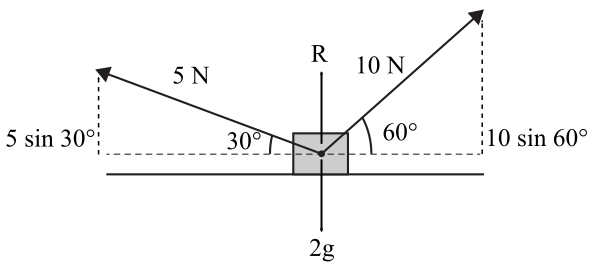
A 2 kg mass is initially at rest on a smooth horizontal surface. The mass is then acted on by two constant forces that cause the mass to move horizontally. One force has magnitude 10 N and acts in a direction 60° upwards from the horizontal, and the other force has magnitude 5 N and acts in a direction 30° upwards from the horizontal, as shown in the diagram below.
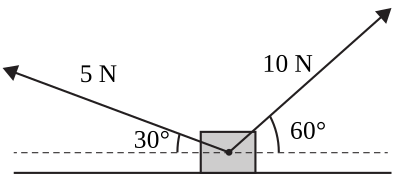
 

  1. Find the normal reaction force, in newtons, that the surface exerts on the mass.   (2 marks)
  2. Find the acceleration of the mass, in ms−2, after it begins to move.   (2 marks)
Show Answers Only

a.    `R = 2g-5/2-5 sqrt 3\ text(N)`

b.    `ddot{x} = 5/2-(5 sqrt 3)/2\ text(ms)^(-2)`

Show Worked Solution
a.  

`text{Let}\ R =\ text{normal force}`

`text(Resolving forces vertically:)`

`2g` `= 5 sin 30 + 10 sin 60 + R`
`2g` `= 5/2 + 5 sqrt 3 + R`
`R` `= 2g-5/2-5 sqrt 3\ text(N)`

 
b.
    `text{Using}\ Sigma F=m ddotx :`

  `2ddot{x}` `= 10 cos 60-5 cos 30`
  `2ddot{x}` `= 5-(5 sqrt 3)/2`
  `:.ddot{x}` `= 5/2-(5 sqrt 3)/4\ text(ms)^(-2)`

Filed Under: Forces and Further Motion in a Straight Line Tagged With: Band 4, smc-7437-40-\(\large F=m \ddot{x}\), smc-7437-50-Resolving Forces

Mechanics, EXT2 M1 2021 HSC 14b

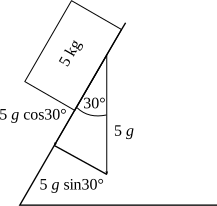
An object of mass 5 kg is on a slope that is inclined at an angle of 60° to the horizontal. The acceleration due to gravity is `g\ text(m s)^(-2)` and the velocity of the object down the slope is `v\ text(m s)^(-1)`.

As well as the force due to gravity, the object is acted on by two forces, one of magnitude `2v` newtons and one of magnitude `2v^2` newtons, both acting up the slope.

  1. Show that the resultant force down the slope is  `(5sqrt3)/2 g-2v-2v^2`  newtons.   (2 marks)

    --- 8 WORK AREA LINES (style=lined) ---

  2. There is one value of `v` such that the object will slide down the slope at a constant speed.
  3. Find this value of `v` in `text(m s)^(-1)`, correct to 1 decimal place, given that  `g = 10`.   (2 marks)

    --- 6 WORK AREA LINES (style=lined) ---

Show Answers Only

i.    `text(See Worked Solutions)`

ii.   `4.2\ \ text(ms)^-1`

Show Worked Solution

i.   

`F_s` `=\ text(force down slope)`
  `= 5g cos30-2v^2-2v`
  `= 5g · sqrt3/2-2v^2-2v`
  `= (5sqrt3)/2 g-2v^2-2v`


ii.   `text(Constant speed occurs if)\ \ a = 0`

`F_s = ma = 0`

`2v^2 + 2v-(5sqrt3)/2 xx 10` `= 0`
`2v^2 + 2v-25sqrt3` `= 0`


`v` `= (-2 + sqrt(2^2 + 4 · 2 · 25sqrt3))/(2 xx 2)`
  `= (-2 + sqrt(4 + 200sqrt3))/4`
  `= (-1 + sqrt(1 + 50 sqrt3))/2`
  `= 4.179…`
  `= 4.2\ \ text(ms)^-1\ text{(1 d.p.)}`

Filed Under: Forces and Further Motion in a Straight Line, Resisted Motion Tagged With: Band 3, Band 4, smc-1061-06-Planes/Inclined Planes, smc-1061-20-R ~ v^2, smc-1061-80-Terminal Velocity, smc-7437-40-\(\large F=m \ddot{x}\), smc-7437-50-Resolving Forces

Mechanics, EXT2 M1 2020 HSC 16a

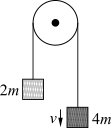
Two masses, `2m` kg and `4m` kg, are attached by a light string. The string is placed over a smooth pulley as shown.

The two masses are at rest before being released and `v` is the velocity of the larger mass at time `t` seconds after they are released.
 

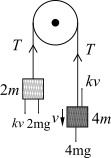
The force due to air resistance on each mass has magnitude `kv`, where `k` is a positive constant.

  1. Show that  `frac{dv}{dt} = frac{gm-kv}{3m}`.   (2 marks)

    --- 6 WORK AREA LINES (style=lined) ---

  2. Given that  `v < frac{gm}{k}`, show that when  `t = frac{3m}{k} ln 2`, the velocity of the larger mass is `frac{gm}{2k}`.   (3 marks)

    --- 12 WORK AREA LINES (style=lined) ---

Show Answers Only

i.    `text{See Worked Solutions}`

ii.   `text{See Worked Solutions}`

Show Worked Solution

i. 

♦ Mean mark part (i) 37%.

`text{Taking} \ v \ text{downwards as positive.}`

`text{Forces acting on}\ 2m\ text{mass:}`
  
`kv + 2 mg-T = -2m * frac{dv}{dt}\ …\ (1)`
  
`text{Forces acting our} \ 4m \ text{mass:}`
 
`4mg-kv-T = 4m * frac{dv}{dt}\ …\ (2)`

`text{Subtract:} \ (2)-(1)`

`2 mg-2 kv` `= 6 m * frac{dv}{dt}`
`:. frac{dv}{dt}` `= frac{2mg-2 kv}{6 m}= frac{gm-kv}{3m}`


ii.    `frac{dv}{dt}` `= frac{gm-kv}{3m}`
  `frac{dt}{dv}` `= frac{3m}{gm-kv}`
  `t` `= int frac{3m}{gm-kv}\ dv-frac{3m}{k} log_e |gm-kv | + c`

 
`text{When} \ \ t = 0, v = 0:`

`0` `= -frac{3m}{k} log_e \ | gm | + c`
`c` `= frac{3m}{k} log_e \ | gm | `
`t` `= frac{3m}{k} log_e  \ | gm | \-frac{3m}{k} log_e  \ | gm -kv |`
  `= frac{3m}{k} log_e \ | frac{mg}{gm-kv} |`

 
`text{Find} \ v\ \ text{when} \ t = frac{3m}{k} log_e 2 :`

`frac{3m}{k} log_e 2` `= frac{3m}{k} log_e | frac{gm}{gm-kv} |`
`2` `= frac{gm}{gm-kv}`
`2gm-2kv` `= gm`
`2kv` `= gm`
`therefore \ v` `= frac{gm}{2k}`

Filed Under: Forces and Further Motion in a Straight Line, Resisted Motion Tagged With: Band 4, Band 5, smc-1061-09-Pulleys, smc-7437-30-\(\large a=f(v)\), smc-7437-40-\(\large F=m \ddot{x}\), smc-7437-70-Inverse

Mechanics, EXT2 M1 2020 HSC 12a

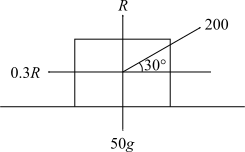
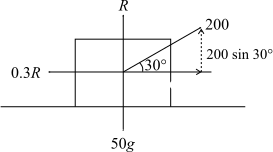
A 50-kilogram box is initially at rest. The box is pulled along the ground with a force of 200 newtons at an angle of 30° to the horizontal. The box experiences a resistive force of `0.3R` newtons, where `R` is the normal force, as shown in the diagram.

Take the acceleration `g` due to gravity to be 10m/s2.
 

  1. By resolving the forces vertically, show that  `R =400`.   (2 marks)

    --- 5 WORK AREA LINES (style=lined) ---

  2. Show that the net force horizontally is approximately 53.2 newtons.   (2 marks)

    --- 4 WORK AREA LINES (style=lined) ---

  3. Find the velocity of the box after the first three seconds.   (2 marks)

    --- 6 WORK AREA LINES (style=lined) ---

Show Answers Only

i.    `text{See Worked Solutions}`

ii.   `text{See Worked Solutions}`

iii.  `3.19 \ text{ms}^-1`

Show Worked Solution

i.   

`text{Resolving forces vertically:}`

`R + 200 \ sin 30^@` `= 50g`
`R + 200 xx frac{1}{2}` `= 50 xx 10`
`R + 100` `= 500`
`therefore \ R` `= 400 \ text(N)`

 
ii.
    `text{Resolving forces horizontally:}`

`text{Net Force}` `= 200 \ cos 30^@-0.3 R`
  `= 200 xx frac{sqrt3}{2}-0.3 xx 400`
  `= 100 sqrt3-120`
  `= 53.2 \ text{N (to 1 d. p.)}`


iii.    `F` `=ma`
  `50 a` `=100 sqrt300-120`
  `a` `= frac{100 sqrt3-120}{50}\ text(ms)^(-2)`

  
`text{Initially,}\ u = 0:`

`v` `= u + at`
`v_(t=3)` `= 0 + frac{100 sqrt3-120}{50} xx 3`
  `= 3.1923 \ …`
  `= 3.19 \ text{ms}^-1 \ text{(to 2 d.p.)}`

Filed Under: Forces and Further Motion in a Straight Line, Resisted Motion Tagged With: Band 3, Band 4, smc-1061-06-Planes/Inclined Planes, smc-1061-30-R ~ c, smc-1061-70-Newton's Law, smc-7437-40-\(\large F=m \ddot{x}\), smc-7437-50-Resolving Forces

Mechanics, EXT2 M1 EQ-Bank 23

A car and its driver has a mass of 1200 kilograms and is travelling at 90 km/h.

Calculate the magnitude of the uniform breaking force, in Newtons, required to bring the car to a stop in 40 metres.   (3 marks)

--- 10 WORK AREA LINES (style=lined) ---

Show Answers Only

`9375\ text(N)`

Show Worked Solution

`text(Let)\ \ k =\ text{Uniform breaking force (constant)}`

`text(Newton’s 2nd law:)`

`F = mddotx` `= −k`
`1200ddotx` `= −k`
`ddotx` `= −k/1200`
`v · (dv)/(dx)` `= −k/1200`
`(dv)/(dx)` `= −k/(1200v)`
`(dx)/(dv)` `= −1200/k v`
`x` `= −1200/k intv\ dv= −600/k v^2 + C`

 
`text(When)\ \ x = 0, v = (90\ 000)/(60 xx 60) = 25\ text(ms)^(−1):`

`0 = −600/k  · 25^2 + C\ \ =>\ \ C = (375\ 000)/k`

`x = (375\ 000)/k-600/k v^2`
 

`text(When)\ \ x = 40, v = 0:`

`40` `= (375\ 000)/k`  
`:. k` `= 9375\ text(N)`  

Filed Under: Forces and Further Motion in a Straight Line, Resisted Motion Tagged With: Band 4, smc-1061-06-Planes/Inclined Planes, smc-1061-30-R ~ other, smc-1061-70-Newton's Law, smc-7437-40-\(\large F=m \ddot{x}\)

Copyright © 2014–2026 SmarterEd.com.au · Log in