SmarterEd

Aussie Maths & Science Teachers: Save your time with SmarterEd

  • Login
  • Get Help
  • About

Mechanics, EXT2 EQ-Bank 30

In a circus act, an 8 kg cannon ball is projected from the origin into the air with an initial velocity of 26 m s\(^{-1}\) and at an angle of 67.4° to the horizontal. The ball is caught at the top of its trajectory by a performer who is at the position \((A, B)\).

The velocity vector, \(\mathbf{v} (t)\), of the ball at time \(t\) seconds after launch is given by

\(\mathbf{v}(t)=10 e^{-0.8 t} \mathbf{i} +\left[36.5 e^{-0.8 t}-12.5\right] \mathbf{j}\).   (Do NOT Prove this.)

  1. Show that the ball reaches the performer at  \(t=1.339\) (to three decimal places).   (2 marks)

    --- 6 WORK AREA LINES (style=lined) ---

  2. Find the values of \(A\) and \(B\).   (3 marks)

    --- 12 WORK AREA LINES (style=lined) ---

  3. What is the speed of the ball when it reaches the performer?   (1 mark)

    --- 3 WORK AREA LINES (style=lined) ---

  4. What is the magnitude of the force on the ball when it reaches the performer?   (2 marks)

    --- 8 WORK AREA LINES (style=lined) ---
Show Answers Only

a.    \(t=1.339 \ \text{s}\)

b.    \(A=8.217\ \text{m},\ \ B=13.257\ \text{m}\)

c.    \(\text{Speed}\ = 3.426\ \text{m s}^{-1}\)

d.    \(82.951 \ \text{N}\)

Show Worked Solution

a.    \(\text{At top of trajectory:}\)

\(36.5 e^{-0.8 t}-12.5\) \(=0\)
\(36.5 e^{-0.8 t}\) \(=12.5\)
\(e^{-0.8 t}\) \(=\dfrac{12.5}{36.5}\)
\(-0.8 t\) \(=\ln \dfrac{12.5}{36.5}\)
\( t\) \(=\dfrac{\ln\frac{12.5}{36.5}}{-0.8}=1.339 \ \text{s (3 d.p.)}\)


b.     \(\text{Horizontal velocity}\ =10 e^{-0.8 t}\)

\(x=\displaystyle \int 10 e^{-0.8 t}\,d t=\dfrac{10}{-0.8} e^{-0.8 t}+c_1=-12.5 e^{-0.8 t}+c_1\) 

\(\text{When} \ \ t=0, \ x=0:\)

\(0=-12.5 e^0+c_1\ \ \Rightarrow\ \ c_1=12.5\)

\(x=-12.5 e^{-0.8 t}+12.5\)
 

\(\text{When } t=1.339, \ x=A:\)

\(A=-12.5 e^{-0.8 \times 1.339}+12.5=8.217\ \text{m (3 d.p.)}\)
 

\(\text {Vertical velocity}\ =36.5 e^{-0.8 t}-12.5\)

\(y=\displaystyle \int\left(36.5 e^{-0.8 t}-12.5\right)\,d t=\dfrac{36.5}{-0.8} e^{-0.8 t}-12.5 t+c_2=-45.625 e^{-0.8 t}-12.5 t+c_2\)

\(\text{When} \ \ t=0, \ y=0:\)

\(0=-45.625+c_2\ \ \Rightarrow\ \ c_2=45.625\)

\(y=-45.625 e^{-0.8 t}-12.5 t+45.625\)
 

\(\text{When}\ \ t=1.339, \ y=B:\)

\(B=-45.625 e^{-0.8 \times 1.339}-12.5 \times 1.339+45.625=13.257\ \text{m (3 d.p.)}\)
 

c.    \(\text{At top of trajectory,}\ \mathbf{j} \text{-component of velocity = 0.}\)

\(\Rightarrow\ \text{Speed at top is the}\ \mathbf{i} \text{-component of velocity at}\ t=1.339:\)

\(\text{Speed}\ =10e^{-0.8 \times 1.339} = 3.426\ \text{m s}^{-1}\ \text{(3 d.p.)}\)
 

d.    \(\text{Using}\ \ F=m \ddot{x}:\)

\(\mathbf{v}(t)=10 e^{-0.8 t}\mathbf{i} +\left(36.5 e^{-0.8 t}-12.5\right) \mathbf{j}\)

\(\mathbf{a} =\dfrac{d v }{d t}=-8 e^{-0.8 t} \mathbf{i} -29.2 e^{-0.8 t} \mathbf{j}\)

\(\text{When} \ \ t=1.339:\)

\(\mathbf{a}=-8 e^{-0.8 \times 1.339}\mathbf{i}-29.2 e^{-0.8 \times 1.339}\mathbf{j}=-2.74 1\,\mathbf{i} -10\, \mathbf{j}\)
 

\(\text{Magnitude of acceleration}\)

\(=\sqrt{(2.741)^2+(10)^2}=10.36885 \ldots\ \text{ms}^{-2}\)
 

\(\therefore \ \text{Magnitude of force}\)

\(=8 \times 10.36885 \ldots =82.951 \ \text{N (3 d.p.)}\)

Filed Under: Projectiles and Resisted Motion Tagged With: Band 4, Band 5, smc-7442-05-Resisted Motion, smc-7442-20-Max Height, smc-7442-92-Vectors

Mechanics, EXT2 M1 2023 HSC 13c

A particle of mass 1 kg is projected from the origin with speed 40 m s\( ^{-1}\) at an angle 30° to the horizontal plane.

  1. Use the information above to show that the initial velocity of the particle is
  2.     \(\mathbf{v}(0)={\displaystyle\left(\begin{array}{cc}20 \sqrt{3} \\ 20\end{array}\right)} \).   (1 mark)

    --- 6 WORK AREA LINES (style=lined) ---

The forces acting on the particle are gravity and air resistance. The air resistance is proportional to the velocity vector with a constant of proportionality 4 . Let the acceleration due to gravity be 10 m s \( ^{-2}\).

The position vector of the particle, at time \(t\) seconds after the particle is projected, is \(\mathbf{r}(t)\) and the velocity vector is \(\mathbf{v}(t)\).
 

  1. Show that  \(\mathbf{v}(t)={\displaystyle \left(\begin{array}{cc}20 \sqrt{3} e^{-4 t} \\ \dfrac{45}{2} e^{-4 t}-\dfrac{5}{2}\end{array}\right)}\)  (3 marks)

    --- 12 WORK AREA LINES (style=lined) ---

  2. Show that  \(\mathbf{r}(t)=\left(\begin{array}{c}5 \sqrt{3}\left(1-e^{-4 t}\right) \\ \dfrac{45}{8}\left(1-e^{-4 t}\right)-\dfrac{5}{2} t\end{array}\right)\)  (2 marks)

    --- 10 WORK AREA LINES (style=lined) ---

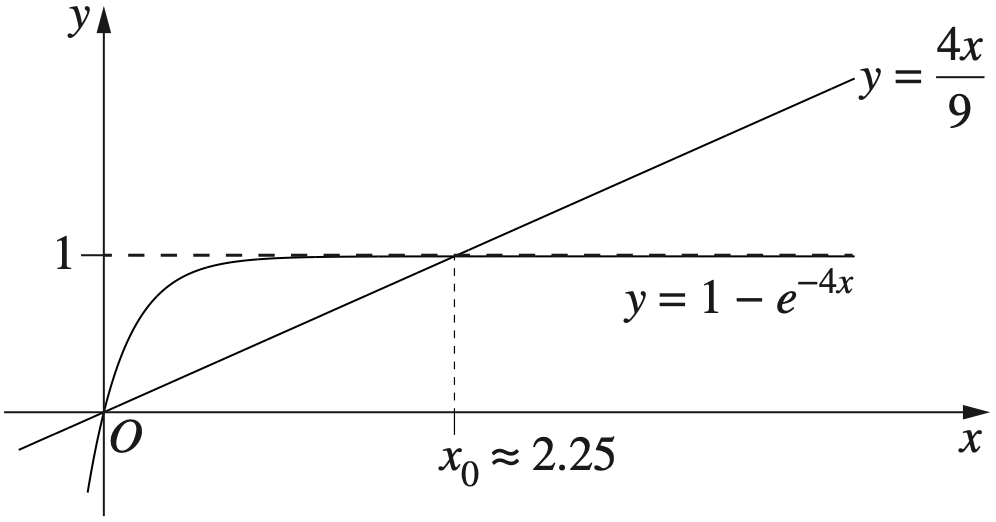
  3. The graphs  \(y=1-e^{-4 x}\)  and  \(y=\dfrac{4 x}{9}\) are given in the diagram below.
     
     
  4. Using the diagram, find the horizontal range of the particle, giving your answer rounded to one decimal place.  (2 marks)

    --- 7 WORK AREA LINES (style=lined) ---

Show Answers Only

  1. \(\text{Proof (See Worked Solutions)}\)
  2. \(\text{Proof (See Worked Solutions)}\)
  3. \(\text{Proof (See Worked Solutions)}\)
  4. \(8.7\ \text{metres}\)

Show Worked Solution

i. 

\(\underset{\sim}{v}(0)={\displaystyle\left(\begin{array}{cc} 40 \cos\ 30° \\ 40 \sin\ 30°\end{array}\right)} = {\displaystyle\left(\begin{array}{cc} 40 \times \frac{\sqrt3}{2} \\ 40 \times \frac{1}{2}\end{array}\right)}  = {\displaystyle\left(\begin{array}{cc}20 \sqrt{3} \\ 20\end{array}\right)} \)
 

ii.   \(\text{Air resistance:} \)

\(\underset{\sim}{F} = -4\underset{\sim}{v} = {\displaystyle\left(\begin{array}{cc} -4\dot{x} \\ -4\dot{y} \end{array}\right)} \)

\(\text{Horizontally:}\)

\(1 \times \ddot{x} \) \(=-4 \dot{x} \)  
\(\dfrac{d\dot{x}}{dt}\) \(=-4\dot{x}\)  
\(\dfrac{dt}{d\dot{x}}\) \(= -\dfrac{1}{4\dot{x}} \)  
\(t\) \(=-\dfrac{1}{4} \displaystyle \int \dfrac{1}{\dot{x}} \ d\dot{x} \)  
\(-4t\) \(=\ln |\dot{x}|+c \)  

 
\(\text{When}\ \ t=0, \ \dot{x}=20\sqrt3 \ \ \Rightarrow\ \ c=-\ln{20\sqrt3} \)

\(-4t\) \(=\ln|\dot{x}|-\ln 20\sqrt3 \)  
\(-4t\) \(=\ln\Bigg{|}\dfrac{\dot{x}}{20\sqrt{3}} \Bigg{|} \)  
\(\dfrac{\dot{x}}{20\sqrt{3}} \) \(=e^{-4t} \)  
\(\dot{x}\) \(=20\sqrt{3}e^{-4t}\)  

 
\(\text{Vertically:} \)

\(1 \times \ddot{y} \) \(=-1 \times 10-4 \dot{y} \)  
\(\dfrac{d\dot{y}}{dt}\) \(=-(10+4\dot{y})\)  
\(\dfrac{dt}{d\dot{y}}\) \(= -\dfrac{1}{10+4\dot{y}} \)  
\(t\) \(=- \displaystyle \int \dfrac{1}{10+4\dot{y}} \ d\dot{y} \)  
\(-4t\) \(=- \displaystyle \int \dfrac{4}{10+4\dot{y}} \ d\dot{y} \)  
\(-4t\) \(=\ln |10+4\dot{y}|+c \)  

 
\(\text{When}\ \ t=0, \ \dot{y}=20 \ \ \Rightarrow\ \ c=-\ln{90} \)

\(-4t\) \(=\ln|10+4\dot{y}|-\ln 90 \)  
\(-4t\) \(=\ln\Bigg{|}\dfrac{10+4\dot{y}}{\ln{90}} \Bigg{|} \)  
\(\dfrac{10+4\dot{y}}{90} \) \(=e^{-4t} \)  
\(4\dot{y}\) \(=90e^{-4t}-10\)  
\(\dot{y}\) \(=\dfrac{45}{2} e^{-4t}-\dfrac{5}{2} \)  

 
\(\therefore \underset{\sim}v={\displaystyle \left(\begin{array}{cc}20 \sqrt{3} e^{-4 t} \\ \dfrac{45}{2} e^{-4 t}-\dfrac{5}{2}\end{array}\right)}\) 

 
iii.
   \(\text{Horizontally:}\)

\(x\) \(= \displaystyle \int \dot{x}\ dx\)  
  \(= \displaystyle \int 20\sqrt3 e^{-4t}\ dt \)  
  \(=-5\sqrt3 e^{-4t}+c \)  

 
\(\text{When}\ \ t=0, \ x=0\ \ \Rightarrow\ \ c=5\sqrt3 \)

\(x\) \(=5\sqrt3-5\sqrt3 e^{-4t} \)  
  \(=5\sqrt3(1-e^{-4t}) \)  

 
\(\text{Vertically:}\)

\(y\) \(= \displaystyle \int \dot{y}\ dx\)  
  \(= \displaystyle \int \dfrac{45}{2} e^{-4t}-\dfrac{5}{2}\ dt \)  
  \(=-\dfrac{45}{8}e^{-4t}-\dfrac{5}{2}t+c \)  

 
\(\text{When}\ \ t=0, \ y=0\ \ \Rightarrow\ \ c= \dfrac{45}{8} \)

\(y\) \(=\dfrac{45}{8}-\dfrac{45}{8} e^{-4t}-\dfrac{5}{2}t \)  
  \(=\dfrac{45}{8}(1-e^{-4t})-\dfrac{5}{2} \)  

 
\(\therefore \underset{\sim}{r}=\left(\begin{array}{c}5 \sqrt{3}\left(1-e^{-4 t}\right) \\ \dfrac{45}{8}\left(1-e^{-4 t}\right)-\dfrac{5}{2} t\end{array}\right)\)
 

iv.   \(\text{Range}\ \Rightarrow\ \text{Find}\ \ t\ \ \text{when}\ \ y=0: \)

\(\dfrac{45}{8}(1-e^{-4t})-\dfrac{5}{2}t \) \(=0\)  
\(\dfrac{45}{8}(1-e^{-4t}) \) \(=\dfrac{5}{2}t \)  
\(1-e^{-4t}\) \(=\dfrac{4}{9}t \)  

 
\(\text{Graph shows intersection of these two graphs.}\)

\(\Rightarrow \text{Solution when}\ \ t\approx 2.25\)

\(\therefore\ \text{Range}\) \(=5\sqrt3(1-e^{(-4 \times 2.25)}) \)  
  \(=8.659…\)  
  \(=8.7\ \text{metres (to 1 d.p.)}\)  

♦ Mean mark (iv) 43%.
 

Filed Under: Projectiles and Resisted Motion, Resisted Motion Tagged With: Band 3, Band 4, Band 5, smc-1061-05-Projectile Motion, smc-1061-10-R ~ v, smc-1061-60-Time of Travel / Distance, smc-1061-95-Vectors, smc-7442-05-Resisted Motion

Mechanics, EXT2 M1 2022 HSC 8 MC

As a projectile of mass `m` kilograms travels through air, it experiences a frictional force. The magnitude of this force is proportional to the square of the speed `v` of the projectile. The constant of proportionality is the positive number `k`. The position of the particle at time `t` is denoted by `([x],[y])`. The acceleration due to gravity is `g \ text{m s}^(-2)`.

Based on Newton's laws of motion, which equation models the motion of this projectile?

  1. `([0],[-mg])+kv([overset.x],[overset.y])=m([overset{..}x],[overset{..}y])`
  2. `([0],[-mg])-kv([overset.x],[overset.y])=m([overset{..}x],[overset{..}y])`
  3. `([0],[-mg])+kv^(2)([overset.x],[overset.y])=m([overset{..}x],[overset{..}y])`
  4. `([0],[-mg])-kv^(2)([overset.x],[overset.y])=m([overset{..}x],[overset{..}y])`
Show Answers Only

`B`

Show Worked Solution

`text{Friction}\ (F)\ text{works against velocity}`

`:.\ F prop v^2\ \ =>\ \ F=-kv^2\ \ (k>0)`

`text{→ Eliminate A and C}`


♦♦♦ Mean mark 26%.

`text{S}text{ince}\ \ v=abs(((dotx),(doty))):`

`- abs(kv((dotx),(doty))) = -kv abs(((dotx),(doty)))=-kv^2`

`=>B`

Filed Under: Projectiles and Resisted Motion, Resisted Motion Tagged With: Band 6, smc-7442-05-Resisted Motion

Copyright © 2014–2026 SmarterEd.com.au · Log in