SmarterEd

Aussie Maths & Science Teachers: Save your time with SmarterEd

  • Login
  • Get Help
  • About

v1 Algebra, STD2 A4 2021 HSC 24

A population of Tasmanian devils, `D`, is to be modelled using the function  `D = 650 (0.8)^t`, where `t` is the time in years.

  1. What is the initial population?   (1 mark)

    --- 2 WORK AREA LINES (style=lined) ---

  2. Find the population after 2 years.   (1 mark)

    --- 2 WORK AREA LINES (style=lined) ---

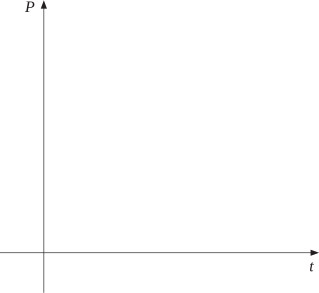
  3. On the axes below, draw the graph of the population against time, in the period  `t = 0`  to  `t = 6`.   (2 marks)
      

    --- 0 WORK AREA LINES (style=lined) ---

Show Answers Only

a.   `650`

b.   `416`

c.   `text{See Worked Solutions}`

Show Worked Solution

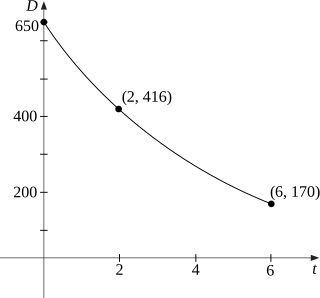
a.   `text{Initial population occurs when}\ \  t = 0:`

`D=650(0.8)^0=650 xx 1= 650`
 

b.    `text{Find} \ D \ text{when} \ \ t = 2: `

`D= 650 (0.8)^2= 416`

♦ Mean mark (c) 48%.

 
c. 
 `\text{At}\ t=6:`

`D=650(0.8)^6=170.39…`
 

Filed Under: Exponential Functions (Y12-X), Non-Linear: Exponential/Quadratics (Std 2-X) Tagged With: Band 3, Band 4, Band 5, smc-7719-10-\(y=ka^{x}\), smc-7719-40-Draw Graph

v1 Algebra, STD2 A4 2021 HSC 10 MC

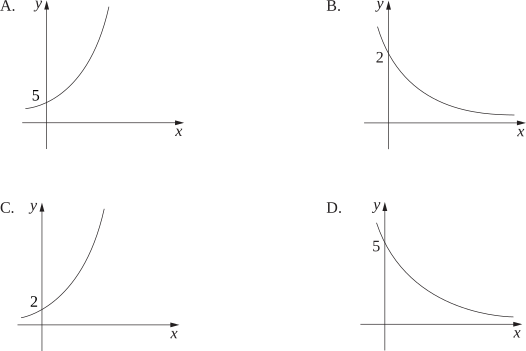
Which of the following best represents the graph of  \(y = 5 (0.4)^{x}\) ?
 

Show Answers Only

\(D\)

Show Worked Solution

\(\text{By elimination:}\)

♦ Mean mark 41%.

\(\text{When}\  x = 0, \ y = 5 \times (0.4)^0 = 5\)

\(\rightarrow\ \text{Eliminate B and C} \)

\(\text{As}\ \ x \rightarrow \infty, \ y \rightarrow 0 \)

\(\rightarrow\ \text{Eliminate A} \)

\(\Rightarrow D\)

Filed Under: Exponential Functions (Y12-X), Non-Linear: Exponential/Quadratics (Std 2-X) Tagged With: Band 5, smc-5238-10-Exponentials, smc-7719-10-\(y=ka^{x}\)

Copyright © 2014–2026 SmarterEd.com.au · Log in