SmarterEd

Aussie Maths & Science Teachers: Save your time with SmarterEd

  • Login
  • Get Help
  • About

Algebra, STD2 EO-Bank 30

The number of monthly subscribers \((S)\) to a print magazine is decreasing. The number of subscribers is modelled using

\(S=k(1.06)^{-t}\)  for  \( t \geq 0,\)

where \(t\) is time in months.

The number of subscribers today is 12 000.

  1. Use the model to estimate the number of subscribers 10 months from today.   (2 marks)

    --- 5 WORK AREA LINES (style=lined) ---

  2. The number of subscribers needs to always be above 3000.
  3. Explain why this model is NOT appropriate to use in this case.   (1 mark)

    --- 3 WORK AREA LINES (style=lined) ---
Show Answers Only

a.    \(S=12\,000(1.06)^{-10}=6700.73…=6701\ \text{(nearest subscriber)}\)

b.    \(\text{When}\ \ t=30\ \ \Rightarrow\ \ S \approx 2089\)

\(\text{Since the number of subscribers needs to always be over 3000, it is not appropriate.}\)

Show Worked Solution

a.    \(\text{When}\ \ t=0,\ \ S=12\,000:\)

\(12\,000=k(1.06)^{0}\ \ \Rightarrow\ \ k=12\,000\)

\(\text{Find}\ S\ \text{when}\ \ t=10:\)

\(S=12\,000(1.06)^{-10}=6700.73…=6701\ \text{(nearest subscriber)}\)
 

b.    \(\text{When}\ \ t=30:\)

\(S=12\,000(1.06)^{-30} \approx 2089\)

\(\text{Since the number of subscribers needs to always be over 3000, it is not appropriate.}\)

Filed Under: Exponential Functions (Y12-X), Non-Linear: Exponential/Quadratics (Std 2-X) Tagged With: Band 4, Band 5, smc-7719-20-\(y=ka^{-x}\), smc-7719-50-Model Limits

Algebra, STD2 EO-Bank 29

The number \((N)\) of native birds in a wildlife reserve is decreasing. The number of birds is modelled using

\(N=k(1.08)^{-t}\)  for \( t \geq 0,\)

where \(t\) is time in years.

The number of birds in the reserve today is 8000.

  1. Use the model to estimate the number of birds in the reserve 12 years from today.   (2 marks)

    --- 5 WORK AREA LINES (style=lined) ---

  2. The number of birds in the reserve needs to always be above 1500.
  3. Explain why this model is NOT appropriate to use in this case.   (1 mark)

    --- 3 WORK AREA LINES (style=lined) ---
Show Answers Only

a.    \(N=8000(1.08)^{-12}=3176.91…=3177\ \text{(nearest bird)}\)

b.    \(\text{When}\ \ t=25:\)

\(N=8000(1.08)^{-25}=1168.14…\)

\(\text{Since the number of birds needs to always be over 1500, it is not appropriate.}\)

Show Worked Solution

a.    \(\text{When}\ \ t=0,\ \ N=8000:\)

\(8000=k(1.08)^{0}\ \ \Rightarrow\ \ k=8000\)

\(\text{Find}\ N\ \text{when}\ \ t=12:\)

\(N=8000(1.08)^{-12}=3176.91…=3177\ \text{(nearest bird)}\)
 

b.    \(\text{When}\ \ t=25:\)

\(N=8000(1.08)^{-25}=1168.14…\)

\(\text{Since the number of birds needs to always be over 1500, it is not appropriate.}\)

Filed Under: Exponential Functions (Y12-X), Non-Linear: Exponential/Quadratics (Std 2-X) Tagged With: Band 4, Band 5, smc-7719-20-\(y=ka^{-x}\), smc-7719-50-Model Limits

Algebra, STD2 A4 2021 HSC 24 (Adapted)

A population of Tasmanian devils, `D`, is to be modelled using the function  `D = 650 (0.8)^t`, where `t` is the time in years.

  1. What is the initial population?   (1 mark)

    --- 2 WORK AREA LINES (style=lined) ---

  2. Find the population after 2 years.   (1 mark)

    --- 2 WORK AREA LINES (style=lined) ---

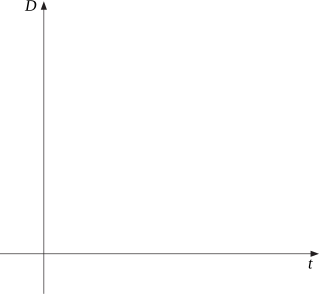
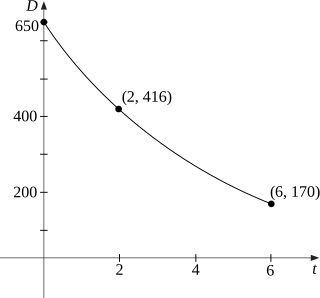
  3. On the axes below, draw the graph of the population against time, in the period  `t = 0`  to  `t = 6`.   (2 marks)
      

    --- 0 WORK AREA LINES (style=lined) ---

Show Answers Only

a.   `650`

b.   `416`

c.   `text{See Worked Solutions}`

Show Worked Solution

a.   `text{Initial population occurs when}\ \  t = 0:`

`D=650(0.8)^0=650 xx 1= 650`
 

b.    `text{Find} \ D \ text{when} \ \ t = 2: `

`D= 650 (0.8)^2= 416`

♦ Mean mark (c) 48%.

 
c. 
 `\text{At}\ t=6:`

`D=650(0.8)^6=170.39…`
 

Filed Under: Exponential Functions (Y12-X), Non-Linear: Exponential/Quadratics (Std 2-X) Tagged With: adapted, Band 3, Band 4, Band 5, smc-7719-10-\(y=ka^{x}\), smc-7719-40-Draw Graph

Algebra, STD2 A4 2021 HSC 10 MC (Adapted)

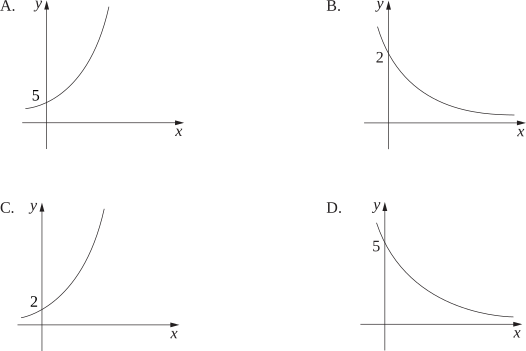
Which of the following best represents the graph of  \(y = 5 (0.4)^{x}\) ?
 

Show Answers Only

\(D\)

Show Worked Solution

\(\text{By elimination:}\)

♦ Mean mark 41%.

\(\text{When}\  x = 0, \ y = 5 \times (0.4)^0 = 5\)

\(\rightarrow\ \text{Eliminate B and C} \)

\(\text{As}\ \ x \rightarrow \infty, \ y \rightarrow 0 \)

\(\rightarrow\ \text{Eliminate A} \)

\(\Rightarrow D\)

Filed Under: Exponential Functions (Y12-X), Non-Linear: Exponential/Quadratics (Std 2-X) Tagged With: adapted, Band 5, smc-5238-10-Exponentials, smc-7719-10-\(y=ka^{x}\)

Copyright © 2014–2026 SmarterEd.com.au · Log in