SmarterEd

Aussie Maths & Science Teachers: Save your time with SmarterEd

  • Login
  • Get Help
  • About

Statistics, STD2 S4 2022 HSC 35

Jo is researching the relationship between the ages of teenage characters in television series and the ages of actors playing these characters.

After collecting the data, Jo finds that the correlation coefficient is 0.4564.

A scatterplot showing the data is drawn. The line of best fit with equation  `y=-7.51+1.85 x`, is also drawn.
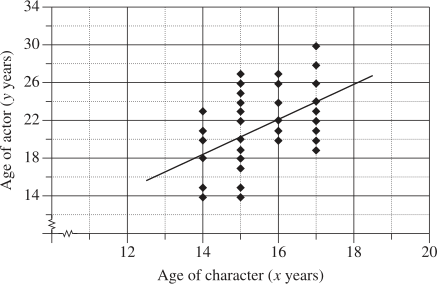


Describe and interpret the data and other information provided, with reference to the context given.  (4 marks)

--- 8 WORK AREA LINES (style=lined) ---
Show Answers Only

`text{Correlation coefficient}\ (r) = 0.4564`

    • `text{Moderate and positive correlation}`

`text{Gradient of LOBF}\ = 1.85`

    • `text{On average, each extra year of a character’s age results}`
      `text{in the actor being 1.85 years older.}`

`text{Mode of data set = 15 years}`
  

`text{Limitations}`

    • `text{Data set is very restricted with just a 4 year range of}`
      `text{character ages.}`
    • `text{LOBF not useful when extrapolated to the left as it drops}`
      `text{below zero (on y-axis).}`
    • `text{Relationship describes correlation only, not causation.}`
Show Worked Solution

`text{Correlation coefficient}\ (r) = 0.4564`

    • `text{Moderate and positive correlation}`

`text{Gradient of LOBF}\ = 1.85`

    • `text{On average, each extra year of a character’s age results}`
      `text{in the actor being 1.85 years older.}`

`text{Mode of data set = 15 years}`
  

`text{Limitations}`

    • `text{Data set is very restricted with just a 4 year range of}`
      `text{character ages.}`
    • `text{LOBF not useful when extrapolated to the left as it drops}`
      `text{below zero (on y-axis).}`
    • `text{Relationship describes correlation only, not causation.}`

♦♦ Mean mark 30%.

Filed Under: S4 Bivariate Data Analysis (Y12) Tagged With: 2adv-std2-common, Band 5, common-content, smc-785-30-Correlation, smc-785-50-Gradient Interpretation, smc-785-60-Limitations

Statistics, STD2 S4 2021 HSC 33

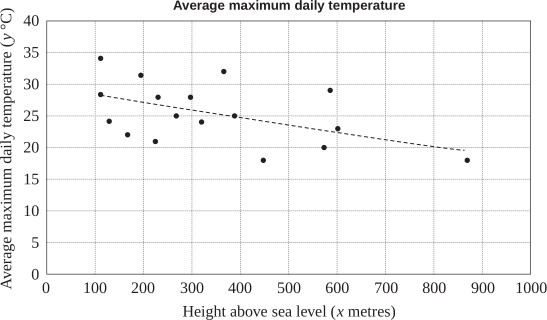
For a sample of 17 inland towns in Australia, the height above sea level, `x` (metres), and the average maximum daily temperature, `y` (°C), were recorded.

The graph shows the data as well as a regression line.


The equation of the regression line is  `y = 29.2 − 0.011x`.

The correlation coefficient is  `r = –0.494`.

  1. i.  By using the equation of the regression line, predict the average maximum daily temperature, in degrees Celsius, for a town that is 540 m above sea level. Give your answer correct to one decimal place.  (1 mark)

    --- 1 WORK AREA LINES (style=lined) ---
  2. ii. The gradient of the regression line is −0.011. Interpret the value of this gradient in the given context.  (2 marks)

    --- 4 WORK AREA LINES (style=lined) ---
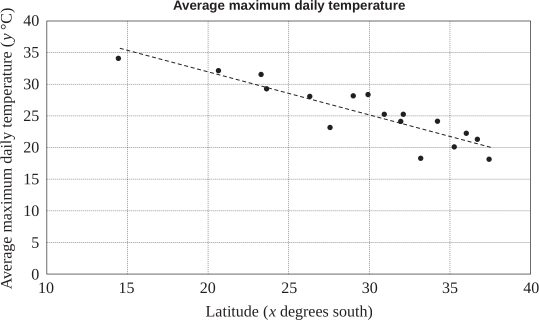
  3. The graph below shows the relationship between the latitude, `x` (degrees south), and the average maximum daily temperature, `y` (°C), for the same 17 towns, as well as a regression line.


    The equation of the regression line is  `y = 45.6 − 0.683x`.
  4. The correlation coefficient is  `r = − 0.897`.
  5. Another inland town in Australia is 540 m above sea level. Its latitude is 28 degrees south.
  6. Which measurement, height above sea level or latitude, would be better to use to predict this town’s average maximum daily temperature? Give a reason for your answer.  (1 mark)

    --- 2 WORK AREA LINES (style=lined) ---
Show Answers Only
  1. i.  `23.3°text(C)`
  2. ii. `text(See Worked Solutions)`
  3. `text(Latitude. Correlation coefficient shows a stronger relationship.)`
Show Worked Solution
a.i.    `y` `=29.2 – 0.011(540)`
    `=23.26`
    `=23.3°text{C  (1 d.p.)`
♦♦ Mean mark part a.ii. 28%.

 
a.ii.
  `text(On average, the average maximum daily temperature of)`

`text(inland towns drops by 0.011 of a degree for every metre)`

`text(above sea level the town is situated.)`
 

♦♦♦ Mean mark part b 18%.

b.  `text(The correlation co-efficient of the regression line using)`

`text(latitude is significantly stronger than the equivalent)`

`text(co-efficient for the regression line using height above sea)`

`text(level.)`

`:.\ text(The equation using latitude is preferred.)`

Filed Under: S4 Bivariate Data Analysis (Y12) Tagged With: 2adv-std2-common, Band 4, Band 5, Band 6, common-content, smc-785-20-Least-Squares Regression Line, smc-785-30-Correlation, smc-785-50-Gradient Interpretation

Statistics, STD2 S4 EQ-Bank 4

Ten high school students have their height and the length of their right foot measured.

The results are recorded in the table below.


  1. Using technology, calculate Pearson's correlation coefficient for the data. Give your answer to 3 decimal places.  (1 mark)

    --- 1 WORK AREA LINES (style=lined) ---

  2. Describe the strength of the association between height and length of right foot for these students.  (1 mark)

    --- 2 WORK AREA LINES (style=lined) ---
  3. Using technology, determine the least squares regression line that allows height to be predicted from right foot length.  (1 mark)

    --- 1 WORK AREA LINES (style=lined) ---

Show Answers Only
  1. `0.941\ \ (text(to 3 d.p.))`
  2. `text(The association is positive and strong.)`
  3. `text(Height) =47.4 + 4.7 xx text(foot length)`
Show Worked Solution

i.   `text(By calculator,)`

COMMENT: Issues here? YouTube has short and excellent help videos – search your calculator model and topic – eg. “fx-82 correlation” .

`r` `= 0.94095…`
  `= 0.941\ \ (text(to 3 d.p.))`


ii.   `text(The association is positive and strong.)`


iii.   `x\ text(value ⇒ foot length (independent variables))`

`y\ text(value ⇒ height.)`

`text(By calculator:)`

`text(Height) = 47.4 + 4.7 xx text(foot length)`

Filed Under: Bivariate Data Analysis (Y12), S4 Bivariate Data Analysis (Y12) Tagged With: Band 4, common-content, smc-1001-20-Least-Squares Regression Line, smc-1001-30-Correlation, smc-1001-40-Pearson's, smc-1001-70-Calculator (Stats Mode), smc-785-20-Least-Squares Regression Line, smc-785-30-Correlation, smc-785-40-Pearson's, smc-785-70-Calculator (Stats Mode)

Statistics, STD2 S4 2019 HSC 23

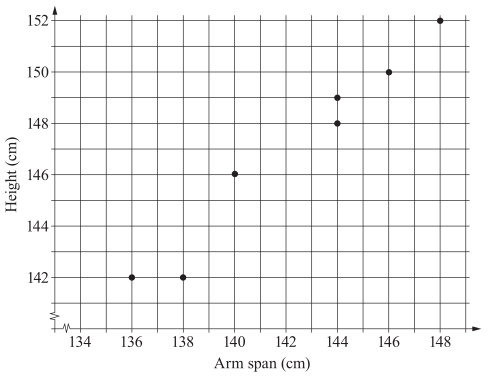
A set of bivariate data is collected by measuring the height and arm span of seven children. The graph shows a scatterplot of these measurements.


  1. Calculate Pearson's correlation coefficient for the data, correct to two decimal places.  (1 mark)

    --- 1 WORK AREA LINES (style=lined) ---
  2. Identify the direction and the strength of the linear association between height and arm span.  (1 mark)

    --- 2 WORK AREA LINES (style=lined) ---
  3. The equation of the least-squares regression line is shown.
     
               Height = 0.866 × (arm span) + 23.7
     
    A child has an arm span of 143 cm.


    Calculate the predicted height for this child using the equation of the least-squares regression line.  (1 mark)

    --- 1 WORK AREA LINES (style=lined) ---

Show Answers Only
  1. `0.98\ \ (text(2 d.p.))`
  2. `text(Direction: positive)`
    `text(Strength: strong)`
  3. `147.538\ text(cm)`
Show Worked Solution

a.   `text{Use  “A + Bx”  function (fx-82 calc):}`

♦ Mean mark 40%.
COMMENT: Issues here? YouTube has short and excellent help videos – search your calculator model and topic – eg. “fx-82 correlation” .

`r` `= 0.9811…`
  `= 0.98\ \ (text(2 d.p.))`


b.   `text(Direction: positive)`

`text(Strength: strong)`


c.    `text(Height)` `= 0.866 xx 143 + 23.7`
    `= 147.538\ text(cm)`

Filed Under: Bivariate Data Analysis (Y12), S4 Bivariate Data Analysis (Y12) Tagged With: Band 3, Band 4, Band 5, common-content, smc-1001-30-Correlation, smc-1001-40-Pearson's, smc-1001-70-Calculator (Stats Mode), smc-785-30-Correlation, smc-785-40-Pearson's, smc-785-70-Calculator (Stats Mode)

Statistics, STD2 S4 SM-Bank 1

A student claimed that as time spent swimming training increases, the time to run a 1 kilometre time trial decreases.

After collecting and analysing some data, the student found the correlation coefficient, `r`, to be – 0.73.

What does this correlation indicate about the relationship between the time a student spends swimming training and their 1 kilometre run time trial times.  (1 mark)

Show Answers Only

`text(– 0.73 indicates a strong negative relationship exists.)`

`text(In this case, it means the more time spent swimming)`

`text(training is associated with a quicker time of running a)`

`text(1 kilometre time trial.)`

Show Worked Solution

`text(– 0.73 indicates a strong negative relationship exists.)`

`text(In this case, it means the more time spent swimming)`

`text(training is associated with a quicker time of running a)`

`text(1 kilometre time trial.)`

Filed Under: Bivariate Data Analysis (Y12), S4 Bivariate Data Analysis (Y12) Tagged With: Band 3, common-content, smc-1001-30-Correlation, smc-785-30-Correlation

Statistics, STD2 S4 2017 HSC 12 MC

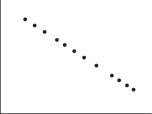
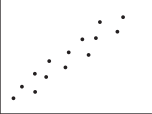
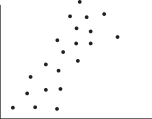
Which of the data sets graphed below has the largest positive correlation coefficient value?
 

A.      B.     
C.      D.     
Show Answers Only

\(C\)

Show Worked Solution

\(\text{Largest positive correlation occurs when both variables move}\)

\(\text{in tandem. The tighter the linear relationship, the higher the}\)

\(\text{correlation.}\)

\(\Rightarrow C\)

\(\text{(Note that B is negatively correlated)}\)

Filed Under: Bivariate Data, Bivariate Data Analysis (Y12), Correlation / Body Measurements, S3 Further Statistical Analysis (Y12), S4 Bivariate Data Analysis (Y12) Tagged With: Band 3, common-content, num-title-ct-coreb, num-title-qs-hsc, smc-1001-30-Correlation, smc-1113-30-Correlation, smc-5022-30-Correlation, smc-785-30-Correlation

Statistics, STD2 S4 2016 HSC 3 MC

The graph shows a scatterplot for a set of data.
 

2ug-2016-hsc-3-mc 

 
Which of the following is the best approximation for the correlation coefficient of this set of data?

  1.    `−1`
  2.    `−0.3`
  3.    `0.3`
  4.    `1`
Show Answers Only

`B`

Show Worked Solution

`text(Correlation is negative and)`

`text(weak.)`

`=> B`

Filed Under: Bivariate Data Analysis (Y12), Correlation / Body Measurements, S4 Bivariate Data Analysis (Y12) Tagged With: Band 4, common-content, smc-1001-30-Correlation, smc-785-30-Correlation

Statistics, STD2 S4 2015 HSC 28e

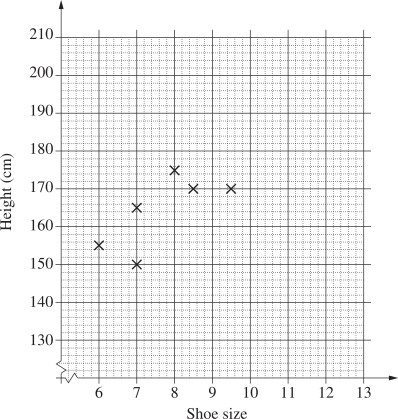
The shoe size and height of ten students were recorded.

\begin{array} {|l|c|c|}
\hline \rule{0pt}{2.5ex} \text{Shoe size} \rule[-1ex]{0pt}{0pt} & \text{6} & \text{7} & \text{7} & \text{8} & \text{8.5} & \text{9.5} & \text{10} & \text{11} & \text{12} & \text{12} \\
\hline \rule{0pt}{2.5ex} \text{Height} \rule[-1ex]{0pt}{0pt} & \text{155} & \text{150} & \text{165} & \text{175} & \text{170} & \text{170} & \text{190} & \text{185} & \text{200} & \text{195} \\
\hline
\end{array}

  1. Complete the scatter plot AND draw a line of fit by eye.  (2 marks)
     
     
  2. Use the line of fit to estimate the height difference between a student who wears a size 7.5 shoe and one who wears a size 9 shoe.  (1 mark)

    --- 1 WORK AREA LINES (style=lined) ---

  3. A student calculated the correlation coefficient to be 1 for this set of data. Explain why this cannot be correct.  (1 mark)

    --- 2 WORK AREA LINES (style=lined) ---
Show Answers Only
  1. `text(See Worked Solutions.)`
  2. `13\ text{cm  (or close given LOBF drawn)}
  3. `text(A correlation co-efficient of 1 would)`
    `text(mean that all data points occur on the)`
    `text(line of best fit which clearly isn’t the case.)`
Show Worked Solution

i.    
      2UG 2015 28e Answer

ii.   `text{Shoe size 7½ gives a height estimate of 162 cm (see graph)}`

`text{Shoe size 9 gives a height estimate of 175 cm (see graph)}`

`:.\ text(Height difference)` `= 175-162`
  `= 13\ text{cm  (or close given LOBF drawn)}`


iii.   `text(A correlation co-efficient of 1 would mean)`

♦ Mean mark (c) 39%.

`text(that all data points occur on the line of best)`

`text(fit which clearly isn’t the case.)`

Filed Under: Bivariate Data Analysis (Y12), Correlation / Body Measurements, S3 Further Statistical Analysis (Y12), S4 Bivariate Data Analysis (Y12) Tagged With: Band 4, Band 5, common-content, smc-1001-10-Line of Best Fit, smc-1001-30-Correlation, smc-1113-10-Line of Best Fit, smc-1113-20-Scatterplot from Table, smc-1113-30-Correlation, smc-785-10-Line of Best Fit, smc-785-30-Correlation

Statistics, STD2 S4 2006 HSC 27b

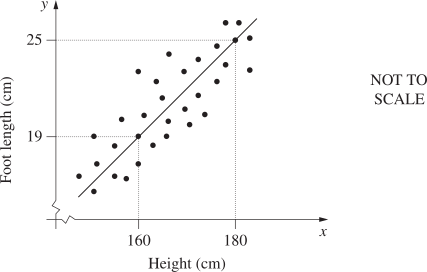
Each member of a group of males had his height and foot length measured and recorded. The results were graphed and a line of fit drawn.
 

  1. Why does the value of the `y`-intercept have no meaning in this situation?  (1 mark)

    --- 2 WORK AREA LINES (style=lined) ---

  2. George is 10 cm taller than his brother Harry. Use the line of fit to estimate the difference in their foot lengths.  (1 mark)

    --- 2 WORK AREA LINES (style=lined) ---

  3. Sam calculated a correlation coefficient of  −1.2  for the data. Give TWO reasons why Sam must be incorrect.  (2 marks)

    --- 5 WORK AREA LINES (style=lined) ---

Show Answers Only
  1. `text(The y-intercept occurs when)\ x = 0.\ text(It has`
    `text(no meaning to have a height of 0 cm.)`
  2. `text(A 10 cm height difference means George should)`
    `text(have a 3 cm longer foot.)`
  3. `text(A correlation co-efficient must be between –1 and 1.)`
    `text(Foot length is positively correlated to a person’s)`
    `text(height and therefore can’t be a negative value.)`
Show Worked Solution

i.  `text(The y-intercept occurs when)\ x = 0.\ text(It has)`

`text(no meaning to have a height of 0 cm.)`


ii.  `text(A 20 cm height difference results in a foot length)`

`text(difference of 6 cm.)`
 

`:.\ text(A 10 cm height difference means George should)`

`text(have a 3 cm longer foot.)`


iii.  `text(A correlation co-efficient must be between –1 and 1.)`

`text(Foot length is positively correlated to a person’s)`

`text(height and therefore isn’t a negative value.)`

Filed Under: Bivariate Data Analysis (Y12), Correlation / Body Measurements, S3 Further Statistical Analysis (Y12), S4 Bivariate Data Analysis (Y12) Tagged With: Band 4, Band 5, Band 6, common-content, smc-1001-10-Line of Best Fit, smc-1001-30-Correlation, smc-1113-10-Line of Best Fit, smc-1113-30-Correlation, smc-785-10-Line of Best Fit, smc-785-30-Correlation

Statistics, STD2 S4 2007 HSC 9 MC

Which of the following would be most likely to have a positive correlation?

  1. The population of a town and the number of schools in that town
  2. The price of petrol per litre and the number of litres of petrol sold
  3. The hours training for a marathon and the time taken to complete the marathon
  4. The number of dogs per household and the number of televisions per household
Show Answers Only

\(A\)

Show Worked Solution

\(\text{Positive correlation means that as one variable increases,}\)

\(\text{the other tends to increase also.}\)

\(\Rightarrow A\)

Filed Under: Bivariate Data, Bivariate Data Analysis (Y12), Correlation / Body Measurements, S3 Further Statistical Analysis (Y12), S4 Bivariate Data Analysis (Y12) Tagged With: Band 4, common-content, num-title-ct-coreb, num-title-qs-hsc, smc-1001-30-Correlation, smc-1113-30-Correlation, smc-5022-35-Causality, smc-785-30-Correlation

Statistics, STD2 S4 2008 HSC 12 MC

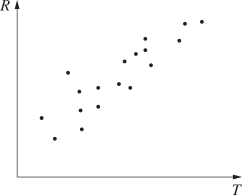
A scatterplot is shown.
 

Which of the following best describes the correlation between  \(R\)  and  \(T\)?

  1. Positive
  2. Negative 
  3. Positively skewed
  4. Negatively skewed
Show Answers Only

\(A\)

Show Worked Solution

\(\text{Correlation is positive.}\)

\(\text{NB. The skew does not directly relate to correlation.}\)

\(\Rightarrow  A\)

Filed Under: Bivariate Data, Bivariate Data Analysis (Y12), Correlation / Body Measurements, S3 Further Statistical Analysis (Y12), S4 Bivariate Data Analysis (Y12) Tagged With: Band 4, common-content, num-title-ct-coreb, num-title-qs-hsc, smc-1001-30-Correlation, smc-1113-30-Correlation, smc-5022-30-Correlation, smc-785-30-Correlation

Statistics, STD2 S4 2014* HSC 30b

The scatterplot shows the relationship between expenditure per primary school student, as a percentage of a country’s Gross Domestic Product (GDP), and the life expectancy in years for 15 countries.


  1. For the given data, the correlation coefficient,  `r`, is 0.83. What does this indicate about the relationship between expenditure per primary school student and life expectancy for the 15 countries?   (1 mark)

    --- 1 WORK AREA LINES (style=lined) ---

  2. For the data representing expenditure per primary school student,  `Q_L`  is 8.4 and  `Q_U`  is 22.5.


    What is the interquartile range?   (1 mark)

    --- 1 WORK AREA LINES (style=lined) ---

  3. Another country has an expenditure per primary school student of 47.6% of its GDP.


    Would this country be an outlier for this set of data? Justify your answer with calculations.   (2 marks)

    --- 4 WORK AREA LINES (style=lined) ---

  4. On the scatterplot, draw the least-squares line of best fit  `y = 1.29x + 49.9`.    (2 marks)

    --- 4 WORK AREA LINES (style=lined) ---

  5. Using this line, or otherwise, estimate the life expectancy in a country which has an expenditure per primary school student of 18% of its GDP.   (1 mark)

    --- 1 WORK AREA LINES (style=lined) ---

  6. Why is this line NOT useful for predicting life expectancy in a country which has expenditure per primary school student of 60% of its GDP?   (1 mark)

    --- 1 WORK AREA LINES (style=lined) ---

Show Answers Only
  1. `text(It indicates there is a strong positive)`


    `text(correlation between the two variables.)`

  2. `14.1`
  3. `text(Yes, because it’s > 43.65%)`
  4.  
  5. `73.1\ text(years)`
  6. `text(At 60% GDP, the line predicts a life expectancy)`
  7.  

    `text(of 127.3. This line of best fit is only accurate)`

  8.  

    `text(in a lower range of GDP expediture.)`

Show Worked Solution
i. `text(It indicates there is a strong positive)`
  `text(correlation between the two variables)`


ii. `text(IQR)` `= Q_U\ – Q_L`
    `= 22.5\ – 8.4`
    `= 14.1`


♦ Mean mark 35% 

iii.  `text(An outlier on the upper side must be more than)` 

`Q_u\ +1.5xxIQR`

`=22.5+(1.5xx14.1)`

`=\ text(43.65%)`

`:.\ text(A country with an expenditure of 47.6% is an outlier).`


iv.  

v.  `text(Life expectancy) ~~ 73.1\ text{years (see dotted line)}`

♦♦ Mean mark 39%


`text(Alternative Solution)`

`text(When)\ x=18`

`y=1.29(18)+49.9=73.12\ \ text(years)`


♦♦♦ Mean mark 0%. The toughest question on the 2014 paper.
COMMENT: Examiners regularly ask students to identify and comment on outliers where linear relationships break down.
vi.   `text(At 60% GDP, the line predicts a life)`
  `text(expectancy of 127.3. This line of best)`
  `text(fit is only predictive in a lower range)`
  `text(of GDP expenditure.)`

Filed Under: Bivariate Data Analysis (Y12), Correlation / Body Measurements, Life Expectancy, Other Linear Modelling, S4 Bivariate Data Analysis (Y12) Tagged With: Band 4, Band 5, Band 6, common-content, smc-1001-10-Line of Best Fit, smc-1001-30-Correlation, smc-1001-60-Limitations, smc-785-10-Line of Best Fit, smc-785-30-Correlation, smc-785-60-Limitations

Statistics, STD2 S4 2009 HSC 28b

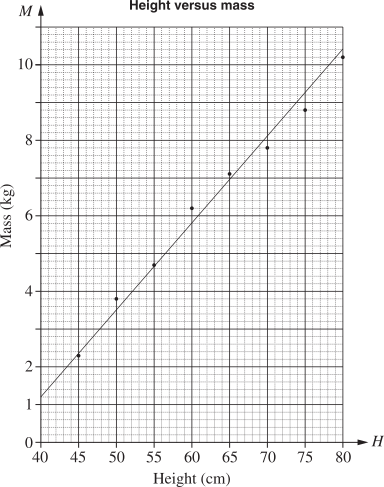
The height and mass of a child are measured and recorded over its first two years. 

\begin{array} {|l|c|c|}
\hline \rule{0pt}{2.5ex} \text{Height (cm), } H \rule[-1ex]{0pt}{0pt} & \text{45} & \text{50} & \text{55} & \text{60} & \text{65} & \text{70} & \text{75} & \text{80} \\
\hline \rule{0pt}{2.5ex} \text{Mass (kg), } M \rule[-1ex]{0pt}{0pt} & \text{2.3} & \text{3.8} & \text{4.7} & \text{6.2} & \text{7.1} & \text{7.8} & \text{8.8} & \text{10.2} \\
\hline
\end{array}

This information is displayed in a scatter graph. 
 

  1. Describe the correlation between the height and mass of this child, as shown in the graph.   (1 mark)

    --- 2 WORK AREA LINES (style=lined) ---

  2. A line of best fit has been drawn on the graph.


    Find the equation of this line.   (2 marks)

    --- 4 WORK AREA LINES (style=lined) ---

Show Answers Only
  1. `text(The correlation between height and)`


    `text(mass is positive and strong.)`

  2. `M = 0.23H-8`
Show Worked Solution

i.  `text(The correlation between height and)`

♦ Mean mark 48%. 

`text(mass is positive and strong.)`


ii.  `text(Using)\ \ P_1(40, 1.2)\ \ text(and)\ \ P_2(80, 10.4)`

♦♦♦ Mean mark 18%. 
MARKER’S COMMENT: Many students had difficulty due to the fact the horizontal axis started at `H= text(40cm)` and not the origin.
`text(Gradient)` `= (y_2-y_1)/(x_2-x_1)`
  `= (10.4-1.2)/(80-40)`
  `= 9.2/40`
  `= 0.23`


`text(Line passes through)\ \ P_1(40, 1.2)`

`text(Using)\ \ \ y-y_1` `= m(x-x_1)`
`y-1.2` `= 0.23(x-40)`
`y-1.2` `= 0.23x-9.2`
`y` `= 0.23x-8`

 
`:. text(Equation of the line is)\ \ M = 0.23H-8`

Filed Under: Bivariate Data, Bivariate Data Analysis (Y12), Life Expectancy, Other Linear Modelling, S3 Further Statistical Analysis (Y12), S4 Bivariate Data Analysis (Y12) Tagged With: Band 5, Band 6, common-content, num-title-ct-coreb, num-title-qs-hsc, smc-1001-10-Line of Best Fit, smc-1001-30-Correlation, smc-1113-10-Line of Best Fit, smc-1113-30-Correlation, smc-5022-28-LOBF equations, smc-5022-30-Correlation, smc-785-10-Line of Best Fit, smc-785-30-Correlation

Statistics, STD2 S4 2011 HSC 8 MC

In which graph would the data have a correlation coefficient closest to  – 0.9?

2UG 2011 8

Show Answers Only

`D`

Show Worked Solution

`text{Data needs to show a strong negative correlation}`

`text{(i.e. top left to lower right.)}`

`=>D`

Filed Under: Bivariate Data Analysis (Y12), Correlation / Body Measurements, S4 Bivariate Data Analysis (Y12) Tagged With: Band 4, common-content, smc-1001-30-Correlation, smc-785-30-Correlation

Statistics, STD2 S4 2012 HSC 11 MC

Which of the following relationships would most likely show a negative correlation?

  1. The population of a town and the number of hospitals in that town. 
  2. The hours spent training for a race and the time taken to complete the race. 
  3. The price per litre of petrol and the number of people riding bicycles to work. 
  4. The number of pets per household and the number of computers per household. 
Show Answers Only

\(B\)

Show Worked Solution

\(\text{Increased hours training should reduce the time}\)

\(\text{to complete a race.}\)

\(\Rightarrow B\)

♦ Mean mark 43%.

Filed Under: Bivariate Data, Bivariate Data Analysis (Y12), Correlation / Body Measurements, S3 Further Statistical Analysis (Y12), S4 Bivariate Data Analysis (Y12) Tagged With: Band 5, common-content, num-title-ct-coreb, num-title-qs-hsc, smc-1001-30-Correlation, smc-1113-30-Correlation, smc-5022-30-Correlation, smc-5022-35-Causality, smc-785-30-Correlation

Statistics, STD2 S4 2013 HSC 2 MC

Which graph best shows data with a correlation closest to 0.3?
 

2013 2 mc1

2013 2 mc2


Show Answers Only

`A`

Show Worked Solution

`A\ text(is correct since the data slopes bottom)`

`text{left to top right (i.e. it’s positive).}`

`D\ text(also slopes correctly but exhibits a higher)`

`text(correlation co-efficient.)`

`=>A`

Filed Under: Bivariate Data Analysis (Y12), Correlation / Body Measurements, S4 Bivariate Data Analysis (Y12) Tagged With: Band 4, common-content, smc-1001-30-Correlation, smc-785-30-Correlation

Copyright © 2014–2025 SmarterEd.com.au · Log in