SmarterEd

Aussie Maths & Science Teachers: Save your time with SmarterEd

  • Login
  • Get Help
  • About

Algebra, STD2 A4 2024 HSC 26

A sheet of metal is folded to make a gutter, as shown. The cross-section of the gutter is a rectangle of width \(w\) cm and height \(h\) cm.
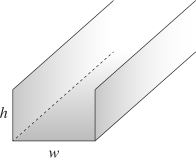


The area, \(A\) cm\(^{2}\), of the cross-section can be modelled by the quadratic formula

\(A=-0.5w^{2}+20w\)

A graph of this model is shown.
 

Find the width and height of the rectangle which will give the greatest possible area of the cross-section.   (3 marks)

--- 8 WORK AREA LINES (style=lined) ---

Show Answers Only

\(w=20\ \text{cm}, h=10\ \text{cm}\)

Show Worked Solution

\(\text{Graph cuts}\ w\text{-axis at}\ \ w=0\ \ \text{and}\ \ w=40.\)

\(\text{By symmetry, maximum area occurs at}\ \ w=20.\)

\(A_{\text{max}}=-0.5 \times 20^2 + 20 \times 20 = 200\ \text{cm}^{2}\)

\(A_{\text{max}}\) \(=w \times h\)  
\(200\) \(=20 \times h\)  
\(h\) \(=10\ \text{cm}\)  

 
\(\therefore A_{\text{max}}\ \text{occurs when:}\ w=20\ \text{cm}, \ h=10\ \text{cm}\)

♦ Mean mark 43%.

Filed Under: Non-Linear: Exponential/Quadratics (Std 2) Tagged With: Band 5, smc-830-20-Quadratics, smc-830-50-Limitations

Algebra, STD2 A4 2019 HSC 31

A rectangle has width `w` centimetres. The area of the rectangle, `A`, in square centimetres, is  `A = 2w^2 + 5w`.

The graph  `A = 2w^2 + 5w`  is shown.


  1. Explain why, in this context, the model  `A = 2w^2 + 5w`  only makes sense for the bold section of the graph.  (1 mark)

    --- 2 WORK AREA LINES (style=lined) ---

  2. The area of the rectangle is 18 cm². Calculate the perimeter of the rectangle.  (2 marks)

    --- 4 WORK AREA LINES (style=lined) ---

Show Answers Only
  1. `text(The width of a rectangle cannot be negative.)`
  2. `22\ text(cm)`
Show Worked Solution

a.   `text(The width of a rectangle cannot be negative.)`

♦ Mean mark 44%.


b.   `text(When)\ A = 18, w = 2`

♦ Mean mark 42%.

`text(Let)\ h =\ text(height of rectangle)`

`18` `= 2 xx h`
`h` `= 9\ text(cm)`


`:.\ text(Perimeter)` `= 2 xx (2 + 9)`
  `= 22\ text(cm)`

Filed Under: Non-Linear: Exponential/Quadratics (Std 2) Tagged With: Band 5, smc-830-20-Quadratics, smc-830-50-Limitations

Algebra, STD2 A4 2012 HSC 30b

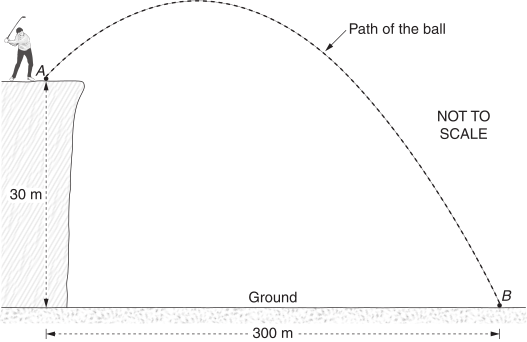
A golf ball is hit from point `A` to point `B`, which is on the ground as shown. Point `A` is 30 metres above the ground and the horizontal distance from point `A` to point `B` is  300 m.
 

The path of the golf ball is modelled using the equation 

`h = 30 + 0.2d-0.001d^2` 

where 

`h` is the height of the golf ball above the ground in metres, and 

`d` is the horizontal distance of the golf ball from point `A` in metres.

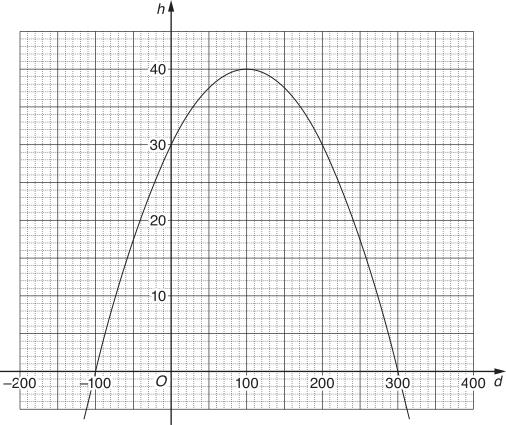
The graph of this equation is drawn below.


  1. What is the maximum height the ball reaches above the ground?    (1 mark)

    --- 1 WORK AREA LINES (style=lined) ---

  2. There are two occasions when the golf ball is at a height of 35 metres.


    What horizontal distance does the ball travel in the period between these two occasions?   (1 mark)

    --- 2 WORK AREA LINES (style=lined) ---

  3. What is the height of the ball above the ground when it still has to travel a horizontal distance of 50 metres to hit the ground at point `B`?   (1 mark)

    --- 2 WORK AREA LINES (style=lined) ---

  4. Only part of the graph applies to this model.


    Find all values of `d` that are not suitable to use with this model, and explain why these values are not suitable.   (2 marks)

    --- 4 WORK AREA LINES (style=lined) ---

Show Answers Only
  1. `40 text(m)`
  2. `140 text(m)`
  3. `text(17.5 m)`
  4. `d < 0\ text(and)\ d>300`
Show Worked Solution

i.   `text(Max height) = 40 text(m)`

COMMENT: With a mean mark of 92% in (i), a classic example of low hanging fruit in later questions.


ii.   `text(From graph)`

`h = 35\ text(when)\ x = 30\ text(and)\ x = 170`

`:.\ text(Horizontal distance)` `= 170-30`
  `= 140\ text(m)`


iii.   `text(Ball hits ground at)\ x = 300`

MARKER’S COMMENT: Responses for (iii) in the range  `17<=\ h\ <=18`  were deemed acceptable estimates read off the graph.

`=>text(Need to find)\ y\ text(when)\ x = 250`

`text(From graph,)\ y = 17.5 text(m)\ text(when)\ x = 250`

`:.\ text(Height of ball is 17.5 m at a horizontal)`

`text(distance of 50m before)\ B.`


iv.   `text(Values of)\ d\ text(not suitable).`

♦♦♦ Mean mark (iv) 12%
MARKER’S COMMENT: Many students did not refer to the domain `d>300` as unsuitable to the model.

`text(If)\ d < 0 text(, it assumes the ball is hit away)`

`text(from point)\ B text(. This is not the case in our)`

`text(example.)`

`text(If)\ d > 300 text(,)\ h\ text(becomes negative which is)`

`text(not possible given the ball cannot go)`

`text(below ground level.)`

Filed Under: Exponential/Quadratic (Projectile), Non-Linear: Exponential/Quadratics (Std 2), Quadratics Tagged With: Band 2, Band 4, Band 6, num-title-ct-coreb, num-title-qs-hsc, page-break-before-question, smc-4443-60-Projectiles, smc-830-20-Quadratics, smc-830-50-Limitations

Copyright © 2014–2025 SmarterEd.com.au · Log in