SmarterEd

Aussie Maths & Science Teachers: Save your time with SmarterEd

  • Login
  • Get Help
  • About

Calculus, 2ADV C4 2025 HSC 25

  1. Show that  \(\dfrac{d}{d x}(\sin x-x\, \cos x)=x\, \sin x\).   (2 marks)

    --- 5 WORK AREA LINES (style=lined) ---

  2. Hence, find the value of  \(\displaystyle\int_0^{2025 \pi} x\, \sin x \, dx\).   (2 marks)

    --- 5 WORK AREA LINES (style=lined) ---

  3. The regions bounded by the \(x\)-axis and the graph of  \(y=x\, \sin x\)  for  \(x \geq 0\)  are shown.
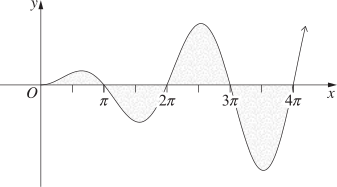
     

  1. Let  \(A_n=\displaystyle \int_{(n-1) \pi}^{n \pi} x\, \sin x \,dx\),  where \(n\) is a positive integer.
  2. It can be shown that  \(\left|A_n\right|=(2 n-1) \pi\).  (Do NOT prove this.)
  3. Find the exact total area of the regions bounded by the curve  \(y=x \sin x\), and the \(x\)-axis between  \(x=0\)  and  \(x=2025 \pi\).   (2 marks)  

    --- 10 WORK AREA LINES (style=lined) ---

Show Answers Only

a.   \(\text{See Worked Solutions}\)

b.   \(2025 \pi\)

c.   \(4\,100\,625 \pi \ \text{units}^2\)

Show Worked Solution
a.     \(\dfrac{d}{dx}(\sin x-x\, \cos x)\) \(=\dfrac{d}{dx} \sin x-\dfrac{d}{dx} x\, \cos x\)
    \(=\cos x+x\, \sin x-\cos x\)
    \(=x\, \sin x\)


b.     \(\displaystyle\int_0^{2025 \pi} x\, \sin x\) \(=\Big[\sin x-x\, \cos x\Big]_0^{2025 \pi}\)
    \(=\Big[(\sin (2025\pi)-2025 \pi \times \cos (2025 \pi))-0\Big]\)
    \(=0-2025 \pi \times -1\)
    \(=2025 \pi\)


c.    \(\text{Area}=\displaystyle \int_0^\pi x\, \sin x \, dx+\left|\int_\pi^{2 \pi} x\, \sin x \, dx\right|+\cdots+\int_{2024 \pi}^{2025 \pi} x\, \sin x \, dx\)

\(\text{Using}\ \ \left|A_n\right|=(2n-1) \pi:\)

\(A_1=\pi, A_2=3 \pi, A_3=5 \pi, \ldots, A_{2025}=4049 \pi\)

\begin{aligned}
\rule{0pt}{2.5ex} \text{Area}& =\underbrace{\pi+3 \pi+5 \pi+\ldots+4049 \pi}_{\text {AP where } a=\pi, \ l=4049 \pi, \ n=2025} \\
\rule{0pt}{4.5ex} & =\frac{2025}{2}(\pi+4049 \pi) \\
\rule{0pt}{3.5ex} & =4\,100\,625 \pi \ \text{units }^2
\end{aligned}

Filed Under: Areas Under Curves (Y12) Tagged With: Band 4, Band 6, smc-975-50-Trig, smc-975-55-Absolute value

Calculus, 2ADV C4 2022 HSC 8 MC

The graph of the even function  `y=f(x)`  is shown.

The area of the shaded region `A` is `1/2` and the area of the shaded region `B` is `3/2`.

What is the value of `int_(-2)^(2)f(x)\ dx`?

  1. `4`
  2. `2`
  3. `–2`
  4. `–4`
Show Answers Only

`C`

Show Worked Solution

`text{Areas under the}\ x text{-axis are negative}`

`int_0 ^2 f(x)\ dx = 1/2-3/2=-1`
 

`text{S}text{ince}\ \ f(x)\ \ text{is even:}`

`int_(-2) ^2 f(x)\ dx = 2int_0 ^2 f(x)\ dx = -2`

`=>C`


Mean mark 52%.

Filed Under: Areas Under Curves (Y12) Tagged With: Band 4, smc-975-50-Trig, smc-975-70-Functions - no integration

Calculus, 2ADV C4 2019 MET1 7

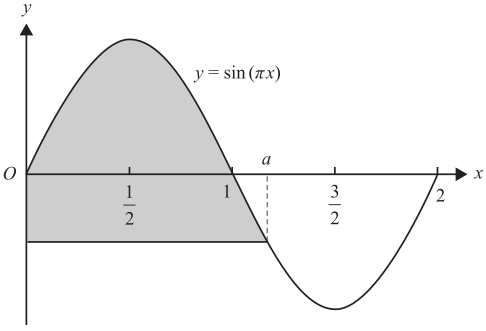
The shaded region in the diagram below is bounded by the vertical axis, the graph of the function with rule  `f(x) = sin(pix)`  and the horizontal line segment that meets the graph at  `x = a`, where  `1 <= a <= 3/2`.


Let  `A(a)`  be the area of the shaded region.

Show that  `A(a) = 1/pi-1/pi cos(a pi)-a sin (a pi)`.  (3 marks)

Show Answers Only

`text(Proof)\ \ text{(See Worked Solutions)}`

Show Worked Solution

`text{Strategy 1}`

  `text(Consider the areas above:)`

`int_0^a \sin (pi x)` `\ = text(Area 1 – Area 3)`
  `=[-{1}/{pi} cos (pi x)]_0^a`
  `=-{1}/{pi} cos (a pi)-(-{1}/{pi})`
  `=1/pi-1/picos(a pi)`

 
`text(Area 2 + Area 3 (rectangle) )`

`=-sin(a pi) \times a`

`=-a sin (a pi) \ text{(Area must be +ve)}`
  

`\therefore \ text(Shaded area)` `\ =text(Area 1 + Area 2)`
  `=1/pi-1/pi cos(a pi)-a sin(a pi)`


`text{Strategy 2}`

`text(Lower border of shaded area:)\ y = f(a) = sin(a pi)`

`text(Area)` `= int_0^a sin(pi x)-sin (a pi)\ dx`
  `= [-1/pi cos (pi x)-x sin(a pi)]_0^a`
  `= [-1/pi cos(pi a)-a sin (a pi)-(-1/pi-0)]`
  `= 1/pi-1/pi cos (a pi)-a sin(a pi)`

Filed Under: Areas Under Curves (Y12) Tagged With: Band 4, smc-975-50-Trig

Calculus, 2ADV C4 2018 HSC 10 MC

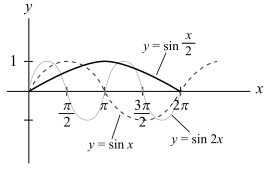
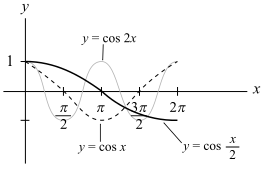
A trigonometric function  `f(x)`  satisfies the condition
 

`int_0^pi f(x)\ dx != int_pi^(2pi) f(x)\ dx.`

 
Which function could be  `f(x)`?

  1. `f(x) = sin (2x)`
  2. `f(x) = cos (2x)`
  3. `f(x) = sin (x/2)`
  4. `f(x) = cos (x/2)`
Show Answers Only

`D`

Show Worked Solution

`text(Consider options A and C)`

 
`text(Consider options B and D)`


`text(When)\ \ y = cos\ x/2 ,`

`int_0^pi f(x)\ dx != int_pi^(2 pi) f(x)\ dx`

`=>  D`

Filed Under: Areas Under Curves (Y12) Tagged With: Band 5, smc-975-50-Trig

Calculus, 2ADV C4 2016 HSC 13d

The curve  `y = sqrt 2 cos (pi/4 x)`  meets the line  `y = x`  at  `P(1, 1)`, as shown in the diagram.
 

hsc-2016-13d
 

Find the exact value of the shaded area.  (3 marks)

Show Answers Only

`(4/pi – 1/2)\ text(u²)`

Show Worked Solution

`text(Shaded Area)`

`= int_0^1 sqrt 2 cos (pi/4 x)\ dx – int_0^1 x\ dx`

`= int_0^1 (sqrt 2 cos (pi/4 x) – x)\ dx`

`= [sqrt 2 xx 4/pi sin (pi/4 x) – x^2/2]_0^1`

`= [((4 sqrt 2)/pi sin\ pi/4 – 1/2) – 0]`

`= (4 sqrt 2)/pi xx 1/sqrt 2 – 1/2`

`= (4/pi – 1/2)\ text(u²)`

Filed Under: Areas Under Curves, Areas Under Curves (Y12) Tagged With: Band 4, smc-975-50-Trig

Calculus, 2ADV C4 2007 HSC 7b

2ua 2007 7b
 

The diagram shows the graphs of  `y = sqrt 3 cos x`  and  `y = sin x`. The first two points of intersection to the right of the `y`-axis are labelled  `A`  and  `B`.

  1. Solve the equation  `sqrt 3 cos x = sin x`  to find the `x`-coordinates of  `A`  and  `B`.  (2 marks)

    --- 5 WORK AREA LINES (style=lined) ---

  2. Find the area of the shaded region in the diagram.  (3 marks)

    --- 7 WORK AREA LINES (style=lined) ---

Show Answers Only
  1. `pi/3, (4 pi)/3`
  2. `4\ text(u²)`
Show Worked Solution
i.  `sqrt 3 cos x` `= sin x`
`tan x` `= sqrt 3`


`text(S)text(ince)\ tan\ pi/3 = sqrt 3 and tan\ text(is)`

`text(positive in 1st/3rd quadrants:)`

`x` `= pi/3 , pi + pi/3`
  `= pi/3, (4 pi)/3`


`:. text(The)\ x text(-coordinates of)\ A and B`

`text(are)\ \ x = pi/3, (4 pi)/3.`


ii.  `text(Shaded Area)`

`= int_(pi/3)^((4 pi)/3) sin\ x\ dx – int_(pi/3)^((4 pi)/3) sqrt 3\ cos\ x\ dx`

`= int_(pi/3)^((4 pi)/3) sin\ x – sqrt 3\ cos\ x\ dx`

`= [-cos\ x – sqrt 3\ sin\ x]_(pi/3)^((4 pi)/3)`

`= [(-cos\ (4 pi)/3 – sqrt 3\ sin\ (4 pi)/3) – (-cos\ pi/3 – sqrt 3\ sin\ pi/3)]`

`= [(1/2 + sqrt 3 xx (sqrt 3)/2) – (- 1/2 – sqrt 3 xx (sqrt 3)/2)]`

`= [2 – (-2)]`

`= 4\ text(u²)`

Filed Under: Areas Under Curves, Areas Under Curves (Y12), Exact Trig Ratios and Other Identities Tagged With: Band 4, smc-975-50-Trig

Calculus, 2ADV C4 2006 HSC 5b

  1. Show that `d/dx log_e (cos x) = -tan x.`  (1 mark)

    --- 2 WORK AREA LINES (style=lined) ---

  2.   
     
    2006 5b
     
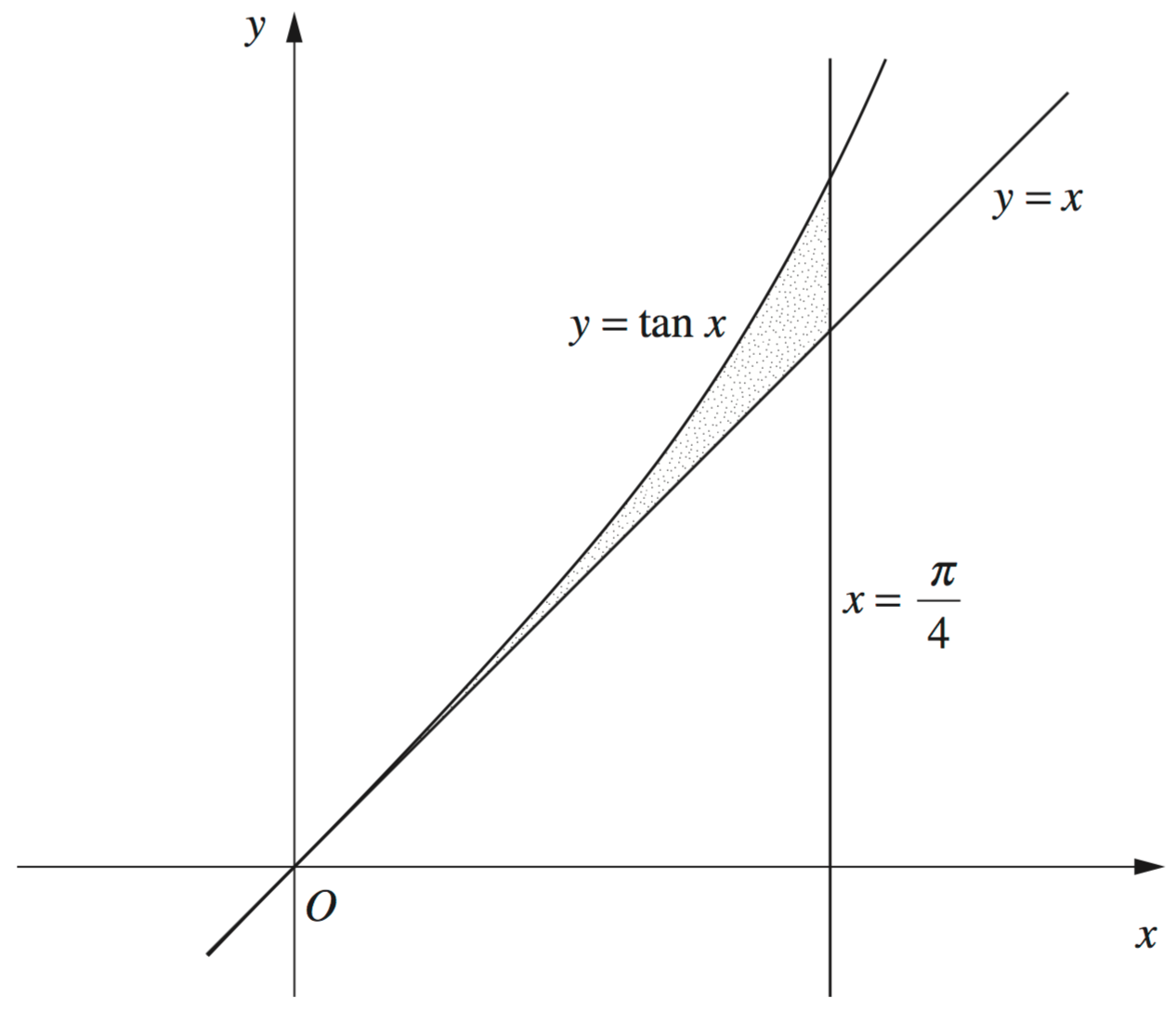
    The shaded region in the diagram is bounded by the curve  `y =tan x`  and the lines  `y =x`  and  `x = pi/4.`


    Using the result of part (i), or otherwise, find the area of the shaded region.  (3 marks)

    --- 6 WORK AREA LINES (style=lined) ---
Show Answers Only
  1. `text(Proof)\ \ text{(See Worked Solutions)}`
  2. `(1/2 log_e 2 – pi^2/32)\ text(u²)`
Show Worked Solution
i.   `d/dx log_e (cos x)` `= (-sin x)/cos x`
  `= – tan x\ …\ text(as required)`


ii.  `text(Shaded Area)`

`= int_0^(pi/4) tan x\ dx – int_0^(pi/4) x\ dx`

`= int_0^(pi/4) tan x – x\ dx`

`= [-log_e (cos x) – 1/2 x^2]_0^(pi/4)`

`=[(-log_e (cos­ pi/4) – 1/2 xx (pi^2)/16) – (-log_e(cos 0) – 0)]`

`= -log_e­ 1/sqrt 2 – pi^2/32 + log_e1`

`= -log_e 2^(-1/2) – pi^2/32`

`= (1/2 log_e 2 – pi^2/32)\ text(u²)`

Filed Under: Areas Under Curves, Areas Under Curves (Y12) Tagged With: Band 3, Band 4, Band 5, smc-975-50-Trig

Trigonometry, 2ADV T3 2006 HSC 7b

A function  `f(x)`  is defined by  `f(x) = 1 + 2 cos x`.

  1. Show that the graph of  `y = f(x)`  cuts the `x`-axis at  `x = (2 pi)/3`.   (1 mark)

    --- 2 WORK AREA LINES (style=lined) ---

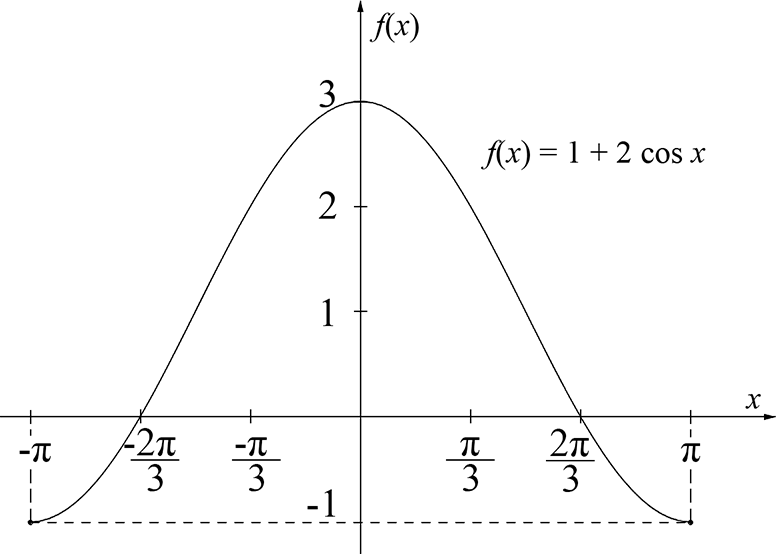
  2. Sketch the graph of  `y = f(x)`  for  `-pi <= x <= pi`  showing where the graph cuts each of the axes.   (3 marks)

    --- 8 WORK AREA LINES (style=lined) ---
  3. Find the area under the curve  `y = f(x)` between  `x = -pi/2`  and  `x = (2 pi)/3`.   (3 marks)

    --- 6 WORK AREA LINES (style=lined) ---

Show Answers Only
  1. `text(Proof)\ \ text{(See Worked Solutions)}`
  2.   
  3. `((7 pi)/6 + sqrt 3 + 1)\ text(u²)`
Show Worked Solution

i.   `f(x) = 1 + 2 cos x`

`f(x)\ text(cuts the)\ x text(-axis when)\ f(x) = 0`

`1 + 2 cos x` `= 0`
`2 cos x` `=-1`
 `cos x` `= -1/2`

`:.  x = (2 pi)/3\ …\ text(as required)`


ii.   2UA HSC 2006 7b


iii.  `text(Area)` `= int_(-pi/2)^((2 pi)/3) 1 + 2 cos x\ \ dx`
  `= [x + 2 sin x]_(-pi/2)^((2 pi)/3)`
  `= [((2 pi)/3 + 2 sin­ (2 pi)/3) – ((-pi)/2 + 2 sin­ (-pi)/2)]`
  `= ((2 pi)/3 + 2 xx sqrt 3/2) – ((-pi)/2 +2(- 1))`
  `= (2 pi)/3 + sqrt(3) + pi/2 + 2`
  `= ((7 pi)/6 + sqrt(3) + 2)\ text(u²)`

Filed Under: Areas Under Curves, Areas Under Curves (Y12), Trig graphs, Trig Graphs (Y12) Tagged With: Band 4, smc-975-50-Trig, smc-977-20-cos

Calculus, 2ADV C3 2010 HSC 9b

Let  `y=f(x)`  be a function defined for  `0 <= x <= 6`, with  `f(0)=0`. 

The diagram shows the graph of the derivative of `f`,  `y = f^{′}(x)`. 

The shaded region `A_1` has area 4 square units. The shaded region `A_2` has area 4 square units. 

  1. For which values of `x` is `f(x)` increasing?  (1 mark)

    --- 2 WORK AREA LINES (style=lined) ---

  2. What is the maximum value of `f(x)`?     (1 mark)

    --- 3 WORK AREA LINES (style=lined) ---

  3. Find the value of `f(6)`.   (1 mark)

    --- 3 WORK AREA LINES (style=lined) ---

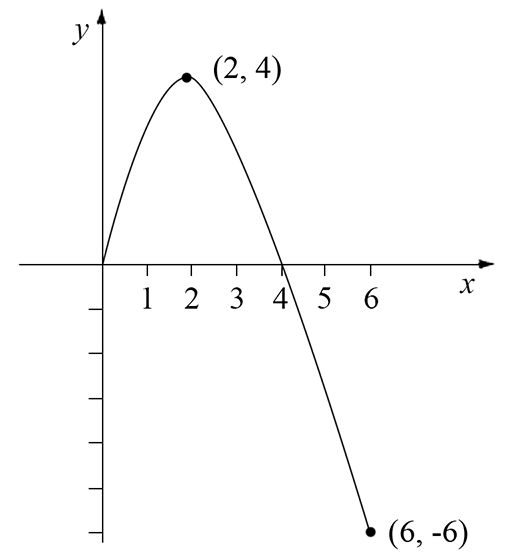
  4. Draw a graph of  `y =f(x)`  for  `0 <= x <= 6`.   (2 marks)

    --- 8 WORK AREA LINES (style=lined) ---

Show Answers Only
  1. `f(x)\ text(is increasing when)\ 0 <= x < 2`
  2. `text(MAX value of)\ f(x) = 4`
  3. `-6`
  4.  
  5.  
Show Worked Solution
i.    `f(x)\ text(is increasing when)\ \ f^{′}(x) > 0`
  `text(From the graph)`
  `f(x)\ text(is increasing when)\ 0 <= x < 2`


ii.   `f^{′}(x) = 0\ \ text(when)\ \ x=2`
  `:.\ text(MAX at)\ \ x = 2`
  `int_0^2 f^{′}(x)\ dx = 4\ \ \ (text(given since)\ A_1 = 4 text{)}`
  `text(We also know)`
`int_0^2\ f^{′}(x)\ dx` `= [f(x)]_0^2`
  `= f(2)-f(0)`
  `= f(2)\ \ \ \ text{(since}\ f(0) = 0 text{)}`

`=> f(2) = 4` 

♦♦♦ Parts (ii) and (iii) proved particularly difficult for students with mean marks of 12% and 11% respectively.

 
`:.\ text(MAX value of)\ \ f(x) = 4`
 

iii.   `int_0^4 f^{′}(x)` `= A_1-A_2`
    `=0`

`text(We also know)`

`int_0^4 f^{′}(x)\ dx` `= int_2^4 f^{′}(x)\ dx + int_0^2 f^{′}(x)\ dx`
  `=[f(x)]_2^4 + 4`
  `= f(4)-f(2) + 4\ \ \ (text(note)\ f(2)=4)`
  `=f(4)`

`=> f(4) = 0`

 
`text(Gradient = – 3  from)\ \ x = 4\ \ text(to)\ \ x = 6`

`:.\ f(6)` `= -3 (6\ – 4)`
  `= -6`


♦♦ Mean mark 28%
EXAM TIP: Clearly identify THE EXTREMES when given a defined domain. In this case, the origin is obvious graphically, and the other extreme at `x=6`, is CLEARLY LABELLED! 
iv.  2UA HSC 2010 9bi

Filed Under: Areas Under Curves, Areas Under Curves (Y12), Curve Sketching and The Primitive Function, The Derivative Function and its Graph (Y12) Tagged With: Band 5, Band 6, page-break-before-solution, smc-1089-10-Graph f(x) given f'(x), smc-975-50-Trig

Calculus, 2ADV C4 2011 HSC 6c

The diagram shows the graph  `y = 2 cos x` . 
  

2011 6c 
  

  1. State the coordinates of  `P`.   (1 mark)

    --- 1 WORK AREA LINES (style=lined) ---

  2. Evaluate the integral  `int_0^(pi/2) 2 cos x\ dx`.    (2 marks)

    --- 4 WORK AREA LINES (style=lined) ---

  3. Indicate which area in the diagram,  `A`,  `B`,  `C` or  `D`, is represented by the integral
     
           `int_((3pi)/2)^(2pi) 2 cos x\ dx`.   (1 mark)

    --- 1 WORK AREA LINES (style=lined) ---

  4. Using parts (ii) and (iii), or otherwise, find the area of the region bounded by the curve  `y = 2 cos x`  and the  `x`-axis, between  `x = 0`  and  `x = 2pi` .   (1 mark)

    --- 2 WORK AREA LINES (style=lined) ---

  5. Using the parts above, write down the value of
     
         `int_(pi/2)^(2pi) 2 cos x\ dx`.   (1 mark)

    --- 2 WORK AREA LINES (style=lined) ---

Show Answers Only
  1. `P(0,2)`
  2. `2`
  3. `C`
  4. `8\ text(u²)`
  5. `-2`
Show Worked Solution

i.  `y = 2 cos x`

`text(At)\ x = 0`

`y = 2 cos 0 = 2`

`:.\ P(0,2)`


ii.  `int_0^(pi/2) 2 cos x\ dx`

`= [2 sin x]_0^(pi/2)`

`= [2 sin (pi/2)\ – 2 sin 0]`

`= 2\ – 0`

`= 2`
 

iii.  `C`
 

iv.    `text(S)text(ince Area)\ A` `=\ text(Area)\ C,\ \ text(and)`
  `text(Area)\ B` `= 2 xx text(Area)\ A`


`:.\ text(Total Area)` `= 2 + (2xx2) + 2`
  `= 8\ text(u²)`


MARKER’S COMMENT: “Using the parts above” in part (v) was ignored by many students. Important to know when finding an area and evaluating an integral may differ.

v.  `int_(pi/2)^(2pi) 2 cos x\ dx`

`= text(Area)\ C\ – text(Area)\ B`

`= 2\ – (2 xx 2)`

`= -2`

Filed Under: Areas Under Curves, Areas Under Curves (Y12), Differentiation and Integration Tagged With: Band 3, Band 4, Band 5, smc-975-50-Trig

Copyright © 2014–2025 SmarterEd.com.au · Log in