SmarterEd

Aussie Maths & Science Teachers: Save your time with SmarterEd

  • Login
  • Get Help
  • About

Functions, 2ADV F1 EQ-Bank 19

Given that  \(f(x)=x^2+1\)  and  \(g(x)=x+2\),  determine \(f(g(x))\) and its range.   (2 marks)

--- 5 WORK AREA LINES (style=lined) ---

Show Answers Only

\(f(g(x))=(x+2)^2+1\)

\(\ \text{Range} \  f(g(x)): \ y \geqslant 1\)

Show Worked Solution

\(f(x)=x^2+1, \quad g(x)=x+2\)

\(f(g(x))=(x+2)^2+1\)

\(\Rightarrow f(g(x)) \ \text{is a concave up parabola, vertex}\ (-2,1)\)

\(\therefore \ \text{Range} \  f(g(x)): \ y \geqslant 1\)

Filed Under: Composite Functions, Composite Functions Tagged With: Band 4, smc-6216-20-Quadratics, smc-6216-40-Domain/Range, smc-986-20-Quadratic, smc-986-40-Domain/Range

Functions, 2ADV F1 2022 HSC 10 MC

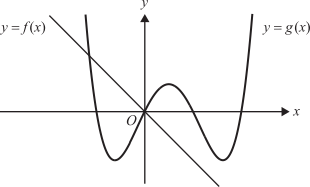
The graphs of `y=f(x)` and `y=g(x)` are shown.
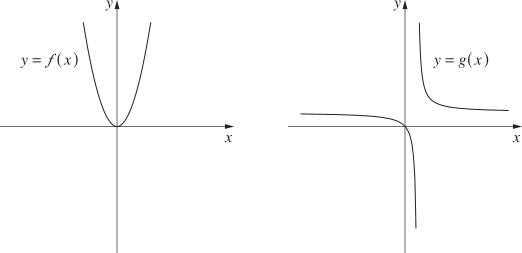
 

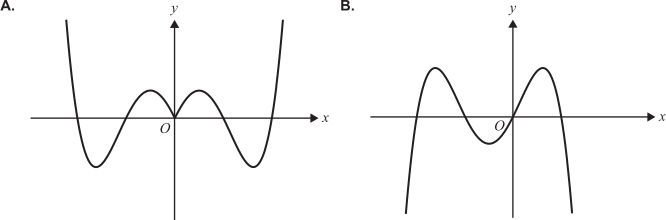
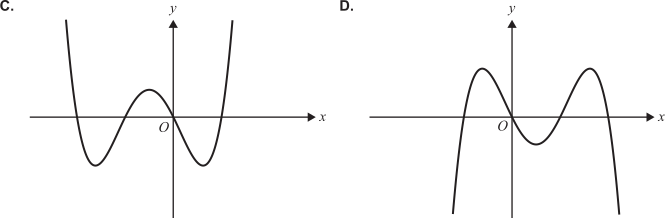
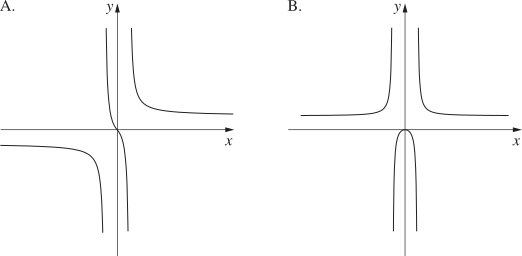
Which graph best represents  `y=g(f(x))`
 

Show Answers Only

`B`

Show Worked Solution

`text{By Elimination:}`

`y=f(x)\ \ text{is an even function}`

`y=f(x)=f(-x)\ \ =>\ \ g(f(x))=g(f(-x))`

`g(f(x))\ \ text{is also an even function}`

`text{→ Eliminate A, C and D}`

`=>B`


♦ Mean mark 46%.

Filed Under: Composite Functions, Composite Functions Tagged With: Band 5, smc-6216-20-Quadratics, smc-6216-30-Other Functions, smc-6216-50-Draw/Interpret Graphs, smc-986-20-Quadratic, smc-986-30-Other, smc-986-50-Sketch

Functions, 2ADV F1 EQ-Bank 20

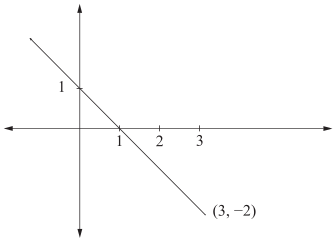
Given the function  `f(x) = sqrt(3-x)`  and  `g(x) = x^2-2`, sketch  `y = g(f(x))`  over its natural domain.   (2 marks)

--- 8 WORK AREA LINES (style=lined) ---
Show Answers Only

Show Worked Solution

`g(x) = x^2-2,\ \ f(x) = sqrt(3-x)`

`g(f(x))` `= (sqrt(3-x))^2-2`
  `= 3-x-2`
  `= 1-x`

 
`text(S)text(ince)\ \ f(x) = sqrt(3-x),`

`=> text(Domain:)\ x <= 3`
 

Filed Under: Composite Functions, Composite Functions Tagged With: Band 4, smc-6216-20-Quadratics, smc-6216-30-Other Functions, smc-6216-50-Draw/Interpret Graphs, smc-986-20-Quadratic, smc-986-30-Other, smc-986-50-Sketch

Functions, 2ADV F1 2019 MET1-N 2

Let  `f(x) = -x^2 + x + 4`  and  `g(x) = x^2-2`.

  1. Find  `g(f(3))`.   (2 marks)

    --- 6 WORK AREA LINES (style=lined) ---

  2. Express  `f(g(x))`  in the form  `ax^4 + bx^2 + c`, where  `a`, `b`  and  `c`  are non-zero integers.   (2 marks)

    --- 4 WORK AREA LINES (style=lined) ---

Show Answers Only

a.    `2`

b.    `-x^4 + 5x^2-2`

Show Worked Solution

a.    `f(3)= -3^2 + 3 + 4= -2`

`g(f(3))= g(-2)= (-2)^2-2= 2`
 

b.    `f(g(x))` `= -(x^2-2)^2 + (x^2-2) + 4`
  `= -(x^4-4x^2 + 4) + x^2 + 2`
  `= -x^4 + 5x^2-2`

Filed Under: Composite Functions, Composite Functions Tagged With: Band 3, Band 4, smc-6216-20-Quadratics, smc-986-20-Quadratic

Functions, 2ADV F1 EQ-Bank 21

Find the domain and range of  `f(g(x))`  given

`f(x) = 2x^2 - 8x`  and  `g(x) = x + 2`.   (2 marks)

--- 4 WORK AREA LINES (style=lined) ---

Show Answers Only

`text(Domain: all)\ x`

`text(Range:)\ −8<=y< ∞`

Show Worked Solution
`f(g(x))` `= 2(x + 2)^2 – 8(x + 2)`
  `= 2(x^2 + 4x + 4) – 8x – 16`
  `= 2x^2 + 8x + 8 – 8x – 16`
  `= 2(x^2 – 4)`

 
`:. text(Domain: all)\ x`

`:. text(Range:)\ −8<=y< ∞`

Filed Under: Composite Functions, Composite Functions Tagged With: Band 4, smc-6216-20-Quadratics, smc-986-20-Quadratic

Functions, 2ADV F1 EQ-Bank 17

Given  `f(x) = sqrtx`  and  `g(x) = 25-x^2`

  1. Find `g(f(x))`.   (1 mark)

    --- 2 WORK AREA LINES (style=lined) ---

  2. Find the domain and range of `f(g(x))`.   (2 marks)

    --- 3 WORK AREA LINES (style=lined) ---

Show Answers Only

a.    `25-x`

b.    `text(Domain:)\ −5<= x <= 5`

`text(Range:)\ 0<=y<= 5`

Show Worked Solution

a.    `g(f(x))= 25-(f(x))^2= 25-(sqrtx)^2= 25-x`
 

b.    `f(g(x))= sqrt(g(x))= sqrt(25-x^2)`

`:.\ text(Domain:)\ −5<= x <= 5`

`:.\ text(Range:)\ 0<=y<= 5`

Filed Under: Composite Functions, Composite Functions Tagged With: Band 3, Band 4, smc-6216-20-Quadratics, smc-6216-30-Other Functions, smc-6216-40-Domain/Range, smc-986-20-Quadratic, smc-986-30-Other, smc-986-40-Domain/Range

Functions, 2ADV F1 EQ-Bank 8 MC

If  `f(x - 1) = x^2 - 2x + 3`, then  `f(x)` is equal to

A.   `x^2 - 2`

B.   `x^2 + 2`

C.   `x^2 - 2x + 4`

D.   `x^2 - 4x + 6`

Show Answers Only

`B`

Show Worked Solution

`text(Let)\ \ g(x) = f(x – 1)`

`g(x+1) = f(x)`

`g(x + 1)` `= (x + 1)^2 – 2(x + 1) + 3`
  `=x^2+2x+1-2x-2+3`
  `= x^2 + 2`

`=>   B`

Filed Under: Composite Functions, Composite Functions Tagged With: Band 4, smc-6216-20-Quadratics, smc-986-20-Quadratic

Functions, 2ADV F1 EQ-Bank 11

Let  `f(x) = x^2 + 1  and  g(x) = 2x + 1.`  Write down the rule of  `f(g(x)).`   (1 mark)

Show Answers Only

`(2x + 1)^2 + 1`

Show Worked Solution

`f (g(x))=f(2x+1)= (2x + 1)^2 + 1`

Filed Under: Composite Functions, Composite Functions Tagged With: Band 3, smc-6216-20-Quadratics, smc-986-20-Quadratic

Functions, 2ADV F1 EQ-Bank 7 MC

Let  `f (x) = x^2`

Which one of the following is not true?

  1. `f(xy) = f (x) f (y)`
  2. `f(x)-f(-x) = 0`
  3. `f (2x) = 4 f (x)`
  4. `f (x-y) = f(x)-f(y)`
Show Answers Only

`D`

Show Worked Solution

`text(By trial and error,)`

`text(Consider option)\ D:`

`f(x-y)` `=(x-y)^2=x^2 -2xy+y^2`
`f(x)-f(y)` `= x^2-y^2`

 
`:.f(x-y) !=f(x)-f(y)`

`=>D`

Filed Under: Composite Functions, Composite Functions Tagged With: Band 4, smc-6216-20-Quadratics, smc-986-20-Quadratic

Functions, 2ADV F1 EQ-Bank 26

Let  `f(x) = log_e(x)`  for  `x>0,` and  `g (x) = x^2 + 1`  for  all `x`.

  1. Find `h(x)`, where  `h(x) = f (g(x))`.   (1 mark)

    --- 2 WORK AREA LINES (style=lined) ---

  2. State the domain and range of `h(x)`.   (2 marks)

    --- 4 WORK AREA LINES (style=lined) ---

  3. Show that  `h(x) + h(−x) = f ((g(x))^2 )`.   (2 marks)

    --- 4 WORK AREA LINES (style=lined) ---

Show Answers Only

a.    `log_e(x^2 + 1)`

b.    text(Domain)\ (h):\ text(all)\ x`

`text(Range)\ h(x):\ \  h>=0`

c.    `text(See Worked Solutions)`

Show Worked Solution
a.    `h(x)` `= f(x^2 + 1)`
    `= log_e(x^2 + 1)`


b.   `text(Domain)\ (h) =\ text(Domain)\ (g):\ text(all)\ x`

♦♦ Mean mark part (a)(ii) 30%.
`=> x^2 + 1 >= 1`
`=> log_e(x^2 + 1) >= 0`

 
`:.\ text(Range)\ h(x):\ \  h>=0`


MARKER’S COMMENT: Many students were unsure of how to present their working in this question. Note the layout in the solution.
c.   `text(LHS)` `= h(x) + h(−x)`
    `= log_e(x^2 _ 1) + log_e((−x)^2 + 1)`
    `= log_e(x^2 + 1) + log_e(x^2 + 1)`
    `= 2log_e(x^2 + 1)`

 
`text(RHS)= f((x^2 + 1)^2)2log_e(x^2 + 1)`

`:. h(x) + h(-x) = f((g(x))^2)\ \ text(… as required)`

Filed Under: Composite Functions, Composite Functions Tagged With: Band 4, Band 5, smc-6216-10-Log/Exp, smc-6216-20-Quadratics, smc-6216-40-Domain/Range, smc-986-10-Log/Exp, smc-986-20-Quadratic, smc-986-40-Domain/Range

Functions, 2ADV F1 EQ-Bank 1 MC

Let  `g(x) = x^2 + 2x-3`  and  `f(x) = e^(2x + 3).`

Then  `f(g(x))`  is given by

  1. `e^(4x + 6) + 2 e^(2x + 3)-3`
  2. `2x^2 + 4x-6`
  3. `e^(2x^2 + 4x-3)`
  4. `e^(2x^2 + 4x-6)`
Show Answers Only

`C`

Show Worked Solution

`text(By trial and error,)`

`text(Consider:)\ \ f(x) = e^(2x^2 + 4x-3)`

`f(g(x))` `=e^(2 (x^2 + 2x-3)+3)`
  `= e^(2x^2 + 4x-3)`

 
`=> C`

Filed Under: Composite Functions, Composite Functions Tagged With: Band 3, smc-6216-10-Log/Exp, smc-6216-20-Quadratics, smc-986-10-Log/Exp, smc-986-20-Quadratic

Copyright © 2014–2026 SmarterEd.com.au · Log in