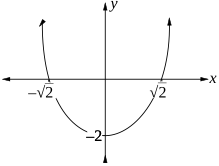
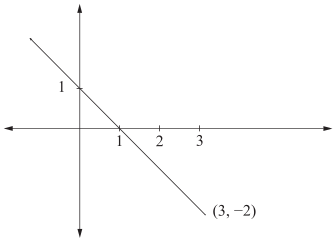
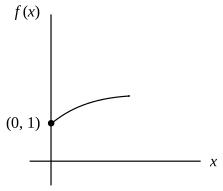
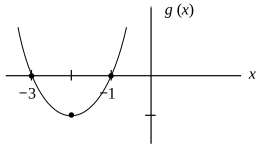
- Given the functions \(f(x)=x-2\) and \(g(x)=x^2\), determine the equation of \(f(g(x))\) and sketch its graph showing all intercepts. (2 marks)
--- 10 WORK AREA LINES (style=lined) ---
- Evaluate \(g(f(-1))\). (1 mark)
--- 2 WORK AREA LINES (style=lined) ---
Functions, 2ADV F1 2025 HSC 18
Find the range of \(g(f(x))\), given \(f(x)=\dfrac{3}{x-1}\) and \(g(x)=x+5\). (2 marks)
--- 8 WORK AREA LINES (style=lined) ---
Functions, 2ADV F1 EQ-Bank 19
Given that \(f(x)=x^2+1\) and \(g(x)=x+2\), determine \(f(g(x))\) and its range. (2 marks)
--- 5 WORK AREA LINES (style=lined) ---
Functions, 2ADV F1 EQ-Bank 18
If \(f(x)=x^2-3\) and \(g(x)=\sqrt{x-2}\), --- 3 WORK AREA LINES (style=lined) --- --- 2 WORK AREA LINES (style=lined) ---
Functions, 2ADV F1 2022 HSC 10 MC
Functions, 2ADV F1 EQ-Bank 4 MC
Let `f(x)` and `g(x)` be functions such that `f(–1)=4, \ f(2)=5, \ g(–1)=2, \ g(2)=7` and `g(4)=6`.
The value of `g(f(–1))` is
- 2
- 4
- 5
- 6
Functions, 2ADV F1 EQ-Bank 20
Given the function `f(x) = sqrt(3-x)` and `g(x) = x^2-2`, sketch `y = g(f(x))` over its natural domain. (2 marks)
--- 8 WORK AREA LINES (style=lined) ---
Functions, 2ADV F1 2019 MET1-N 2
Let `f(x) = -x^2 + x + 4` and `g(x) = x^2-2`.
- Find `g(f(3))`. (2 marks)
--- 6 WORK AREA LINES (style=lined) ---
- Express `f(g(x))` in the form `ax^4 + bx^2 + c`, where `a`, `b` and `c` are non-zero integers. (2 marks)
--- 4 WORK AREA LINES (style=lined) ---
Functions, 2ADV F1 EQ-Bank 21
Find the domain and range of `f(g(x))` given
`f(x) = 2x^2 - 8x` and `g(x) = x + 2`. (2 marks)
--- 4 WORK AREA LINES (style=lined) ---
Functions, 2ADV F1 EQ-Bank 17
Given `f(x) = sqrtx` and `g(x) = 25-x^2`
- Find `g(f(x))`. (1 mark)
--- 2 WORK AREA LINES (style=lined) ---
- Find the domain and range of `f(g(x))`. (2 marks)
--- 3 WORK AREA LINES (style=lined) ---
Functions, 2ADV F1 EQ-Bank 9 MC
If the equation `f(2x)-2f(x) = 0` is true for all real values of `x`, then `f(x)` could equal
- `x^2/2`
- `sqrt (2x)`
- `2x`
- `x-2`
Functions, 2ADV F1 EQ-Bank 14 MC
Let `g(x) = log_2(x),\ \ x > 0`
Which one of the following equations is true for all positive real values of `x?`
- `2g (8x) = g (x^2) + 8`
- `2g (8x) = g (x^2) + 6`
- `2g (8x) = (g (x) + 8)^2`
- `2g (8x) = g (2x) + 6`
Functions, 2ADV F1 EQ-Bank 6 MC
Which one of the following functions satisfies the functional equation `f (f(x)) = x`?
A. `f(x) = 2 - x`
B. `f(x) = x^2`
C. `f(x) = 2 sqrt x`
D. `f(x) = x - 2`
Functions, 2ADV F1 EQ-Bank 8 MC
If `f(x - 1) = x^2 - 2x + 3`, then `f(x)` is equal to
A. `x^2 - 2`
B. `x^2 + 2`
C. `x^2 - 2x + 4`
D. `x^2 - 4x + 6`
Functions, 2ADV F1 EQ-Bank 30
Given `f(x) = sqrt (x^2 - 9)` and `g(x) = x + 5`
- Find integers `c` and `d` such that `f(g(x)) = sqrt {(x + c) (x + d)}` (2 marks)
--- 4 WORK AREA LINES (style=lined) ---
- State the domain for which `f(g(x))` is defined. (2 marks)
--- 6 WORK AREA LINES (style=lined) ---
Functions, 2ADV F1 EQ-Bank 11
Let `f(x) = x^2 + 1 and g(x) = 2x + 1.` Write down the rule of `f(g(x)).` (1 mark)
Functions, 2ADV F1 EQ-Bank 3 MC
If `f(x) = 1/2e^(3x) and g(x) = log_e(2x) + 3` then `g (f(x))` is equal to
- `3(x + 1)`
- `e^(3x) + 3`
- `e^(8x + 9)`
- `log_e (3x) + 3`
Functions, 2ADV F1 EQ-Bank 7 MC
Let `f (x) = x^2`
Which one of the following is not true?
- `f(xy) = f (x) f (y)`
- `f(x)-f(-x) = 0`
- `f (2x) = 4 f (x)`
- `f (x-y) = f(x)-f(y)`
Functions, 2ADV F1 EQ-Bank 26
Let `f(x) = log_e(x)` for `x>0,` and `g (x) = x^2 + 1` for all `x`.
- Find `h(x)`, where `h(x) = f (g(x))`. (1 mark)
--- 2 WORK AREA LINES (style=lined) ---
- State the domain and range of `h(x)`. (2 marks)
--- 4 WORK AREA LINES (style=lined) ---
- Show that `h(x) + h(−x) = f ((g(x))^2 )`. (2 marks)
--- 4 WORK AREA LINES (style=lined) ---
Functions, 2ADV F1 EQ-Bank 15 MC
Let `f(x) = e^x + e^(-x).`
`f(2u)` is equal to
- `f(u) + f(-u)`
- `2 f(u)`
- `(f(u))^2-2`
- `(f(u))^2 + 2`
Functions, 2ADV F1 EQ-Bank 1 MC
Let `g(x) = x^2 + 2x-3` and `f(x) = e^(2x + 3).`
Then `f(g(x))` is given by
- `e^(4x + 6) + 2 e^(2x + 3)-3`
- `2x^2 + 4x-6`
- `e^(2x^2 + 4x-3)`
- `e^(2x^2 + 4x-6)`
Functions, 2ADV F1 EQ-Bank 13 MC
The function `f(x)` satisfies the functional equation `f (f (x)) = x` for `{x:\ text(all)\ x,\ x!=1}`.
The rule for the function is
- `f(x) = x + 1`
- `f(x) = x-1`
- `f(x) = (x-1)/(x + 1)`
- `f(x) = (x + 1)/(x-1)`
Functions, 2ADV F1 EQ-Bank 25
Let `f(x) = sqrt(x + 1)` for `x>=0`
- State the range of `f(x)`. (1 mark)
--- 4 WORK AREA LINES (style=lined) ---
- Let `g(x)=x^2+4x+3`, where `x<=c` and `c<=0`.
- Find the largest possible value of `c` such that the range of `g(x)` is a subset of the domain of `f(x)`. (2 marks)
--- 6 WORK AREA LINES (style=lined) ---
Functions, 2ADV F1 EQ-Bank 2 MC
Let `f(x)` and `g(x)` be functions such that `f (2) = 5`, `f (3) = 4`, `g(2) = 5`, `g(3) = 2` and `g(4) = 1`.
The value of `f (g(3))` is
- `1`
- `2`
- `4`
- `5`
Functions, 2ADV F1 EQ-Bank 12 MC
Let `h(x) = 1/(x - 1)` for `-1<h<1`.
Which one of the following statements about `h` is not true?
- `h(x)h(–x) = –h(x^2)`
- `h(x) - h(0) = xh(x)`
- `h(x) - h(–x) = 2xh(x^2)`
- `(h(x))^2 = h(x^2)`