The graph shows the salvage value of a car over 5 years.
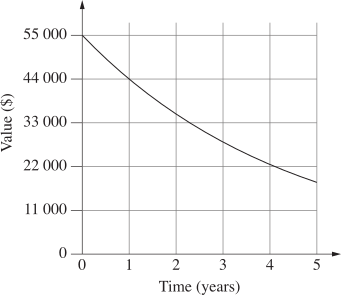
The salvage values are based on the declining-balance method.
By what amount will the car’s value depreciate during the 10th year? (4 marks)
--- 12 WORK AREA LINES (style=lined) ---
Aussie Maths & Science Teachers: Save your time with SmarterEd
The graph shows the salvage value of a car over 5 years.
The salvage values are based on the declining-balance method.
By what amount will the car’s value depreciate during the 10th year? (4 marks)
--- 12 WORK AREA LINES (style=lined) ---
A used car has a sale price of $24 200. In addition to the sale price, the following costs are charged:
Kat borrows the total amount to be paid for the car, including transfer of registration and stamp duty. Simple interest at the rate of 6.8% per annum is charged on the loan. The loan is to be repaid in equal monthly repayments over 3 years.
Calculate Kat’s monthly repayment. (5 marks)
--- 15 WORK AREA LINES (style=lined) ---
It costs $465 to register a passenger car and $350 to register a motorcycle.
| Let | \(P\) | \(\ =\ \text{the number of passenger cars, and}\) |
| \(B\) | \(\ =\ \text{the number of motorcycles}\) |
Write TWO linear equations that represent the relationship below.
--- 8 WORK AREA LINES (style=lined) ---
A credit card has an interest-free period of 45 days from and including the date of purchase. Interest is charged on purchases made, compounding daily at a rate of 13.74% per annum, from and including the day following the interest-free period.
Concert tickets were purchased for a total of $392 using this credit card.
Full payment was made on the 68th day from the date of purchase. There were no other purchases on this credit card.
What was the total interest charged when the account was paid in full? (3 marks)
--- 7 WORK AREA LINES (style=lined) ---
Paint is sold in two sizes at a local shop.
Mina needs to purchase 80 litres of paint.
Calculate the amount of money Mina will save by purchasing only ten-litre cans of paint rather than only four-litre cans of paint. (2 marks)
--- 7 WORK AREA LINES (style=lined) ---
The ratio of the dimensions of a model car to the dimensions of an actual car is \(1:64\). The actual car has a length of 4.9 m.
What is the length of the model car in cm, correct to 1 decimal place?
A spinner made up of 4 colours is spun 100 times. The frequency histogram shows the results.
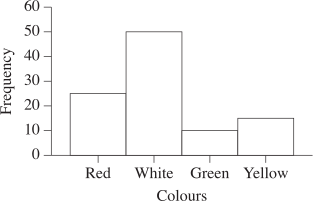
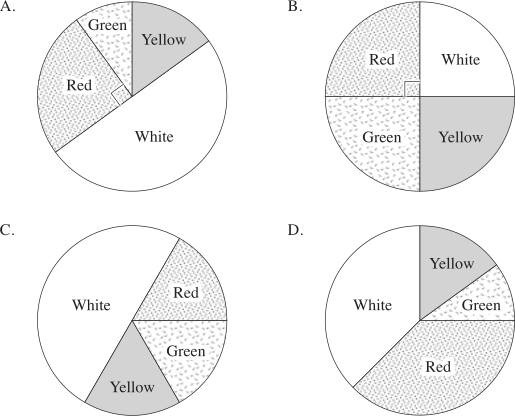
Which of these spinners is most likely to give the results shown?
The network shows the distances, in kilometres, along a series of roads that connect towns.
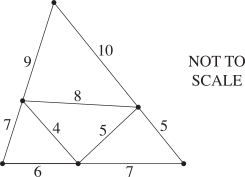
What is the value of the largest weighted edge included in the minimum spanning tree for this network?
\(\text{Minimum spanning tree:}\)
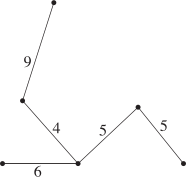
\(\text{Using Kruskal’s algorithm:}\)
\(\text{Edge 1 = 4, Edge 2/3 = 5, Edge 4 = 6, Edge 5 = 9}\)
\(\therefore\ \text{The largest weighted edge in the MST = 9.}\)
\(\Rightarrow C\)
Consider the network diagram.

Which vertex has degree 4?
Zazu works a 38-hour week and is paid at an hourly rate of $45. Any overtime hours worked are paid at time-and-a-half. In a particular week, Zazu worked the regular 38 hours and some overtime hours. In that week Zazu earned $2790. How many hours of overtime did Zazu work in that week? (3 marks) --- 6 WORK AREA LINES (style=lined) ---
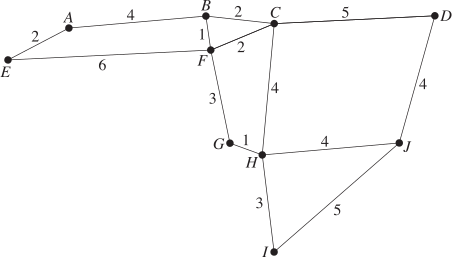
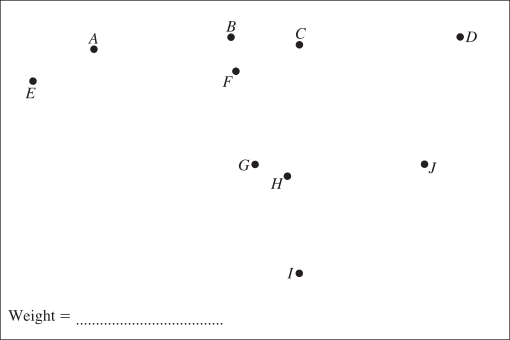
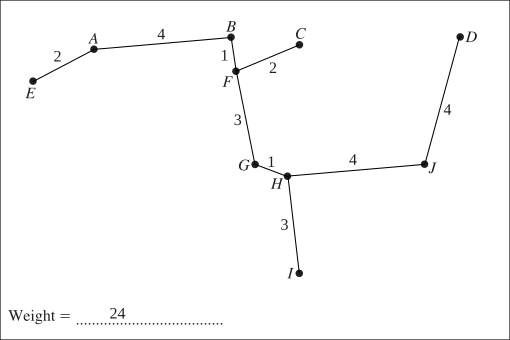
The diagram shows a network with weighted edges. --- 0 WORK AREA LINES (style=lined) --- --- 3 WORK AREA LINES (style=lined) --- a. b. \(\text{Yes.}\) \(\text{→ The edge}\ FC\ \text{on the MST above could be replaced by the edge}\ BC\) \(\text{to create a second MST (with equivalent weight = 24)}\) a. \(\text{→ The edge}\ FC\ \text{on the MST above could be replaced by the edge}\ BC\) \(\text{to create a second MST (with equivalent weight = 24)}\)
Show Answers Only
 Show Worked Solution
♦ Mean mark 53%.
b. \(\text{Yes.}\)
♦♦♦ Mean mark 16%.
Given the formula \(D=\dfrac{B(x+1)}{18}\), calculate the value of \(x\) when \(D=90\) and \(B=400\). (3 marks)
--- 6 WORK AREA LINES (style=lined) ---
A plumber leases equipment which is valued at $60 000.
The salvage value of the equipment at any time can be calculated using either of the two methods of depreciation shown in the table.
\begin{array} {|l|c|}
\hline
\rule{0pt}{2.5ex} \textit{Method of depreciation} \rule[-1ex]{0pt}{0pt} & \textit{Rate of depreciation} \\
\hline
\rule{0pt}{2.5ex} \text{Straight-line method} \rule[-1ex]{0pt}{0pt} & \text{\$3500 per annum} \\
\hline
\rule{0pt}{2.5ex} \text{Declining-balance method} \rule[-1ex]{0pt}{0pt} & \text{12% per annum} \\
\hline
\end{array}
Under which method of depreciation would the salvage value of the equipment be lower at the end of 3 years? Justify your answer with appropriate mathematical calculations. (3 marks)
--- 6 WORK AREA LINES (style=lined) ---
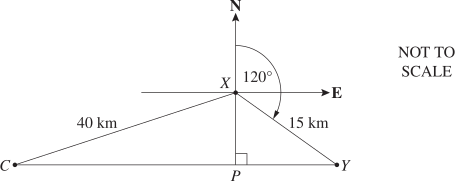
The diagram shows the location of three places \(X\), \(Y\) and \(C\).
\(Y\) is on a bearing of 120° and 15 km from \(X\).
\(C\) is 40 km from \(X\) and lies due west of \(Y\).
\(P\) lies on the line joining \(C\) and \(Y\) and is due south of \(X\).
--- 4 WORK AREA LINES (style=lined) ---
--- 5 WORK AREA LINES (style=lined) ---
a. \(\text{In}\ \Delta XPY:\)
\(\angle PXY=180-120=60^{\circ}\)
| \(\cos 60^{\circ}\) | \(=\dfrac{XP}{15}\) | |
| \(XP\) | \(=15\times \cos 60^{\circ}\) | |
| \(=7.5\ \text{km}\) |
b. \(\text{In}\ \Delta XPC:\)
\(\text{Let}\ \theta = \angle CXP\)
| \(\cos \theta\) | \(=\dfrac{7.5}{40}\) | |
| \(\theta\) | \(=\cos^{-1} \Big(\dfrac{7.5}{40}\Big)\) | |
| \(=79.193…\) | ||
| \(=79^{\circ}\ \text{(nearest degree)}\) |
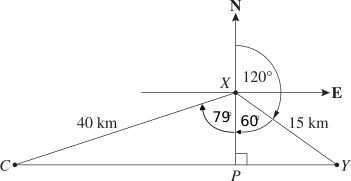
| \(\text{Bearing}\ C\ \text{from}\ X\) | \(=180+79\) | |
| \(=259^{\circ}\) |
Electricity provider \(A\) charges 25 cents per kilowatt hour (kWh) for electricity, plus a fixed monthly charge of $40. \begin{array} {|l|c|} Provider \(B\) charges 35 cents per kWh, with no fixed monthly charge. The graph shows how Provider \(B\) 's charges vary with the amount of electricity used in a month. --- 2 WORK AREA LINES (style=lined) --- --- 5 WORK AREA LINES (style=lined) --- a. \begin{array} {|l|c|} b. c. \(400\text{ kWh}\) d. \(A\text{ is cheaper by }$40.\) a. \begin{array} {|l|c|} b.
c. \(\text{Same charge when Provider }A = \text{Provider } B \text{ i.e. where the lines intersect}\) \(=400\text{ kWh (see graph above)}\) d. \(\text{When kWh}= 800, \ \ A=$240 \text{ and } B=$280\) \(\therefore A\text{ is cheaper by }$40.\)
\hline
\rule{0pt}{2.5ex} \text{Electricity used in a month (kWh)} \rule[-1ex]{0pt}{0pt} & \ \ \ \ \ 0\ \ \ \ \ & \ \ \ 400\ \ \ & \ \ 1000\ \ \\
\hline
\rule{0pt}{2.5ex} \text{Monthly charge (\$)} \rule[-1ex]{0pt}{0pt} & 40 & & 290 \\
\hline
\end{array}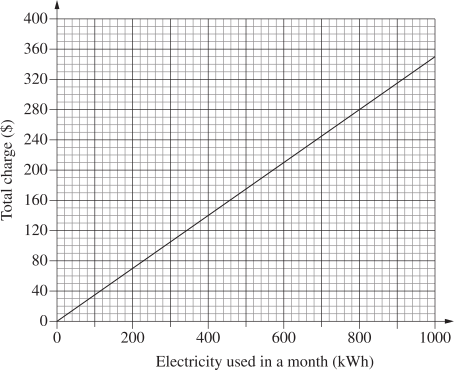
Show Answers Only
\hline
\rule{0pt}{2.5ex} \text{Electricity used in a month (kWh)} \rule[-1ex]{0pt}{0pt} & \ \ \ \ \ 0\ \ \ \ \ & \ \ \ 400\ \ \ & \ \ 1000\ \ \\
\hline
\rule{0pt}{2.5ex} \text{Monthly charge (\$)} \rule[-1ex]{0pt}{0pt} & 40 & \textbf{140} & 290 \\
\hline
\end{array}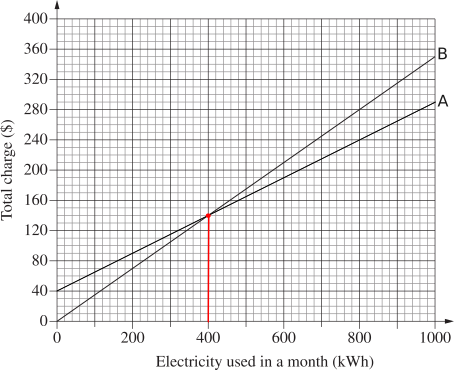 Show Worked Solution
\hline
\rule{0pt}{2.5ex} \text{Electricity used in a month (kWh)} \rule[-1ex]{0pt}{0pt} & \ \ \ \ \ 0\ \ \ \ \ & \ \ \ 400\ \ \ & \ \ 1000\ \ \\
\hline
\rule{0pt}{2.5ex} \text{Monthly charge (\$)} \rule[-1ex]{0pt}{0pt} & 40 & \textbf{140} & 290 \\
\hline
\end{array}
♦♦ Mean mark (b) 40%.
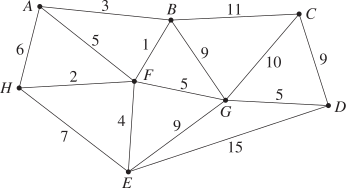
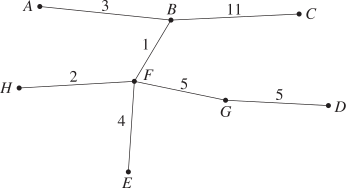
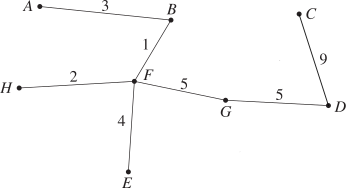
A network of running tracks connects the points \(A, B, C, D, E, F, G, H\), as shown. The number on each edge represents the time, in minutes, that a typical runner should take to run along each track. --- 4 WORK AREA LINES (style=lined) --- --- 4 WORK AREA LINES (style=lined) ---
a. \(\text{Using Djikstra’s Algorithm:}\) \(=3+11+1+2+4+5+5\) \(=31\) \(\text{Consider the MST below:}\) \(\text{Total time (MST)}= 3+1+2+4+5+5+9=29\) \(\therefore \text{ Given tree is NOT a MST.}\)
Show Worked Solution
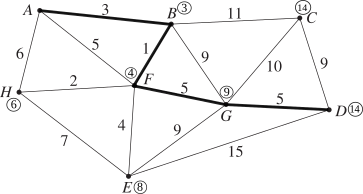
\(\text{Shortest route}\)
\(=ABFGD\)
\(=3+1+5+5\)
\(=14\)
b. \(\text{Total time of given spanning tree}\)
 ♦♦ Mean mark (b) 21%.
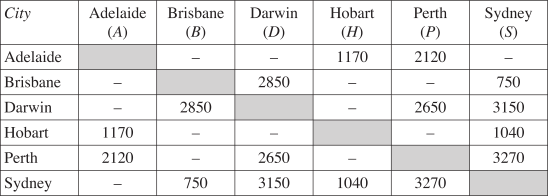
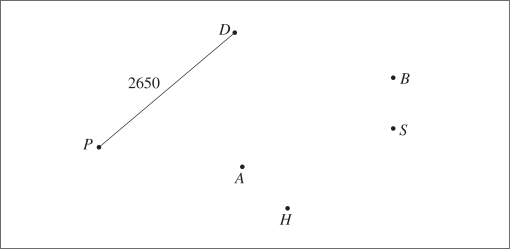
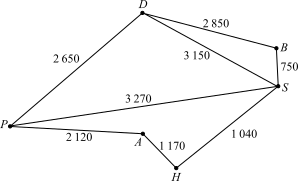
The table shows some of the flight distances (rounded to the nearest 10 km between various Australian cities. --- 1 WORK AREA LINES (style=lined) --- a. b. \(4190\text{ km}\) a. b. \(\text{Changing planes only once}\Rightarrow H\rightarrow S\rightarrow D\) \(\text{Kilometres travelled}=1040+3150=4190\text{ km}\)
Show Answers Only
 Show Worked Solution
A bag contains 150 jelly beans. Some of them are red and the rest are blue. The ratio of red to blue jelly beans is 2 : 3.
Sophie eats 10 of each colour.
What is the new ratio of red to blue jelly beans?
An item was purchased for a price of \($880\), including \(10\%\) GST.
What is the amount of GST included in the price?
A delivery truck was valued at \($65 000\) when new. The value of the truck depreciates at a rate of \(22\) cents per kilometre travelled.
What is the value of the truck after it has travelled a total distance of \(132 600\) km?
An amount of $2500 is invested at a simple interest rate of 3% per annum.
How much interest is earned in the first two years?
Given the formula `C = (A(y + 1))/24`, calculate the value of `y` when `C = 120` and `A = 500`. (3 marks)
--- 6 WORK AREA LINES (style=lined) ---
Julie has a gross annual salary of $67 000. During the year she also received an income of $780 from investments and had tax deductions totalling $1000.
The table below shows the income tax rates for the 2021–2022 financial year.
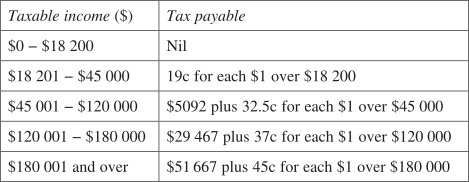
Calculate the tax payable on Julie's taxable income, ignoring the Medicare levy. (3 marks)
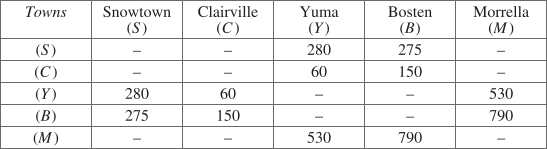
The table below shows the distances, in kilometres, between a number of towns.
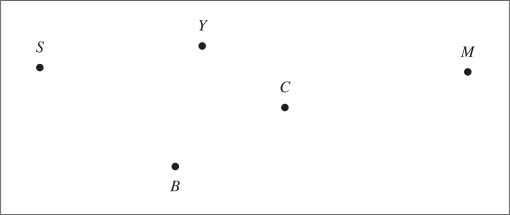
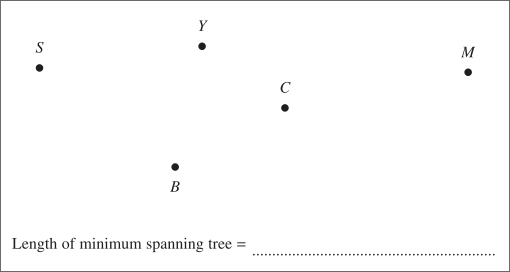
--- 0 WORK AREA LINES (style=lined) ---
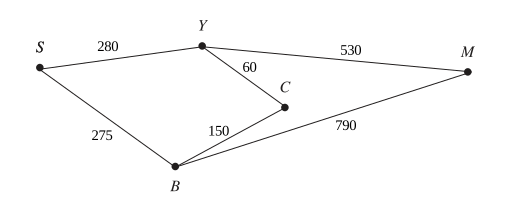
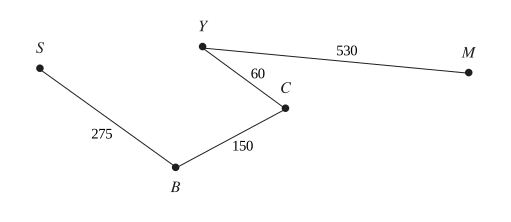
a.
b. `text{Using Prim’s algorithm (starting at}\ Y):`
`text{1st edge:}\ YC`
`text{2nd edge:}\ CB`
`text{3rd edge:}\ SB`
`text{4th edge:}\ YM`
`text{Length of minimum spanning tree}`
`=275 + 150+60+530`
`=1015\ text{km}`
Tian is paid $20.45 per hour, as well as a meal allowance of $16.20 per day.
What are Tian's total earnings if she works 9 hours per day for 5 days?
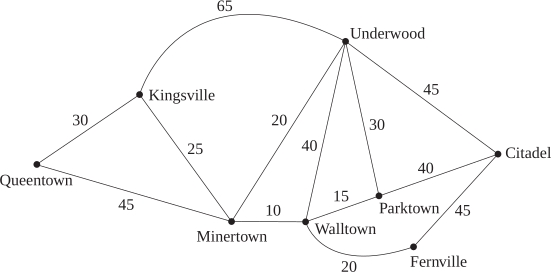
The network diagram shows the travel times in minutes along roads connecting a number of different towns.
--- 8 WORK AREA LINES (style=lined) ---
--- 2 WORK AREA LINES (style=lined) ---
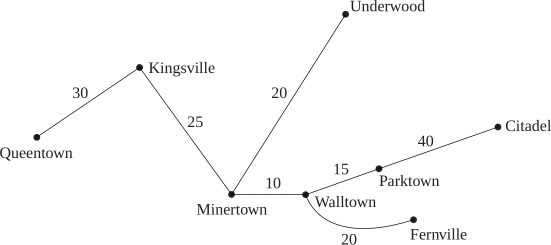
a. `text{Using Prim’s algorithm (starting at}\ W):`
`text(1st edge:)\ \ WM`
`text(2nd edge:)\ \ WP`
`text(3rd/4th edges:)\ \ MU\ text(and)\ \ WF`
`text(5th edge:)\ \ MK`
`text(6th edge:)\ \ KQ`
`text(7th edge:)\ \ PC`
| b. | `text{Fastest route}\ (Q\ text(to)\ U)` | `= 45 + 20` |
| `= 65 \ text{minutes}` |
Consider the network diagram.
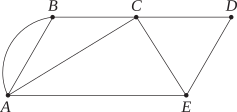
What is the sum of the degrees of all the vertices in this network?
The diagram represents a network with weighted edges.
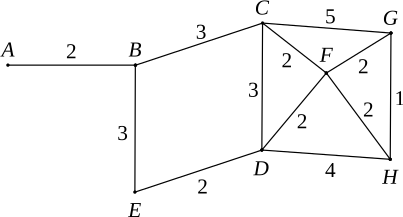
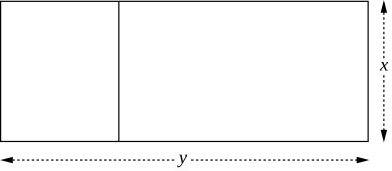
--- 8 WORK AREA LINES (style=lined) ---
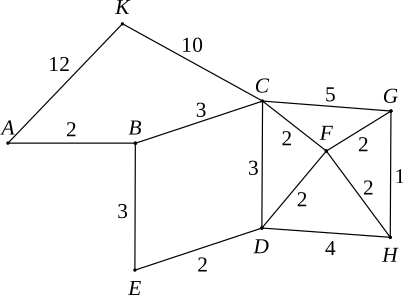
What is the length of the minimum spanning tree for this revised network? (1 mark)
--- 1 WORK AREA LINES (style=lined) ---
`text(One of many possibilities:)`
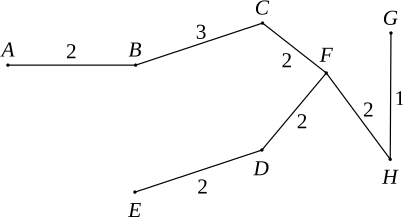
a. `text{Using Kruskal’s Algorithm (one of many possibilities):}`
`text{Edge 1 :}\ GH\ (1)`
`text{Edge 2 :}\ FH\ (2)`
`text{Edge 3 :}\ CF\ (2)`
`text{Edge 4 :}\ FD\ (2)`
`text{Edge 5 :}\ DE\ (2)`
`text{Edge 6 :}\ BC\ (3)`
`text{Edge 7 :}\ AB\ (2)`
| `text{Minimum length of spanning tree}` | `= 1 + 2 + 2 + 2 +2 + 3 +2` |
| `= 14` |
b. `text{Add}\ CK \ text{to the minimum spanning tree in (a).}`
| `therefore \ text(Revised length)` | `= 14 + 10` |
| `= 24` |
A plumber charges a call-out fee of $90 as well as $2 per minute while working.
Suppose the plumber works for `t` hours.
Which equation expresses the amount the plumber charges ($`C`) as a function of time (`t` hours)?
The distance between Bricktown and Koala Creek is 75 km. A person travels from Bricktown to Koala Creek at an average speed of 50 km/h.
How long does it take the person to complete the journey?
The network diagram shows the tracks connecting 8 picnic sites in a nature park. The vertices `A` to `H` represents the picnic sites. The weights on the edges represent the distance along the tracks between the picnic sites, in kilometres.
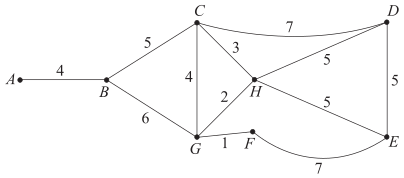
Draw a minimum spanning tree and calculate the minimum length of water pipes required to supply water to all the sites if the water pipes can only be laid along the tracks. (2 marks)
--- 5 WORK AREA LINES (style=lined) ---
--- 1 WORK AREA LINES (style=lined) ---
a. `text(One strategy – using Prim’s algorithm:)`♦ Mean mark part (a) 45%.
`text(Starting at)\ A`
`text(1st edge -)\ AB,\ \ text(2nd edge -)\ BC`
`text(3rd edge -)\ CH,\ \ text(4th edge -)\ HG`
`text(5th edge -)\ GF,\ \ text(6th edge -)\ HD`
`text(7th edge -)\ DE\ text(or)\ HE`
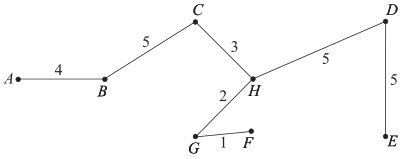
`text(Maximum length = 4 + 5 + 3 + 2 + 1 + 5 + 5 = 25 km)`
♦♦ Mean mark part (b) 30%.
b. `text(Shortest Path is)\ CGHE`