Evaluate \(\displaystyle \sum_{r=4}^7\left(2^r+3 r\right)\). (2 marks)
--- 4 WORK AREA LINES (style=lined) ---
Aussie Maths & Science Teachers: Save your time with SmarterEd
Evaluate \(\displaystyle \sum_{r=4}^7\left(2^r+3 r\right)\). (2 marks)
--- 4 WORK AREA LINES (style=lined) ---
\(306\)
| \(\displaystyle \sum_{r=4}^7\) | \(=2^4+12+2^5+15+2^6+18+2^7+21\) |
| \(=306\) |
An army training fitness station requires soldiers to climb up steel cylinders steps that gradually ascend in height, as shown below.
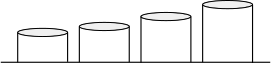
The shortest cylinder is 0.7 metres high and the highest is 4.0 metres. The height of each cylinder increases by the same amount and the fitness station is made up of a total of 23 steel cylinders.
--- 5 WORK AREA LINES (style=blank) ---
--- 3 WORK AREA LINES (style=lined) ---
--- 6 WORK AREA LINES (style=lined) ---
a. \(2.5\ \text{metres}\)
b. \(\text{See worked solutions} \)
c. \(\text{19 cylinders} \)
a. \(a=0.7\)
| \(T_{23}\) | \(=0.7+22 d\) |
| \(22 d\) | \(=4.0-0.7\) |
| \(d\) | \(=0.15\) |
\(\therefore T_{13}=0.7+(13-1) 0.15=2.5\ \text{metres}\)
| b. | \(S_{23}\) | \(=\dfrac{n}{2}(a+l)\) |
| \(=\dfrac{23}{2}(0.7+4.0)\) | ||
| \(=54.05 \ \text{metres … as required}\) |
c. \(\text{Find} \ n \ \text{such that}\ \ S_n=41:\)
| \(S_n\) | \(=\dfrac{n}{2}(2a+(n-1)d) \) |
| \(41\) | \(=\dfrac{n}{2}[2 \times 0.7+(n-1) 0.15]\) |
| \(82\) | \(=1.4 n+0.15 n^2-0.15 n\) |
| \(0\) | \(=0.15n^2+1.25n-82\) |
| \(n\) | \(=\dfrac{-1.25 \pm \sqrt{1.25^2+4 \times 0.15 \times 82}}{2 \times 0.15}\) |
| \(=19.58…\ \ (n>0) \) |
\(\therefore\ \text{19 cylinders can be made.}\)
Find the sum of the terms in the arithmetic series
\(50 + 57 + 64 +\ ...\ +2024\) (3 marks)
--- 8 WORK AREA LINES (style=lined) ---
\(293\,471\)
\(\text{AP where}\ \ a=50, d=57-50=7\)
| \(\text{Last term}\) | \(=a + (n-1)d\) |
| \(2024\) | \(=50+(n-1)d\) |
| \(n-1\) | \(=\dfrac{2024-50}{7}\) |
| \(n\) | \(=283\) |
| \(S_{283}\) | \(=\dfrac{n}{2}(a + l)\) |
| \(=\dfrac{283}{2}(50+2024)\) | |
| \(=293\,471\) |
The first three terms of an arithmetic sequence are 3, 7 and 11 .
Find the 15th term. (2 marks)
`59`
`a=T_1=3`
`d=T_2-T_1=7-3=4`
| `T_15` | `=a+14xxd` | |
| `=3+14xx4` | ||
| `=59` |
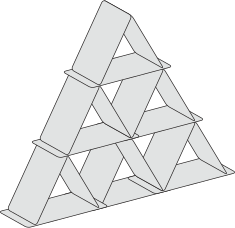
Cards are stacked to build a 'house of cards'. A house of cards with 3 rows is shown.
A house of cards requires 3 cards in the top row, 6 cards in the next row, and each successive row has 3 more cards than the previous row.
--- 4 WORK AREA LINES (style=lined) ---
--- 6 WORK AREA LINES (style=lined) ---
a. `text{Proof (See Worked Solutions)}`
b. `23`
a. `a=3, \ d=3`
| `S_n` | `=n/2[2a+(n-1)d]` |
| `S_12` | `=12/2(2xx3 + 11xx3)` |
| `=6(6+33)` | |
| `=234\ \ text{… as required}` |
b. `text{Find}\ \ n\ \ text{given}\ \ S_n=828:`
| `828` | `=n/2[6+(n-1)3]` |
| `1656` | `=n(3+3n)` |
| `=3n^2+3n` |
| `3n^2+3n-1656` | `=0` |
| `n^2+n-552` | `=0` |
| `(n+24)(n-23)` | `=0` |
`:. n=23\ text{rows}\ \ (n>0)`
The first term of an arithmetic sequence is 5. The sum of the first 43 terms is 2021.
What is the common difference of the sequence? (2 marks)
--- 4 WORK AREA LINES (style=lined) ---
`2`
`T_1 = a = 5`
| `S_43` | `= n/2 [2a + (n-1)d]` |
| `2021` | `= 43/2 (10 + 42d)` |
| `2021` | `= 215 + 903d` |
| `903d` | `= 1806` |
| `:. d` | `= 2` |
Calculate the sum of the arithmetic series `4 + 10 + 16 + … + 1354`. (3 marks)
--- 6 WORK AREA LINES (style=lined) ---
`153\ 454`
`a = 4, \ l = 1354, \ d = 10-4 = 6`
`text(Find)\ n:`
| `T_n` | `= a + (n-1)d` |
| `1354` | `= 4 + (n-1)6` |
| `1354` | `= 6n-2` |
| `n` | `= 1356/6` |
| `= 226` |
| `:. S_226` | `= n/2 (a + l)` |
| `= 226/2(4 + 1354)` | |
| `= 153\ 454` |
In an arithmetic series, the fourth term is 6 and the sum of the first 16 terms is 120.
Find the common difference. (3 marks)
--- 7 WORK AREA LINES (style=lined) ---
`1/3`
`T_4 = 6,`
`a + 3d = 6\ …\ \ (1)`
`S_16 = 120,`
| `16/2(2a + 15d)` | `= 120` |
| `16a + 120d` | `= 120\ …\ \ (2)` |
`text(Substitute)\ \ a = 6-3d\ \ text{from (1) into (2):}`
| `16(6-3d) + 120d` | `= 120` |
| `96-48d + 120d` | `= 120` |
| `72d` | `= 24` |
| `d` | `= 1/3` |
An artist posted a song online. Each day there were `2^n + n` downloads, where `n` is the number of days after the song was posted.
--- 1 WORK AREA LINES (style=lined) ---
--- 4 WORK AREA LINES (style=lined) ---
i. `text(Day 1) : 3`
`text(Day 2) : 6`
`text(Day 3) : 11`
ii. `2\ 097\ 360`
i. `text(Day 1:)\ \ 2^1 + 1 = 3`
`text(Day 2:)\ \ 2^2 + 2 = 6`
`text(Day 3:)\ \ 2^3 + 3 = 11`
ii. `text{Total downloads (20 days)}`
`= 2^1 + 1 + 2^2 + 2 + … + 2^20 + 20`
`= underbrace(2^1 + 2^2 + … + 2^20)_{text(GP),\ a = 2,\ r=2} + underbrace(1 + 2 + … + 20)_{text(AP),\ a = 1,\ d = 1}`
`= (2(2^20-1))/(2-1) + 20/2(1 + 20)`
`= 2\ 097\ 150 + 210= 2\ 097\ 360`
In an arithmetic series, the third term is 8 and the twentieth term is 59.
--- 2 WORK AREA LINES (style=lined) ---
--- 4 WORK AREA LINES (style=lined) ---
i. `d = 3`
ii. `149`
| i. | `a + 2d` | `= 8 qquad text{… (1)}` |
| `a + 19d` | `= 59 qquad text{… (2)}` |
`text(Substract)\ \ (2)-(1)`
| `17d` | `= 51` |
| `:. d` | `= 3` |
ii. `text(Find)\ \ T_50`
`text(Substitute)\ \ d = 3\ \ text{into (1)}`
`=> a = 12`
| `T_n` | `=a+(n-1)d` |
| `:. T_50` | `= 2 + 49 xx 3` |
| `= 149` |
In an arithmetic series, the fifth term is 200 and the sum of the first four terms is 1200.
Find the value of the tenth term. (3 marks)
--- 6 WORK AREA LINES (style=lined) ---
`0`
`T_n = a + (n-1) d`
`=>a + 4d = 200 …\ (1)`
`S_n = n/2 [2a + (n-1) d]`
`=>4a + 6d = 1200 …\ (2)`
`text(Multiply)\ (1) xx 4`
`=>4a + 16d = 800 …\ (1 prime)`
`text(Subtract)\ \ (1 prime) – (2)`
| `10d` | `= -400` |
| `d` | `= -40` |
`text(Substitute)\ \ d = -40\ \ text(into)\ (1)`
| `a-160` | `= 200` |
| `a` | `= 360` |
| `:. T_10` | `= 360+9(-40)` |
| `= 0` |
The graph above shows the first six terms of a sequence.
This sequence could be
`D`
`text(Series is 1, 1, 1, …)`
`text(The only possibility within the choices)`
`text(is a geometric sequence where)\ \ r=1.`
`=> D`
There are 3000 tickets available for a concert.
On the first day of ticket sales, 200 tickets are sold.
On the second day, 250 tickets are sold.
On the third day, 300 tickets are sold.
This pattern of ticket sales continues until all 3000 tickets are sold.
How many days does it take for all of the tickets to be sold?
`C`
`200+250+300+…`
`text(AP where)\ \ a=200, \ d=250-200=50`
`text(Find)\ \ n\ \ text(when)\ \ S_n=3000:`
| `S_n` | `=n/2[2a+(n-1)d]` |
| `3000` | `=n/2[2×200+(n-1)50]` |
| `3000` | `=n/2(400+50n-50)` |
| `3000` | `=n/2(350+50n)` |
| `3000` | `=175n+25n^2` |
| `0` | `=n^2+7n-120` |
| `0` | `=(n-8)(n+15)` |
`:. n=8,\ \ \ (n>0)`
`=> C`
A toy train track consists of a number of pieces of track which join together.
The shortest piece of the track is 15 centimetres long and each piece of track after the shortest is 2 centimetres longer than the previous piece.
The total length of the complete track is 7.35 metres.
Find the length of the longest piece of track. (3 marks)
--- 9 WORK AREA LINES (style=lined) ---
`55\ text(cm)`
`text(Sequence is 15, 17, 19 , . . .)`
`text(AP where)\ \ a=15, \ d=2`
| `S_n` | `= n / 2 [ 2a + (n-1) d ]` |
| `735` | `= n / 2 [ 2 xx 15 + (n-1) 2 ]` |
| `735` | `= n / 2 [ 30 + 2n-2 ]` |
| `735` | `= n^2 + 14n` |
| `0` | `= n^2 + 14n-735` |
`text(Using the quadratic formula:)`
`n= {-14 +- sqrt (14^2-4. 1. (-735))} / (2 xx 1)= (-14 +-56) / 2= 21 \ \ (n > 0)`
| `:.\ text(Longest piece of track)` | `= a + (n-1) d` |
| `= 15 + (21-1) 2` | |
| `= 55\ text(cm)` |
The first three terms of an arithmetic sequence are `1, 3, 5 . . .`
The sum of the first `n` terms of this sequence, `S_n`, is
`A`
`text(Sequence is 1, 3, 5 , . . .)`
`text(AP where)\ \ \ a=1, \ d=3-1=2`
| `S_n` | `= n / 2 [ 2a + (n-1) d ]` |
| `= n / 2 [ 2 xx 1 + (n-1) 2 ]` | |
| `= n / 2 [ 2 + 2n-2 ]` | |
| `= n^2` |
`=> A`
Clare is learning to drive. Her first lesson is 30 minutes long. Her second lesson is 35 minutes long. Each subsequent lesson is 5 minutes longer than the lesson before.
--- 2 WORK AREA LINES (style=lined) ---
--- 5 WORK AREA LINES (style=lined) ---
--- 4 WORK AREA LINES (style=lined) ---
a. `text(130 minutes)`
b. `28\ text(hours)`
c. `text(30th lesson)`
a. `30, 35, 40, …`
`=>\ text(AP where)\ \ a = 30,\ \ d = 5`
| `T_n` | `= a + (n − 1) d` |
| `T_(21)` | `= 30 + 20(5)` |
| `= 30 + 100` | |
| `= 130` |
`:.\ text(Clare’s twenty-first lesson will be 130)`
`text(minutes long.)`
b. `text(Find)\ \ S_21\ \ text(given)\ \ a = 30, \ d = 5`
| `S_n` | `= n/2[2a + (n − 1)d]` |
| `:.S_21` | `= 21/2[2(30) + 20 × 5]` |
| `= 21/2[60 + 100]` | |
| `= 21/2 × 160` | |
| `= 1680\ text(minutes)` | |
| `= 28\ text(hours.)` |
| c. `text(50 hours)` | `= 50 × 60` |
| `= 3000\ text(minutes)` |
`text(Find)\ \ n,\ \ text(given)\ \ a = 30, \ d = 5, \ S_n = 3000`
| `S_n` | `= n/2[2a + (n − 1)d]` |
| `:. 3000` | `= n/2[2(30) + (n − 1)5]` |
| `6000` | `= n[60 + 5n − 5]` |
| `6000` | `= n[55 + 5n]` |
| `6000` | `= 55n + 5n^2` |
| `5n^2 + 55n − 6000` | `= 0` |
| `n^2 + 11n − 1200` | `= 0` |
| `:.n` | `= (−11 ± sqrt((11)^2 − 4(1)(−1200)))/(2(1))` |
| `= (−11 ± sqrt(121 + 4800))/(2)` | |
| `= (−11 ± sqrt4921)/2` | |
| `= 29.5749…\ \ \ (n> 0)` |
`:.\ text(Clare completes 50 hours of lessons during)`
`text(her 30th lesson.)`
Heather decides to swim every day to improve her fitness level.
On the first day she swims 750 metres, and on each day after that she swims `100` metres more than the previous day. That is, she swims 850 metres on the second day, 950 metres on the third day and so on.
--- 2 WORK AREA LINES (style=lined) ---
--- 1 WORK AREA LINES (style=lined) ---
--- 2 WORK AREA LINES (style=lined) ---
--- 5 WORK AREA LINES (style=lined) ---
a. `T_n = 650 + 100n`
b. `1650\ text(metres)`
c. `12\ text(km)`
d. `34\ text(km)`
| a. `T_1` | `= 750` |
| `T_2` | `= 850` |
`=> text(AP)\ text(where)\ a = 750\ ,\ d = 100`
| `:. T_n` | `= a + (n-1) d` |
| `= 750 + (n-1) 100` | |
| `= 750 + 100n-100` | |
| `= 650 + 100n` |
| b. `T_10` | `= 650 + 100 xx 10` |
| `= 1650\ text(metres)` |
`:.\ text(She swims 1650 metres on the 10th day.)`
c. `S_n = n/2 [2a + (n – 1) d]`
| `:. S_10` | `= 10/2 [2 xx 750 + (10-1) 100]` |
| `= 5 [1500 + 900]` | |
| `= 12\ 000` |
`:.\ text(She swims 12 km in the first 10 days.)`
d. `text(Find)\ n\ text(such that)\ S_n = 34\ text(km)`
| `n/2 [2 xx 750 + (n-1) 100]` | `= 34\ 000` |
| `n/2 [1500 + 100n-100]` | `= 34\ 000` |
| `n/2 [1400 + 100n]` | `= 34\ 000` |
| `700n + 50n^2` | `= 34\ 000` |
| `50 n^2 + 700n-34\ 000` | `= 0` |
| `50 (n^2 + 14 n-680)` | `= 0` |
`text(Using the quadratic formula)`
| `n` | `= {-b +- sqrt(b^24ac)}/(2a)` |
| `= {-14 +- sqrt(14^2-4 xx 1 xx (-680))}/(2 xx 1)` | |
| `= (-14 +- sqrt 2916)/2` | |
| `= (-14 +- 54)/2` | |
| `= 20 or -34` | |
| `= 20\ ,\ n > 0` |
`:.\ text(Her total distance equals 34 km after 20 days.)`
The first three terms of an arithmetic series are 3, 7 and 11.
What is the 15th term of this series?
`A`
`3, 7, 11, …`
`T_1 = 3`
`T_2 = 7`
`=> text(AP where)\ a = 3, d = 7-3 = 4`
| `T_n` | `= a + (n-1) d` |
| `T_15` | `= 3 + (15-1) 4= 59` |
`=> A`
On the first day of the harvest, an orchard produces 560 kg of fruit. On the next day, the orchard produces 543 kg, and the amount produced continues to decrease by the same amount each day.
--- 4 WORK AREA LINES (style=lined) ---
--- 2 WORK AREA LINES (style=lined) ---
--- 4 WORK AREA LINES (style=lined) ---
a. `text(339 kg of fruit is produced on 14th day.)`
b. `text(6293 kg of fruit is produced in the 1st 14 days.)`
c. `text(On the 31st day, production will first drop below 60 kg.)`
a. `T_1 = a = 560`
`T_2 = a + d = 543`
`=>\ text(AP where)\ a = 560, d = -17`
`vdots`
| `T_14` | `= a + 13d` |
| `= 560-(13 xx 17)` | |
| `= 339` |
`:.\ text(339 kg of fruit is produced on 14th day.)`
b. `S_14 = text(total fruit produced in 1st 14 days)`
| `S_14` | `= n/2 [2a + (n-1)d]` |
| `= 14/2 [2 xx 560-(14-1) xx 17]` | |
| `= 7 [1120-221]` | |
| `= 6293` |
`:.\ text(6293 kg of fruit is produced in the 1st 14th days.)`
c. `text(Find)\ n\ text(such that)\ T_n < 60`
| `T_n = a + (n-1)d` | `< 60` |
| `560-17(n-1)` | `< 60` |
| `560-17n + 17` | `< 60` |
| `17n` | `> 517` |
| `n` | `> 30.41…` |
`:.\ text(On the 31st day, production will first drop below 60 kg.)`
Anne and Kay are employed by an accounting firm.
Anne accepts employment with an initial annual salary of $50 000. In each of the following years her annual salary is increased by $2500.
Kay accepts employment with an initial annual salary of $50 000. In each of the following years her annual salary is increased by 4%.
--- 4 WORK AREA LINES (style=lined) ---
--- 6 WORK AREA LINES (style=lined) ---
a. `$80\ 000`
b. `text{$80 052 (nearest dollar)}`
c. `text{$13 904 (nearest $)}`
a. `text(Let)\ T_n = text(Anne’s salary in year)\ n`
`T_1 = a = $50\ 000`
`T_2 = a + d = $52\ 500`
`⇒\ text(AP where)\ a = $50\ 000,\ \ d = $2500`
`T_n = a + (n-1)d`
| `T_13` | `= 50\ 000 + (13-1) xx 2500` |
| `=80\ 000` |
`:.\ text(Anne’s salary in her 13th year is $80 000.)`
b. `text(Let)\ K_1 =text(Kay’s salary in year)\ n`
| `K_1` | `= a` | `= 50\ 000` |
| `K_2` | `= ar` | `= 50\ 000 xx 1.04 = 52\ 000` |
| `⇒\ text(GP where)\ \ a = 50\ 000, \ \ r = 1.04` | ||
| `K_n` | `= ar^(n-1)` |
| `K_13` | `= 50\ 000 xx (1.04)^12` |
| `= $80\ 051.61…` | |
| `= $80\ 052\ \ \ text{(nearest dollar)}` |
c. `text(Anne)`
| `S_n` | `= n/2[2a + (n-1)d]` |
| `S_20` | `= 20/2[2 xx 50\ 000 + (20-1)2500]` |
| `= 10[100\ 000 + 47\ 500]` | |
| `= $1\ 475\ 000` |
`text(Kay)`
| `S_n` | `= (a(r^n-1))/(r-1)` |
| `S_20` | `= (50\ 000(1.04^20-1))/(1.04-1)` |
| `= $1\ 488\ 903.929…` |
`text(Difference)`
`= 1\ 488\ 903.929…-1\ 475\ 000`
`= $13\ 903.928…`
`= $13\ 904\ \ \ text{(nearest $)}`
`:.\ text(Kay’s total salary exceeds Anne’s by)\ $13\ 904`
Evaluate `sum_(n = 3)^5 (2n + 1)`. (1 mark)
`27`
| `sum_(n = 3)^5 (2n + 1)` | `= (2 xx 3 +1) + (2 xx 4 + 1)+(2 xx 5 + 1)` |
| `= 7 + 9 + 11` | |
| `= 27` |
There are 10 checkpoints in a 4500 metre orienteering course. Checkpoint 1 is the start and checkpoint 10 is the finish.
The distance between successive checkpoints increases by 50 metres as each checkpoint is passed.
Calculate the distance, in metres, between checkpoint 2 and checkpoint 3. (3 marks)
--- 8 WORK AREA LINES (style=lined) ---
`text(350 m)`
`text(9 intervals exist between 10 checkpoints)`
`=>\ text(9 distances form an AP where:)\ d=50, \ S_9=4500`
| `S_n` | `= n/2[2a + (n-1)d]` |
| `4500` | `= 9/2 [2a + (9-1) × 50]` |
| `4500` | `= 9/2[2a + 400]` |
| `9a` | `= 2700` |
| `a` | `= 300` |
`text(Distance between checkpoint 1 and 2)`
`= a=300\ text(m)`
`:.\ text(Distance between checkpoint 2 and 3)`
`= a+d=350\ text(m)`
Find the sum of the first 21 terms of the arithmetic series 3 + 7 + 11 + ... (2 marks)
--- 5 WORK AREA LINES (style=lined) ---
`903`
| `S` | `= 3 + 7 + 11 + …` |
| `a` | `= 3` |
| `d` | `= 7-3 = 4` |
| `:. S_21` | `= n/2 [2a + (n-1) d]` |
| `= 21/2 [2 xx 3 + (21-1)4]` | |
| `= 21/2 [6 + 80]` | |
| `= 903` |
Evaluate the arithmetic series 2 + 5 + 8 + 11 + ... + 1094. (2 marks)
--- 4 WORK AREA LINES (style=lined) ---
`200\ 020`
`2 + 5 + 8 + … + 1094`
`AP\ \ text(where)\ \ a = 2,\ \ \ d = 5-2 = 3`
`text(Find)\ n:`
| `T_n` | `= a + (n-1) d` |
| `1094` | `= 2 + (n-1)3` |
| `3n-3` | `= 1092` |
| `3n` | `= 1095` |
| `n` | `= 365` |
| `:. S_365` | `= n/2 (a + l)` |
| `= 365/2 (2 + 1094)` | |
| `= 200\ 020` |
An arithmetic series has 21 terms. The first term is 3 and the last term is 53.
Find the sum of the series. (2 marks)
`588`
| `S_n` | `=n/2 (a+l)` |
| `S_21` | `=21/2(3+53)` |
| `=588` |
Susanna is training for a fun run by running every week for 26 weeks. She runs 1 km in the first week and each week after that she runs 750 m more than the previous week, until she reaches 10 km in a week. She then continues to run 10 km each week.
--- 3 WORK AREA LINES (style=lined) ---
--- 4 WORK AREA LINES (style=lined) ---
a. `7\ text(km)`
b. `13 text(th week)`
c. `201.5\ text(km)`
a. `T_1=a=1`
`T_2=a+d=1.75`
`T_3=a+2d=2.50`
`=>\ text(AP where)\ a=1 \ \ d=0.75`
`\ \ vdots`
| `T_9` | `=a+8d` |
| `=1+8(0.75)` | |
| `=7` |
`:.\ text(Susannah runs 7 km in the 9th week.)`
b. `text(Find)\ n\ text(such that)\ T_n=10\ text(km)`
`text(Using)\ T_n=a+(n-1)d`
| `1+(n-1)(0.75)` | `=10` |
| `0.75n-0.75` | `=9` |
| `n` | `=9.75/0.75` |
| `=13` |
`:.\ text(Susannah runs 10 km for the first time in the 13th Week.)`
c. `text{Let D = the total distance Susannah runs in 26 weeks}`
| `text(D)` | `=S_13+13(10)` |
| `=n/2[2a+(n-1)d]+13(10)` | |
| `=13/2[2(1)+(13-1)(0.75)]+130` | |
| `=13/2(2+9)+130` | |
| `=201.5` |
`:.\ text(Susannah runs a total of 201.5 km in 26 weeks.)`
A skyscraper of 110 floors is to be built. The first floor to be built will cost $3 million. The cost of building each subsequent floor will be $0.5 million more than the floor immediately below.
--- 4 WORK AREA LINES (style=lined) ---
a. `$15\ text(million)`
b. `$3327.5\ text(million)`
| a. `T_1` | `=a=3` |
| `T_2` | `=a+d=3.5` |
| `T_3` | `=a+2d=4` |
`=>\ text(AP where)\ \ a=3\ \ d=0.5`
| `T_25` | `=a+24d` |
| `=3+24(0.5)` | |
| `=15` |
`:.\ text(The 25th floor costs)\ $15\ 000\ 000.`
| b. `S_110` | `=\ text(Total cost of 110 floors)` |
| `=n/2(2a+(n-1)d)` | |
| `=110/2(2xx3\ 000\ 000+(110-1)500\ 000)` | |
| `=55(6\ 000\ 000+49\ 500\ 000)` | |
| `=$3327.5\ text(million)` |
`:.\ text{The total cost of 110 floors is $3327.5 million}`
Jay is making a pattern using triangular tiles. The pattern has 3 tiles in the first row, 5 tiles in the second row, and each successive row has 2 more tiles than the previous row.
--- 4 WORK AREA LINES (style=lined) ---
--- 2 WORK AREA LINES (style=lined) ---
--- 6 WORK AREA LINES (style=lined) ---
a. `41`
b. `440`
c. `13\ text(rows)`
| a. | `T_1` | `=a=3` |
| `T_2` | `=a+d=5` | |
| `T_3` | `=a+2d=7` |
`=>\ text(AP where)\ \ a=3,\ \ d=2`
`\ \ \ \ \ vdots`
| `T_20` | `=a+19d` |
| `=3+19(2)` | |
| `=41` |
`:.\ text(Row 20 has 41 tiles.)`
| b. `S_20` | `=\ text(the total number of tiles in first 20 rows)` |
| `S_20` | `=n/2(a+l)` |
| `=20/2(3+41)` | |
| `=440` |
`:.\ text(There are 440 tiles in the first 20 rows.)`
c. `text(If Jay only has 200 tiles, then)\ \ S_n<=200`
| `n/2(2a+(n-1)d)` | `<=200` |
| `n/2(6+2n-2)` | `<=200` |
| `n(n+2)` | `<=200` |
| `n^2+2n-200` | `<=0` |
| `n` | `=(-2+-sqrt(4+4*1*200))/(2*1)` |
| `=(-2+-sqrt804)/2` | |
| `=-1+-sqrt201` | |
| `=13.16\ \ text{(answer must be positive)}` |
`:.\ text(Jay can complete 13 rows.)`
Kim and Alex start jobs at the beginning of the same year. Kim's annual salary in the first year is `$30 000` and increases by 5% at the beginning of each subsequent year. Alex's annual salary in the first year is `$33 000`, and increases by $1500 at the beginning of each subsequent year.
--- 4 WORK AREA LINES (style=lined) ---
--- 6 WORK AREA LINES (style=lined) ---
a. `text{Proof (See Worked Solutions)}`
b. `$377\ 336.78`
c. `text(7 years)`
a. `text(Let)\ \ K_n=text(Kim’s salary in Year)\ n`
`{:{:(K_1=a=30\ 000),(K_2=ar^1=30\ 000(1.05^1)):}}{:(\ =>\ GP),(\ \ \ \ \ \ a=30\ 000),(\ \ \ \ \ \ r=1.05):}`
`vdots`
`:.K_10=ar^9=30\ 000(1.05)^9=$46\ 539.85`
`text(Let)\ \ A_n=text(Alex’s salary in Year)\ n`
`{:{:(A_1=a=33\ 000),(A_2=33\ 000+1500=34\ 500):}}{:(\ =>\ AP),(\ \ \ \ \ \ a=33\ 000),(\ \ \ \ \ \ d=1500):}`
`vdots`
`A_10=a+9d=33\ 000+1500(9)=$46\ 500`
`=>K_10>A_10`
`:.\ text(Kim earns more than Alex in the 10th year)`
b. `text(In the first 10 years, Kim earns)`
`K_1+K_2+\ ….+ K_10`
| `S_10` | `=a((r^n-1)/(r-1))` |
| `=30\ 000((1.05^10-1)/(1.05-1))` | |
| `=377\ 336.78` |
`:.\ text(In the first 10 years, Kim earns $377 336.78)`
c. `text(Let)\ T_n=text(Alex’s savings in Year)\ n`
`{:{:(T_1=a=1/3(33\ 000)=11\ 000),(T_2=a+d=1/3(34\ 500)=11\ 500),(T_3=a+2d=1/3(36\ 000)=12\ 000):}}{:(\ =>\ AP),(\ \ \ \ a=11\ 000),(\ \ \ \ d=500):}`
`text(Find)\ n\ text(such that)\ S_n=87\ 500`
| `S_n` | `=n/2[2a+(n-1)d]` |
| `87\ 500` | `=n/2[22\ 000+(n-1)500]` |
| `87\ 500` | `=n/2[21\ 500+500n]` |
| `250n^2+10\ 750n-87\ 500` | `=0` |
| `n^2+43n-350` | `=0` |
| `(n-7)(n+50)` | `=0` |
`:.n=7,\ \ \ \ n>0`
`:.\ text(Alex’s savings will be $87,500 after 7 years).`