Evaluate \(\displaystyle \sum_{r=4}^7\left(2^r+3 r\right)\). (2 marks)
--- 4 WORK AREA LINES (style=lined) ---
Aussie Maths & Science Teachers: Save your time with SmarterEd
Evaluate \(\displaystyle \sum_{r=4}^7\left(2^r+3 r\right)\). (2 marks)
--- 4 WORK AREA LINES (style=lined) ---
\(306\)
| \(\displaystyle \sum_{r=4}^7\) | \(=2^4+12+2^5+15+2^6+18+2^7+21\) |
| \(=306\) |
The numbers, 75, \(p\), \(q\), 2025, form a geometric sequence.
Find the values of \(p\) and \(q\). (2 marks)
--- 5 WORK AREA LINES (style=lined) ---
\(p=225, \ q=675\)
\(a=75, \ 75r=p, \ 75r^2=q, \ 75r^3=2025\)
\(\text{Using}\ \ 75r^3=2025:\)
\(r=\sqrt[3]{\dfrac{2025}{75}}=3\)
\(p=75 \times 3 = 225\)
\(q=75 \times 3^{2}=675\)
Suppose the geometric series \(x+x^2+x^3+\ \cdots\) has a limiting sum.
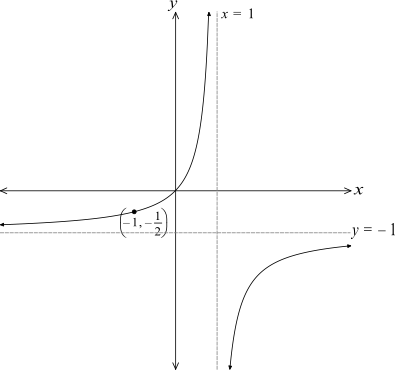
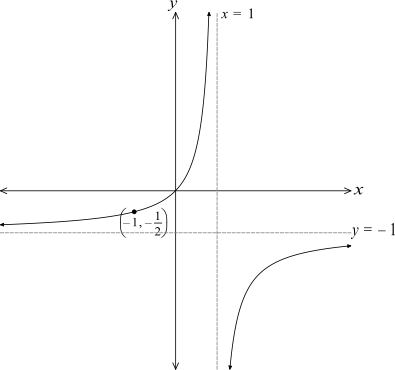
By considering the graph \(y=-1-\dfrac{1}{x-1}\), or otherwise, find the range of possible values of \(S\). (3 marks)
--- 12 WORK AREA LINES (style=lined) ---
\(S \in \Big( -\dfrac{1}{2}, \infty\Big ) \)
\(x + x^2+x^3\ \cdots \Rightarrow a=x, r=x\)
\(S=\dfrac{a}{1-r} = \dfrac{x}{1-x}=\dfrac{-(1-x)+1}{1-x} = -1+\dfrac{1}{1-x}=-1-\dfrac{1}{x-1}\)
\(\text{If limiting sum}\ \Rightarrow \abs{r} \lt 1\ \Rightarrow \ \abs{x} \lt 1\)
\(\Rightarrow \text{Possible values of}\ S =\ \text{range of}\ \ y=-1-\dfrac{1}{x-1}\ \text{in domain}\ \abs{x} \lt 1\)
\(\text{Consider}\ \ y=-1-\dfrac{1}{x-1}:\)
\(\text{Asymptote at}\ \ x=1.\)
\begin{array} {|c|c|c|c|c|c|}
\hline
\rule{0pt}{2.5ex} x \rule[-1ex]{0pt}{0pt} & -2 & -1 & 0 & 1 & 2 \\
\hline
\rule{0pt}{2.5ex} y \rule[-1ex]{0pt}{0pt} & -\dfrac{2}{3} & -\dfrac{1}{2} & \ \ 0\ \ & \infty & -2 \\
\hline
\end{array}
\(\text{As}\ x \rightarrow \infty, \ y \rightarrow -1\)
\(\text{As}\ x \rightarrow -\infty, \ y \rightarrow -1\)
\(\abs{x} \lt 1\ \Rightarrow \ y \in \Big( -\dfrac{1}{2}, \infty\Big ) \)
\(\therefore\ \text{Possible values of}\ S \in \Big( -\dfrac{1}{2}, \infty\Big ) \)
The fourth term of a geometric sequence is 48 .
The eighth term of the same sequence is `3/16`.
Find the possible value(s) of the common ratio and the corresponding first term(s). (3 marks)
--- 6 WORK AREA LINES (style=lined) ---
`a=3072,\ r=1/4, or`
`a=-3072,\ r=-1/4`
`T_4=ar^3=48\ …\ (1)`
`T_8=ar^7=3/16\ …\ (2)`
| `(ar^7)/(ar^3)` | `=(3/16)/48` |
| `r^4` | `=1/256` |
| `r` | `=+-1/4` |
`text{If}\ \ r=1/4`
| `a(1/4)^3` | `=48` |
| `a/64` | `=48` |
| `a` | `=3072` |
`text{If}\ \ r=-1/4,\ \ a=-3072`
| `a(-1/4)^3` | `=48` |
| `-a/64` | `=48` |
| `a` | `=-3072` |
`:.\ a=3072,\ r=1/4\ or\ a=-3072,\ r=-1/4`
What is the limiting sum of the following geometric series?
`2000-1200 + 720-432…` (2 marks)
`1250`
`text(GP): \ r = T_2/T_1 = (-1200)/2000 = -3/5`
`|\ r\ | < 1`
| `S_oo` | `= a/(1-r)` |
| `= 2000/(1 + 3/5)` | |
| `= 1250` |
An artist posted a song online. Each day there were `2^n + n` downloads, where `n` is the number of days after the song was posted.
--- 1 WORK AREA LINES (style=lined) ---
--- 4 WORK AREA LINES (style=lined) ---
i. `text(Day 1) : 3`
`text(Day 2) : 6`
`text(Day 3) : 11`
ii. `2\ 097\ 360`
i. `text(Day 1:)\ \ 2^1 + 1 = 3`
`text(Day 2:)\ \ 2^2 + 2 = 6`
`text(Day 3:)\ \ 2^3 + 3 = 11`
ii. `text{Total downloads (20 days)}`
`= 2^1 + 1 + 2^2 + 2 + … + 2^20 + 20`
`= underbrace(2^1 + 2^2 + … + 2^20)_{text(GP),\ a = 2,\ r=2} + underbrace(1 + 2 + … + 20)_{text(AP),\ a = 1,\ d = 1}`
`= (2(2^20-1))/(2-1) + 20/2(1 + 20)`
`= 2\ 097\ 150 + 210= 2\ 097\ 360`
A geometric series has first term `a` and limiting sum 2.
Find all possible values for `a`. (3 marks)
--- 6 WORK AREA LINES (style=lined) ---
`0 < a < 4`
`S_oo = a/(1 – r)`
`text(If)\ \ S_oo = 2:`
| `2` | `= a/(1-r)` |
| `2(1-r)` | `= a` |
| `1-r` | `= a/2` |
| `r` | `= 1-a/2` |
`text(S)text(ince)\ \ |r| < 1,`
`|1-a/2| < 1`
| `1-a/2` | `< 1` | `or qquad -(1-a/2)` | `< 1` |
| `a/2` | `> 0` | `a/2` | `< 2` |
| `a` | `> 0` | `a` | `< 4` |
`:. 0 < a < 4`
By summing the geometric series `1 + x + x^2 + x^3 + x^4`, or otherwise,
find `lim_(x -> 1) (x^5 - 1)/(x - 1)`. (2 marks)
--- 5 WORK AREA LINES (style=lined) ---
`5`
`1 + x + x^2 + x^3 + x^4`
`=> text(GP where)\ \ a = 1,\ \ r = x,\ \ n = 5`
| `S_n` | `= (a(r^n-1))/(r-1)` |
| `S_5` | `= ((x^5-1))/(x-1)` |
`:. lim_(x -> 1) (x^5-1)/(x-1)`
`= lim_(x -> 1) (1 + x + x^2 + x^3 + x^4)`
`= 5`
The graph above shows the first six terms of a sequence.
This sequence could be
`D`
`text(Series is 1, 1, 1, …)`
`text(The only possibility within the choices)`
`text(is a geometric sequence where)\ \ r=1.`
`=> D`
A dragster is travelling at a speed of 100 km/h.
It increases its speed by
and so on in this pattern.
Correct to the nearest whole number, the greatest speed, in km/h, that the dragster will reach is
`D`
`text (Sequence of speed increases is)`
`text (50, 30, 18, …)`
`text (GP where)\ \ a=50, \ r=t_2/t_1 = 30/50 = 0.6`
`text{Since}\ \ |\ r\ | < 1 :`
`S_oo= a / (1-r)= 50/ (1-0.6)= 125`
`:.\ text (Max speed is 100 + 125 = 225 km/h)`
`=> D`
The first four terms of a geometric sequence are
`4, -8,\ 16, -32`
The sum of the first ten terms of this sequence is
`B`
`4, -8, 16, -32,\ …`
`text(GP where)\ \ a=4, \ r=t_(2)/t_(1)= (-8)/4=-2`
| `S_n` | `=(a(r^n-1))/(r-1)` |
| `S_10` | `=[4[(-2)^10-1]]/(-2-1)= -1364` |
`=> B`
The first three terms of a geometric sequence are
`0.125, 0.25, 0.5`
The fourth term in this sequence would be
`D`
`text(GP sequence is 0.125, 0.25, 0.5)`
| `a` | `=0.125` |
| `r` | `=t_(2)/t_(1)=0.25/0.125=2` |
| `T_4` | `=ar^3=0.125 xx 2^3=1` |
`=> D`
The first four terms of a geometric sequence are `6400\ ,\ t_2\ ,\ 8100\ , -9112.5`
The value of `t_2` is
`B`
`text(GP is)\ \ 6400, t_2, 8100, –9112.5`
| `r` | `=t_2/t_1 = t_3/t_2` |
| `t_2 / 6400` | `= (-9112.5) / 8100` |
| `t_2` | `= (-9112.5 × 6400) / 8100= -7200` |
`=> B`
The first three terms of a geometric sequence are `6, x, 54.`
A possible value of `x` is
`C`
`text(S)text(ince the sequence is geometric:)`
| `r` | `=x/6=54/x` |
| `x^2` | `=54 xx 6=324` |
| `:.x` | `=18` |
`=> C`
Consider the geometric series `1-tan^2 theta + tan^4 theta- …`
--- 4 WORK AREA LINES (style=lined) ---
--- 5 WORK AREA LINES (style=lined) ---
a. `cos^2 theta`
b. `-pi/4 < theta < pi/4`
a. `1-tan^2 theta + tan^4 theta- …`
`=>\ text(GP where)\ \ a=1,\ \ r=T_2/T_1= − tan^2 theta`
| `:. S_∞` | `= 1/(1-(-tan^2 theta))` |
| `= 1/(1 + tan^2 theta)` | |
| `= 1/(sec^2 theta)` | |
| `= cos^2 theta` |
b. `text(Find)\ theta\ text(such that)\ |r |<1:`
| `|-tan^2 theta\ |` | `< 1` |
| ` tan^2 theta` | `< 1` |
| `-1 < tan theta` | `< 1` |
| `:. -pi/4 < theta` | `< pi/4` |
Evaluate `sum_(n = 2)^4 n^2`. (1 mark)
`29`
| `sum_(n = 2)^4 n^2` | `= 2^2 + 3^2 + 4^2` |
| `= 4 + 9 + 16` | |
| `= 29` |
Find the limiting sum of the geometric series
`3/4 + 3/16 + 3/64 + …` (2 marks)
`1`
`3/4 + 3/16 + 3/64 + …`
`=> text(GP where)\ \ a = 3/4,\ \ \ r = T_2/T_1 = 1/4`
| `:. S_oo` | `= a/(1-r)` |
| `= (3/4)/(1-1/4)` | |
| `= 1` |
Find the limiting sum of the geometric series `1 - 1/4 + 1/16 - 1/64 + …` (2 marks)
--- 5 WORK AREA LINES (style=lined) ---
`4/5`
`1-1/4 + 1/16-1/64 + …`
`r = -1/4,\ \ a=1`
`text(S)text(ince)\ |\ r\ | = 1/4 < 1`
| `S_oo` | `= a/(1-r)` |
| `= 1/(1-(-1/4))` | |
| `= 1/(5/4)` | |
| `= 4/5` |
Evaluate `sum_(r=2)^4 1/r`. (1 mark)
`13/12`
| `sum_(r=2)^4 1/r` | `= 1/2 + 1/3 + 1/4` |
| `= 13/12` |
The triangle `ABC` has a right angle at `B, \ ∠BAC = theta` and `AB = 6`. The line `BD` is drawn perpendicular to `AC`. The line `DE` is then drawn perpendicular to `BC`. This process continues indefinitely as shown in the diagram.
--- 6 WORK AREA LINES (style=lined) ---
--- 8 WORK AREA LINES (style=lined) ---
a. `text(See Worked Solutions)`
b. `text(See Worked Solutions)`
| a. | ![]() |
`text(Show)\ EF = 6 sin^3 theta`
`text(In)\ ΔADB:`
| `sin theta` | `= (DB)/6` |
| `DB` | `= 6 sin theta` |
| `∠ABD` | `= 90-theta\ \ \ text{(angle sum of}\ ΔADB)` |
| `:.∠DBE` | `= theta\ \ \ (∠ABE\ text{is a right angle)}` |
`text(In)\ ΔBDE:`
`sin theta= (DE)/(DB)= (DE)/(6 sin theta)`
| `DE` | `= 6 sin^2 theta` |
| `∠BDE` | `= 90-theta\ \ \ text{(angle sum of}\ ΔDBE)` |
| `∠EDF` | `= theta\ \ \ (∠FDB\ text{is a right angle)}` |
`text(In)\ ΔDEF:`
| `sin theta` | `= (EF)/(DE)= (EF)/(6 sin^2 theta)` |
| `:.EF` | `= 6 sin^3 theta\ \ …text(as required)` |
b. `text(Show)\ \ BD + EF + GH\ …`
`text(has limiting sum)\ =6 sec theta tan theta`
`underbrace{6 sin theta + 6 sin^3 theta +\ …}_{text(GP where)\ \ a = 6 sin theta, \ \ r = sin^2 theta}`
`text(S)text(ince)\ \ 0 < theta < 90^@`
| `-1` | `< sin\ theta` | `< 1` |
| `0` | `< sin^2\ theta` | `< 1` |
`:. |\ r\ | < 1`
| `:.S_∞` | `= a/(1-r)` |
| `= (6 sin theta)/(1-sin^2 theta)` | |
| `= (6 sin theta)/(cos^2 theta)` | |
| `= 6 xx 1/(cos theta) xx (sin theta)/(cos theta)` | |
| `= 6 sec theta tan theta\ \ …text( as required.)` |
Anne and Kay are employed by an accounting firm.
Anne accepts employment with an initial annual salary of $50 000. In each of the following years her annual salary is increased by $2500.
Kay accepts employment with an initial annual salary of $50 000. In each of the following years her annual salary is increased by 4%.
--- 4 WORK AREA LINES (style=lined) ---
--- 6 WORK AREA LINES (style=lined) ---
a. `$80\ 000`
b. `text{$80 052 (nearest dollar)}`
c. `text{$13 904 (nearest $)}`
a. `text(Let)\ T_n = text(Anne’s salary in year)\ n`
`T_1 = a = $50\ 000`
`T_2 = a + d = $52\ 500`
`⇒\ text(AP where)\ a = $50\ 000,\ \ d = $2500`
`T_n = a + (n-1)d`
| `T_13` | `= 50\ 000 + (13-1) xx 2500` |
| `=80\ 000` |
`:.\ text(Anne’s salary in her 13th year is $80 000.)`
b. `text(Let)\ K_1 =text(Kay’s salary in year)\ n`
| `K_1` | `= a` | `= 50\ 000` |
| `K_2` | `= ar` | `= 50\ 000 xx 1.04 = 52\ 000` |
| `⇒\ text(GP where)\ \ a = 50\ 000, \ \ r = 1.04` | ||
| `K_n` | `= ar^(n-1)` |
| `K_13` | `= 50\ 000 xx (1.04)^12` |
| `= $80\ 051.61…` | |
| `= $80\ 052\ \ \ text{(nearest dollar)}` |
c. `text(Anne)`
| `S_n` | `= n/2[2a + (n-1)d]` |
| `S_20` | `= 20/2[2 xx 50\ 000 + (20-1)2500]` |
| `= 10[100\ 000 + 47\ 500]` | |
| `= $1\ 475\ 000` |
`text(Kay)`
| `S_n` | `= (a(r^n-1))/(r-1)` |
| `S_20` | `= (50\ 000(1.04^20-1))/(1.04-1)` |
| `= $1\ 488\ 903.929…` |
`text(Difference)`
`= 1\ 488\ 903.929…-1\ 475\ 000`
`= $13\ 903.928…`
`= $13\ 904\ \ \ text{(nearest $)}`
`:.\ text(Kay’s total salary exceeds Anne’s by)\ $13\ 904`
Find the limiting sum of the geometric series `13/5 + 13/25 + 13/125 + …` (2 marks)
--- 5 WORK AREA LINES (style=lined) ---
`13/4`
`13/5 + 13/25 + 13/125`
`=>\ text(GP where)\ \ a=13/5,\ text(and)`
`r = T_2/T_1 = 13/25 ÷ 13/5 = 1/5`
`text(S)text(ince)\ |\ r\ | < 1`
| `S_oo` | `= a/(1-r)` |
| `= (13/5)/(1-1/5)` | |
| `= 13/5 xx 5/4` | |
| `= 13/4` |
Express the recurring decimal `0.323232...` as a fraction. (2 marks)
--- 6 WORK AREA LINES (style=lined) ---
`32/99`
| `0.3232…` | `=32/100+32/10^4+32/10^6+…` |
| `=32/100(1+1/10^2+1/10^4+…)` |
`=>\ text(GP where)\ \ a=1,\ \ r=1/10^2`
| `0.3232…` | `=32/100(a/(1-r))` |
| `=32/100(1/(1-1/100))` | |
| `=32/100(1/(99/100))` | |
| `=32/99` |
The first term of a geometric sequence is `a`, where `a < 0`.
The common ratio of this sequence, `r`, is such that `r <-1`.
Which one of the following graphs best shows the first `10` terms of this sequence?
`B`
`text(By elimination:)`
`a < 0\ \ text{(eliminate C)}`
`r < -1\ \ \->\ text{successive terms change sign and increase exponentially.}`
`text{(eliminate A and D)}`
`=> B`
The graph above shows consecutive terms of a sequence.
The sequence could be
`B`
`text (As)\ \ n\ \ text (increases,) \ \ t_n →0.`
`:.\ text (Series is a GP with a limiting sum, where\ \ |\ r\ | < 1.`
`text (Only one choice satisfies these conditions.)`
`=> B`
At the beginning of every 8-hour period, a patient is given 10 mL of a particular drug.
During each of these 8-hour periods, the patient’s body partially breaks down the drug. Only `1/3` of the total amount of the drug present in the patient’s body at the beginning of each 8-hour period remains at the end of that period.
--- 2 WORK AREA LINES (style=lined) ---
--- 4 WORK AREA LINES (style=lined) ---
a. `13.33\ text{mL (2 d.p.)}`
b. `text(Proof)\ \ text{(See Worked Solutions)}`
a. `text(Let)\ \ A =\ text(Amount of drug in body)`
`text(Initially)\ A = 10`
| `text(After 8 hours)\ \ \ A` | `=1/3 xx 10` |
| `text(After 2nd dose)\ \ A` | `= 10 + 1/3 xx 10\ text(mL)` |
| `=13.33\ text{mL (2 d.p.)}` |
b. `text(After the 3rd dose)`
| `A_3` | `= 10 + 1/3 (10 + 1/3 xx 10)` |
| `= 10 + 1/3 xx 10 + (1/3)^2 xx 10` |
` =>\ text(GP where)\ a = 10,\ r = 1/3`
`text(S)text(ince)\ \ |\ r\ | < 1:`
| `S_oo` | `= a/(1\ – r)` |
| `= 10/(1\ – 1/3)` | |
| `= 10/(2/3)` | |
| `= 15` |
`:.\ text(The amount of the drug will never exceed 15 mL.)`
Which expression is a term of the geometric series `3x-6x^2 + 12x^3- ...` ?
`C`
`3x-6x^2 + 12x^3- …`
| `a` | `= 3x` |
| `r` | `= (T_2)/(T_1) = (-6x^2)/(3x) = -2x` |
| `:.\ T_n = ar^n` | `= 3x (-2x)^n` |
| `= 3(-2)^n x^(n + 1)` |
`text(If)\ n = 9`
`T_9 = 3(-2)^9 x^(9 + 1) = -1536 x^10`
`text(If)\ n = 10`
`T_10 = 3(-2)^10 x^(10 + 1) = 3072 x^11`
`=> C`
--- 4 WORK AREA LINES (style=lined) ---
--- 5 WORK AREA LINES (style=lined) ---
a. `sqrt(n+1)-sqrtn`
b. `9`
a. `1/(sqrtn + sqrt(n+1)) xx (sqrtn-sqrt(n+1))/(sqrtn-sqrt(n+1))`
`= (sqrtn-sqrt(n+1))/((sqrtn)^2-(sqrt(n+1))^2)`
`= (sqrtn-sqrt(n+1))/(n-(n + 1))`
`= (sqrtn-sqrt(n+1))/-1`
`= sqrt(n+1)-sqrtn`
b. `1/(sqrt1 + sqrt2) + 1/(sqrt2 + sqrt3) + 1/(sqrt3 + sqrt4) + … + 1/(sqrt99 + sqrt100)`
`= (sqrt2-sqrt1) + (sqrt3-sqrt2) + (sqrt4-sqrt3) + … + (sqrt100\ – sqrt99)`
`=-sqrt1 + sqrt 100`
`= -1 + 10= 9`
Consider the geometric series
`5+10x+20x^2+40x^3+\ ...`
--- 4 WORK AREA LINES (style=lined) ---
a. `-1/2<x<1/2`
b. `19/40`
a. `text(Limiting sum when)\ |\ r\ |<1`
`r=T_2/T_1=(10x)/5=2x`
`:.\ |\ 2x\ |<1`
| `text(If)\ \ 2x` | `>0` | `text(If)\ \ 2x` | `<0` |
| `2x` | `<1` | `-(2x)` | `<1` |
| `x` | `<1/2` | `2x` | `> -1` |
| `x` | `> -1/2` |
`:. text(Limiting sum when)\ \ -1/2<x<1/2`
b. `text(Given)\ S_oo=100, text(find) \ x`
`=> S_oo=a/(1-r)=100`
| ` 5/(1-2x)` | `=100` |
| `100(1-2x)` | `=5` |
| `200x` | `=95` |
| `:.\ x` | `=95/200=19/40` |
The zoom function in a software package multiplies the dimensions of an image by 1.2. In an image, the height of a building is 50 mm. After the zoom function is applied once, the height of the building in the image is 60 mm. After the second application, it is 72 mm.
--- 4 WORK AREA LINES (style=lined) ---
a. `text(215 mm)`
b. `12`
| a. | `T_1` | `=a=50` |
| `T_2` | `=ar^1=50(1.2)=60` | |
| `T_3` | `=ar^2=50(1.2)^2=72` |
`=>\ text(GP where)\ \ a=50,\ \ r=1.2`
`\ \ vdots`
| `T_9` | `=50(1.2)^8` |
| `=214.99` |
`:.\ text{Height will be 215 mm (nearest mm)}`
| b. | `T_n=ar^(n-1)` | `>400` |
| `:.\ 50(1.2)^(n-1)` | `>400` | |
| `1.2^(n-1)` | `>8` | |
| `ln 1.2^(n-1)` | `>ln8` | |
| `n-1` | `>ln8/ln1.2` | |
| `n` | `>12.405` |
`:.\ text(The height of the building in the 13th image)`
`text(will be higher than 400 mm, which is the 12th)`
`text(time the zoom would be applied.)`
A tree grows from ground level to a height of 1.2 metres in one year. In each subsequent year, it grows `9/10` as much as it did in the previous year.
Find the limiting height of the tree. (2 marks)
--- 4 WORK AREA LINES (style=lined) ---
`12\ text(m)`
`a=1.2, \ \ \ r=9/10`
`text(S)text(ince)\ \ |\ r\ |<1,`
| `S_oo` | `=a/(1-r)` |
| `=1.2/(1-(9/10))` | |
| `=12\ text(m)` |
`:.\ text(Limiting height of tree is 12 m.)`
Evaluate `sum_(k=1)^4 (-1)^kk^2`. (2 marks)
`10`
`sum_(k=1)^4 (-1)^kk^2`
`=(-1)^1 xx 1^2+(-1)^2 xx 2^2+(-1)^3 xx 3^2+(-1)^4 xx 4^2`
`=-1+4-9+16`
`=10`
Find the limiting sum of the geometric series ..
`1\ -1/3\ +1/9\ -1/27\ ...` (2 marks)
--- 4 WORK AREA LINES (style=lined) ---
`3/4`
`a=1`
`r=T_2/T_1=(-1/3)/1=- 1/3`
`text(S)text(ince)\ |\ r\ |<1,`
| `:. S_oo` | `=a/(1-r)` |
| `=1/(1-(-1/3))` | |
| `=3/4` |
The number of members of a new social networking site doubles every day. On Day 1 there were 27 members and on Day 2 there were 54 members.
--- 1 WORK AREA LINES (style=lined) ---
--- 6 WORK AREA LINES (style=lined) ---
--- 5 WORK AREA LINES (style=lined) ---
a. `55\ 296`
b. `text(20th)`
c. `$553`
a. `T_1=a=27`
`T_2=27xx2^1=54`
`T_3=27xx2^2=108`
`=>\ text(GP where)\ \ a=27,\ \ r=2`
`\ \ \ vdots`
| `T_n` | `=ar^(n-1)` |
| `T_12` | `=27 xx 2^11=55\ 296` |
`:.\ text(On Day 12, there are 55 296 members.)`
b. `text(Find)\ n\ text(such that)\ T_n>10\ 000\ 000`
| `T_n` | `=27(2^(n-1))` |
| `27xx2^(n-1)` | `>10\ 000\ 000` |
| `2^(n-1)` | `>(10\ 000\ 000)/27` |
| `ln 2^(n-1)` | `>ln((10\ 000\ 000)/27)` |
| `(n-1)ln2` | `>ln(370\ 370.370)` |
| `n-1` | `>ln(370\ 370.370)/ln 2` |
| `n-1` | `>18.499…` |
| `n` | `>19.499…` |
`:.\ text(On the 20th day, the number of members >10 000 000.)`
c. `text(If the site earns 0.5 cents per day per member,)`
`text(On Day 1, it earns)\ 27 xx 0.5 = 13.5\ text(cents)`
`text(On Day 2, it earns)\ 27 xx 2 xx 0.5 = 27\ text(cents)`
`T_1=a=13.5`
`T_2=27`
`T_3=54`
`=>\ text(GP where)\ \ a=13.5,\ \ r=2`
`S_12=text(the total amount of money earned in the first 12 Days)`
| `S_12` | `=(a(r^n-1))/(r-1)` |
| `=(13.5(2^12-1))/(2-1)` | |
| `=55\ 282.5\ \ text(cents)` | |
| `=552.825\ \ text(dollars)` |
`:.\ text{The site earned $553 in the first 12 Days (nearest $).}`
Rectangles of the same height are cut from a strip and arranged in a row. The first rectangle has width 10cm. The width of each subsequent rectangle is 96% of the width of the previous rectangle.
--- 5 WORK AREA LINES (style=lined) ---
--- 2 WORK AREA LINES (style=lined) ---
a. `83.8\ text{cm (1 d.p.)}`
b. `S_oo=2.5\ text(m)\ \ =>\ \ text(sufficient.)`
| a. `T_1` | `=a=10` |
| `T_2` | `=ar=10xx0.96=9.6` |
| `T_3` | `=ar^2=10xx0.96^2=9.216` |
`=>\ text(GP where)\ \ a=10\ \ text(and)\ \ r=0.96`
| `S_10` | `=\ text(Length of strip for 10 rectangles)` |
| `=(a(1-r^n))/(1-r)` | |
| `=10((1-0.96^10)/(1-0.96))` | |
| `=83.8\ text{cm (to 1 d.p.)}` |
b. `text(S)text(ince)\ |\ r\ |<\ 1`
| `S_oo` | `=a/(1-r)` |
| `=10/(1-0.96)` | |
| `=250\ text(cm)` |
`:.\ text(S)text(ince 3 m > 2.5 m, it is sufficient.)`
Pat and Chandra are playing a game. They take turns throwing two dice. The game is won by the first player to throw a double six. Pat starts the game.
--- 2 WORK AREA LINES (style=lined) ---
--- 5 WORK AREA LINES (style=lined) ---
a. `1/36`
b. `(2521)/(46\ 656)\ \ text(or)\ \ 0.054`
c. `36/71`
a. `P\ text{(Pat wins on 1st throw)}=P(W)`
| `P(W)` | `=P\ text{(Pat throws 2 sixes)}` |
| `=1/6 xx 1/6` | |
| `=1/36` |
b. `text(Let)\ P(L)=P text{(loss for either player on a throw)}=35/36`
`P text{(Pat wins on 1st or 2nd throw)}`
`=P(W) + P(LL W)`
`=1/36\ + \ (35/36)xx(35/36)xx(1/36)`
`=(2521)/(46\ 656)`
`=0.054\ \ \ text{(to 3 d.p.)}`
c. `P\ text{(Pat wins eventually)}`
`=P(W) + P(LL\ W)+P(LL\ LL\ W)+ … `
`=1/36\ +\ (35/36)^2 (1/36)\ +\ (35/36)^2 (35/36)^2 (1/36)\ +…`
`=>\ text(GP where)\ \ a=1/36,\ \ r=(35/36)^2=(1225)/(1296)`
`text(S)text(ince)\ |\ r\ |<\ 1:`
| `S_oo` | `=a/(1-r)` |
| `=(1/36)/(1-(1225/1296))` | |
| `=1/36 xx 1296/71` | |
| `=36/71` |
`:.\ text(Pat’s chances to win eventually are)\ 36/71`.
Kim and Alex start jobs at the beginning of the same year. Kim's annual salary in the first year is `$30 000` and increases by 5% at the beginning of each subsequent year. Alex's annual salary in the first year is `$33 000`, and increases by $1500 at the beginning of each subsequent year.
--- 4 WORK AREA LINES (style=lined) ---
--- 6 WORK AREA LINES (style=lined) ---
a. `text{Proof (See Worked Solutions)}`
b. `$377\ 336.78`
c. `text(7 years)`
a. `text(Let)\ \ K_n=text(Kim’s salary in Year)\ n`
`{:{:(K_1=a=30\ 000),(K_2=ar^1=30\ 000(1.05^1)):}}{:(\ =>\ GP),(\ \ \ \ \ \ a=30\ 000),(\ \ \ \ \ \ r=1.05):}`
`vdots`
`:.K_10=ar^9=30\ 000(1.05)^9=$46\ 539.85`
`text(Let)\ \ A_n=text(Alex’s salary in Year)\ n`
`{:{:(A_1=a=33\ 000),(A_2=33\ 000+1500=34\ 500):}}{:(\ =>\ AP),(\ \ \ \ \ \ a=33\ 000),(\ \ \ \ \ \ d=1500):}`
`vdots`
`A_10=a+9d=33\ 000+1500(9)=$46\ 500`
`=>K_10>A_10`
`:.\ text(Kim earns more than Alex in the 10th year)`
b. `text(In the first 10 years, Kim earns)`
`K_1+K_2+\ ….+ K_10`
| `S_10` | `=a((r^n-1)/(r-1))` |
| `=30\ 000((1.05^10-1)/(1.05-1))` | |
| `=377\ 336.78` |
`:.\ text(In the first 10 years, Kim earns $377 336.78)`
c. `text(Let)\ T_n=text(Alex’s savings in Year)\ n`
`{:{:(T_1=a=1/3(33\ 000)=11\ 000),(T_2=a+d=1/3(34\ 500)=11\ 500),(T_3=a+2d=1/3(36\ 000)=12\ 000):}}{:(\ =>\ AP),(\ \ \ \ a=11\ 000),(\ \ \ \ d=500):}`
`text(Find)\ n\ text(such that)\ S_n=87\ 500`
| `S_n` | `=n/2[2a+(n-1)d]` |
| `87\ 500` | `=n/2[22\ 000+(n-1)500]` |
| `87\ 500` | `=n/2[21\ 500+500n]` |
| `250n^2+10\ 750n-87\ 500` | `=0` |
| `n^2+43n-350` | `=0` |
| `(n-7)(n+50)` | `=0` |
`:.n=7,\ \ \ \ n>0`
`:.\ text(Alex’s savings will be $87,500 after 7 years).`