SmarterEd

Aussie Maths & Science Teachers: Save your time with SmarterEd

  • Login
  • Get Help
  • About

Probability, 2ADV EQ-Bank 8

A survey of 50 students found that:

  • 28 students study Mathematics (set \(M\))
  • 22 students study Physics (set \(P\) )
  • 12 students study both Mathematics and Physics.
  1. How many students study Mathematics or Physics, or both?   (1 mark)

    --- 5 WORK AREA LINES (style=lined) ---

  2. If two students are chosen at random, what is the probability that both DO NOT study either Mathematics or Physics?   (2 marks)

    --- 5 WORK AREA LINES (style=lined) ---

Show Answers Only

a.
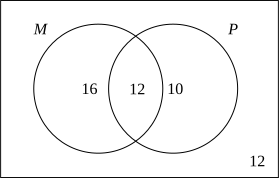
     

\(n(M \cup P)=38 \ \text {students}\)
 

b.    \(\dfrac{66}{1225}\)

Show Worked Solution

a.
     

\(n(M \cup P)=38 \ \text {students}\)
 

b.    \(P(M \cup P)=\dfrac{38}{50}\)

\(\text{Student 1:}\ P(\overline{M \cup P})=1-\dfrac{38}{50}=\dfrac{12}{50}\)

\(\text{Student 2:} \ P(\overline{M \cup P})=\dfrac{11}{49}\)

\(\therefore P\left(\text{Both study neither }\right)=\dfrac{12}{50} \times \dfrac{11}{49}=\dfrac{66}{1225}\)

Filed Under: Conditional Probability and Venn Diagrams Tagged With: Band 3, Band 4, smc-6470-05-Sets/Set Notation, smc-6470-20-Venn Diagrams

Probability, 2ADV EQ-Bank 6

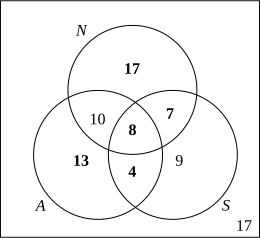
A survey of 85 households asked if they subscribed to the streaming services provided by Netflix (set \(N\)), Apple TV (set \(A\)), and Stan (set \(S\)).

The survey found that 17 households had no subscription and that \(n(N)=42, n(A)=35, n(S)=28\).

The survey also found

\(n(N \cap A)=18, n(N \cap S)=15, n(A \cap S)=12\) and \(n(N \cap A \cap S)=8\)

  1. Complete the Venn diagram below to accurately describe the information given.   (2 marks)

    --- 0 WORK AREA LINES (style=lined) ---


  2. A household is chosen randomly and is found to subscribe to Apple TV. What is the probability the household also subscribes to Stan?   (2 marks)

    --- 2 WORK AREA LINES (style=lined) ---

Show Answers Only

a.


b.    \(P(S \mid A)=\dfrac{12}{35}\)

Show Worked Solution

a.


b.    \(n(A)=35, n(A \cap S)=12\)

\(P(S \mid A)=\dfrac{n(A \cap S)}{n(A)}=\dfrac{12}{35}\)

Filed Under: Conditional Probability and Venn Diagrams Tagged With: Band 3, Band 4, smc-6470-05-Sets/Set Notation, smc-6470-10-Conditional Prob Formula

Probability, 2ADV EQ-Bank 5

Consider the universal set  \(U=\{x\) is a positive integer and  \(x \leqslant 24\}\)

Three sets are defined as

\begin{aligned}
& A=\{x \text { is a factor of } 24\} \\
& B=\{x \text { is a perfect square}\} \\
& C=\{x \text { is divisible by } 3\}
\end{aligned}

  1. List the elements of set \(A\).   (1 mark)

    --- 1 WORK AREA LINES (style=lined) ---

  2. Find \(A \cap B\).   (1 mark)

    --- 2 WORK AREA LINES (style=lined) ---

  3. Find \((A \cup B) \cap C^c\)   (2 marks)

    --- 5 WORK AREA LINES (style=lined) ---

Show Answers Only

a.    \(A=\{1,2,3,4,6,8,12,24\}\)

b.    \(A \cap B=\{1,4\}\)

c.    \((A \cup B) \cap C^c=\{1,2,4,8,16\}\)

Show Worked Solution

a.    \(A=\{1,2,3,4,6,8,12,24\}\)
 

b.    \(B=\{1,4,9,16\}\)

\(A \cap B=\{1,4\}\)
 

c.    \(A \cup B=\{1,2,3,4,6,8,9,12,16,24\}\)

\(C=\{3,6,9,12,15,18,21,24\}\)

\(C^c=\{1,2,4,5,7,8,10,11,13,14,16,17,19,20,22,23\}\)

\((A \cup B) \cap C^c=\{1,2,4,8,16\}\)

Filed Under: Conditional Probability and Venn Diagrams Tagged With: Band 2, Band 3, smc-6470-05-Sets/Set Notation, syllabus-2027

Probability, 2ADV EQ-Bank 3

Consider the universal set  \(U=\{x\) is a positive integer and \(x \leqslant 15\}\)

Three sets are defined as:

\begin{aligned}
& A=\{x \text { is a multiple of } 3\} \\
& B=\{x \text{ is a prime number}\} \\
& C=\{x \text{ is even}\}
\end{aligned}

  1. List the elements of set \(A\).   (1 mark)

    --- 1 WORK AREA LINES (style=lined) ---

  2.  Find  \(B \cap C\)   (1 mark)

    --- 3 WORK AREA LINES (style=lined) ---

  3. Find  \(A \cup \overline{C}\)   (2 marks)

    --- 4 WORK AREA LINES (style=lined) ---

Show Answers Only

a.    \(A=\{3,6,9,12,15\}\)

b.   \(B \cap C = \{2\} \)

c.    \(A \cup \overline{C}=\{1,3,5,6,7,9,11,12,13,15\}\)

Show Worked Solution

a.    \(A=\{3,6,9,12,15\}\)
 

b.    \(B=\{2,3,5,7,11,13\}\)

\(C=\{2,4,6,8,10,12,14\}\)

\(B \cap C = \{2\} \)
 

c.    \(\text{Find} \ \ A \cup \overline{C}:\)

\(\overline{C}=\{1,3,5,7,9,11,13\}\)

\(A \cup \overline{C}=\{1,3,5,6,7,9,11,12,13,15\}\)

Filed Under: Conditional Probability and Venn Diagrams Tagged With: Band 2, Band 3, smc-6470-05-Sets/Set Notation, syllabus-2027

Probability, 2ADV EQ-Bank 4

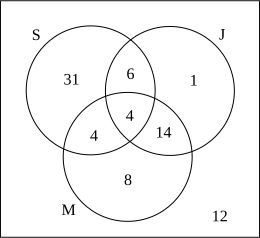
In Year 11 there are 80 students. The students may choose to study Spanish (S), Japanese (J) and Mandarin (M).

The Venn diagram shows their choices.


Two of the students are selected at random.

  1. What is the probability that both students study only Spanish?   (2 marks)

    --- 6 WORK AREA LINES (style=lined) ---

  2. What is the probability that at least one of the students studies two languages.   (2 marks)

    --- 6 WORK AREA LINES (style=lined) ---

Show Answers Only

a.    \(\dfrac{93}{632}\)

b.   \(\dfrac{81}{158} \)

Show Worked Solution

a.    \(\text{Students only studying Spanish = 31}\)

\(P(\text{both study only Spanish}\ =\dfrac{31}{80} \times \dfrac{30}{79} = \dfrac{93}{632}\)
 

b.   \(\text{1st student chosen:}\)

\(P(2L) =\dfrac{6+4+14}{80} = \dfrac{24}{80}\ \ \Rightarrow\ \ P(\overline{2L})=\dfrac{56}{80} \)

\(\text{2nd student chosen:}\)

\(P(\overline{2L})=\dfrac{55}{79} \)
 

\(P(\text{at least one studies two languages})\)

\(= 1- P(\text{both don’t study two languages)}\)

\(=1-\dfrac{56}{80} \times \dfrac{55}{79} \)

\(=\dfrac{81}{158} \)

Filed Under: Conditional Probability and Venn Diagrams Tagged With: Band 4, Band 5, smc-6470-20-Venn Diagrams

Probability, 2ADV EQ-Bank 2

Consider the universal set  \(U=\{1,2,3,4,5,6,7,8,9,10\}\).

Two sets, \(A\) and \(B\), are given as

\(A= \{1,3,4,7,9\}\)

\(B =\{2,4,7,10\}\)

  1. Find \(A \cup B\)   (1 mark)

    --- 2 WORK AREA LINES (style=lined) ---

  2. Find \(A \cap \overline{B}\)   (2 marks)

    --- 4 WORK AREA LINES (style=lined) ---

Show Answers Only

a.    \(A \cup B = \{1,2,3,4,7,9,10\}\)

b.    \(A \cap \overline{B} = \{3, 4, 9\}\)

Show Worked Solution

a.    \(A= \{1,3,4,7,9\},\ \ B=\{2,4,7,10\}\)

\(A \cup B = \{1,2,3,4,7,9,10\}\)
 

b.     \(\overline{B} = \{1,3,5,6,8,9\}\)

\(A \cap \overline{B} = \{3, 4, 9\}\)

Filed Under: Conditional Probability and Venn Diagrams Tagged With: Band 2, Band 3, smc-6470-05-Sets/Set Notation, syllabus-2027

Probability, 2ADV S1 2025 HSC 19

Three girls, Amara, Bala and Cassie, have nominated themselves for the local soccer team. Exactly one of the girls will be selected. The chances of their selection are in the ratio \(1:2:3\), respectively.

The probability that the team wins when:

  • Amara is selected is 0.5
  • Bala is selected is 0.4
  • Cassie is selected is 0.2.

Given that the team wins, find the probability that Amara was selected.   (3 marks)

--- 10 WORK AREA LINES (style=lined) ---

Show Answers Only

\(P(A |W)=\dfrac{5}{19}\)

Show Worked Solution

♦ Mean mark 49%.

\(P(A |W)=\dfrac{P(A \cap W)}{P(W)}\)

\(P(W)=\dfrac{1}{6} \times \dfrac{1}{2}+\dfrac{1}{3} \times \dfrac{2}{5}+\dfrac{1}{2} \times \dfrac{1}{5}=\dfrac{19}{60}\)

\(P(A \cap W)=\dfrac{1}{6} \times \dfrac{1}{2}=\dfrac{1}{12}\)

\(\therefore P(A |W)=\dfrac{1}{12} \times \dfrac{60}{19}=\dfrac{5}{19}\)

Filed Under: Conditional Probability and Venn Diagrams, Conditional Probability and Venn Diagrams (Y11) Tagged With: Band 5, smc-6470-10-Conditional Prob Formula, smc-991-10-Conditional Prob Formula

Probability, 2ADV S1 EQ-Bank 1 MC

Consider the independent events \(A\) and \(B\) where the following is true:

  • \(P(A)=p, \ P(B)=p^2\)  and
  • \(P(A)+P(B)=1\)

What represents \(P\left(A \cup B^{\prime}\right)\) ?

  1. \(p \)
  2. \(1-p^2+p^3 \)
  3. \(1+p-p^2 \)
  4. \(1-p^3\)
Show Answers Only

\(B\)

Show Worked Solution

\(P\left(A \cup B^{\prime}\right)=P(A)+P\left(B^{\prime}\right)-P\left(A \cap B^{\prime}\right)\)

\(\text{Calculate each value:}\)

\(P(A)=p \ \ \text{(given)}\)

\(P(B^{\prime})=1-P(B)=1-p^2\)

\(\text {Since}\ P(A)\ \text{and}\ P(B)\ \text {are independent, so are}\ P(A)\ \text {and}\ P\left(B^{\prime}\right)\)

\(P\left(A \cap B^{\prime}\right)=p\left(1-p^2\right)=p-p^3\)

\(\therefore P\left(A \cup B^{\prime}\right)\) \(=p+1-p^2-\left(p-p^3\right)\)
  \(=1-p^2+p^3\)

\(\Rightarrow B\)

Filed Under: Conditional Probability and Venn Diagrams, Conditional Probability and Venn Diagrams (Y11) Tagged With: Band 5, smc-6470-10-Conditional Prob Formula, smc-991-10-Conditional Prob Formula

Probability, 2ADV S1 EQ-Bank 1

Arnold has a manbag that contains three coins.

Two are fair coins where  \(P(\text{tails})=P(\text{heads})\).

The third coin is biased where  \(P(\text{tails})=\dfrac{2}{3}\).

Initially, Arnold tosses all 3 coins.

  1. Determine the probability that at least 1 coin lands on tails.   (1 mark)

    --- 4 WORK AREA LINES (style=lined) ---

Arnold then randomly selects one coin and tosses it.

  1. Show the probability it is a head = \(\dfrac{4}{9}\).   (1 mark)

    --- 4 WORK AREA LINES (style=lined) ---

  2. Given that the coin lands on a tail, what is the probability that the coin is biased?   (2 marks)

    --- 5 WORK AREA LINES (style=lined) ---

Show Answers Only

a.   \(\dfrac{11}{12}\)

b.   \(\text{See Worked Solution}\)

c.   \(\dfrac{2}{5}\)

Show Worked Solution

a.    \(\text{Biased coin} \ \ \Rightarrow \  P(H)=\dfrac{1}{3}\)

\(P(\text{at least} \ 1 \ T)\) \(=1-P(\text{All heads})\)
  \(=1-\left[\dfrac{1}{2} \times \dfrac{1}{2} \times \dfrac{1}{3}\right]\)
  \(=\dfrac{11}{12}\)


b.    \(\text{1 coin tossed only:}\)

\(P(H)=\dfrac{1}{3} \times \dfrac{1}{2}+\dfrac{1}{3} \times \dfrac{1}{2}+\dfrac{1}{3} \times \dfrac{1}{3}=\dfrac{4}{9}\)
  

c.
       

\(P(T)=1-\dfrac{4}{9}=\dfrac{5}{9}\)

\(P\left(T_{\text {bias}} \big | T\right)\) \(=\dfrac{P\left(T_{\text {bias}}\right) \cap P(T)}{P(T)}\)
  \(=\dfrac{\frac{1}{3} \times \frac{2}{3}}{\frac{5}{9}}\)
  \(=\dfrac{2}{5}\)

Filed Under: Conditional Probability and Venn Diagrams, Conditional Probability and Venn Diagrams (Y11) Tagged With: Band 4, Band 5, smc-6470-10-Conditional Prob Formula, smc-991-10-Conditional Prob Formula

Probability, 2ADV S1 2024 MET2 9*

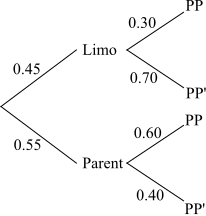
At a Year 12 formal, 45% of the students travelled to the event in a hired limousine, while the remaining 55% were driven to the event by a parent.

Of the students who travelled in a hired limousine, 30% had a professional photo taken.

Of the students who were driven by a parent, 60% had a professional photo taken.

Given that a student had a professional photo taken, what is the probability that the student travelled to the event in a hired limousine?   (3 marks)

--- 7 WORK AREA LINES (style=lined) ---

Show Answers Only

\(\dfrac{9}{31}\)

Show Worked Solution

\(\text{Pr(Limo|PP)}\) \(=\dfrac{\text{Pr(Limo)}\ \cap\ \text{Pr(PP)}}{\text{Pr(PP)}}\)
  \(=\dfrac{0.45\times 0.30}{(0.45\times 0.30)+(0.55\times 0.6)}\)
  \(=\dfrac{0.135}{0.465}\)
  \(=\dfrac{9}{31}\)

Filed Under: Conditional Probability and Venn Diagrams, Conditional Probability and Venn Diagrams (Y11) Tagged With: Band 5, smc-6470-10-Conditional Prob Formula, smc-991-10-Conditional Prob Formula

Probability, 2ADV S1 2024 HSC 9 MC

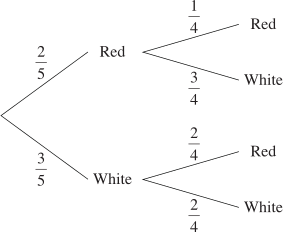
A bag contains 2 red and 3 white marbles. Jovan randomly selects two marbles at the same time from this bag. The probability tree diagram shows the probabilities for each of the outcomes.
 

Given that one of the marbles that Jovan has selected is red, what is the probability that the other marble that he has selected is also red?

  1. \(\dfrac{1}{10}\)
  2. \(\dfrac{1}{7}\)
  3. \(\dfrac{1}{4}\)
  4. \(\dfrac{7}{10}\)
Show Answers Only

\(B\)

Show Worked Solution
\(P(R_2|_{\text{other is red}})\) \(=\dfrac{P(R_1 \cap R_2)}{P\text{(at least 1 red)}}\)  
  \(=\dfrac{\frac{2}{5} \times \frac{1}{4}}{1-P(WW)}\)  
  \(=\dfrac{\frac{2}{5} \times \frac{1}{4}}{1-(\frac{3}{5} \times \frac{2}{4})}\)  
  \(=\dfrac{1}{7}\)  

 
\(\Rightarrow B\)

♦♦♦ Mean mark 14%.

Filed Under: Conditional Probability and Venn Diagrams, Conditional Probability and Venn Diagrams (Y11) Tagged With: Band 6, smc-6470-10-Conditional Prob Formula, smc-991-10-Conditional Prob Formula

Probability, 2ADV S1 2024 HSC 2 MC

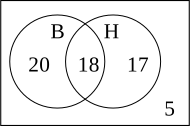
In a group of 60 students, 38 play basketball, 35 play hockey and 5 do not play either basketball or hockey.

How many students play both basketball and hockey?

  1. 55
  2. 18
  3. 13
  4. 8
Show Answers Only

\(B\)

Show Worked Solution

\(\text{Method 1:}\)

 
\(\text{Method 2:}\)

\(n(B \cup H)\) \(=n(B) + n(H)-n(B \cap H) \)  
\(55\) \(=38+35-n(B \cap H) \)  
\(n(B \cap H) \) \(=18\)  

 
\( \Rightarrow B \)

Filed Under: Conditional Probability and Venn Diagrams, Conditional Probability and Venn Diagrams (Y11) Tagged With: Band 3, smc-6470-20-Venn Diagrams, smc-991-20-Venn Diagrams/Intersections

Probability, 2ADV S1 2023 HSC 31

Four Year 12 students want to organise a graduation party. All four students have the same probability, \(P(F)\), of being available next Friday. All four students have the same probability, \(P(S)\), of being available next Saturday.

It is given that  \(P(F)=\dfrac{3}{10}, P(S\mid F)=\dfrac{1}{3}\), and \(P(F\mid S)=\dfrac{1}{8}\).

Kim is one of the four students.

  1. Is Kim's availability next Friday independent from his availability next Saturday? Justify your answer.  (1 mark)

    --- 2 WORK AREA LINES (style=lined) ---

  2. Show that the probability that Kim is available next Saturday is \(\dfrac{4}{5}\).  (2 marks)

    --- 5 WORK AREA LINES (style=lined) ---

  3. What is the probability that at least one of the four students is NOT available next Saturday?  (2 marks)

    --- 3 WORK AREA LINES (style=lined) ---

Show Answers Only

a.    \(P(F) \neq P(F|S)\ \text{which is not the case}\ \ (\dfrac{3}{10} \neq \dfrac{1}{8}) \)

\(\therefore\ \text{Kim’s availability on Friday is not independent of Saturday}\)

b.    \(\text{See Worked Solutions} \)

c.    \(\dfrac{369}{625} \)

Show Worked Solution

a.    \(P(F) \neq P(F|S)\ \text{which is not the case}\ \ (\dfrac{3}{10} \neq \dfrac{1}{8}) \)

\(\therefore\ \text{Kim’s availability on Friday is not independent of Saturday}\)

♦♦♦ Mean mark (a) 18%.
b.     \(P(S|F) \) \(= \dfrac{P(S) \cap P(F)}{P(F)} \)
  \(\dfrac{1}{3}\) \(= \dfrac{P(S) \cap P(F)}{\frac{3}{10}} \)
  \(\dfrac{1}{10}\) \(=P(S) \cap P(F) \)
♦ Mean mark (b) 44%.
\(P(F|S)\)  \(= \dfrac{P(F) \cap P(S)}{P(S)} \)  
\(\dfrac{1}{8}\) \(=\dfrac{\frac{1}{10}}{P(S)} \)  
\(\dfrac{1}{8} \times P(S) \) \(=\dfrac{1}{10} \)  
\(P(S)\) \(=\dfrac{4}{5} \)  


c.     \(P\text{(at least 1 not available)}\) \(=1-P\text{(all are available)} \)
    \(=1-\left(\dfrac{4}{5}\right)^4 \)
    \(=\dfrac{369}{625} \)
♦♦ Mean mark (c) 34%.

Filed Under: Conditional Probability and Venn Diagrams, Conditional Probability and Venn Diagrams (Y11) Tagged With: Band 5, Band 6, smc-6470-10-Conditional Prob Formula, smc-6470-30-Independent Events, smc-991-10-Conditional Prob Formula, smc-991-30-Independent Events

Probability, 2ADV S1 2022 HSC 15

In a bag there are 3 six-sided dice. Two of the dice have faces marked  1, 2, 3, 4, 5, 6. The other is a special die with faces marked  1, 2, 3, 5, 5, 5.

One die is randomly selected and tossed.

  1. What is the probability that the die shows a 5?  (1 mark)

    --- 2 WORK AREA LINES (style=lined) ---

  2. Given that the die shows a 5, what is the probability that it is the special die?  (1 mark)

    --- 3 WORK AREA LINES (style=lined) ---

Show Answers Only
  1. `5/18`
  2. `3/5`
Show Worked Solution
a.    `P(5)` `=1/3 xx 1/6 + 1/3 xx 1/6 + 1/3 xx 1/2`
    `=1/18+1/18+1/6`
    `=5/18`


b.   `Ptext{(special die given a 5 is rolled)}`

`=(Ptext{(special die)} ∩  P(5))/(P(5))`

`=(1/3 xx 1/2)/(5/18)`

`=1/6 xx 18/5`

`=3/5`


Mean mark (a) 53%.
 
♦ Mean mark (b) 40%.

Filed Under: Conditional Probability and Venn Diagrams, Conditional Probability and Venn Diagrams (Y11), Multi-Stage Events, Multi-Stage Events (Y11) Tagged With: Band 4, Band 5, smc-6469-20-Other Multi-Stage Events, smc-6470-10-Conditional Prob Formula, smc-989-20-Other Multi-Stage Events, smc-991-10-Conditional Prob Formula

Probability, 2ADV S1 2012 MET1 2

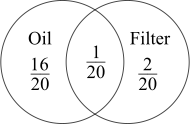
A car manufacturer is reviewing the performance of its car model X. It is known that at any given six-month service, the probability of model X requiring an oil change is `17/20`, the probability of model X requiring an air filter change is `3/20` and the probability of model X requiring both is `1/20`.

  1. State the probability that at any given six-month service model X will require an air filter change without an oil change.  (1 mark)

    --- 5 WORK AREA LINES (style=lined) ---

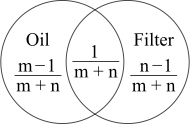
  2. The car manufacturer is developing a new model. The production goals are that the probability of model Y requiring an oil change at any given six-month service will be `m/(m + n)`, the probability of model Y requiring an air filter change will be `n/(m + n)` and the probability of model Y requiring both will be `1/(m + n)`, where `m, n ∈ Z^+`.
     
    Determine `m` in terms of `n` if the probability of model Y requiring an air filter change without an oil change at any given six-month service is 0.05.  (2 marks)

    --- 6 WORK AREA LINES (style=lined) ---

Show Answers Only
  1. `1/10`
  2. `m = 19n – 20`
Show Worked Solution
a.   
  `text(Pr)(F ∩ O′)` `= text(Pr)(F) – text(Pr)(F∩ O)`
    `= 3/20 – 1/20`
    `= 1/10`


b.   
`text(Pr)(F ∩ O′)` `= n/(m + n) – 1/(m + n)`
`1/20` `= (n – 1)/(m + n)`
`m + n` `= 20n – 20`
`m` `= 19n – 20`

Filed Under: Conditional Probability and Venn Diagrams, Conditional Probability and Venn Diagrams (Y11) Tagged With: Band 3, Band 4, smc-6470-20-Venn Diagrams, smc-991-20-Venn Diagrams/Intersections

Probability, 2ADV S1 2020 HSC 14

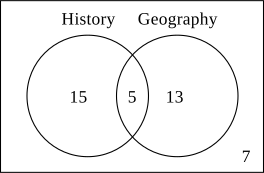
History and Geography are two of the subjects students may decide to study. For a group of 40 students, the following is known.

    • 7 students study neither History nor Geography
    • 20 students study History
    • 18 students study Geography
  1. A student is chosen at random. By a using a Venn diagram, or otherwise, find the probability that the student studies both History and Geography.  (2 marks)

    --- 8 WORK AREA LINES (style=lined) ---

  2. A students is chosen at random. Given that the student studies Geography, what is the probability that the student does NOT study History?  (1 mark)

    --- 1 WORK AREA LINES (style=lined) ---

  3. Two different students are chosen at random, one after the other. What is the probability that the first student studies History and the second student does NOT study History?  (2 marks)

    --- 3 WORK AREA LINES (style=lined) ---

Show Answers Only
  1.  
  2. `13/18`
  3. `10/39`
Show Worked Solution
a.   
`P(text(H and G))` `= 5/40`
  `= 1/8`


♦ Mean mark (b) 49%.
b.    `P(bartext(H) | text(G))` `= (P(bartext(H) ∩ text(G)))/(Ptext{(G)})`
    `= 13/18`


c.    `P(text(H), bartext(H))` `= 20/40 xx 20/39`
    `= 10/39`

Filed Under: Conditional Probability and Venn Diagrams, Conditional Probability and Venn Diagrams (Y11) Tagged With: Band 3, Band 4, Band 5, smc-6470-20-Venn Diagrams, smc-991-20-Venn Diagrams/Intersections

Probability, 2ADV S1 2019 MET2 11 MC

`A` and `B` are events from a sample space such that  `P(A) = p`, where  `p > 0, \ P(B\ text{|}\ A) = m`  and  `P(B\ text{|}\ A^{′}) = n`.

`A` and `B` are independent events when

  1. `m = n`
  2. `m = 1-p`
  3. `m + n = 1`
  4. `m = p`
Show Answers Only

`A`

Show Worked Solution

`text(S) text(ince)\ A and B\ text(are independent:)`

`P(B\ text{|}\ A) = P(B\ text{|}\ A^{′})`

`:. m = n`
 

`=>   A`

Filed Under: Conditional Probability and Venn Diagrams, Conditional Probability and Venn Diagrams (Y11) Tagged With: Band 4, smc-6470-10-Conditional Prob Formula, smc-6470-30-Independent Events, smc-991-10-Conditional Prob Formula, smc-991-30-Independent Events

Probability, 2ADV S1 SM-Bank 3

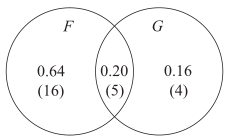
In a workplace of 25 employees, each employee speaks either French or German, or both.

If 36% of the employees speak German, and 20% speak both French and German.

  1. Calculate the probability one person chosen could speak German if they could speak French. Give your answer to the nearest percent.  (1 mark)

    --- 4 WORK AREA LINES (style=lined) ---

  2. Calculate the probability one person chosen could not speak French if they could speak German. Give your answer to the nearest percent.  (1 mark)

    --- 3 WORK AREA LINES (style=lined) ---

Show Answers Only
  1. `24text(%)`
  2. `44text(%)`
Show Worked Solution

i.   `text(Expressing in a Venn diagram:)`


`P(G|F)` `= (P(G ∩ F))/(P(F))`
  `= 0.20/0.84`
  `= 0.238…`
  `= 24text(%)`


ii.    `P(text(not)\ F|G)` `= (P(text(not)\ F ∩ G))/(P(G))`
    `= 0.16/0.36`
    `= 0.444…`
    `= 44text(%)`

Filed Under: Conditional Probability and Venn Diagrams, Conditional Probability and Venn Diagrams (Y11) Tagged With: Band 4, smc-6470-10-Conditional Prob Formula, smc-6470-20-Venn Diagrams, smc-991-10-Conditional Prob Formula, smc-991-20-Venn Diagrams/Intersections

Probability, 2ADV S1 SM-Bank 4 MC

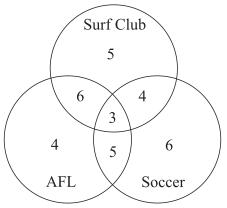
In a classroom, students are asked what sports club they are members of and the results are shown in the Venn diagram.


A student who is a member of a soccer club is chosen at random. What is the probability that he/she is also a member of a surf club?

  1. `2/5`
  2. `4/11`
  3. `2/9`
  4. `7/18`
Show Answers Only

`D`

Show Worked Solution
`P(text(Surf | Soccer))` `= (n(text(Surf) ∩ text(Soccer)))/(n(text(Soccer)))`
  `= (3 + 4)/(3 + 4 + 5 + 6)`
  `= 7/18`

 
`=>\ D`

Filed Under: Conditional Probability and Venn Diagrams, Conditional Probability and Venn Diagrams (Y11) Tagged With: Band 4, smc-6470-10-Conditional Prob Formula, smc-6470-20-Venn Diagrams, smc-991-10-Conditional Prob Formula, smc-991-20-Venn Diagrams/Intersections

Probability, 2ADV S1 2007 MET1 6

Two events, `A` and `B`, from a given event space, are such that  `P(A) = 1/5`  and  `P(B) = 1/3`.

  1. Calculate  `P(A^{′} ∩ B)`  when  `P(A ∩ B) = 1/8`.  (1 mark)

    --- 6 WORK AREA LINES (style=lined) ---

  2. Calculate  `P(A^{′} ∩ B)`  when `A` and `B` are mutually exclusive events.  (1 mark)

    --- 4 WORK AREA LINES (style=lined) ---

Show Answers Only

i.    `5/24`

ii.   `1/3`

Show Worked Solution

i.   `text(Sketch Venn diagram:)`

♦♦ Mean mark 31%.
MARKER’S COMMENTS: Students who drew a Venn diagram were the most successful.

met1-2007-vcaa-q6-answer3

`:.P(A^{′} ∩ B)` `=P(B)-P(A ∩B)`
  `=1/3-1/8`
  `=5/24`


♦♦ Mean mark 23%.
ii.    met1-2007-vcaa-q6-answer4

`text(Mutually exclusive means)\ \ P(A ∩ B)=0,`

`:. P(A^{′} ∩ B) = 1/3`

Filed Under: Conditional Probability and Venn Diagrams, Conditional Probability and Venn Diagrams (Y11) Tagged With: Band 5, Band 6, smc-6470-20-Venn Diagrams, smc-6470-30-Independent Events, smc-991-20-Venn Diagrams/Intersections, smc-991-30-Independent Events

Probability, 2ADV S1 2017 MET1 8

For events `A` and `B` from a sample space, `P(A text(|)B) = 1/5`  and  `P(B text(|)A) = 1/4`.  Let  `P(A nn B) = p`.

  1. Find  `P(A)` in terms of `p`.  (1 mark)

    --- 2 WORK AREA LINES (style=lined) ---

  2. Find  `P(A nn B^{′})` in terms of `p`.  (2 marks)

    --- 6 WORK AREA LINES (style=lined) ---

  3. Given that  `P(A uu B) <= 1/5`, state the largest possible interval for `p`.  (2 marks)

    --- 3 WORK AREA LINES (style=lined) ---

Show Answers Only
  1. `P (A) = 4p,\ \ p > 0`
  2. `1-8p`
  3. `0 < p <= 1/40`
Show Worked Solution
i.    `P\ (A)` `=(P\ (A nn B))/(P\ (B text(|) A))`
    `=p/(1/4)`
    `=4p`


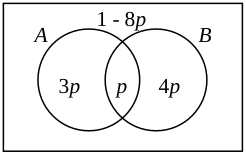
ii.  `text(Consider the Venn diagram:)`

♦ Mean mark 40%.
MARKER’S COMMENT: The most successful answers used a Venn diagram or table.
 

`P\ (A^{′} nn B^{′}) = 1-8p`


iii.  `text(Given)\ P(A uu B) = 8p`

♦ Mean mark 37%.

`=> 0 < 8p <= 1/5`

`:. 0 < p <= 1/40`

Filed Under: Conditional Probability and Venn Diagrams, Conditional Probability and Venn Diagrams (Y11) Tagged With: Band 4, Band 5, smc-6470-10-Conditional Prob Formula, smc-6470-20-Venn Diagrams, smc-991-10-Conditional Prob Formula, smc-991-20-Venn Diagrams/Intersections

Probability, 2ADV S1 2014 MET1 9

Sally aims to walk her dog, Mack, most mornings. If the weather is pleasant, the probability that she will walk Mack is `3/4`, and if the weather is unpleasant, the probability that she will walk Mack is `1/3`.

Assume that pleasant weather on any morning is independent of pleasant weather on any other morning.

  1. In a particular week, the weather was pleasant on Monday morning and unpleasant on Tuesday morning.


    Find the probability that Sally walked Mack on at least one of these two mornings.  (2 marks)

    --- 3 WORK AREA LINES (style=lined) ---

  2. In the month of April, the probability of pleasant weather in the morning was `5/8`.
    1. Find the probability that on a particular morning in April, Sally walked Mack.  (2 marks)

      --- 6 WORK AREA LINES (style=lined) ---

    2. Using your answer from part b.i., or otherwise, find the probability that on a particular morning in April, the weather was pleasant, given that Sally walked Mack that morning.  (2 marks)

      --- 4 WORK AREA LINES (style=lined) ---

Show Answers Only
  1. `5/6`
  2. i. `19/32`
     
    ii. `15/19`
Show Worked Solution
a.    `Ptext{(at least 1 walk)}` `= 1 – Ptext{(no walk)}`
    `= 1 – 1/4 xx 2/3`
    `= 5/6`


b.i.   `text(Construct tree diagram:)`
 

met1-2014-vcaa-q9-answer1 
 

`P(PW) + P(P′W)` `= 5/8 xx 3/4 + 3/8 xx 1/3`
  `= 19/32`


♦ Part (b)(ii) mean mark 38%.
b.ii.    `P(P | W)` `= (P(P ∩ W))/(P(W))`
    `= (5/8 xx 3/4)/(19/32)`
    `= 15/32 xx 32/19`
    `= 15/19`

Filed Under: Conditional Probability and Venn Diagrams, Conditional Probability and Venn Diagrams (Y11) Tagged With: Band 4, Band 5, smc-6470-10-Conditional Prob Formula, smc-991-10-Conditional Prob Formula

Probability, 2ADV S1 2011 MET1 8

Two events, `A` and `B`, are such that  `P(A) = 3/5`  and  `P(B) = 1/4.`

If  `A^{′}` denotes the compliment of `A`, calculate  `P (A^{′} nn B)` when

  1. `P (A uu B) = 3/4`  (2 marks)

    --- 8 WORK AREA LINES (style=lined) ---

  2. `A` and `B` are mutually exclusive.  (1 mark)

    --- 6 WORK AREA LINES (style=lined) ---

Show Answers Only
  1. `3/20`
  2. `1/4`
Show Worked Solution

i.   `text(Sketch Venn Diagram)`

vcaa-2011-meth-8i

`P (A uu B)` `= P (A) + P (B)-P (A nn B)`
`3/4` `= 3/5 + 1/4-P (A nn B)`
`P (A nn B)` `= 1/10`


 `:.\ P(A^{′} nn B) = 1/4-1/10 = 3/20`


ii.   vcaa-2011-meth-8ii

`P (A∩ B)=0\ \ text{(mutually exclusive)},`

`:.\ P (A^{′} nn B) = P (B) = 1/4`

Filed Under: Conditional Probability and Venn Diagrams, Conditional Probability and Venn Diagrams (Y11) Tagged With: Band 4, Band 5, smc-6470-20-Venn Diagrams, smc-6470-30-Independent Events, smc-991-20-Venn Diagrams/Intersections, smc-991-30-Independent Events

Probability, 2ADV S1 2007 MET1 11

There is a daily flight from Paradise Island to Melbourne. The probability of the flight departing on time, given that there is fine weather on the island, is 0.8, and the probability of the flight departing on time, given that the weather on the island is not fine, is 0.6.

In March the probability of a day being fine is 0.4.

Find the probability that on a particular day in March

  1. the flight from Paradise Island departs on time  (2 marks)

    --- 8 WORK AREA LINES (style=lined) ---

  2. the weather is fine on Paradise Island, given that the flight departs on time.  (2 marks)

    --- 3 WORK AREA LINES (style=lined) ---

Show Answers Only
  1. `0.68`
  2. `8/17`
Show Worked Solution
i.   

 
`P(FT) +\ P(F^{′}T)`

`= 0.4 xx 0.8 + 0.6 xx 0.6`

`= 0.32 + 0.36`

`= 0.68`


ii.   `text(Conditional probability:)`

♦♦ Mean mark 29%.
MARKER’S COMMENT: Students continue to struggle with conditional probability. Attention required here.
`P(F\ text(|)\ T)` `= (P(F ∩ T))/(P(T))`
  `= 0.32/0.68`


`:. P(F\ text(|)\ T) = 8/17`

Filed Under: Conditional Probability and Venn Diagrams, Conditional Probability and Venn Diagrams (Y11) Tagged With: Band 4, Band 5, smc-6470-10-Conditional Prob Formula, smc-991-10-Conditional Prob Formula

Probability, 2ADV S1 2015 MET1 8

For events `A` and `B` from a sample space, `P(A | B) = 3/4`  and  `P(B) = 1/3`.

  1.  Calculate  `P(A ∩ B)`.  (1 mark)

    --- 3 WORK AREA LINES (style=lined) ---

  2.  Calculate  `P(A^{′} ∩ B)`, where `A^{′}` denotes the complement of `A`.  (1 mark)

    --- 3 WORK AREA LINES (style=lined) ---

  3.  If events `A` and `B` are independent, calculate  `P(A ∪ B)`.  (1 mark)

    --- 3 WORK AREA LINES (style=lined) ---

Show Answers Only
  1. `1/4`
  2. `1/12`
  3. `5/6`
Show Worked Solution

i.   `text(Using Conditional Probability:)`

`P(A | B)` `= (P(A ∩ B))/(P(B))`
`3/4` `= (P(A ∩ B))/(1/3)`
`:. P(A ∩ B)` `= 1/4`


ii.    met1-2015-vcaa-q8-answer
`P(A^{′} ∩ B)` `= P(B)-P(A ∩B)`
  `= 1/3-1/4`
  `= 1/12`


iii.   `text(If)\ A, B\ text(independent)`

♦♦ Mean mark 28%.
MARKER’S COMMENT: A lack of understanding of independent events was clearly evident.
`P(A ∩ B)` `= P(A) xx P(B)`
`1/4` `= P(A) xx 1/3`
`:. P(A)` `= 3/4`


`P(A ∪ B)` `= P(A) + P(B)-P(A ∩ B)`
  `= 3/4 + 1/3-1/4`
`:. P(A ∪ B)` `= 5/6`

Filed Under: Conditional Probability and Venn Diagrams, Conditional Probability and Venn Diagrams (Y11) Tagged With: Band 3, Band 4, Band 5, smc-6470-10-Conditional Prob Formula, smc-6470-20-Venn Diagrams, smc-6470-30-Independent Events, smc-991-10-Conditional Prob Formula, smc-991-20-Venn Diagrams/Intersections, smc-991-30-Independent Events

Probability, 2ADV S1 2009 MET1 5

Four identical balls are numbered 1, 2, 3 and 4 and put into a box. A ball is randomly drawn from the box, and not returned to the box. A second ball is then randomly drawn from the box.

  1. What is the probability that the first ball drawn is numbered 4 and the second ball drawn is numbered 1?  (1 mark)

    --- 1 WORK AREA LINES (style=lined) ---

  2. What is the probability that the sum of the numbers on the two balls is 5?  (1 mark)

    --- 2 WORK AREA LINES (style=lined) ---

  3. Given that the sum of the numbers on the two balls is 5, what is the probability that the second ball drawn is numbered 1?  (2 marks)

    --- 4 WORK AREA LINES (style=lined) ---

Show Answers Only
  1. `1/12`
  2. `1/3`
  3. `1/4`
Show Worked Solution
i.    `P (4, 1)` `= 1/4 xx 1/3`
    `= 1/12`


ii.   `P (text(Sum) = 5)`

`= P (1, 4) + P (2, 3) + P (3, 2) + P (4, 1)`

`= 4 xx (1/4 xx 1/3)`

`= 1/3`


iii.   `text(Conditional Probability)`

♦ Mean mark 46%.

`P (2^{text(nd)} = 1\ |\ text(Sum) = 5)`

`= (P (4, 1))/(P (text(Sum) = 5))`

`= (1/12)/(1/3)`

`= 1/4`

Filed Under: Conditional Probability and Venn Diagrams, Conditional Probability and Venn Diagrams (Y11) Tagged With: Band 3, Band 4, Band 5, smc-6470-10-Conditional Prob Formula, smc-991-10-Conditional Prob Formula

Probability, 2ADV S1 2014 MET2 14 MC

If  `X`  is a random variable such that  `P(X > 5) = a`  and  `P(X > 8) = b`, then  `P(X < 5 | X < 8)`  is

A.   `a/b`

B.   `(a - b)/(1 - b)`

C.   `(1 - b)/(1 - a)`

D.   `(a - 1)/(b - 1)`

Show Answers Only

`D`

Show Worked Solution

`P(X < 5) | P(X < 8)`

♦ Mean mark 45%.

`=(P(X<5 ∩ X<8))/(P(X < 8))`

`= (P(X < 5))/(P(X < 8))`

`= (1 – a)/(1 – b)`

`= (a – 1)/(b – 1)`

 
`=>   D`

Filed Under: Conditional Probability and Venn Diagrams, Conditional Probability and Venn Diagrams (Y11) Tagged With: Band 5, smc-6470-10-Conditional Prob Formula, smc-991-10-Conditional Prob Formula

Probability, 2ADV S1 2013 MET2 17 MC

`A` and `B` are events of a sample space.

Given that  `P(A | B) = p,\ \ P(B) = p^2`  and  `P(A) = p^(1/3),\ P(B | A)`  is equal to

A.   `p^3`

B.   `p^(4/3)`

C.   `p^(7/3)`

D.   `p^(8/3)`

Show Answers Only

`D`

Show Worked Solution
`P(A | B)` `= (P(A ∩ B))/(P(B)`
`p` `= (P(A ∩ B))/(p^2)`
`:. P(A ∩ B)` `= p^3`
♦ Mean mark 49%.


`P(B | A)` `= (P(A ∩ B))/(P(A))`
  `= (p^3)/(p^(1/3))`
`:. P(B | A)` `= p^(8/3)`

 
`=>   D`

Filed Under: Conditional Probability and Venn Diagrams, Conditional Probability and Venn Diagrams (Y11) Tagged With: Band 5, smc-6470-10-Conditional Prob Formula, smc-991-10-Conditional Prob Formula

Probability, 2ADV S1 2010 MET2 21 MC

Events `A` and `B` are mutually exclusive events of a sample space with

`P(A) = p and P (B) = q\ \ text(where)\ \ 0 < p < 1 and 0 < q < 1.`

`P (A^{′} nn B^{′})` is equal to

  1. `(1-p) (1-q)`
  2. `1-pq`
  3. `1-(p + q)`
  4. `1 - (p + q - pq)`
Show Answers Only

`C`

Show Worked Solution

♦ Mean mark 43%.
`P (A^{′} nn B^{′})` `= 1-p-q`
  `= 1-(p + q)`

`=>   C`

Filed Under: Conditional Probability and Venn Diagrams, Conditional Probability and Venn Diagrams (Y11) Tagged With: Band 5, smc-6470-30-Independent Events, smc-991-30-Independent Events

Probability, 2ADV S1 2013 MET2 10 MC

For events `A` and `B,\ P(A ∩ B) = p,\ P(A^{′}∩ B) = p -1/8`  and  `P(A ∩ B^{′}) = (3p)/5.`

If `A` and `B` are independent, then the value of  `p`  is

  1. `0`
  2. `1/4`
  3. `3/8`
  4. `1/2`
Show Answers Only

`C`

Show Worked Solution
`P(A)` `= P(A ∩ B) + P(A ∩ B^{′})`
  `= p + (3p)/5`
  `= (8p)/5`


`P(B)` `= P(B ∩ A) + P(B ∩ A^{′})`
  `= p + p-1/8`
  `= 2p – 1/8`

 
`text(S)text(ince)\ A and B\ text(are independent events,)`

`P(A ∩ B)` ` = P(A) xx P(B)`
`p` `=(8p)/5 (2p-1/8)`
`5p` `=16p^2-p`
`16p^2-6p` `=0`
`2p(8p-3)` `=0`
`:.p` `=3/8,\ \ \ p!=0`

 
`=>   C`

Filed Under: Conditional Probability and Venn Diagrams, Conditional Probability and Venn Diagrams (Y11) Tagged With: Band 4, smc-6470-30-Independent Events, smc-991-30-Independent Events

Probability, 2ADV S1 2012 MET2 13 MC

`A` and `B` are events of a sample space `S.`

`P(A nn B) = 2/5`  and  `P(A nn B^(′)) = 3/7`

`P(B^(′) | A)`  is equal to

  1. `6/35`
  2. `15/29`
  3. `14/35`
  4. `29/35`
Show Answers Only

`B`

Show Worked Solution

met2-2012-vcaa-13-mc-answer

`P(B ^(′) | A)` `= (P(B^(′) nn A))/(P(A))`
  `= (P(B^(′) nn A))/(P(B^(′) nn A)+ P(A nn B))`
  `= (3/7)/(3/7 + 2/5)`
  `= 15/29`

`=>   B`

Filed Under: Conditional Probability and Venn Diagrams, Conditional Probability and Venn Diagrams (Y11) Tagged With: Band 4, smc-6470-20-Venn Diagrams, smc-991-20-Venn Diagrams/Intersections

Copyright © 2014–2026 SmarterEd.com.au · Log in